
⚡ Quick answer
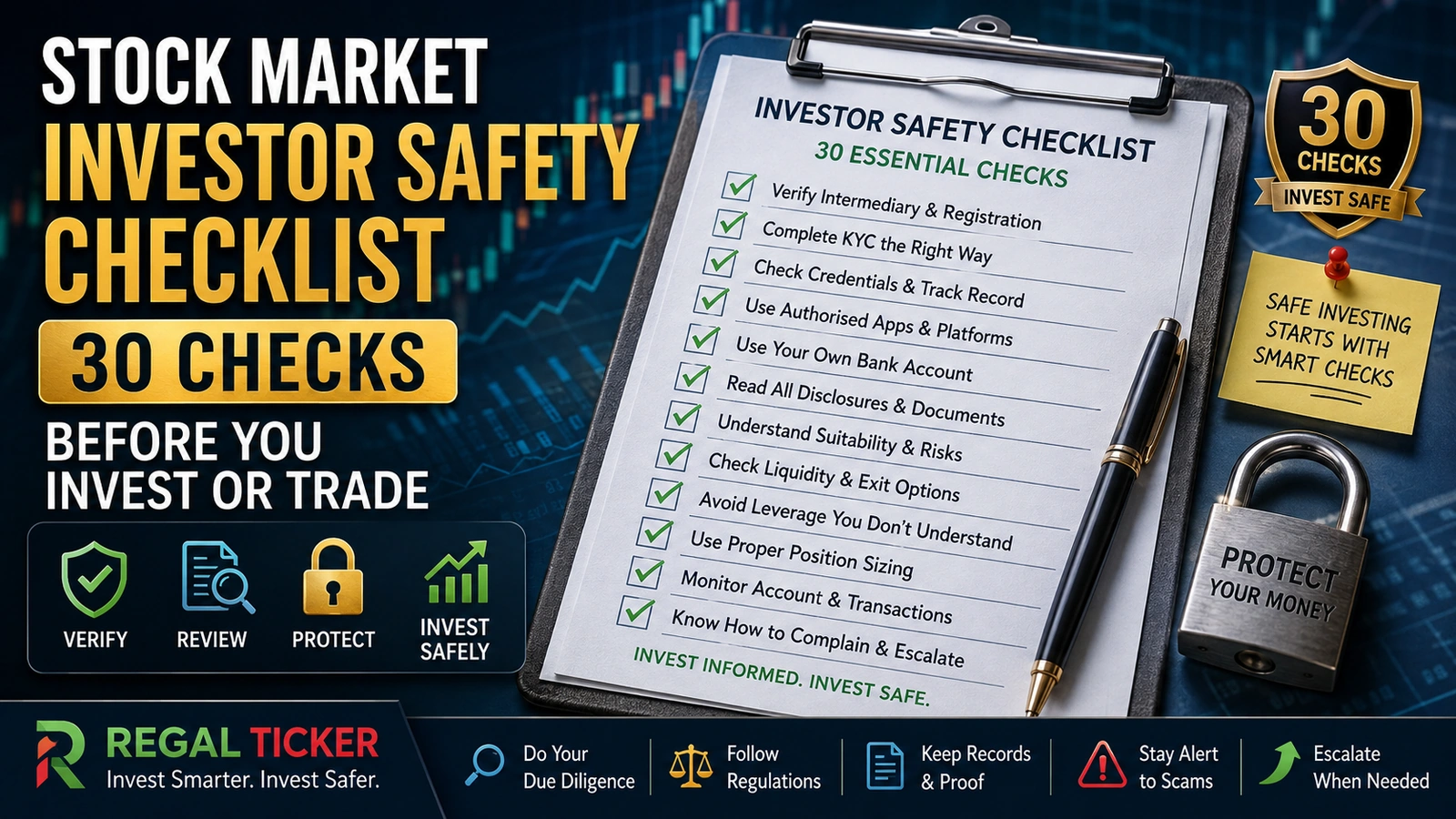
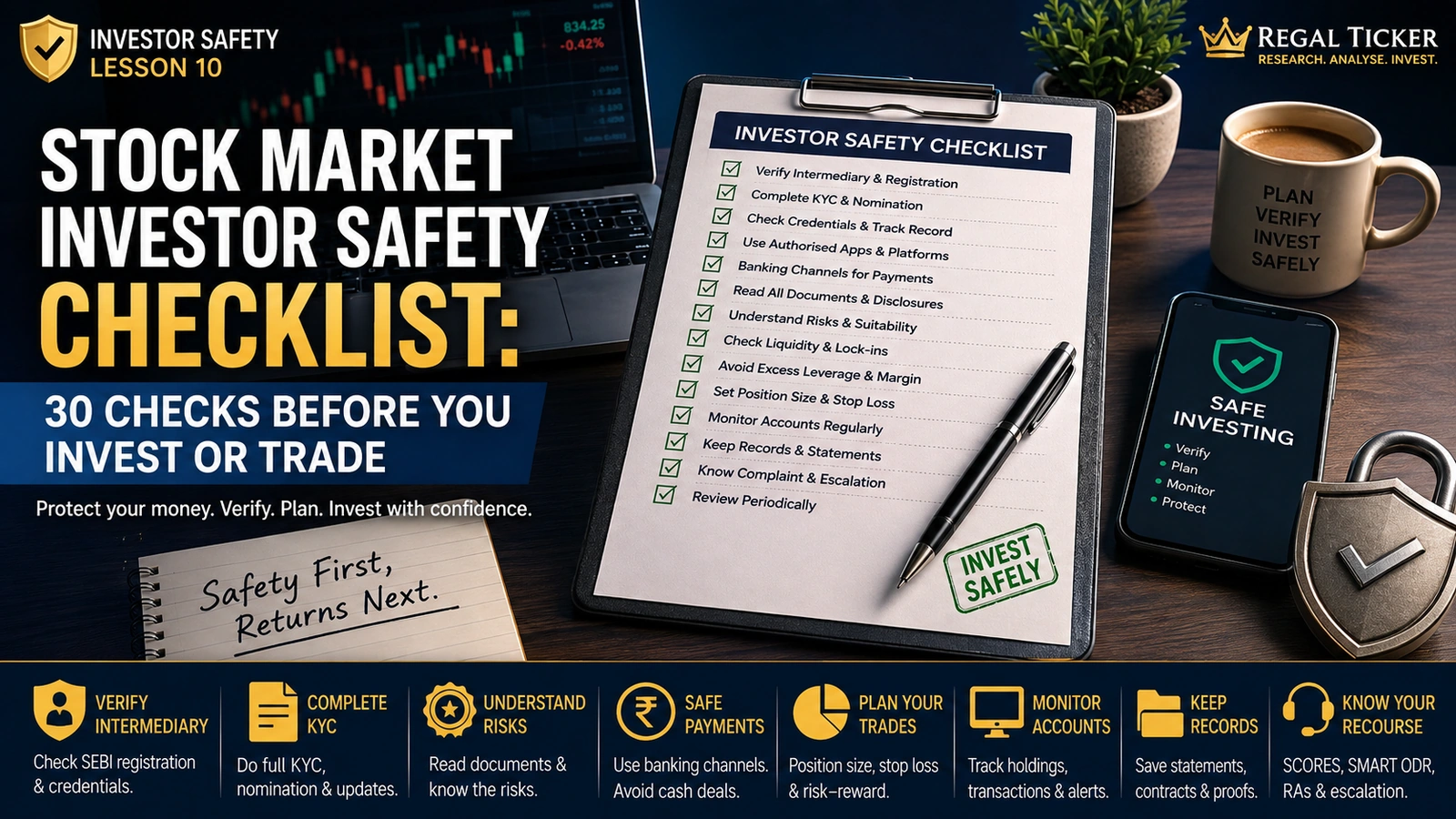
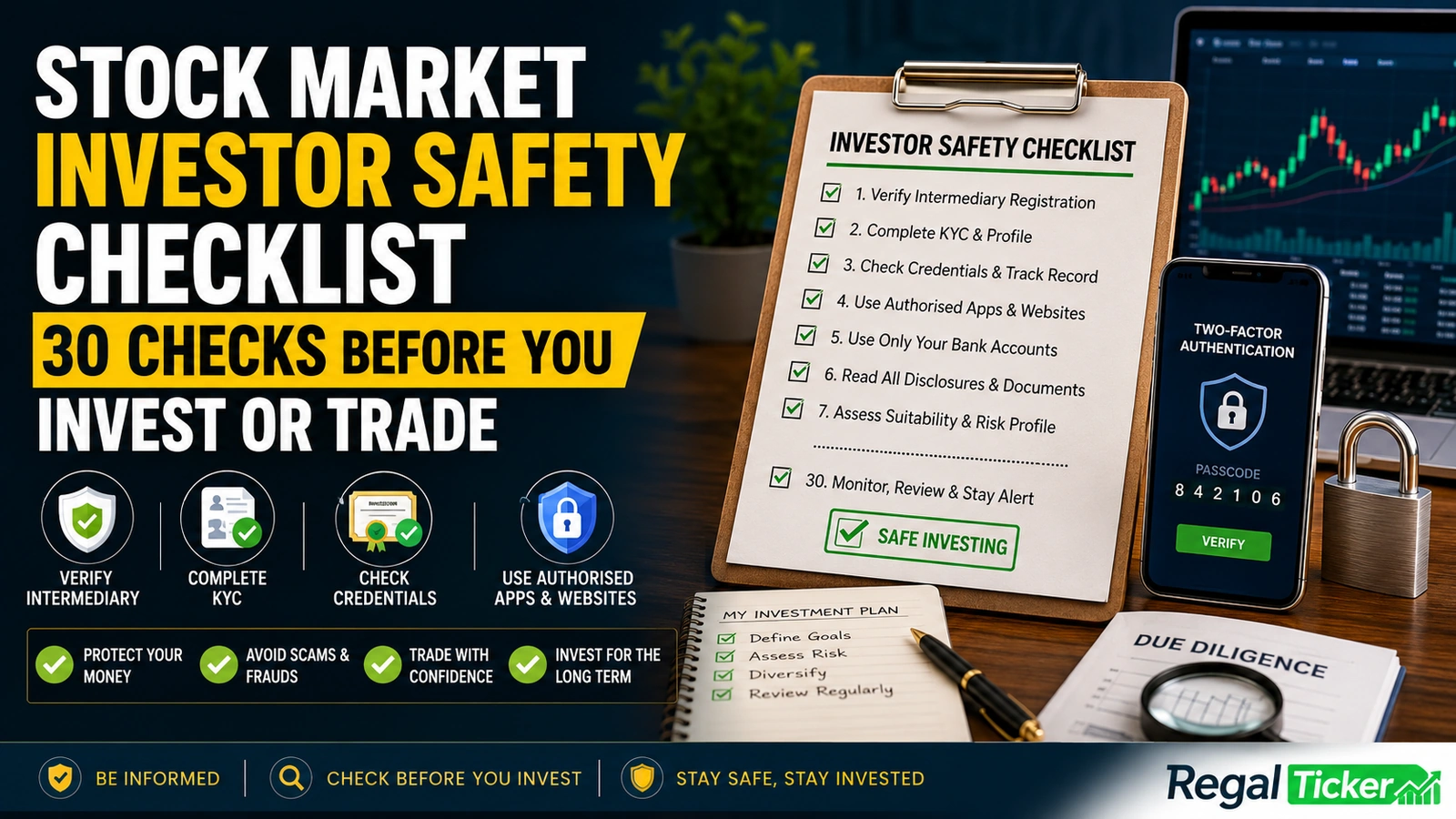
A stock market investor safety checklist is a repeatable set of checks used before opening an account, transferring money, accepting advice, buying a security, placing a trade or responding to an urgent market claim.
The checklist should confirm five things:
1. the entity is genuine and registered for the service offered; 2. the product, news or recommendation can be independently verified; 3. money and securities move only through authorised channels; 4. passwords, OTPs, TPINs and devices remain under the investor’s control; and 5. the potential loss fits the investor’s goals, time horizon and financial capacity.
What Is a Stock Market Investor Safety Checklist?
A safety checklist turns investor protection into a process rather than a reaction.
Fraudsters and unsuitable sellers rely on urgency, complexity and emotional pressure. A checklist slows the decision down and forces the investor to verify the same essential items every time.
SEBI Investor’s securities-market do’s and don’ts advise investors to understand risks, read documents carefully, deal only with registered intermediaries, monitor accounts, use banking channels, preserve records and report discrepancies promptly.
The Investor Safety in the Stock Market guide explains the overall protection framework. This final lesson converts the complete hub into a practical checklist.
A checklist cannot eliminate market risk. It can reduce avoidable risks caused by fraud, mis-selling, impersonation, poor account security and incomplete research.
Before You Open a Demat or Trading Account
The first safety decision is choosing the entity that will hold your account and execute your trades.
Check 1: Verify the Broker
Confirm the legal name, SEBI registration number and exchange membership independently.
Do not rely only on a certificate, advertisement, social-media profile or visiting card.
Use the process in How to Verify a SEBI-Registered Intermediary.
Check 2: Verify the Depository Participant
Confirm whether the demat account is being opened through a genuine participant connected with the relevant depository.
Check 3: Read the Account-Opening Documents
Understand:
- brokerage and charges;
- account-maintenance fees;
- settlement preference;
- margin and pledge terms;
- DDPI or PoA permissions;
- account-closure procedure;
- grievance contact details.
Check 4: Complete the KYC Yourself
Do not sign blank forms or leave important fields incomplete.
NSE’s investor guidance advises investors to fill required KYC details themselves and retain a signed copy.
Check 5: Use Your Own Mobile Number and Email
Your alerts, password resets, contract notes and grievance records should remain under your control.
Review What Is a Demat Account?, What Is a Trading Account? and Demat Account vs Trading Account before authorising account access.
Verify the Broker, Adviser or Analyst
A registration must match the exact service offered.
Check 6: Match the Registration Category
A broker registration does not automatically authorise personalised investment advice.
A research-analyst registration does not automatically authorise account handling.
An investment-adviser registration does not validate a Telegram profile that copied the registration number.
Check 7: Confirm the Representative
Contact the genuine entity through independently verified details and confirm whether the person, branch, authorised person or channel is connected with it.
Check 8: Reject Guaranteed Returns
SEBI Investor and NSE repeatedly warn that assured, fixed or near-certain returns are not credible promises in the securities market.
The risk remains even when the seller displays a genuine registration number.
Check 9: Ask How the Seller Is Paid
Understand fees, commissions, brokerage incentives, referral income and conflicts of interest.
The Investment Fraud and Mis-Selling guide explains why compensation can influence recommendations.
Protect Your Identity, Device and Credentials
Account security depends on protecting the investor’s identity and access channels.
Check 10: Use Unique Passwords
The trading account and registered email should not share the same password.
Check 11: Never Share OTPs, TPINs or Passwords
NSE advises investors not to share login IDs, passwords, OTPs or TPINs with anyone, including broker employees and authorised persons.
Check 12: Avoid Remote-Access Software
Do not install screen-sharing or remote-control applications because someone claims to help with KYC, account activation, trading, withdrawal or loss recovery.
Check 13: Use Only the Authorised Application
Verify the official app-store publisher and the genuine intermediary website.
Private APK files and applications distributed through messaging groups are major warning signs.
Check 14: Keep Contact Details Updated
A current mobile number and email help the investor receive timely trade, balance and demat alerts.
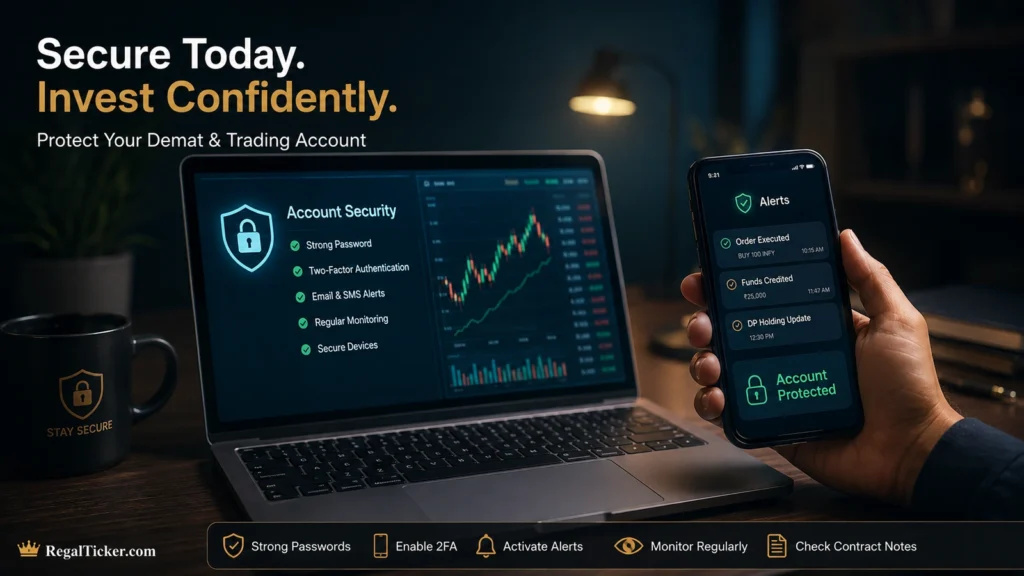
The complete account-protection workflow is available in How to Secure Your Demat and Trading Account.
Before You Transfer Money
Real money should move only through independently verified channels.
Check 15: Verify the Beneficiary
The beneficiary should match the genuine intermediary and the intended transaction.
Do not transfer investment money to:
- an employee;
- adviser;
- Telegram administrator;
- account handler;
- unrelated company;
- personal UPI account.
Check 16: Use Banking Channels
SEBI Investor advises investors to use banking channels rather than cash for securities-market transactions.
Check 17: Stop When the Account Keeps Changing
Repeated changes in beneficiary details are a strong warning sign.
Check 18: Never Pay to Unlock a Withdrawal
Fake platforms often demand tax, margin, compliance or processing money after showing fabricated profits.
Read Fake Trading Apps and Telegram Stock Tips before funding an unfamiliar platform.
Before You Buy a Stock or Investment Product
A genuine broker and payment route do not make every investment suitable.
Check 19: Understand the Business or Product
You should be able to explain:
- how the company or product earns money;
- what can cause loss;
- how liquid the investment is;
- how long the capital may remain exposed;
- what information supports the decision.
Check 20: Read Original Disclosures
Use official exchange filings, the company’s genuine investor-relations page and regulator or exchange notices.
Do not rely only on headlines, forwarded screenshots or social-media summaries.
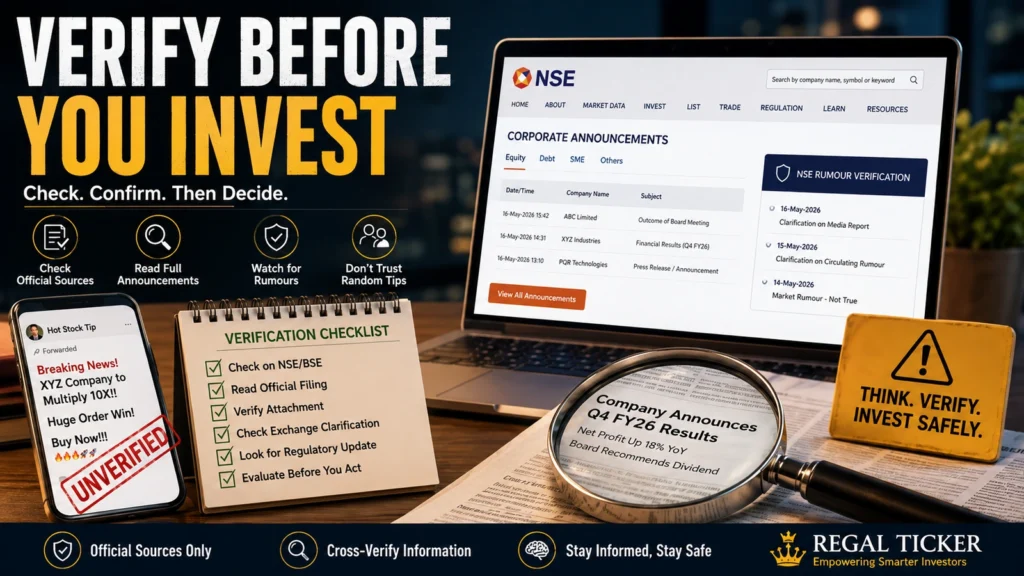
The Stock Market News Verification guide provides a 10-minute verification workflow.
Check 21: Review Financial Strength
For a company, check revenue, profit, margins, cash flow, debt, dilution and governance.
Use What Is Fundamental Analysis? before treating a rising price as proof of business quality.
Check 22: Confirm Suitability
Compare the investment with:
- financial goal;
- time horizon;
- knowledge;
- income stability;
- emergency reserves;
- capacity to bear loss.
Check 23: Understand Liquidity
A displayed market price does not guarantee that a large position can be sold quickly.
Illiquid stocks can trap investors in repeated lower circuits.
Check Whether the Return Claim Is Realistic
Large rupee figures often hide extreme percentage assumptions.
Assume someone claims that ₹1,00,000 can become ₹2,00,000 in one year.
That requires a 100% return.
Use the Stock Return Calculator to calculate the required percentage.
For a multi-year projection, use the CAGR Calculator.
For a monthly investment plan, use the SIP Calculator to test the corpus using transparent assumptions.
Check 24: Separate Possibility From Guarantee
A high return may be mathematically possible. It cannot be promised as risk-free.
Check 25: Question Perfect Consistency
Markets do not produce identical daily or monthly profits on command.
Overly consistent results may indicate selective reporting, hidden risk or fabrication.
The warning signs in How to Identify Stock Market Scams should be applied whenever extraordinary returns are combined with urgency or weak documentation.
Before You Trade or Use Leverage
Trading decisions require additional risk controls.
Check 26: Define Entry, Exit and Maximum Loss
A trade should have a clear invalidation point.
Use the Risk–Reward Calculator to compare entry, stop-loss and target.
Check 27: Size the Position
A favourable setup can still cause serious damage when the position is too large.
The position should be based on acceptable rupee loss—not excitement about the target.
Check 28: Understand Leverage and Margin
Leverage magnifies gains and losses.
Know the margin requirement, possible additional margin demand and liquidation risk before entering.
Check 29: Do Not Average Automatically
A lower market price does not automatically make the position safer.
Use the Stock Average Calculator to understand the new average price, then reassess the business, liquidity and original thesis.
The broader loss-control principles are covered in Risk Management in the Stock Market.
Verify News, Tips and Corporate Announcements
A real company announcement can still be exaggerated.
Check 30: Trace the Claim to the Original Filing
Verify:
- company name and symbol;
- announcement timestamp;
- complete attachment;
- approval status;
- conditions;
- record date;
- financial effect.
For dividends, use the Dividend Calculator only after the amount and eligible shareholding are confirmed.
For bonus issues, stock splits and other actions, verify the exchange filing before using any calculator or making a trade.
Social media should be treated as an unverified lead.
The Pump-and-Dump Schemes guide explains how rumours and coordinated promotion can manufacture demand.
After Every Trade or Investment
Investor safety continues after the transaction.
Verify:
- exchange SMS or email;
- contract note;
- price and quantity;
- brokerage and charges;
- fund debit or credit;
- securities credit or debit;
- pledge activity;
- settlement status.
SEBI Investor advises investors to insist on valid transaction records and preserve account statements, payments and signed documents.
An alert that does not match your instructions should be reported to the broker or depository participant immediately in writing.
Review Portfolio, Statements and Charges Regularly
A regular review can reveal mistakes, unauthorised activity and unsuitable exposure.
Check:
- trading-account ledger;
- demat statement;
- consolidated account statement;
- funds and securities balance;
- running-account settlement;
- dormant holdings;
- nominee and contact details;
- recurring subscriptions and advisory fees.
Review whether the portfolio still matches the financial goal and risk capacity.
A falling stock should not be held only because the investor wants to recover the original price.
What to Do When Something Looks Wrong
Stop Further Payments or Access
Do not send more money to fix a withdrawal, recover a loss or activate an account.
Preserve Evidence
Save messages, emails, advertisements, screenshots, contract notes, statements, payment details and complaint references.
Contact the Genuine Entity
Use independently verified support or grievance details.
Secure the Account
Change credentials and remove suspicious device permissions.
Escalate Through the Correct Route
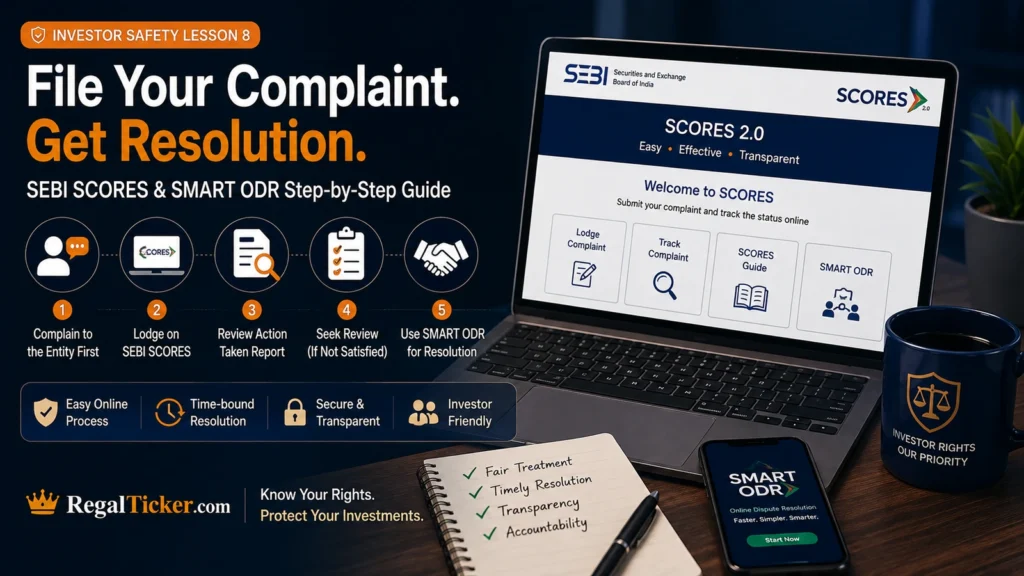
For a complaint against a listed company or SEBI-regulated intermediary, approach the entity first and use SCORES if unresolved.
Eligible disputes may be taken through SMART ODR.
Use How to File a Complaint on SEBI SCORES and SMART ODR for the step-by-step workflow.
A fake app, impersonation fraud or unauthorised payment may also require immediate bank, payment-provider and cybercrime reporting.
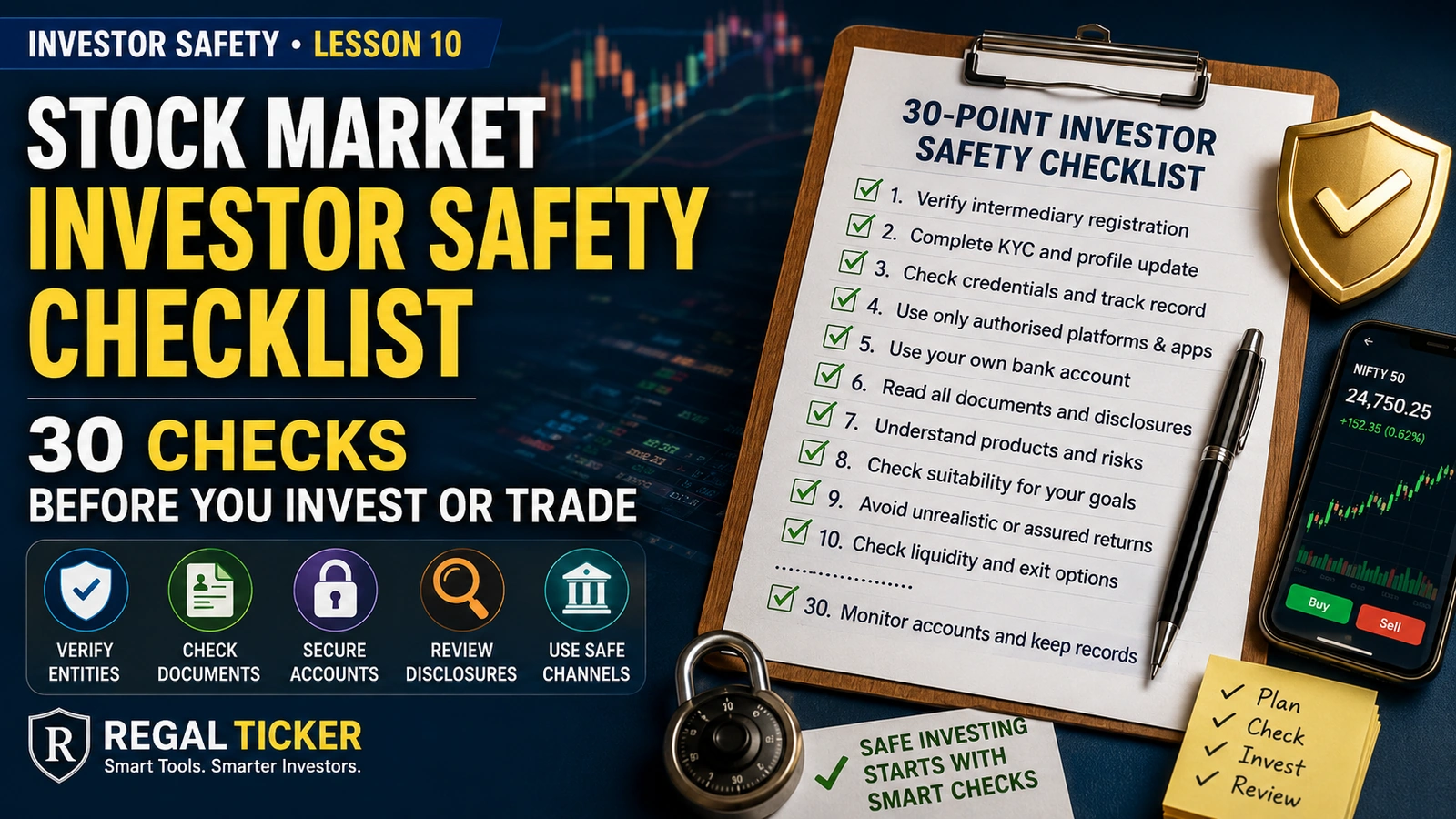
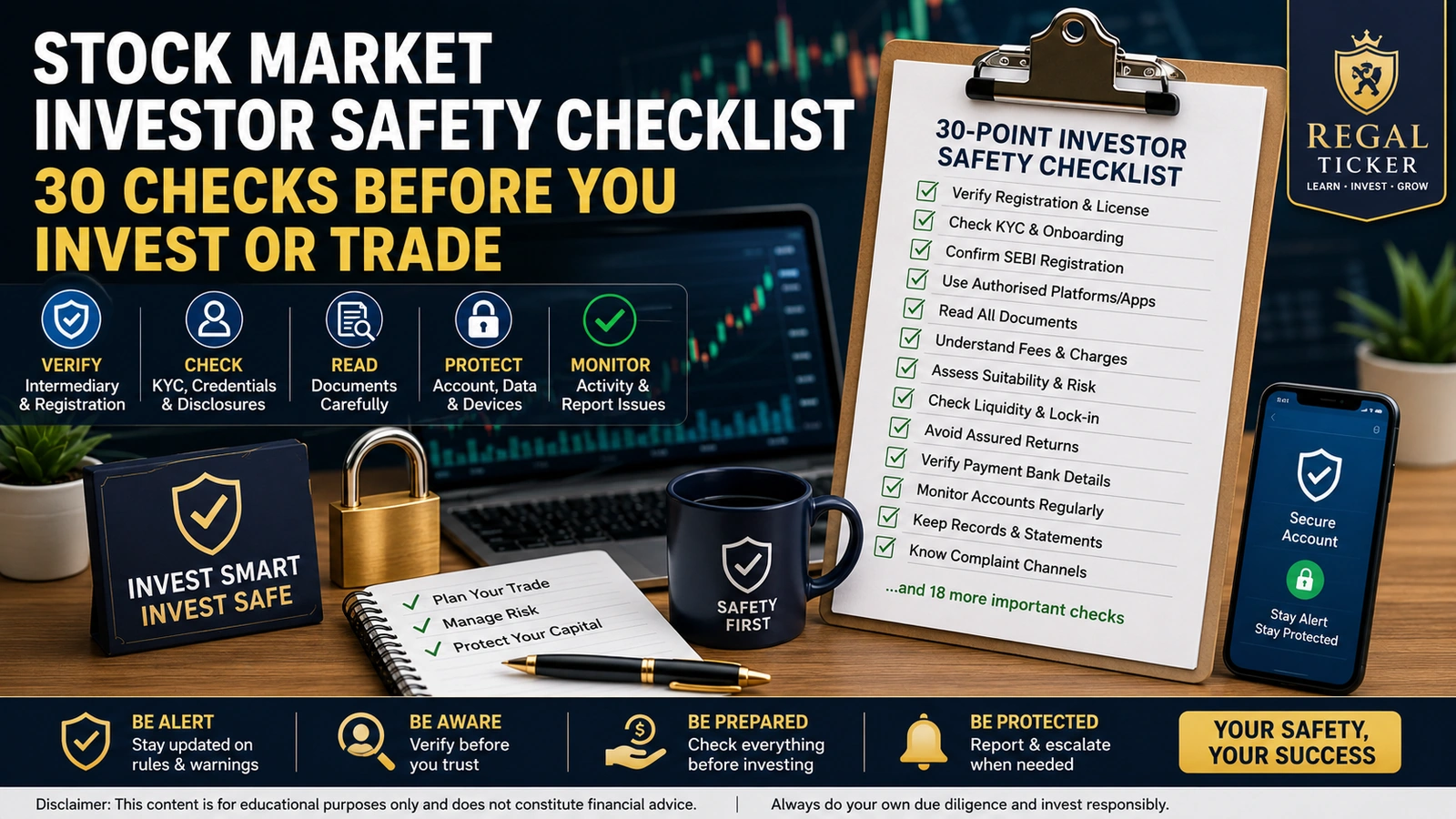
30-Point Stock Market Investor Safety Checklist
Before opening an account, investing, trading or paying for advice, confirm:
- The broker is SEBI registered.
- Exchange membership is verified.
- The depository participant is genuine.
- Account-opening documents are complete.
- My own mobile number and email are registered.
- The seller’s registration matches the service.
- The representative is genuinely authorised.
- No guaranteed return is promised.
- Fees and conflicts are disclosed.
- I use unique passwords.
- I never share OTP, TPIN or login credentials.
- I avoid remote-access applications.
- The trading application is authorised.
- Contact details are current.
- The payment beneficiary is verified.
- I use banking channels.
- Beneficiary accounts are not changing repeatedly.
- Withdrawal does not require another payment.
- I understand the business or product.
- I have read original disclosures.
- Financial strength and governance are reviewed.
- The investment suits my goal and time horizon.
- Liquidity is adequate.
- The return claim is mathematically realistic.
- Performance is not presented as guaranteed.
- Entry, exit and maximum loss are defined.
- Position size fits my loss capacity.
- Leverage and margin risks are understood.
- Averaging is based on a fresh thesis.
- News and corporate-action claims are verified at source.
The Regal Ticker Investor Tools hub contains calculators for return, compounding, averaging, trade risk and corporate-action checks.
Final Takeaway
Investor safety is not a single verification step.
It is a chain:
- verify the entity;
- verify the information;
- verify the payment route;
- protect the account;
- measure the potential loss;
- preserve records;
- act quickly when something is wrong.
Market losses cannot be eliminated. Avoidable losses caused by fraud, weak security, unsuitable advice and incomplete due diligence can often be reduced.
This completes the Investor Safety learning hub.
Frequently asked questions
What is the most important stock market safety rule?
Never act only on trust. Verify the entity, information, payment route and potential loss independently before committing money.
Is a SEBI registration number enough to prove an offer is genuine?
No. Fraudsters can copy genuine registration details. The person, service, website, app and beneficiary account must also match the registered entity.
Should I share my trading password with a broker employee?
No. NSE advises investors not to share login IDs, passwords, OTPs or TPINs with anyone, including broker employees and authorised persons.
How can I test a guaranteed-return claim?
Convert the promised profit into a percentage or CAGR and compare it with the stated risk, evidence and market reality. Guaranteed securities-market returns are a major warning sign.
Is averaging down a safe way to recover a stock loss?
Not automatically. Averaging increases exposure. Reassess the business, liquidity and original investment thesis before adding money.
What records should an investor preserve?
Preserve account-opening documents, agreements, contract notes, statements, alerts, payment records, recommendations, screenshots and complaint references.
What should I do after detecting an unauthorised trade?
Contact the broker in writing immediately, secure the account, preserve the alert and request the relevant order and transaction records.
Where can I complain about a regulated securities-market entity?
First approach the entity. If unresolved, eligible complaints may be filed through SEBI SCORES, with SMART ODR available for applicable disputes.
Verify through official sources
Official references
- 1. [SEBI Investor — Securities Market Investment Do’s and Don’ts](https://investor.sebi.gov.in/securities-dos_and_donts.html)
- 2. [SEBI Investor — Investor Charter](https://investor.sebi.gov.in/Investor-charter.html)
- 3. [SEBI Investor — How to Spot a Scam](https://investor.sebi.gov.in/spot-any-scam.html)
- 4. [SEBI Investor — Staying Away from Investment Frauds](https://investor.sebi.gov.in/beware-of-investment.html)
- 5. [SEBI Investor — Due Diligence](https://investor.sebi.gov.in/due_diligence.html)
- 6. [SEBI Investor — Secure Your Investment Account](https://investor.sebi.gov.in/secure_ur_inv_account.html)
- 7. [NSE — Investor Do’s and Don’ts](https://www.nseindia.com/static/invest/first-time-investor-fraud-dos-and-donts)
- 8. [NSE — Be a Smart Investor](https://www.nseindia.com/static/invest/be-a-smart-investor)
- 9. [SEBI — Recognised Intermediaries](https://www.sebi.gov.in/sebiweb/other/OtherAction.do?doRecognised=yes)
- 10. [SEBI SCORES — Official Portal](https://scores.sebi.gov.in)
- 11. [SMART ODR — Official Portal](https://smartodr.in)
Educational disclaimer: This article is for education and general information only. It does not provide investment, legal, regulatory, cybersecurity or financial advice. Market conditions, intermediary details, account features and complaint procedures may change. Verify current information through official SEBI, exchange, depository and intermediary sources before acting.