
⚡ Quick answer
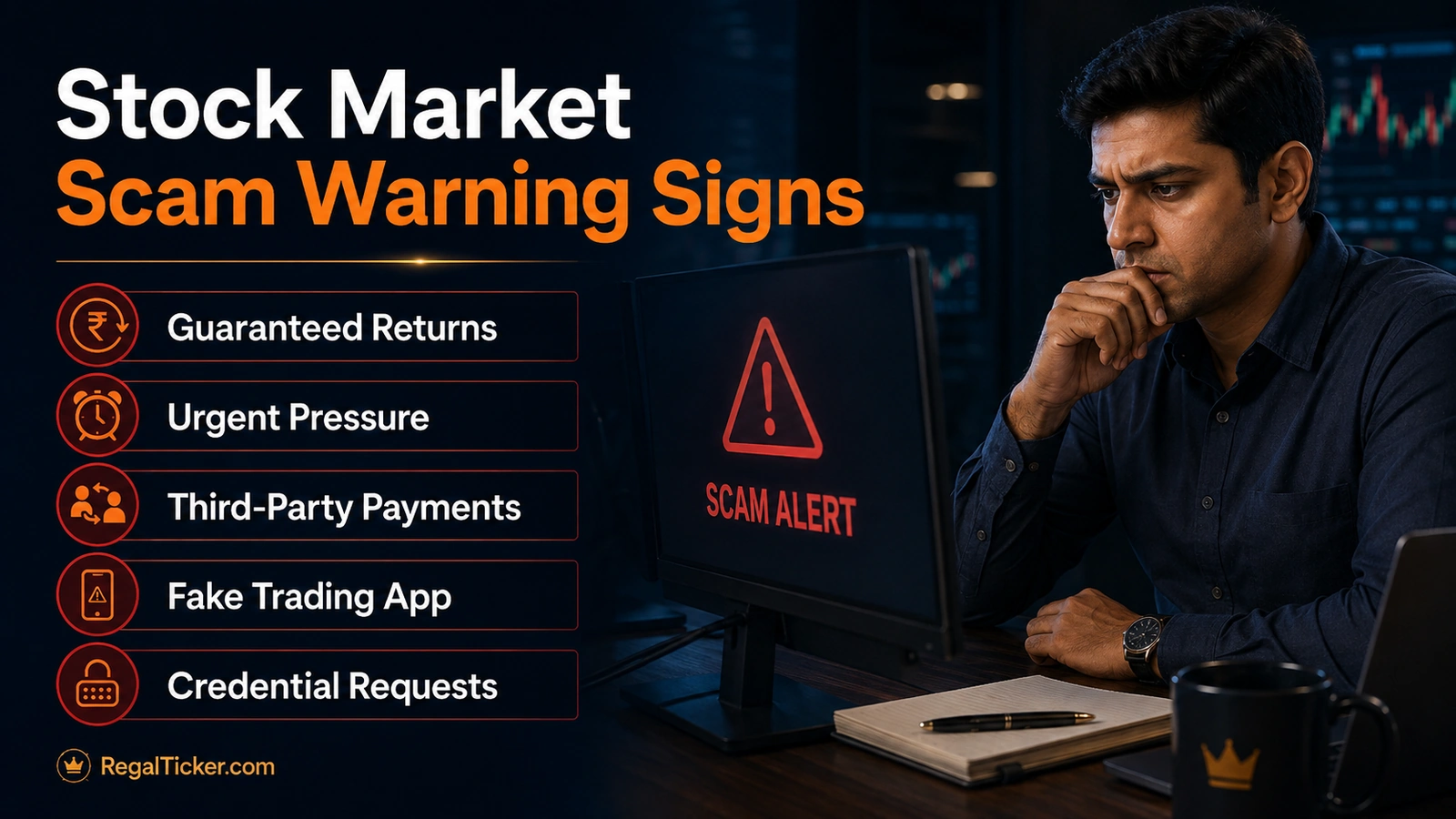
You can identify many stock market scams by looking for the same recurring warning signs: guaranteed or unusually consistent returns, pressure to invest immediately, requests to transfer money to third-party accounts, fake trading applications, unregistered advisers, requests for login credentials, blocked withdrawals and demands for additional fees.
Before investing, independently verify the intermediary through official SEBI or exchange sources, check whether the trading application is genuine, confirm the authorised payment account and compare every return claim with realistic market mathematics.
This lesson builds on Investor Safety in the Stock Market and the practical principles in Risk Management in the Stock Market.
What Is a Stock Market Scam?
A stock market scam is a fraudulent scheme that uses the language, appearance or infrastructure of investing and trading to obtain money, account access or personal information from investors.
Some scams involve completely fake investments. Others use a real stock, broker name, trading concept or regulatory certificate to appear legitimate.
The fraud may be presented as:
- a guaranteed-return trading plan;
- an exclusive institutional account;
- a fake mobile trading application;
- a paid WhatsApp or Telegram tips group;
- an account-handling service;
- a pre-IPO or discounted-block-deal opportunity;
- a stock-market training or mentorship programme;
- an impersonated broker, adviser or financial institution;
- a recovery service claiming it can retrieve previous losses.
SEBI’s investor guidance highlights high or assured returns, unregistered entities, unclear strategies, missing documentation and pressure tactics as major scam indicators. Recent SEBI cautions have also focused on fake trading apps, social-media impersonation and account-handling services.
Why Stock Market Scams Look Convincing
Modern scams are often designed to resemble genuine investment platforms.
Fraudsters may copy:
- a recognised broker’s name and colours;
- SEBI or exchange-style certificates;
- professional app interfaces;
- live-looking price charts;
- fake profit-and-loss statements;
- fabricated client testimonials;
- screenshots of successful trades;
- photographs or videos of public personalities;
- customer-support numbers and office addresses.
The scam may begin with small profits or a successful withdrawal. This builds trust and encourages the victim to deposit a larger amount.
The important question is not whether the platform looks professional. The correct question is whether the entity, application, website and payment route can be independently verified through official sources.
The Typical Stock Market Scam Journey
Many investment scams follow a predictable sequence.
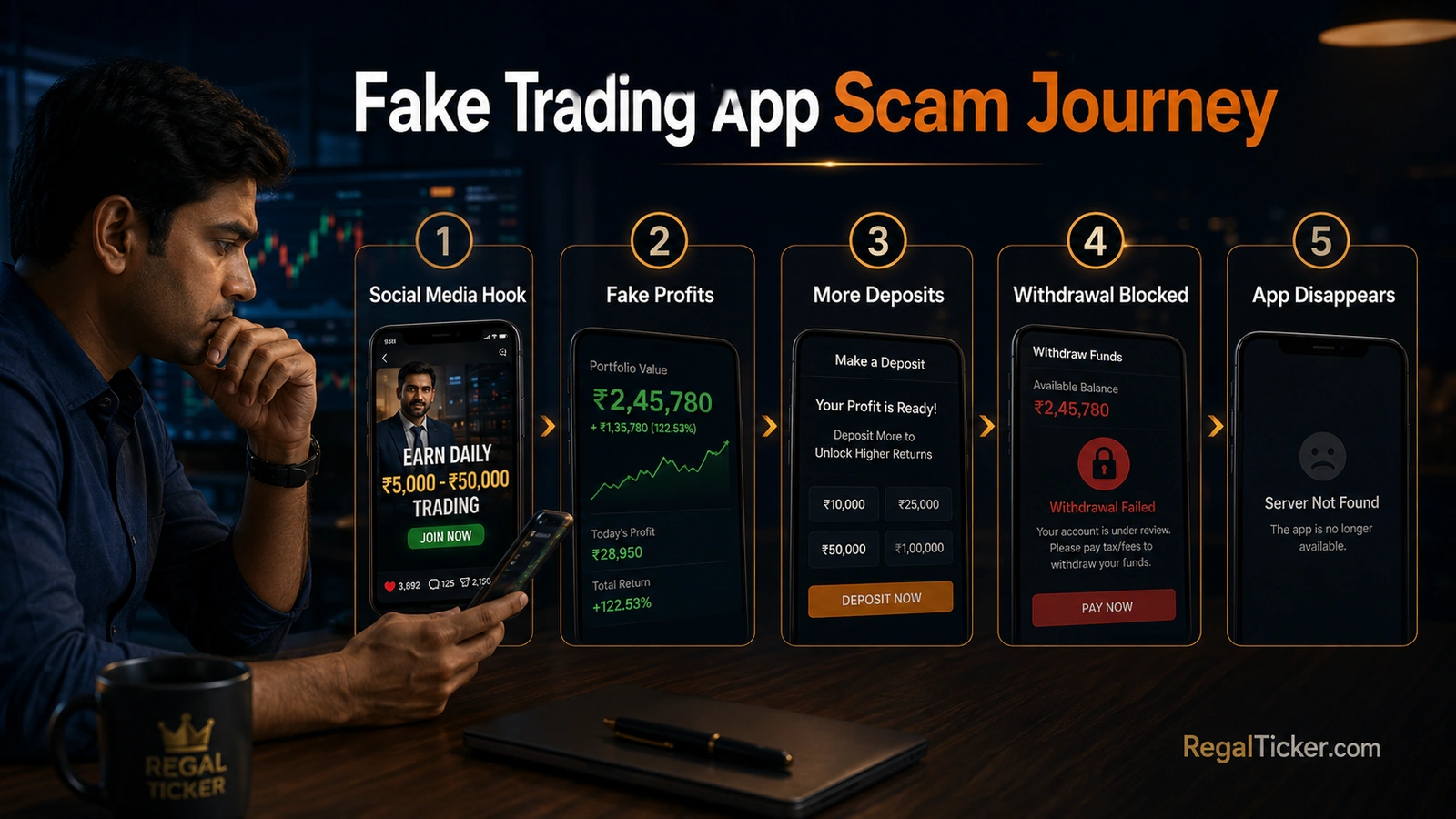
Stage 1: The Initial Hook
The investor sees an advertisement, receives an unsolicited message or is added to a social-media group.
The message may promise:
- daily income;
- guaranteed profit;
- early access to upper-circuit stocks;
- institutional trading privileges;
- discounted shares;
- assured IPO allotment;
- recovery of previous trading losses.
Stage 2: Trust Building
The group administrator or so-called expert shares market commentary, screenshots and successful calls.
Some members appear to confirm that they have earned large profits. These accounts may be controlled by the same scam network.
Stage 3: Movement to a Private Platform
The investor is asked to download an application, open a special account or transfer funds to participate.
The application may not be available through an authorised source. It may be distributed as an APK file or through a private link.
Stage 4: Fake Profits
The dashboard displays rapid gains. The figures may have no connection with genuine exchange transactions.
Stage 5: Pressure to Deposit More
The investor is encouraged to increase the amount, borrow money or join a higher-value plan.
Stage 6: Withdrawal Is Blocked
When the investor attempts to withdraw, the platform demands:
- tax;
- margin;
- processing fees;
- security deposit;
- account-unfreezing charge;
- profit-sharing payment.
Stage 7: The Platform Disappears
The application stops working, support contacts disappear or the investor is removed from the group.
SEBI’s fake-trading-app awareness material describes a similar pattern: a social-media hook, trust-building, fake app installation, displayed profits, pressure for more money and blocked withdrawal.
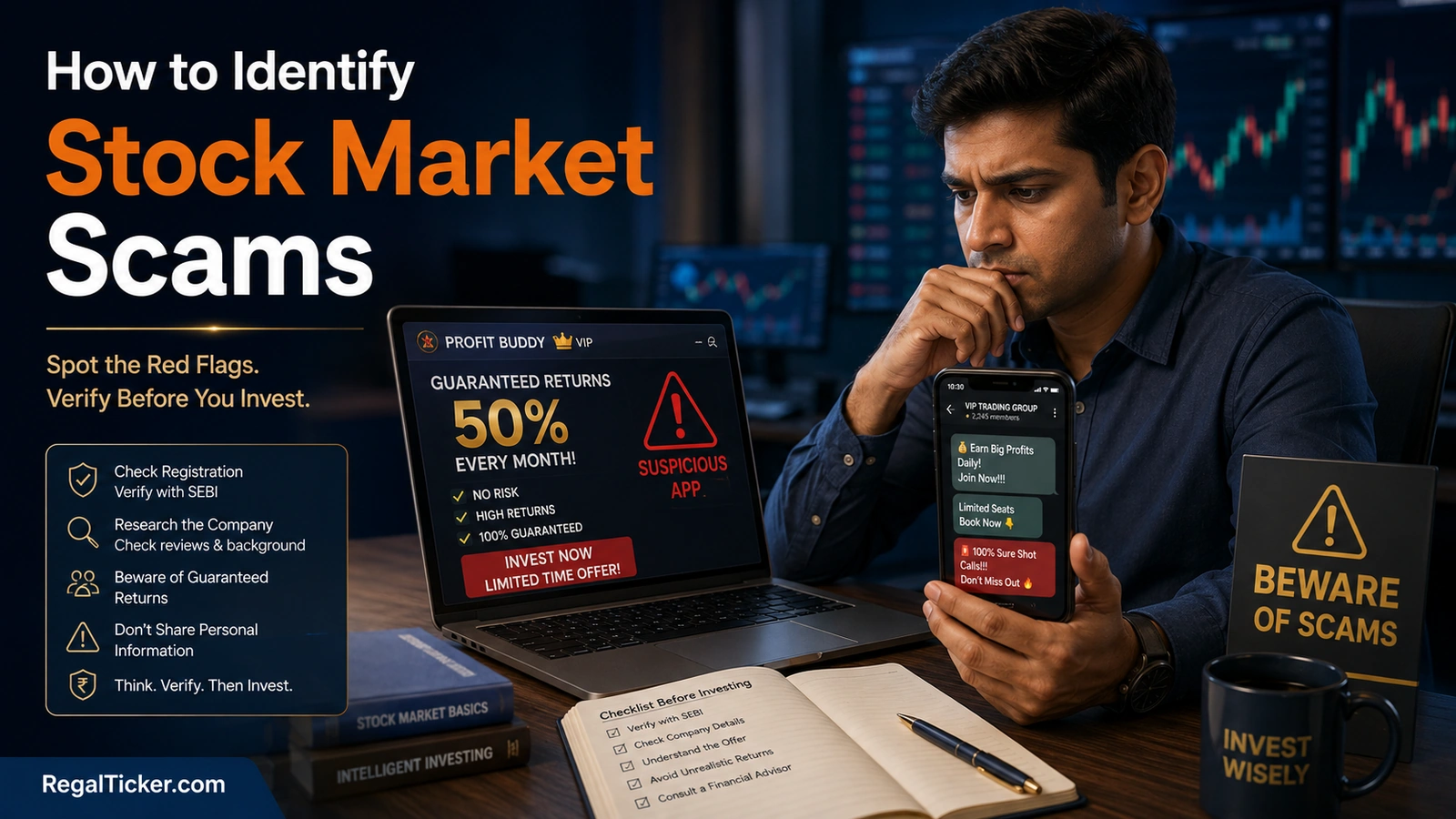
Twelve Warning Signs of a Stock Market Scam
No single warning sign proves fraud in every case, but multiple red flags should stop the transaction immediately.
1. Guaranteed or Risk-Free Returns
Stock-market investments carry risk. A person claiming assured, fixed or risk-free profits is contradicting the basic nature of the market.
The wording may include:
- guaranteed profit;
- no-loss strategy;
- fixed monthly return;
- 100% successful calls;
- capital fully protected;
- sure-shot trade.
Use the Regal Ticker CAGR Calculator to test long-term growth claims.
A promise that turns a small amount into a very large sum within a short period often implies an extraordinary annual growth rate. Calculating that rate can make an unrealistic claim immediately visible.
2. Perfectly Consistent Profits
Real market returns fluctuate. A scheme claiming positive returns every day or every month regardless of market conditions should be treated with suspicion.
Use the Regal Ticker Stock Return Calculator to compare the promised gain with the actual percentage return required.
3. Pressure to Act Immediately
Fraudsters create urgency because verification can expose the scheme.
Common statements include:
- the opportunity closes in one hour;
- only a few accounts remain;
- the stock will hit upper circuit tomorrow;
- pay now to lock the allocation;
- verification can be completed later.
A legitimate investment opportunity should withstand reasonable due diligence.
4. Unregistered Adviser or Operator
A social-media profile, visiting card, office or certificate does not prove regulatory registration.
Verify whether the person or firm is registered for the service being offered. Registration for one activity does not automatically authorise another.
5. Fake or Unverified Trading Application
Warning signs include:
- an APK file sent through chat;
- an app that cannot be verified through official exchange or SEBI resources;
- a different publisher name in the app store;
- login only through a referral code;
- special “institutional” or “VIP” access;
- trades that do not generate exchange alerts or contract notes.
6. Payment to a Third-Party Account
Investment funds should not be transferred to an unrelated individual, merchant, wallet or company.
A fraudster may explain that the account belongs to:
- an authorised agent;
- a settlement partner;
- a liquidity provider;
- a tax department;
- a block-deal desk.
Verify the authorised payment route independently.
7. Request for Password, OTP or TPIN
SEBI’s 2026 caution on account-handling scams states that fraudsters may portray themselves as expert fund managers and ask investors to share trading credentials. The investor bears the loss, while the handler seeks a share of any profit.
Readers who are unclear about account ownership and access should first review What Is a Demat Account? and Demat Account vs Trading Account.
Never share:
- trading password;
- OTP;
- TPIN;
- email password;
- screen-sharing access;
- remote-control access.
8. Exclusive Institutional Account Claims
Fraudsters may claim that retail investors can access:
- FPI or FII sub-accounts;
- institutional block deals;
- discounted upper-circuit shares;
- preferential IPO allotments;
- pre-market privileged trades.
The language is designed to make the victim feel selected for an opportunity unavailable to ordinary investors.
9. Fake Profit Screenshots and Testimonials
Screenshots can be edited, dashboards can be fabricated and group members can be impersonated.
Evidence of profit is meaningful only when supported by independently verifiable contract notes, exchange messages, bank transactions and demat records.
10. Difficulty Withdrawing Money
A genuine investment platform should explain withdrawal rules and charges before the transaction.
Repeated excuses, unexplained delays or demands for additional payment are serious warning signs.
11. Secret or Unclear Strategy
A legitimate professional should be able to explain:
- what is being purchased;
- how the strategy works;
- what risks exist;
- what fees apply;
- how losses can occur.
Do not invest in a strategy that depends on secrecy, insider access or unexplained algorithms.
12. Recovery Promises After a Loss
After a victim loses money, another person may claim to recover it for an upfront fee.
The recovery agent may be connected to the original scam. Do not send further money without independently verifying the authority and process.
How to Verify an Investment Offer
Use a structured verification process before transferring money or sharing documents.
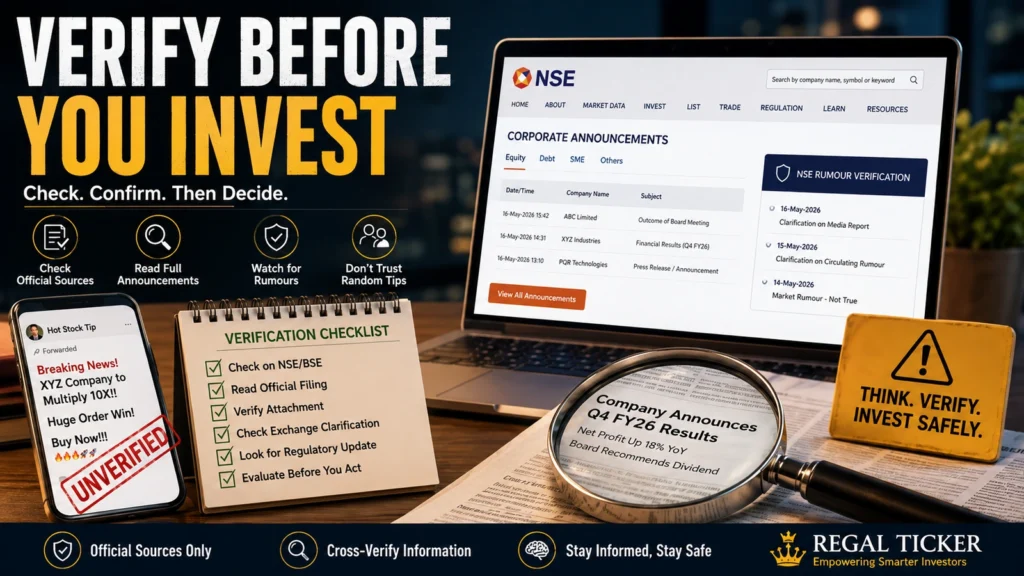
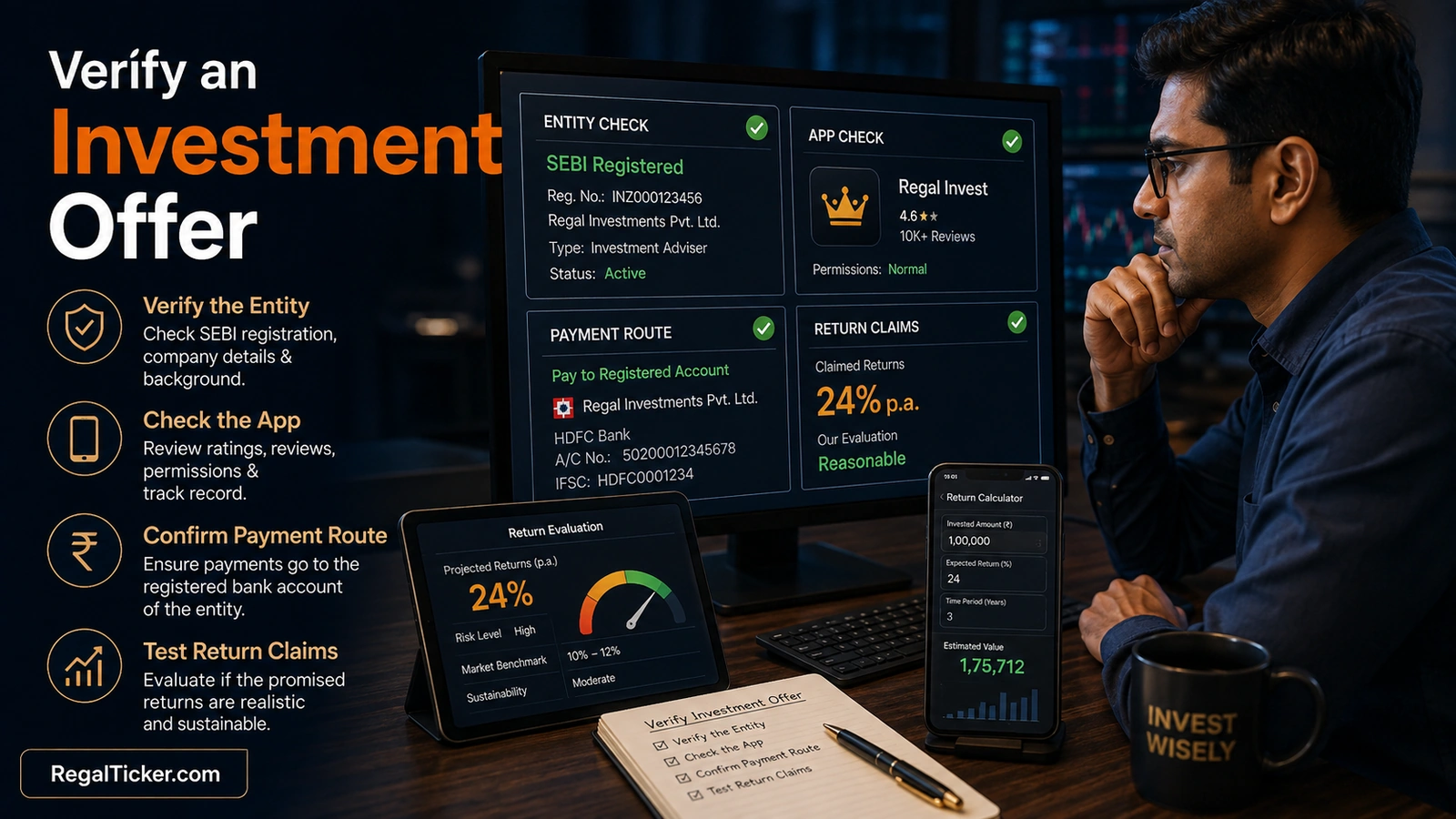
Verify the Entity
Check the name, registration number and authorised activity through official SEBI or exchange resources.
Do not use only the link sent by the promoter. Open the official website independently.
Verify the Trading Application
Confirm that the application belongs to a SEBI-registered intermediary and appears in the official list of authorised mobile trading apps.
Verify the Website Domain
Look for:
- misspelled brand names;
- extra words or hyphens;
- unusual domain extensions;
- recently created support pages;
- inconsistent contact details.
Verify the Payment Route
Confirm the receiving account and UPI handle through official intermediary information.
SEBI has advised investors to use validated UPI handles and the SEBI Check platform for secure payments to registered investor-facing intermediaries.
Verify the Return Claim
Convert the promised rupee profit into a percentage.
Use the Stock Return Calculator to convert the promised rupee gain into a percentage return.
For multi-year claims, use the CAGR Calculator to reveal the annualised growth rate required.
For a trade that appears to offer a large reward with minimal downside, use the Risk–Reward Calculator to examine whether the stated stop-loss and target are mathematically credible.
These calculators cannot prove that an offer is genuine, but they can expose exaggerated or internally inconsistent claims.
Fake Trading Apps: Specific Safety Checks
Fake trading apps are particularly dangerous because they can simulate the complete investing experience.
Check the Download Source
Do not install an APK file or an application sent through a private message.
Check the Publisher
The developer or publisher name should match the verified intermediary information.
Check Exchange Alerts
Real exchange transactions normally generate relevant confirmations through the registered communication channels.
Check Contract Notes
A changing number inside an app is not proof of an executed trade.
Check the Withdrawal Process
A small initial withdrawal does not establish legitimacy. Scammers may allow it deliberately to build confidence.
Check the Bank Account
Payments to changing or unrelated third-party accounts are a major red flag.
Check for Remote Access
Do not permit screen sharing or device control for account activation, KYC, withdrawal or technical support.
Social-Media and “Stock Guru” Scams
Fraudsters may present themselves as educators, mentors or successful traders.
The scam can begin with free content and later move to:
- paid tips;
- exclusive channels;
- managed-account services;
- referral links;
- unverified trading apps;
- guaranteed-profit plans.
A large audience does not establish regulatory status. Neither does a verified social-media badge.
Before paying for advice, check:
- whether the person is registered for the service;
- whether fees and conflicts are disclosed;
- whether returns are guaranteed;
- whether losses are hidden;
- whether account credentials are requested;
- whether money is transferred outside authorised channels.
Be especially cautious when an educator claims to trade on your behalf or offers to recover losses through higher-risk trades.
Account-Handling Scams
Account-handling services deserve special attention because they may operate inside the investor’s real trading account.
The handler may say:
- you provide the capital;
- they place the trades;
- profit is shared;
- losses will be recovered later;
- the strategy is risk-free.
SEBI’s February 2026 caution states that such operators may describe themselves as PMS providers, expert fund managers or account handlers, ask for trading credentials and take a percentage of profits while not sharing losses.
Do not hand over account control to an unregistered person.
If portfolio management is required, use only properly registered services and understand the applicable agreement, fees, risks and custody structure.
Scam Offer vs Genuine Investment Process
A genuine process normally includes:
- verifiable registration;
- clear documentation;
- transparent risk disclosure;
- official payment routes;
- no demand for account credentials;
- contract notes or formal records;
- access to a defined grievance mechanism;
- no guarantee of market returns.
A scam process often includes:
- urgency;
- secrecy;
- assured profit;
- private app links;
- third-party bank accounts;
- fake certificates;
- withdrawal barriers;
- additional-payment demands;
- disappearing support.
The presence of professional language does not convert a scam process into a regulated one.
What to Do Before Sending Money
Pause and complete this checklist:
- Search the entity independently.
- Verify the exact registration and authorised activity.
- Confirm the website and app.
- Check the payment account.
- Calculate the promised return.
- Ask how losses can occur.
- Request written documentation.
- Refuse to share credentials.
- Speak to a trusted person outside the sales process.
- Do not act under pressure.
Investor note
Important point
A genuine opportunity does not become fraudulent merely because it offers high potential returns. The warning sign is the combination of high-return claims with guarantees, secrecy, urgency, weak verification or unauthorised payment methods.
What to Do If You Suspect a Scam
Do Not Send More Money
Fraudsters may claim that one more payment will unlock the account or release the withdrawal.
Secure Your Accounts
Change passwords and protect the registered email, mobile number and banking access.
Contact the Genuine Intermediary
Use verified contact information rather than the phone number or chat used by the suspected fraudster.
Inform the Bank or Payment Provider
Report fraudulent transfers immediately.
Preserve Evidence
Save:
- messages;
- phone numbers;
- app links;
- APK files;
- bank details;
- UPI IDs;
- screenshots;
- payment references;
- fake certificates;
- support conversations.
Report Quickly
Exchange cautions advise victims of financial fraud to report through the cybercrime helpline 1930 or the National Cyber Crime Reporting Portal.
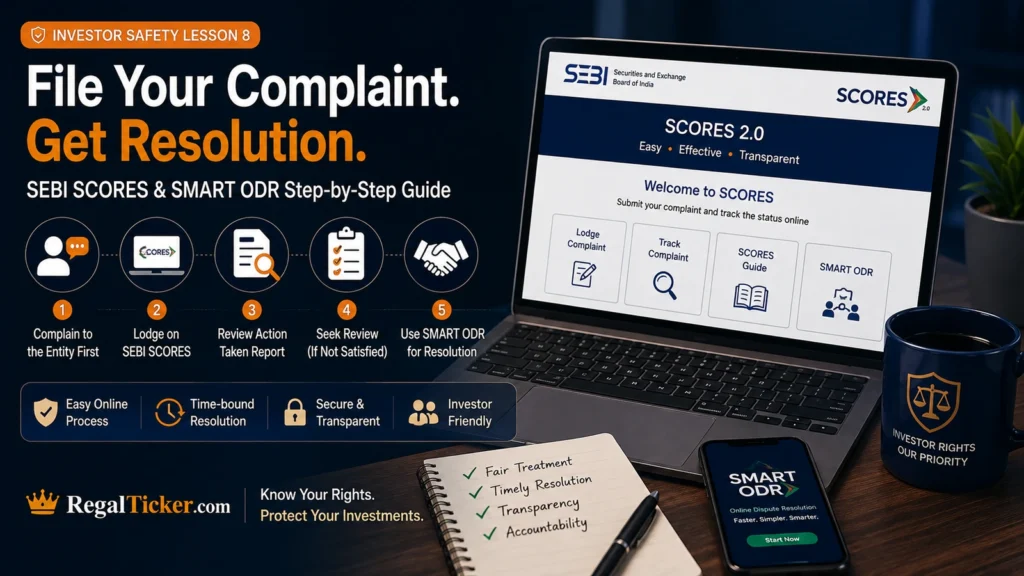
Suspicious communications may also be reported through relevant government facilities. Securities-market complaints involving registered entities may require escalation through the intermediary, exchange, depository or SEBI grievance mechanisms depending on the facts.
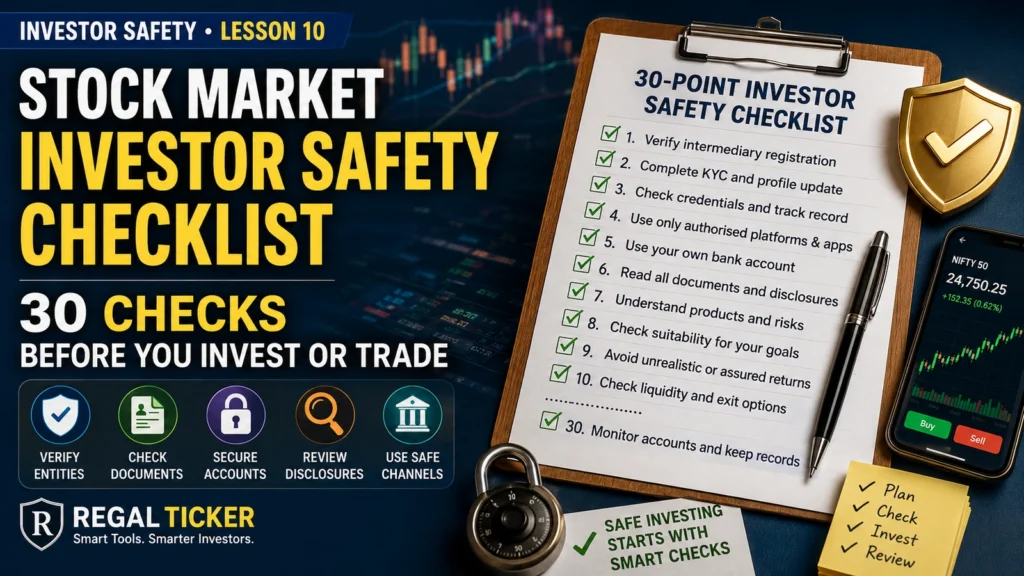
Stock Market Scam Checklist
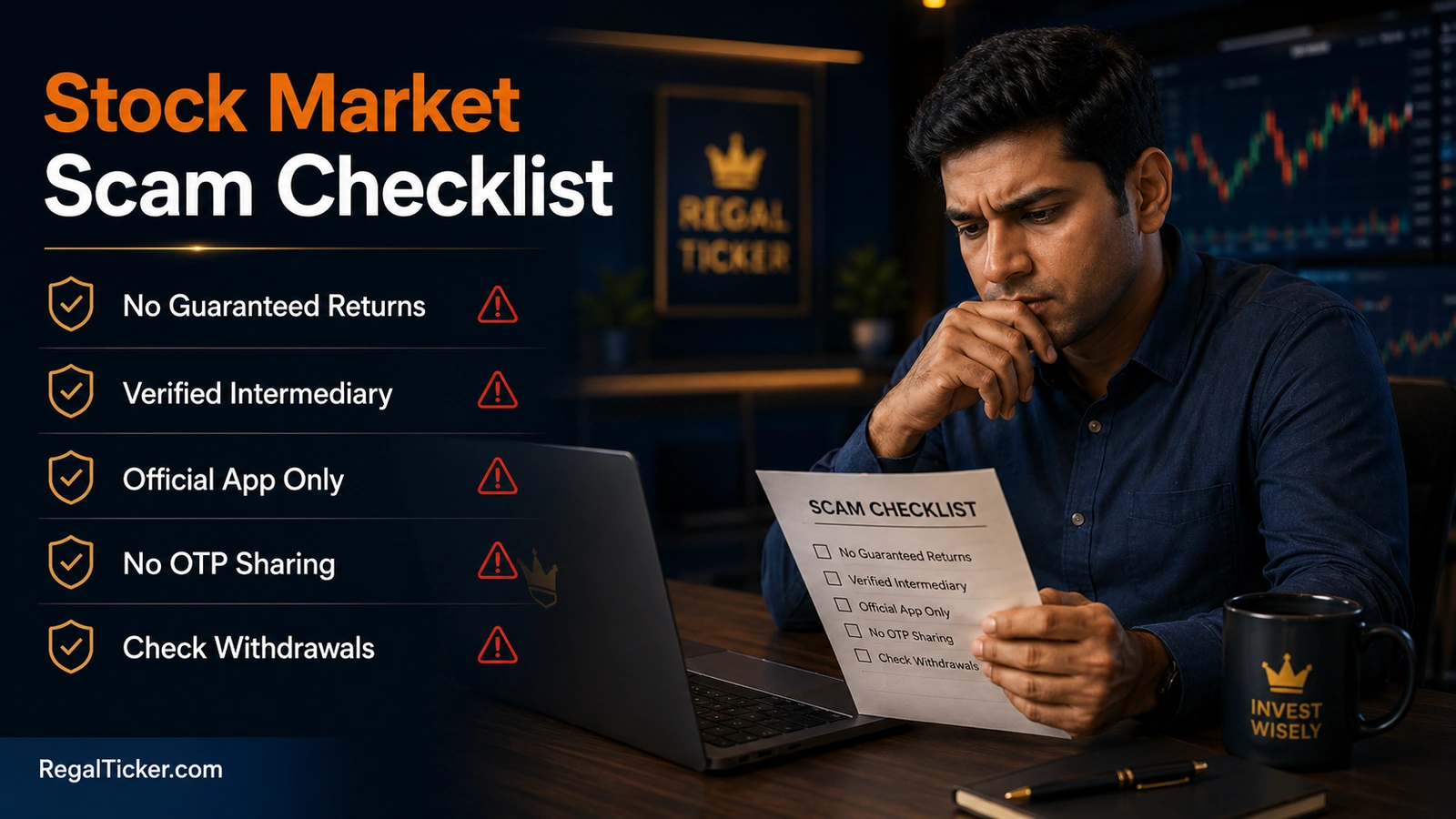
Treat an offer as high risk when several of these are present:
- assured or risk-free return;
- daily fixed income;
- pressure to invest now;
- unregistered adviser;
- fake or unclear certificate;
- private trading app;
- APK download;
- third-party payment;
- changing bank accounts;
- no contract note;
- no exchange alert;
- request for OTP or password;
- institutional-account story;
- discounted upper-circuit shares;
- guaranteed IPO allotment;
- fake profit screenshots;
- blocked withdrawal;
- extra fee to release funds;
- secret strategy;
- recovery promise.
Final Takeaway
Stock market scams change their names, applications and sales stories, but their underlying methods remain similar.
They create trust, promise extraordinary returns, discourage independent verification and gradually move the investor’s money or account control outside regulated channels.
The strongest protection is a repeatable process:
- verify the entity;
- verify the app;
- verify the payment route;
- calculate the return claim;
- protect credentials;
- preserve records;
- stop when pressure begins.
Calculators help test whether a return claim is mathematically realistic, but they do not replace regulatory verification. Always combine financial calculation with official checks. The Regal Ticker Investor Tools hub contains the full calculator ecosystem.
Frequently asked questions
What is the most common sign of a stock market scam?
Guaranteed or unusually consistent returns are among the most common warning signs, especially when combined with urgency, private payment accounts or an unverified platform.
Can a genuine broker guarantee profit?
No broker can guarantee market profit. Stock-market investments involve risk, and assured-return claims should be treated with caution.
How can I check whether a trading app is genuine?
Verify that the app belongs to a SEBI-registered intermediary and confirm it through official SEBI or exchange resources rather than relying on a private download link.
Is an APK trading app always fraudulent?
Not every APK file proves fraud, but investors should not install trading apps sent through chats or unknown links. Use only independently verified authorised applications.
Why do scammers allow an initial withdrawal?
A small withdrawal may be allowed to build trust and encourage the investor to deposit a much larger amount.
Can I share my trading password with an account manager?
No. Trading passwords, OTPs and TPINs should remain confidential. SEBI has cautioned investors against account handlers who request credentials.
Can calculators identify an investment scam?
Calculators cannot verify registration or legitimacy, but they can reveal unrealistic return percentages, impossible compounding claims and misleading reward calculations.
What should I do if a fake trading app blocks my withdrawal?
Stop further payments, preserve evidence, contact the bank or payment provider and report the fraud quickly through the appropriate cybercrime and regulatory channels.
Verify through official sources
Official references
- 1. SEBI Investor — How to Spot a Scam
- investor.sebi.gov.in/spot-any-scam.html
- 2. SEBI — Caution to Investors on Stock Market Scams through Account Handling Services, 26 February 2026
- www.sebi.gov.in/sebi_data/attachdocs/feb-2026/1772113926582.pdf
- 3. SEBI — Caution Against Fraudulent or Manipulative Activities on Social Media Platforms, May 2025
- www.sebi.gov.in/sebi_data/attachdocs/may-2025/1746621138080.pdf
- 4. SEBI Investor — Fake Trading App Scam Landscape
- investor.sebi.gov.in/pdf/Fake%20trading%20app%20scam%20Landscape.pdf
- 5. NSE India — Do’s and Don’ts for Investors
- www.nseindia.com/static/invest/first-time-investor-fraud-dos-and-donts
- 6. Joint Exchange Investor Caution — Fake Institutional Accounts and Trading Apps
- nsearchives.nseindia.com/web/sites/default/files/2024-08/PR_cc_23082024_0.pdf
Educational disclaimer: This article is for education and general information only. It does not provide investment, legal, cybersecurity or financial advice. Stock-market investments carry risk. Verify intermediaries, applications, websites, bank accounts and payment handles independently through official sources before acting. Reporting and grievance procedures depend on the nature of the incident and the entities involved.