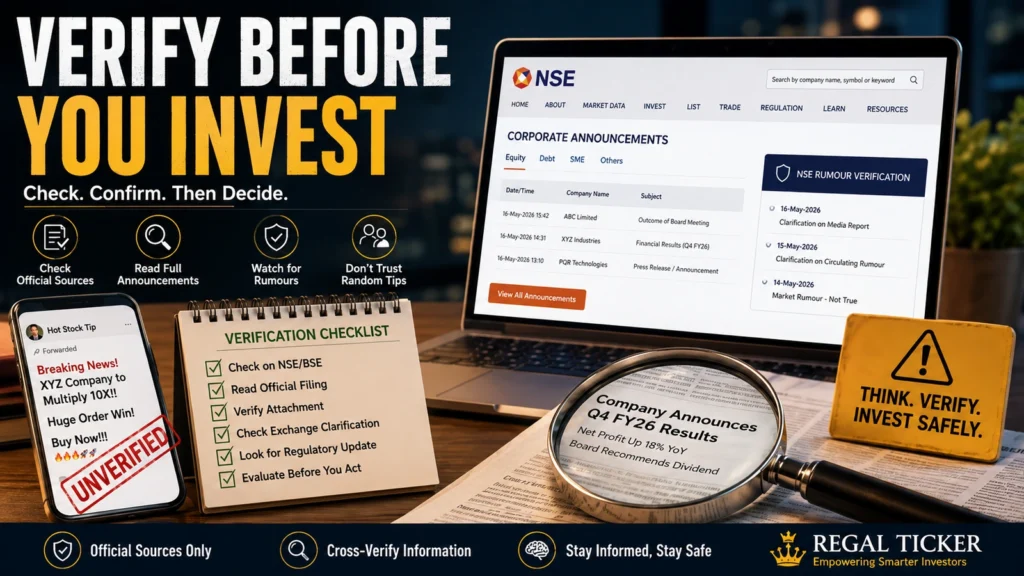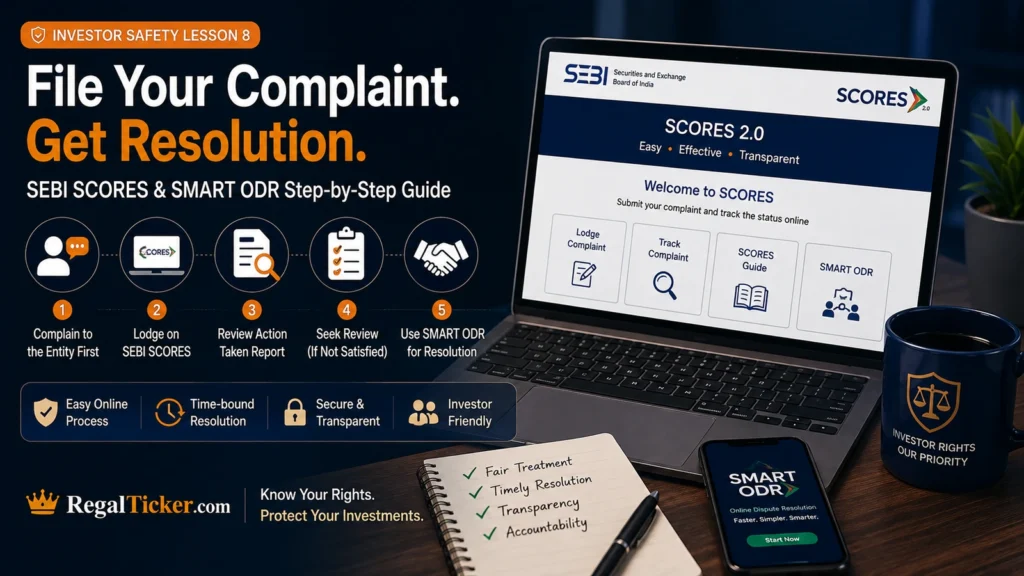

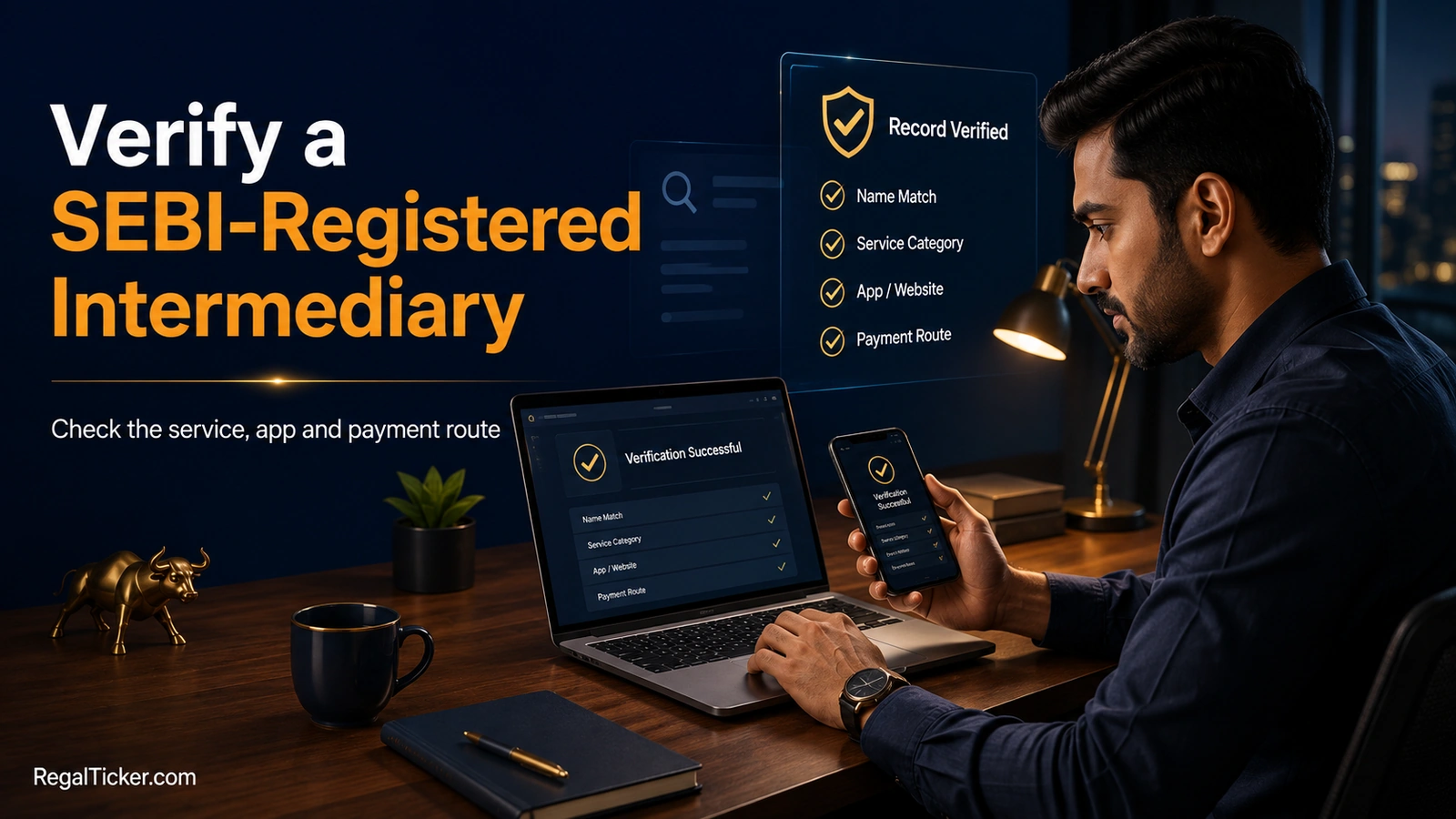
⚡ Quick answer
To verify a SEBI-registered intermediary, search the entity independently in SEBI’s Recognised Intermediaries database and confirm the exact name, registration number, intermediary category, contact details, address and current status. For a stock broker, also verify exchange membership through the exchange’s broker-search facility. For an investment adviser or research analyst, confirm that the registration category matches the service being offered.
Do not rely only on a certificate, social-media profile, app screen or registration number sent by the seller. A genuine registration number can be copied and used by an impersonator. The website, mobile app, payment account, email address and phone number should also match independently verified official records.
What Is a SEBI-Registered Intermediary?
A securities-market intermediary is an individual or organisation that performs a regulated role between investors and the market.
Depending on the activity, the intermediary may:
- execute buy and sell orders;
- hold securities through a demat account;
- provide personalised investment advice;
- publish stock research or recommendations;
- manage a portfolio;
- facilitate an issue of securities;
- process investor records and corporate actions.
SEBI maintains searchable lists of recognised intermediaries across many categories. The official database includes stock brokers, depository participants, investment advisers, research analysts, portfolio managers, merchant bankers and other regulated entities.
The starting point is the SEBI Recognised Intermediaries database.
A name appearing in one category does not automatically authorise every financial service. Investors must verify the category as carefully as the registration number.
This lesson continues the verification principles explained in Investor Safety in the Stock Market and How to Identify Stock Market Scams.

Why SEBI Registration Verification Matters
Fraudsters frequently use the identity of a genuine intermediary.
They may copy:
- a registration number;
- company logo;
- office address;
- employee name;
- certificate;
- website design;
- social-media profile;
- mobile application name.
The registration number may be real, but the person contacting the investor may have no connection with the registered entity.
Verification helps answer four separate questions:
- Does the entity exist in the official record?
- Is it registered for the service being offered?
- Do the contact details match?
- Are the website, app and payment route genuinely connected with it?
A single “yes” is not enough. All four should align.
What SEBI Registration Does—and Does Not—Mean
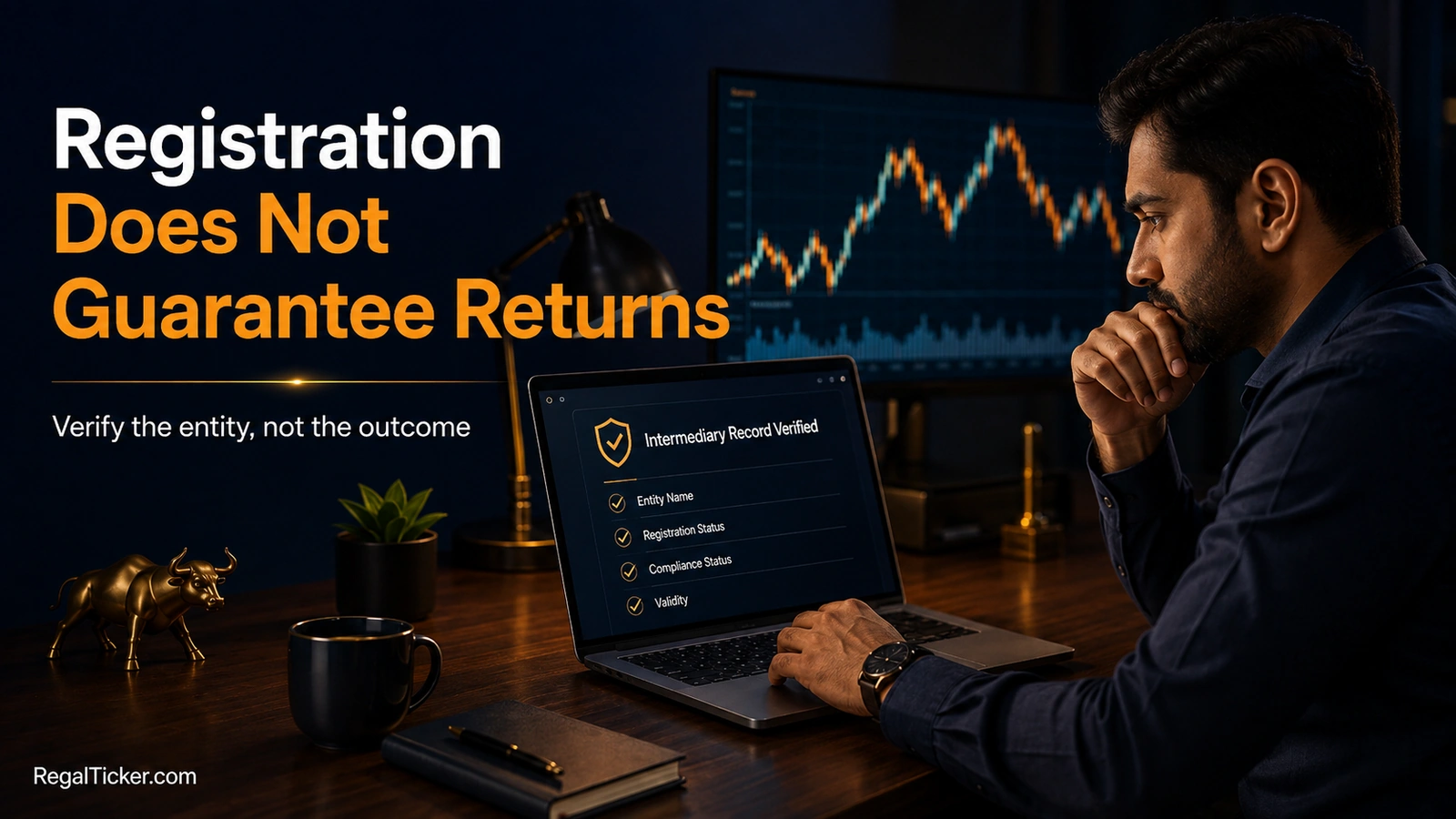
SEBI registration is an important regulatory check, but it should not be misunderstood.
What Registration Can Confirm
Registration can help confirm that:
- the person or entity appears in the relevant official category;
- a registration number has been assigned;
- contact and address details are recorded;
- the intermediary is subject to applicable regulatory requirements;
- investors have access to recognised grievance mechanisms.
What Registration Cannot Guarantee
Registration does not guarantee:
- investment profit;
- accurate stock predictions;
- protection from market loss;
- suitability of every recommendation;
- honest conduct by an impersonator using copied details;
- that a related-looking app or website is genuine.
A registered broker can execute trades, but that does not make every stock idea safe. A registered research analyst can publish research, but no analyst can guarantee a target price.
Use the Stock Return Calculator to convert promised rupee gains into percentages and the CAGR Calculator to test long-term growth claims. Extraordinary guaranteed returns remain a warning sign even when a genuine registration number is displayed.
Identify the Exact Service Being Offered
Before searching the database, classify the service.
Stock Broker
A stock broker executes securities transactions for clients and provides access to exchanges.
The broker may also provide research or other services through permitted structures, but execution authority should be verified through the broker and exchange records.
Investment Adviser
An investment adviser provides personalised advice based on an investor’s goals, financial circumstances and risk profile.
SEBI Investor describes investment advisers as registered professionals providing personalised guidance and charging fees directly to clients. Investors can review the official SEBI Investor guide to investment advisers.
Research Analyst
A research analyst studies securities or industries and publishes research reports or recommendations.
Research analysis is not the same as personalised investment advice. The official SEBI Investor guide to research analysts explains the distinction.
Depository Participant
A depository participant connects investors with a depository and provides demat-account services.
The SEBI Investor depository guide explains that investors hold securities electronically through demat accounts opened with depository participants.
Portfolio Manager
A portfolio manager manages client portfolios under the applicable agreement and regulatory framework.
Someone claiming to manage an ordinary trading account by taking the investor’s password should not be assumed to be a registered portfolio manager.
How to Search the SEBI Intermediary Database
Use the official website independently rather than opening a link supplied by the promoter.
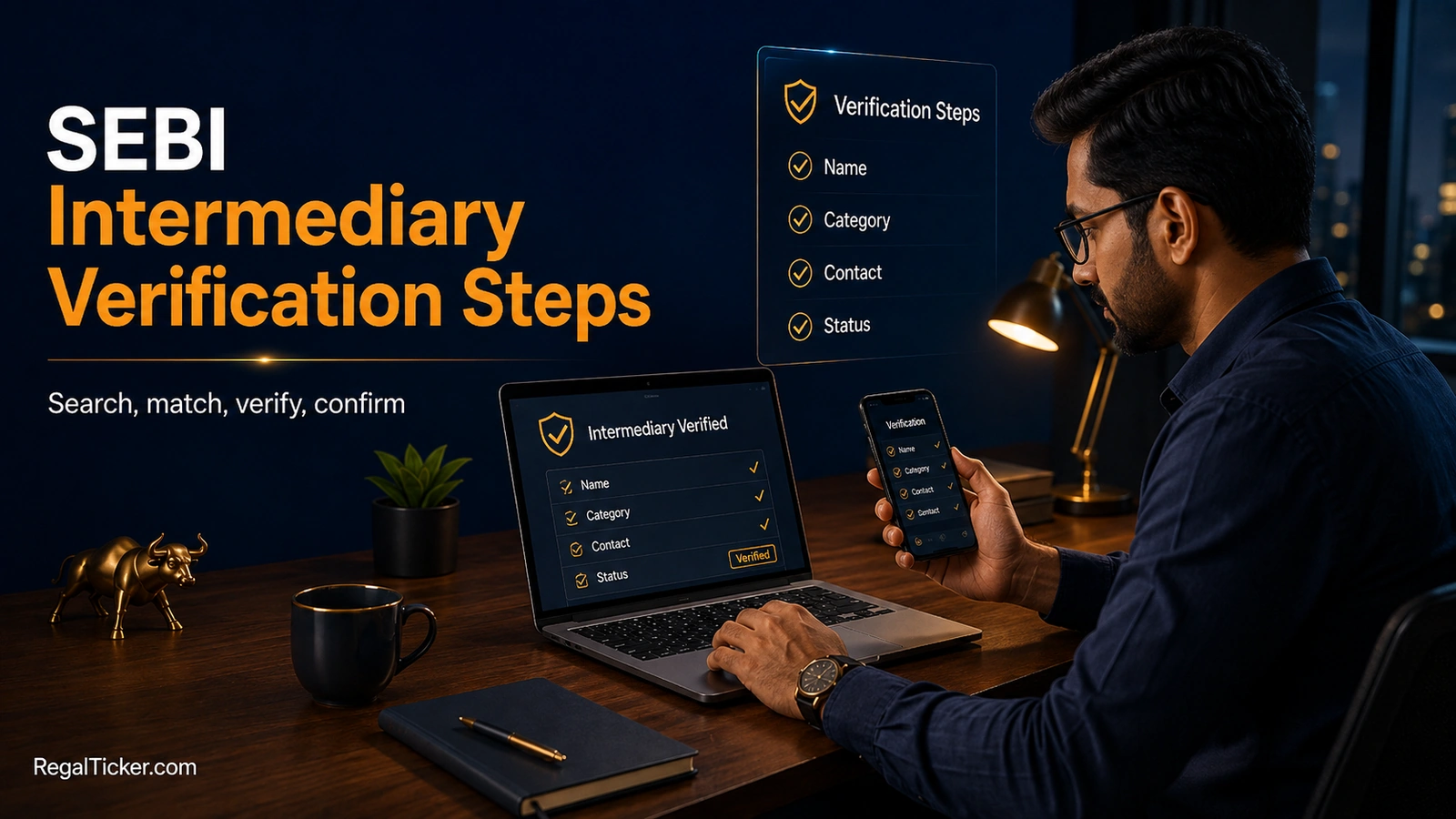
Step 1: Open the Recognised Intermediaries Page
Use the official SEBI intermediary search.
Step 2: Select the Correct Category
Choose the type of intermediary you want to verify.
Examples include:
- registered stock broker;
- investment adviser;
- research analyst;
- registered depository participant;
- portfolio manager.
Step 3: Search by Name or Registration Number
Use the legal name, trade name or complete registration number.
A shortened brand name may return incomplete or misleading results.
Step 4: Open the Matching Record
Do not stop when a similar name appears.
Open the relevant record and review all available details.
Step 5: Match the Information
Option A
- legal name;
- trade name;
- registration number;
- category;
- address;
- email;
- phone number;
- contact person;
- validity or status;
- exchange name where applicable.
Option B
Step 6: Contact the Entity Independently
Use contact information from the official record or independently verified website.
Ask whether the person, app, channel or payment request is genuinely connected with the entity.
How to Verify a Stock Broker
A broker should be checked at both the regulator and exchange level.
Check the SEBI Broker Record
SEBI provides a searchable list of registered stock brokers in the equity segment.
Review the:
- registration number;
- legal and trade names;
- exchange name;
- address;
- compliance email;
- validity or current status.
Check Exchange Membership
Use the exchange’s official broker-search facility.
For NSE membership, use NSE Know Your Broker.
The exchange record can help verify the member name, SEBI registration number and member code.
Check the Authorised Person
A local representative or franchise office may claim association with a broker.
Confirm that relationship through the broker or exchange rather than trusting a visiting card or office sign.
Check Client Bank Accounts
The account used for transferring funds should be an officially disclosed client account of the broker.
Do not transfer investment money to an employee, dealer, franchise owner or unrelated business.
How to Verify an Investment Adviser
An investment adviser should be registered specifically as an adviser.
Search the Investment Adviser Category
Use SEBI’s recognised-intermediary database and select “Investment Adviser.”
Match the registration number and official contact information.
Confirm the Service
The service should involve personalised advice rather than guaranteed returns or unauthorised account handling.
Review the Agreement and Fees
Understand:
- scope of advice;
- fee structure;
- risk profiling;
- conflicts of interest;
- complaint process;
- cancellation terms.
Never Transfer Investment Capital to the Adviser
An advisory fee and investment capital are different.
The investor’s investment funds should remain within appropriate authorised investment channels.
Reject Profit Guarantees
Registration does not permit an adviser to guarantee market returns.
How to Verify a Research Analyst
A research analyst may publish reports and recommendations but should not be confused with an account manager.
Search the Research Analyst Register
Use SEBI’s official Research Analyst register.
The record may display:
- name or trade name;
- registration number;
- address;
- email;
- contact person;
- validity.
Match the Publication Identity
The name on the research report, website, invoice and social-media profile should correspond with the registered record.
Review Disclosures
A research report should disclose relevant conflicts and interests as required.
Do Not Surrender Account Control
A research analyst providing a recommendation should not need the investor’s password, OTP or TPIN.
Question Private Guaranteed Calls
“Sure-shot” calls and guaranteed targets are inconsistent with market uncertainty.
How to Verify a Depository Participant
A depository participant provides access to demat services through NSDL or CDSL.
Check the DP Name
The demat-account opening documents should clearly identify the depository participant.
Confirm the Depository Relationship
Verify whether the DP is connected with NSDL or CDSL through official sources.
SEBI’s recognised-intermediary database provides separate lists for registered CDSL and NSDL depository participants.
Match Account Communications
Demat statements, transaction alerts and support communication should use verified contact channels.
Understand Broker and DP Roles
A company may provide both trading and demat services, but the trading account and demat account perform different functions.
Review What Is a Demat Account? and Demat Account vs Trading Account before sharing account information.
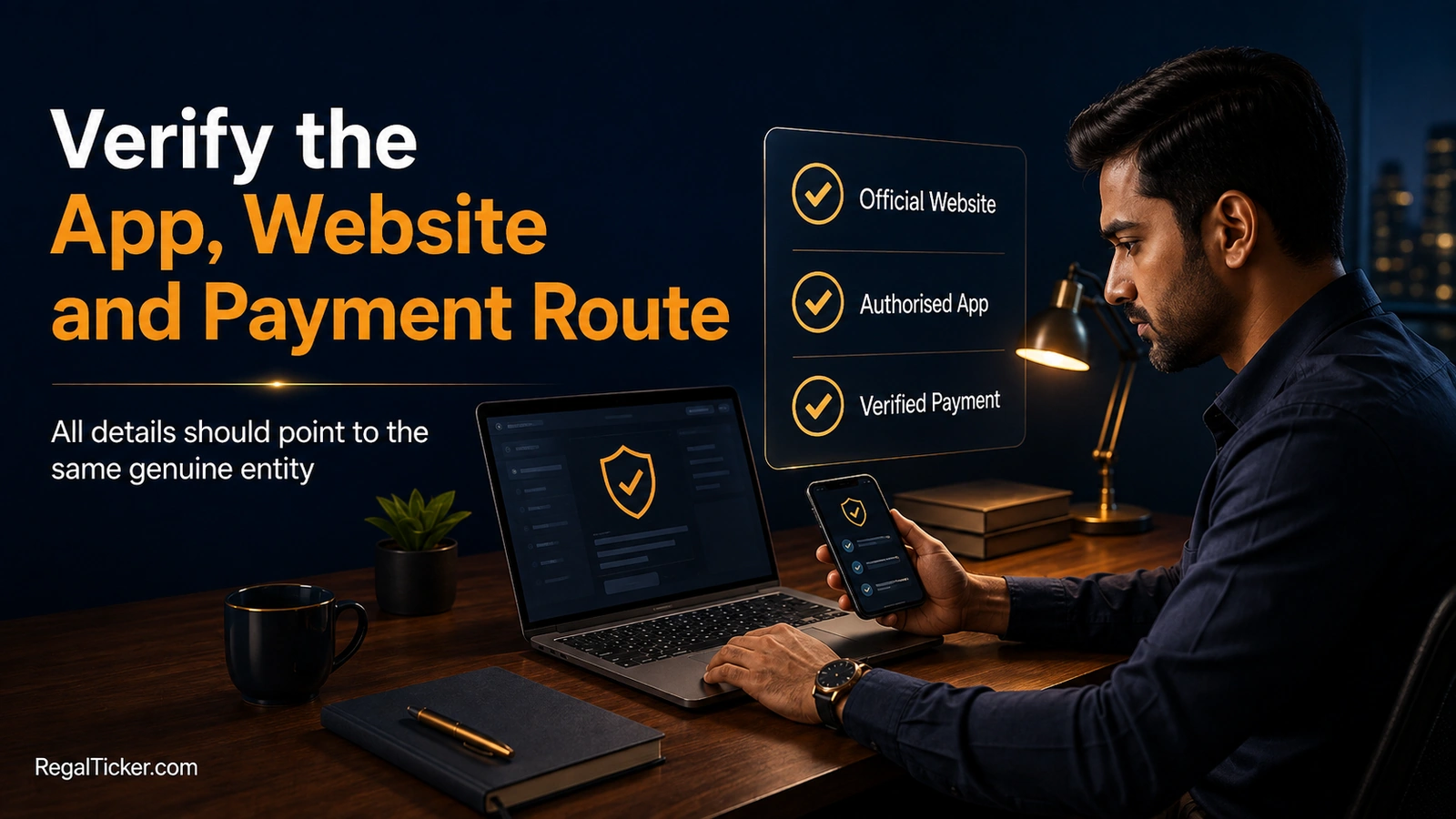
Verify the Website, App and Payment Route
A fraudulent website may differ from the genuine domain by one character.
Check for:
- additional words;
- substituted letters;
- hyphens;
- unusual domain extensions;
- copied contact pages;
- newly created support addresses;
- spelling inconsistencies.
Do not use the website link inside a Telegram message as proof of authenticity.
Find the genuine domain through official records, the exchange or an independently verified search.
The email domain should correspond with the genuine entity. A free email address does not automatically prove fraud, but it deserves additional verification when the official record shows a corporate domain.
Verify the Mobile Trading Application
A genuine broker name can be used to distribute a fake app.
SEBI Investor maintains an authorised mobile trading apps support page linking to exchange-maintained application lists.
In March 2026, SEBI and Google introduced a “Verified” label for stock-trading apps of SEBI-registered brokers on Google Play. SEBI described its investor-protection approach as Check, Validate and Verify: check bank accounts through SEBI Check, validate UPI handles and verify stock-trading apps. Review the official SEBI Verified-label announcement.
Still verify:
- developer or publisher name;
- official app-store link;
- website domain;
- requested permissions;
- broker support confirmation.
Never install a private APK merely because the branding looks familiar.
Verify the Payment Account or UPI Handle
A genuine registration record does not validate every bank account sent through chat.
Match the Beneficiary
The beneficiary name should correspond with the verified intermediary and the intended purpose.
Check the Account Independently
SEBI Investor provides SEBI Check account verification for account-detail checks.
Verify UPI Information
SEBI Check also provides QR and UPI-verification facilities through the investor website and Saa₹thi ecosystem.
Do Not Pay Personal Accounts
Do not transfer investment money to:
- an adviser’s personal account;
- a Telegram administrator;
- an employee;
- a franchise representative;
- an unrelated merchant;
- a recovery agent.
Stop When Accounts Keep Changing
Repeated changes in beneficiary accounts are a major warning sign.
Match Registration With the Exact Activity
A common mistake is to find any SEBI registration and assume the entire offer is genuine.
Examples:
- a broker registration does not automatically validate personalised advisory services;
- a research analyst registration does not authorise password-based account handling;
- an investment adviser registration does not prove that a Telegram profile belongs to the adviser;
- a depository-participant relationship does not validate a guaranteed-return scheme.
Ask:
- What exact service is being sold?
- Which registration category covers that service?
- Does the official record match the person contacting me?
- Does the payment route match the verified entity?
- Are the app and website officially authorised?
The activity, identity and infrastructure must all align.
Warning Signs Even When a Registration Number Is Shown
Stop and investigate when you see:
- a certificate sent only as an image;
- registration details that cannot be found independently;
- a name similar to but not identical to the official record;
- contact information that does not match;
- guaranteed returns;
- pressure to act immediately;
- personal or third-party bank accounts;
- private APK files;
- requests for passwords or OTPs;
- blocked withdrawals;
- extra fees to release funds;
- refusal to communicate through official channels.
Fraudsters may use a genuine number precisely because investors recognise the importance of SEBI registration.
Verification must go beyond the number.
What to Do When the Details Do Not Match
Do Not Send Money
Pause the transaction until the discrepancy is resolved.
Do Not Share Documents or Credentials
Avoid sending PAN, Aadhaar, bank statements, passwords, OTPs or TPINs.
Contact the Genuine Intermediary
Use the contact details in the official record or verified website.
Preserve the Evidence
Save:
- messages;
- registration certificate;
- app link;
- website domain;
- phone number;
- payment details;
- screenshots.
Report Impersonation
Inform the genuine intermediary that its identity may be misused.
Depending on the facts, suspicious activity may also be reported to the relevant exchange, SEBI, bank, payment provider or cybercrime authorities.
SEBI Intermediary Verification Checklist
Before paying, investing or sharing account access, confirm:
- I searched the entity independently.
- The legal name matches exactly.
- The registration number matches.
- The intermediary category matches the service.
- The status or validity is current.
- The address and contact details match.
- The exchange membership is verified where applicable.
- The representative is genuinely authorised.
- The website domain is genuine.
- The mobile application is authorised.
- The developer name matches.
- The beneficiary account is verified.
- No guaranteed return is promised.
- No password, OTP or TPIN is requested.
- The service includes proper documents and disclosures.
- I understand that registration does not guarantee performance.
For a proposed trade, use the Risk–Reward Calculator to test the entry, stop-loss and target. Regulatory verification confirms the intermediary—not the quality of the trade.
The Regal Ticker Investor Tools hub contains additional calculators for checking return and risk assumptions.
Final Takeaway
A SEBI registration number is an important verification point, but it is not a complete safety check.
The investor should match:
- the official entity;
- the exact registration category;
- the service offered;
- the representative;
- the website;
- the app;
- the payment account;
- the communication channel.
A copied certificate can look genuine. A copied registration number can be genuine. The offer can still be fraudulent if the person, platform or payment route does not belong to the registered entity.
Use official SEBI and exchange records independently. Verify first, transfer money later.
Frequently asked questions
How can I check whether a broker is SEBI registered?
Search the broker in SEBI’s registered-stock-broker records and verify exchange membership through the relevant exchange’s official broker-search facility.
Does SEBI registration guarantee investment returns?
No. Registration confirms regulatory status for a particular activity. It does not guarantee profit, recommendation accuracy or protection from market loss.
Can a fraudster use a genuine SEBI registration number?
Yes. Fraudsters may copy genuine registration details while using fake phone numbers, websites, apps or payment accounts.
Is a research analyst the same as an investment adviser?
No. A research analyst generally publishes research and recommendations, while an investment adviser provides personalised advice based on the client’s circumstances and risk profile.
How do I verify a trading app?
Check the authorised-application lists linked through SEBI Investor, confirm the developer name and use the genuine broker website to reach the official app-store page.
How can I verify a payment account?
Match the beneficiary with the verified intermediary and use official facilities such as SEBI Check where applicable. Do not rely only on account details received through chat.
Can a registered intermediary ask for my OTP or trading password?
Investors should not share passwords, OTPs or TPINs. A request for account credentials is a serious warning sign.
What should I do if the registration details and contact information do not match?
Stop the transaction, contact the genuine intermediary through verified details, preserve the evidence and report suspected impersonation through applicable official channels.
Verify through official sources
Official references
- 1. [SEBI — Recognised Intermediaries](https://www.sebi.gov.in/sebiweb/other/OtherAction.do?doRecognised=yes)
- 2. [SEBI — Registered Stock Brokers in the Equity Segment](https://www.sebi.gov.in/sebiweb/other/OtherAction.do?doRecognisedFpi=yes&intmId=30)
- 3. [NSE — Know Your Broker](https://enit.nseindia.com/MemDirWeb/form/tradingMemberLocator_beta.jsp)
- 4. [SEBI Investor — Understanding Brokers](https://investor.sebi.gov.in/Brokers.html)
- 5. [SEBI Investor — Understanding Investment Advisers](https://investor.sebi.gov.in/investment_advisor.html)
- 6. [SEBI Investor — Understanding Research Analysts](https://investor.sebi.gov.in/research_analyst.html)
- 7. [SEBI Investor — Understanding Depositories](https://investor.sebi.gov.in/depositories.html)
- 8. [SEBI Investor — Authorised Mobile Trading Apps](https://investor.sebi.gov.in/Investor-support.html)
- 9. [SEBI Investor — SEBI Check Account Verification](https://investor.sebi.gov.in/account-verification.html)
- 10. [SEBI — Verified Label for Stock Trading Apps, March 2026](https://www.sebi.gov.in/media-and-notifications/press-releases/mar-2026/chairman-sebi-today-launched-an-important-investor-protection-measure-in-the-form-of-verified-label-for-stock-trading-apps-of-brokers-registered-with-sebi-on-google-play-store_100616.html)
Educational disclaimer: This article is for education and general information only. It does not provide investment, legal, regulatory or financial advice. Official registration records, authorised-application lists, contact details and payment facilities may change. Verify all details directly through current SEBI, exchange, depository and intermediary sources before investing, transferring money or sharing information.