
Rights Issue Calculator
Understand the full economics of a rights issue: how many shares you may apply for, the cash required, TERP and the theoretical value of your Rights Entitlements.
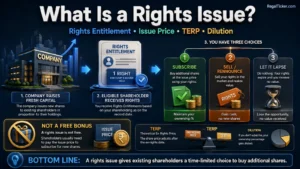 Learn the concept firstWhat Is a Rights Issue? Meaning, RE, TERP and Choices→
—
—
Theoretical only; the market RE price can differ.
—
—
TERP, RE value, dilution and parity are educational mathematical references—not price forecasts or investment advice. Eligibility, fraction handling, payment calls, renunciation and allotment always follow the company’s Letter of Offer.
How to use the Rights Issue Calculator
Start with the offer terms. Open the advanced section only when the Letter of Offer is partly paid or you want to compare a traded RE.
- 1Enter the eligible holdingUse shares eligible on the record date, not today’s holding if it changed later.
- 2Copy the exact ratio and pricesEnter new shares first, existing shares second, then the full issue price.
- 3Choose your subscription percentageThe result uses whole REs and keeps the fraction visible for filing verification.
- 4Read the decision visualsCompare payment, value, dilution and optional market parity before checking the offer document.
500 eligible shares create a mathematical entitlement of 100 rights shares.
500 eligible shares create a mathematical entitlement of 200 rights shares.
The calculator separates whole REs from the decimal remainder instead of silently rounding.
Subscribe fully or partly
Pay the required application money and complete the application within the issue timeline. Full subscription normally maintains the pre-issue ownership proportion before rounding.
Renounce or sell eligible REs
A shareholder may act on the entitlement permitted by the offer. On-market and off-market renunciation deadlines can differ, so check the exact issue schedule.
Do nothing and the RE lapses
SEBI states that REs neither subscribed nor renounced by the closing date lapse and are extinguished. A visible discount is not received automatically.
A 1:5 offer with payment split across calls
With 500 eligible shares, a 1:5 offer creates 100 whole REs. At a full issue price of ₹200, total commitment is ₹20,000. If ₹150 is payable on application, the immediate cash is ₹15,000 and ₹5,000 remains for later calls. TERP still uses the full ₹200 issue price.
Verify these five items before relying on the result
- 1Record date and your eligible share count
- 2Rights ratio and fractional-entitlement treatment
- 3Full issue price, application money and later calls
- 4On-market renunciation and issue-closing deadlines
- 5Application route, bank details and allotment terms
Frequently asked questions
How do I use the Rights Issue Calculator?
Enter the shares eligible on the record date, the cum-rights market price, the issue price and the announced ratio as new shares for existing shares. Choose how much of the whole entitlement you plan to subscribe. Use Offer and market check only when you want to model a partly-paid issue, pooled average cost or observed RE parity.
What does a 1:5 rights issue mean?
It means an eligible shareholder may apply for one rights share for every five shares held on the record date. A holding of 500 eligible shares produces a mathematical entitlement of 100 rights shares.
What happens to a fractional Rights Entitlement?
The calculator separates the exact mathematical entitlement, whole RE component and fractional remainder. The company Letter of Offer may ignore the fraction, aggregate it or prescribe another treatment, so the calculator does not present a fraction as a guaranteed credited RE.
What is TERP in a rights issue?
TERP is the theoretical ex-rights price. It blends the cum-rights market value of existing shares with the rights issue price in the announced ratio. TERP is a mathematical reference, not a forecast of the market price after the shares trade ex-rights.
What is the theoretical value of one Rights Entitlement?
Where one RE permits subscription to one rights share, the theoretical value per RE is TERP minus the full rights issue price. The actual traded RE price can be higher or lower because of market demand, time remaining, charges and execution risk.
Can the calculator handle a partly-paid rights issue?
Yes. Open Offer and market check and enter the application money payable now per rights share. The calculator separates immediate cash from the remaining future calls while still using the full issue price for TERP and total commitment.
What happens if I neither subscribe nor sell my REs?
SEBI states that Rights Entitlements neither subscribed nor renounced by the issue closing date lapse and are extinguished. The calculator shows the theoretical value attached to the whole REs left under your selected plan so the consequence is visible, but the actual traded value can differ.
Is buying an RE on the exchange enough to receive the rights share?
No. An investor who buys an RE must also submit the rights application and pay the required application money within the offer timeline. Buying the RE alone does not complete the subscription.
What does the RE parity view show?
It compares the observed ex-rights share price with the traded RE price plus the full rights issue price. A gap is only a market-mechanics reference; it excludes brokerage, taxes, slippage, settlement, payment-call timing and execution risk and is not an arbitrage recommendation.
Can the calculator estimate a cashless or cash-budget take-up?
Yes. Enter the traded RE price and an optional cash budget. The planner estimates how many whole rights shares could be funded by combining that cash with theoretical proceeds from selling the other whole REs. It uses the application money due now and separately shows future calls, but excludes charges, slippage, deadlines, liquidity and execution risk.