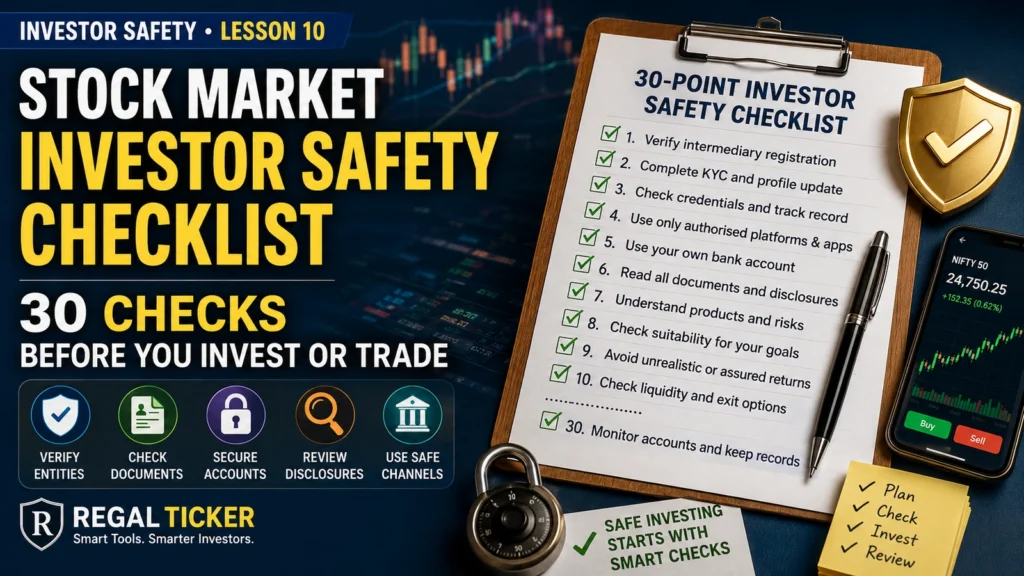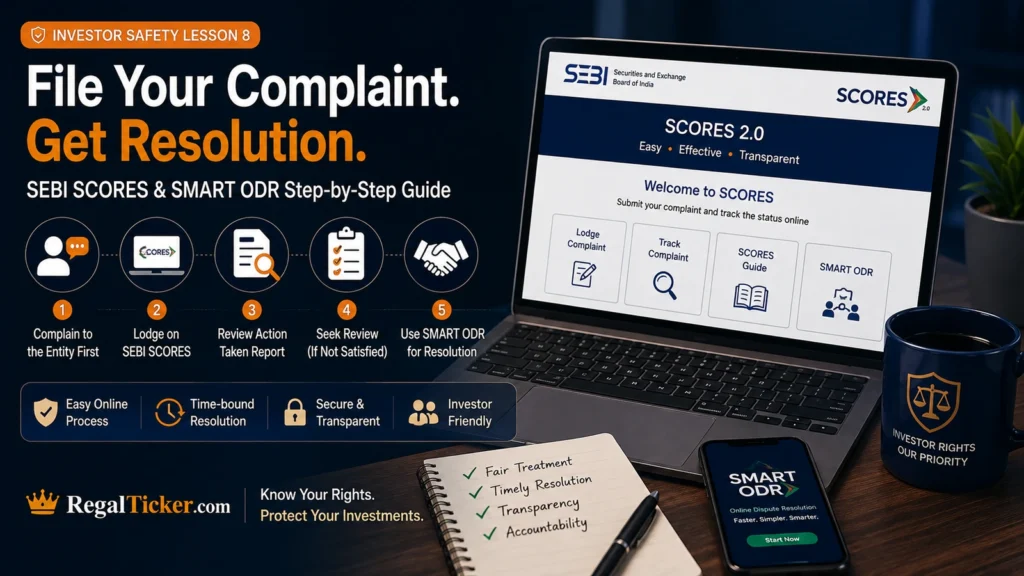

⚡ Quick answer
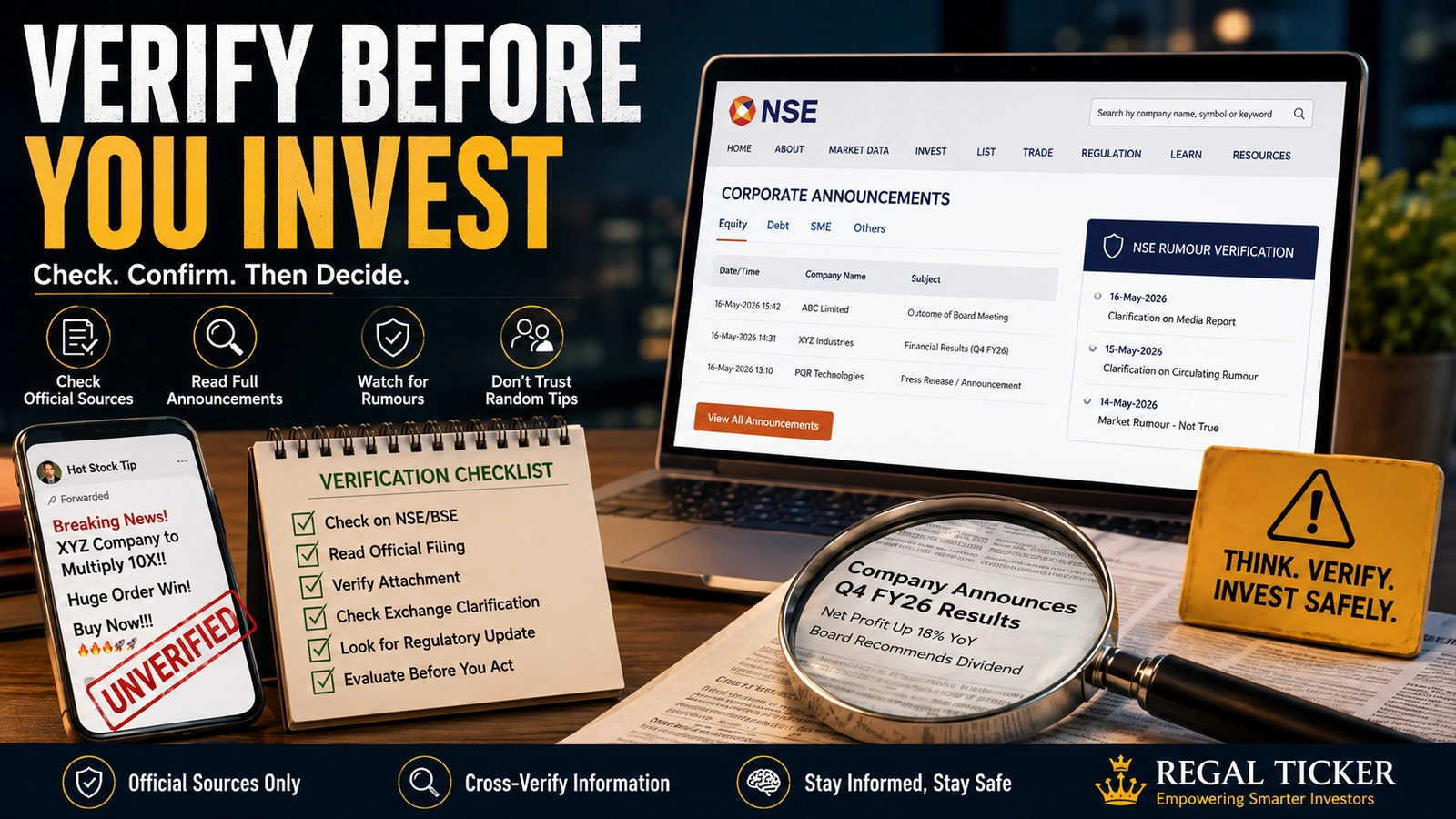
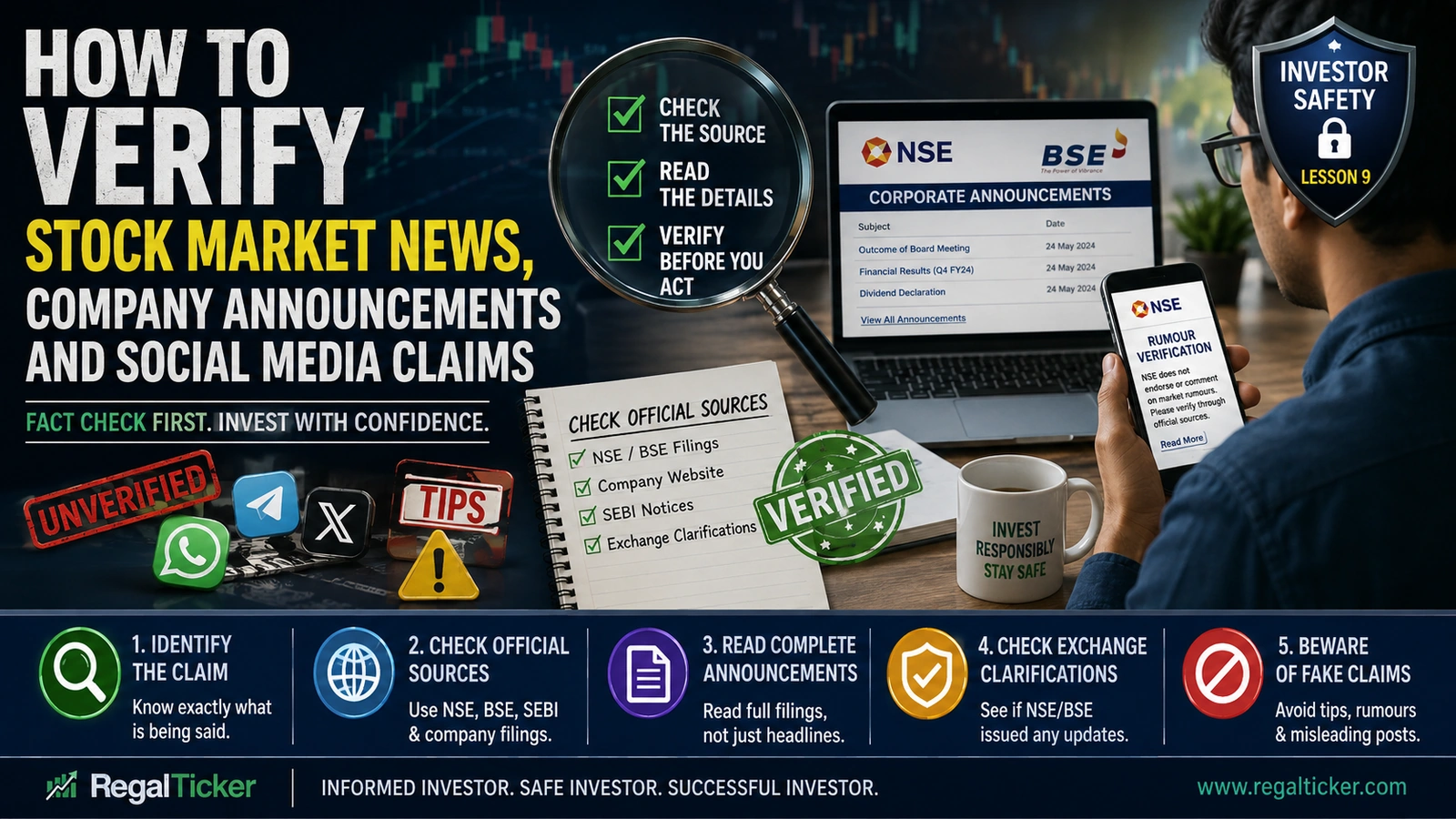
To verify stock market news, search the company’s official filings on NSE or BSE, open the original attachment, confirm the company name and exchange timestamp, and read the complete disclosure including approvals, conditions, dates and financial details. Then compare it with the company’s official investor-relations page and any exchange clarification or rumour-verification entry.
Do not trade only from a screenshot, forwarded message, deepfake video, anonymous target price or social-media summary. A genuine announcement may still be exaggerated, outdated or presented without important conditions.
What Does It Mean to Verify Stock Market Information?
Verification means tracing a claim back to its original, accountable source.
For a listed company, the strongest source is usually the disclosure filed with the recognised stock exchange. The company’s investor-relations website may publish the same document, presentation or press release.
Verification asks:
- Who made the claim?
- Where was it first published?
- Is the company identity correct?
- Is there an official filing?
- When was it disclosed?
- Is the headline consistent with the full attachment?
- Is the event approved, proposed, conditional or completed?
- Does the claim change the company’s financial position?
SEBI Investor describes due diligence as examining relevant information so that material facts about the company, security or opportunity are understood before investing.
The broader safety framework is explained in Investor Safety in the Stock Market.
Why False or Incomplete News Moves Stock Prices
Market prices react to expectations.
A rumour about an order, merger, dividend, bonus issue, regulatory approval or large investor can create immediate demand. The price movement then makes the story appear credible.
This creates a dangerous loop:
- an unverified claim is circulated;
- the price begins to move;
- traders interpret the movement as confirmation;
- more people share the claim;
- late investors enter at a higher price;
- the company later denies or qualifies the information.
A rising price does not verify the news.
The coordinated-promotion risks covered in Pump-and-Dump Schemes Explained become more serious when a vague rumour is combined with low liquidity and repeated social-media promotion.
Use an Information Source Hierarchy
Not every source deserves equal confidence.
Level 1: Exchange Filings
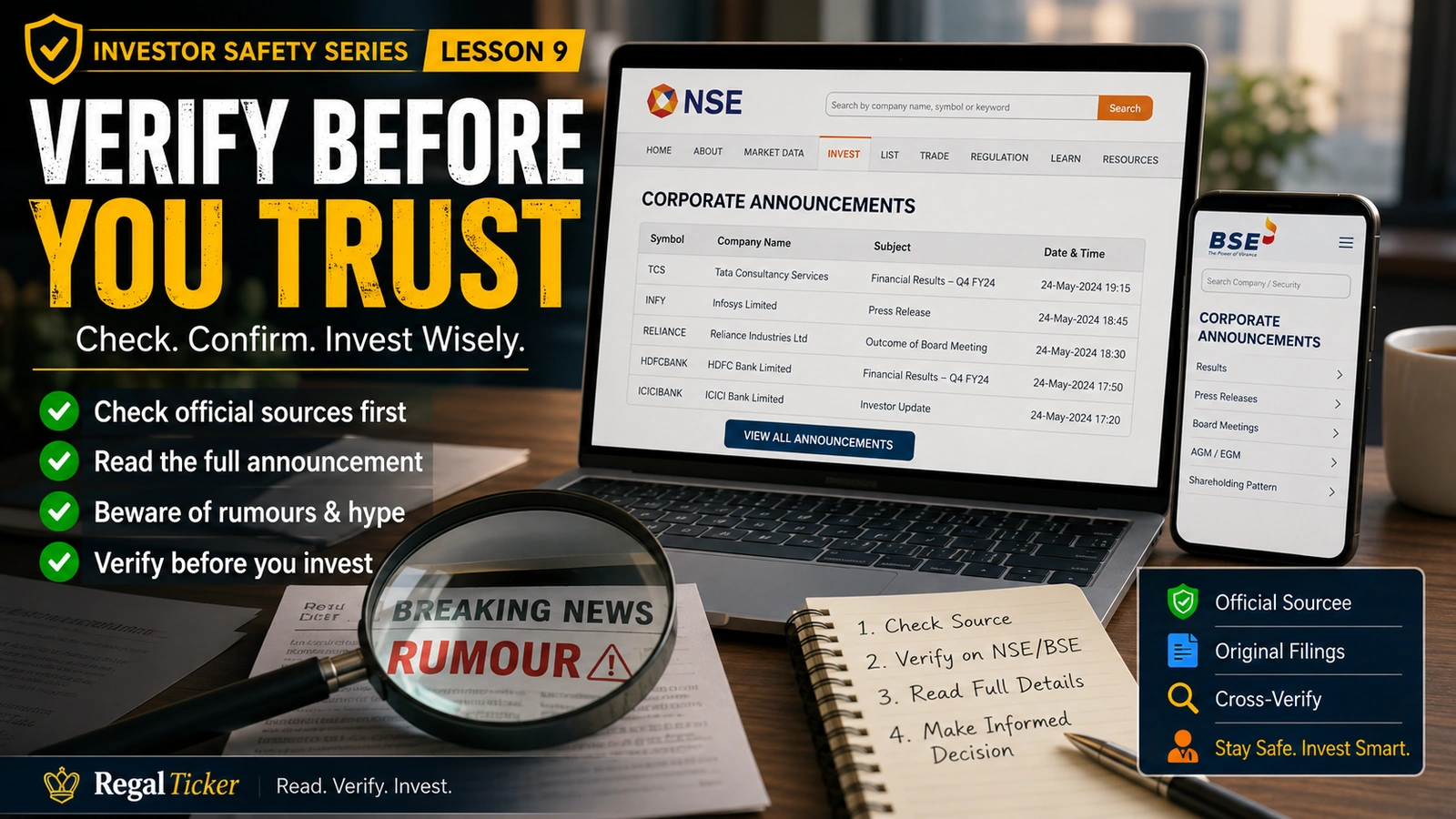
Use the official NSE Corporate Filings and Announcements and BSE Corporate Announcements pages.
These provide the company name, subject, attachment and dissemination time.
Level 2: Company Investor-Relations Website
Confirm whether the same filing, presentation or press release appears on the genuine company website.
Verify the domain independently.
Level 3: Regulator and Exchange Notices
SEBI, NSE and BSE may issue cautions, clarifications, orders or investor advisories.
Level 4: Reputable Financial News
A credible report can explain the event, but the original filing remains important.
Level 5: Social Media and Messaging Groups
Treat posts, videos, screenshots, voice notes and forwarded messages as leads—not proof.
An anonymous post should never outrank an exchange filing.
How to Verify a Company Announcement on NSE or BSE
Step 1: Search the Exact Company
Use the company name, NSE symbol or BSE security code.
Confirm that you selected the correct listed entity. Similar company names can create confusion.
Step 2: Check the Subject
The subject may identify:
- financial results;
- board meeting;
- order or contract;
- acquisition;
- resignation;
- credit rating;
- dividend;
- bonus issue;
- stock split;
- rights issue;
- investor presentation;
- clarification or update.
Step 3: Check the Broadcast Date and Time
A screenshot from an old announcement may be circulated as new information.
Compare the dissemination time with the time when the message or video appeared.
Step 4: Open the Attachment
The exchange summary may be brief. The attached PDF contains the actual wording, amounts, conditions and approvals.
Step 5: Confirm the Stage of the Event
Distinguish between:
- proposal;
- board consideration;
- board approval;
- shareholder approval;
- regulatory approval;
- agreement signing;
- record-date announcement;
- completion.
A proposed transaction is not the same as a completed transaction.
Read the Complete Filing, Not Only the Headline
A headline may be technically correct but economically misleading.
Order-Win Example
A message says:
> Company wins ₹1,000 crore order.
The filing may reveal that:
- the amount includes taxes;
- execution is spread over five years;
- the order is conditional;
- the company is part of a consortium;
- only a portion belongs to the listed company;
- the contract can be terminated;
- margins are not disclosed.
Acquisition Example
A message says:
> Company acquires global business.
The filing may describe only a non-binding term sheet or preliminary negotiation.
Regulatory Approval Example
A claim may refer to one approval while other approvals remain pending.
Financial Results Example
Revenue growth may appear strong while profit, cash flow or margins weaken.
Use What Is Fundamental Analysis? to evaluate whether the announcement changes the business rather than merely changing the narrative.
Understand Rumour Verification and Exchange Clarifications
NSE maintains a Rumour Verification Latest News section that includes company clarifications, price-movement queries, volume-spurt queries and news-verification requests.
An exchange clarification may show that the company:
- confirms the report;
- denies the report;
- says discussions are preliminary;
- says no binding agreement exists;
- says it has no undisclosed material information;
- provides additional context.
Do not read “company confirms discussions” as “transaction completed.”
Similarly, “the company has no comment” is not confirmation of the rumour.
Exchange clarifications should be read with the original media report and subsequent filings.

Verify Social-Media Posts, Videos and Screenshots
SEBI has warned investors about fraudulent and manipulative content across YouTube, Facebook, Instagram, X, WhatsApp, Telegram and app stores.
Warning signs include:
- assured or risk-free returns;
- fake registration certificates;
- impersonation of a registered entity;
- private VIP or institutional groups;
- fake trading applications;
- fabricated testimonials;
- pressure to act immediately.
A professional video is not proof of authenticity.
Verify the Account
Check whether the account is linked from the organisation’s official website.
Verify the Original Upload
A clipped video may remove warnings, dates or context.
Check for Deepfake Indicators
Look for unnatural lip movement, voice timing, facial edges, lighting or abrupt edits.
Check the Claim Independently
Search the exchange filing, company website and official organisation channels.
BSE and NSE have both warned investors about deepfake videos falsely using the identities of exchange officials to promote stock tips. Exchange employees are not authorised to recommend individual stocks through private groups.
The private-group fraud pattern is covered in Fake Trading Apps and Telegram Stock Tips.
Verify Dividend, Bonus, Split and Rights-Issue Claims
Corporate-action claims are widely circulated because they can sound like free money.
Dividend
Confirm:
- dividend type;
- amount per share;
- face value;
- record date;
- approval requirement;
- payment timeline.
Use the Dividend Calculator to estimate cash entitlement from the confirmed amount and eligible shareholding.
Bonus Issue
Confirm:
- bonus ratio;
- approval status;
- record date;
- source of capitalisation;
- eligibility conditions.
Use the Bonus Share Calculator only after the ratio and eligible quantity are verified.
Stock Split
Confirm the old face value, new face value, split ratio and record date.
Use the Stock Split Calculator to understand the quantity and reference-price adjustment.
Rights Issue
Confirm the issue price, entitlement ratio, record date, application period and renunciation terms.
A corporate action can change the number of shares or cash entitlement. It does not automatically improve operating profit or total investment value.
The detailed concepts are available in the Corporate Actions learning hub.
Verify Financial Results and Business Claims
A result headline may focus on the strongest number.
Check:
- consolidated versus standalone results;
- year-on-year versus quarter-on-quarter comparison;
- exceptional items;
- finance costs;
- tax effects;
- cash flow;
- auditor observations;
- segment performance;
- management commentary.
A company can report higher profit because of a one-time gain while the core business weakens.
Similarly, an investor presentation may contain forecasts, opportunities and management estimates. These are not the same as audited results.
Compare claims with at least two years of financial statements and the latest exchange filing.
Investigate Price and Volume Spikes Without Clear News
A sudden rise in price or volume deserves investigation, especially in an illiquid stock.
Check:
- the latest exchange announcements;
- the exchange rumour-verification page;
- price-movement or volume-spurt clarifications;
- promoter and insider disclosures;
- corporate-action announcements;
- financial results;
- whether social-media promotion began before the move.
SEBI’s SME advisory tells investors not to rely only on public announcements or social-media posts and to cross-check information from multiple reliable sources.
A price spike without verified business improvement may still continue for a time. Verification protects the decision process; it does not predict the exact top or bottom.
Test Return Claims Mathematically
A viral post may say:
- “This stock will double in six months.”
- “₹1 lakh can become ₹10 lakh.”
- “The dividend alone gives 20%.”
- “The bonus issue creates guaranteed profit.”
Convert the claim into mathematics.
Use the Stock Return Calculator to calculate the required percentage gain.
Use the CAGR Calculator for multi-year wealth claims.
Then ask whether the company’s earnings, cash flow, balance sheet and valuation can support the implied outcome.
A calculator cannot verify a news item, but it can expose how extreme the claim is.
A 10-Minute Verification Workflow
Minute 1–2: Identify the Original Claim
Save the exact message, video, headline or screenshot.
Minute 3–4: Search NSE and BSE
Find the company’s latest official filings.
Minute 5: Open the Attachment
Read the complete document.
Minute 6: Check the Company Website
Confirm the investor-relations page and domain.
Minute 7: Search Rumour Verification
Look for exchange clarification or news verification.
Minute 8: Check the Date and Event Stage
Identify whether the event is proposed, approved, conditional or completed.
Minute 9: Estimate the Financial Impact
Calculate the amount relative to revenue, profit, debt or market capitalisation.
Minute 10: Decide Whether More Research Is Needed
Do not trade merely because ten minutes have passed. The workflow is a filter, not a deadline.
What to Do When a Claim Appears False or Manipulative
Do Not Forward It
Forwarding increases reach and perceived credibility.
Preserve Evidence
Save the original account, URL, timestamp, screenshot and group details.
Warn Through Facts
Share the official clarification or filing rather than making unsupported accusations.
Report the Content
Use the platform’s reporting facility.
Inform the Genuine Entity
A company, broker or exchange may need to know that its identity is being misused.
Use the Appropriate Official Route
Potential securities-market manipulation or unregistered advisory activity may be reported through the relevant SEBI or exchange channel. Financial fraud may also require bank, payment-provider and cybercrime reporting.
Stock Market News Verification Checklist
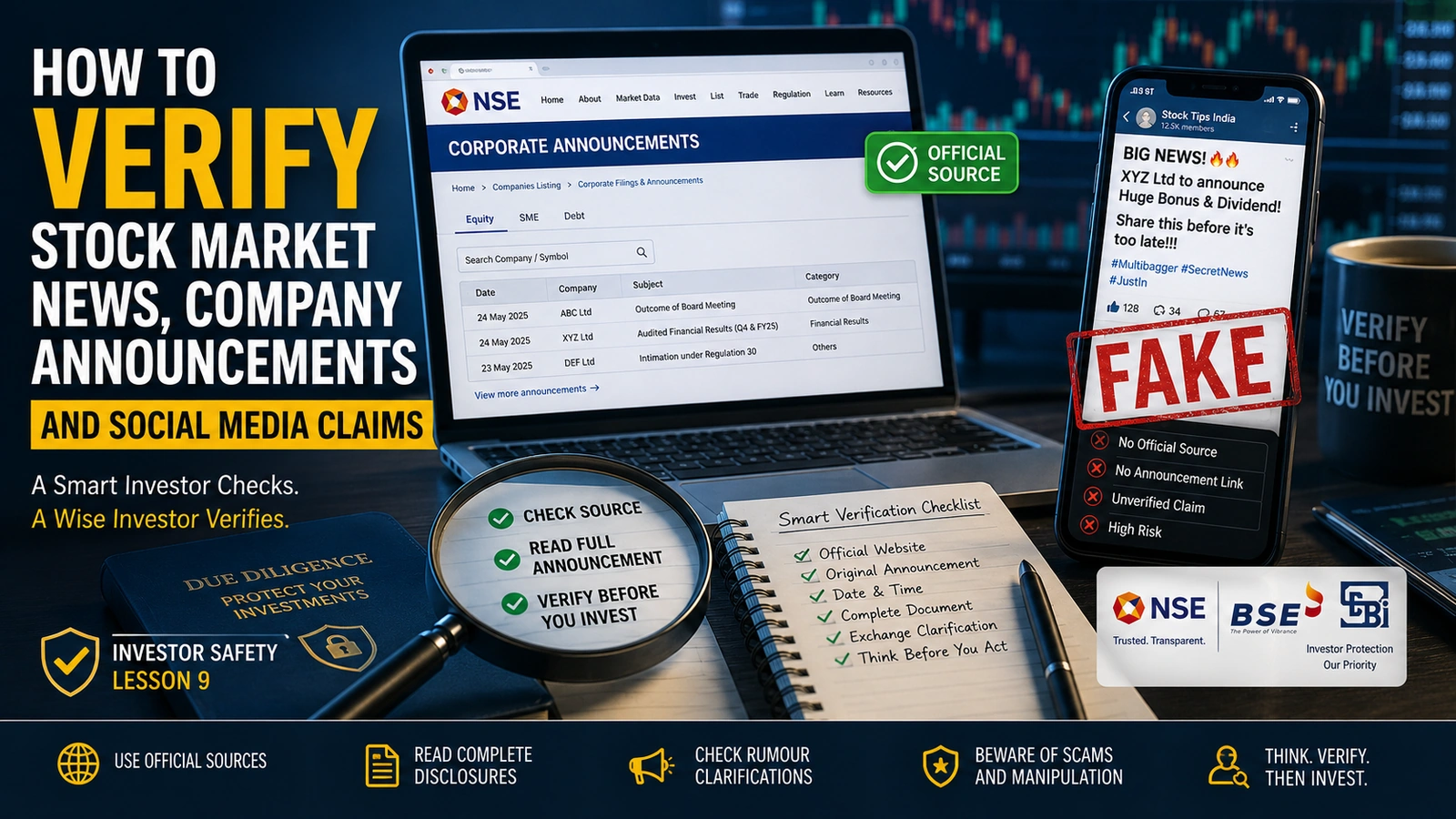
Before acting, confirm:
- I know the original source.
- The company identity and symbol are correct.
- I found the official exchange filing.
- The filing date and time are current.
- I opened the complete attachment.
- I understand whether the event is proposed, approved or completed.
- I checked important conditions and approvals.
- I compared the claim with the company’s investor-relations page.
- I searched for exchange clarification or rumour verification.
- I checked whether a social-media account is authentic.
- I did not rely on a deepfake, screenshot or forwarded message.
- I calculated the implied return.
- I assessed the financial impact relative to company size.
- I checked whether promoters or connected parties may benefit.
- I can explain why the information changes the investment thesis.
The Regal Ticker Investor Tools hub contains calculators for testing return and corporate-action claims.
Final Takeaway
Stock market news should be traced, read and interpreted—not merely consumed.
The safest order is:
- exchange filing;
- complete attachment;
- company investor-relations page;
- regulator or exchange clarification;
- reputable reporting;
- social media only as an unverified lead.
A genuine announcement can still be exaggerated. A price rise can still be driven by speculation. A famous-looking video can still be fake.
Verify the source before analysing the opportunity.
Frequently asked questions
Where should I verify a company announcement?
Search the company’s official filings on NSE and BSE, open the original attachment and compare it with the genuine company investor-relations website.
Is a social-media screenshot of an exchange filing reliable?
It may be genuine, altered, incomplete or outdated. Verify the same announcement directly on the exchange website.
What is NSE rumour verification?
NSE’s rumour-verification section publishes company clarifications and exchange queries relating to news reports, price movements and volume changes.
Does a board meeting notice confirm a bonus issue or dividend?
No. A board meeting notice may only state that the proposal will be considered. Wait for the board outcome and subsequent record-date or approval disclosures.
How can I identify a deepfake stock-tip video?
Check the official source, look for visual or audio inconsistencies and verify whether the exchange, company or person has published the same message on an official channel.
Does an order-win announcement guarantee profit growth?
No. Review the contract value, duration, company share, conditions, margins and execution risk before estimating the financial effect.
Can a real corporate action create guaranteed profit?
No. Dividends, bonus issues, splits and rights issues have specific entitlement effects, but they do not guarantee a positive investment return.
What should I do with a suspicious market claim?
Do not act or forward it. Preserve the evidence, verify official records and report suspected fraud or manipulation through the appropriate platform and official channel.
Verify through official sources
Official references
- 1. [NSE — Corporate Filings and Announcements](https://www.nseindia.com/companies-listing/corporate-filings-announcements)
- 2. [BSE — Corporate Announcements](https://www.bseindia.com/corporates/ann.html)
- 3. [NSE — Rumour Verification Latest News](https://www.nseindia.com/reports/rumour-verification)
- 4. [SEBI Investor — Due Diligence](https://investor.sebi.gov.in/due_diligence.html)
- 5. [SEBI — Caution Against Fraudulent and Manipulative Social-Media Activity, April 2025](https://www.sebi.gov.in/sebi_data/attachdocs/may-2025/1746621138080.pdf)
- 6. [SEBI — Online Investment Scam Protection Measures, November 2025](https://www.sebi.gov.in/sebi_data/attachdocs/nov-2025/1762429172296.pdf)
- 7. [SEBI Investor — SME Segment Advisory](https://investor.sebi.gov.in/advisory-investment-in-sme-segment.html)
- 8. [BSE — Warning on Resurfaced Deepfake Video, April 2026](https://www.bseindia.com/Downloads/MediaRelease/PR24042026_20262404.pdf)
- 9. [NSE — Warning on Fake Videos of NSE Officials](https://nsearchives.nseindia.com/web/sites/default/files/2024-06/PR_cc_10062024_1.pdf)
- 10. [NSE — Advisory for Investors](https://www.nseindia.com/invest/advisory-for-investors)
Educational disclaimer: This article is for education and general information only. It does not provide investment, legal, financial or trading advice. Exchange pages, company disclosures, corporate-action details and regulatory requirements may change. Verify current information directly through official exchange, company and regulator sources before making an investment decision.