
Quick answer
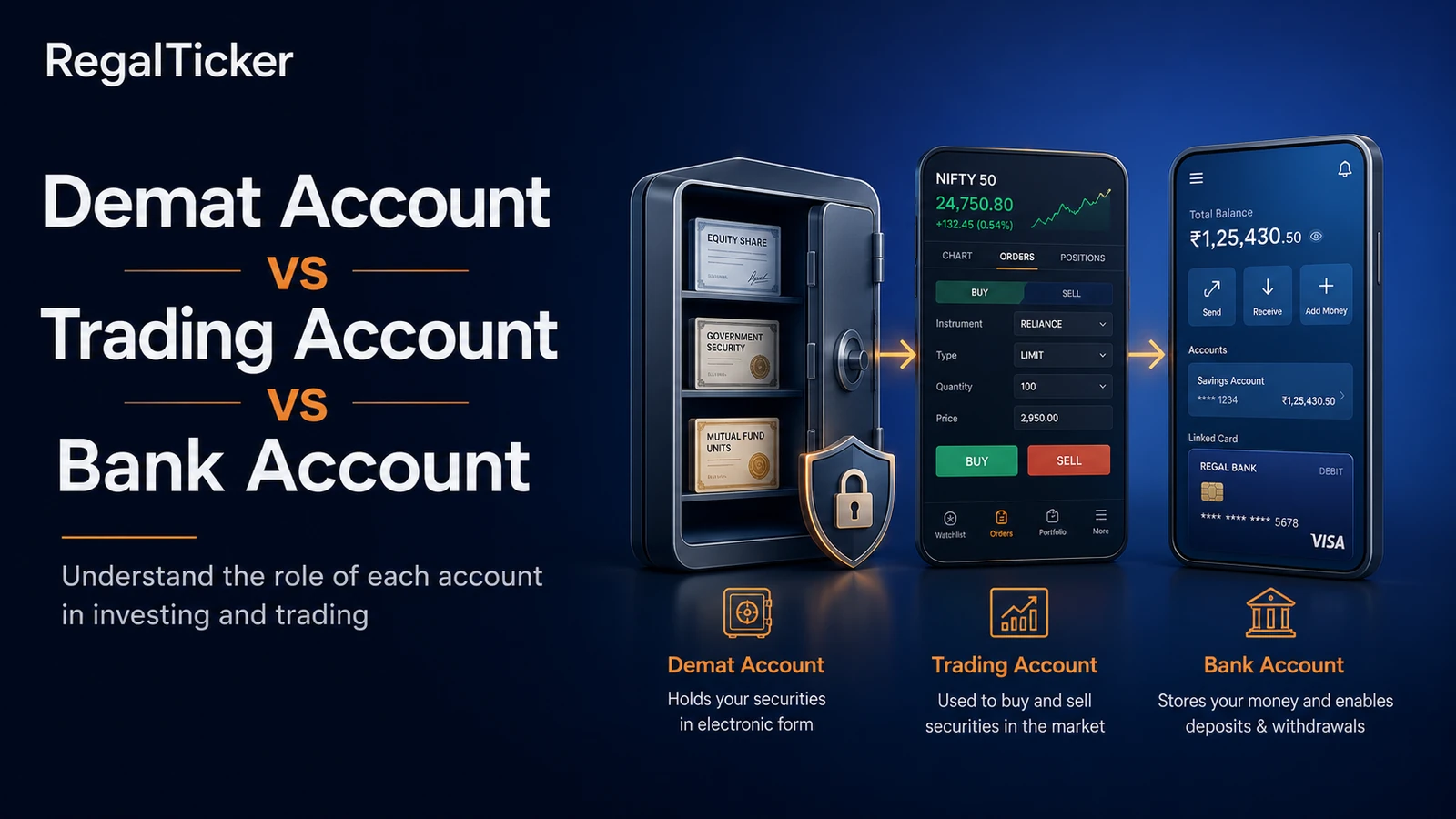
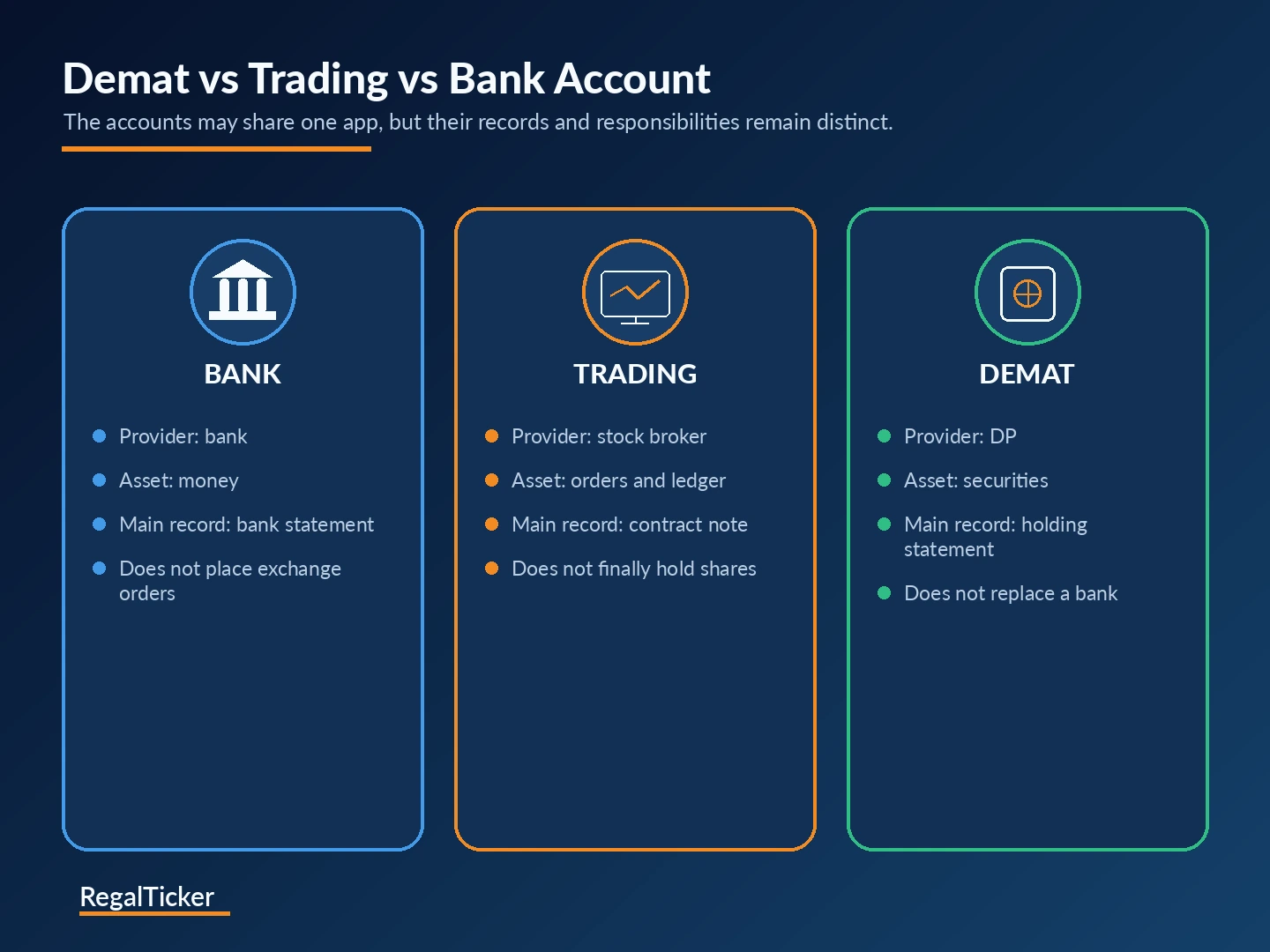
A bank account holds and transfers money, a trading account places and records buy or sell orders through a registered stock broker, and a demat account holds eligible securities electronically through a Depository Participant. The three accounts may be linked and may even be offered by the same financial group, but they perform different legal and operational functions.
Investor note
Key Takeaways
Bank account = money. Trading account = orders, trades and broker ledger. Demat account = electronic securities holdings. A combined application does not merge the underlying functions. Buying and selling involve both money movement and securities movement. The trading app’s displayed balance may not equal your bank balance or settled withdrawable amount. Contract notes verify trades; bank statements verify money; demat statements verify holdings. Investors should reconcile all three records and protect each account separately.
Why are there three different accounts?
A securities transaction contains three different activities:
- Money must be paid or received.
- A buy or sell instruction must reach the exchange.
- Securities must be held, credited or debited electronically.
One account is not designed to perform all three functions.
Bank account
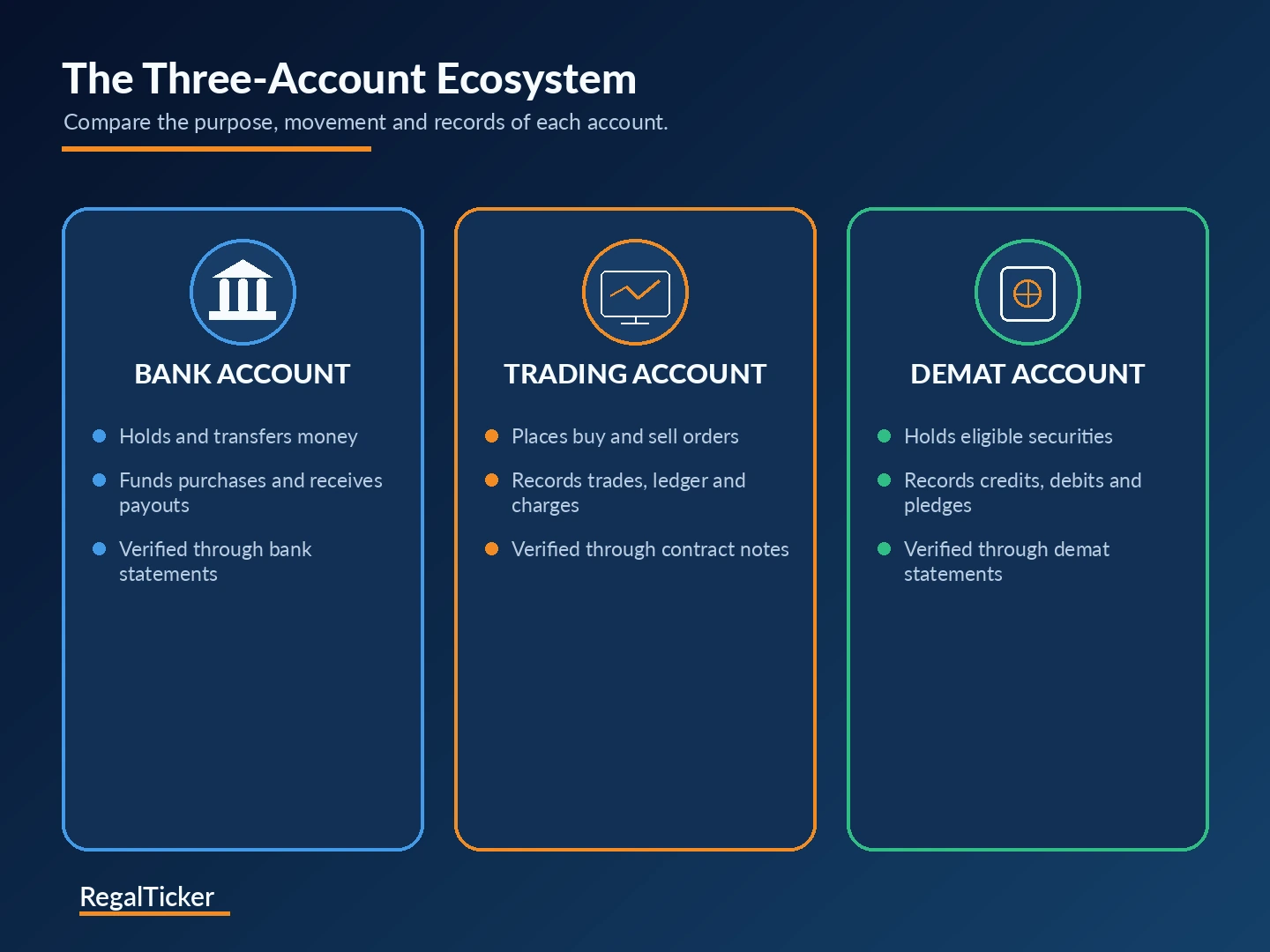
The bank account handles cash. It is used for transferring money into the investment or trading arrangement and receiving withdrawals, sale proceeds or eligible cash benefits.
Trading account
The trading account is opened with a registered stock broker. It is used to place orders and records trading-related entries such as executed trades, charges, margins and ledger movements.
Demat account
The demat account is opened through a Depository Participant connected to a recognised depository. It records eligible securities in electronic form.
SEBI investor education summarises the same structure: a demat account holds securities, a trading account is used to buy and sell through a registered broker, and a bank account makes or receives payments.
Demat account vs trading account vs bank account
| Feature | Bank account | Trading account | Demat account |
|---|---|---|---|
| Main purpose | Hold and transfer money | Place and record market orders | Hold eligible securities electronically |
| Typical provider | Bank | SEBI-registered stock broker | Registered Depository Participant |
| Connected system | Banking and payment network | Recognised stock exchange through broker | NSDL or CDSL through DP |
| What it stores | Cash deposits and banking entries | Orders, trades, ledger and margin records | Securities balances and demat transactions |
| Used when buying | Supplies money | Sends the buy order | Receives eligible securities after settlement |
| Used when selling | Receives applicable payout | Sends the sell order | Delivers eligible securities through authorised process |
| Primary proof | Bank statement | Contract note and trading ledger | Demat holding and transaction statement |
| Can show investment value? | Not normally | May show platform portfolio estimates | Records quantities of eligible holdings |
| Can replace the other two? | No | No | No |
A simple analogy
Think of buying a product online:
- The bank account is the payment wallet.
- The trading account is the ordering system.
- The demat account is the secure digital storage location where the purchased security is recorded.
The analogy is not perfect, because securities transactions are regulated and settled through exchanges, clearing corporations and depositories. But it helps beginners remember each role.
How the three accounts work when buying shares
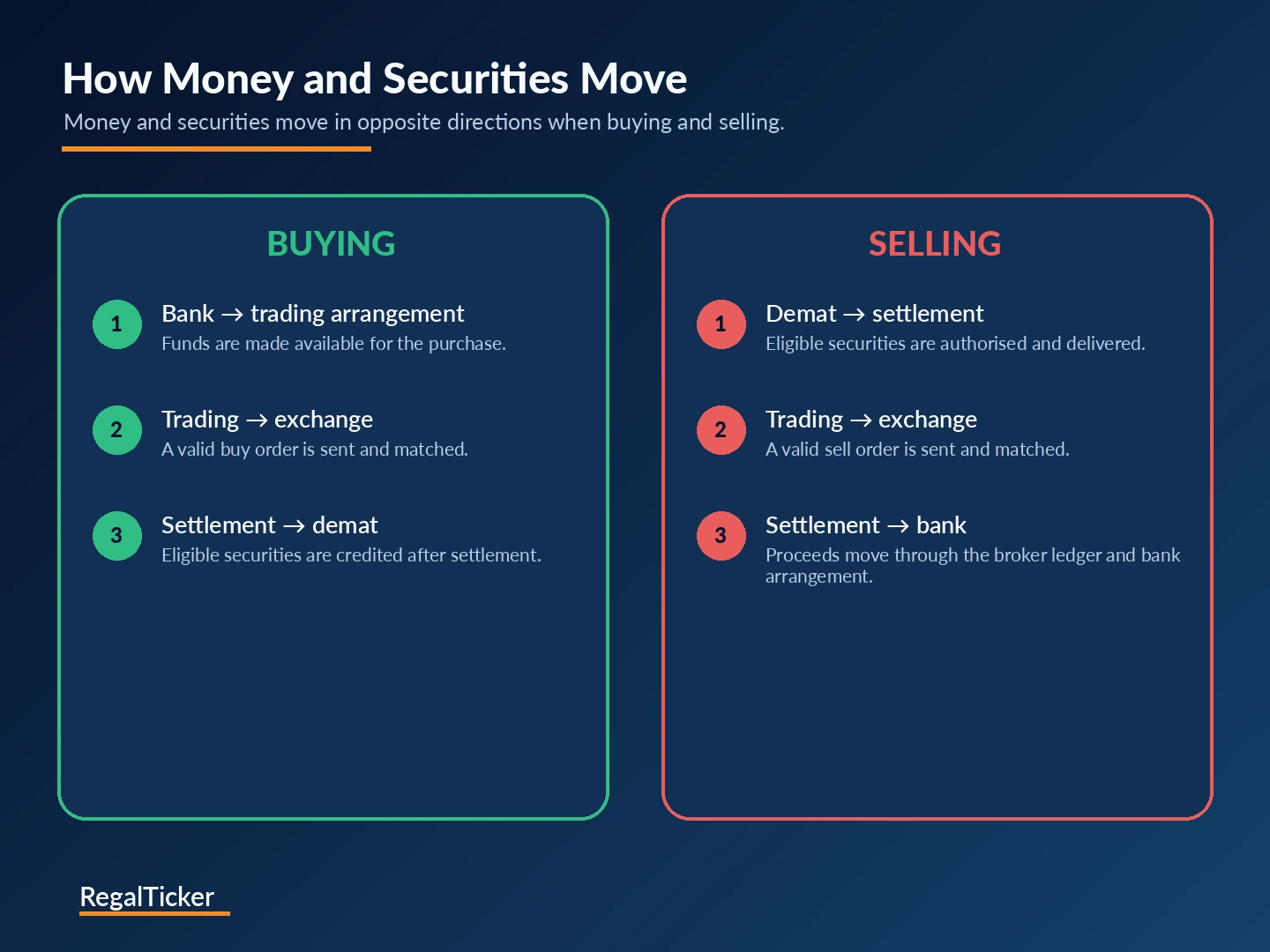
A simplified delivery purchase works as follows:
- The investor makes money available from the registered bank account.
- The investor places a buy order through the trading account.
- The broker routes the valid order to the exchange.
- The exchange matches the order with a suitable sell order.
- The clearing system calculates funds and securities obligations.
- Money is applied toward settlement.
- Eligible securities are credited to the investor’s demat account under the applicable process.
Worked example
Buying 50 shares
Asha wants to buy 50 shares at a limit price of ₹200.
Bank account: provides the money used for the transaction. Trading account: sends the order for 50 shares. Demat account: receives the shares after execution and settlement.
If only 20 shares execute, only the executed quantity proceeds toward settlement. Charges can make the final money debit different from the simple calculation of 50 × ₹200.
How the three accounts work when selling shares
A simplified delivery sale works in the opposite direction:
- The investor’s demat account contains the eligible securities.
- The investor places a sell order through the trading account.
- The broker and depository arrangement verifies or obtains the required authorisation.
- The exchange matches the order with a buyer.
- The securities are debited through the settlement process.
- Sale proceeds are reflected through the broker ledger and registered bank arrangement.
Risk warning
Selling from the app does not itself prove delivery
The order must execute, and the required securities debit must be validly completed. Review the contract note, depository alert and account statements.
Where is my money actually kept?
This question requires careful distinction.
Money in the bank
Cash held in the bank account is recorded by the bank.
Money transferred for trading
When funds are transferred for market transactions, the broker’s ledger may display a balance, obligation or available amount. That display is not the same as the bank account statement.
A broker ledger can include:
- Funds received
- Purchase obligations
- Sale credits
- Brokerage and statutory charges
- Margin blocks
- Withdrawals
- Running-account settlements
An “available balance” can differ from “withdrawable balance” because of unsettled trades, margins, pending charges or broker risk rules.
Investor note
Reconcile the broker ledger with your bank
Check that every transfer shown by the broker has a corresponding banking record and that withdrawals reach the registered account.
Where are my shares actually kept?
Eligible delivery securities are recorded in the demat account through the depository system.
The trading application may show a portfolio view, but the authoritative custody record should be checked through:
- Demat holding statement
- Demat transaction statement
- Depository alerts
- Consolidated account statement where applicable
A trading app’s temporary position, unsettled quantity or watchlist entry is not necessarily a settled demat holding.
What exactly does the trading account store?
The trading account does not act as the final electronic vault for delivery securities.
It mainly records and manages:
- Orders
- Executed trades
- Open or closed positions
- Broker ledger entries
- Margins and collateral information
- Charges
- Segment permissions
- Contract notes and reports
The platform may combine demat holdings and bank-related information for convenience, but that does not change the source system.
What documents verify each account?
| Question | Best record to check |
|---|---|
| Did money leave or enter my bank? | Bank statement |
| What trade executed? | Contract note and exchange trade alert |
| What quantity is currently held in demat? | Demat holding statement |
| Were securities credited or debited? | Demat transaction statement or depository alert |
| What charges did the broker apply? | Contract note and trading ledger |
| What funds does the broker show? | Trading-ledger statement |
| What account is linked? | Client master, profile sheet and official account records |
Are the accounts always opened with the same company?
No. The accounts can be provided by separate organisations or by companies within the same financial group.
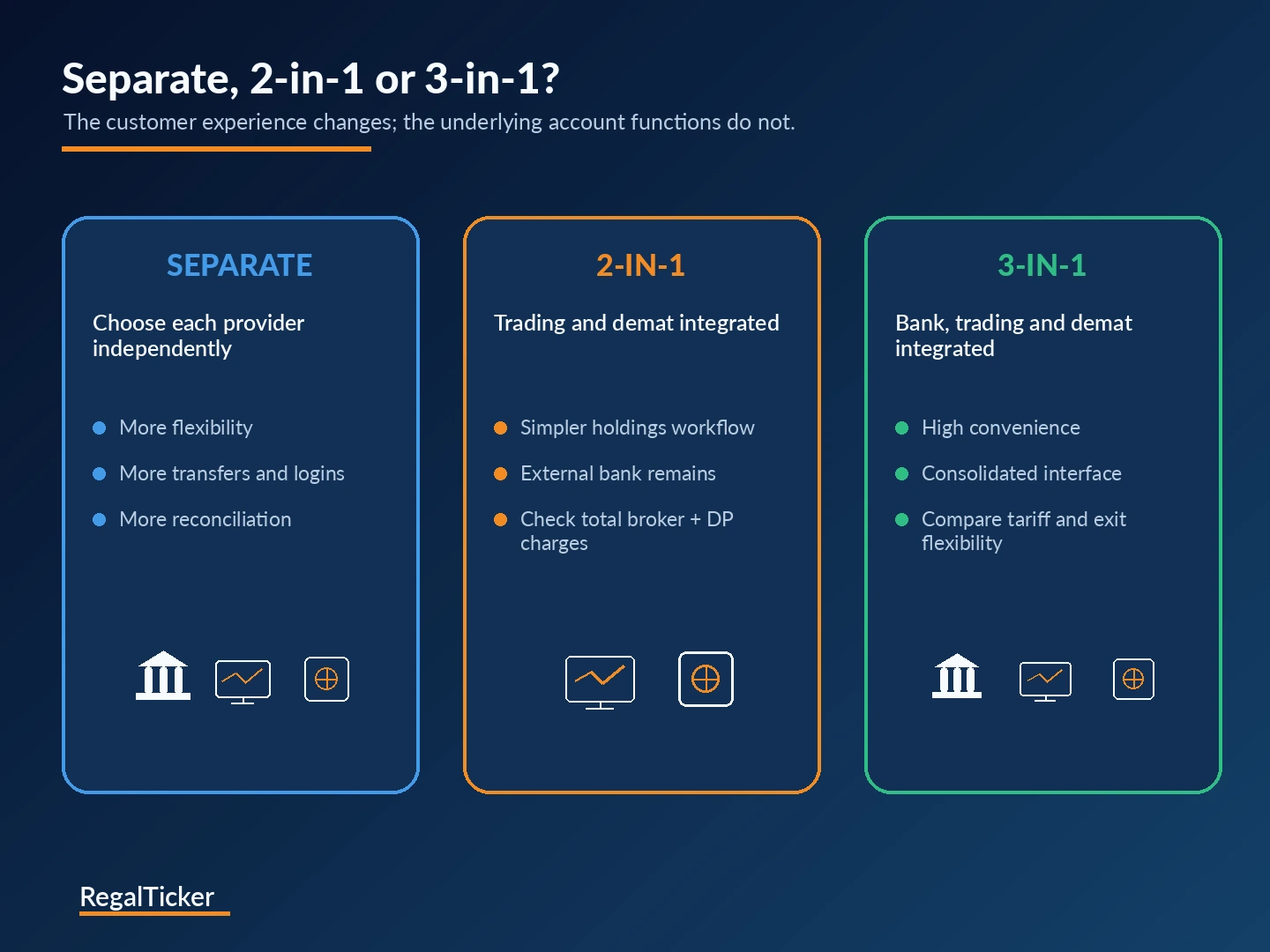
Common setups include:
Separate setup
- Bank account with one bank
- Trading account with one broker
- Demat account with a DP that may be the broker or another institution
Two-in-one setup
The broker combines trading and demat onboarding or service access, while the bank account remains external.
Three-in-one setup
A banking or financial group integrates bank, trading and demat services into one customer experience.
| Setup | Main benefit | Main caution |
|---|---|---|
| Separate accounts | More freedom to choose each provider | More transfers, logins and reconciliation |
| Two-in-one trading + demat | Easier order and holdings integration | Bank transfers and complete charges still need review |
| Three-in-one | Convenient movement and consolidated interface | Convenience may come with different tariffs or less flexibility |
Can the bank and demat accounts be in different names?
Account linking must follow current KYC, ownership and intermediary rules. The investor should not assume that any third-party bank or demat account can be linked.
The correct name, PAN, account status and ownership pattern matter. Joint accounts, minors, NRIs, entities and other account categories may follow additional requirements.
Use the broker’s official process and do not transfer money to personal accounts provided by an agent or social-media contact.
Does buying a share immediately increase the demat balance?
Not necessarily.
The sequence is:
- Order submitted
- Order executed
- Trade confirmed
- Settlement obligation completed
- Securities credited
A broker may display the executed quantity before the depository completes the final credit. The label can be “positions,” “T1 holdings,” “unsettled holdings” or another platform-specific term.
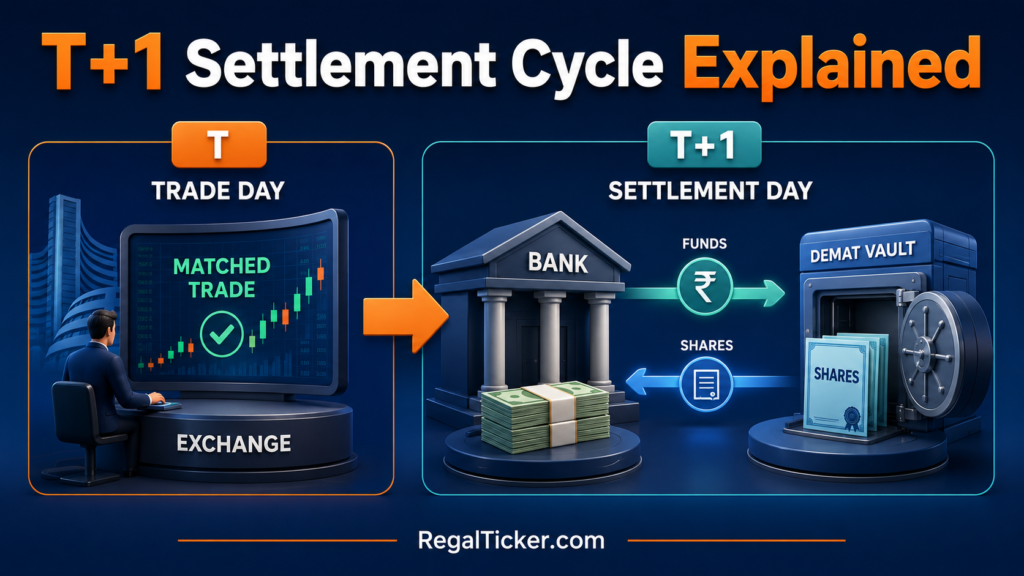
NSE publishes T+1 and eligible T+0 settlement processes. The relevant cycle depends on the security, segment, broker support and current market rules.
Does selling a share immediately put money in the bank?
Not always.
After a sale executes:
- The broker records the trade.
- Securities must be delivered under the applicable process.
- Settlement must complete.
- The ledger reflects the resulting credit and charges.
- Withdrawal or automatic payout follows the broker and bank arrangement.
A displayed sale value should not be treated as final cash until charges, settlement and withdrawability are confirmed.
Can a demat account exist without a trading account?
A demat account can be used for holding and depository services even when the investor is not actively trading through the same organisation. Transfers, corporate actions, transmission and other depository functions can exist separately from exchange order placement.
However, a trading account is normally needed to place secondary-market buy or sell orders through a broker.
Can a trading account exist without a demat account?
The answer depends on the product and activity.
For normal delivery-based investing in listed shares, a demat account is generally required to receive and deliver electronic securities.
Some products, cash-settled contracts or non-delivery activities can follow different arrangements. Beginners should not use this technical distinction as a reason to activate complex segments before understanding them.
Common charges across the three accounts
| Account | Possible charges |
|---|---|
| Bank account | Banking-service, transfer or account charges according to bank terms |
| Trading account | Brokerage, platform services, call-and-trade, interest or other tariff charges |
| Demat account | Account maintenance, debit, pledge, rematerialisation or service charges |
| Transaction itself | Statutory taxes, exchange charges, SEBI fees and stamp duty where applicable |
Security responsibilities for each account
Bank account security
- Protect banking password, PIN and OTP.
- Verify beneficiary details.
- Use only registered bank channels.
- Review unknown debits immediately.
Trading account security
- Use only the official broker platform.
- Check exchange alerts and contract notes.
- Do not share login access or permit unauthorised trading.
- Disable unused segments.
Demat account security
- Review debit and pledge alerts.
- Understand DDPI or other authorisations.
- Check holding and transaction statements.
- Maintain correct nomination and contact details.
Risk warning
One compromised login can affect connected accounts
Linked services improve convenience, but they can also make weak passwords, shared devices or fraudulent remote access more dangerous. Use separate strong credentials and account-level controls where supported.
How to reconcile all three accounts
A monthly reconciliation can follow this sequence:
- Download the bank statement.
- Download the broker ledger and contract notes.
- Download the demat holding and transaction statements.
- Match every fund transfer.
- Match every executed trade.
- Match every securities credit and debit.
- Verify brokerage, taxes and DP charges.
- Investigate unknown trades, pledges or transfers.
- Save records securely for tax and complaint purposes.
Worked example
Finding a mismatch
Suppose the trading ledger shows a withdrawal of ₹25,000, but the bank statement does not show the credit.
The investor should check the withdrawal status, registered bank details, processing date and official broker communication. If unresolved, raise the issue through the broker’s grievance channel and then use the applicable exchange, SEBI SCORES or online dispute-resolution process.
Which setup is best for a beginner?
There is no single best structure for every investor.
A beginner may value:
- Simple onboarding
- Transparent charges
- Reliable statements
- Easy fund withdrawal
- Strong account security
- Responsive grievance support
- Clear separation of investing and complex trading features
An experienced investor may value API access, multi-broker redundancy, advanced reports or specialised products. These features are useful only when the investor understands the operational and financial risks.
Common myths
Myth 1: The trading account holds my shares
Delivery securities are recorded in the demat account, not finally stored in the trading account.
Myth 2: The demat account holds my cash
A demat account records eligible securities, not ordinary bank deposits.
Myth 3: A 3-in-1 account combines everything into one legal account
It combines the customer experience, but banking, broking and depository functions remain distinct.
Myth 4: The app balance is my final bank balance
The app can show ledger, margin or unsettled values. Check withdrawability and bank records.
Myth 5: If the order executes, settlement is finished
Execution creates a trade. Settlement completes the funds and securities obligations.
Myth 6: Using one company removes all risk
Integration can improve convenience, but market, cyber, service and intermediary risks still require monitoring.
Frequently asked questions
What is the main difference between demat and trading accounts?
A trading account places buy and sell orders, while a demat account holds eligible securities electronically.
Why is a bank account needed for share investing?
It supplies money for purchases and receives withdrawals, sale proceeds and eligible cash benefits.
Can one application show all three accounts?
Yes. A broker or financial group can integrate the interface, but the underlying account functions remain separate.
Which account receives shares after I buy them?
Eligible delivery securities are credited to the demat account after the applicable settlement process.
Which account receives money after I sell shares?
The trade first appears in the broker ledger; payout or withdrawal then reaches the registered bank account according to the applicable process.
What proves that I own the shares?
Demat holding and transaction records are the main electronic custody records for eligible holdings.
What proves that a trade happened?
The broker-issued contract note and exchange alerts verify the executed trade.
Is a 3-in-1 account compulsory?
No. Investors can use separate providers, a trading-plus-demat setup or an integrated arrangement, subject to current rules.
Can I link any bank account to my trading account?
Linking must follow the broker’s KYC and ownership requirements. Use only the official account-linking process.
What should I learn after these three account guides?
Continue with How to Open a Demat and Trading Account in India, followed by KYC and order-type guides.
Continue learning in Demat & Trading
Conclusion
Bank, trading and demat accounts form a connected system, but each has one primary job:
- The bank account handles money.
- The trading account handles orders and broker records.
- The demat account handles electronic securities holdings.
Understanding the separation helps investors read statements correctly, identify missing credits or debits, compare charges and respond to suspicious activity. It also prevents a common beginner mistake: assuming that everything shown inside a trading application belongs to one account.
The safest habit is to verify every important transaction across the correct source records—bank statement, contract note, broker ledger and demat statement.
Verify through official sources
Official references
- SEBI Investor — What You Need to Start Investing
- SEBI Investor — Understanding Depositories
- SEBI Investor — Difference Between Depository and Depository Participant
- SEBI Investor — Do’s and Don’ts of Investing
- NSE — Opening an Account
- NSE — How to Connect to NSE
- NSE — Equity Market Settlement Cycle
- NISM — What Is Trading Account and Demat Account?
- NSDL — e-Guide for Demat Account Holders
- CDSL — Open a Demat Account
Educational disclaimer: This article is for investor education and general information only. It is not investment advice, a recommendation, a trading strategy, an offer to buy or sell securities or an assurance of returns. Account structures, KYC rules, settlement arrangements, charges and intermediary processes can change. Verify current information through SEBI, exchanges, depositories, banks and registered intermediaries before acting.