
⚡ Quick answer
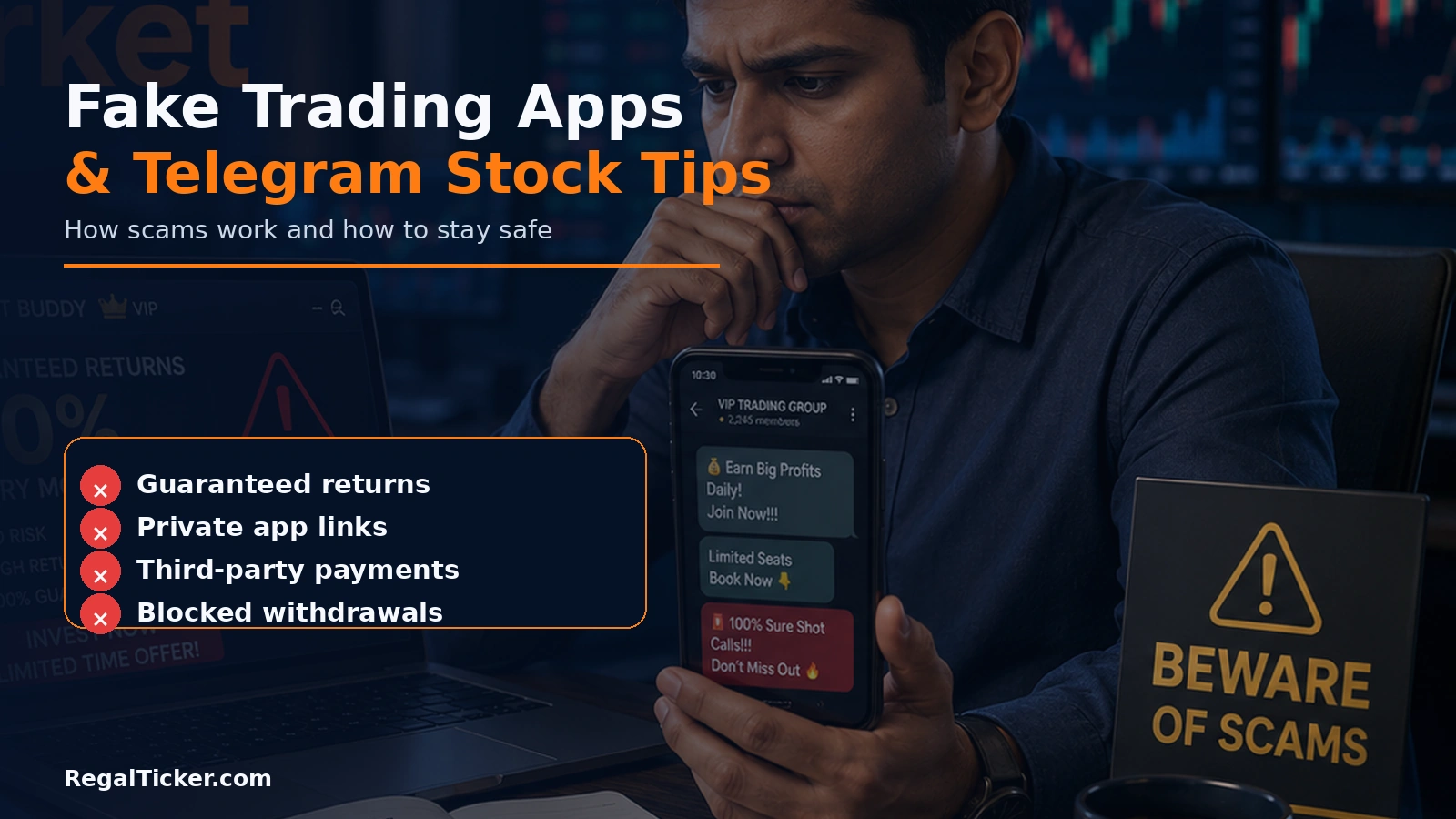
A fake trading app scam uses a fraudulent application or website to imitate real stock-market trading. The scam often begins through Telegram, WhatsApp, YouTube, Instagram or another social platform. Victims are invited to private groups, shown fake profits and persuaded to transfer increasing amounts to third-party accounts. When they try to withdraw, the app demands extra fees or stops working.
The safest response is to verify the intermediary and authorised trading application independently, use only official payment routes, never share login credentials, and treat guaranteed returns, institutional-account access and private APK links as major warning signs.
What Is a Fake Trading App Scam?
A fake trading app scam is a fraud in which an application or website creates the appearance of stock-market investing without executing genuine exchange transactions.
The app may display:
- live-looking market prices;
- a portfolio balance;
- profit-and-loss figures;
- IPO allotments;
- block-deal opportunities;
- withdrawal buttons;
- customer-support chat;
- tax and fee calculations.
These features do not prove that the investor owns securities or that any trade has reached a recognised exchange.
The money may be transferred directly to accounts controlled by fraudsters, while the app displays numbers that can be changed at will.
SEBI’s investor-awareness material describes a typical fake-app journey involving a social-media hook, trust-building, installation of the fraudulent app, displayed profits, pressure for further investment and blocked withdrawals.
The SEBI Investor fake trading app guidance advises investors to verify platforms and remain cautious about unsolicited stock tips.
This lesson builds on How to Identify Stock Market Scams and Investor Safety in the Stock Market.
How Telegram and WhatsApp Groups Feed the Scam
The application is only one part of the operation. The private group creates the story that persuades the investor to use it.
Public Advertisement
The investor first sees an advertisement or message promising:
- daily trading income;
- high-accuracy calls;
- institutional access;
- discounted IPO shares;
- block deals;
- upper-circuit stocks;
- a free mentorship programme.
Private Group Invitation
The investor is moved into a Telegram or WhatsApp group labelled as:
- VIP group;
- institutional trading group;
- investment club;
- official stock community;
- discounted trading group;
- premium research channel.
SEBI’s May 2025 caution specifically identified misleading invitations to private WhatsApp and Telegram groups using similar labels and offering supposed preferential trading services.
Authority Building
The administrators may present themselves as:
- professors;
- analysts;
- institutional traders;
- fund managers;
- broker representatives;
- assistants to a well-known expert.
Manufactured Social Proof
Other group members post:
- profit screenshots;
- successful withdrawals;
- appreciation messages;
- purchase confirmations;
- pressure on hesitant investors to participate.
Some or all of these accounts may be controlled by the scam network.
Movement to the Fake App
The group eventually directs members to a private application or website. The fraudster may say the ordinary broker account cannot access the special opportunity.
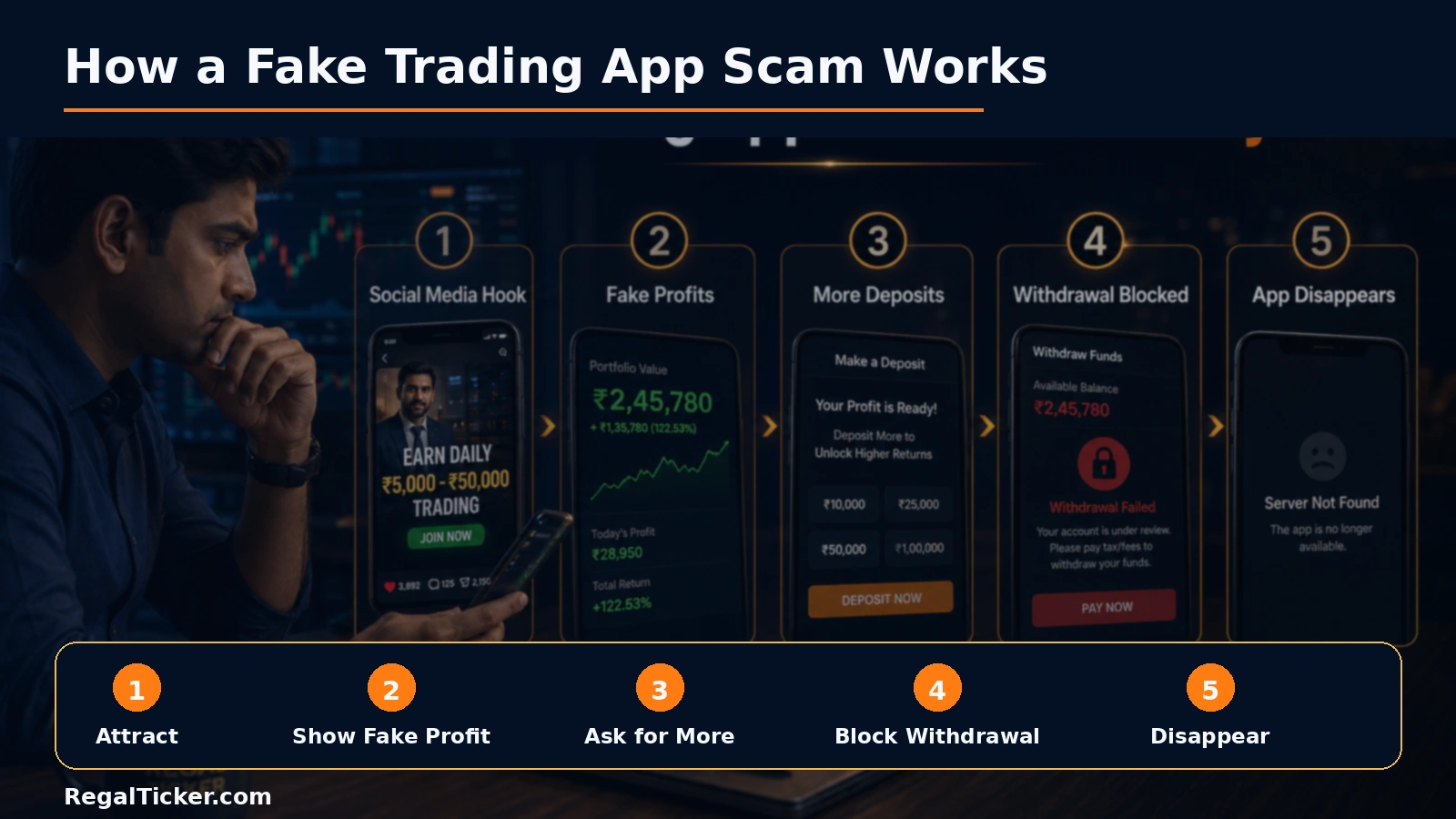
The Fake Trading App Scam Journey
Most fake-app operations follow a repeatable sequence.
Stage 1: Attraction
The investor is attracted by a social-media advertisement, stock tip or supposed education programme.
Stage 2: Trust Building
The group shares analysis, screenshots and initial successful calls. An investor may be allowed to observe for several days before being asked to deposit money.
Stage 3: App Installation
The investor receives:
- an APK file;
- a private download link;
- a website login;
- a referral code;
- a supposed institutional-account registration form.
Stage 4: Initial Deposit
The first amount may be relatively small. The app immediately shows active trades or a profitable allocation.
Stage 5: Fake Profit
The account balance rises. The investor may even receive a small withdrawal to build confidence.
Stage 6: Larger Deposit
The group claims that a larger amount is needed for a high-value opportunity, IPO allocation, block trade or premium account.
Stage 7: Withdrawal Blocked
The investor is told to pay:
- tax;
- margin;
- processing fee;
- compliance charge;
- account-unfreezing amount;
- profit-sharing fee;
- security deposit.
Stage 8: Disappearance
The support team stops responding, the app becomes inaccessible or the investor is removed from the group.
The SEBI fake trading app scam landscape presents substantially the same pattern and warns against unverified app links, third-party payments and guaranteed returns.
Common Fake Trading App Warning Signs
A suspicious app may show several of the following signs.
Private APK or Unknown Download Link
A trading application should not be installed merely because a Telegram administrator sends a file or QR code.
Publisher Name Does Not Match
The app-store developer should match the verified intermediary. A familiar logo with a different publisher name is not enough.
No Genuine Exchange Alerts
Real trades normally generate relevant confirmations through registered communication channels.
No Contract Notes
A changing dashboard balance is not a contract note.
Unusual Deposit Accounts
The app may direct each payment to a different individual or company.
Guaranteed Profit Display
A dashboard may show profits immediately or claim that losses cannot occur.
Special Institutional Features
The app may offer:
- upper-circuit access;
- discounted block deals;
- anchor-book participation;
- guaranteed IPO allotment;
- FPI or FII sub-accounts.
SEBI’s August 2025 advisory clarified that schemes claiming FPI or FII access for resident Indian investors through social-media groups or apps are fraudulent, subject to limited regulatory exceptions unrelated to such retail offers.
Withdrawal Depends on Another Payment
A legitimate withdrawal should not require repeated deposits into unrelated accounts.
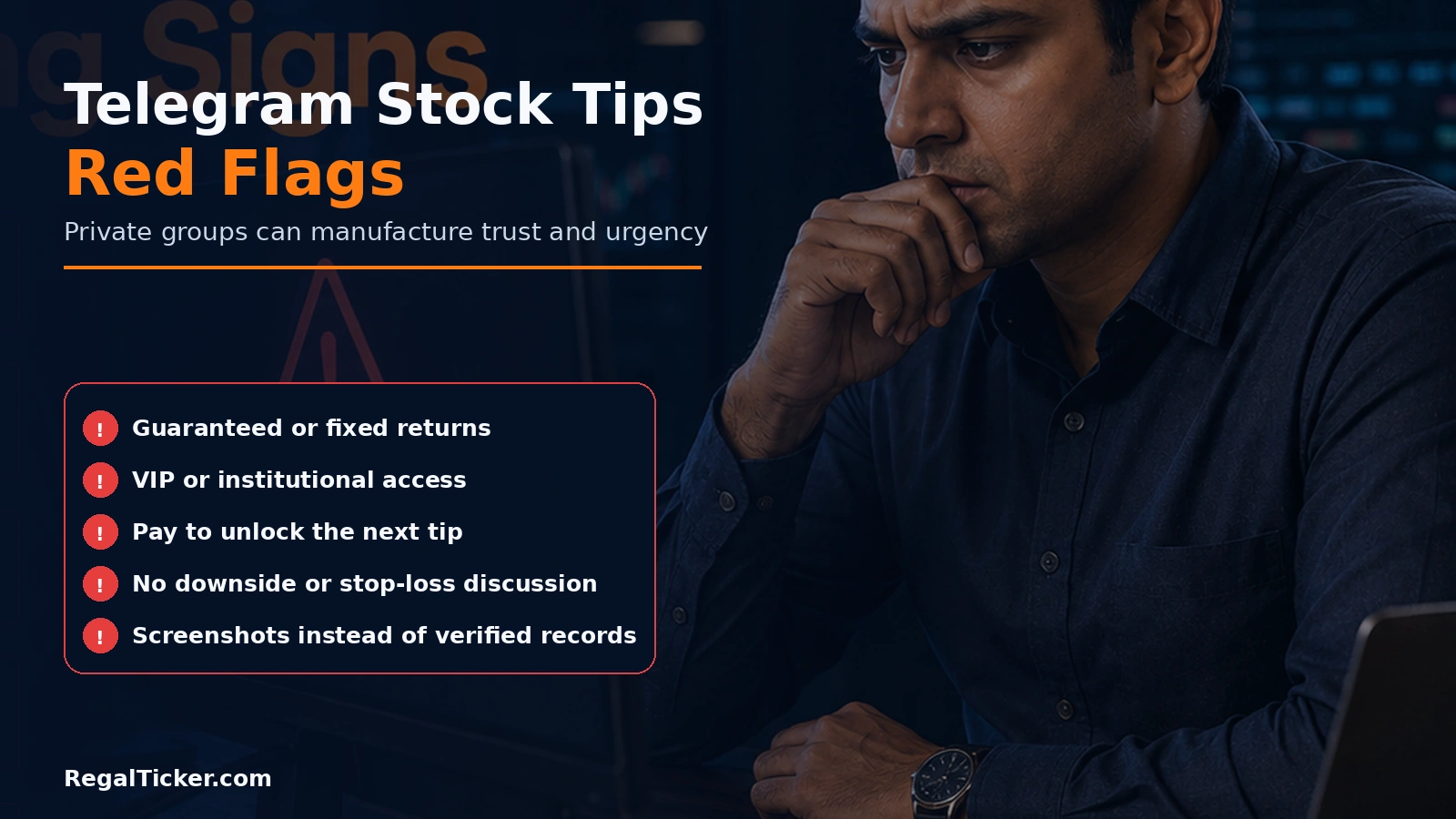
Telegram Stock Tips: Red Flags to Watch
Not every Telegram channel discussing markets is fraudulent, but investors should treat the following patterns as high risk.
Assured or Fixed Returns
NSE issued investor cautions in January and April 2026 concerning Telegram channels that offered stock-market tips, assured returns or account-handling services while not being registered as exchange members or authorised persons.
A market call cannot guarantee the future price.
No Downside Discussion
A responsible analysis should explain what can go wrong. A channel that provides only targets and success claims is selling excitement rather than risk awareness.
Deleted Failed Calls
A group may remove unsuccessful recommendations while keeping only profitable screenshots.
Account Handling
The administrator asks the investor to share a password, OTP, TPIN or remote-access screen.
Referral Pressure
Members receive discounts or commissions for bringing in new investors.
Celebrity or Expert Impersonation
Deepfake videos and copied profiles may misuse the identity of exchange officials, business leaders or market personalities.
BSE issued repeated 2026 warnings about deepfake videos falsely using its MD and CEO’s identity to promote stock tips, extraordinary returns and private messaging groups.
Urgency and Secrecy
The investor is instructed not to share the opportunity outside the group and to deposit before a deadline.
Fake Institutional Accounts and Discounted Deals
One of the most persuasive scam stories is the claim that ordinary investors can access an institutional account.
The fraudster may offer:
- FPI or FII sub-account trading;
- block deals below the market price;
- preferential IPO allotment;
- anchor-investor allocation;
- upper-circuit stocks before the public;
- a special settlement route.
A professional-looking app then displays these opportunities.
The joint exchange advisory warns that such schemes may impersonate reputable financial institutions, show fake certificates and direct victims to third-party bank accounts while displaying only paper profits in fraudulent apps.
Retail investors should not assume that the phrase “institutional account” creates a legal or protected arrangement.
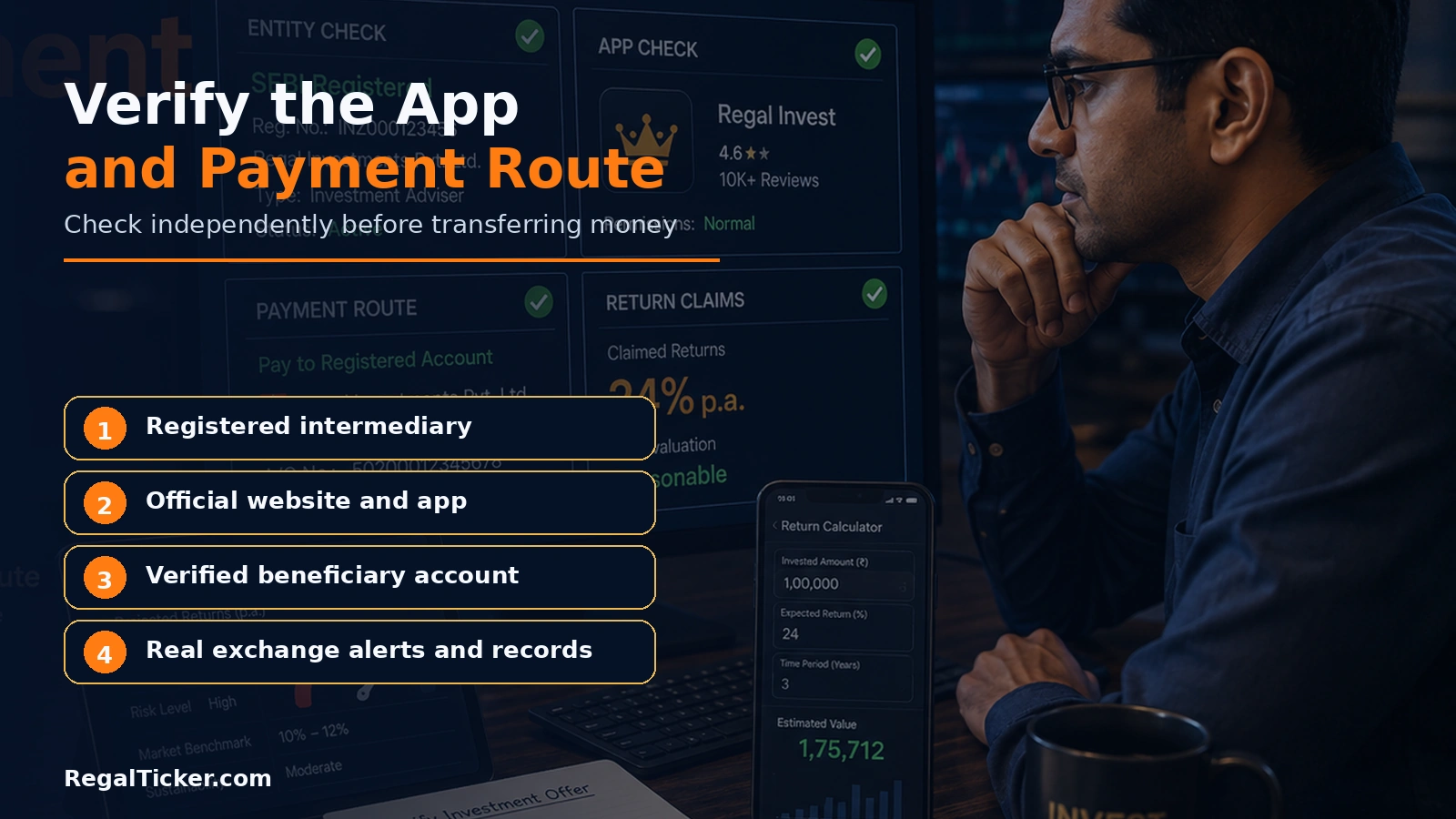
How to Verify a Trading Application and Payment Route
Verification should happen outside the app and outside the Telegram group.
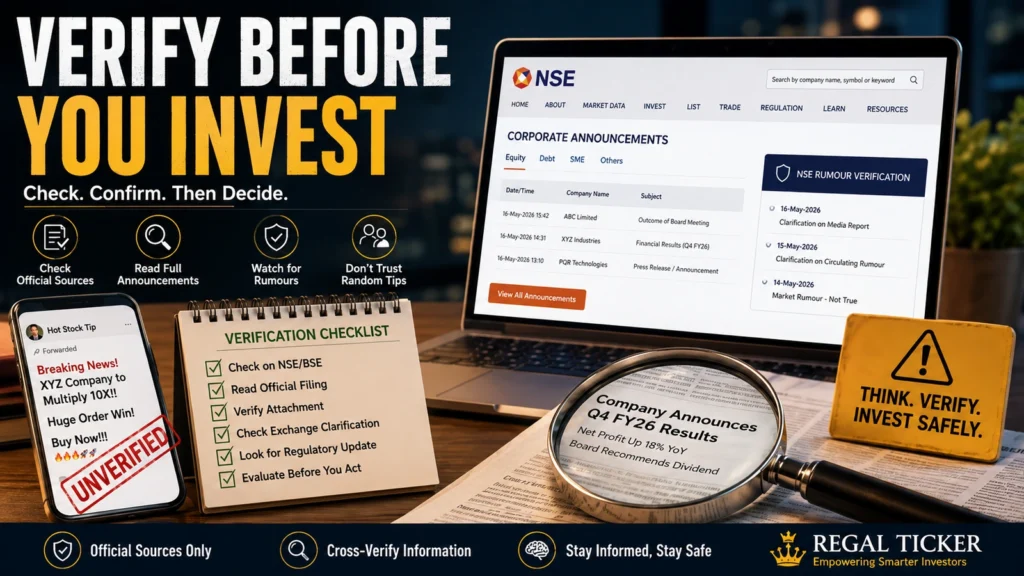
Verify the Intermediary
Search the entity through official SEBI and exchange resources.
Verify the Authorised Application
Check whether the mobile trading application belongs to a registered intermediary.
SEBI’s investor-support resources provide access to information for verifying registered mobile trading applications.
Verify the Website Domain
Compare the domain with the official intermediary website. Look for additional words, spelling changes or unusual extensions.
Verify Customer-Support Details
Use contact information from the independently verified website, not from the advertisement or private group.
Verify Exchange Membership
NSE provides a “Know/Locate Your Stock Broker” facility for checking registered members, authorised persons and disclosed client bank accounts.
Verify the Payment Route
Confirm that money is being transferred to an authorised client account connected with the genuine intermediary.
How to Verify Payment Details
Payment verification is as important as app verification.
Do Not Pay an Individual
An adviser, group administrator or supposed account manager should not receive the investment amount in a personal account.
Question Changing Accounts
Repeated requests to use different beneficiaries suggest that the payment network is being moved or layered.
Check the Beneficiary Name
The bank or UPI beneficiary should match the independently verified intermediary details.
Use Validated Payment Information
SEBI’s November 2025 investor-protection communication advised investors to use validated UPI handles and the SEBI Check platform for payments to registered investor-facing intermediaries.
Do Not Pay to Release a Withdrawal
A demand for tax or compliance money through a chat message does not prove a genuine obligation.
Test the Return Claim Before You Trust It
Fraudsters rely on large rupee numbers while avoiding transparent percentage calculations.
Assume an app claims that ₹1,00,000 will become ₹1,50,000 in one month.
That is a 50% monthly return.
Use the Regal Ticker Stock Return Calculator to convert the promised gain into a percentage.
If someone claims that ₹1,00,000 can become ₹10,00,000 in three years, use the CAGR Calculator to see the annualised return required.
Unrealistic mathematics does not by itself prove fraud, but guaranteed extraordinary returns combined with a private app, third-party payment and blocked withdrawal create a strong scam pattern.
For a specific trading call, the Risk–Reward Calculator can test whether the stated target and stop-loss are internally consistent.
A calculator cannot verify an app. It helps expose claims that do not make financial sense.
Never Share Trading Credentials or Device Access
Protect:
- user ID;
- password;
- OTP;
- TPIN;
- email password;
- registered mobile access;
- screen-sharing access;
- remote-control permissions.
A fraudster may say the information is needed to:
- activate the account;
- complete KYC;
- execute an institutional trade;
- fix a withdrawal;
- recover losses;
- manage the portfolio.
Readers who are unclear about account ownership should review What Is a Demat Account? and Demat Account vs Trading Account.
A genuine support process should not require the investor to surrender control of confidential credentials.
Deepfake Videos and Impersonated Experts
Artificial intelligence can make a fraudulent promotion appear more credible.
A deepfake may show a known person apparently recommending:
- a stock;
- a Telegram group;
- a guaranteed-return programme;
- a private trading app;
- an exclusive investment opportunity.
Check:
- whether the content appears on the person’s official channel;
- whether the organisation has issued a clarification;
- whether the voice or lip movement appears unnatural;
- whether the message directs viewers to a private group;
- whether extraordinary returns are promised.
Do not forward unverified videos. Repetition increases the credibility and reach of the scam.
Genuine Trading App vs Fake Trading App
A genuine trading arrangement normally includes:
- a verifiable registered intermediary;
- an authorised application;
- formal account-opening documents;
- a unique client code;
- exchange alerts;
- contract notes;
- demat records;
- official client bank accounts;
- defined grievance mechanisms;
- no guaranteed market return.
A fake arrangement often includes:
- private group recruitment;
- APK files;
- fake certificates;
- institutional-account stories;
- third-party payments;
- fabricated profits;
- no contract notes;
- no exchange messages;
- blocked withdrawals;
- repeated fee demands;
- disappearing administrators.
A polished interface does not replace these independent records.
What to Do After Installing or Funding a Suspicious App
Stop Using the App
Do not enter additional credentials or make another deposit.
Disconnect Permissions
Remove screen-sharing, accessibility, device-administrator or remote-control permissions where applicable.
Change Important Passwords
Secure the trading account, registered email, banking access and other accounts exposed on the device.
Contact the Genuine Broker
Use independently verified contact details.
Inform the Bank or Payment Provider
Report suspicious transfers as quickly as possible.
Preserve Evidence
Keep:
- installation files;
- download links;
- screenshots;
- group messages;
- phone numbers;
- beneficiary details;
- transaction references;
- support conversations.
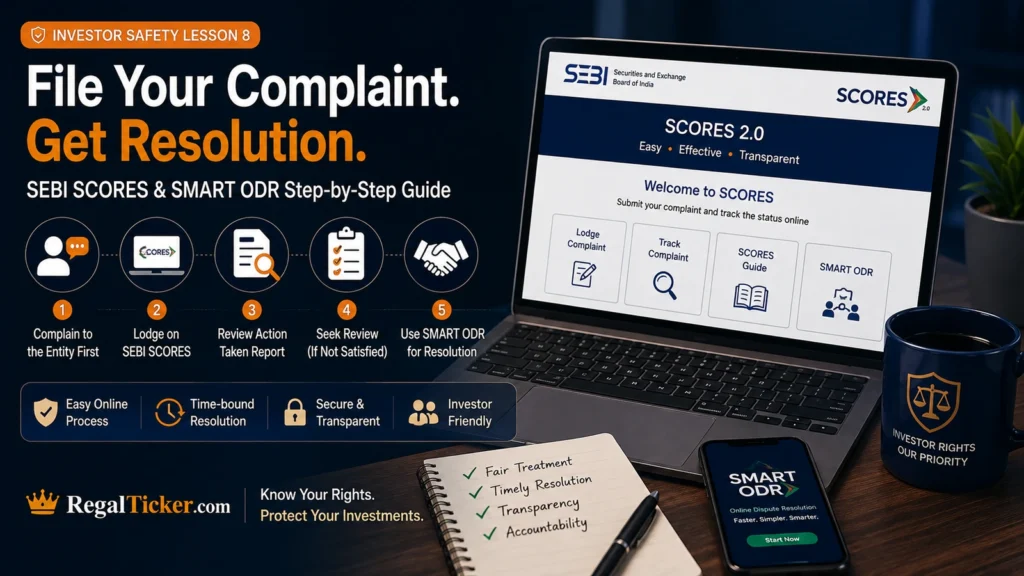
Report the Incident
The exchange advisory directs victims of financial fraud to report quickly through cybercrime helpline 1930 or the National Cyber Crime Reporting Portal. Suspicious communications may also be reported through the relevant government and regulatory facilities.
Do not delete the app or messages before preserving evidence needed for reporting, unless continued installation creates a security risk.
What to Do If Withdrawal Is Blocked
A blocked withdrawal is often the point at which the victim realises the profits were fabricated.
Do not:
- pay another tax;
- borrow to satisfy a margin demand;
- accept a recovery trade;
- give remote access;
- trust a new support number sent by the group.
Instead:
- stop all further payments;
- secure accounts and devices;
- preserve the displayed balance and messages;
- contact the bank;
- report the fraud;
- verify whether any real securities or exchange trades exist.
The displayed account value may have no recoverable connection with the money transferred.
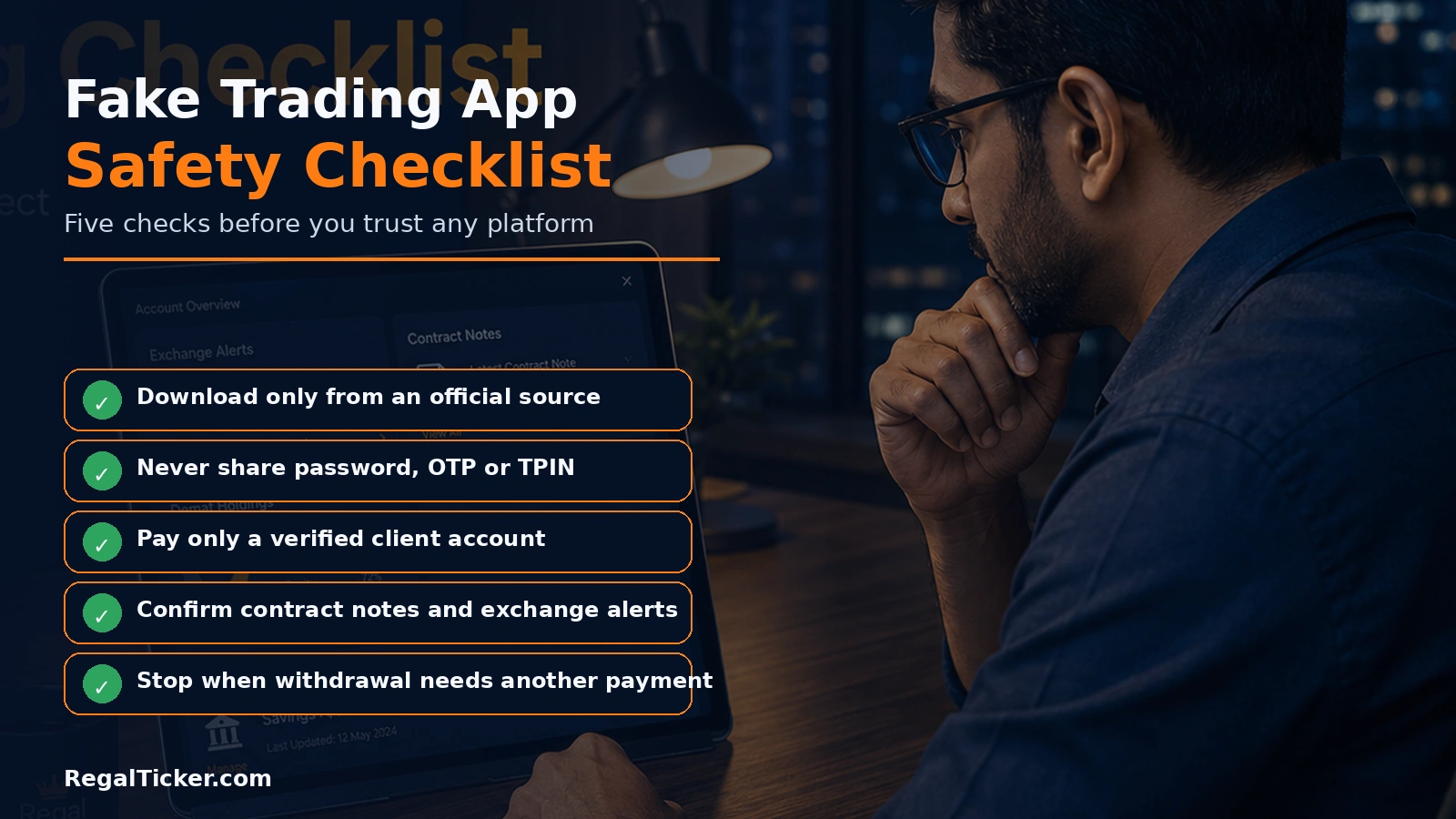
Fake Trading App and Telegram Safety Checklist
Before using a trading application or joining a paid tip service, confirm:
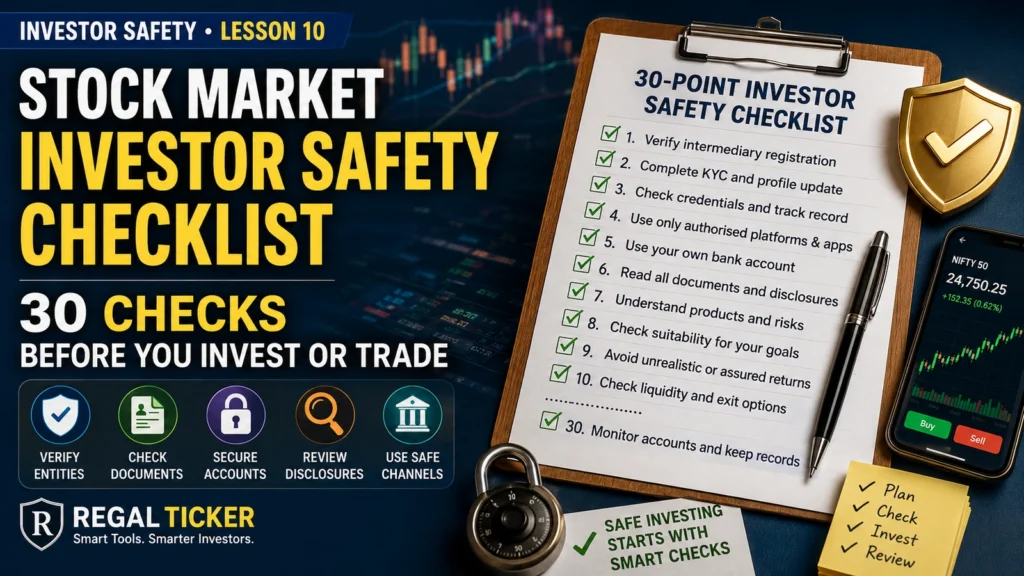
- The intermediary is independently verified.
- The service being offered matches its registration.
- The app is authorised and downloaded from a verified source.
- The publisher name matches the intermediary.
- The website domain is genuine.
- Payments go only to an authorised client account.
- No guaranteed return is promised.
- No institutional-account shortcut is offered.
- No APK file is sent through chat.
- No password, OTP or TPIN is requested.
- Real trades generate exchange alerts and contract notes.
- Withdrawals do not require repeated third-party payments.
- The administrator discusses risk as well as return.
- The channel does not rely on deepfake or impersonated endorsements.
- You have checked the promised return mathematically.
- You can stop and verify without pressure.
The Regal Ticker Investor Tools hub contains calculators for checking return, compounding and trade-risk claims before acting.
Final Takeaway
Fake trading apps succeed because they combine three elements:
- a trusted-looking social-media community;
- a professional-looking app;
- a payment route outside genuine market infrastructure.
Telegram and WhatsApp groups create urgency and social proof. The app creates fake visibility. The payment account moves real money.
The safest process is simple:
- verify the intermediary;
- verify the app;
- verify the domain;
- verify the payment route;
- calculate the promised return;
- protect credentials;
- demand independent records;
- stop when withdrawal requires another payment.
A real-looking chart is not proof of a real trade. Contract notes, exchange alerts, demat records and independently verified intermediary details matter far more than an app dashboard.
Frequently asked questions
What is a fake trading app scam?
It is a fraud in which an application or website displays fabricated trades and profits while the investor’s money is transferred outside genuine exchange and broker infrastructure.
Are all Telegram stock-tip groups illegal?
No, but investors should verify whether advice or account-handling services are being offered by properly registered entities. Assured returns and credential requests are major warning signs.
How can I check whether a trading app is genuine?
Verify the intermediary through official SEBI or exchange sources and confirm that the application is an authorised mobile trading app connected with that intermediary.
Why do fake apps show initial profits?
Displayed profits build trust and encourage the victim to make larger deposits. The numbers may not represent real exchange transactions.
Can a fake app allow one successful withdrawal?
Yes. Fraudsters may permit a small withdrawal to create confidence before asking for a much larger deposit.
What is an institutional-account scam?
It is a fraudulent claim that a retail investor can access special FPI, FII, block-deal, anchor-book or discounted IPO opportunities through a private app or group.
Should I pay tax or margin to unlock a withdrawal?
Repeated demands for payment through a chat group or unrelated account are serious warning signs. Stop and verify independently before sending more money.
What should I do after losing money through a fake trading app?
Stop further payments, secure accounts, preserve evidence, inform the bank or payment provider and report the fraud quickly through appropriate cybercrime and regulatory channels.
Verify through official sources
Official references
- 1. [SEBI — Caution Against Fraudulent or Manipulative Activities on Social Media Platforms, May 2025](https://www.sebi.gov.in/sebi_data/attachdocs/may-2025/1746621138080.pdf)
- 2. [SEBI Investor — Fake Trading App Scam Landscape](https://investor.sebi.gov.in/pdf/Fake%20trading%20app%20scam%20Landscape.pdf)
- 3. [SEBI — Advisory Against Fraudulent Trading Schemes Claiming FPI Access, August 2025](https://www.sebi.gov.in/sebi_data/attachdocs/aug-2025/1755862022145.pdf)
- 4. [SEBI — Online Investment Scam Protection Measures, November 2025](https://www.sebi.gov.in/sebi_data/attachdocs/nov-2025/1762429172296.pdf)
- 5. [NSE — Caution for Investors Regarding Telegram Stock Tips, April 2026](https://nsearchives.nseindia.com/web/pressrelease/2026-04/PR_cc_02042026_0_20260402115130.pdf)
- 6. [Joint Exchange Advisory — Fake Institutional Accounts and Trading Apps](https://nsearchives.nseindia.com/web/sites/default/files/2024-08/PR_cc_23082024_0.pdf)
- 7. [BSE — Warning on Deepfake Investment Videos, April 2026](https://www.bseindia.com/Downloads/MediaRelease/PR24042026_20262404.pdf)
Educational disclaimer: This article is for education and general information only. It does not provide investment, legal, cybersecurity or financial advice. Verify intermediaries, applications, domains, payment details and regulatory status independently through official sources before acting. Reporting procedures and available remedies depend on the nature of the incident and entities involved.