
⚡ Quick answer
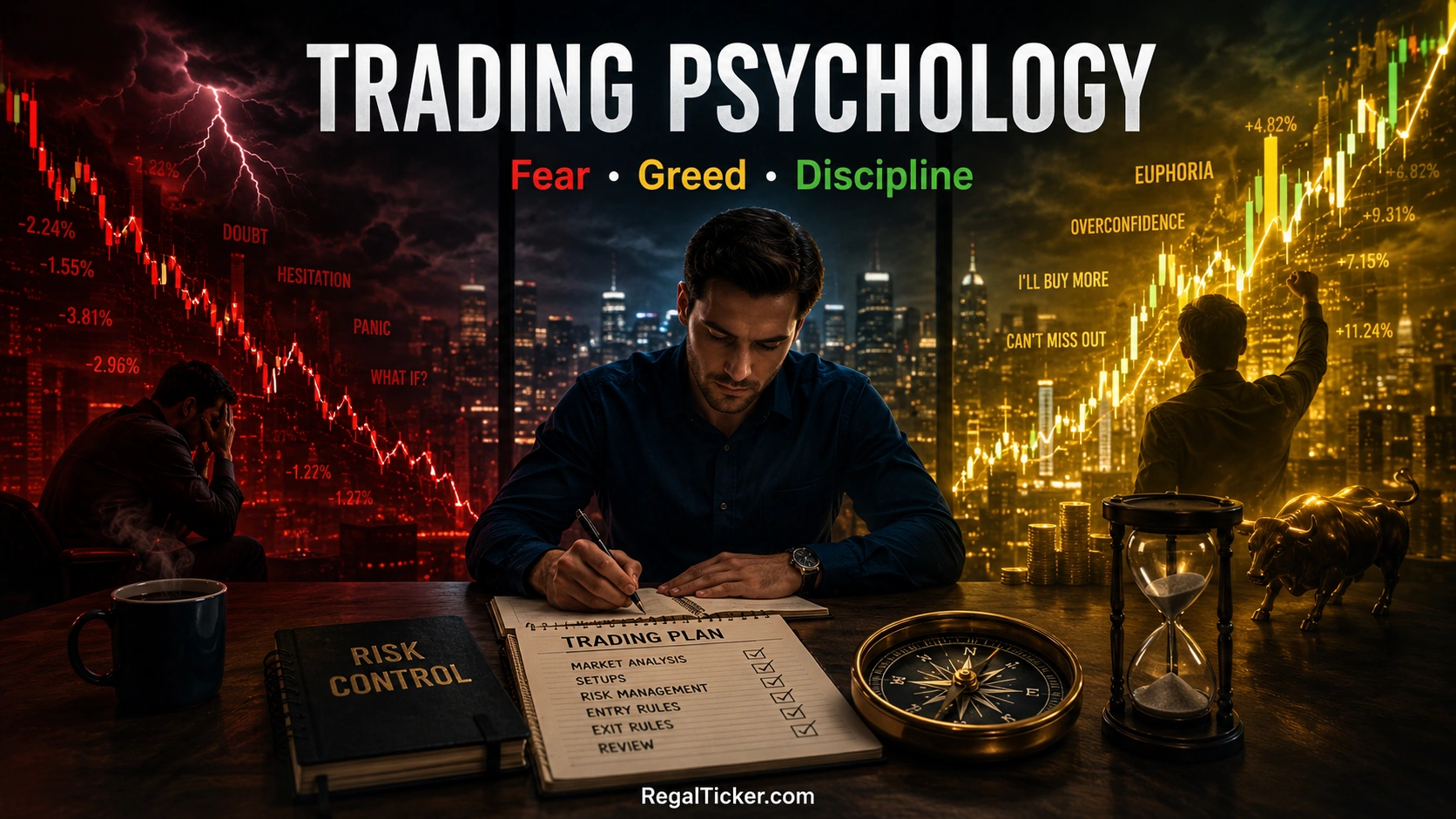
Trading psychology is the study and management of the thoughts, emotions and behavioural habits that influence trading decisions. Fear may cause a trader to avoid valid setups, exit too early or freeze after a loss. Greed may lead to chasing price, increasing quantity, ignoring a stop or holding beyond a planned target. Discipline means following a tested decision process despite those emotions. It does not mean feeling nothing; it means preventing emotion from controlling risk.
Investor note
Key Takeaways
Fear and greed are normal responses to uncertainty, not proof that a trader is weak. The danger begins when emotion changes entry, position size, stop-loss, target or exit without evidence. FOMO usually appears after price has already moved and the original risk-reward structure has worsened. Loss aversion can make traders hold losers too long and book winners too early. Overconfidence often appears after a winning streak and can increase trade frequency or quantity. Discipline is a system of written rules, predefined risk, execution limits and review. A trade journal should compare the planned decision with the actual decision. Brokerage and statutory charges make emotional overtrading more expensive. Calculators make the numbers visible but cannot control the trader’s behaviour. A controlled loss is a normal business outcome; revenge trading is a process failure.
Trading psychology becomes visible whenever money, uncertainty and time pressure meet.
A trader may understand chart patterns, support and resistance, stop-loss orders and position sizing, yet still produce poor results because the process changes under emotional pressure.
Examples include:
buying after a rapid rise because everyone else appears to be making money; cancelling a valid stop because accepting the loss feels painful; taking a second impulsive trade to recover the first loss; reducing a well-planned position because recent losses created fear; increasing quantity after a winning streak because confidence became overconfidence; exiting a winner early and then holding a loser for much longer; checking price continuously until every small fluctuation feels urgent.
This lesson follows Risk Management in Stock Market, Position Sizing in Stock Market, Risk-Reward Ratio in Stock Market, Stop-Loss Orders in Stock Market, Diversification and Asset Allocation Explained and Portfolio Drawdown and Capital Protection.
Those lessons define the numbers. Trading psychology determines whether the trader follows them.
SEBI’s investor-education material repeatedly encourages investors to match products with their risk appetite, conduct independent research, avoid hot tips and rumours, review investments periodically and practise patience instead of reacting to every market movement.
The central principle is simple:
You cannot remove emotion from trading, but you can stop emotion from changing the risk plan.
What Is Trading Psychology?
Trading psychology is the collection of emotional and behavioural influences that affect how a person analyses, enters, manages and exits a trade.
It includes:
- fear;
- greed;
- hope;
- regret;
- impatience;
- overconfidence;
- loss aversion;
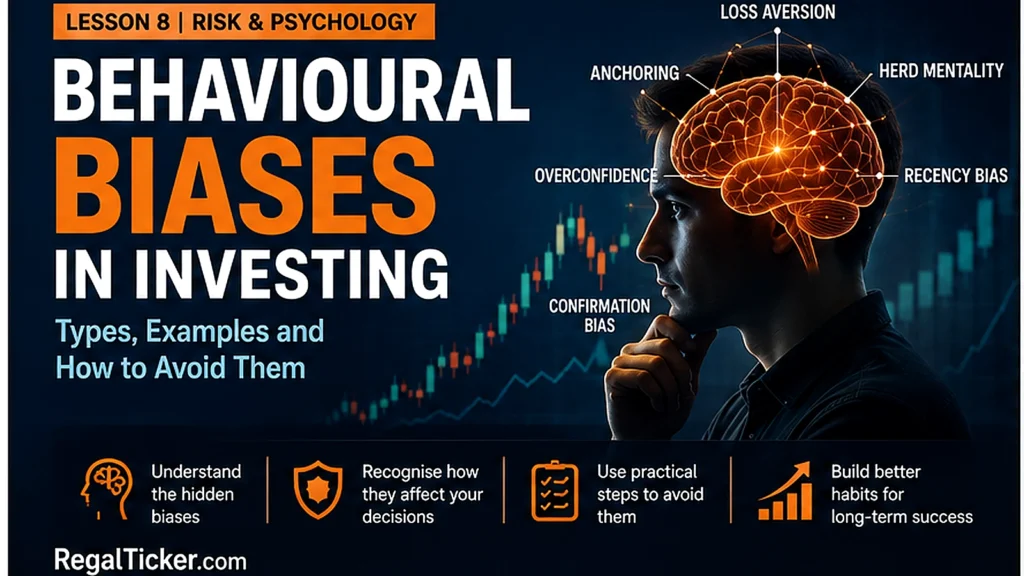
- anchoring;
- recency bias;
- herd behaviour;
- confirmation bias;
- the need to be right.
The same market movement can produce different decisions in different traders because each person interprets risk through past experience, current financial pressure and recent outcomes.
Emotion Is Not the Enemy
Fear can warn that risk is too large. Greed can reveal that expectations are becoming unrealistic. Regret can identify a process mistake.
The goal is not to suppress every emotion.
The useful questions are:
- What triggered the emotion?
- Is it supported by new evidence?
- Is it changing the written plan?
- Is the proposed action reducing risk or only reducing discomfort?
- Would the same decision be made if the position were not already open?
Psychology Changes the Complete Trade
Emotion can affect every stage:
| Stage | Fear may cause | Greed may cause |
|---|---|---|
| Setup selection | Avoiding a valid opportunity | Accepting a weak setup |
| Entry | Entering too late after confirmation | Chasing after a sharp rise |
| Position size | Buying too little to follow the plan | Buying too much |
| Stop-loss | Placing the stop too close | Removing or widening the stop |
| Target | Booking too early | Ignoring a realistic target |
| Exit | Freezing during a loss | Refusing to realise available profit |
| Review | Avoiding the journal | Blaming the market |
Process Quality vs Trade Outcome
A good decision can lose money. A bad decision can make money.
Suppose a trader follows a tested setup, uses an appropriate quantity and exits at the planned stop. The trade loses 1R.
That is a negative financial outcome but may still be a high-quality process.
Another trader chases an unplanned move, uses excessive quantity and happens to profit. The financial outcome is positive, but the process is dangerous because it rewards behaviour that can later create a large loss.
A journal should therefore score both:
- outcome;
- process quality.
Fear in Trading
Fear is a protective response to perceived danger. In markets, it can appear before entry, while holding a position or after a loss.
Fear of Losing Money
This fear may cause a trader to:
- avoid every setup;
- use a stop so tight that ordinary volatility triggers it;
- exit as soon as a small profit appears;
- reduce quantity after the entry rather than before it;
- watch price continuously;
- abandon a strategy after a small sample.
The solution is not to become careless. It is to define an amount of risk that is small enough to accept.
Review Position Sizing in Stock Market before relying on confidence alone.
Fear of Missing Out
FOMO is the fear that an opportunity will disappear before the trader participates.
It often appears when:
- price has already moved rapidly;
- social media is repeating the same idea;
- a friend reports a large profit;
- the trader recently missed another move;
- the chart looks obvious only after the move;
- the market is making new highs.
FOMO changes the arithmetic.
Assume the original plan was:
- entry: ₹500;
- stop-loss: ₹480;
- target: ₹560.
Risk per share = ₹20 Reward per share = ₹60 Risk-reward ratio = 1:3
The trader waits, then enters at ₹540 while keeping the same stop and target.
New risk per share = ₹60 New reward per share = ₹20 New risk-reward ratio = 1:0.33
The same chart now represents a completely different trade.
Enter both scenarios into the Risk-Reward Calculator before treating a late entry as the original opportunity.
Fear after a Losing Streak
Several losses can cause a trader to:
- skip the next valid trade;
- reduce quantity inconsistently;
- change strategy;
- search for certainty;
- use more indicators;
- wait for impossible confirmation.
The correct response depends on evidence.
Ask:
- Were the losses within the tested expectation?
- Did market conditions change?
- Were the trades executed according to plan?
- Is the sample large enough?
- Did costs or slippage reduce the edge?
- Was the position size emotionally tolerable?
Fear of Giving Back Profit
A trader may enter correctly and then exit after a very small favourable move because the open profit feels fragile.
This can create a pattern of:
- full-sized losses;
- undersized winners;
- low realised reward-to-risk;
- negative expectancy despite a high win rate.
Compare the planned result with the actual exit using the Stock Return Calculator and record the realised R-multiple.
Greed in Trading
Greed is the desire for more profit, more action or faster recovery than the plan supports.
Chasing Price
A trader sees a strong move and assumes that not entering immediately means losing the opportunity.
Chasing can produce:
- poor entry location;
- wider stop distance;
- smaller remaining reward;
- emotional dependence on continued momentum;
- pressure to increase quantity before price moves farther.
A missed trade is not a financial loss. A bad entry can become one.
Oversizing the Position
Greed often appears as quantity.
The trader may think:
- “This setup looks certain.”
- “I need to recover the last loss.”
- “This is the best opportunity of the month.”
- “I will reduce the position if it goes against me.”
Position size should come from the risk budget and stop distance—not emotional conviction.
Moving the Target Farther
A target may be extended because price is rising and the trader does not want the profit to end.
A target can be changed when new evidence supports the change, but not simply because the open gain feels exciting.
Use Support and Resistance in the Stock Market to connect targets with price structure.
Removing or Widening the Stop
Greed and hope can combine when a losing position approaches the stop.
The trader may widen it because:
- the position is large;
- the loss feels unacceptable;
- a recovery seems possible;
- accepting the stop would make the earlier decision look wrong.
This converts a defined-risk trade into an undefined-risk position.
Review Stop-Loss Orders in Stock Market and remember that actual execution can still differ from the trigger price.
Overtrading
Greed may appear as the desire to participate continuously.
More trades can create:
- more brokerage and statutory charges;
- more slippage;
- weaker setup selection;
- fatigue;
- lower patience;
- greater exposure to random movement.
Estimate the cost of repeated activity with the Brokerage Calculator.
A strategy with a small gross edge may become unattractive after frequent costs.
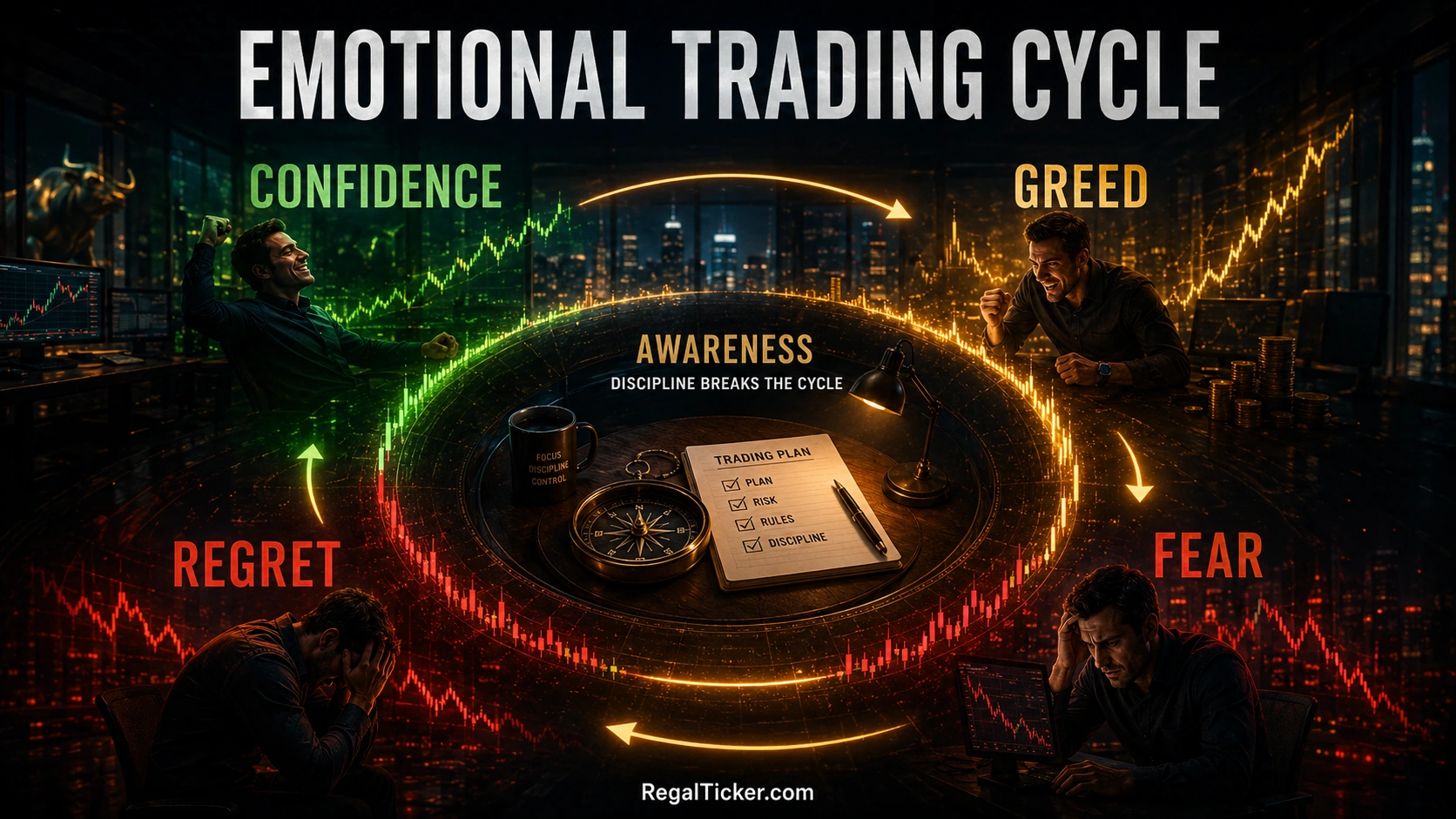
The Emotional Trading Cycle
An emotional trading cycle often follows this sequence:
- Market event
- Emotional interpretation
- Impulsive action
- Financial outcome
- Reinforced belief
Example: Greed Cycle
A trader sees a rapid rise.
The interpretation is:
“Everyone is making money except me.”
The action is:
- chasing price;
- using larger quantity;
- skipping the risk calculation.
If the trade profits, the trader may conclude that urgency and oversized risk are effective.
The bad process is reinforced.
If the trade loses, fear and regret may dominate the next decision.
Example: Fear Cycle
A trader experiences three losses.
The interpretation is:
“The strategy no longer works.”
The action is:
- skipping the next valid setup;
- entering late after price confirms strongly.
The missed trade succeeds, reinforcing regret and FOMO.
The next entry may then be chased.
Breaking the Cycle
Awareness creates a pause between emotion and action.
Use a simple note:
| Field | Question |
|---|---|
| Trigger | What just happened? |
| Emotion | What am I feeling? |
| Urge | What do I want to do immediately? |
| Evidence | What changed in the setup? |
| Rule | What does the written plan require? |
| Decision | What action follows the rule? |
The pause does not need to remove the feeling. It only needs to prevent an immediate impulsive order.
Loss Aversion, Hope and Regret
Loss aversion describes the tendency to experience a loss more intensely than an equivalent gain.
It can produce a damaging combination:
- winners are sold quickly to secure relief;
- losers are held because selling confirms pain.
The Disposition Effect
Suppose a trader has two positions:
- Position A: +8%
- Position B: −8%
The trader sells Position A because the gain feels satisfying and keeps Position B because a recovery is hoped for.
The decision may have nothing to do with the current quality of either setup.
Ask instead:
Which position would I choose today if I held neither?
Anchoring to the Purchase Price
A trader may treat the purchase price as the stock’s “correct” value.
Statements such as these reveal anchoring:
- “I will sell when it returns to my entry.”
- “It cannot fall much more because I bought much higher.”
- “The stock owes me a recovery.”
The market does not know the trader’s purchase price.
If the position was built in several tranches, the Stock Average Calculator can calculate the weighted average. It cannot determine whether the investment thesis remains valid.
Regret after Missing a Trade
A missed trade can lead to:
- entering the next setup too early;
- chasing the same stock;
- taking a lower-quality setup;
- increasing quantity;
- abandoning patience.
A missed opportunity should be recorded as information, not treated as money already lost.
Overconfidence and Winning Streaks
Overconfidence can be more dangerous than fear because it often feels like skill.
It may appear after:
- several consecutive winners;
- a strong bull market;
- one unusually large profit;
- social praise;
- success in a narrow market condition.
Common Signs
- increasing quantity without updating the risk plan;
- taking more trades;
- ignoring contradictory evidence;
- reducing research;
- believing stops are unnecessary;
- attributing all wins to skill and all losses to bad luck.
The Market-Regime Problem
A strategy may work well because the current environment suits it.
Examples include:
- breakout strategies during strong trends;
- mean-reversion strategies during ranges;
- high-beta positions during a broad rally.
A winning streak does not prove that the edge will remain unchanged.
Use Fixed Escalation Rules
If quantity is increased, use a rule based on:
- account growth;
- maximum risk percentage;
- minimum sample size;
- stable execution quality;
- acceptable drawdown.
Do not increase size only because confidence is high.
Herd Behaviour, Tips and Social Pressure
Herd behaviour occurs when a person follows the group instead of independently evaluating the decision.
It is powerful because social agreement reduces uncertainty.
Warning Signs
- “Everyone is buying.”
- “It is trending everywhere.”
- “Several influencers mentioned it.”
- “My group says it cannot fall.”
- “I do not understand it, but I do not want to miss it.”
SEBI warns investors not to rely on hot tips, rumours or unregistered advice and encourages independent research.
Crowd Agreement Is Not Risk Analysis
Even when the crowd is correct about direction, the trader may still have:
- a poor entry;
- excessive quantity;
- no exit plan;
- unsuitable time horizon;
- liquidity risk;
- concentration risk.
The trade must still pass the same process.
Discipline Is a System, Not a Mood
Discipline does not mean forcing yourself to behave perfectly all day.
It means designing rules that reduce the number of emotional decisions required.
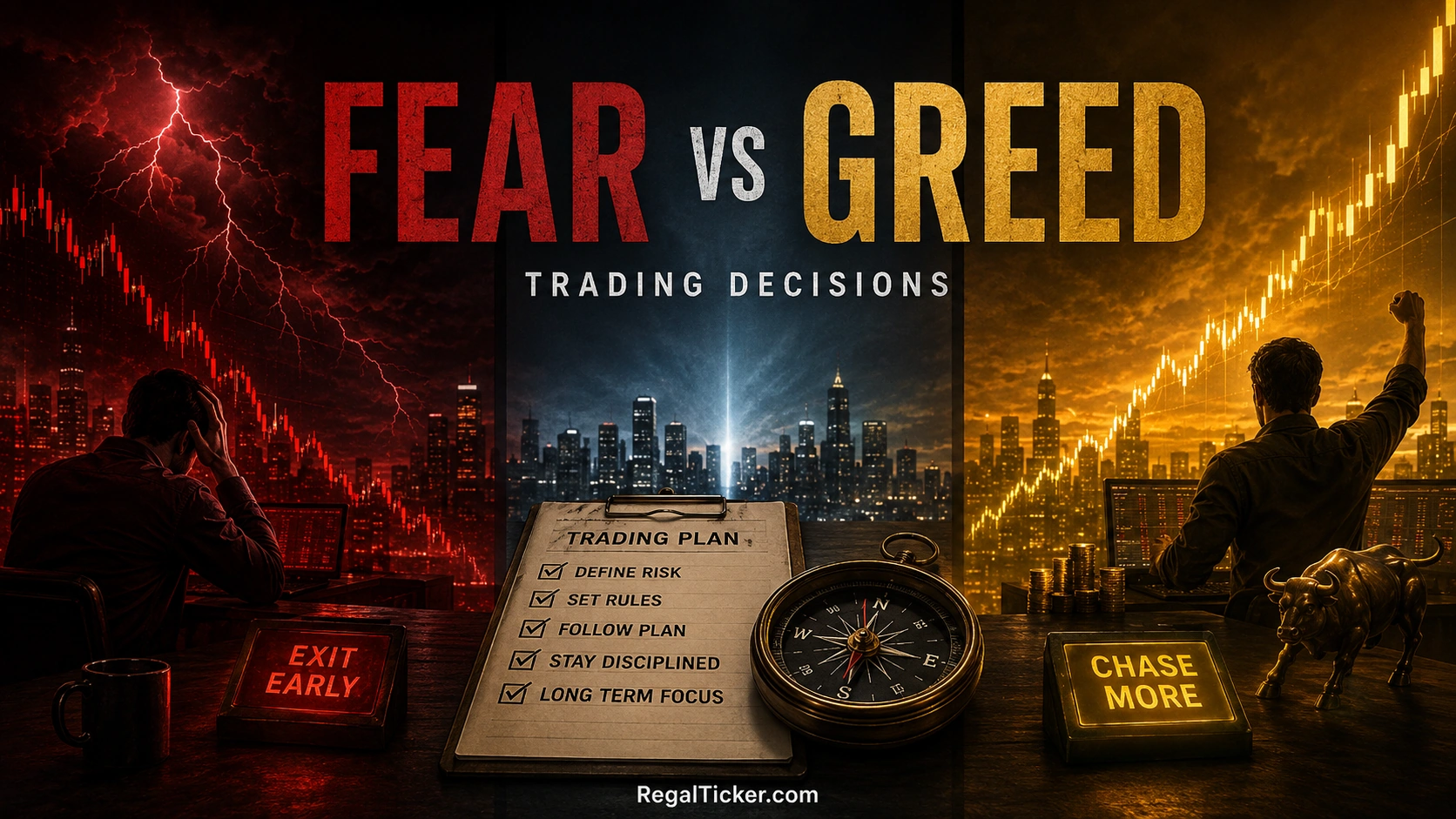
The Four-Part Discipline Framework
- Plan
- Risk
- Execute
- Review
Plan
Before entry, define:
- setup;
- entry area;
- invalidation;
- target;
- position size;
- maximum total risk;
- event risk;
- holding period;
- conditions for no trade.
Risk
Calculate:
- risk per share;
- quantity;
- total planned loss;
- total open portfolio risk;
- reward-to-risk;
- estimated charges.
Use the Risk-Reward Calculator and Brokerage Calculator before placing the order.
Execute
Execution rules may include:
- use the planned order type;
- do not chase beyond the entry range;
- do not increase quantity after entry;
- do not widen the stop;
- avoid repeated manual interference;
- record any deviation immediately.
Read Market Order, Limit Order, Stop-Loss and Stop-Limit Order to understand how order choice affects execution.
Review
After exit, record:
- planned result;
- actual result;
- realised R;
- charges;
- emotional state;
- rule violations;
- one process improvement.
Use the Stock Return Calculator for the actual result where appropriate.
Building a Trading Journal That Improves Behaviour
A useful journal is not a diary of feelings alone.
It connects emotion with measurable decisions.
Before-Trade Fields
| Field | Record |
|---|---|
| Setup | Why the opportunity exists |
| Entry | Planned entry or range |
| Stop | Invalidation level |
| Target | Realistic objective |
| Quantity | Risk-based size |
| Planned risk | Rupees and R |
| Estimated charges | Cost estimate |
| Emotion | Fear, calm, urgency or excitement |
| No-trade condition | What cancels the idea |
During-Trade Fields
Record only meaningful changes:
- new information;
- order execution;
- stop movement;
- partial exit;
- rule violation;
- emotional urge.
Constant journaling during every price movement can become another form of over-monitoring.
After-Trade Fields
Record:
- entry and exit;
- gross and net result;
- realised R;
- maximum favourable movement;
- maximum adverse movement;
- process score;
- emotional trigger;
- lesson.
Score the Process
Use a simple score out of five:
| Score | Meaning |
|---|---|
| 5 | Followed the complete plan |
| 4 | Minor harmless deviation |
| 3 | One material rule broken |
| 2 | Several emotional changes |
| 1 | No usable process |
A profitable trade can receive a low process score.
A planned loss can receive a high score.
Practical Trading Psychology Examples
Example 1: FOMO after a Breakout
A stock breaks resistance and moves from ₹500 to ₹540.
The planned entry was ₹502–₹508 with a stop at ₹480 and target at ₹560.
At ₹540, the remaining reward is only ₹20 while the risk to ₹480 is ₹60.
The late entry is rejected.
This is discipline—not a missed profit.
Example 2: Booking a Winner Too Early
A trader plans:
- risk: ₹3,000;
- target reward: ₹6,000.
The position reaches ₹1,200 of open profit and the trader exits from fear.
After twenty similar trades, average winners may become too small to cover full losses.
The solution may include:
- smaller position size;
- alerts instead of continuous monitoring;
- predefined partial exits;
- reviewing realised R.
Example 3: Widening the Stop
A trader enters at ₹800 with a stop at ₹770.
When price reaches ₹772, the stop is moved to ₹740 because “the stock may bounce.”
Original risk per share: ₹30 Revised risk per share: ₹60
The risk doubled after entry without a new position-size calculation.
Example 4: Revenge Trading
A trader loses ₹5,000 on a planned trade.
The next position is entered immediately with double quantity to recover the loss.
The second setup is weak and loses ₹10,000.
The original controlled loss became a ₹15,000 emotional sequence.
Use the reset protocol below.
Example 5: Overconfidence after Five Winners
A trader normally risks ₹2,000 per trade.
After five wins, risk is increased to ₹8,000 without reviewing the strategy sample or drawdown.
The next three losses total ₹24,000—equivalent to twelve normal losses.
A temporary emotional increase in size changed the complete risk profile.
Example 6: Averaging a Losing Position
A trader buys:
- 100 shares at ₹600;
- another 100 at ₹540.
The weighted average is ₹570.
Use the Stock Average Calculator to confirm the number.
However:
- quantity doubled;
- total capital increased;
- the thesis may have weakened;
- concentration increased.
A lower average price does not automatically mean lower risk.
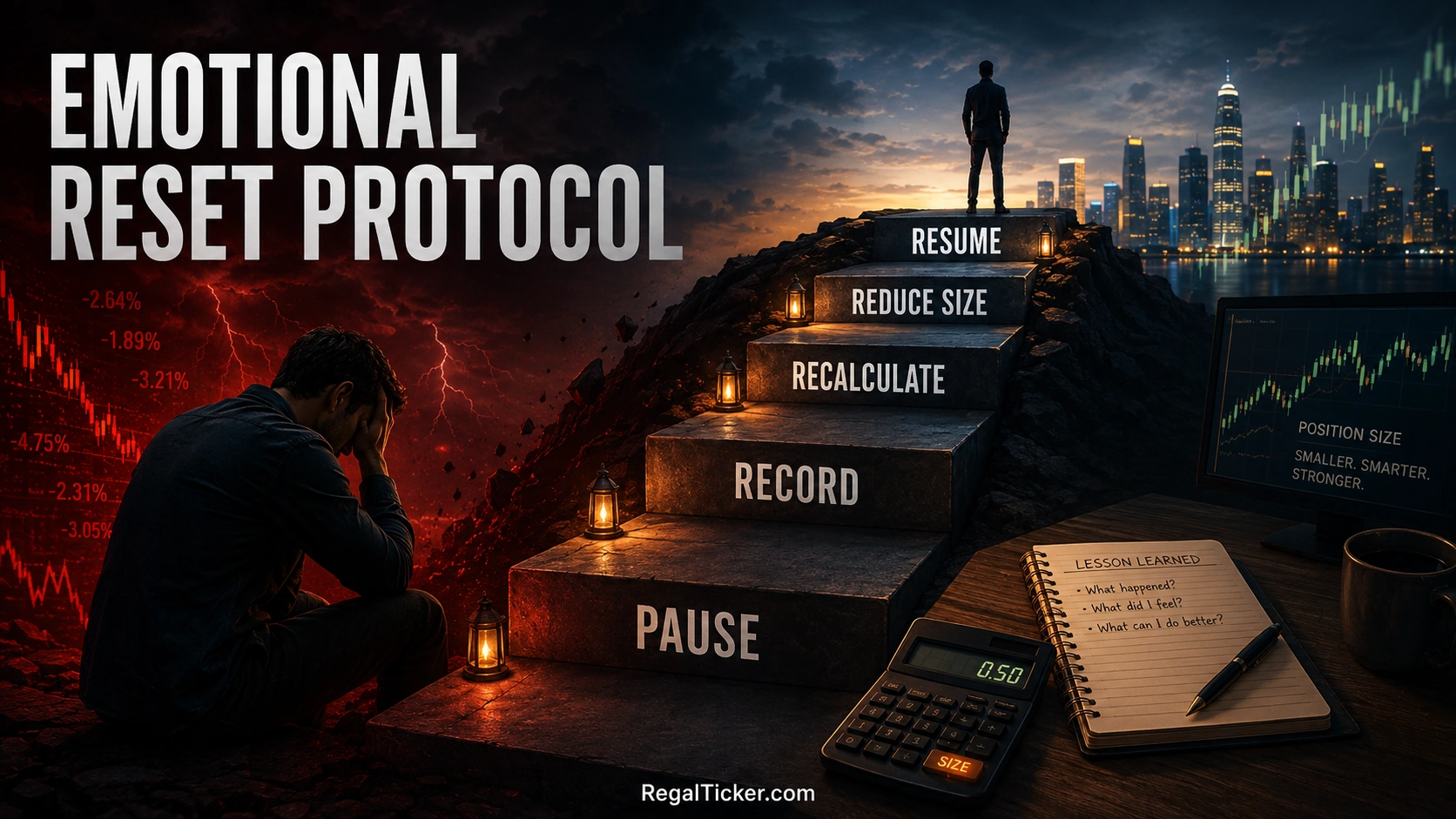
Emotional Reset Protocol after a Loss
Use a reset when:
- a daily loss limit is reached;
- two rule violations occur;
- quantity is changed emotionally;
- revenge-trading urges appear;
- the trader cannot describe the next setup calmly.
Step 1: Pause
Stop placing new orders for a predefined period.
The pause may be:
- fifteen minutes;
- the remainder of the session;
- one trading day.
The correct period depends on the strategy and the severity of the deviation.
Step 2: Record
Write:
- what happened;
- what rule was followed;
- what rule was broken;
- what emotion appeared;
- whether the loss was planned or avoidable.
Step 3: Recalculate
Review:
- capital;
- current drawdown;
- open risk;
- transaction costs;
- strategy limits.
Use the Brokerage Calculator to include the cost of repeated activity.
Step 4: Reduce Size
When returning after a material emotional mistake, use smaller quantity until execution quality stabilises.
This is not punishment. It reduces the financial cost of rebuilding the process.
Step 5: Resume Only with a Valid Setup
The next trade must meet the original rules.
Do not trade only because the pause has ended.
Use RegalTicker Calculators as a Discipline Workflow
The calculators should be used before and after the trade.
Before Entry: Risk-Reward Calculator
Use the Risk-Reward Calculator to compare:
- planned entry;
- chased entry;
- conservative target;
- realistic stop;
- proposed quantity.
This makes FOMO deterioration visible.
Before Entry: Brokerage Calculator
Use the Brokerage Calculator to estimate:
- brokerage;
- STT;
- exchange charges;
- GST;
- stamp duty;
- DP charge where applicable;
- net result;
- break-even price.
This is especially important when overtrading or using small profit targets.
During Position Building: Stock Average Calculator
Use the Stock Average Calculator for staged entries.
Then return to the risk calculation with:
- revised average;
- total quantity;
- current invalidation;
- revised portfolio exposure.
After Exit: Stock Return Calculator
Use the Stock Return Calculator to calculate total profit or loss and return.
Option A
- planned R;
- realised R;
- gross result;
- net result;
- process score.
Option B
Complete Tools Hub
The RegalTicker Investor Tools Hub contains the complete calculator collection.
A practical psychology workflow is:
Plan → Risk-Reward → Costs → Execute → Actual Return → Journal
Calculators support discipline because they make assumptions explicit. They cannot prevent an impulsive click.
Common Trading Psychology Mistakes
Mistake 1: Trying to Eliminate Emotion
Emotion is normal. The goal is to control behaviour.
Mistake 2: Trading with Money Needed Soon
Financial pressure increases fear and reduces decision quality.
Mistake 3: Using Oversized Positions
When the amount at risk is emotionally intolerable, the trader is more likely to interfere.
Mistake 4: Chasing after Missing a Move
The original trade no longer exists at the later price.
Mistake 5: Moving the Stop to Avoid Being Wrong
The market outcome is uncertain. The risk limit should not depend on pride.
Mistake 6: Booking Every Winner Early
This can destroy the payoff structure.
Mistake 7: Increasing Size after a Winning Streak
Confidence should not replace the risk formula.
Mistake 8: Revenge Trading
A new trade cannot repair the emotional discomfort of the previous loss.
Mistake 9: Changing Strategy Too Quickly
A small sample cannot reliably prove that an edge disappeared.
Mistake 10: Ignoring Costs
Frequent emotional activity increases friction.
Mistake 11: Following the Crowd
Agreement is not independent analysis.
Mistake 12: Confusing Activity with Progress
More screen time and more trades do not guarantee better decisions.
Mistake 13: Hiding Rule Violations from the Journal
An incomplete journal protects ego instead of capital.
Mistake 14: Judging Discipline Only by Profit
A lucky result can reward a dangerous process.
Mistake 15: Expecting Perfect Control
The objective is gradual reduction in costly mistakes, not flawless behaviour.
Trading Psychology Checklist
Before the trade:
- Is the setup written clearly?
- Is the entry still inside the planned range?
- Is the stop based on invalidation?
- Is the target realistic?
- Has quantity been calculated?
- Is total open risk acceptable?
- Have costs been estimated?
- Am I entering from evidence or urgency?
- Would I take this trade after a recent win?
- Would I take it after a recent loss?
During the trade:
- Has new evidence appeared?
- Am I changing the plan to reduce discomfort?
- Am I watching too frequently?
- Has the risk increased?
- Am I widening the stop?
- Am I holding beyond the target from greed?
- Is the position larger than intended?
- Is a partial exit already defined?
- Has an event changed the setup?
- Should no action be taken?
After the trade:
- Was the plan followed?
- Was the result within the expected risk?
- What was the realised R?
- What were the total charges?
- Which emotion was strongest?
- Did that emotion change behaviour?
- Was the mistake avoidable?
- Is the sample large enough for a strategy change?
- Is a reset required?
- What one rule should be reinforced?
Frequently Asked Questions
Trading psychology is the effect of emotions, beliefs and behavioural habits on trading decisions.
Are fear and greed always bad?
No. They are normal signals. They become harmful when they change risk, quantity or execution without evidence.
How does fear affect trading?
Fear can cause missed setups, late entries, overly tight stops, early exits and inconsistent position size.
How does greed affect trading?
Greed can cause chasing, oversized positions, overtrading, wider stops and unrealistic targets.
What is FOMO in trading?
FOMO is fear of missing out. It often causes entry after the original risk-reward structure has deteriorated.
What is revenge trading?
Revenge trading is taking an impulsive position to recover a recent loss or emotional discomfort.
How can I become more disciplined?
Use written rules, predefined risk, a journal, daily loss limits, an emotional reset protocol and regular process review.
Does a trading journal improve results?
A journal can expose repeated behaviour and rule violations. It helps only when entries are honest and reviewed.
Should I stop trading after a loss?
A planned loss does not automatically require stopping. A rule violation, revenge-trading urge or daily loss-limit breach may require a pause.
Can smaller position size improve psychology?
Yes. Smaller risk can make it easier to follow the stop, target and holding plan.
How do I control FOMO?
Compare the current entry with the original entry using the Risk-Reward Calculator. Accept that a missed trade is not money lost.
Why do traders hold losers and sell winners?
Loss aversion and hope can delay accepting a loss, while fear of losing open profit can cause early booking.
Can calculators improve trading psychology?
Calculators clarify risk, cost and outcome. They support a process but cannot create self-control.
Is discipline more important than strategy?
Both matter. A strategy without discipline is not executed consistently, while discipline cannot create an edge in a strategy that has none.
What should I do after revenge trading?
Stop, document the event, recalculate risk, reduce size and resume only when a valid setup appears.
Final Takeaway
Trading psychology is not separate from risk management.
It determines whether the trader:
- enters at the planned price;
- accepts the calculated quantity;
- keeps the stop;
- respects the target;
- avoids chasing;
- limits repeated activity;
- records the result honestly;
- returns calmly after a loss.
Fear usually tries to reduce discomfort immediately.
Greed usually tries to increase reward immediately.
Discipline protects the longer-term process.
Use this sequence:
- define the setup;
- calculate risk;
- estimate costs;
- execute the written plan;
- record emotion without obeying it;
- review process and outcome separately;
- use a reset after material rule violations;
- return with controlled size.
Use the Risk-Reward Calculator, Brokerage Calculator, Stock Average Calculator, Stock Return Calculator and complete Investor Tools Hub to make trade assumptions visible.
Continue Learning on RegalTicker
- Risk Management in Stock Market
- Position Sizing in Stock Market
- Risk-Reward Ratio in Stock Market
- Stop-Loss Orders in Stock Market
- Diversification and Asset Allocation Explained
- Portfolio Drawdown and Capital Protection
- Risk Management Learning Hub
- All Investor Tools
Official References
- SEBI Investor — How to Manage Investment Risks
- SEBI Investor — Do’s and Don’ts of Investing
- SEBI Investor — Factors to Consider Before Investing
- SEBI Investor — Due Diligence Before Investing
- SEBI Investor — Investor Education Videos
- NSE India — First-Time Investor Do’s and Don’ts
Educational disclaimer: This article is for general investor education only. It is not personalised financial advice, investment advice, tax advice, a research recommendation, a solicitation or a guarantee of returns. Trading and investing involve risk, actual execution can differ from planned prices, and losses may exceed expectations. Verify current information through official sources and consult appropriately qualified professionals where necessary.