
⚡ Quick answer
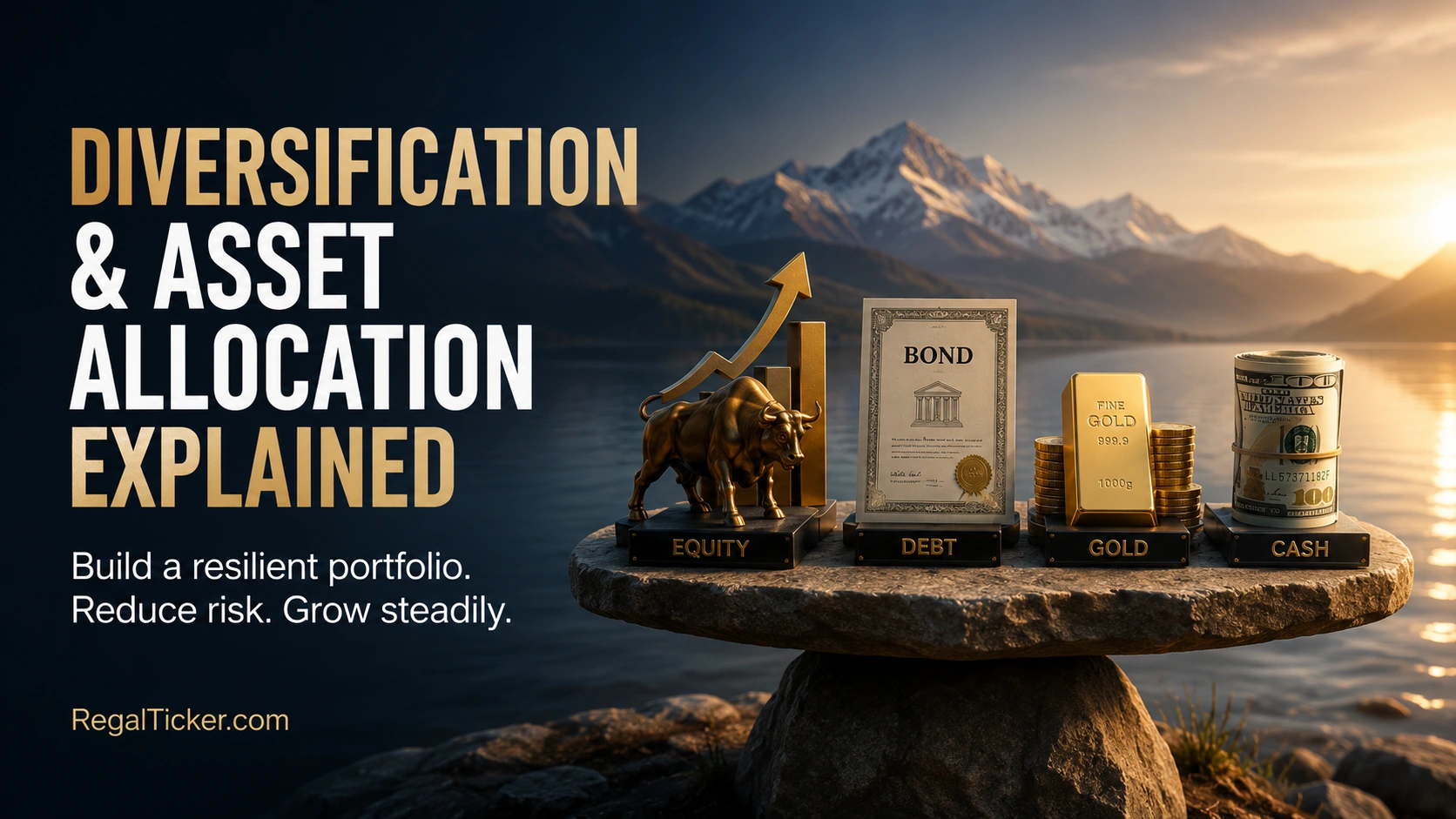
Diversification and asset allocation are two connected risk-management ideas. Diversification spreads money across several holdings so that one company, sector or investment does not control the entire outcome. Asset allocation decides how much of the portfolio is placed in broad categories such as equity, debt, gold and cash. Diversification works inside and across asset classes; asset allocation sets the portfolio’s overall risk structure. Neither method guarantees profit or prevents all losses.
Investor note
Key Takeaways
Diversification reduces dependence on one holding, sector, theme or asset class. Asset allocation decides the percentage assigned to equity, debt, gold, cash and other eligible categories. Owning many securities is not enough when they are highly correlated. The correct allocation depends on goals, time horizon, liquidity needs, risk capacity and behaviour during losses. Rebalancing restores the intended allocation after market movement creates portfolio drift. Costs and taxes can make excessive rebalancing inefficient. Use the Stock Return, Brokerage, Capital Gains Tax and Stock Average calculators to review portfolio decisions with transparent arithmetic.
Diversification and asset allocation are often used as if they mean the same thing. They do not.
Diversification answers:
How widely is the portfolio spread?
Asset allocation answers:
How much of the portfolio belongs in each major investment category?
An investor can own twenty shares and still be poorly diversified if most of them belong to the same industry, depend on the same economic factor or move in the same direction during market stress. Another investor may hold only a few broad funds and fixed-income instruments but have a more balanced exposure across equity, debt and cash.
This lesson follows Risk Management in Stock Market, Position Sizing in Stock Market, Risk-Reward Ratio in Stock Market and Stop-Loss Orders in Stock Market.
Those lessons focus mainly on position-level risk. Diversification and asset allocation move one level higher: they organise the risk of the complete portfolio.
SEBI’s investor guidance explains that different assets can react differently to economic conditions and that diversification can reduce the impact of poor performance in one investment. It also describes asset allocation as the process of distributing capital across asset classes according to goals, risk tolerance and time horizon.
The central principle is simple:
Do not allow one decision, one company, one sector or one market condition to control your financial future.
What Are Diversification and Asset Allocation?
Diversification is the practice of spreading exposure across investments that do not all depend on exactly the same outcome.
Asset allocation is the process of dividing total investment capital among broad asset classes.
A portfolio may be diversified:
- across individual companies;
- across sectors;
- across market-cap categories;
- across investment styles;
- across equity, debt, gold and cash;
- across maturity periods in debt;
- across domestic and international exposure where suitable and permitted;
- across time through phased investing;
- across different sources of return.
Asset allocation usually begins with broad categories such as:
- equity;
- fixed income or debt;
- gold or other eligible commodities;
- cash and liquid reserves;
- real estate exposure;
- other regulated assets appropriate to the investor.
The exact allocation is personal. It should reflect the investor’s real situation rather than a model copied from social media.
Diversification Does Not Mean Buying Everything
Diversification is not the same as collecting a large number of investments.
A portfolio can become unnecessarily complicated when the investor adds:
- overlapping funds;
- multiple companies from the same sector;
- several investments tracking the same index;
- products that the investor does not understand;
- small positions that are too insignificant to improve the portfolio;
- assets added only because they recently performed well.
The purpose is to reduce avoidable concentration, not to create a portfolio that is impossible to monitor.
Asset Allocation Is the Portfolio’s Risk Engine
The percentage placed in equity, debt, gold and cash often has a greater effect on overall portfolio behaviour than the choice between two similar securities within the same category.
For example, changing a portfolio from 80% equity to 50% equity can alter its volatility and drawdown potential more significantly than replacing one large-cap share with another.
Asset allocation should therefore be decided before selecting every individual holding.
Diversification Cannot Remove All Risk
Diversification can reduce company-specific, sector-specific and some strategy-specific risks.
It cannot eliminate:
- broad market declines;
- inflation;
- interest-rate changes;
- liquidity problems;
- regulatory changes;
- economic recessions;
- geopolitical shocks;
- currency movements;
- fraud or operational failure across connected institutions;
- the risk of choosing an unsuitable allocation.
When the whole equity market falls, a diversified equity portfolio can also fall. Diversification aims to reduce dependence on one source of risk; it does not create certainty.
Why Concentration Risk Matters
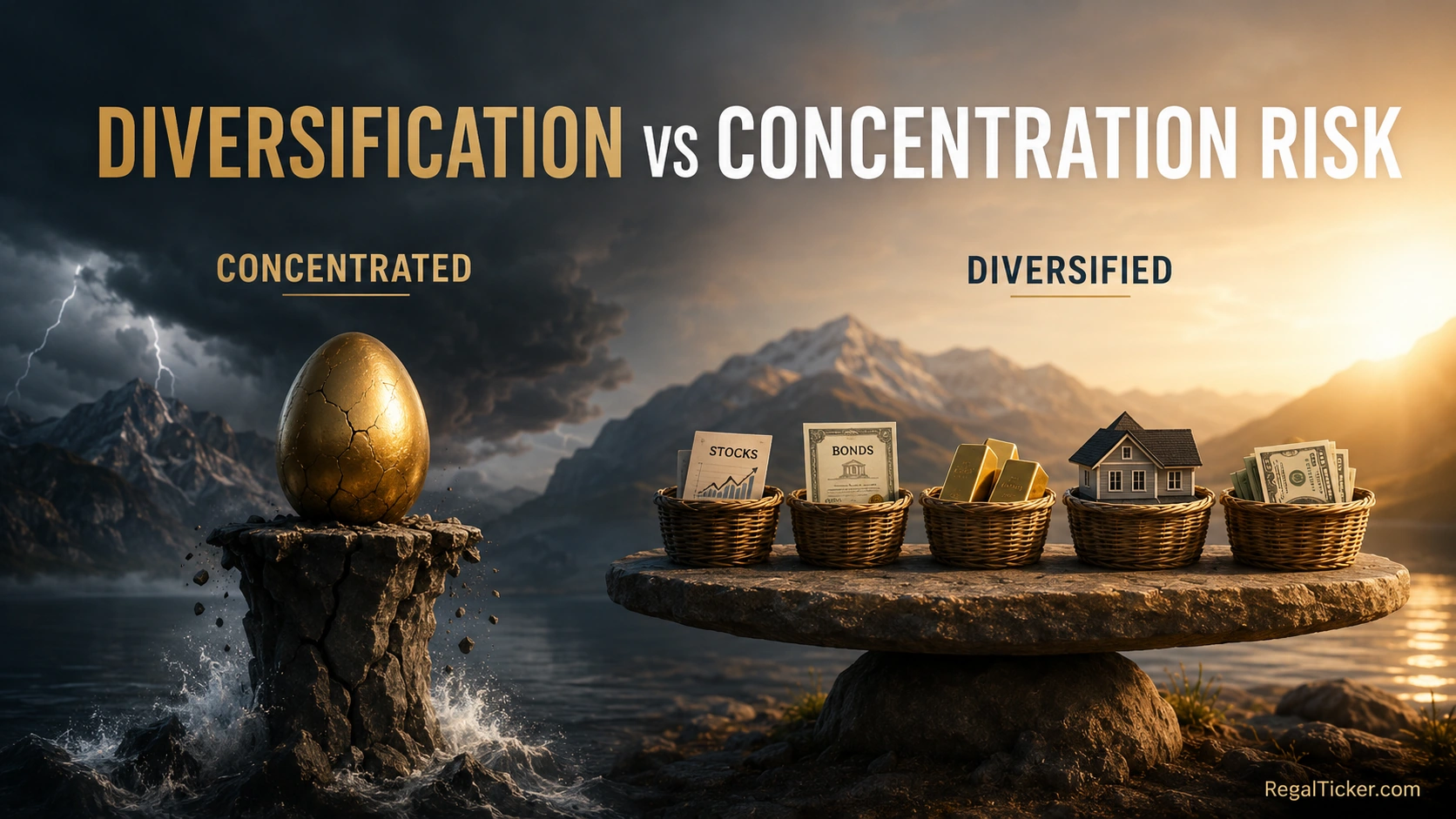
Concentration risk appears when too much of the portfolio depends on one holding, one sector, one theme or one type of market outcome.
Single-Company Concentration
Suppose an investor has a ₹10,00,000 portfolio and invests ₹6,00,000 in one company.
The company weight is:
₹6,00,000 ÷ ₹10,00,000 × 100 = 60%
If that holding falls by 40%, the damage to the full portfolio is:
60% × 40% = 24%
The portfolio loses approximately ₹2,40,000 from one holding before considering changes in the remaining assets.
The investor may have chosen a good company, but the position size created a portfolio-level vulnerability.
Use the Stock Return Calculator to test how a change in one large holding affects rupee profit, loss and total return. Then compare the result with the complete portfolio value.
Sector Concentration
Owning six banking stocks does not necessarily create six independent sources of risk.
The holdings may all be influenced by:
- interest rates;
- credit growth;
- asset quality;
- regulation;
- liquidity conditions;
- economic slowdown;
- changes in deposit or funding costs.
A sector shock can affect many holdings together.
Theme Concentration
Different company names can still represent one economic bet.
For example, several holdings may all depend on:
- infrastructure spending;
- commodity prices;
- defence orders;
- real-estate demand;
- export growth;
- digital consumption;
- interest-rate cuts.
The investor should identify the common driver behind the holdings rather than counting only ticker symbols.
Employer and Income Concentration
An investor may work in one sector, receive salary from that sector and also own many shares from the same industry.
If the sector weakens, the investor may face:
- employment risk;
- bonus or income risk;
- investment loss;
- reduced ability to invest more.
Financial risk should be considered across the household, not only inside the demat account.
Geographic and Currency Concentration
A portfolio invested entirely in one country depends heavily on that country’s economy, policy, currency and market structure.
International diversification can introduce different opportunities, but it also introduces:
- currency risk;
- foreign-market valuation risk;
- different regulations;
- taxation and reporting considerations;
- product and tracking risk.
International exposure is not automatically safer. It should be understood and sized appropriately.
Types of Diversification
A practical diversification plan uses several layers.
Diversification Across Companies
Within direct equity, spreading capital among several companies reduces dependence on one business.
However, the number of companies should remain manageable. Every holding should have a reason for being in the portfolio.
Questions to ask:
- Does this company add a different source of return?
- Does it reduce dependence on an existing holding?
- Can I monitor its results, balance sheet and risks?
- Is the position large enough to matter but small enough to protect the portfolio?
Diversification Across Sectors
Sector diversification spreads exposure across industries such as:
- financial services;
- consumer businesses;
- healthcare;
- technology;
- industrials;
- energy;
- utilities;
- communication services;
- materials.
The purpose is not to maintain equal exposure to every sector. It is to avoid an accidental portfolio dominated by one economic driver.
Diversification Across Market Capitalisation
Large-cap, mid-cap and small-cap companies can behave differently.
Large companies may offer greater scale, liquidity and established business models. Smaller companies may offer higher growth potential but can carry greater volatility, liquidity and business risk.
A portfolio should not assume that small companies always outperform or that large companies are always safe.
Diversification Across Investment Styles
Different equity strategies may include:
- growth;
- value;
- quality;
- dividend;
- momentum;
- low volatility;
- broad-market indexing.
Styles can perform differently across market cycles. However, style labels can overlap, and combining too many strategies may recreate the broad market with extra complexity and cost.
Diversification Across Asset Classes
Cross-asset diversification is a core part of asset allocation.
Equity, debt, gold and cash have different roles.
- Equity may support long-term growth but can be volatile.
- Debt may support stability, income and planned cash-flow needs but carries interest-rate and credit risk.
- Gold may behave differently during some inflationary, currency or crisis periods but does not generate business earnings.
- Cash supports liquidity and near-term needs but can lose purchasing power to inflation.
SEBI’s investor education describes shares, bonds, mutual funds, ETFs, real estate and precious metals as investment avenues with different risk and return characteristics.
Diversification Across Time
Phased investing can reduce dependence on one purchase date.
A systematic approach may help investors avoid committing all capital immediately before a market decline. However, spreading purchases over time does not guarantee a better result, and holding cash while prices rise can create an opportunity cost.
Diversification Through Funds and ETFs
A diversified mutual fund or ETF can provide exposure to many securities through one product.
The investor must still review:
- investment objective;
- underlying portfolio;
- sector concentration;
- market-cap exposure;
- index methodology;
- expense ratio;
- tracking difference;
- credit quality for debt products;
- liquidity;
- duplication with other holdings.
Owning several funds does not guarantee diversification when their portfolios overlap heavily.
How Asset Allocation Works
Asset allocation converts financial goals and risk boundaries into portfolio percentages.
Step 1: Define the Goal
Each major goal should have:
- a target amount;
- a target date;
- priority level;
- current savings;
- required future contributions;
- acceptable uncertainty.
Retirement, a home purchase and an emergency reserve should not automatically use the same allocation.
Step 2: Identify the Time Horizon
Time horizon influences the amount of volatility the investor may be able to accept.
Money needed soon should generally not depend heavily on assets that can experience large short-term declines.
SEBI’s risk-management guidance explains that investments should match the investment horizon and that volatile assets may be unsuitable for short-term needs.
A long horizon can provide more time to recover from temporary market declines, but it does not remove loss risk.
Step 3: Separate Risk Tolerance From Risk Capacity
Risk tolerance is the investor’s emotional willingness to accept fluctuations.
Risk capacity is the investor’s financial ability to absorb loss without damaging essential goals.
An investor may say, “I am comfortable with risk,” but have:
- unstable income;
- high debt;
- no emergency fund;
- a near-term financial obligation;
- dependants;
- limited ability to replace lost capital.
In that case, risk capacity may be lower than stated risk tolerance.
The portfolio should respect the lower practical limit.
Step 4: Account for Liquidity Needs
Liquidity refers to the ability to access money without unacceptable delay, cost or price impact.
Keep near-term obligations separate from long-term risk assets.
Possible liquidity needs include:
- emergency expenses;
- tuition;
- insurance premiums;
- home purchase;
- taxes;
- business requirements;
- planned large purchases.
A portfolio can appear valuable but still be unsuitable when the money is locked, volatile or difficult to sell.
Step 5: Select Broad Allocation Ranges
A simplified illustration may be:
| Investor situation | Equity | Debt | Gold | Cash/liquid reserve | Important note |
|---|---|---|---|---|---|
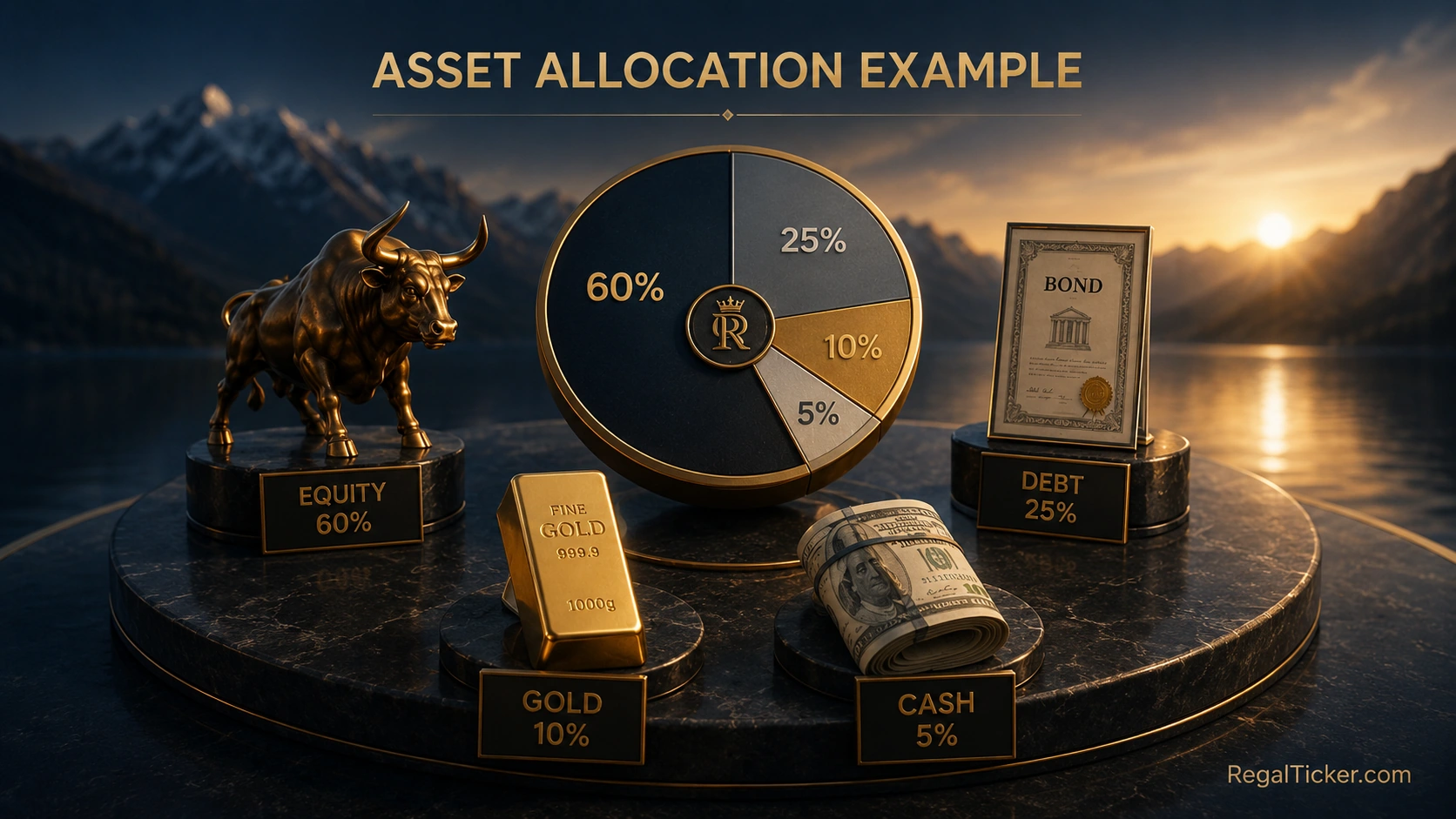
| Long horizon and high risk capacity | 65% | 20% | 10% | 5% | Illustration only; a high equity weight can still experience major drawdowns |
| Moderate horizon and balanced risk | 45% | 35% | 10% | 10% | Stability and liquidity receive more weight |
| Shorter horizon or lower risk capacity | 20% | 50% | 10% | 20% | Goal protection may matter more than maximum growth |
Step 6: Select Investments Within Each Asset Class
After the broad allocation is defined, choose suitable instruments within each category.
For equity, review:
- direct shares;
- diversified equity funds;
- index funds;
- ETFs;
- market-cap exposure;
- sector concentration.
For debt, review:
- maturity;
- duration;
- interest-rate sensitivity;
- issuer quality;
- credit risk;
- liquidity;
- taxation;
- product structure.
For gold, review:
- physical ownership;
- ETFs;
- eligible bonds or regulated instruments;
- storage, liquidity and tracking considerations.
For cash, review:
- bank access;
- deposit safety limits;
- liquidity;
- inflation;
- purpose of the reserve.
Step 7: Calculate the Portfolio Weights
Asset weight = Current asset value ÷ Total portfolio value × 100
Suppose a portfolio contains:
- equity: ₹5,40,000;
- debt: ₹2,60,000;
- gold: ₹1,20,000;
- cash: ₹80,000.
Total portfolio:
₹5,40,000 + ₹2,60,000 + ₹1,20,000 + ₹80,000 = ₹10,00,000
Weights:
- equity = 54%;
- debt = 26%;
- gold = 12%;
- cash = 8%.
A spreadsheet or portfolio tracker can calculate these percentages. The Stock Return Calculator can help measure the return of individual holdings, while the complete Investor Tools Hub supports related calculations.
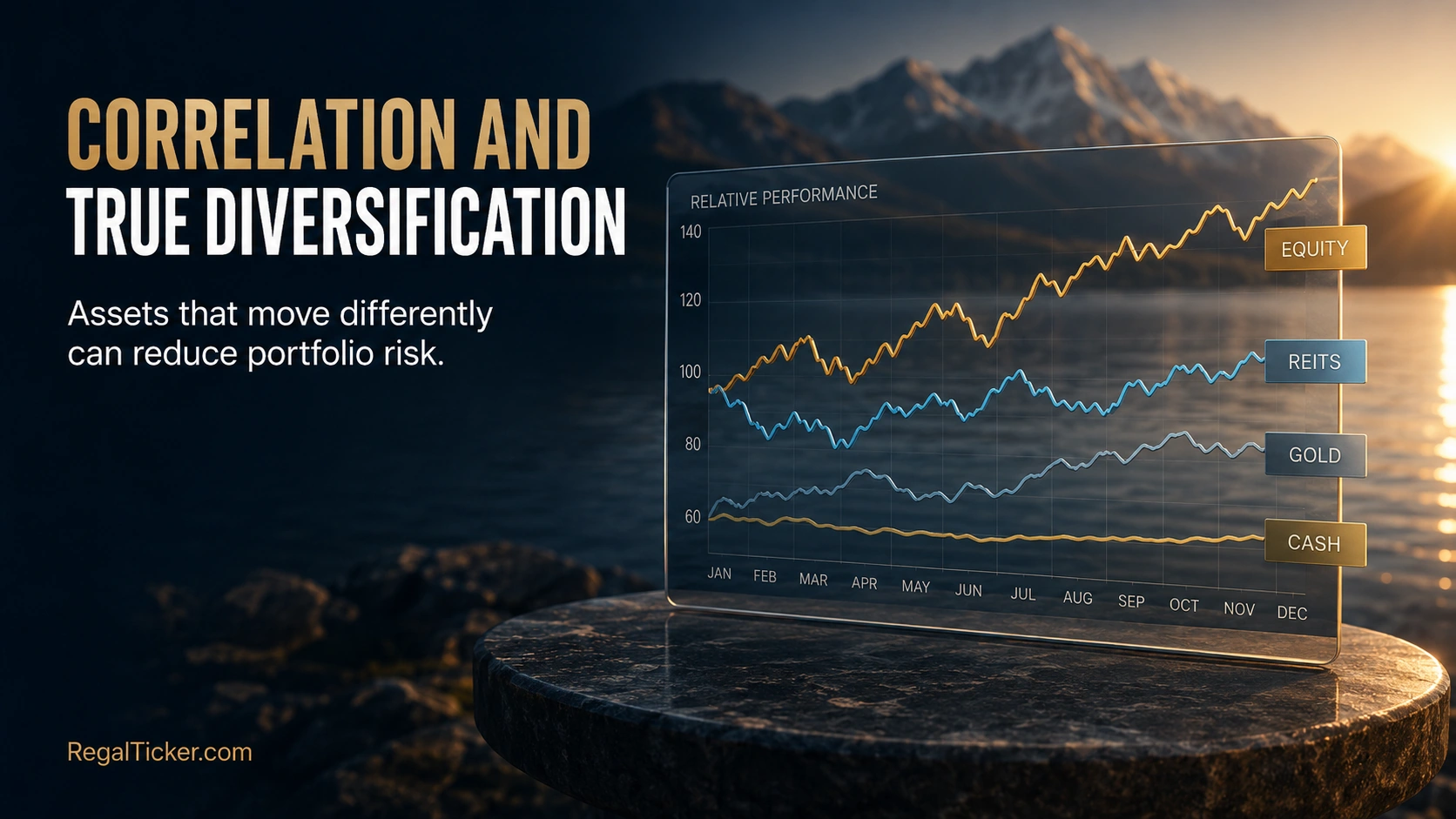
Correlation and True Diversification
Correlation describes how investments tend to move in relation to each other.
Positive Correlation
Two investments with high positive correlation often move in the same direction.
Examples may include:
- companies from the same industry;
- two funds tracking similar indices;
- several cyclical businesses;
- businesses dependent on the same commodity.
High correlation reduces the diversification benefit.
Low or Negative Correlation
Two assets with lower correlation may respond differently to the same market condition.
For example, an asset focused on capital growth may behave differently from a high-quality fixed-income allocation or cash reserve.
Low correlation does not mean one asset will always rise when another falls. Correlations can change during crises, and assets that appeared independent can decline together.
Number of Holdings vs Independent Risks
A portfolio with thirty positions may still contain only three major risk drivers.
A useful portfolio review asks:
- How many sectors are represented?
- What economic factors affect the holdings?
- How much depends on interest rates?
- How much depends on one currency?
- How much depends on consumer demand?
- How much depends on government spending?
- How much is highly liquid?
- How much can decline together during a broad market fall?
Fund Overlap
Suppose an investor owns four equity funds.
Fund A and Fund B both hold many of the same large companies. Fund C tracks a similar large-cap index. Fund D is labelled diversified but also has a large overlap.
The investor may believe four funds provide wide diversification, while the underlying portfolio remains concentrated in the same shares.
Option A
- top holdings;
- sector weights;
- market-cap weights;
- benchmark;
- investment style;
- portfolio turnover.
Option B
Correlation Is Not Permanent
Relationships change over time.
During normal markets, different assets may behave independently. During severe stress, investors may sell many assets simultaneously, causing correlations to rise.
Diversification should therefore be treated as a risk-reduction method, not a promise that one asset will always protect another.
Diversification Examples
Example 1: Concentrated Stock Portfolio
A ₹5,00,000 portfolio contains:
- Company A: ₹2,50,000;
- Company B: ₹1,00,000;
- Company C: ₹75,000;
- Company D: ₹50,000;
- cash: ₹25,000.
Company A represents 50% of the total portfolio.
If Company A falls by 35%, the portfolio loses:
₹2,50,000 × 35% = ₹87,500
That equals 17.5% of the complete portfolio before changes in other holdings.
Position-level research does not solve the allocation problem. Review Position Sizing in Stock Market when one holding has become too large.
Example 2: Many Stocks, One Sector
An investor holds ten companies, but eight are lenders or financial businesses.
A change in credit conditions affects most of the holdings together.
The portfolio has many names but limited sector diversification.
Example 3: Balanced Asset Allocation
A ₹12,00,000 portfolio has:
- equity: ₹6,00,000;
- debt: ₹3,60,000;
- gold: ₹1,20,000;
- cash: ₹1,20,000.
Weights:
- equity: 50%;
- debt: 30%;
- gold: 10%;
- cash: 10%.
The portfolio still has risk. Equity can fall, debt can face rate or credit changes, gold can decline and cash can lose purchasing power. However, the outcome is not controlled by one company or one asset class.
Example 4: Allocation Drift After a Bull Market
Initial target:
- equity: 50%;
- debt: 35%;
- gold: 10%;
- cash: 5%.
After strong equity performance, current weights become:
- equity: 65%;
- debt: 24%;
- gold: 8%;
- cash: 3%.
The portfolio is now riskier than intended even though the investor did not actively buy more equity.
This is called allocation drift.
Example 5: Rebalancing With New Contributions
Instead of selling appreciated equity immediately, the investor directs new monthly contributions toward debt, gold and cash.
This can move the portfolio gradually toward target weights while reducing transaction costs and potential tax consequences.
Example 6: Rebalancing Through Sales
When drift is large, contributions may be insufficient.
The investor may sell part of the overweight asset and buy underweight assets.
Before selling, estimate:
- brokerage;
- statutory charges;
- bid-ask spread;
- capital gains tax;
- exit load or product-specific costs;
- settlement and liquidity.
Use the Brokerage Calculator to estimate entered transaction charges and the Capital Gains Tax Calculator to review an illustrative listed-equity tax outcome under current assumptions.
Example 7: Averaging Increases Concentration
An investor owns 100 shares at ₹500 and buys another 200 shares at ₹400.
The new average price may improve, but the quantity triples from 100 to 300 shares.
Use the Stock Average Calculator to calculate the revised average. Then review the new position value and portfolio weight.
A lower average purchase price can coexist with higher concentration risk.
Portfolio Rebalancing
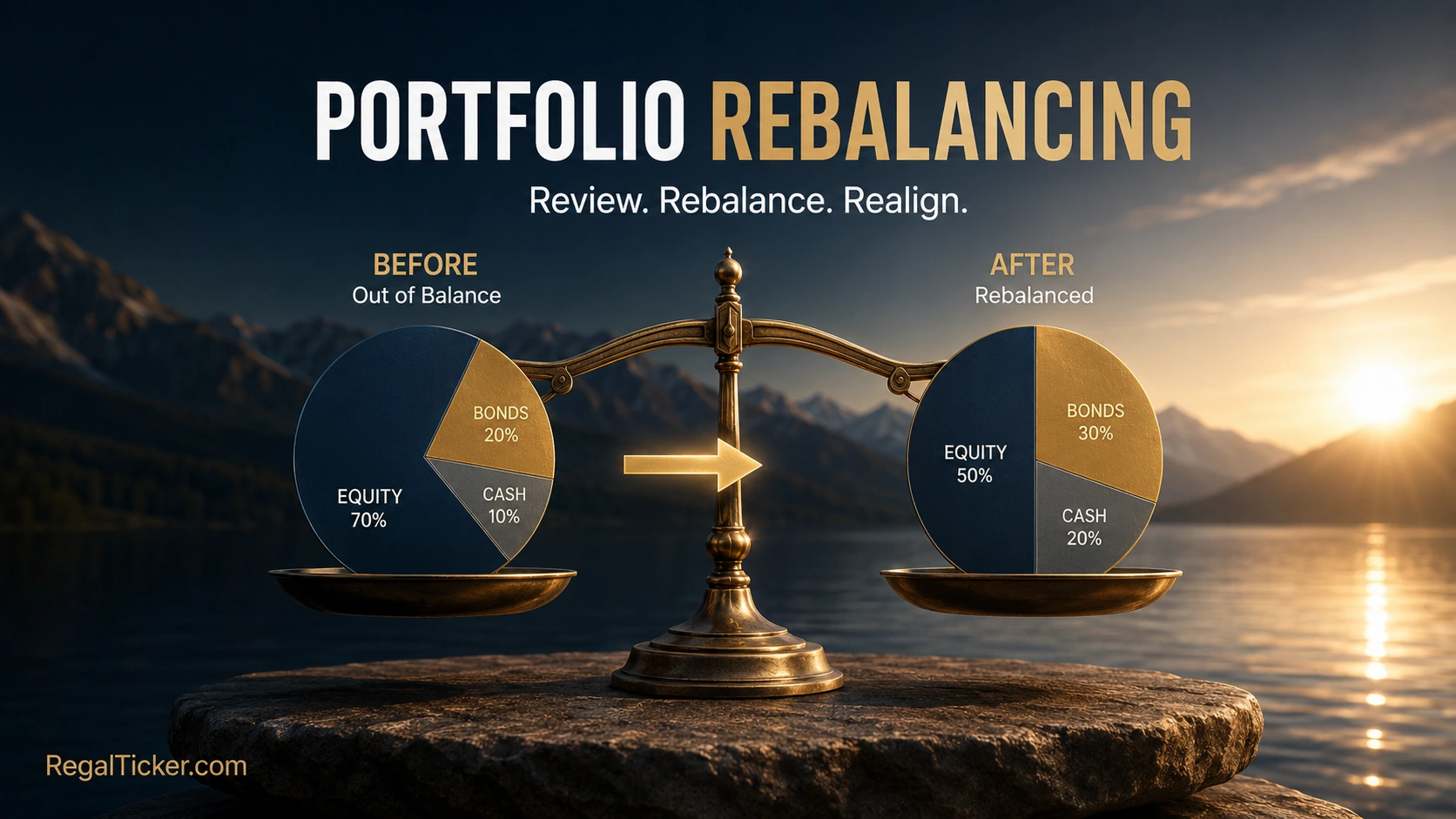
Rebalancing restores the portfolio toward its intended allocation.
Why Rebalancing Is Needed
Market returns change the weights.
If equity rises faster than debt, the equity percentage increases. If equity falls sharply, the debt and cash percentages may become larger.
Without review, the portfolio gradually becomes different from the plan.
Calendar-Based Rebalancing
The investor reviews at a fixed interval, such as:
- quarterly;
- half-yearly;
- annually.
The benefit is simplicity.
The risk is unnecessary trading when the allocation has barely changed.
Threshold-Based Rebalancing
The investor acts when an asset class moves beyond a specified range.
💡 Real example
Simple example
target equity: 50%; permitted band: 45% to 55%; rebalance only when equity moves outside the band.
Thresholds should be reasonable. Very narrow bands can cause frequent trading.
Contribution-Based Rebalancing
New contributions are directed to underweight asset classes.
This method can reduce sales, taxes and transaction costs.
It works best when new contributions are meaningful relative to the portfolio size.
Withdrawal-Based Rebalancing
When money is needed, withdrawals can come from overweight assets.
This can support rebalancing without separate sales.
Rebalancing Formula
Rebalancing amount = Target asset value − Current asset value
Suppose total portfolio value is ₹10,00,000 and target equity is 50%.
Target equity value:
₹10,00,000 × 50% = ₹5,00,000
Current equity value is ₹6,20,000.
Equity is overweight by:
₹6,20,000 − ₹5,00,000 = ₹1,20,000
The investor does not automatically need to sell the full ₹1,20,000. New contributions, tax effects, transaction costs and goal changes should be considered.
Rebalancing Is Not Market Timing
Rebalancing does not require predicting the next market move.
It follows a predetermined risk structure.
The investor sells or contributes based on portfolio weights, not because of a claim that a market peak or bottom is certain.
Review Before Rebalancing
Check:
- Has the financial goal changed?
- Has the time horizon shortened?
- Has income stability changed?
- Is the emergency reserve adequate?
- Has risk capacity changed?
- Are the investments still suitable?
- What costs and taxes will apply?
- Can contributions correct the drift?
- Is the portfolio truly diversified?
- Is the target allocation itself still appropriate?
Calculator Workflow for Diversification and Allocation
RegalTicker calculators should be used as one connected review process.
Stock Return Calculator
Use the Stock Return Calculator to measure:
- purchase and current value;
- realised or unrealised profit and loss;
- dividends where entered;
- total return;
- annualised return where relevant.
Do not evaluate a holding only by return. Also examine its portfolio weight and contribution to total risk.
Stock Average Calculator
Use the Stock Average Calculator before adding to an existing position.
The calculator shows the revised weighted average, but the investor must separately check:
- total quantity;
- total capital committed;
- portfolio percentage;
- sector exposure;
- thesis risk.
Brokerage Calculator
Use the Brokerage Calculator when rebalancing requires buying and selling.
A mathematically perfect rebalance can be inefficient when trading costs are high relative to the adjustment.
Capital Gains Tax Calculator
Use the Capital Gains Tax Calculator to estimate the possible tax effect of a listed-equity sale under the entered assumptions.
Tax rules and personal circumstances can change. Verify the current law and seek professional guidance where needed.
Risk-Reward Calculator
The Risk-Reward Calculator is mainly a trade-planning tool. It can still be useful when a portfolio position has a defined entry, invalidation and target.
It does not determine the correct portfolio allocation.
Investor Tools Hub
Use the Investor Tools Hub to access the full calculator collection.
A practical portfolio-review sequence is:
Measure holding return → calculate revised average → review position weight → estimate rebalancing costs → estimate tax impact → update allocation records
Common Diversification and Asset Allocation Mistakes
Mistake 1: Counting Holdings Instead of Risks
Twenty highly correlated holdings can behave like one large position.
Mistake 2: Diversifying After a Loss
Investors often concentrate during excitement and diversify only after damage occurs.
Diversification should be planned before risk becomes visible.
Mistake 3: Buying Every Popular Sector
Adding the latest popular theme can increase correlation and valuation risk.
Mistake 4: Owning Too Many Overlapping Funds
Several funds may hold the same companies and sectors.
Mistake 5: Ignoring Position Size
A portfolio may include many holdings, but one position can still represent half the capital.
Mistake 6: Equal Weighting Without Reason
Equal percentages are simple, but the holdings may have very different risk, liquidity and business quality.
Mistake 7: Using Age Alone
Rules such as “equity percentage equals 100 minus age” are broad shortcuts. They ignore goals, liabilities, income stability, dependants, risk capacity and market conditions.
Mistake 8: Treating Debt as Risk-Free
Debt carries interest-rate, reinvestment, credit, liquidity and inflation risk.
Mistake 9: Treating Gold as a Guaranteed Hedge
Gold can decline and may not protect the portfolio during every market event.
Mistake 10: Keeping No Cash Reserve
An investor may be forced to sell volatile assets during a decline when no liquid reserve is available.
Mistake 11: Excessive Rebalancing
Frequent small adjustments can create costs, taxes and behavioural stress.
Mistake 12: Never Rebalancing
A portfolio can become much more aggressive or conservative than intended.
Mistake 13: Ignoring the Household Balance Sheet
Loans, property, salary, business ownership and emergency reserves affect the total financial risk.
Mistake 14: Chasing Past Performance
The best-performing asset class from the previous period may not lead the next period.
Mistake 15: Confusing Diversification With Guaranteed Safety
Diversification reduces selected risks. It does not guarantee returns or prevent broad losses.
Diversification and Asset Allocation Checklist
Before finalising a portfolio, ask:
- What financial goal does this portfolio serve?
- When will the money be required?
- How much loss can the goal tolerate?
- How much volatility can I tolerate emotionally?
- Is my risk capacity lower than my risk tolerance?
- Is an emergency reserve maintained separately?
- What percentage is in equity, debt, gold and cash?
- Is one company too large?
- Is one sector too large?
- Do several holdings depend on the same economic factor?
- Do my funds overlap?
- Is the debt allocation diversified by issuer and maturity where relevant?
- Is the portfolio liquid enough for expected needs?
- Are costs and taxes considered?
- Is the allocation documented?
- What drift will trigger a review?
- Can contributions rebalance the portfolio?
- Have my goals or liabilities changed?
- Do I understand every product?
- Am I relying on diversification as a guarantee?
Frequently Asked Questions
What is diversification in simple words?
Diversification means spreading money across several investments so that one poor outcome does not control the whole portfolio.
What is asset allocation?
Asset allocation is the percentage distribution of a portfolio among broad asset classes such as equity, debt, gold and cash.
What is the difference between diversification and asset allocation?
Asset allocation sets the broad percentages. Diversification spreads risk within and across those categories.
How many stocks are needed for diversification?
There is no universal number. Sector mix, position size, correlation, liquidity and the ability to monitor holdings matter more than a fixed count.
Can mutual funds provide diversification?
A diversified mutual fund can hold many securities, but the investor must review the scheme objective, portfolio concentration, benchmark, costs and overlap with other funds.
Does diversification reduce returns?
Diversification can reduce dependence on one exceptional winner, but its purpose is to improve the balance between risk and return rather than maximise the outcome of one concentrated bet.
Can diversification prevent losses?
No. A diversified portfolio can lose money during broad market declines or when several assets fall together.
What is portfolio correlation?
Correlation describes how investments tend to move relative to one another. Highly correlated holdings provide less diversification benefit.
What is rebalancing?
Rebalancing is the process of restoring the portfolio toward its target allocation after market movements or cash flows change the weights.
How often should a portfolio be rebalanced?
There is no single schedule. Calendar-based and threshold-based reviews are common. Costs, taxes and the size of the drift should be considered.
Should an investor sell winners to rebalance?
Not automatically. New contributions, withdrawals, taxes, costs and goal changes should be considered before selling.
Can averaging down create concentration risk?
Yes. A lower average price may come with a much larger quantity and portfolio weight. Recalculate the average and total exposure.
Is cash part of asset allocation?
Yes. Cash and liquid reserves support near-term obligations and reduce forced selling, although inflation can reduce purchasing power.
Is gold necessary in every portfolio?
No asset is universally required. Suitability depends on goals, total financial position, risk tolerance, product understanding and the role the asset is expected to play.
Where can I review investment asset classes?
SEBI Investor provides educational guidance on shares, bonds, mutual funds, ETFs, real estate and precious metals, along with an illustrative asset-allocation calculator.
Final Takeaway
Diversification and asset allocation are portfolio-level risk-management tools.
Diversification reduces dependence on one holding, sector, strategy or economic outcome.
Asset allocation determines how much capital is placed in equity, debt, gold, cash and other suitable categories.
Use the process in the correct order:
- define the goal;
- identify the time horizon;
- separate risk tolerance from risk capacity;
- protect liquidity needs;
- choose broad allocation ranges;
- diversify within each category;
- calculate current portfolio weights;
- identify concentration and correlation;
- define rebalancing rules;
- consider costs and taxes;
- review after major life changes;
- measure actual outcomes.
The Stock Return Calculator helps measure holding performance, the Stock Average Calculator helps review staged purchases, the Brokerage Calculator estimates trading costs and the Capital Gains Tax Calculator helps review an illustrative tax impact before rebalancing.
The complete Investor Tools Hub supports the wider calculation workflow.
A portfolio should not be diversified merely to look sophisticated. Every holding should have a clear role, every asset class should serve a goal and the complete allocation should remain understandable.
Continue Learning on RegalTicker
- Risk Management in Stock Market
- Position Sizing in Stock Market
- Risk-Reward Ratio in Stock Market
- Stop-Loss Orders in Stock Market
- What Is a Share?
- What Is Fundamental Analysis?
- Investor Tools Hub
Official References
- SEBI Investor — Factors to Consider Before Investing
- SEBI Investor — Understanding Investment Asset Classes
- SEBI Investor — How to Manage Investment Risks
- SEBI Investor — Asset Allocation Calculator
- AMFI — Investor Corner
- AMFI — Types of Mutual Fund Schemes
Educational disclaimer: This article is for investor education and general information only. It is not personalised investment advice, a research recommendation, a solicitation, a financial plan or a guarantee of returns. Diversification and asset allocation cannot eliminate all market, liquidity, credit, inflation, tax or operational risks. Illustrative percentages and examples are not recommendations. Verify current information through official sources and consult an appropriately qualified professional where necessary.