
⚡ Quick answer
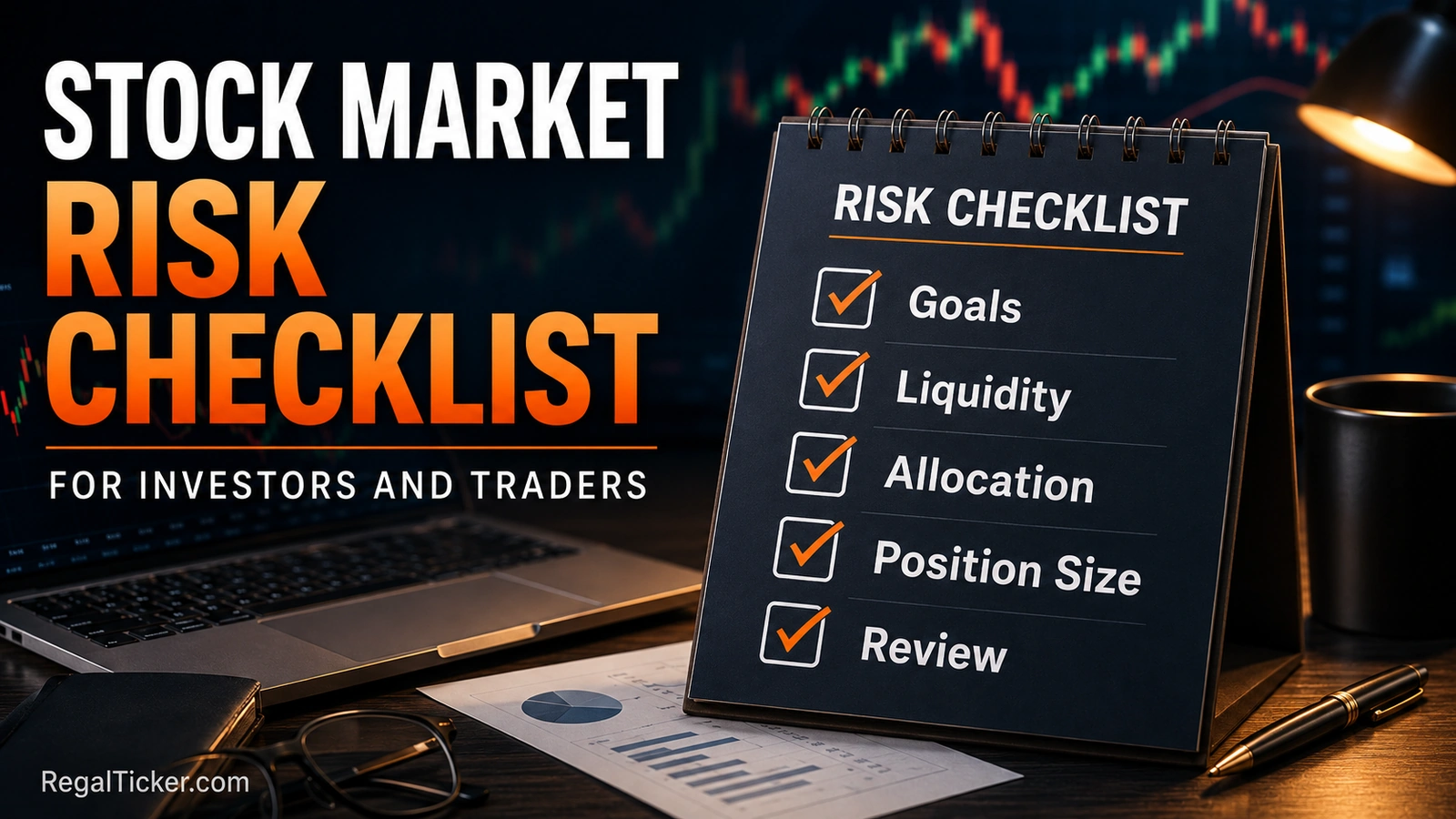
A stock market risk checklist is a structured set of questions used before, during and after an investment or trade. It checks whether the decision matches the investor’s goal, time horizon, liquidity needs, risk capacity, portfolio allocation, position-size limit, exit plan and emotional state. It does not predict whether the market will rise or fall. Its purpose is to prevent one decision from taking more financial or behavioural risk than the overall plan can safely absorb.
Investor note
Key Takeaways
Risk should be checked before capital is committed, not after the market moves against the position. Essential expenses and near-term goals should not depend on a favourable market price. Risk appetite and financial risk capacity are different. Portfolio allocation, concentration and liquidity matter more than the number of holdings alone. A position should be sized from the maximum acceptable loss and the distance to invalidation. A stop-loss order does not guarantee execution at the chosen price. Reward-to-risk arithmetic cannot prove that an idea is likely to succeed. Brokerage, statutory charges, taxes and slippage reduce the actual outcome. FOMO, revenge trading and overconfidence are risk variables, not merely emotions. Investors and traders need different checklists because their holding periods and exit rules differ. The checklist should produce a clear action: proceed, reduce size, wait, reject or review. Calculators make the assumptions visible but cannot replace analysis or judgement.
A market decision can look attractive and still be unsuitable.
A company may be fundamentally strong, but the position may be too large. A trade may offer an appealing target, but the entry may be late. A diversified fund may be reasonable, but the money may be required too soon. A profitable strategy may still create poor results when brokerage, taxes and emotional overtrading are ignored.
This is why risk management should not be reduced to one stop-loss number.
A complete decision includes:
the purpose of the money; the investment horizon; essential liquidity; portfolio allocation; concentration; entry and exit conditions; quantity; total open risk; transaction costs; tax consequences; behavioural readiness; the process for reviewing the result.
This final lesson brings together the complete Risk & Psychology learning sequence:
Risk Management in Stock Market Position Sizing in Stock Market Risk-Reward Ratio in Stock Market Stop-Loss Orders in Stock Market Diversification and Asset Allocation Explained Portfolio Drawdown and Capital Protection Trading Psychology: Fear, Greed and Discipline Behavioural Biases in Investing How to Create a Personal Risk-Management Plan
SEBI’s investor guidance asks investors to consider their objectives, risk appetite, investment horizon, safety, return, liquidity, diversification, asset allocation, charges and periodic portfolio review. This checklist converts those broad principles into practical questions.
How to Use This Stock Market Risk Checklist
The checklist is not a form that must be completed mechanically.
Its job is to expose a weak assumption before that weakness becomes a financial loss.
Use It at Three Stages
Use the checklist:
- Before the decision
Confirm suitability, allocation, risk, price, quantity and costs.
- While the position is open
Check whether new evidence has changed the thesis or whether emotion is changing the plan.
- After the decision
Compare the written plan with the actual execution and outcome.
Use Clear Answers
Avoid vague answers such as:
- “The risk looks manageable.”
- “The company is good.”
- “I will exit if something goes wrong.”
- “I can hold for the long term.”
- “The price should recover.”
Use measurable answers:
- maximum allocation: 7%;
- maximum planned loss: ₹5,000;
- goal date: March 2032;
- emergency reserve: eight months;
- thesis review: after the next quarterly result;
- invalidation: debt exceeds the written limit;
- stop-loss: ₹472;
- target: ₹575;
- quantity: 150 shares.
The Checklist Must Be Allowed to Reject the Decision
A checklist is useless when every answer is adjusted until the desired trade is approved.
Possible outcomes should include:
- proceed;
- proceed with smaller size;
- wait for a better price;
- reduce another exposure first;
- conduct more research;
- move the money to a more suitable asset;
- reject the opportunity.
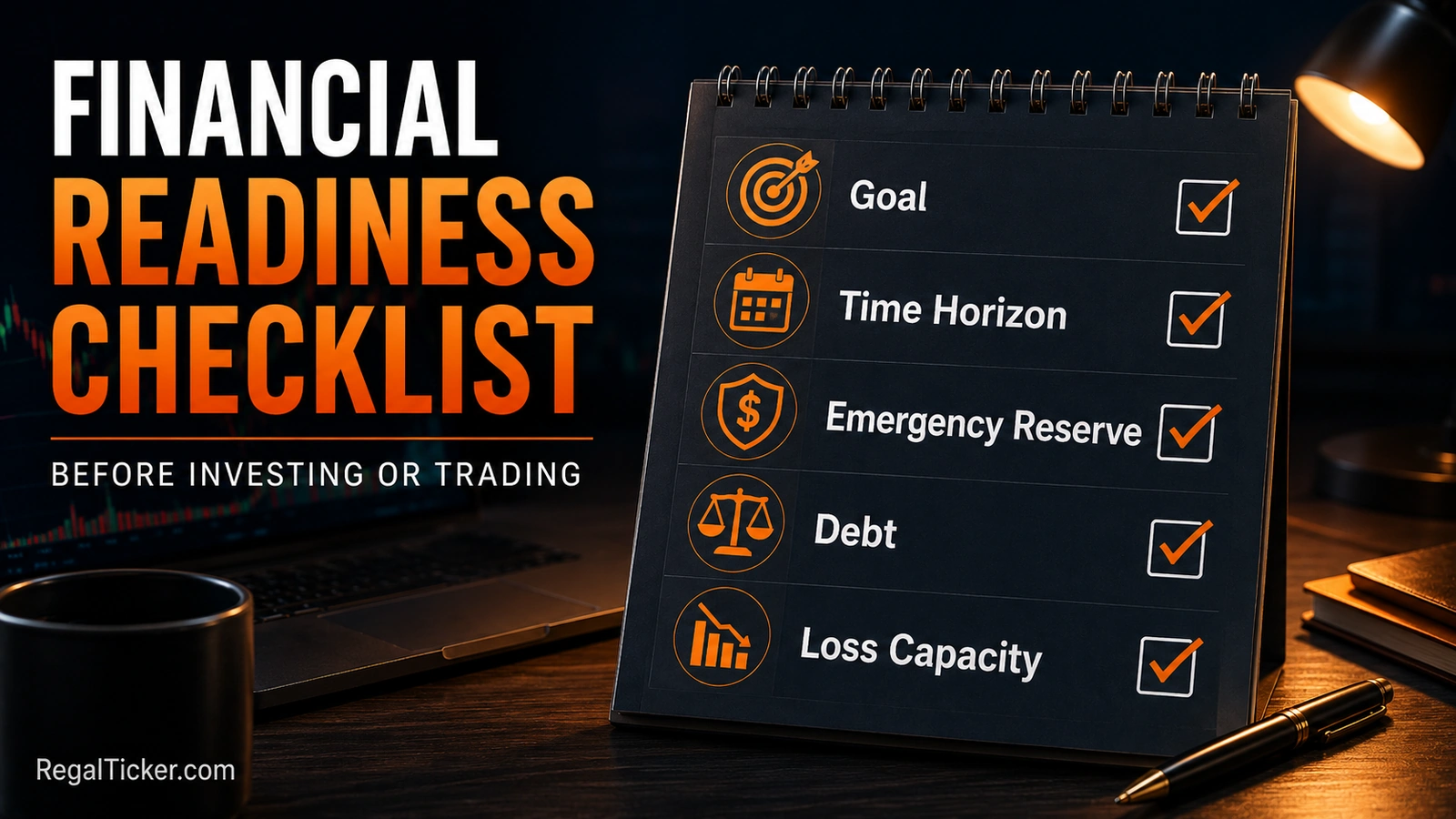
Financial Readiness Before Investing or Trading
Market risk begins outside the market.
An investor who has no emergency reserve, unstable income or a near-term financial obligation may be unable to tolerate even an ordinary decline.
Check 1: What Is the Money For?
Write the purpose.
Examples:
- emergency reserve;
- education;
- house purchase;
- retirement;
- long-term wealth;
- active trading;
- speculation.
Money without a clear purpose is easily moved toward whatever currently appears exciting.
Check 2: When Will the Money Be Needed?
The investment horizon influences suitable risk.
A long horizon may allow time for market cycles and compounding. A short horizon increases the danger of being forced to sell during a decline.
Ask:
- Is the date fixed or flexible?
- Can the goal be delayed?
- Can contributions increase?
- Would a 20% decline near the goal date create a crisis?
- Is the investment sufficiently liquid?
SEBI notes that volatile or illiquid investments may be unsuitable when money is needed in the near future.
Check 3: Is Emergency Liquidity Separate?
Do not treat a volatile portfolio as an emergency reserve.
The checklist should record:
- months of essential expenses available;
- where the reserve is held;
- whether it can be accessed quickly;
- whether insurance covers major risks;
- whether the reserve must be replenished.
Check 4: Is High-Cost Debt Under Control?
A person paying expensive interest while taking speculative market risk may be creating a fragile financial structure.
Option A
- guaranteed interest cost;
- uncertain expected investment return;
- liquidity;
- tax effect;
- behavioural pressure.
- The checklist should not automatically approve market risk while essential debt obligations are unstable.
Option B
Check 5: What Is the Real Loss Capacity?
Risk capacity is the financial ability to absorb a loss.
Ask what would happen if the invested amount fell:
- 10%;
- 20%;
- 30%;
- 50%.
Convert each percentage into rupees.
For ₹8,00,000:
| Decline | Rupee loss | Remaining value |
|---|---|---|
| 10% | ₹80,000 | ₹7,20,000 |
| 20% | ₹1,60,000 | ₹6,40,000 |
| 30% | ₹2,40,000 | ₹5,60,000 |
| 50% | ₹4,00,000 | ₹4,00,000 |
The rupee amount often reveals more than the percentage.
Check 6: Does the Product Match the Investor’s Knowledge?
Complexity is a source of risk.
Before using a product or strategy, ask:
- Can I explain how returns are generated?
- Can the loss exceed the initial amount?
- Is leverage involved?
- Is liquidity available when needed?
- What fees apply?
- What events can create sudden loss?
- Is the product regulated?
- Do I understand the tax treatment?
NSE’s investor guidance notes that higher-risk products require relevant experience and risk tolerance.
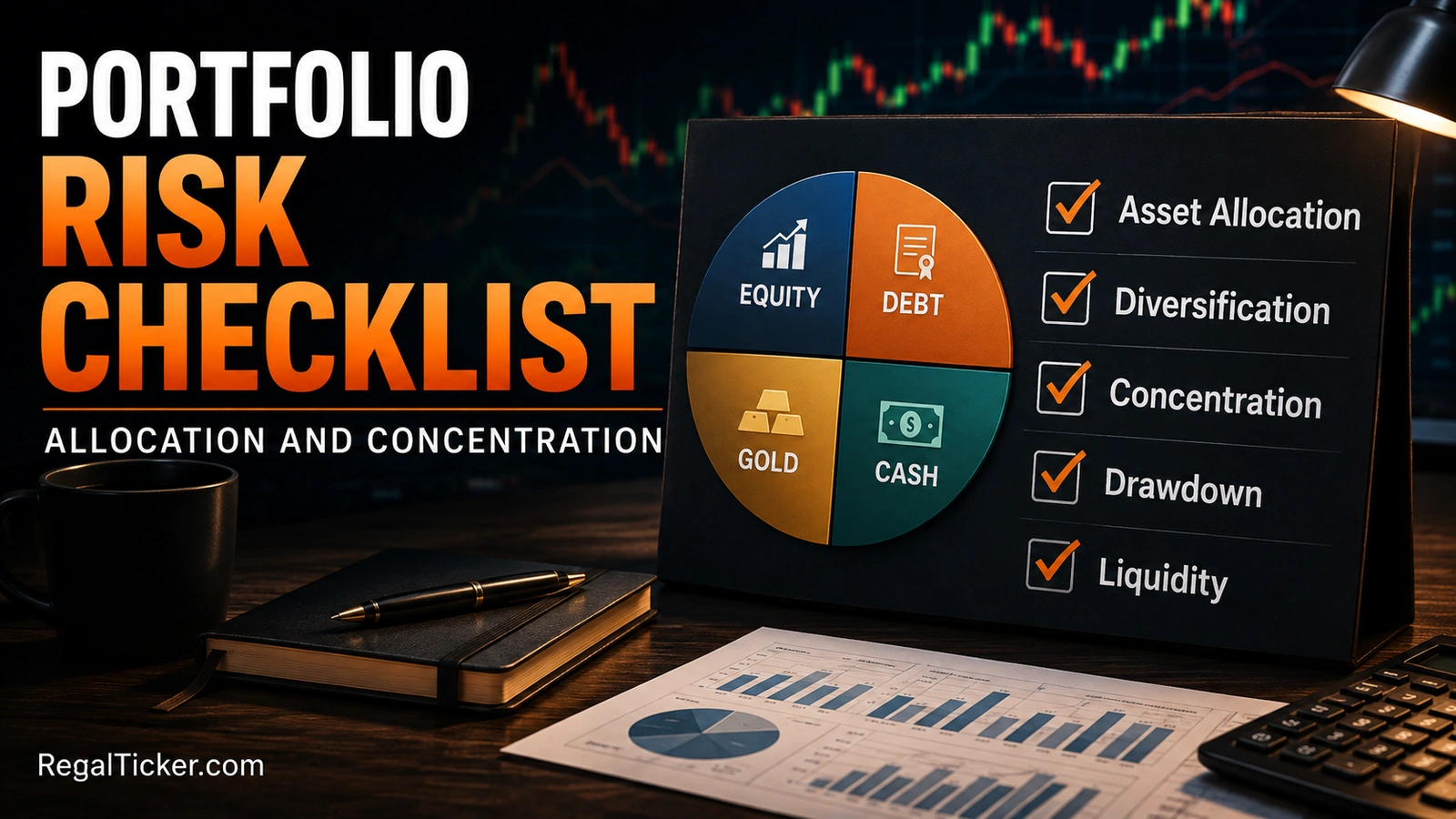
Portfolio Risk Checklist for Investors
A portfolio containing many securities is not automatically diversified.
Twenty stocks can still depend on the same sector, economic cycle, interest-rate outcome or market style.
Check 7: Is the Asset Allocation Written?
Record the target allocation and permitted range.
💡 Real example
Simple example
| Asset class | Target | Permitted range | |—|—:|—:| | Equity | 60% | 55%–65% | | Debt | 25% | 20%–30% | | Gold | 10% | 5%–15% | | Cash | 5% | 3%–10% |
The percentages are only an example.
Allocation should reflect goals, horizon, liquidity, risk capacity and personal circumstances.
Check 8: Is the Portfolio Diversified by Risk Source?
Check diversification across:
- companies;
- sectors;
- market capitalisation;
- asset classes;
- investment styles;
- geographies where appropriate;
- income sources;
- liquidity profiles.
Diversification can reduce the effect of one failure, but it cannot remove market-wide risk.
Check 9: Is Any Position Too Large?
Write maximum limits for:
- one company;
- one sector;
- employer shares;
- one investment theme;
- illiquid assets;
- speculative positions.
A stock that rises sharply may become oversized even when the original purchase was reasonable.
Check 10: Is the Portfolio More Correlated Than It Appears?
Different names may represent the same underlying risk.
Examples:
- several banks;
- several small-cap funds;
- multiple technology companies;
- employer income and employer shares;
- gold-related securities and gold funds;
- different leveraged strategies dependent on market momentum.
Ask what could fall together during stress.
Check 11: What Drawdown Can the Portfolio Tolerate?
A drawdown is measured from the previous peak.
Review Portfolio Drawdown and Capital Protection and write:
- the expected drawdown range;
- the drawdown that triggers review;
- the drawdown that stops new speculative activity;
- the drawdown that requires a formal allocation review.
Do not create a threshold that guarantees panic before it is reached.
Check 12: Is Near-Term Withdrawal Money Protected?
A portfolio may be suitable for long-term accumulation but unsuitable for an investor who must withdraw money soon.
For regular withdrawals, use the SWP Calculator to test different withdrawal amounts and assumed returns.
The projection does not guarantee that returns will occur in a smooth sequence.
Check 13: Has Allocation Drifted?
A rising asset can become overweight. A falling asset can become underweight.
Rebalancing options include:
- directing new contributions;
- using dividends or interest;
- partially selling an overweight asset;
- combining methods.
Before selling, estimate charges with the Brokerage Calculator and possible tax with the Capital Gains Tax Calculator.
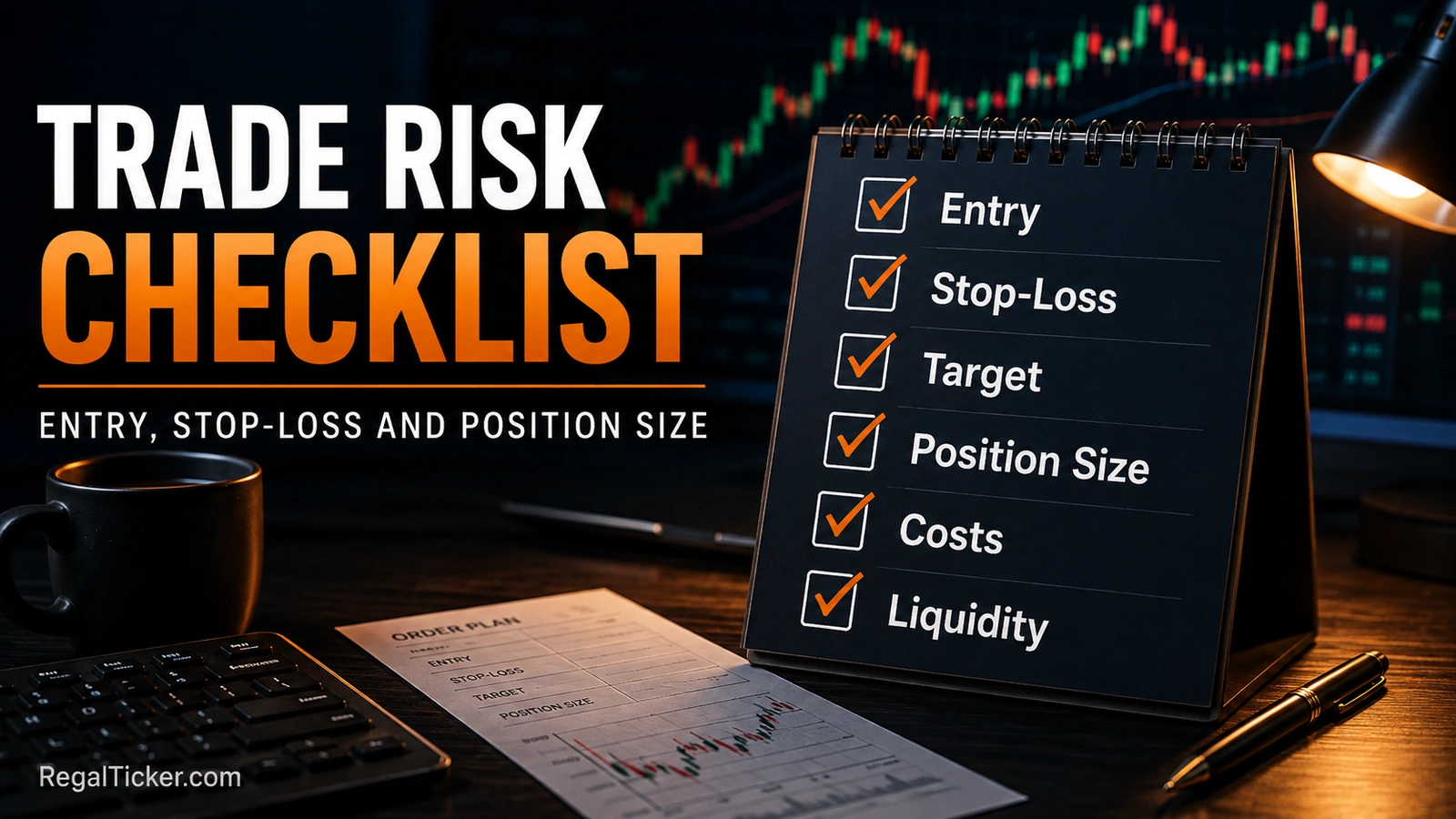
Trade Risk Checklist Before Entry
A trader needs a more precise execution checklist because the holding period, invalidation and quantity are usually defined before entry.
Check 14: Is the Setup Clearly Defined?
A setup should be explainable without using the expected profit as the reason.
Examples:
- breakout with volume;
- pullback in an established trend;
- reversal near a defined support zone;
- event-driven setup with known risk;
- mean-reversion setup within a tested range.
Avoid:
- “The stock is moving.”
- “Everyone is buying.”
- “It has already fallen a lot.”
- “I need to recover my last loss.”
Check 15: Is the Entry Still Valid at the Current Price?
A valid idea can become an invalid trade when the price moves.
Assume the original plan:
- entry: ₹500;
- stop-loss: ₹480;
- target: ₹560.
Risk per share = ₹20 Potential reward per share = ₹60 Reward-to-risk ratio = 3:1
If the trader enters at ₹545 while keeping the same stop and target:
Risk per share = ₹65 Potential reward per share = ₹15 Reward-to-risk ratio = 0.23:1
The original opportunity no longer exists.
Use the Risk-Reward Calculator to compare the planned entry with the current entry.
Check 16: Is the Invalidation Logical?
The stop-loss should represent the point at which the setup is no longer acceptable.
It should not be selected only because:
- a round number looks convenient;
- the trader wants a larger quantity;
- the loss amount feels emotionally comfortable;
- another person suggested it.
The correct process is:
- identify the invalidation;
- calculate the distance from entry;
- reduce quantity until the total planned loss fits the risk limit.
Check 17: Is Position Size Calculated from Risk?
The basic structure is:
Position size = Maximum acceptable loss ÷ Risk per share
Suppose:
- account capital: ₹6,00,000;
- maximum risk per trade: 0.75%;
- entry: ₹320;
- stop-loss: ₹308.
Maximum acceptable loss:
₹6,00,000 × 0.75% = ₹4,500
Risk per share:
₹320 − ₹308 = ₹12
Quantity:
₹4,500 ÷ ₹12 = 375 shares
The calculation assumes the stop executes at the chosen price. Gaps and poor liquidity can produce a larger loss.
Check 18: Is Total Open Risk Acceptable?
Four positions risking 1% each create 4% open risk.
If the positions are highly correlated, several may fail together.
Record:
- risk on each open trade;
- total open risk;
- same-sector risk;
- event risk;
- overnight gap risk;
- leverage.
Check 19: Is the Target Realistic?
A target should be connected to:
- support or resistance;
- volatility;
- expected price structure;
- tested strategy rules;
- valuation or event expectation.
A very distant target can create an attractive ratio without a realistic probability.
Check 20: Have Costs Been Included?
Trading costs can include:
- brokerage;
- STT;
- exchange transaction charges;
- SEBI turnover fees;
- GST;
- stamp duty;
- DP charges for delivery sales;
- bid-ask spread;
- slippage.
Use the Brokerage Calculator before accepting a small profit target.
Zero brokerage does not mean zero trading cost.
Check 21: Is Liquidity Sufficient?
Check:
- average volume;
- bid-ask spread;
- market depth;
- order size relative to normal activity;
- possible price gap;
- ability to exit.
A position can be easy to enter and difficult to exit.
Execution, Stop-Loss and Order Checklist
A correct analysis can still produce a poor result through weak execution.
Check 22: Is the Order Type Appropriate?
Understand the difference between:
- market order;
- limit order;
- stop-loss order;
- stop-limit order.
Read Market Order, Limit Order, Stop-Loss and Stop-Limit Order before using an unfamiliar order type.
A market order prioritises execution, not price. A limit order prioritises price, not execution.
Check 23: Is the Stop-Loss Order Actually Placed?
A mental stop may be changed when the loss becomes emotionally uncomfortable.
A written process should define:
- stop trigger;
- stop order type;
- whether the stop may be tightened;
- whether it may be widened;
- gap-risk assumption;
- action if the order fails.
Read Stop-Loss Orders in Stock Market.
Check 24: Are Partial Exits Planned?
If the strategy uses partial profit booking, define:
- the quantity to exit;
- the price or condition;
- what happens to the remaining stop;
- how the final result is recorded.
Do not invent partial-exit rules only after open profit creates anxiety.
Check 25: Is Event Risk Known?
Relevant events can include:
- earnings;
- board meeting;
- regulatory decision;
- court ruling;
- dividend or corporate action;
- economic data;
- election result;
- central-bank announcement.
An investor may accept event risk. A short-term trader may reduce or avoid it.
The key is that the exposure is deliberate.
Emotional Risk Checklist
Emotions do not need to disappear. They must not be allowed to change the risk limits without evidence.
Check 26: Is the Decision Driven by FOMO?
Warning signs:
- price has already moved sharply;
- social media is repeating the idea;
- the trader recently missed another opportunity;
- the current entry is outside the plan;
- quantity is being increased because the move may continue.
Recalculate the current reward-to-risk ratio.
A missed trade is not a financial loss.
Check 27: Is This Revenge Trading?
Ask:
- Am I trying to recover the previous loss immediately?
- Is the quantity larger than normal?
- Is the setup weaker?
- Did I skip the normal review?
- Would I take this trade after a profitable day?
If the answer shows emotional escalation, stop.
Check 28: Has a Winning Streak Created Overconfidence?
Overconfidence can cause:
- larger positions;
- more trades;
- weaker research;
- reduced diversification;
- leverage;
- ignored stops.
A series of profitable outcomes does not prove that risk has disappeared.
Check 29: Is Loss Aversion Preventing a Necessary Exit?
Ask:
- Am I holding only because selling would realise the loss?
- Would I buy this position today?
- Has the thesis changed?
- Is the position consuming capital that has a better use?
- Am I anchored to the purchase price?
Review Behavioural Biases in Investing.
Check 30: Is the Position Size Emotionally Tolerable?
An oversized position changes behaviour.
Signs include:
- continuous price checking;
- early profit booking;
- stop widening;
- inability to sleep;
- conflict with family;
- panic during ordinary volatility.
A smaller position may improve execution more than a more complicated strategy.
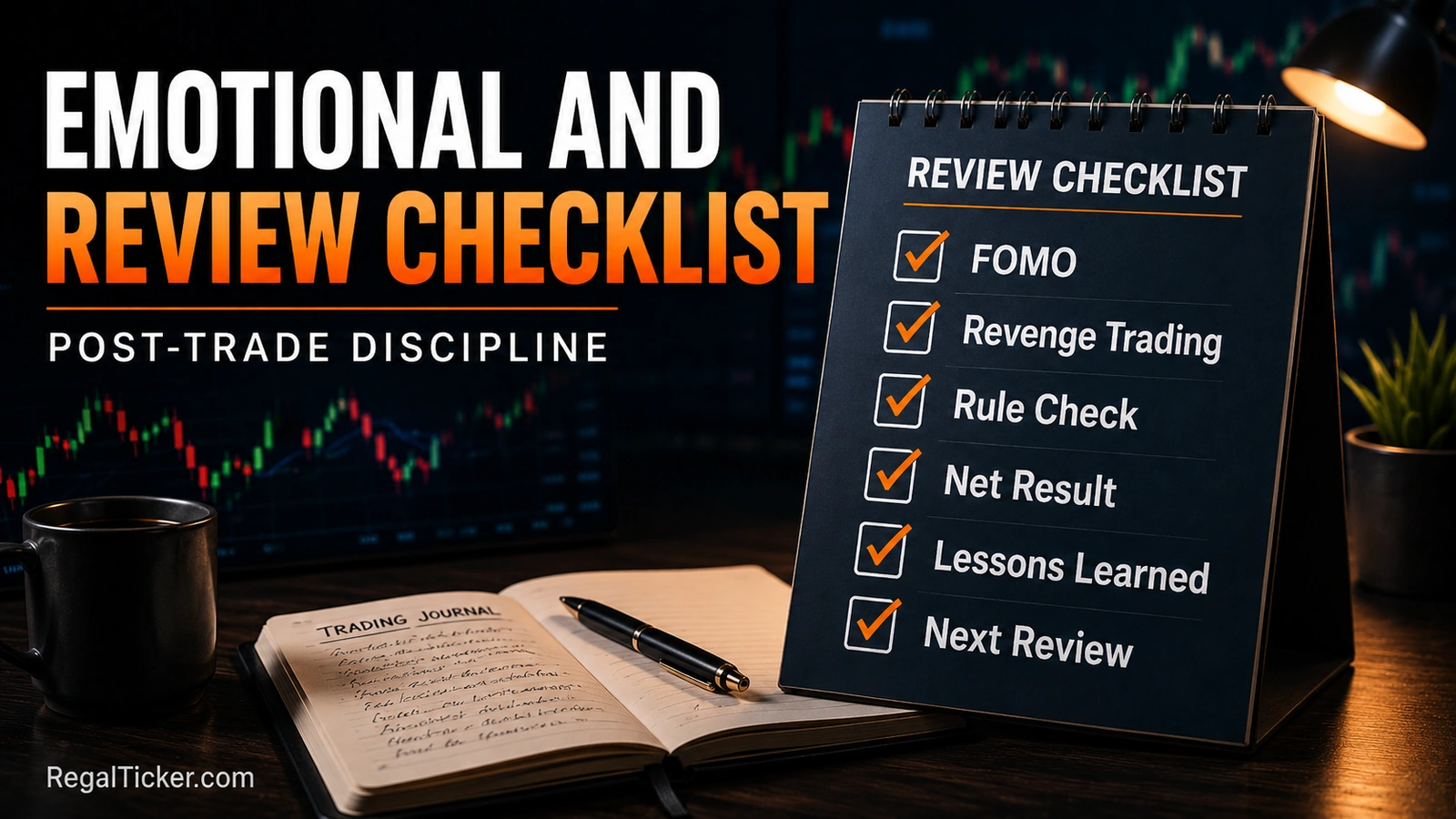
Post-Trade and Post-Investment Review Checklist
The review should separate outcome from process.
A good process can lose. A bad process can profit.
Check 31: What Was Planned?
Record:
- thesis or setup;
- entry;
- quantity;
- stop or invalidation;
- target;
- expected holding period;
- estimated costs;
- emotional state.
Check 32: What Actually Happened?
Record:
- executed entry;
- executed exit;
- slippage;
- gross result;
- charges;
- tax estimate where relevant;
- net result;
- maximum adverse movement;
- maximum favourable movement.
Check 33: Was the Process Followed?
Score the process:
| Score | Meaning |
|---|---|
| 5 | Complete plan followed |
| 4 | Minor harmless deviation |
| 3 | One material rule broken |
| 2 | Several emotional changes |
| 1 | No usable process |
A profitable trade can receive a low score.
A planned loss can receive a high score.
Check 34: Was the Performance Measured Correctly?
Use the Stock Return Calculator to calculate total return and annualised return for a holding.
Use the CAGR Calculator to compare beginning and ending values over a fixed period.
Use the XIRR Calculator when deposits, purchases, dividends or withdrawals occurred on different dates.
Check 35: Did Costs Change the Conclusion?
A gross profit can become a weak net result after:
- repeated brokerage;
- statutory charges;
- spread;
- slippage;
- tax.
Use the Brokerage Calculator and Capital Gains Tax Calculator.
Check 36: What Should Change?
Change the process only when evidence supports the change.
Possible improvements:
- reduce position size;
- improve entry discipline;
- avoid low-liquidity securities;
- reduce concentration;
- use fewer trades;
- improve journaling;
- change the review frequency;
- strengthen the emergency reserve.
Do not rewrite the complete strategy after one loss.
Separate Checklist for Long-Term Investors
Before investing:
- Is the financial goal written?
- Is the horizon suitable?
- Is emergency liquidity separate?
- Does the asset match the risk capacity?
- Is the product understood?
- Has independent research been completed?
- Is the valuation considered?
- Is the position inside the allocation limit?
- Is sector concentration acceptable?
- Is liquidity sufficient?
While holding:
- Has the business thesis changed?
- Has debt or governance deteriorated?
- Has the position become oversized?
- Has the goal or horizon changed?
- Is allocation outside the permitted range?
- Is the investment being retained only because of loss aversion?
- Is new evidence being considered fairly?
- Are taxes and charges understood?
- Is rebalancing required?
- Is the next review date recorded?
Before selling:
- Is the thesis broken?
- Is the position unsuitable for the goal?
- Is the decision based on evidence or fear?
- Is the portfolio concentration reduced?
- What is the opportunity cost of holding?
- What costs and tax apply?
- Would a partial reduction solve the risk problem?
- Is the decision consistent with the written plan?
- Has a qualified professional been consulted where needed?
- Is the reason documented?
Separate Checklist for Traders
Before entry:
- Is the setup valid?
- Is the entry inside the planned range?
- Is invalidation clear?
- Is the stop-loss price defined?
- Is the target realistic?
- Is quantity calculated?
- Is total open risk acceptable?
- Is the current reward-to-risk acceptable?
- Are costs included?
- Is event risk known?
- Is liquidity sufficient?
- Is the decision free from FOMO or revenge?
During the trade:
- Has new evidence appeared?
- Has the stop been widened?
- Has quantity been increased?
- Is open risk larger than planned?
- Is a partial exit defined?
- Is the target being changed from greed?
- Is continuous monitoring creating interference?
- Has a daily loss limit been reached?
- Is a pause required?
- Should no action be taken?
After exit:
- Was the order executed as expected?
- What was the gross result?
- What was the net result?
- What was the realised reward-to-risk?
- Was the plan followed?
- Was the position size suitable?
- Did emotion change the decision?
- What repeated mistake appeared?
- Is the strategy sample large enough for change?
- What is the next action?
Worked Risk Checklist Examples
Example 1: Good Company, Unsuitable Goal
An investor needs ₹8,00,000 for education fees in eighteen months.
The investor considers placing the amount in a volatile equity portfolio because long-term historical returns appear attractive.
The checklist identifies:
- fixed near-term goal;
- low capacity for delay;
- high consequence of loss;
- insufficient time for recovery;
- mismatch between asset volatility and goal date.
The decision may be rejected even if the companies are high quality.
Example 2: Attractive Trade, Late Entry
Original plan:
- entry: ₹740;
- stop: ₹710;
- target: ₹830;
- quantity: 200 shares.
Original risk:
₹30 × 200 = ₹6,000
Original reward:
₹90 × 200 = ₹18,000
Reward-to-risk ratio = 3:1
The price moves to ₹805 before entry.
At ₹805:
- risk to the original stop = ₹95;
- reward to the original target = ₹25;
- ratio = 0.26:1.
The checklist rejects the chased entry.
Example 3: Diversified by Name, Concentrated by Risk
A portfolio holds:
- three public-sector banks;
- two private banks;
- one financial-services company;
- one banking-sector fund.
There are seven holdings, but the portfolio remains heavily dependent on the financial sector.
The checklist identifies sector concentration.
Example 4: Small Profit Target, High Friction
A trader repeatedly seeks a gross profit of ₹700.
Estimated average charges and slippage are ₹260.
Net expected profit before tax falls to ₹440.
Several small losing trades can remove the benefit of many winners.
The checklist requires the trader to calculate costs before entry.
Example 5: Averaging Down from Anchoring
An investor buys:
- 100 shares at ₹600;
- 100 shares at ₹500;
- 200 shares at ₹400.
Weighted average:
(₹60,000 + ₹50,000 + ₹80,000) ÷ 400 = ₹475
Use the Stock Average Calculator to verify the average.
The checklist then asks:
- Is the thesis still valid?
- Is concentration acceptable?
- Is liquidity protected?
- Is the additional purchase based on evidence or the desire to recover the original entry?
The average price alone does not answer those questions.
RegalTicker Calculator Workflow for Risk Checking
Use the calculators in a sequence rather than as isolated tools.
For a New Trade
- Analyse the setup.
- Define entry, stop and target.
- Use the Risk-Reward Calculator.
- Calculate quantity from the maximum acceptable loss.
- Use the Brokerage Calculator.
- Confirm total open risk.
- Place the order only when the complete plan remains acceptable.
For an Existing Holding
- Verify the investment thesis.
- Check allocation and concentration.
- Use the Stock Return Calculator.
- Use the CAGR Calculator for a lump-sum holding.
- Use the XIRR Calculator for irregular cash flows.
- Estimate transaction costs and tax before selling.
- Record the reason for holding, reducing or exiting.
For Goal Planning
Use:
Do not use an optimistic return assumption to make an unsuitable goal appear achievable.
Complete Investor Tools Hub
The complete calculator collection is available at the RegalTicker Investor Tools Hub.
Common Mistakes When Using a Risk Checklist
Treating the Checklist as a Guarantee
A completed checklist cannot prevent market loss.
It improves the quality and consistency of the process.
Using the Same Checklist for Every Decision
A long-term index investment and a leveraged short-term trade require different detail.
Filling the Checklist after Entry
Post-entry justification is not pre-trade risk management.
Ignoring Rupee Loss
A percentage may look small while the rupee loss remains unacceptable.
Treating Diversification as a Number of Holdings
Risk sources matter more than the number of names.
Setting a Stop without Calculating Quantity
A correct stop with excessive quantity can still produce an unacceptable loss.
Ignoring Correlated Open Positions
Several individually small trades can fail together.
Using an Unrealistic Target to Improve the Ratio
A reward-to-risk ratio is only as useful as the target assumptions.
Ignoring Costs
Frequent low-margin activity can lose its edge after charges.
Refusing to Reject a Popular Opportunity
The checklist must be allowed to say no.
Reviewing Only Losing Decisions
Profitable decisions may contain dangerous rule violations.
Changing Rules after Every Outcome
Risk rules should evolve from evidence, not recent emotion.
Frequently Asked Questions
What is a stock market risk checklist?
It is a structured set of questions used to examine suitability, allocation, position size, execution, costs, behaviour and review before and after a market decision.
Is the checklist only for traders?
No. Investors need checks for goals, horizon, liquidity, allocation, concentration and thesis quality. Traders need additional checks for entry, stop, quantity and execution.
What should I check before investing in a stock?
Check the goal, horizon, company thesis, valuation, liquidity, portfolio allocation, concentration and the conditions that would change the decision.
What should I check before a trade?
Check the setup, entry, invalidation, stop-loss, target, position size, reward-to-risk, total open risk, costs, liquidity, event risk and emotional state.
Can a checklist prevent losses?
No. It can prevent avoidable process errors and keep losses within a planned structure, but markets remain uncertain.
Why is liquidity part of the checklist?
Liquidity affects whether money can be accessed and whether a position can be exited without a significant price impact.
How much should I risk per trade?
There is no universal percentage. It depends on capital, strategy, drawdown tolerance, total open risk, stop distance and personal circumstances.
Is a stop-loss enough for risk management?
No. Position size, diversification, liquidity, gap risk, total open risk and behavioural discipline still matter.
What is total open risk?
It is the combined planned loss across all open positions if their invalidation or stop levels are reached.
How does the Risk-Reward Calculator help?
It calculates the planned downside and upside from entry, stop, target and quantity. It does not estimate the probability of success.
Why should brokerage be checked before entry?
Because gross profit is not net profit. Brokerage, statutory charges, spread and slippage can materially reduce a small expected gain.
How do I know whether a position is too large?
Compare the position with total capital, maximum acceptable loss, portfolio concentration, liquidity and the emotional effect of normal volatility.
Should I average down after a price fall?
Only after rechecking the thesis, concentration, liquidity and total risk. A lower average purchase price does not automatically reduce risk.
How often should the checklist be reviewed?
Use it for every material decision, review the portfolio periodically and update the checklist after major financial or life changes.
What is the most important question on the checklist?
The most important question is whether the possible loss is financially and behaviourally survivable without damaging essential goals.
Final Takeaway
A stock market risk checklist is not designed to make investing complicated.
It is designed to stop one exciting idea, one emotional loss or one oversized position from bypassing the complete financial plan.
Before investing or trading, check:
- the goal;
- time horizon;
- liquidity;
- risk capacity;
- allocation;
- concentration;
- entry;
- invalidation;
- stop-loss;
- target;
- quantity;
- total open risk;
- charges;
- tax;
- emotional readiness.
After the decision, check:
- execution;
- net result;
- process quality;
- behavioural mistakes;
- allocation impact;
- the next review date.
A useful checklist produces one of five actions:
Proceed, reduce, wait, reject or review.
Use the Risk-Reward Calculator, Brokerage Calculator, Stock Average Calculator, Stock Return Calculator, CAGR Calculator, XIRR Calculator, SIP Calculator, SWP Calculator, Capital Gains Tax Calculator and the complete Investor Tools Hub to verify the arithmetic.
Continue Learning on RegalTicker
- Risk Management in Stock Market
- Position Sizing in Stock Market
- Risk-Reward Ratio in Stock Market
- Stop-Loss Orders in Stock Market
- Diversification and Asset Allocation Explained
- Portfolio Drawdown and Capital Protection
- Trading Psychology: Fear, Greed and Discipline
- Behavioural Biases in Investing
- How to Create a Personal Risk-Management Plan
- Risk Management Learning Hub
- All Investor Tools
Official References
- SEBI Investor — Factors to Consider Before Investing
- SEBI Investor — How to Manage Investment Risks
- SEBI Investor — Key Risks in Investing
- SEBI Investor — Do’s and Don’ts of Investing
- SEBI Investor — Understanding the Riskometer
- NSE India — Be a Smart Investor
- NSE India — Getting Started as an Investor
Educational disclaimer: This article is for general investor education only. It is not personalised financial advice, investment advice, tax advice, a research recommendation, a solicitation or a guarantee of returns. Market investments involve risk. Stop-loss execution can differ from the selected trigger price, losses can exceed planned amounts, and charges, taxes and regulations can change. Verify current information through official sources and consult appropriately qualified professionals where necessary.