


The AI investment race is moving through the connections between chips
An AI data centre can contain some of the world’s most powerful processors and still struggle if those processors cannot exchange data quickly enough. That networking problem is central to the deal announced by Marvell and Lumentum on 2 November 2026.
Marvell has agreed to acquire Lumentum in an all-stock transaction with an announced implied enterprise value of $115 billion for Lumentum. The proposed combination brings together semiconductor and networking capabilities with lasers and other optical technologies used to move data.
For investors, the announcement raises two questions. Can combining more of the connection between electronic and optical systems create a stronger business? And can the future earnings justify the price and execution risk?
Indian investors have a third question: where might this wider infrastructure cycle reach domestic companies? The answer needs more care than a list of “AI beneficiaries”. A global acquisition can sharpen an investment theme without creating a new order for an Indian supplier.
⚡ Quick answer
Why does the Marvell–Lumentum deal matter?
It is a major corporate bet on demand for faster, more efficient AI connectivity. Marvell’s interconnect and networking semiconductors would be combined with Lumentum’s photonics capabilities. India’s possible exposure runs through data centres, components, engineering and supporting infrastructure, but any company-level benefit needs evidence of relevant products, customers and profitable orders.
Key takeaways
The announced $115 billion figure is Lumentum’s implied enterprise value, not a cash payment into India or an AI construction budget.
Lumentum shareholders would receive 4.5 Marvell shares per share; the value of that consideration moves with Marvell’s share price.
Closing is expected in the first half of calendar 2028 and remains subject to approvals and other conditions.
Optical connectivity complements electronic processing; this is not a claim that every copper connection will disappear.
India’s investment opportunity needs to be assessed through business exposure, execution, margins and cash generation.
Investor note
A signed agreement still has a path to completion
This article treats the transaction as proposed. Company descriptions of future integration and financial benefits are expectations. The India discussion is an analysis of possible transmission channels, rather than a report of newly awarded Indian contracts.
What the $115 billion announcement actually says
The companies’ release and Marvell’s accompanying investor materials set out the main terms:
| Item | Announced position |
|---|---|
| Buyer and target | Marvell Technology and Lumentum Holdings |
| Consideration | All stock; 4.500 Marvell common shares for each Lumentum common share |
| Target enterprise value | Approximately $115 billion at announcement |
| Reference value per Lumentum share | Approximately $1,132, based on the unaffected October 28 share prices used in the announcement |
| Expected ownership after closing | Approximately 67% existing Marvell holders and 33% Lumentum holders, fully diluted |
| Expected closing window | First half of calendar 2028, subject to approvals and customary conditions |
The distinction between the share ratio and the reference dollar value matters. A fixed exchange ratio specifies the number of buyer shares to be delivered. It does not lock in a cash amount as the buyer’s market price changes.
Enterprise value is also different from the cash an individual shareholder receives. It is a business-valuation measure that incorporates financing claims and adjustments. Treating the headline as $115 billion of fresh data-centre spending would confuse an ownership transaction with a customer’s capital-expenditure programme.
The company-analysis checklist is useful here: establish what is being bought, how it is being paid for and the earnings assumptions before judging the headline number.
Why optical links matter to AI infrastructure
Large AI systems distribute work across many processing units. Moving information among those units, switches, racks and facilities becomes part of the performance problem. More computing capacity therefore creates demands on the network as well as on the processors themselves.
Marvell’s technical material describes scale-out networking as the fabric connecting racks into an AI cluster. It also describes a mix of connection types, with choices depending on distance, bandwidth, power, cost and other design requirements.
The simplified diagram shows the idea behind an optical link:
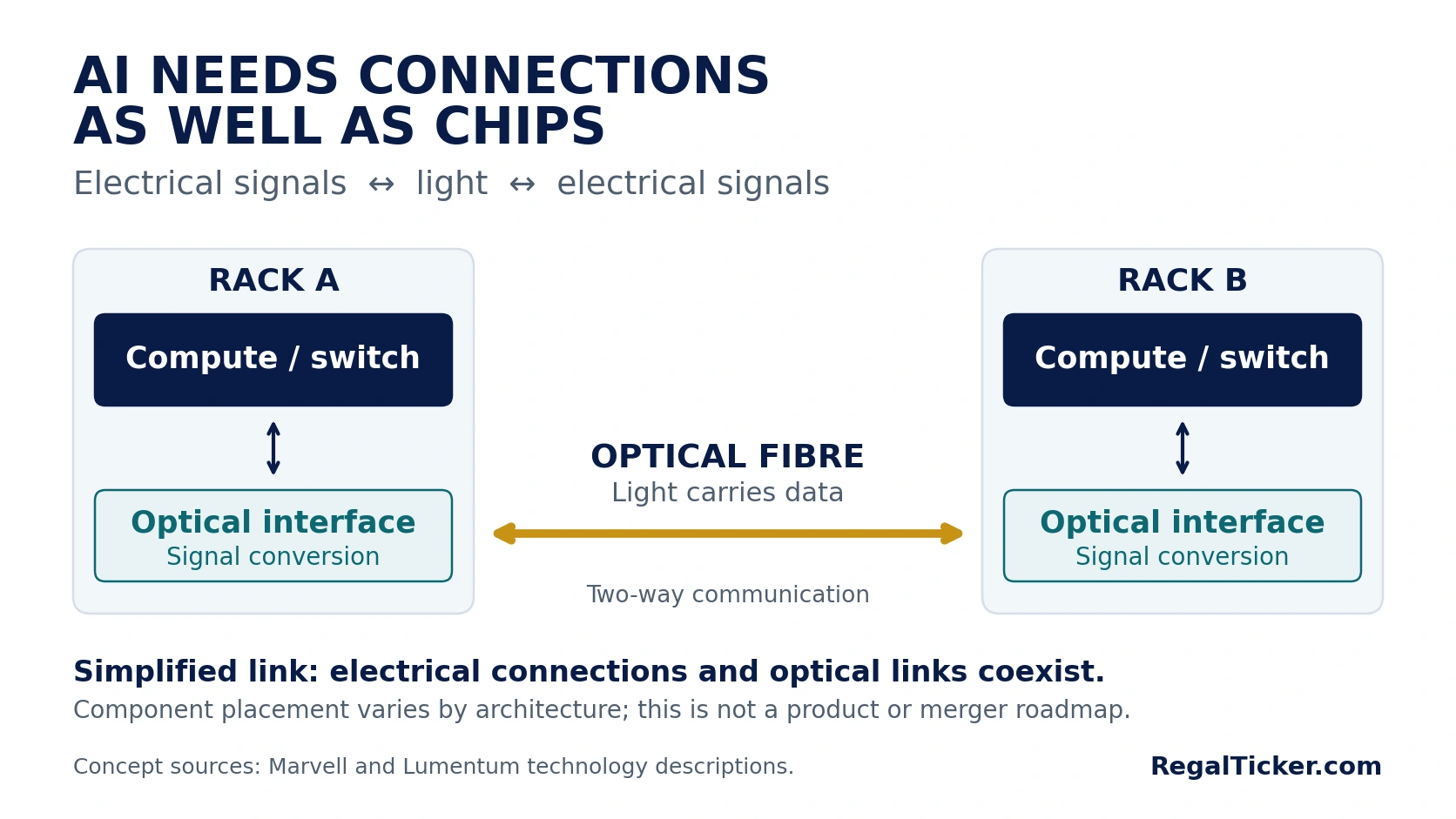
Electronic systems process the data. Optical interfaces translate between electrical signalling and light carried through fibre. The receiving side converts the signal for electronic use again. The diagram is a conceptual link, not the complete architecture of a particular Marvell or Lumentum product.
That helps explain the strategic fit. Marvell already supplies electrical and optical interconnect silicon and networking technology. Lumentum brings capabilities including lasers, optical modules and optical switching. The proposal is to coordinate more of those technologies, rather than simply add another unrelated chip product.
Lumentum’s external-laser-source material provides one example of the design choices involved: a serviceable light source can supply optical engines in a co-packaged system. Its 2026 optical scale-up demonstration also illustrates why investors must distinguish a demonstrated technology, a product design win and sustained commercial shipments.
Copper connections and different optical formats can coexist. The economic question is which connection solves a particular workload’s requirements at an acceptable cost and power level. An optical-growth thesis should not assume that one design replaces every other connection at once.
The earlier AI memory and HBM analysis covers another infrastructure constraint. Memory and connectivity address different problems; better performance in one area does not remove the need to improve the other.
A big AI deal can still meet a sceptical market
Reuters reported both Marvell and Lumentum shares falling in early U.S. trading after the announcement. That was an intraday report, not a final November 2 closing-price assessment.
The reaction is consistent with a basic investment distinction: an attractive industry can still contain an expensive transaction. Possible investor concerns include the purchase price, the number of shares being issued, integration demands and the durability of customer spending. The reported price action alone does not establish how much weight investors placed on each concern.
Marvell shareholders would own a smaller percentage of a larger combined business. Whether that creates value depends on the earnings and cash flows attributable to each share over time. Issuing shares is a form of payment; it does not make an acquisition costless.
For Lumentum holders, the exchange ratio creates exposure to Marvell’s share-price movements while the transaction remains pending. A reference takeover premium should not be treated as a guaranteed cash return from buying the target after an announcement.
The risks extend beyond the closing process. Customers need to deploy useful capacity and earn enough from that capacity to support continued investment. Strong demand expectations can coexist with pressure on pricing, manufacturing yields or the returns earned on new facilities.
Our earlier semiconductor-cycle analysis provides related context on why a broad technology theme cannot substitute for evaluating the individual business.
Where the India opportunity could emerge
India already has a separate policy and industrial agenda around AI infrastructure. The Ministry of Electronics and IT’s Budget 2026–27 communication explicitly discusses AI data centres, semiconductor capabilities and electronics components. That is relevant background to this story, rather than evidence that this particular merger has awarded business locally.
The potential channels below are analytical possibilities. Each requires its own company-level verification.
Optical networking and specialist components
A larger market for high-speed connections could create opportunities for businesses with the required products, customer qualifications and manufacturing or engineering capabilities. However, producing general telecom cable is different from supplying a qualified optical component for a demanding AI system.
For an Indian company, investors should ask what it actually sells, where it sits in the system and whether its product has been approved for the relevant application. A customer announcement or commercial order would carry more weight than a broad reference to AI in a presentation.
Data-centre power, cooling and construction
Physical AI capacity also needs land, dependable electricity, cooling, equipment and operating services. These are possible channels through which the broader build-out can reach domestic infrastructure businesses.
The Marvell–Lumentum transaction is not itself an order for those services in India. The connection would have to come through separately funded projects and customer procurement. Investors need to distinguish a proposed site, a project under construction and revenue from commissioned capacity.
Design, packaging and electronics engineering
More complex combinations of digital, analogue and optical technology can increase the engineering needed to bring a system into production. India’s semiconductor growth feature explains the wider domestic capability-building context.
The investment test is more specific than whether a business has engineers or an electronics label. It is whether the company performs the relevant work, captures value from it and can deliver at the required quality and scale. A design-service contract, an assembly order and a semiconductor manufacturing project have different economics.
What would turn the theme into earnings?
The announcement makes the infrastructure question more visible. It does not answer the earnings question for an Indian listed company.
| Question for a potential Indian exposure | Evidence that would make the case stronger |
|---|---|
| Does the product fit the AI-networking application? | Specific product capability and customer qualification |
| Is demand commercial rather than exploratory? | A disclosed order, contract or clearly identified production programme |
| Can the business deliver at scale? | Capacity readiness, production quality and execution history |
| Does revenue growth earn an adequate return? | Margins, capital employed and realistic funding needs |
| Does reported profit become cash? | Collections, working-capital discipline and operating cash flow |
The cash-flow-statement guide helps with the last question. A company can announce an expanding order book while still absorbing substantial cash in inventories, receivables and new equipment.
The balance-sheet guide is equally relevant when expansion requires borrowing or equity. Growth can be commercially attractive while leaving shareholders exposed to financing and execution demands.
The final step is valuation. A plausible future opportunity may already be reflected in a high share price. Investors need a view on the profits that can reasonably be earned and the price being paid for them, rather than assuming that exposure to an expanding market settles the decision.
The risks behind the technology story
Deal completion and integration: shareholder and regulatory approvals remain necessary. Combining engineering, manufacturing and customer-facing operations then creates its own execution demands. The expected 2028 window is a company timetable, not a completed event.
The pace of customer spending: infrastructure plans can change as customers reassess usage, revenue and financing. Investors should test the earnings case against slower deployment or less favourable pricing, rather than rely on one uninterrupted growth path.
Product transitions: a demonstration does not guarantee manufacturing economics or customer adoption. New designs must work within a larger system and meet reliability, supply and service requirements.
Concentration: several holdings described as AI plays may depend on the same small group of customers or the same investment cycle. The diversification guide explains why different company names do not necessarily create independent risks.
These are reasons to investigate the business case carefully. They are not a forecast that the transaction will fail or that AI infrastructure spending must reverse.
What to watch after the announcement
For the transaction, follow the formal shareholder documents, regulatory process and any changes to the announced terms or timetable. For the operating case, watch customer adoption, commercially shipped products and the financial results that follow.
For India, prioritise separate disclosures of relevant contracts, capital deployment and profitable execution. The companies’ announcement does not identify a new order for a named Indian listed supplier. An investor linking this deal to a domestic holding should be able to explain the missing commercial steps between the global headline and that holding’s future cash flows.
The strongest outcome would be more than enthusiasm around an AI label: useful infrastructure delivered to paying customers, with returns that justify the capital invested.
Investor note
Keep the event and the investment record separate
An acquisition announcement can affect a holding before any shares are exchanged. Use the terms and effective dates of an actual corporate action when updating records. The related demerger calculator serves a separate cost-allocation task; it is not a calculator for this proposed U.S. merger.
Frequently asked questions
Has Marvell completed the Lumentum acquisition?
No. The companies announced a definitive agreement. Closing is expected in the first half of calendar 2028, subject to shareholder and regulatory approvals and other conditions.
Is the $115 billion figure a cash payment?
No. It is the announced implied enterprise value of Lumentum. The consideration is a fixed exchange of 4.5 Marvell shares for each Lumentum share, rather than a fixed cash amount.
Why do AI data centres need optical connectivity?
Processing units and racks need to exchange large amounts of data. Optical links carry information through fibre, alongside electronic processing and other connection types chosen for the system’s requirements.
Does the deal confirm orders for Indian companies?
The announcement does not identify a new order for a named Indian listed supplier. A domestic investment case needs separate evidence of relevant products, customers, contracts and earnings.
Does an expanding AI market make every related stock attractive?
No. Valuation, competitive position, customer concentration, capital requirements and cash generation still affect the return available to shareholders.
Verify through official sources
Official references
- Marvell — Joint acquisition announcement, 2 November 2026 — Primary release: proposed all-stock acquisition, target enterprise value, exchange ratio, reference prices, expected ownership and conditional closing window; future benefits are management expectations.
- Marvell — November 2 Form 8-K and accompanying materials — Official filing and presentation corroborate the transaction structure and approvals; target enterprise value must not be confused with the presentation’s combined-company valuation.
- Reuters — Deal and market-reaction report — Independent transaction reporting and early U.S.-session share-price reaction; not used as a final November 2 close.
- Marvell — Scale-out networking for AI — Technical background on AI-cluster networking and the coexistence of electrical cables, optical modules and different interconnect architectures.
- Lumentum — External laser source module — Product example of a serviceable light source for optical engines in co-packaged AI/cloud systems; not a statement that all future merger products are deployed.
- Lumentum — OFC 2026 optical scale-up demonstration — Primary demonstration announcement; illustrates the need to distinguish demonstrated capability from sustained commercial production.
- Ministry of Electronics and IT / PIB — Budget 2026–27 technology priorities — February 1 policy background on AI data centres, semiconductors and electronics components; not evidence of a new Indian contract resulting from this transaction.
Final takeaway
The next AI opportunity needs a commercial connection to the headline
Marvell and Lumentum’s proposed combination puts the network between AI processors in the spotlight. For Indian investors, the useful task is to identify businesses with the right capabilities, real customers and returns that justify their valuation. The size of the deal makes it newsworthy; the path from technology to cash flow will determine its investment significance.
Educational disclaimer: This article provides financial information and investor education, not personalised investment advice or a recommendation to buy, sell or hold a security. The acquisition remains subject to its announced conditions. Future commercial and financial outcomes are uncertain, and the India discussion describes possible channels rather than confirmed supplier benefits. Assess valuation, business exposure, concentration and your circumstances before making an investment decision.


