

One semiconductor market is booming; another is under pressure
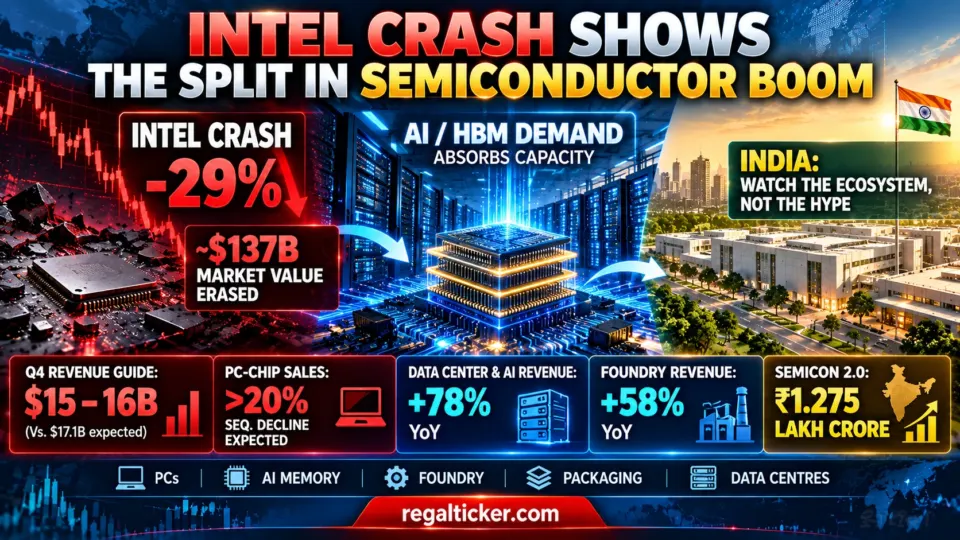
Intel’s roughly 29% plunge on 30 October is one of the clearest signs yet that “the semiconductor boom” is no longer a useful single category.
The company’s third-quarter numbers were not uniformly weak. Revenue rose 21% year on year to $16.5 billion. Data Center and AI revenue jumped 78% to $7.3 billion. Intel Foundry revenue increased 58% to $6.7 billion.
Yet the stock collapsed after Intel guided fourth-quarter revenue to only $15 billion–$16 billion, below the market consensus cited by Reuters of about $17.07 billion. The company also warned that the PC slowdown is likely to continue into at least the first half of 2027, while Reuters reported that Intel expects PC-chip sales to fall more than 20% sequentially in the fourth quarter.
That combination explains the real story. AI servers, HBM, premium data-centre processors and advanced infrastructure are absorbing capital and attention, while traditional PC economics remain weak and memory costs are rising. Intel sits in both worlds at once.
For Indian investors, the lesson is bigger than Intel. The India semiconductor boom will create opportunities only if domestic companies build capabilities that match the profitable parts of the global cycle. A policy label or a factory announcement is not enough.
⚡ Quick answer
Why did Intel fall nearly 29% if AI demand is still strong?
Intel’s Q3 results showed strong data-centre and foundry revenue growth, but investors focused on weak Q4 guidance, a continuing PC slowdown, full-year cash-flow pressure and the cost of manufacturing expansion. AI demand is not lifting every semiconductor segment equally. Memory and AI-server demand are strong, while consumer PCs remain under pressure and Intel’s foundry business still reported a quarterly operating loss of about $1.85 billion. The sell-off therefore reflects a split semiconductor cycle rather than evidence that global AI demand has collapsed.
Key takeaways
Intel shares plunged roughly 29% on 30 October, putting the stock on course for its worst one-day decline.
Reuters estimated more than $137 billion of market value was erased during the sell-off.
Intel Q3 revenue rose 21% YoY to $16.5 billion.
Data Center and AI revenue grew 78% to $7.3 billion.
Intel Foundry revenue rose 58% to $6.7 billion, but the segment still posted an operating loss of about $1.85 billion.
Client Computing and Physical AI revenue fell 5% YoY to $8.1 billion.
Intel guided Q4 revenue to $15 billion–$16 billion versus roughly $17.07 billion expected by analysts cited by Reuters.
Reuters reported Intel expects PC-chip sales to fall more than 20% sequentially in Q4.
Rising memory prices are increasing PC costs as suppliers prioritise higher-value AI-related memory.
The sell-off spread across AMD, Arm, Qualcomm, Nvidia, Broadcom, Micron and server companies.
India’s realistic opportunity is in design, packaging/test, equipment, materials, power, data centres and selected manufacturing—not a blanket “semiconductor stocks” trade.
Semicon 2.0 has a ₹1,27,500 crore outlay across design, machines/materials, fabs, advanced packaging, R&D and talent.
1. Intel’s quarter was stronger than the share-price reaction suggests
Intel reported third-quarter revenue of $16.5 billion, up 21% year on year.
GAAP operating margin improved to 15.3% from 5.0% a year earlier, and the company generated $5.1 billion of cash from operations during the quarter.
Those are not the numbers of a company whose entire business is collapsing.
The problem is that markets price the next several quarters, not only the last one.
Intel’s guidance for Q4 called for revenue between $15 billion and $16 billion, with GAAP gross margin of 37.1% and non-GAAP gross margin of 38.0%. Reuters said the revenue outlook was well below the analyst consensus of about $17.07 billion.
That gap reset expectations immediately.
The market was effectively saying: “Q3 execution improved, but the next quarter looks weaker than investors had priced.”
This is why RegalTicker’s Fundamental Analysis guide is useful around earnings. Revenue growth, margins, guidance, segment mix and cash requirements can point in different directions at the same time.
2. Data-centre demand is strong enough to hide a very different PC cycle
Intel’s Data Center and AI segment generated $7.3 billion of Q3 revenue, up 78% year on year.
The company said server revenue increased sharply as average selling prices rose, helped by a richer mix of premium products and strong demand.
That is important because it confirms that parts of Intel are participating in the AI infrastructure build-out.
But Client Computing and Physical AI revenue was $8.1 billion, down 5% year on year.
Intel’s SEC filing said client revenue fell because unit volume declined 14%, partly offset by a 9% increase in average selling prices. The company also used pricing actions to offset higher input costs.
So Intel is facing a split customer environment:
servers / AI infrastructure → stronger demand and higher-value products
consumer PCs → weaker units, higher input costs and more cautious demand
That is why saying “AI is booming” does not automatically tell you whether Intel’s consolidated earnings should rise.
3. Rising memory prices are making the PC problem worse
Reuters linked part of Intel’s PC weakness to rising memory prices.
Memory manufacturers have been shifting capital and capacity toward higher-value AI products such as HBM and advanced DRAM. That can tighten supply for conventional memory and increase the bill of materials for PCs.
The chain is straightforward:
AI infrastructure demand → more high-value memory capacity → tighter conventional memory → higher PC component costs → higher device prices → weaker consumer demand
This is one of the most important crossovers between the AI boom and traditional electronics.
A shortage can be excellent for a memory supplier while simultaneously becoming a cost problem for a PC vendor or CPU supplier.
That is the semiconductor split in its simplest form: one company’s pricing power can become another company’s demand headwind.
4. Foundry revenue is growing—but Intel is still paying heavily for the turnaround
Intel Foundry revenue increased 58% year on year to $6.7 billion.
At first glance, that looks like exactly the growth investors want from Intel’s manufacturing strategy.
But the segment still reported an operating loss of about $1.85 billion for the quarter.
That is the economic tension behind the foundry story.
A new semiconductor process requires enormous investment before utilisation reaches a level that produces attractive returns. New fabs need buildings, EUV tools, clean rooms, process development, engineers and years of customer qualification.
Intel is making technological progress. It released the Intel 14A 0.9 process design kit in October and continues to work with ASML, Lam Research and Applied Materials on process and manufacturing capabilities.
The question for shareholders is not only whether the technology works. It is whether enough external and internal volume arrives at good enough yields to cover depreciation and operating costs.
This is why a semiconductor fab can be strategically valuable and financially painful at the same time.
5. The 29% crash spread far beyond Intel
Intel’s warning triggered a broader semiconductor sell-off.
Reuters reported declines across AMD, Arm, Qualcomm, Nvidia, Broadcom and Micron, while Dell, HPE and Super Micro also fell. The U.S. semiconductor index dropped sharply as investors reduced exposure to crowded technology trades.
That contagion does not mean every chip company suddenly has Intel’s problem.
Nvidia’s AI accelerators, Micron’s memory portfolio and Intel’s PC/server/foundry mix have very different economics.
Markets often sell a sector first and differentiate later.
For investors, that creates a useful discipline: when a broad technology index falls because one large company disappoints, ask whether the underlying problem is company-specific, segment-specific or genuinely systemic.
The RegalTicker news-verification framework is designed for exactly that process—trace the headline back to the original company disclosure before turning a sector sell-off into a universal conclusion.
6. Intel shows why AI capex can be both bullish and painful
The global AI infrastructure cycle is still absorbing enormous amounts of capital.
The hyperscaler AI-capex analysis tracks the other side of the same trade: Meta, Microsoft, Amazon and Alphabet continue to spend heavily, but investors are increasingly asking whether those investments will generate adequate cash returns.
Intel adds another layer.
When hyperscalers spend more:
- server CPU demand can rise;
- accelerator demand rises;
- HBM demand rises;
- networking and power demand rise;
- advanced packaging demand rises.
But the same spending boom can pull capital, engineering talent and manufacturing capacity away from slower-growth markets such as consumer PCs.
So “AI capex up” is not universally bullish.
It changes the allocation of scarce resources across the technology supply chain.
7. The stock crash also reflects cash-flow anxiety
Intel generated $5.1 billion of operating cash flow in Q3, but Reuters reported that the company does not expect positive cash flow for the full year.
That is not a contradiction.
Operating cash flow is only one layer of the cash picture. Intel also has large capital expenditures, working-capital needs and restructuring/investment commitments.
A company can report positive operating cash in a quarter and still consume cash after investments.
The Cash Flow Statement guide is useful here because semiconductor turnarounds are capital-intensive by design. Investors need to compare:
- operating cash flow;
- capital expenditure;
- free cash flow;
- debt/equity financing;
- depreciation;
- utilisation; and
- expected returns on new capacity.
Revenue growth without sustainable cash generation can still destroy shareholder value if the investment required to produce that growth is too large.
8. What Intel’s crash means for India’s semiconductor strategy
India is trying to build a semiconductor ecosystem at exactly the moment the global industry is becoming more segmented.
Semicon 2.0 has a ₹1,27,500 crore outlay and explicitly covers:
- chip design;
- machines and materials;
- new fabs;
- advanced packaging;
- research and development; and
- talent.
The Intel lesson is useful because it argues against trying to measure success only by announced fab capacity.
A fab is valuable when it has:
- qualified customers;
- competitive yields;
- stable process technology;
- high utilisation;
- manageable financing costs; and
- attractive returns on capital.
India’s near-term opportunity may therefore be strongest where execution barriers are lower or where global demand is already visible: advanced packaging, assembly/test, power semiconductors, equipment supply, materials, precision engineering and data-centre infrastructure.
The India Semiconductor Boom 2026 article lays out that ecosystem approach in more detail.
9. Why Indian investors should avoid a blanket “semiconductor stocks” trade
Intel’s results show why the word “semiconductor” is too broad for investment analysis.
A company exposed to:
- AI accelerators;
- HBM;
- consumer PCs;
- smartphone chips;
- automotive power semiconductors;
- foundry services;
- packaging;
- semiconductor equipment; or
- speciality materials
can experience a completely different cycle from another company in the same industry.
For Indian stocks, the correct question is therefore not “Is semiconductor demand growing?”
It is:
Which product? Which customer? Which node? Which margin? Which capex burden? Which contract?
A precision-engineering supplier serving packaging tools may benefit while a consumer-electronics company faces higher memory costs.
A data-centre company may gain from AI demand while an electronics assembler suffers if device demand weakens.
A theme is not a business model.
10. What would show Intel’s turnaround is actually working?
The share price can rebound before the fundamentals fully improve, so investors need measurable checkpoints.
For the PC business:
- unit volumes need to stabilise;
- memory and input costs need to stop pressuring pricing;
- market share needs to hold or improve.
For Data Center and AI:
- strong revenue growth needs to continue;
- premium pricing needs to remain defensible;
- Intel must convert demand into sustainable margins.
For Foundry:
- losses need to narrow;
- utilisation needs to improve;
- external customer commitments need to become commercial production;
- process yields need to improve.
For cash flow:
- operating cash needs to cover a larger share of capital spending;
- external funding should become less necessary.
For the balance sheet:
- heavy investment needs to translate into return on invested capital rather than only strategic capacity.
Those are stronger signals than a one-day share-price bounce.
Investor note
A historic price fall is not automatically a bargain
A stock can fall 29% and still be expensive if future earnings deteriorate more than the price. It can also recover sharply if expectations became too pessimistic. Use guidance, segment economics, cash flow and valuation—not the size of the fall alone—to judge the opportunity.
11. What to watch next in the global chip market
Three things now matter most.
First, PC demand. Intel says the slowdown could persist through at least the first half of 2027. If the weakness spreads to device makers and component suppliers, the traditional semiconductor cycle could deteriorate further.
Second, memory pricing. If AI-focused capacity keeps conventional memory tight, higher PC costs can reinforce the slowdown even while HBM suppliers enjoy strong demand.
Third, AI-capex returns. If cloud companies keep spending but investors continue to punish weak cash flow, technology valuations may rotate away from capital-intensive infrastructure even before absolute AI demand slows.
The global chip market is therefore entering a more selective phase.
AI demand is real. The semiconductor boom is real. But the winners and losers are separating faster.
Frequently asked questions
Why did Intel stock fall about 29%?
Investors reacted to weak Q4 revenue guidance, continuing PC-market weakness, full-year cash-flow concerns and the high cost of Intel’s manufacturing turnaround despite strong Q3 data-centre growth.
What was Intel’s Q3 2026 revenue?
Intel reported Q3 revenue of $16.5 billion, up 21% year on year.
How fast did Intel’s Data Center and AI business grow?
Data Center and AI revenue rose 78% year on year to $7.3 billion.
Did Intel Foundry grow?
Yes. Foundry revenue rose 58% year on year to $6.7 billion, but the segment still reported an operating loss of about $1.85 billion.
What is Intel’s Q4 revenue guidance?
Intel guided Q4 revenue to $15 billion–$16 billion. Reuters said analysts had expected about $17.07 billion.
Why are memory prices hurting the PC market?
AI-related memory demand is absorbing capacity and supporting higher memory prices. More expensive memory raises PC component costs and can weaken consumer demand.
Does Intel’s crash mean the AI chip boom is over?
No. Intel’s own Data Center and AI revenue grew strongly. The sell-off shows that AI-related strength and traditional PC weakness can coexist.
What does this mean for India?
India’s semiconductor opportunity remains strongest in building a full ecosystem—design, packaging/test, equipment, materials, fabs, power and data centres—rather than assuming every semiconductor-linked company benefits equally.
Verify through official sources
Official references
- Intel — Q3 2026 financial results — Primary source for Q3 revenue, segment growth, operating margin, cash from operations and Q4 guidance.
- Intel — Q3 2026 SEC filing — Primary filing for client volume, pricing, server revenue and segment economics.
- Reuters — Intel crash and global chip rout — Current reporting on the share-price fall, market-value loss, analyst Q4 expectation, PC outlook, memory-cost pressure and sector contagion.
- Reuters — Amazon and Intel expose AI boom’s costs — Current context on Intel, PC memory costs, hyperscaler cash burn and broader AI-infrastructure financing pressure.
- Reuters — Global markets 30 October — Global risk-off reaction, technology sell-off, yields, oil and AI-spending concern.
- PIB — Semicon 2.0 approval — Primary government source for the ₹1,27,500 crore Semicon 2.0 programme and its six ecosystem pillars.
- PIB — Semicon 2.0 ecosystem implementation — Current government implementation focus on design, equipment, fabs, advanced packaging, R&D and talent.
Educational disclaimer: RegalTicker provides educational and informational content only. This article is not investment advice, a recommendation to buy or sell Intel or any semiconductor-related security, or a forecast of future share prices. Earnings guidance, market prices, memory pricing, technology roadmaps and semiconductor project economics can change quickly. Verify current company, exchange, regulator and government disclosures before making financial decisions and consider valuation, liquidity, concentration and your own risk tolerance.
Final takeaway
AI is not lifting the whole semiconductor industry at the same speed
Intel’s historic sell-off does not disprove the AI boom. In some ways, it confirms how powerful that boom has become.
The strongest parts of the chip market—AI servers, HBM, premium processors and advanced infrastructure—are attracting capital, pricing power and customer demand. At the same time, traditional PCs are facing weak unit demand and higher memory costs, while foundry expansion remains expensive and cash-intensive.
For India, that is an important warning and an opportunity. Building a semiconductor ecosystem is valuable, but success should be measured by customer qualification, utilisation, yields, cash generation and returns—not by announced capacity alone.
The next semiconductor winners may not be the companies closest to the word “AI.” They will be the companies that can turn the new supply-chain structure into durable economics.


