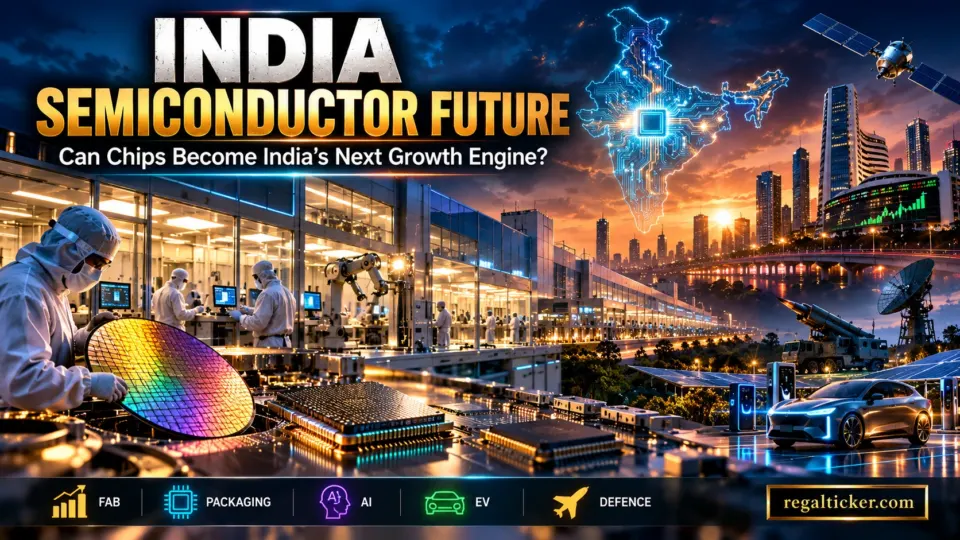
India has spent years talking about becoming a serious semiconductor country. In 2026, that conversation is beginning to feel different. The country still does not have a mature leading-edge foundry ecosystem, and it would be premature to describe India as a rival to Taiwan or South Korea. But the building blocks are no longer theoretical. Packaging plants have moved into commercial production, Tata Electronics is building a large wafer fab in Dholera, global equipment companies are committing capital, and electronics manufacturing is already much larger than it was a decade ago.
That matters to investors because semiconductors are not a narrow technology theme. They sit underneath cars, industrial machinery, telecom networks, data centres, defence systems, satellites, consumer electronics and artificial intelligence. A successful semiconductor ecosystem can pull investment into power, precision engineering, chemicals, gases, water treatment, logistics, electronics assembly and advanced manufacturing. The stock-market opportunity, therefore, is unlikely to be confined to a handful of companies with “semiconductor” in their name.
The more interesting question is whether India can turn this wave of announcements into a durable industrial advantage. If it can, chips may become to the next decade what software services were to an earlier phase of India’s growth story: not the whole economy, but a powerful source of skills, exports, investment and market confidence. If execution slips, however, investors could discover that exciting policy headlines do not automatically produce attractive returns.
Investor note
The real opportunity is the ecosystem, not a single “chip stock”
India’s semiconductor build-out touches fabrication, packaging, electronic components, power, cooling, data centres, engineering, logistics and end-use industries. Investors should study the full value chain rather than assuming every company associated with the theme will earn semiconductor-like margins.
1. Why semiconductors matter far beyond the chip industry
A modern economy cannot function without semiconductors. They control engines, charge batteries, route telecom traffic, process images, run industrial robots, secure defence systems and power the servers behind cloud computing and AI.
That is why the semiconductor story is really an industrial story.
When a new fab or packaging plant is built, it needs more than wafers and machines. It needs reliable electricity, clean water, specialty gases, chemicals, precision components, clean-room infrastructure, testing equipment, logistics and engineers. Around that core, suppliers and service providers tend to cluster. Over time, that can raise local value addition and make an economy more attractive for other high-value manufacturing.
India already has a large semiconductor-design workforce and a growing electronics manufacturing base. What it has historically lacked is enough domestic manufacturing depth. The current policy push is an attempt to close that gap.
2. India’s chip push has moved from promise to physical projects
The numbers are now large enough to deserve attention.
Reuters reported in September that India has committed more than $21 billion in semiconductor incentives and expects domestic semiconductor consumption to reach around $110 billion by 2030. Applied Materials, one of the world’s most important semiconductor-equipment companies, announced plans to invest $5 billion in India over the next decade, with spending aimed at research, supply-chain development and workforce expansion.
At the project level, the Ministry of Electronics and Information Technology has approved a broad mix of fabrication and assembly/testing facilities. Tata Electronics’ Dholera fab was approved with an investment of about ₹91,526 crore and an intended capacity of roughly 50,000 wafer starts per month. Tata’s Assam OSAT project carries an approved investment of about ₹27,120 crore. CG Power’s Gujarat OSAT project was approved at about ₹7,584 crore, while Kaynes’ Sanand OSAT project was approved at about ₹3,307 crore.
Those facilities serve different parts of the chain. A fab manufactures chips on wafers. OSAT and ATMP facilities handle assembly, packaging and testing. Packaging is less glamorous than the image of a giant wafer fab, but it is economically important and increasingly sophisticated as advanced computing moves toward chiplets and complex multi-die packages.
India has already seen commercial production begin at packaging facilities. What it has not yet demonstrated is high-volume production from a large front-end fab. That distinction is crucial.
3. Tata’s semiconductor bet could become an anchor for a wider supplier network
Tata Electronics is emerging as the most visible private-sector anchor in India’s semiconductor build-out.
In May 2026, Tata Electronics and ASML announced a partnership connected with the Dholera fab. ASML is the dominant global supplier of advanced lithography equipment, so the relationship matters even though the Indian project is not intended to leap immediately into the most advanced process nodes used for cutting-edge AI GPUs.
In September, Dutch chipmaker Nexperia also announced a partnership with Tata. Under that arrangement, Nexperia power-control chips are expected to be manufactured at the Dholera facility and packaged at Tata’s Jagiroad plant in Assam.
Power semiconductors are not a fashionable AI headline, but they are essential to automobiles, industrial equipment, power systems and consumer electronics. For India, that may be a sensible place to build scale. A country does not need to manufacture the world’s most advanced logic chip on day one to create a valuable semiconductor industry.
The deeper opportunity is what happens around an anchor project. If a large fab attracts materials suppliers, equipment-service teams, packaging specialists and design customers, the economic value can extend well beyond the fab’s own revenue.
4. Packaging may be India’s most practical near-term advantage
Investors often jump straight to wafer fabrication because it sounds like the highest-value part of the chain. But semiconductor packaging deserves much more attention.
Advanced packaging is becoming more important because modern high-performance chips increasingly combine multiple dies, memory and specialised components in one package. AI systems, automotive electronics and industrial power modules all benefit from this trend.
India has already made tangible progress here. Kaynes’ Sanand facility has entered commercial production, and Micron’s India packaging operation has also moved into production. MeitY’s project pipeline includes Tata, CG Power, Kaynes and other assembly/testing investments across several states.
For India, packaging has three advantages. It is closer to current manufacturing capabilities, it can serve global customers before a domestic fab ecosystem reaches full maturity, and it creates a bridge between semiconductor design and electronics manufacturing.
That makes packaging more than a temporary stepping stone. If India becomes strong in advanced packaging, it can capture meaningful value even while the country continues building front-end fabrication expertise.
5. The AI boom gives India a second route into the semiconductor value chain
The current global AI investment cycle strengthens the case for semiconductor capacity, but it also broadens the list of Indian beneficiaries.
AI infrastructure needs GPUs and memory, but it also needs servers, optical connectivity, power equipment, cooling systems, data-centre construction, backup power and grid capacity. That is why India’s AI opportunity is not limited to producing an advanced processor domestically.
RegalTicker’s recent analysis of the AI infrastructure and hyperscaler capex cycle looks at the other side of this boom: how much capital is being committed globally, how financing risk is rising, and why investors are beginning to ask harder questions about returns.
For India, the semiconductor and AI stories intersect in three places. First, domestic electronics and packaging companies can participate in the hardware chain. Second, data-centre growth creates demand for power, networking and cooling equipment. Third, a stronger local semiconductor ecosystem makes India more credible as a location for future electronics and AI-hardware investment.
The opportunity is real, but it is not risk-free. AI capex is enormous, and global spending cycles can reverse. A good semiconductor strategy should still make economic sense even if AI enthusiasm cools.
6. Why electronics manufacturing makes the chip ambition more credible
India is not starting from zero.
Mobile-phone manufacturing has expanded dramatically. Reuters reported that Indian phone production reached nearly $60 billion in 2024–25, around 28 times the level of a decade earlier, while phone exports reached about $21.7 billion. The government is targeting roughly $500 billion in electronics manufacturing by fiscal 2030.
That history matters because semiconductor plants need customers. A domestic electronics industry creates nearby demand for chips, components, packaging and testing. It also gives manufacturers a reason to localise more of the supply chain rather than import almost every high-value component.
This is where the long-term economic payoff could become significant. Assembly creates jobs and exports, but a country captures more value when it also makes components, designs products, owns intellectual property and supplies parts to the factories doing final assembly.
The semiconductor push is therefore best understood as the next layer of India’s electronics strategy—not as a completely separate industry.
7. How semiconductors could energise the Indian stock market
The market effect is likely to arrive in waves rather than through one sudden re-rating.
The first wave is capital expenditure. New fabs and packaging plants require construction, electrical systems, industrial equipment, clean rooms, water treatment and precision engineering.
The second is supply-chain localisation. As production grows, demand can rise for specialty materials, electronic components, testing, logistics and maintenance.
The third is downstream manufacturing. Automotive electronics, industrial systems, telecom equipment, consumer devices, defence platforms and data centres all benefit from a deeper domestic component base.
The fourth is exports and strategic positioning. If India becomes a reliable part of global semiconductor supply chains, foreign investment can spread beyond individual projects into research, design and supplier ecosystems.
For equity investors, that means the theme should be analysed through businesses rather than slogans. A company may benefit from semiconductor capex but still be a poor investment if it has weak margins, too much debt or an excessive valuation. RegalTicker’s guide to fundamental analysis is useful here because the key questions remain familiar: how much revenue is actually linked to the theme, what returns are being earned on new capital, and how much of the story is already reflected in the share price?
8. The sectors that could benefit even without a domestic Nvidia or TSMC
India does not need to create a local Nvidia or TSMC immediately for the semiconductor build-out to matter to the market.
The more realistic opportunity sits across a network of industries:
| Part of the ecosystem | Why it matters |
|---|---|
| Semiconductor packaging and testing | Converts wafers/dies into usable packaged chips and modules |
| Electronics manufacturing and components | Raises domestic value addition in phones, autos, telecom and industrial products |
| Power equipment and grid infrastructure | Fabs and data centres require reliable, high-quality electricity |
| Industrial automation and precision engineering | Clean-room manufacturing depends on high-precision equipment and controls |
| Specialty chemicals, gases and water systems | Chip production has demanding materials and process requirements |
| Optical fibre, networking and data centres | AI and cloud infrastructure expand demand for connectivity and compute facilities |
| Auto and EV electronics | Vehicles use growing amounts of power-control, sensing and computing silicon |
| Defence and space electronics | Strategic systems require secure, reliable and increasingly local component supply |
The point is not that every company in these industries becomes a semiconductor winner. It is that a successful chip ecosystem increases the addressable market for many businesses around it.
That is also why investors should avoid chasing a label. If a stock rallies because management mentions “semiconductors” in a presentation, the next step is to check orders, customer relationships, capital requirements and realised revenue rather than treating the theme itself as proof of value.
9. The geopolitical argument is becoming stronger, not weaker
Semiconductors have become part of national security policy.
The world’s most advanced manufacturing remains heavily concentrated in East Asia, while China controls important parts of the critical-mineral and industrial supply chain. On 22 October, Reuters reported that TSMC is exploring alternatives to Chinese rare-earth components used in semiconductor manufacturing equipment because of supply-security concerns.
India is not going to replace Taiwan, South Korea, Japan or China across the semiconductor value chain in a few years. That is not a realistic benchmark.
But global companies increasingly want more geographic diversity. For India, even a modest share of new investment can be meaningful because the domestic base is still relatively small. The strategic value also extends beyond exports: local capability can reduce vulnerability in defence, telecom, automotive and critical infrastructure.
India’s wider manufacturing challenge remains substantial. Reuters noted earlier this month that the country still relies heavily on Chinese imports for electronics, machinery and chemicals, with a large bilateral trade deficit. Semiconductor policy cannot solve that dependence by itself, but it is part of the same effort to move from assembly toward deeper domestic capability.
10. The risks investors should not ignore
There is a temptation to look at large investment announcements and assume the outcome is already secured. It is not.
The biggest risk is execution. Reuters reported in September that the Tata Dholera fab’s launch had been delayed by nearly two years. Large fabs are among the most complex industrial projects in the world. Construction delays, equipment qualification, yield problems, customer certification and technology transfer can all push out the economics.
The second risk is cost. Semiconductor manufacturing requires huge upfront capital, and plants can become uncompetitive if utilisation stays low. Subsidies can help build capacity, but they do not guarantee that the capacity will earn attractive returns.
The third risk is technology. Process nodes and packaging standards evolve quickly. A plant must serve products that customers still want by the time it reaches volume production.
The fourth is infrastructure. Reliable power and water are not optional. Semiconductor facilities require exceptionally stable utilities and process control.
The fifth is valuation. Markets often price a long runway years before the earnings arrive. A company can participate in a genuine growth industry and still deliver poor shareholder returns if investors pay too much for that future.
This is where risk management becomes especially important. A structural theme can remain intact while individual stocks suffer deep drawdowns, project delays or valuation compression.
11. What would prove that India’s semiconductor strategy is really working?
Over the next few years, investors should look for evidence rather than announcements.
The most important milestone is sustained commercial output from approved projects. Packaging facilities need to move from pilot runs to stable customer volumes. The Dholera fab needs to progress toward qualification and high-volume production. Suppliers need to establish operations around these projects rather than servicing them entirely from overseas.
The second proof point is domestic value addition. If India continues exporting more electronics but still imports most high-value components, the economic gain is smaller than the headline export number suggests.
The third is repeat investment. One global company announcing a facility is useful. Existing investors expanding after seeing acceptable economics is much stronger evidence.
The fourth is talent depth. India already has design engineers, but high-volume manufacturing requires process engineers, equipment technicians, materials specialists and experienced plant operators.
The fifth is export competitiveness. The strongest outcome would be Indian facilities serving global customers without depending permanently on extraordinary subsidies.
Investors can follow the broader macro and market context through RegalTicker’s Market hub and Monthly Market Review. For stocks already caught in a semiconductor or AI-led momentum move, technical analysis can help separate price behaviour from the longer-term business thesis—but charts should not substitute for project execution and financial evidence.
12. Could semiconductors become India’s next major growth engine?
Yes—but not because India is about to become the next Taiwan.
The more credible bull case is quieter and more practical. India already has software talent, semiconductor design capability, a rapidly expanding electronics manufacturing base and a large domestic market. If the country can add reliable fabrication, advanced packaging and a deeper component ecosystem, it begins to capture more value from products it already consumes and manufactures.
That can improve exports, attract foreign capital, create higher-value industrial jobs and strengthen strategic resilience. It can also broaden the Indian equity market’s growth story beyond banks, consumer demand and traditional IT services.
But this is a decade-long industrial build-out, not a one-quarter trade. The winners will be determined by execution, customer qualification, return on capital and global competitiveness. Some companies attached to the theme will disappoint. Others may become important suppliers without ever becoming household names.
For long-term investors, that is precisely why the semiconductor story is interesting. The opportunity is not a single heroic chip company. It is the possibility that an entire manufacturing ecosystem becomes deeper, more valuable and more difficult for the world to ignore.
Investor note
Keep thematic investing separate from corporate-action bookkeeping
A semiconductor theme can change a company’s growth outlook, but it does not change how acquisition cost is allocated after a demerger. If one of your holdings undergoes a demerger, use the latest official company allocation and RegalTicker’s Demerger Cost Basis Calculator to maintain the cost record separately from your investment thesis.
Frequently asked questions
Is India already manufacturing advanced semiconductor chips at scale?
Not yet. India has made visible progress in packaging and testing, and several large projects are under development, but the country has not yet demonstrated large-scale front-end fab production comparable with established Asian semiconductor hubs.
How large could India’s semiconductor market become?
Reuters reported in September 2026 that India expects domestic semiconductor consumption to reach around $110 billion by 2030.
What is the difference between a semiconductor fab and an OSAT plant?
A fab manufactures circuits on semiconductor wafers. OSAT facilities assemble, package and test chips after wafer fabrication. Both are important parts of the value chain.
Why is semiconductor packaging important for India?
Packaging is already moving into commercial production in India and is becoming more technologically important as chips use advanced multi-die designs. It offers a practical route to scale before front-end fab capacity is fully established.
How can AI benefit India’s semiconductor ecosystem?
AI raises global demand for compute, networking, power and data-centre infrastructure. India can participate through packaging, electronics, power equipment, connectivity, data centres and potentially future chip manufacturing.
Which Indian sectors could benefit from semiconductor investment?
Potential beneficiaries include electronics manufacturing, packaging/testing, precision engineering, power equipment, specialty materials, networking, data centres, auto electronics, EVs and defence electronics. Participation in a theme does not guarantee attractive stock returns.
What is the biggest risk to India’s semiconductor ambitions?
Execution is the central risk. Large fabs are expensive and technically difficult, and project delays, low utilisation, weak yields or insufficient customer demand can damage economics.
Does India need to beat Taiwan to succeed in semiconductors?
No. India can create substantial economic value by becoming a meaningful additional manufacturing, packaging, design and supply-chain location without replacing the established global leaders.
Verify through official sources
Official references
- Reuters — Applied Materials India semiconductor investment — $5 billion Applied Materials plan, India incentive scale, 2030 semiconductor-consumption estimate and execution context.
- Reuters — Tata Electronics and Nexperia partnership — Nexperia-Tata manufacturing and packaging partnership details.
- Reuters — Tata Electronics and ASML partnership — ASML relationship and Dholera fab context.
- MeitY Annual Report 2025–26 — Approved project investment and production-capacity details for Tata, CG Power, Kaynes and other semiconductor projects.
- MeitY Electronics Component Manufacturing Scheme — Official objectives and covered component/capital-equipment segments.
- Reuters — India phone manufacturing incentives — Electronics manufacturing, smartphone production and export figures and 2030 electronics target.
- Reuters — India-China economic dependence — Import dependence and manufacturing-supply-chain context.
- Reuters — TSMC rare-earth equipment alternatives — Latest semiconductor supply-chain diversification and rare-earth risk context.