A real rebound—but not a clean all-clear
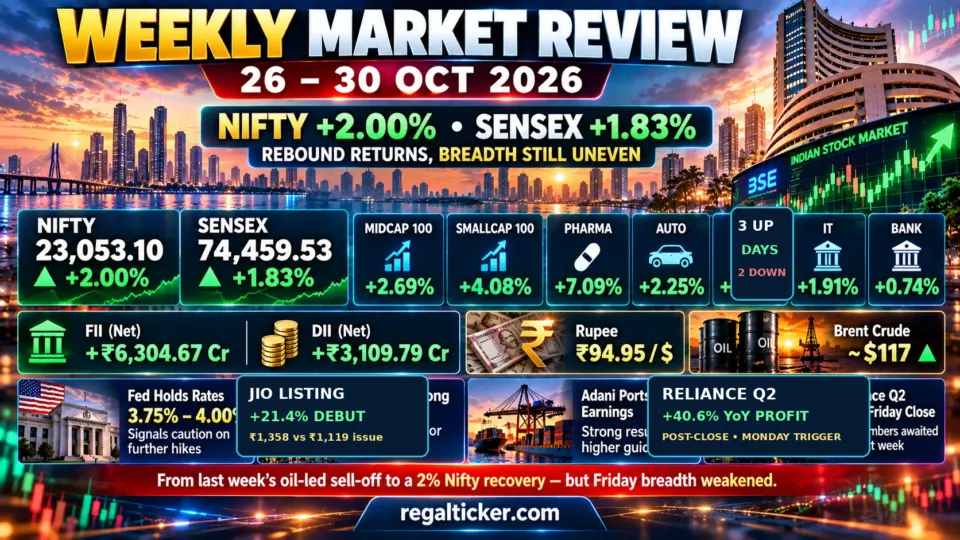
The final trading week of October repaired a meaningful part of the damage from the previous week. Nifty 50 rose 2.00% from 22,600.00 on 23 October to 23,053.10 on 30 October, while Sensex gained 1.83% to 74,459.53.
The recovery was broader than the headline indices suggest. Nifty Midcap 100 rose 2.69% for the week and Smallcap 100 gained 4.08%, both outperforming the large-cap benchmarks after suffering far deeper losses in the previous week. Pharma was the strongest major sector among the indices tracked here, rising about 7.09%, while auto gained 2.25%, IT 1.91% and Bank Nifty 0.74%.
There was also a genuine shift in institutional flows: provisional cash-market data show FIIs net bought about ₹6,304.67 crore across the five sessions, while DIIs were also net buyers at roughly ₹3,109.79 crore.
But the week did not end with a perfect breadth signal. Friday’s Nifty close above 23,000 came while midcaps and smallcaps fell and NSE decliners substantially outnumbered advancers. Brent also climbed back toward $117. The better conclusion is therefore “recovery with selective leadership,” not “all risks cleared.”
That is a sharp contrast with the 19–23 October Weekly Market Review, when Nifty fell 2.4%, midcaps lost 5.6% and smallcaps dropped 7.3% under the weight of expensive oil and global risk aversion.
⚡ Quick answer
What happened in the Indian stock market during 26–30 October 2026?
Nifty 50 gained 2.00% and Sensex 1.83% over the week, reversing part of the previous week’s sell-off. Midcap 100 rose 2.69% and Smallcap 100 4.08%, while pharma led major sectors with a roughly 7.09% weekly gain. The Federal Reserve held rates at 3.75%–4.00%, Jio Platforms made a strong market debut, several large companies reported supportive earnings, and provisional cash-market data showed both FIIs and DIIs as net buyers for the week. The main unresolved risk remained crude oil, which ended Friday near $117, while Friday’s weak market breadth showed that the rebound was not uniformly healthy.
Key takeaways
Nifty 50 rose 2.00% for the week to 23,053.10.
Sensex gained 1.83% to 74,459.53.
Nifty Midcap 100 advanced 2.69%; Smallcap 100 rose 4.08%.
Nifty Pharma gained about 7.09%, Auto 2.25%, IT 1.91% and Bank Nifty 0.74%.
The recovery followed a previous week in which Nifty fell 2.36%, midcaps 5.63% and smallcaps 7.27%.
Nifty had three positive sessions and two negative sessions during the week.
Provisional five-session FII cash flow was +₹6,304.67 crore; DII flow was +₹3,109.79 crore.
The Fed held its policy rate at 3.75%–4.00%, though two policymakers preferred a hike.
Jio Platforms listed at ₹1,358, 21.4% above its ₹1,119 issue price.
TVS Motor reported record Q2 revenue and approved a proposed consumer-finance demerger.
Adani Ports raised FY27 revenue and EBITDA guidance after strong Q2 results.
Reliance Industries reported a 40.6% YoY profit increase after Friday’s close, making Monday’s reaction a key next-session trigger.
The rupee ended Friday near ₹94.95 per dollar and recorded its best monthly gain in eight months.
Brent returned to roughly $117 by Friday, keeping India’s imported-inflation risk alive.
October ended positively for Nifty and Sensex, but midcaps and smallcaps still finished the month lower.
1. Weekly scorecard: the rebound recovered part of last week’s damage
| Index / sector | 23 Oct close | 30 Oct close | Weekly change |
|---|---|---|---|
| Nifty 50 | 22,600.00 | 23,053.10 | +2.00% |
| Sensex | 73,123.83 | 74,459.53 | +1.83% |
| Nifty Midcap 100 | 55,800.65 | 57,301.25 | +2.69% |
| Nifty Smallcap 100 | 17,739.45 | 18,463.60 | +4.08% |
| Nifty Pharma | 25,329.45 | 27,124.85 | +7.09% |
| Nifty Auto | 24,862.30 | 25,422.70 | +2.25% |
| Nifty IT | 31,995.50 | 32,606.90 | +1.91% |
| Bank Nifty | 54,287.35 | 54,686.95 | +0.74% |
The recovery is easiest to understand in context.
In the week ended 23 October, Nifty lost 2.36%, Midcap 100 fell 5.63% and Smallcap 100 dropped 7.27%. This week’s gains therefore represent a meaningful rebound, especially in smaller companies, but not a complete repair of the prior drawdown.
Smallcaps are the clearest example. A 4.08% weekly gain sounds powerful, but it follows a 7.27% weekly decline. The two moves do not cancel mathematically; the index still sits below where it began before the previous sell-off.
That is why weekly reviews are more useful than isolated daily headlines. They show whether a rebound is recovering lost ground, creating new highs or merely stabilising after a shock.
2. How the five sessions unfolded
The week did not move in a straight line.
| Session | Nifty 50 | Daily move | What mattered |
|---|---|---|---|
| Monday, 26 Oct | 22,753.20 | +0.68% | Earnings helped snap a four-session losing streak; metal and pharma led |
| Tuesday, 27 Oct | 22,749.75 | -0.02% | Benchmarks flat, but broader-market participation improved |
| Wednesday, 28 Oct | 22,698.85 | -0.22% | IT and oil dragged; Jio listed strongly; broader market held up |
| Thursday, 29 Oct | 22,936.75 | +1.05% | Fed hold and earnings triggered a broad rebound |
| Friday, 30 Oct | 23,053.10 | +0.51% | IT/pharma lifted benchmarks; breadth weakened sharply |
Monday mattered because it stopped the previous week’s losing run. Fifteen of 16 major sectors advanced, while strong results from JSW Steel, Dr Reddy’s and Kotak Mahindra Bank improved stock-specific sentiment.
Tuesday was almost flat at the benchmark level, but that hid better participation underneath. RegalTicker’s 27 October Daily Review showed why a flat Nifty can still contain useful information when midcaps and smallcaps are improving.
Wednesday then tested the rebound. IT and energy heavyweights pulled the indices lower, Brent remained expensive and the market waited for the Fed. Yet banks, autos, midcaps and smallcaps still held up, as shown in the 28 October Daily Review.
Thursday was the week’s cleanest risk-on session. Nifty rose 1.05%, Sensex 1.24%, and 15 of 16 major sectors advanced after the Fed held rates.
Friday preserved the benchmark recovery but narrowed participation. That change in market shape is one of the most important signals to carry into next week.
3. Pharma led the week; smallcaps and midcaps also rebounded strongly
Pharma gained roughly 7.09% from the previous Friday’s close, making it the strongest major sector among the indices tracked here.
That strength came from a combination of defensive demand and company-specific earnings reactions. Monday’s strong move in Dr Reddy’s helped set the tone, and Friday’s pharma advance reinforced the sector’s weekly leadership.
The broader market also recovered faster than large caps:
- Smallcap 100: +4.08%
- Midcap 100: +2.69%
- Nifty 50: +2.00%
This is encouraging because smaller companies suffered the most during the 19–23 October sell-off.
But Friday’s session showed why investors should not treat the weekly number as a guarantee of improving breadth. Midcap 100 fell about 0.93% on Friday and Smallcap 100 1.85%, while NSE decliners substantially outnumbered advancers.
The best interpretation is that risk appetite returned during the week but became more selective by Friday.
Investor note
Weekly strength and Friday weakness can both be true
A broad index can finish the week higher even when the final session shows deteriorating participation. Use the weekly gain to judge recovery from the prior week, and Friday’s breadth to judge whether that recovery is still broadening or starting to concentrate.
4. IT gained only 1.9% for the week—but October belonged to technology
Nifty IT rose about 1.91% from 23 October to 30 October.
That weekly number looks modest compared with Friday’s 2.32% jump. The more dramatic signal is monthly: Nifty IT finished October roughly 17.7% higher, its strongest month in more than six years.
The sector’s recovery has been supported by a combination of relatively lower valuations after earlier weakness, company earnings, and optimism that enterprise AI spending can create new implementation, cloud, cybersecurity and transformation work.
But the AI story is not one-directional.
RegalTicker’s Anthropic IPO analysis shows the demand side: enterprise adoption is scaling rapidly and compute spending remains enormous.
The other side is margin and business-model pressure. AI can automate parts of coding, testing and support, potentially reducing effort-based billing even while creating new consulting and implementation demand.
The right weekly conclusion is therefore not “AI made IT bullish.” It is that investors are re-rating the sector while waiting for evidence that AI-led revenue can grow faster than automation compresses traditional labour intensity.
5. FII and DII flows improved materially during the week
The institutional-flow picture changed.
Provisional cash-market data for 26–30 October sum to:
| Date | FII / FPI net | DII net |
|---|---|---|
| 26 Oct | -₹1,462.49 crore | +₹2,609.57 crore |
| 27 Oct | +₹4,240.39 crore | -₹1,250.03 crore |
| 28 Oct | +₹871.83 crore | +₹643.35 crore |
| 29 Oct | -₹943.60 crore | +₹1,924.41 crore |
| 30 Oct | +₹3,598.54 crore | -₹817.51 crore |
| Week total | +₹6,304.67 crore | +₹3,109.79 crore |
That is a meaningful shift after a month dominated by foreign selling.
It does not erase October’s cumulative FPI outflow. The October FPI outflow analysis remains the correct longer-horizon context: high oil, the rupee, valuations, global yields and large primary-market events all influenced foreign positioning.
But the final week of October was no longer one-way selling.
That matters because foreign cash buying, a firmer rupee and better large-cap earnings can reinforce each other. The risk is that expensive crude or higher global yields reverse that improvement quickly.
Flow data should still be used as market context, not as a stand-alone signal.
6. The rupee improved, but crude remained the macro contradiction
The rupee ended Friday near ₹94.95 per U.S. dollar and gained roughly 1% during October, its strongest monthly performance in eight months.
That was supportive for foreign investors and for import-dependent businesses.
Oil moved in the opposite direction.
Brent remained mostly in the mid-$110s through the week and climbed toward $117.14 on Friday as Middle East supply concerns intensified again.
For India, the combination matters more than either variable in isolation.
A stronger rupee can cushion imported energy costs. But if crude remains above $110 for long enough, the import bill, inflation expectations, corporate costs and dollar demand can overwhelm part of that currency relief.
The crude-oil and Hormuz market-impact guide remains the useful framework because oil reaches Indian equities through several channels: inflation, the current account, the rupee, rates and sector margins.
This week proved that Indian equities can rally with oil above $110. It did not prove that high oil has stopped mattering.
7. The Fed hold reduced event risk, not inflation risk
The Federal Reserve kept the target range at 3.75%–4.00%.
Indian markets reacted positively on Thursday because the Fed did not deliver an immediate rate increase.
But the statement still described inflation as elevated, and two policymakers dissented in favour of a 25-basis-point hike.
That distinction is important.
A hold means policy was unchanged at that meeting. It does not guarantee the tightening cycle is over or that global yields will stay lower.
The Fed October 2026 India-market guide explains the transmission: U.S. rates influence Treasury yields, the dollar, relative emerging-market returns and FII positioning.
Thursday’s rebound was therefore partly about relief from an immediate surprise. The next step depends on inflation, growth and how markets price the December meeting.
8. Earnings and corporate events created unusually strong stock-specific leadership
This was one of the busiest corporate weeks of the month.
Jio Platforms listed at a 21.4% premium
Jio Platforms listed at ₹1,358, about 21.4% above its ₹1,119 issue price, after a ₹30,000-crore-plus public offering.
The strong debut created a major valuation event for Indian technology and telecom investors.
RegalTicker’s Jio Platforms IPO guide remains the more useful long-term reference because listing-day demand and business value are different questions.
L&T reported a record order book
Larsen & Toubro reported a strong Q2 with record quarterly order inflow and an order book of roughly ₹8.5 lakh crore.
That helped capital-goods sentiment and reinforced the infrastructure-cycle narrative.
TVS Motor combined record operating growth with a demerger
TVS Motor reported Q2 revenue of ₹17,103 crore, up 44%, while PAT rose 52% to ₹1,377 crore. The board also approved a proposed separation of its consumer-finance business into Harita ARC.
The TVS Motor demerger guide is important because the proposed 1:1 share entitlement should not be confused with a 50:50 tax-cost allocation.
Adani Ports raised guidance
Adani Ports reported Q2 revenue growth of 24% and EBITDA growth of 23%, then raised its FY27 revenue and EBITDA guidance bands by ₹1,000 crore each.
The share-price reaction made it one of Thursday’s strongest large-cap earnings stories.
Reliance results arrived after Friday’s close
Reliance Industries reported a 40.6% year-on-year increase in quarterly net profit to ₹25,548 crore after the Indian cash market had closed.
That result cannot be used to explain Friday’s market move.
It becomes a Monday trigger instead.
This separation between session cause and after-close information is essential for a clean weekly review.
9. The week also carried a larger AI and semiconductor signal
Global AI demand remained one of the strongest cross-market themes.
Anthropic’s IPO filing strengthened the evidence that enterprise AI adoption is scaling rapidly, while also exposing how capital-intensive frontier-model economics remain.
At the hardware layer, SK hynix reported record results and warned that memory demand could exceed supply through 2030 as HBM demand accelerates.
For India, those stories matter through different channels.
Indian IT can benefit from enterprise AI implementation while facing productivity and pricing pressure.
India’s semiconductor opportunity is more indirect: advanced packaging, memory assembly/test, electronics manufacturing, power, cooling and data centres can benefit if the global infrastructure cycle remains strong.
The key investor discipline is to avoid turning a global shortage or IPO filing into a direct order-book assumption for an Indian listed company without evidence.
The Fundamental Analysis path is useful precisely because a thematic tailwind becomes investable only when it appears in revenue, margins, cash flow and returns on capital.
10. October ended positive for large caps—but the month was still uneven underneath
The final week helped Nifty and Sensex end October in positive territory.
For the month:
- Nifty 50 gained about 1.9%.
- Sensex rose about 2.7%.
- Nifty IT surged roughly 17.7%.
- Midcap 100 still fell about 3.4%.
- Smallcap 100 still declined about 4.1%.
That tells a very different story from the weekly numbers.
The week of 26–30 October was broad enough to lift smaller-company indices sharply. But the month as a whole still shows how much damage had accumulated earlier.
This is why month-end and week-end views should not be confused.
A strong final week can improve momentum without fully repairing a weak month for the broader market.
11. Global cues: supportive enough for India, but AI spending concerns returned
At India’s Friday close, the U.S. and European Friday sessions were not yet complete, so a fully finished global weekly comparison was not available.
Through Thursday’s U.S. close, the S&P 500 was up roughly 1.3% for the week, the Nasdaq about 0.9%, the Dow around 0.2% and the Russell 2000 about 3%.
The pattern was similar to India in one respect: smaller-company and value-oriented segments performed relatively well during parts of the week.
But late-week technology sentiment became less comfortable.
Investors started questioning the cash burn behind massive AI infrastructure spending after several large technology-company results, even as SK hynix and other semiconductor suppliers continued to report strong physical demand.
That tension is likely to stay important: AI demand can be very strong at the hardware level while investors simultaneously question whether the companies funding that build-out will earn adequate returns.
Europe also remained supported by earnings but vulnerable to technology weakness, inflation and political risk.
For Indian investors, the global message is not simply “risk-on” or “risk-off.” It is a rotation between strong earnings, expensive energy, restrictive rates and AI spending expectations.
12. What to watch in the week of 2–6 November
The next week begins with several unresolved questions.
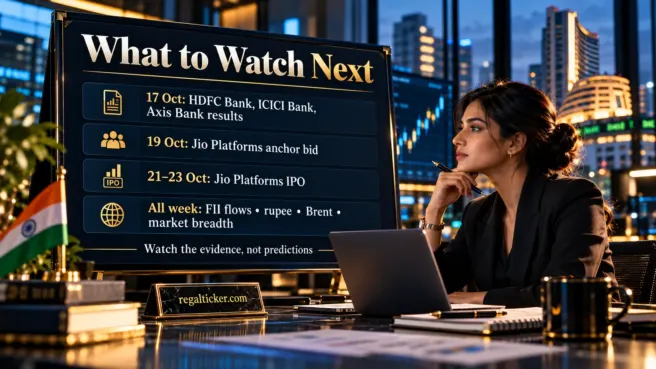
Reliance Industries: Monday will be the first cash-market reaction to Friday’s post-close Q2 results. Energy, digital and retail segment commentary will matter beyond the headline profit increase.
Crude oil: Brent near $117 remains the largest macro threat to the improving rupee/FII combination.
Breadth: Friday’s weak participation is the clearest technical-health question. A healthier next leg would ideally bring banks, autos, midcaps and smallcaps back into the move instead of relying heavily on IT and pharma.
FII follow-through: ₹6,304.67 crore of net foreign cash buying in one week is meaningful. Persistence would matter more than the absolute number.
AI spending and technology: Global markets are balancing genuine semiconductor demand against concerns over hyperscaler cash burn. Indian IT could remain sensitive to that debate.
U.S. data and politics: U.S. growth, labour-market data and the midterm election can influence yields, the dollar and global risk appetite.
Earnings: India remains in the middle of results season. Stock-specific reactions may continue to dominate index-level narratives.
For investors, the Risk Management path is more useful than trying to predict which one of these triggers will dominate. The week can contain a strong structural story and still produce violent short-term rotation.
Frequently asked questions
How much did Nifty rise in the week of 26–30 October 2026?
Nifty 50 rose 2.00%, from 22,600.00 on 23 October to 23,053.10 on 30 October.
How did Sensex perform?
Sensex gained 1.83%, closing the week at 74,459.53.
Did midcaps and smallcaps outperform?
Yes. Nifty Midcap 100 rose 2.69% and Smallcap 100 gained 4.08% over the week, though both weakened on Friday.
Which major sector performed best?
Nifty Pharma was the strongest among the major indices tracked here, rising about 7.09% over the week.
Were FIIs buyers during the week?
Yes. Provisional five-session cash-market data sum to FII net buying of ₹6,304.67 crore. DIIs were also net buyers at ₹3,109.79 crore.
What happened to the rupee?
The rupee ended Friday near ₹94.95 per dollar and recorded its strongest monthly gain in eight months.
What was the main risk at the end of the week?
Brent crude near $117 and Friday’s weak breadth were the two clearest caution signals despite the positive weekly index close.
What is the biggest domestic trigger for next week?
Reliance Industries’ Q2 results, released after Friday’s close, are one of the first major triggers for Monday, alongside crude, FII flows and market breadth.
Verify through official sources
Official references
- RegalTicker — Weekly Review 19–23 October 2026 — Prior-week benchmark, midcap, smallcap and macro context.
- Reuters — India market 26 October — Monday close, sector breadth, crude and key earnings reactions.
- Moneycontrol — Nifty 50 — 30 October Nifty close and one-week return.
- Moneycontrol — Nifty Midcap 100 — 30 October close and monthly/weekly context.
- Moneycontrol — Nifty Smallcap 100 — 30 October close and monthly/weekly context.
- Moneycontrol — FII/DII activity — Daily provisional institutional cash flows for the week.
- Federal Reserve — 28 October FOMC statement — Primary source for the 3.75%–4.00% rate hold and dissenting votes.
- Reuters — Rupee 30 October — Rupee close and October performance.
- Reuters — Oil 30 October — Brent near $117 and supply-risk context.
- BSE — Jio Platforms listing notice — Listing date, issue price and exchange admission details.
- TVS Motor — Q2 FY27 results — Primary source for Q2 revenue, EBITDA and PAT growth.
- Adani Ports — Q2 FY27 results — Primary source for Q2 revenue, EBITDA and revised FY27 guidance.
- Reuters — Reliance Q2 — Post-close Reliance profit, refining, Jio and retail context.
- Reuters — Global market outlook 30 October — AI spending concerns, global central banks, oil and next-week risk context.
Educational disclaimer: RegalTicker provides educational and informational content only. This weekly review is not investment advice, a trading signal or a recommendation to buy or sell any security. Weekly returns, institutional flows, commodity prices, exchange rates and company figures can be revised or superseded by later data. Verify current exchange, issuer, regulator and central-bank information before making financial decisions and consider your own objectives, liquidity, valuation discipline and risk tolerance.
Final takeaway
The rebound is real; the next question is whether it can broaden
The week of 26–30 October repaired a significant part of the previous week’s damage. Nifty gained 2%, smaller-company indices outperformed, pharma led, both foreign and domestic institutions were net cash buyers, and the rupee improved.
But the final session supplied an important warning. Nifty reclaimed 23,000 while breadth weakened sharply, midcaps and smallcaps fell, and crude returned toward $117.
That is the right setup to carry into November: the market has moved from broad stress to selective recovery, but it has not yet moved into a clean, low-risk expansion. The strongest confirmation next week would be a combination of broad participation, continued foreign buying, stable crude and earnings that justify the recent rerating.