India’s strongest week in years came from a rare alignment of macro and market forces
The first full trading week of November produced a market move India had not seen since February 2021.
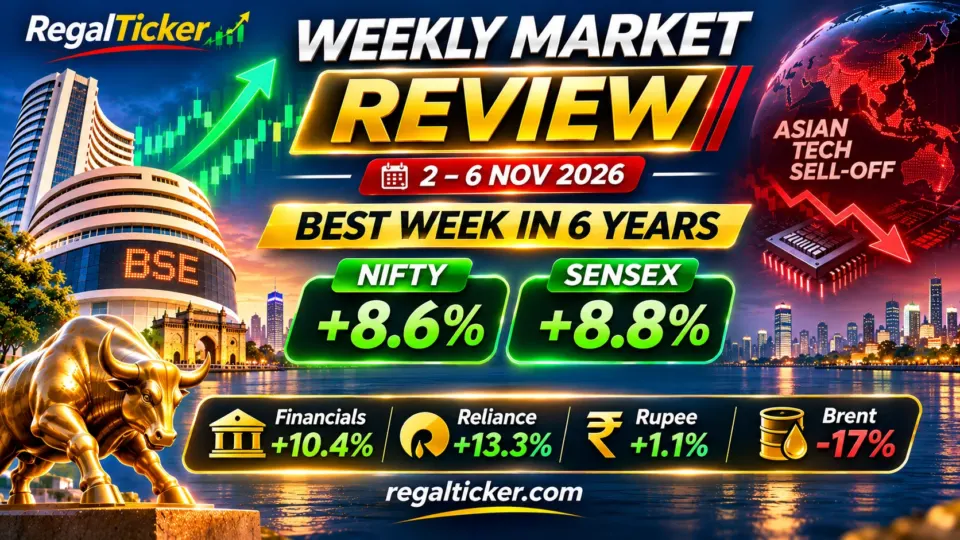
Nifty 50 gained about 8.6% from the previous Friday’s close to finish at 25,030.35 on 6 November, while Sensex rose about 8.8% to 81,028.02. Both benchmarks ended at their highest levels in more than eight months and extended their winning streaks to seven sessions.
The headline move was spectacular, but the more important story was what changed underneath it.
Brent crude fell about 17% over the week, sharply reducing one of India’s biggest macro risks. The rupee gained 1.1% and strengthened to 93.9050 per dollar. Foreign investors bought roughly ₹45,960 crore of Indian equities across the five sessions, while domestic institutions sold about ₹24,197 crore. Financials rose 10.4% for the week, private banks gained 9.1%, and Reliance Industries advanced 13.3%.
At the same time, technology-heavy Asian markets sold off as investors questioned the economics of the global AI infrastructure boom. India’s lower exposure to capital-intensive semiconductor and data-centre trades suddenly became an advantage rather than a weakness.
The result was not simply a rebound. It was a sharp relative re-rating of India against markets that had led much of 2026.
⚡ Quick answer
What happened in the Indian stock market during 2–6 November 2026?
Nifty 50 gained about 8.6% and Sensex about 8.8%, their best weekly performance since February 2021. The rally was driven by strong Reliance earnings, a 17% weekly fall in Brent crude, aggressive FII buying, a 1.1% rupee gain and powerful financial-sector leadership. All 16 major sectors advanced over the week. Financials gained 10.4%, private banks rose 9.1%, midcaps 5.8% and smallcaps 2.8%. India also outperformed technology-heavy Asian markets as global investors reduced exposure to capital-intensive AI infrastructure trades.
Key takeaways
Nifty 50 ended the week at 25,030.35, up about 8.6%.
Sensex closed at 81,028.02, up about 8.8%.
It was the strongest weekly performance for both benchmarks since February 2021.
Nifty rose in all five sessions from Monday to Friday.
FIIs bought approximately ₹45,960 crore of Indian cash equities during the five sessions.
DIIs sold approximately ₹24,197 crore over the same period.
Financials gained 10.4% for the week and private banks rose 9.1%.
HDFC Bank gained about 13.8% and ICICI Bank about 12.4% over the week.
Reliance Industries rose 13.3% after strong quarterly results.
Nifty Midcap 100 gained 5.8% while Smallcap 100 rose 2.8%.
All 16 major sectors posted weekly gains.
The rupee strengthened 1.1% for the week to 93.9050 per dollar.
Brent crude ended Friday at $98.32 and fell about 17% for the week.
India dramatically outperformed Japan, South Korea and Taiwan during Friday’s global technology sell-off.
Friday’s weak breadth showed that the rally became more concentrated in heavyweight stocks toward the end of the week.
1. Weekly scorecard: five straight positive sessions
The week moved in one direction at the benchmark level.
| Session | Nifty 50 close | Daily move |
|---|---|---|
| 30 Oct baseline | 23,053.10 | — |
| Monday, 2 Nov | 23,440.80 | +1.68% |
| Tuesday, 3 Nov | 23,810.85 | +1.58% |
| Wednesday, 4 Nov | 23,960.60 | +0.63% |
| Thursday, 5 Nov | 24,536.60 | +2.40% |
| Friday, 6 Nov | 25,030.35 | +2.01% |
A market that rises every session is unusual. A market that does so while its biggest macro risk—oil—falls sharply is even more significant.
The weekly gain also followed a 2% Nifty rebound in the final week of October. That means the market did not begin November from a fresh low. It began with improving breadth, stronger earnings reactions and tentative foreign buying already in place.
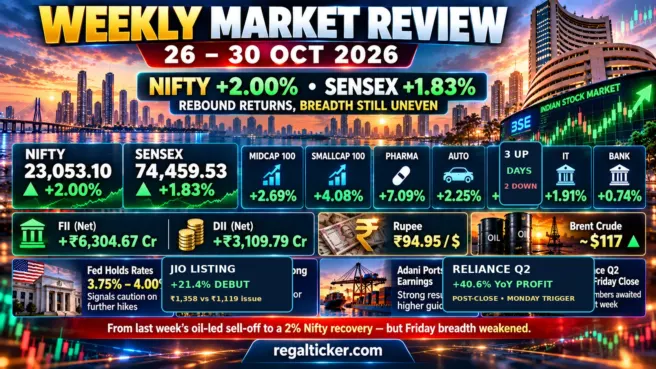
The previous Weekly Market Review for 26–30 October captured that repair phase. The 2–6 November week transformed the repair into a genuine breakout.
2. Monday started with Reliance and oil relief
The week opened with a powerful Reliance-driven session.
Nifty rose 1.68% and Sensex gained 1.66% on Monday. Reliance Industries jumped 11.6% after reporting quarterly profit above expectations, its strongest daily gain since April 2020.
That single stock contributed roughly half of Nifty’s Monday advance.
Oil also helped.
Brent had retreated to around $109 from a six-month high of $118 as Iran-related diplomacy improved the possibility of de-escalation. For an oil-importing economy such as India, even a partial reversal of the war premium matters.
Monday therefore established two themes that lasted all week:
large heavyweight earnings support,
and falling crude improving India’s macro risk profile.
3. Tuesday and Wednesday confirmed that foreign money was returning
The rally did not stop after Monday’s Reliance surge.
Nifty gained another 1.58% on Tuesday and 0.63% on Wednesday.
More importantly, provisional institutional data showed FIIs buying about ₹6,837 crore on Tuesday and ₹7,284 crore on Wednesday.
That was a meaningful change from the record foreign selling that had shaped much of 2026.
The 5 November Daily Market Review showed how quickly the combination of lower oil and returning foreign money began changing India’s market narrative.
A sustained market rally needs more than domestic buying and short covering. Large foreign inflows can improve liquidity, support the rupee and lift the large financial stocks that carry heavy benchmark weights.
That feedback loop became much stronger in the second half of the week.
4. Thursday was the macro reset
Thursday was the week’s decisive session.
Nifty jumped 2.40% and Sensex rose 2.40% after Brent crude had fallen 8.7% in the previous global session.
The move followed the U.S. midterm election result, which markets interpreted as increasing political checks on further escalation in the Iran war and abrupt changes in trade policy.
Financials and autos surged roughly 4%, while oil-sensitive businesses such as Asian Paints and IndiGo rallied.
Foreign buying also accelerated dramatically.
FIIs bought approximately ₹14,975 crore on Thursday, their largest one-day net purchase in nearly six years.
This was the moment the week stopped looking like an earnings rebound and started looking like a broader asset-allocation shift.
Investor note
The oil move mattered because several India risks improved at once
Lower crude does not only help fuel-sensitive companies. It can improve the trade balance, reduce imported inflation, support the rupee, improve bond sentiment and reduce pressure on corporate margins. That multi-channel effect explains why Thursday’s rally was much broader than an energy-sector trade.
5. Friday pushed Nifty above 25,000—but breadth weakened
Friday delivered another 2% index gain.
Nifty closed at 25,030.35 and Sensex at 81,028.02, both at more than eight-month highs.
Bank Nifty gained strongly and heavyweight financials continued to lead.
But the internals became less convincing.
While the benchmarks surged, broader-market data showed substantially more declining stocks than advancing stocks on the NSE.
That divergence matters.
A market can remain strong while breadth narrows, especially when banks and Reliance are rising together. But a durable next leg usually benefits from broader participation.
Friday therefore gave investors two signals at once:
the benchmark breakout was real,
but the rally had become more concentrated.
That is the most important caution to carry into the next week.
6. Financials were the defining sector of the week
Financials gained 10.4% over the week.
Private banks rose 9.1%.
HDFC Bank gained about 13.8% and ICICI Bank about 12.4%, giving both stocks their strongest weekly gains in around six years.
This was not accidental.
Financial stocks sit at the intersection of several improving variables:
foreign inflows,
a stronger rupee,
lower imported inflation,
better rate expectations,
and improving domestic growth confidence.
Banks are also among the most liquid Indian stocks available to foreign investors.
When overseas institutions decide to rebuild India exposure quickly, large private banks are natural beneficiaries.
This is why financial leadership matters more than a temporary rally in a small sector. It gives the broader index a stronger foundation.
7. Reliance gave the rally a second heavyweight pillar
Reliance Industries gained 13.3% for the week.
That was crucial because it prevented the rally from becoming a one-sector financial trade.
Monday’s 11.6% jump followed better-than-expected quarterly earnings and immediately changed index momentum.
Reliance remains exposed to energy, telecom, retail and digital businesses, so its earnings reaction carries a broader message about domestic demand and corporate cash generation.
When Reliance and large banks rally together, the Nifty can move very quickly because several of its largest weights are pulling in the same direction.
The next question is valuation.
A strong weekly re-rating is justified only if earnings, margins and cash flows continue supporting the higher prices.
The Fundamental Analysis learning path is useful here because large index moves can make valuation discipline more important, not less.
8. The rupee finally joined the equity rally
The rupee ended Friday at 93.9050 per dollar.
It gained 1.1% for the week and became the second-best performing Asian currency.
The currency had spent much of 2026 under pressure from high oil prices and sustained foreign equity outflows.
Both forces reversed during the week.
Lower crude reduced demand for dollars from oil importers.
Foreign equity and debt inflows improved dollar supply.
A stronger rupee then improved currency-adjusted returns for overseas investors.
This creates a positive feedback loop when it persists.
But the rupee is still weaker for the year, and one strong week does not remove structural external risks.
The important change is direction: equities, currency and oil moved in India’s favour at the same time.
9. Brent’s 17% weekly fall was the biggest macro gift
Brent settled Friday at $98.32 per barrel.
Despite a small Friday increase, it fell about 17% over the week—its steepest weekly percentage decline since the early COVID period.
That is a major shift for India.
The country imports close to 90% of its crude needs. High oil therefore feeds into the trade deficit, currency pressure, inflation, fiscal risks and operating costs across several industries.
The week’s oil collapse removed part of that pressure almost instantly.
Airlines, paints, autos and consumer-facing sectors benefited from the change in expectations.
The risk remains geopolitical.
Tanker attacks continued and U.S.-Iran tensions were unresolved. A renewed escalation can restore the war premium quickly.
The correct conclusion is therefore not “oil risk is over.”
It is that oil moved from a severe headwind to a meaningful tailwind during the week.
10. India’s low AI exposure suddenly became a relative advantage
For much of 2026, India’s limited exposure to semiconductor and hyperscale AI names was viewed as a disadvantage.
This week, the same structure helped it outperform.
Technology-heavy Asian markets were hit hard as investors questioned the returns on enormous data-centre and AI infrastructure investment.
On Friday alone, South Korea’s KOSPI and Japan’s Nikkei fell around 6%, while Taiwan dropped roughly 4.5%.
The Nasdaq had fallen 5.5% overnight before partially rebounding on Friday.
Indian IT stocks held up far better.
That reflects an important distinction.
Indian IT services companies are generally not funding hundreds of billions of dollars of AI infrastructure. Their opportunity is more closely tied to enterprise adoption, implementation and productivity services.
That does not make Indian IT immune to a technology downturn.
It does mean global investors may increasingly separate companies financing AI infrastructure from companies monetising AI adoption with less capital.
For India, that relative distinction was a major advantage this week.
11. Midcaps and smallcaps participated—but less than large caps
All 16 major sectors ended the week higher.
Nifty Midcap 100 gained 5.8%.
Nifty Smallcap 100 rose 2.8%.
Those are strong absolute returns.
But both lagged the 8.6% Nifty gain.
That tells us the rally was increasingly driven by large-cap leadership.
This is not necessarily unhealthy. Large-cap leadership often appears first when foreign capital returns because overseas investors prefer liquidity and benchmark exposure.
The important test is what happens next.
If midcaps and smallcaps begin participating more strongly while financials remain firm, the rally broadens.
If smaller stocks continue lagging while only a handful of heavyweights rise, the headline indices can remain strong even as underlying risk increases.
12. Institutional flows were extraordinary—and unusually one-sided
The five-session provisional cash-market numbers were striking.
FIIs bought approximately ₹45,960 crore.
DIIs sold approximately ₹24,197 crore.
The daily FII pattern was also consistent:
about ₹3,115 crore on Monday,
₹6,837 crore on Tuesday,
₹7,284 crore on Wednesday,
₹14,975 crore on Thursday,
and ₹13,750 crore on Friday.
This was not one isolated large order.
Foreign demand accelerated as the week progressed.
The DII selling is also important.
Domestic institutions had helped support Indian equities during long periods of foreign selling. This week, some of that domestic demand was effectively replaced by much larger foreign buying.
That handoff from domestic support to overseas demand is one of the clearest structural changes in the week.
13. What changed relative to October?
October ended with a recovery, but not a clean bull-market signal.
The October Monthly Market Review showed improving large-cap performance alongside heavy foreign selling and weaker broader-market participation.
The first week of November changed three of those variables at once.
Foreign flows reversed.
Oil fell sharply.
The rupee strengthened.
That is why the weekly return was so much larger than a normal earnings-season rebound.
India’s year-to-date performance is still negative. Reuters noted that after this week’s rally, Nifty remained down about 4.2% for 2026 and Sensex about 4.9%, compared with roughly 7% gains for the MSCI Emerging Markets index.
So the week did not erase the year’s underperformance.
It dramatically narrowed it.
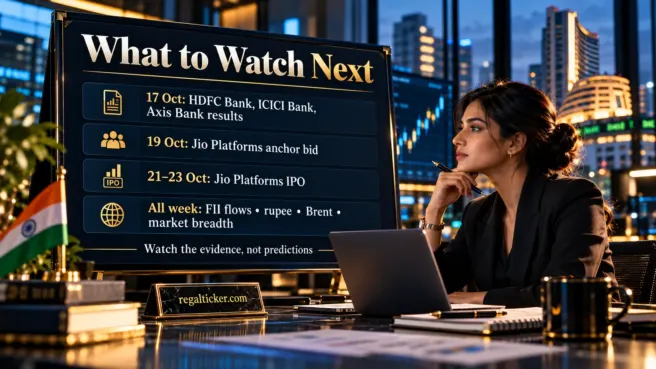
14. What investors should watch next week
The first signal is breadth.
Friday’s weak advance-decline profile is the clearest reason not to treat the 8.6% weekly gain as an automatic all-clear.
Second, watch FII flows.
A ₹45,960 crore week is extraordinary. Continuation matters more than repeating the exact magnitude.
Third, watch crude.
Brent near $98 is highly supportive compared with the previous week’s roughly $117 level, but Middle East geopolitics can reverse that move quickly.
Fourth, watch the rupee around 94.
A sustained move stronger than 94 would reinforce India’s improving external story.
Fifth, watch banks.
Financials led the week. If banks consolidate normally while other sectors broaden, that would be healthier than another narrow bank-only surge.
Sixth, watch the global technology sell-off.
A deeper AI unwind can eventually tighten global liquidity even if India initially benefits from rotation.
Seventh, watch U.S. inflation and rate expectations.
The coming U.S. CPI and producer-price data could influence Treasury yields, the dollar and foreign allocations to emerging markets.
Finally, the special Diwali trading session can create unusual liquidity and price behaviour. Investors should avoid treating a short ceremonial session as equivalent to a normal full trading day.
Frequently asked questions
How much did Nifty gain during 2–6 November 2026?
Nifty 50 gained about 8.6% for the week, closing Friday at 25,030.35.
How much did Sensex gain?
Sensex gained about 8.8% for the week and closed at 81,028.02.
Was this really the market’s best week in six years?
Yes. Reuters reported that the Nifty and Sensex posted their strongest weekly gains since February 2021.
Which sector led the week?
Financials led, gaining about 10.4%. Private banks rose about 9.1%.
How did HDFC Bank and ICICI Bank perform?
HDFC Bank gained about 13.8% and ICICI Bank about 12.4% over the week.
How much did Reliance Industries gain?
Reliance Industries rose about 13.3% for the week after strong quarterly earnings.
Were FIIs buyers during the week?
Yes. Provisional cash-market data show FIIs bought approximately ₹45,960 crore across the five sessions.
What did DIIs do?
DIIs were net sellers of approximately ₹24,197 crore during the same five sessions.
What happened to the rupee?
The rupee gained 1.1% for the week and closed at 93.9050 per dollar, its strongest level since 22 April.
What happened to crude oil?
Brent settled Friday at $98.32 per barrel and fell roughly 17% over the week.
Did midcaps and smallcaps participate?
Yes, but they lagged the large-cap indices. Midcap 100 gained 5.8% and Smallcap 100 rose 2.8%.
What is the biggest warning after such a strong week?
Friday’s weak market breadth. The benchmark rally became more concentrated in large financials and other heavyweight stocks, so broader participation will matter next.
Verify through official sources
Official references
- Reuters — Weekly Indian equities — Weekly Nifty and Sensex returns, sector performance, foreign inflows, heavyweight gains and India’s relative outperformance during the Asian tech rout.
- Reuters — Monday Indian equities — Monday closing levels, Reliance earnings reaction and early-week crude context.
- Reuters — Thursday Indian equities — Thursday index surge, oil-sensitive sectors, foreign buying and lower-crude catalyst.
- Reuters — Indian rupee — Rupee close at 93.9050, 1.1% weekly gain and foreign-flow/oil transmission.
- Reuters — Crude oil — Brent Friday settlement at $98.32 and roughly 17% weekly decline.
- Moneycontrol — FII/DII cash activity — Five-session provisional FII and DII cash-market flows.
- Economic Times — FII/DII and Nifty daily series — Daily Nifty closes and weekly institutional-flow totals for 2–6 November.
- Reuters — Global markets — Global technology sell-off, Asian market divergence, U.S. market reaction and cross-asset context.
Final takeaway
The week was a genuine breakout, but the next phase needs breadth
The 2–6 November week was one of the clearest shifts in India’s market narrative this year.
Nifty gained 8.6%, Sensex 8.8%, financials 10.4%, Reliance 13.3%, the rupee strengthened 1.1% and Brent fell about 17%.
Foreign investors also returned with nearly ₹46,000 crore of provisional cash buying across five sessions.
That combination explains why India could rally even while technology-heavy Asian markets suffered severe losses.
The next question is no longer whether the rebound is real.
It is whether the rally can become broader.
If foreign flows remain positive, crude stays near or below $100, the rupee holds firm and smaller stocks begin participating more consistently, the first week of November can become the start of a more durable re-rating.
If breadth continues weakening while banks and a few heavyweights carry the indices, the benchmarks can stay strong even as the underlying market becomes more fragile.
After the best week in nearly six years, that distinction matters more than another headline percentage gain.
Educational disclaimer: This weekly market review is for education and general market information only. It is not investment advice or a recommendation to buy, sell or hold any security, sector, commodity or currency. Provisional institutional-flow data may be revised, and commodity, currency and index levels can change after publication. Verify current exchange, regulator, company and market disclosures before making financial decisions, and consider valuation, liquidity, diversification and your own risk tolerance.