TVS Motor is separating finance from mobility just as the operating business is accelerating
TVS Motor Company has approved a proposed composite restructuring that would separate its consumer-finance and related business into Harita ARC Limited while merging wholly owned TVS Motor Services Limited back into the listed parent.
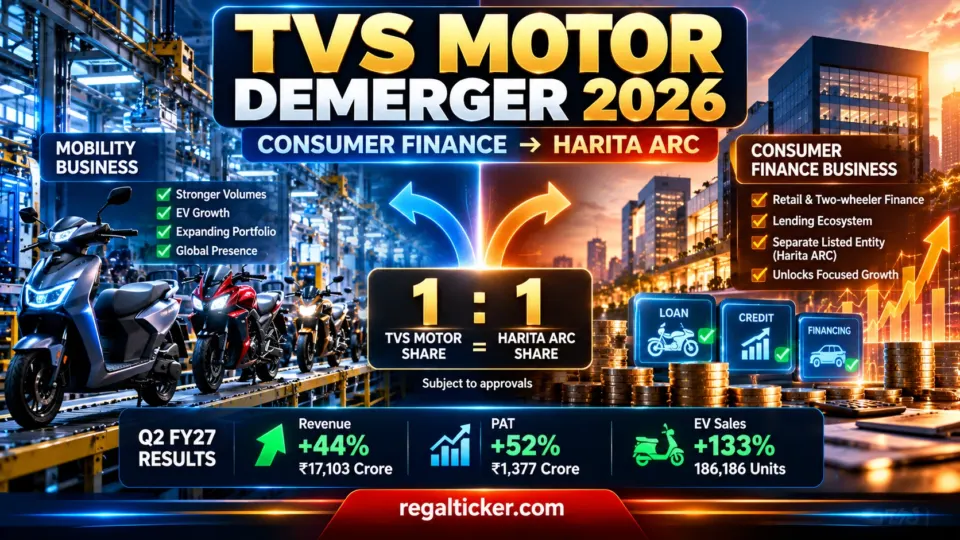
For shareholders, the headline term is simple: under the proposed scheme, an eligible investor would receive one fully paid-up Harita ARC share for every one fully paid-up TVS Motor share held on the applicable record date. Harita ARC is proposed to become a separately listed company, subject to the required approvals.
The timing makes the restructuring more interesting. On the same day, TVS Motor reported record Q2 FY27 revenue of ₹17,103 crore, EBITDA of ₹2,219 crore and profit after tax of ₹1,377 crore. Two-wheeler EV sales rose 133% to 186,186 units.
This is therefore not merely a corporate-action ratio story. It is a separation between two businesses with very different economics: a fast-growing mobility manufacturer and a consumer-finance platform whose capital needs, regulation, leverage and valuation framework are fundamentally different. RegalTicker’s demerger guide explains why that distinction matters before investors assume a restructuring automatically creates value.
⚡ Quick answer
What does the TVS Motor demerger mean for shareholders?
TVS Motor’s board has approved a scheme to demerge the consumer-finance and related undertaking into Harita ARC Limited. The proposed share-entitlement ratio is 1:1: one Harita ARC share for every one TVS Motor share held by an eligible shareholder on the future record date. Harita ARC is proposed to list separately. The scheme still requires exchange, SEBI, NCLT and shareholder/creditor approvals. The record date, effective date and listing date are not yet final. Importantly, a 1:1 share ratio does not mean investors should split their original TVS Motor acquisition cost 50:50; the official cost-allocation percentage must be published later.
Key takeaways
TVS Motor’s board approved the composite scheme on 28 October 2026.
The consumer-finance and related business would move into Harita ARC Limited.
Eligible shareholders are proposed to receive 1 Harita ARC share for every 1 TVS Motor share held on the record date.
Harita ARC is proposed to list on the stock exchanges after the required approvals.
TVS Motor Services Limited would merge into TVS Motor Company without a separate consideration because it is a wholly owned subsidiary.
The demerged consumer-finance undertaking reported turnover of about ₹3,921 crore for the six months ended 30 September 2026, around 11% of TVS Motor’s ₹35,770 crore total turnover for that period.
Harita ARC itself had not commenced business before the proposed transfer; it is being used as the resulting company for the finance undertaking.
Q2 FY27 TVS Motor revenue rose 44% to ₹17,103 crore and PAT rose 52% to ₹1,377 crore.
EV two-wheeler sales increased 133% to 186,186 units in Q2 FY27.
A 1
1 entitlement ratio is a share-allotment rule, not a tax cost-allocation percentage.
Investors should wait for the final scheme timetable and official cost-of-acquisition communication before adjusting portfolio records.
1. What TVS Motor’s board approved
The restructuring has two principal moving parts.
First, TVS Motor Services Limited is proposed to be amalgamated with TVS Motor Company. The subsidiary is wholly owned, so the merger is intended to simplify the group structure rather than create a new shareholder entitlement.
Second, TVS Motor’s consumer-finance and related undertaking is proposed to be demerged into Harita ARC Limited on a going-concern basis.
The finance undertaking includes lending, investments, leasing and associated support activities carried out directly or through the relevant business structure. Harita ARC would become the resulting company that houses this business.
Before implementing the arrangement, TVS Motor acquired the entire equity stake in Harita ARC from TVS Credit Services for ₹25,000. Harita ARC had not commenced business operations at the time of the filing. That is an important detail: shareholders are not receiving shares in a mature pre-existing listed lender. They would receive shares in the resulting company after the finance undertaking is transferred into it under the approved scheme.
This is why the Corporate Actions Academy is a more useful framework than reading only the first headline. A board announcement begins the process; it does not complete it.
2. The proposed 1:1 share entitlement
The proposed ratio is straightforward:
1 Harita ARC share for every 1 TVS Motor share held by an eligible shareholder.
If an investor holds 100 TVS Motor shares on the eventual record date, the proposed entitlement would therefore be 100 Harita ARC shares, subject to the scheme becoming effective and the final eligibility mechanics.
| TVS Motor shares on record date | Proposed Harita ARC entitlement |
|---|---|
| 10 | 10 |
| 100 | 100 |
| 500 | 500 |
| 1,000 | 1,000 |
The resulting company’s shareholding pattern is expected to mirror TVS Motor’s pattern after implementation, because shares are being issued proportionately to existing shareholders.
But the record date has not yet been fixed. Nor has the resulting company started trading.
The correct investor sequence is therefore:
board approval → regulatory review → NCLT process → scheme effectiveness → record date → share allotment/credit → exchange listing and trading.
RegalTicker’s Corporate Actions Calendar becomes relevant only when confirmed dates are formally announced. Until then, treating an estimated record date as official would be premature.
3. Why 1:1 does not mean a 50:50 cost split
This is the most important practical point for existing shareholders.
A share-entitlement ratio answers: “How many resulting-company shares do I receive?”
A cost-allocation percentage answers: “How much of my original acquisition cost belongs to the resulting-company shares after the demerger?”
They are not the same thing.
Suppose an investor originally bought 100 TVS Motor shares for a total cost of ₹2,00,000. A 1:1 entitlement may result in 100 Harita ARC shares, but it does not tell the investor whether ₹20,000, ₹50,000 or another amount of the original cost should move to Harita ARC.
That allocation depends on the official post-scheme communication under the applicable tax framework.
So investors should not divide the cost 50:50 merely because the share ratio is 1:1. They also should not use the first listed market prices to invent an allocation.
Once the official allocation percentage is published, the Demerger Cost Basis Calculator can be used to divide the original TVS Motor acquisition cost between the continuing TVS Motor holding and Harita ARC. Until then, the correct input is unknown.
Investor note
Keep the original contract notes and do not rewrite cost records yet
The TVS Motor scheme is only at the approval stage. Preserve the original purchase lots, acquisition dates and total cost. Wait for the final scheme, actual share credit and official cost-allocation communication before changing tax-lot records.
4. How large is the finance business being separated?
The demerged consumer-finance undertaking reported turnover of approximately ₹3,921 crore for the six months ended 30 September 2026.
TVS Motor’s disclosed total turnover for the same period was about ₹35,770 crore.
That puts the finance undertaking at roughly 11% of the reported turnover base in the filing.
Turnover is only one measure of size, and it should not be confused with profit, net worth or fair value. Financial-services businesses also cannot be analysed in the same way as vehicle manufacturing. Borrowing is part of the operating model, credit quality matters heavily, and valuation often focuses on measures such as book value, return on equity, asset quality, growth and funding cost rather than only EV/EBITDA.
That is one reason the proposed separation can make the group easier to analyse.
A combined TVS Motor valuation forces investors to think about manufacturing, EV growth, international two-wheeler demand and consumer finance inside one structure. A successful demerger would allow the market to price the continuing mobility business and the finance business separately.
RegalTicker’s book value and valuation guide is useful here because it explains why valuation tools that work for industrial companies are not always appropriate for financial firms.
5. The mobility business is entering the split from a position of strength
The demerger announcement arrived alongside TVS Motor’s strongest quarterly revenue to date.
For Q2 FY27:
| Metric | Q2 FY27 | YoY change |
|---|---|---|
| Revenue | ₹17,103 crore | +44% |
| EBITDA | ₹2,219 crore | +47% |
| EBITDA margin | 13.0% | +30 bps |
| Profit after tax | ₹1,377 crore | +52% |
| Total 2W + 3W sales | 1.9 million units | +27% |
| International sales | 0.5 million units | +35% |
| Two-wheeler EV sales | 186,186 units | +133% |
This matters for the post-demerger investment case.
The continuing TVS Motor business would remain exposed to motorcycles, scooters, electric two-wheelers, three-wheelers and international operations. The finance platform would be analysed separately.
If the split proceeds, investors will eventually need to ask two different questions:
- What multiple should the market assign to TVS Motor’s mobility growth and operating margins?
- What book-value, ROE, growth, funding and asset-quality profile justifies Harita ARC’s valuation?
That separation can improve transparency, but it does not guarantee that the combined market value of the two securities will rise.
6. EV growth is becoming a material part of the operating story
Two-wheeler EV sales grew 133% year on year to 186,186 units in Q2 FY27.
That is faster than the company’s overall vehicle growth and gives the continuing mobility company another distinct growth driver.
The operating question now becomes whether EV scale translates into durable margins and returns rather than only unit growth. Investors should track product mix, battery and component costs, competitive pricing, warranty economics, capex and working capital.
A strong revenue and PAT quarter is encouraging, but accounting profit alone does not answer how efficiently growth is being funded. The cash-flow statement guide is useful when assessing whether fast unit growth is converting into operating cash after inventory, receivables, capex and financing movements.
That matters even more after a restructuring because investors will eventually be reading two separate capital-allocation stories.
7. Why TVS Motor wants finance in a separate listed structure
Management’s stated rationale is strategic focus and value creation.
Consumer finance operates under a very different set of business conditions from manufacturing. It has different regulatory requirements, funding structures, credit risks, capital requirements and potential strategic investors.
A separate structure can theoretically help the finance business:
- pursue its own growth strategy;
- raise capital appropriate to financial services;
- attract lenders or strategic partners;
- disclose its performance more clearly;
- manage risk independently; and
- be valued using sector-appropriate metrics.
At the same time, TVS Motor’s continuing mobility business can be judged more directly on vehicle sales, margins, EV execution, international growth and capital efficiency.
That is the classic argument for a demerger: two businesses that were bundled together may become easier to understand and capitalise separately.
But value unlocking is not mechanical. The fundamental-analysis framework still applies to each resulting business after the split.
8. What Harita ARC is—and what it is not yet
Harita ARC is the proposed resulting company for the demerged finance business.
At the time of the TVS Motor filing, Harita ARC itself had no operating turnover and had not commenced business operations. TVS Motor acquired its shares for ₹25,000 in connection with the proposed restructuring.
So today’s Harita ARC should not be analysed as though it already contains the full consumer-finance platform.
The economics change only after the scheme becomes effective and the designated undertaking, assets, liabilities and related operations are transferred into the resulting company.
The company then needs to complete the allotment and listing process before public shareholders can trade the new security.
This is also why screenshots, broker placeholders or speculative “Harita ARC prices” should be ignored until exchange notices are available. RegalTicker’s market-news verification guide explains how to work from the original exchange filing rather than forwarded summaries.
9. What happens to TVS Motor’s share price after the demerger?
There is no reliable way to predict the eventual post-demerger TVS Motor price today.
When a business is separated, part of the economic value previously embedded inside the parent moves to the resulting company. The parent’s market value normally adjusts to reflect the assets, liabilities, earnings and growth profile that remain.
But the actual trading values depend on:
- market conditions;
- the final transferred balance sheet;
- debt and capital allocation;
- earnings outlook;
- investor demand;
- liquidity;
- management strategy; and
- the valuation multiple assigned to each business.
The first listed price of Harita ARC will also be a market-discovery event, not a guaranteed measure of “value created.”
The right comparison after implementation is therefore the combined value of the continuing TVS Motor shares plus Harita ARC shares, adjusted for the final cost basis and any subsequent market movements.
More securities in the demat account do not automatically mean more wealth.
10. What approvals and dates are still pending?
The board approval is only the first major milestone.
The company has disclosed that the scheme is subject to approvals including:
- BSE and NSE;
- SEBI;
- the jurisdictional National Company Law Tribunal;
- shareholders; and
- creditors where applicable.
The final process will also need the scheme to become effective before the record date and resulting-company allotment can be completed.
Investors should therefore distinguish clearly between what is known and what is not.
Known now: the structure, proposed 1:1 entitlement and intended separation.
Not final now: effective date, record date, share-credit date, Harita ARC listing date, first trading price and official acquisition-cost allocation percentage.
Any social-media post presenting one of those pending dates as confirmed should be checked against the latest exchange filing.
11. What shareholders should watch next
For existing TVS Motor shareholders, the next useful information will not come from another headline about “value unlocking.” It will come from documents.
Watch for:
- the detailed scheme and subsequent exchange observations;
- shareholder and creditor approval notices;
- NCLT orders;
- the effective date;
- the record date;
- final share-allotment mechanics;
- the Harita ARC listing approval and trading date;
- the official cost-of-acquisition allocation communication;
- standalone financial disclosures for the resulting finance business; and
- management commentary on capital allocation at both companies.
The Corporate Actions Academy provides the sequence for following these milestones, while the Risk Management path is useful if event-driven volatility causes the stock to move faster than the available information.
The key is to separate corporate-action mechanics from the investment thesis. The first determines what securities shareholders receive. The second determines whether the businesses deserve the market valuations they eventually command.
Frequently asked questions
What is the TVS Motor demerger ratio?
The proposed share-entitlement ratio is 1:1. Eligible shareholders are expected to receive one fully paid-up Harita ARC share for every one fully paid-up TVS Motor share held on the applicable record date, subject to the scheme becoming effective.
Is the TVS Motor demerger complete?
No. The board has approved the proposed scheme, but it still requires regulatory, NCLT and stakeholder approvals before implementation.
What is Harita ARC?
Harita ARC Limited is the proposed resulting company into which TVS Motor’s consumer-finance and related undertaking would be demerged. It had not commenced operating business before the proposed transfer.
Will Harita ARC be listed?
The scheme proposes that Harita ARC’s equity shares be listed on the stock exchanges, subject to the required approvals and listing process.
Is the record date announced?
Not yet in the board-approved announcement. Investors should wait for an official company or exchange notice.
Does a 1:1 share ratio mean I should allocate 50% of my TVS Motor purchase cost to Harita ARC?
No. Share entitlement and tax cost allocation are separate calculations. Wait for the official cost-allocation percentage before changing acquisition-cost records.
How strong were TVS Motor’s Q2 FY27 results?
Revenue rose 44% to ₹17,103 crore, EBITDA increased 47% to ₹2,219 crore and PAT rose 52% to ₹1,377 crore. Two-wheeler EV sales increased 133% to 186,186 units.
What should existing shareholders do now?
Preserve original purchase records, monitor official scheme filings and avoid acting on unconfirmed dates or cost-allocation assumptions. The final record date, listing timetable and acquisition-cost allocation will matter later.
Verify through official sources
Official references
- TVS Motor Company — Q2 FY27 results press release — Primary company source for Q2 revenue, EBITDA, PAT, sales, international growth and EV volumes.
- TVS Motor Company — Stock exchange intimations — Company investor-relations page for exchange disclosures and subsequent restructuring updates.
- BSE — TVS Motor board outcome filing — Exchange filing covering Harita ARC acquisition and the board-approved composite scheme.
- Autocar Professional — TVS Motor demerger terms — Reports the 1:1 proposed share-entitlement ratio, resulting-company listing plan and finance-undertaking turnover from the company filing.
- Business Standard — TVS Motor restructuring — Current reporting on the demerger structure, finance-business scale, approvals and management rationale.
- Moneycontrol — TVS Motor Q2 and demerger — Secondary confirmation of Q2 performance and the board’s restructuring approval.
Final takeaway
The 1:1 ratio is easy; valuing the two businesses will be harder
TVS Motor’s proposed demerger gives shareholders a simple entitlement headline: one Harita ARC share for every one TVS Motor share held on the future record date. The more important questions begin after that.
The continuing TVS Motor business enters the process with strong operating momentum—record revenue, higher margins, 52% PAT growth and 133% EV-sales growth. The consumer-finance undertaking, meanwhile, is large enough to deserve its own capital structure and valuation framework.
If the scheme completes, shareholders will own two different economic exposures instead of one bundled structure. That can improve transparency and capital allocation, but it does not guarantee value creation.
For now, keep the original cost records unchanged, follow the official approval sequence and wait for the formal cost-allocation communication. The 1:1 ratio tells you how many Harita ARC shares you may receive; it does not tell you what those shares will be worth or how much of your original TVS Motor cost belongs to them.
Educational disclaimer: RegalTicker provides educational and informational content only. This article is not investment, tax or legal advice and is not a recommendation to buy or sell TVS Motor Company or any resulting security. The scheme remains subject to regulatory, NCLT and stakeholder approvals, and the record date, listing timetable and official acquisition-cost allocation are not yet final. Verify the latest TVS Motor, NSE, BSE and resulting-company communications before changing portfolio records or making an investment decision.