

Lesson 01
Beginner
What Is a Mutual Fund? Meaning, How It Works, Types and Risks
Learn what a mutual fund is, how it pools money, how NAV and units work, major fund types, costs, risks…
Learn mutual funds in India step by step, from NAV, units and fund categories to SIPs, plan choices, costs, taxation, risk and a practical fund-selection framework.

A mutual fund pools money from many investors into a professionally managed portfolio. The useful beginner question is not simply whether mutual funds are good or bad; it is which scheme category, investment route, option, cost structure and risk level fit the goal and holding period. Start with how funds and NAV work, then separate the decisions that are often mixed together.
Use this hub as an ordered decision path: understand the fund category and NAV first, decide SIP versus lumpsum separately from Direct versus Regular and Growth versus IDCW, then review expense ratio, exit load, taxation, portfolio risk and the final selection checklist. Always read the current scheme documents and Riskometer before investing because category labels, costs, portfolio characteristics and tax treatment can differ.
Jump to the lesson that matches the decision in front of you, then return to the ordered path for the surrounding concepts.
Use the recommended learning order, or jump directly to the guide you need.
Learn what a mutual fund is, how it pools money, how NAV and units work, major fund types, costs, risks…

Understand the types of mutual funds in India, including equity, debt, hybrid, life cycle, index, ETF and fund of funds…
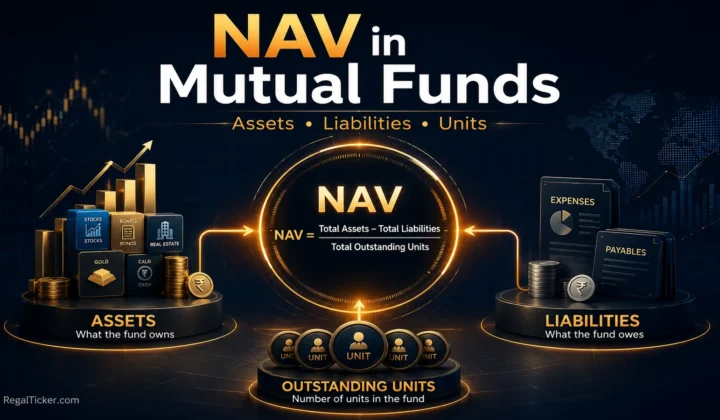
Learn what NAV in mutual funds means, how NAV is calculated, how units are allotted, and why a lower NAV…

Compare SIP vs lumpsum mutual fund investing, including differences, examples, risks, rupee-cost averaging and a practical framework to choose.

Compare direct vs regular mutual funds, including expense ratio, NAV, returns, advice, switching rules and the plan suited to different…
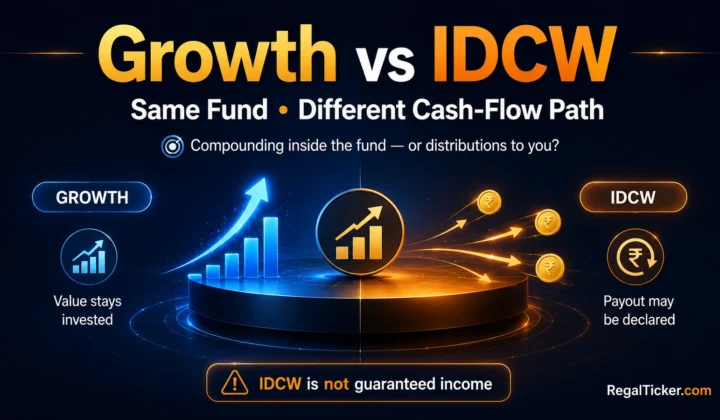
Growth vs IDCW mutual funds explained with NAV impact, IDCW tax, TDS, compounding, SWP comparison, examples and a practical decision…

Learn expense ratio in mutual funds, TER and BER under 2026 rules, calculation formula, daily NAV deduction and long-term impact…

Learn exit load in mutual funds, the 2026 SEBI cap, formula, SIP and FIFO rules, switches, partial redemption and practical…

Learn mutual fund taxation in India for 2026, including equity fund LTCG and STCG, debt-fund Section 50AA rules, IDCW tax,…

Learn how to choose a mutual fund in India with a practical 15-point checklist covering goals, risk, category, returns, benchmark,…
Calculators help test cash-flow assumptions and measure entered outcomes; they do not identify the best mutual fund, forecast returns or replace the scheme documents, Riskometer and suitability review.
Model how a regular monthly contribution could grow under an assumed return and time period. Treat the return as an input, not a promise.
Open calculatorWork backward from a target amount and horizon to estimate the monthly contribution required under an assumed return.
Open calculatorEstimate the future value of a one-time investment using your own assumed return and holding period.
Open calculatorModel a systematic withdrawal plan and see how recurring withdrawals interact with an assumed portfolio return over time.
Open calculatorMeasure money-weighted annualised return when investments, redemptions or distributions happen on different dates.
Open calculatorEstimate tax only after correctly identifying the applicable investment and tax classification; verify current rules before acting.
Open calculator
Learn how to choose a mutual fund in India with a practical 15-point checklist covering goals, risk, category, returns, benchmark, costs, portfolio, tax and red flags.
Read Latest ArticleUse current SEBI regulations, the Mutual Fund Master Circular, scheme documents and AMFI investor resources to verify product structure, disclosures and investor information. Regulations and scheme-specific details can change, so prefer the latest official document over a saved screenshot or old article.
No. A SIP is a method of investing a chosen amount at regular intervals. The underlying scheme can belong to different mutual-fund categories, and its risk, costs and portfolio still need to be evaluated separately.
No. NAV is the per-unit value of a scheme. A lower NAV by itself does not make a scheme cheaper, safer or more attractive; portfolio quality, category, costs, benchmark, risk and suitability matter more.
No. Mutual fund returns depend on the underlying investments and market conditions. Calculator projections and historical performance are not guarantees of future returns.
Start with the goal, horizon and risk capacity, then check the scheme category, benchmark, Riskometer, portfolio, consistency, expense ratio, exit load, plan and option, taxation and current scheme documents.