
A mutual fund is not one uniform investment product. It is a regulated structure through which money from many investors is pooled and invested according to a stated objective. One scheme may hold shares of large listed companies, another may hold short-maturity debt instruments, and another may combine equity, debt, gold-related instruments and other permitted assets.
That is why the first question should not be, “Which mutual fund gave the highest return?”
The first question should be, “What type of mutual fund is this, what is it permitted to own, and does that category match my goal?”
The category determines the broad behaviour of the portfolio. It affects the kind of volatility, credit exposure, interest-rate sensitivity, concentration and liquidity risk an investor may face. Two schemes can both be called mutual funds while having completely different purposes and risk profiles.
This lesson explains the major types of mutual funds in India under the categorisation framework issued by the Securities and Exchange Board of India on February 26, 2026. It covers equity schemes, debt schemes, hybrid schemes, life cycle funds, index funds, exchange-traded funds and fund of funds. It also explains other labels such as open-ended, active, passive, direct, regular, growth, IDCW, SIP and lump sum.
Before continuing, read What Is a Mutual Fund? Meaning, How It Works, Types and Risks if you need a foundation in units, NAV, fund management, expenses and basic risks.
Quick Answer: What Are the Main Types of Mutual Funds in India?
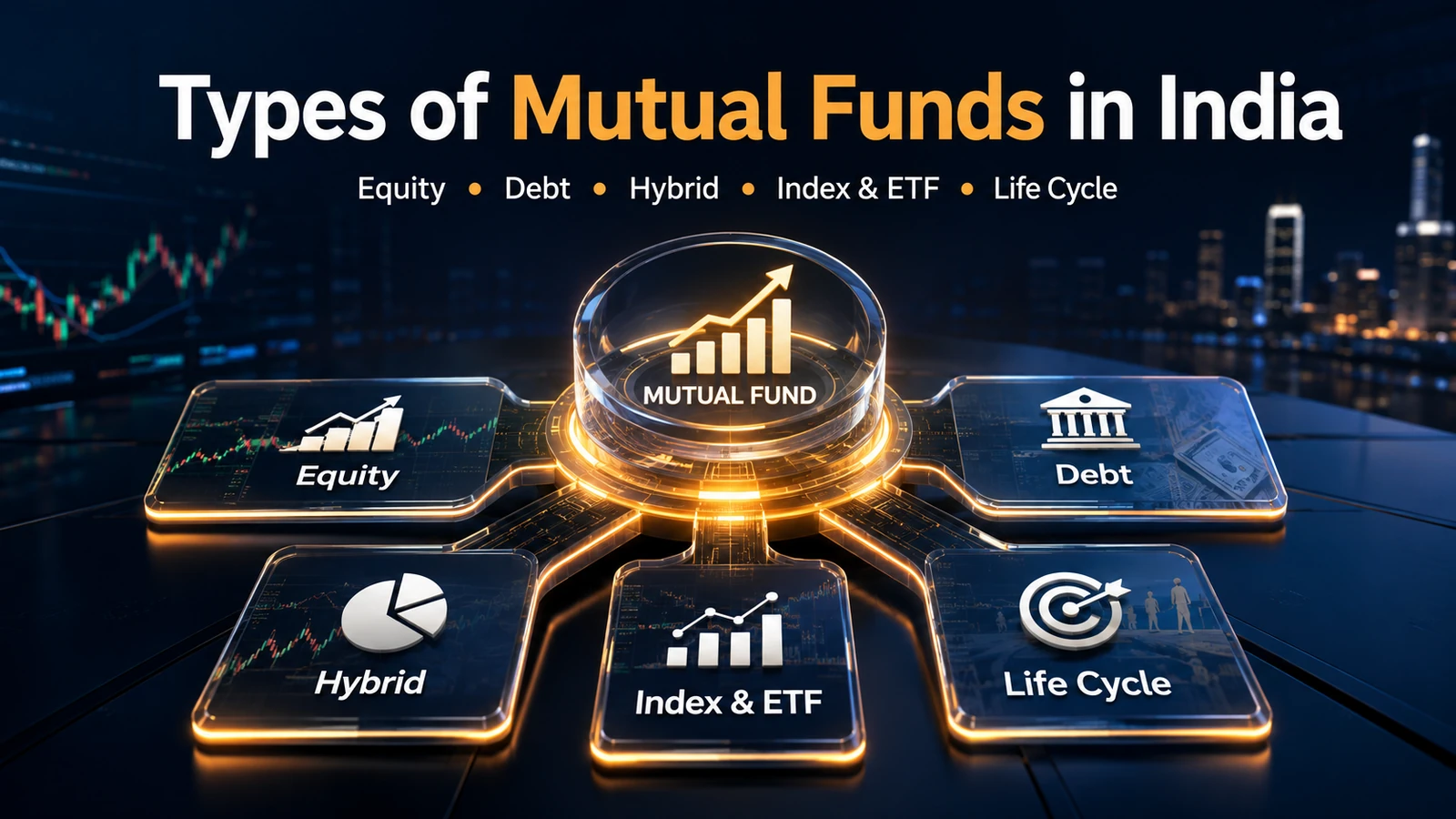
SEBI’s revised framework broadly classifies mutual fund schemes into five groups:
- Equity schemes
- Debt schemes
- Hybrid schemes
- Life cycle funds
- Other schemes, including index funds, ETFs and fund of funds
Each broad group contains subcategories with defined portfolio characteristics.
An equity category may specify how much must be invested in large-cap, mid-cap or small-cap companies. A debt category may be defined by maturity, portfolio duration, credit quality or issuer type. A hybrid category may prescribe an equity-debt range. An index fund or ETF must substantially replicate or track its stated index. A life cycle fund follows a glide path that changes asset allocation as a predetermined maturity approaches.
The classification describes the scheme’s mandate. It does not guarantee returns, safety or suitability.
The 2026 Transition Matters
The SEBI circular dated February 26, 2026 superseded the earlier categorisation provisions. Existing schemes received six months to align their names, objectives, benchmarks and other required parameters with the revised framework.
This means investors may temporarily encounter old and new terminology together. The latest Scheme Information Document, Key Information Memorandum, factsheet and official AMC communication should take priority over an old article, screenshot or app label.
The revised framework also discontinued the earlier solution-oriented scheme category and introduced life cycle funds as a separate broad group. It introduced or renamed several subcategories, including a sectoral debt fund and an ultra short to short term fund.
How Mutual Fund Classification Works
A single mutual fund can carry several labels at the same time because each label answers a different question.
For example, one scheme might be:
- an equity scheme by asset class;
- a flexi-cap fund by SEBI category;
- open-ended by structure;
- actively managed by investment style;
- purchased through a direct plan;
- selected under the growth option;
- funded through a monthly SIP.
These descriptions are not alternatives. They describe different layers of the same investment.
Category
The category defines the scheme’s core portfolio mandate.
Examples include large-cap fund, liquid fund, aggressive hybrid fund, index fund and fund of funds.
Structure
The structure explains when units can usually be purchased or redeemed.
The common structures are open-ended, close-ended and interval.
Management Style
An active fund gives a fund manager discretion to select securities within the scheme mandate. A passive fund attempts to replicate or track a stated benchmark or portfolio.
Plan
A direct plan is purchased without distributor commission being included in that plan’s expense structure. A regular plan includes distribution-related expenses.
Option
A growth option retains returns within the scheme, where they are reflected in NAV. An IDCW option may distribute income when declared from distributable surplus. IDCW is not guaranteed interest and is not an additional return over and above the scheme portfolio.
Investment Method
A SIP, lump-sum investment, systematic transfer plan or systematic withdrawal plan describes how money enters or leaves the scheme. A SIP is not a fund category. It is a contribution method.
Understanding these layers prevents comparisons such as “SIP versus equity fund” or “direct plan versus index fund.” Those pairs describe different dimensions.
Equity Mutual Funds
Equity schemes invest predominantly in equity and equity-related instruments. Their returns are influenced mainly by company earnings, valuations, market sentiment, sector conditions, economic growth and portfolio decisions.
Equity funds can deliver long-term growth, but they can also experience severe and prolonged declines. Diversification reduces dependence on one holding; it does not remove market risk.
The revised framework lists 13 equity categories.
Multi Cap Fund
A multi-cap fund must invest at least 75% of total assets in equity and equity-related instruments. Within the portfolio, it must maintain at least:
- 25% in large-cap companies;
- 25% in mid-cap companies;
- 25% in small-cap companies.
The compulsory allocation provides exposure across all three market-cap segments. It also means the fund must retain meaningful mid-cap and small-cap exposure even when those segments are expensive or volatile.
A multi-cap fund is not the same as a flexi-cap fund.
Large Cap Fund
A large-cap fund must invest at least 80% of total assets in equity and equity-related instruments of large-cap companies.
Large companies are generally more established than smaller businesses and may have more diversified operations, deeper trading liquidity and broader access to capital. They can still suffer major losses because of weak earnings, high valuations, sector stress, regulation or a broad market decline.
Large-cap does not mean capital guaranteed.
Large and Mid Cap Fund
A large and mid-cap fund must maintain at least 35% in large-cap companies and at least 35% in mid-cap companies.
The category combines established businesses with companies that may offer faster growth but higher volatility. Its risk and return can sit between a large-cap fund and a mid-cap-heavy portfolio, although actual behaviour depends on the remaining allocation and stock selection.
Mid Cap Fund
A mid-cap fund must invest at least 65% of total assets in mid-cap companies.
Mid-cap companies may have greater growth potential than mature large businesses, but they can also have:
- less diversified revenue;
- weaker access to funding;
- lower trading liquidity;
- greater sensitivity to economic cycles;
- higher valuation risk;
- sharper drawdowns during market stress.
A mid-cap fund is normally unsuitable for money required in the near term.
Small Cap Fund
A small-cap fund must invest at least 65% of total assets in small-cap companies.
Small-cap investing provides exposure to emerging companies, but this category can face severe volatility and liquidity pressure. When many investors redeem simultaneously, a fund may find it harder to sell smaller-company shares without affecting market prices.
A small-cap fund should not be chosen merely because its recent return is higher than a large-cap or hybrid fund. The portfolios do different jobs and take different risks.
Flexi Cap Fund
A flexi-cap fund must invest at least 65% in equity and equity-related instruments. Unlike a multi-cap fund, it does not have a compulsory 25%-25%-25% allocation across large-, mid- and small-cap stocks.
The manager can shift market-cap exposure according to the scheme’s process and market view.
This flexibility can help the manager respond to opportunity and risk. It also makes the result more dependent on allocation and stock-selection decisions.
Dividend Yield Fund
A dividend yield fund must invest predominantly in dividend-yielding stocks and maintain at least 80% in equity and equity-related instruments.
The name does not mean the investor will receive fixed dividends. The scheme invests in companies selected under a dividend-yield strategy, while the investor’s return still depends on portfolio performance, expenses and the option selected.
Value Fund
A value fund follows a value investment strategy and must maintain at least 80% in equity and equity-related instruments.
A value approach generally looks for securities believed to trade below an assessment of their underlying worth. However, a stock can remain inexpensive for a long period, and a low valuation can reflect genuine business deterioration.
Value strategies can underperform growth-oriented markets for extended periods.
Contra Fund
A contra fund follows a contrarian investment strategy and must maintain at least 80% in equity and equity-related instruments.
Contrarian investing involves taking positions that differ from prevailing market preference or sentiment. A contra fund can sometimes own stocks that also look inexpensive, but its investment logic is not identical to that of a value fund.
Under the revised framework, an AMC may offer both a value fund and a contra fund subject to the prescribed portfolio-overlap rule.
Focused Fund
A focused fund invests in a portfolio of no more than 30 stocks and must maintain at least 80% in equity and equity-related instruments.
Concentration can help when high-conviction positions perform well. It can also amplify losses when a few major holdings disappoint.
The word “focused” refers to the number of stocks, not to safety, quality or guaranteed outperformance.
Sectoral Fund
A sectoral fund must invest at least 80% in equity and equity-related instruments of a particular sector.
A banking, technology, healthcare or energy fund may rise rapidly when its sector is favoured. It may also decline when regulation, demand, competition, disruption, commodity prices or valuation conditions turn against that sector.
Sectoral funds carry greater concentration risk than diversified equity funds.
Thematic Fund
A thematic fund must invest at least 80% in equity and equity-related instruments connected with a stated theme.
A theme may combine two or more sectors. For example, a manufacturing theme might include industrial companies, logistics providers, capital-goods manufacturers and related businesses.
A thematic portfolio may appear diversified because it owns several industries, but many holdings can still depend on the same economic narrative.
ELSS Tax Saver Fund
An Equity Linked Savings Scheme, or ELSS, must maintain at least 80% in equity and equity-related instruments and operate according to the applicable ELSS framework.
ELSS combines equity exposure with a statutory lock-in and tax-related treatment under prevailing law. The tax feature should not be the only selection criterion. Investors should still evaluate market-cap exposure, benchmark, portfolio concentration, expenses and long-term consistency.
Tax law can change, while equity risk remains.

Multi Cap vs Flexi Cap
This is one of the most common mutual-fund classification confusions.
A multi-cap fund must maintain at least 25% each in large-cap, mid-cap and small-cap companies. A flexi-cap fund has no fixed three-way market-cap allocation, although it must maintain the required overall equity exposure.
Therefore:
- multi-cap provides a rule-based spread across market caps;
- flexi-cap gives the manager greater freedom to change the mix.
Neither is automatically better. They suit different portfolio preferences.
Debt Mutual Funds
Debt funds invest in instruments such as government securities, treasury bills, corporate bonds, certificates of deposit, commercial paper and other permitted debt or money-market instruments.
Debt funds are not fixed deposits.
Their NAV can move because of:
- changes in market interest rates;
- credit-rating upgrades or downgrades;
- default or delayed payment;
- changes in liquidity;
- changing yield spreads;
- portfolio duration;
- reinvestment conditions.
The revised framework lists 17 debt categories.
Overnight Fund
An overnight fund invests in overnight securities with a maturity of one day, subject to the permitted provisions for short government-security or treasury-bill collateral.
Its interest-rate sensitivity is very low because instruments mature quickly. However, the fund is still a market-linked scheme and is not a bank guarantee.
Liquid Fund
A liquid fund invests only in debt and money-market securities with a maturity of up to 91 days.
Liquid funds are often used for short-term surplus, but an investor should still check portfolio quality, applicable exit load, cut-off rules and redemption arrangements.
The word “liquid” describes the category, not an unconditional promise of instant withdrawal or zero loss.
Ultra Short Term Fund
An ultra short term fund maintains a portfolio Macaulay duration between three and six months.
Its short duration normally reduces sensitivity to interest-rate changes compared with longer-duration portfolios. Credit and liquidity risks can still remain.
Ultra Short to Short Term Fund
This category maintains a portfolio Macaulay duration between six and twelve months.
Because the name resembles the ultra short term and short term categories, investors should check the official category and portfolio duration rather than depending on a shortened app label.
Money Market Fund
A money market fund invests in money-market instruments with maturity of up to one year.
Its risk and return depend on the quality, maturity and liquidity of the securities held. “Money market” does not mean guaranteed return.
Short Term Fund
A short term fund maintains a portfolio Macaulay duration between one and three years.
A three-year financial goal does not automatically make a short term fund suitable. The investor must also consider the possibility of NAV fluctuation, credit quality, liquidity, expense ratio, tax treatment and the timing of the goal.
Medium Term Fund
A medium term fund generally maintains portfolio Macaulay duration between three and four years. The framework permits a reduction under an anticipated adverse interest-rate situation, subject to the stated rules and disclosures.
Longer duration normally increases sensitivity to changes in market yields.
Medium to Long Term Fund
This category generally maintains portfolio Macaulay duration between four and seven years, with the permitted adverse-situation provisions.
Its NAV can move materially when interest rates change. A fall in yields can support bond prices, while a rise in yields can reduce them.
Long Term Fund
A long term fund maintains portfolio Macaulay duration greater than seven years.
Long-duration debt can perform strongly when yields decline, but it can also suffer meaningful losses when yields rise. Long maturity is a source of interest-rate exposure, not a guarantee of higher return.
Dynamic Term Fund
A dynamic term fund can invest across duration.
The manager changes duration according to the scheme’s process and view on interest rates. Flexibility may help, but it creates manager-decision risk because the timing and magnitude of duration changes matter.
Corporate Bond Fund
A corporate bond fund must invest at least 80% in eligible corporate bonds rated AA+ and above, subject to applicable rules.
Higher ratings reduce credit risk relative to lower-rated debt, but they do not eliminate it. Ratings can change, bond prices can fluctuate and liquidity can weaken.
Credit Risk Fund
A credit risk fund must maintain at least 65% in eligible corporate bonds rated AA and below, excluding AA+ securities under the category rule.
The strategy deliberately accepts greater credit exposure in search of higher yield. Defaults, downgrades and poor liquidity can cause sharp NAV declines and slow recovery.
This is not a low-risk debt category merely because it avoids equities.
Banking and PSU Debt Fund
This category must invest at least 80% in eligible debt instruments of banks, public sector undertakings, public financial institutions and municipal bonds.
The issuer segment may appear familiar, but the investor should still examine duration, concentration, credit profile, yield and liquidity.
Gilt Fund
A gilt fund must invest at least 80% in government securities across maturity.
Government securities have very low sovereign credit-default risk in domestic currency. Their market prices can still fluctuate substantially with interest rates.
A gilt fund is therefore not the same as a guaranteed-return product.
10-Year Constant Maturity Gilt Fund
This category must invest at least 80% in government securities while maintaining a portfolio Macaulay duration of approximately ten years as prescribed.
Its high duration can make the NAV highly sensitive to changes in yields.
Floating Interest Rates Fund
A floating interest rates fund must maintain at least 65% in floating-rate instruments, including permitted fixed-rate instruments converted into floating-rate exposure through swaps or derivatives.
Floating rates can reduce some fixed-rate duration exposure, but the scheme can still carry credit, liquidity and derivative-related risks.
Sectoral Debt Fund
The revised framework includes a sectoral debt fund category. It must invest at least 80% in eligible AA+ and above debt and debt-related instruments of one permitted sector across duration.
The permitted sectors listed in the framework are:
- financial services;
- energy;
- infrastructure;
- housing;
- real estate.
This category adds sector concentration to debt investing. Investors must assess both the quality of individual issuers and the economic risks shared across the chosen sector.

Duration Is Not the Same as Maturity
Debt-fund category labels often refer to portfolio Macaulay duration rather than the maturity date of one bond.
A mutual fund can own many instruments with different maturities. Duration is a portfolio-level measure connected with the timing of cash flows and sensitivity to interest-rate changes.
Beginners should not select a debt fund only because its name contains words such as liquid, short, corporate or gilt. Read the duration, credit-quality table, holdings and riskometer.
Hybrid Mutual Funds and Life Cycle Funds
Hybrid schemes invest across more than one asset class. Depending on the category and prevailing rules, the portfolio can combine equity, debt, InvITs and permitted commodity-related instruments.
Hybrid does not automatically mean moderate risk.
A scheme holding 75% equity can behave very differently from one holding 20% equity. Actual allocation, hedging, debt quality and rebalancing policy matter more than the word “hybrid.”
Conservative Hybrid Fund
A conservative hybrid fund must invest:
- 10% to 25% in equity and equity-related instruments;
- 75% to 90% in debt instruments.
The portfolio is debt-dominant, but the equity portion can add volatility. The debt allocation can still face credit and interest-rate risks.
Balanced Hybrid Fund
A balanced hybrid fund must invest:
- 40% to 60% in equity and equity-related instruments;
- 40% to 60% in debt instruments.
Arbitrage is not permitted in this category under the revised framework.
The category provides a relatively even mix of equity and debt, but it does not promise balanced or positive returns in every market phase.
Aggressive Hybrid Fund
An aggressive hybrid fund must invest:
- 65% to 80% in equity and equity-related instruments;
- 20% to 35% in debt instruments.
Because equity dominates, the scheme can experience equity-like declines. The debt portion may reduce some volatility, but it cannot prevent losses.
Dynamic Asset Allocation Fund
A dynamic asset allocation fund changes equity and debt exposure according to its stated process.
One scheme may use valuation, another may use trends, and another may combine several indicators. Investors should understand:
- the permitted allocation range;
- whether derivatives are used;
- how frequently allocation changes;
- whether the model has remained consistent;
- whether the benchmark reflects the strategy.
Multi Asset Allocation Fund
A multi asset allocation fund invests in at least three asset classes and must maintain at least 10% in each selected asset class.
Possible exposures may include equity, debt, gold, silver, commodity-related instruments or other permitted assets.
The category can add diversification, but it can also duplicate assets already held elsewhere in the investor’s portfolio.
Arbitrage Fund
An arbitrage fund follows an arbitrage strategy and must maintain at least 65% in equity and equity-related instruments under the category rule.
The strategy generally attempts to capture price differences between related positions rather than taking full unhedged equity exposure.
Returns are not guaranteed. Spreads can narrow, expenses reduce returns and available opportunities change with market conditions.
Equity Savings Fund
An equity savings fund combines equity, arbitrage and debt.
The revised category requires:
- at least 65% gross equity and equity-related exposure;
- net equity exposure between 15% and 40%;
- at least 10% in debt.
Gross equity can include hedged positions, so the headline equity percentage does not describe the same risk as an unhedged equity fund.
Investors should examine net equity, hedged exposure, debt quality and the maximum arbitrage allocation stated in scheme documents.
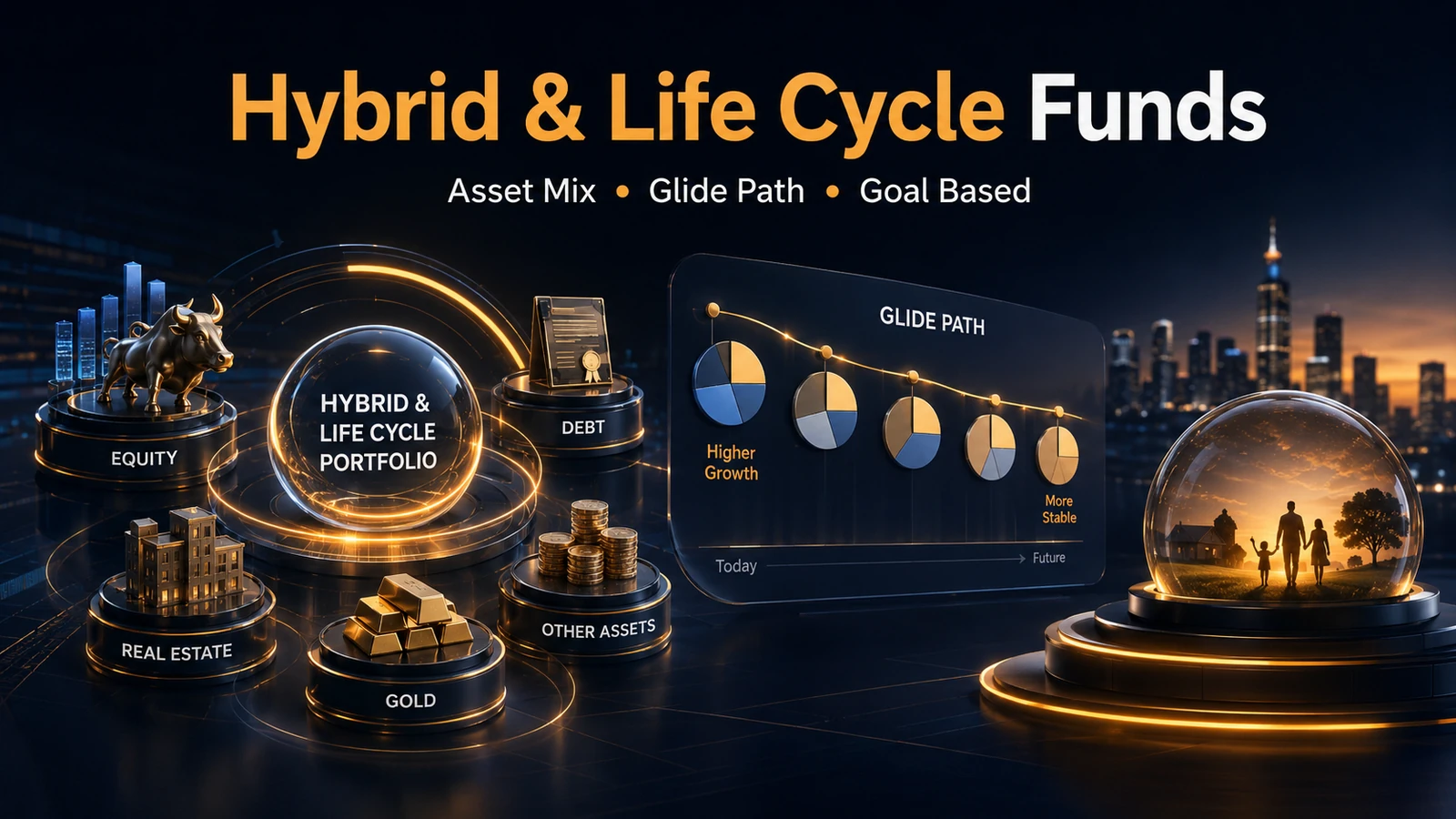
Life Cycle Funds
Life cycle funds are a major feature of the revised classification.
A life cycle fund is an open-ended, goal-based, target-date-style fund with a predetermined maturity and a glide path. Its asset allocation changes as the target date approaches.
The permitted mix can include equity, debt, InvITs, exchange-traded commodity derivatives and gold or silver ETFs within applicable limits.
The broad logic is:
- when the target is far away, the fund may hold a higher growth-oriented allocation;
- as the target approaches, equity exposure generally declines;
- debt and relatively stable assets generally increase.
The glide path automates allocation changes. It does not guarantee that the financial goal will be achieved.
A goal can still fall short because of poor market returns, inflation, insufficient contributions, high costs, missed investments or an unrealistic target.
Use the Goal SIP Calculator to estimate the contribution required for a target under different return, inflation and step-up assumptions. The calculator handles the arithmetic; the fund category determines how the money is invested.
What Happened to Solution-Oriented Funds?
The February 2026 circular discontinued the earlier solution-oriented scheme category with effect from the circular date. Existing schemes in that category were required to stop new subscriptions and follow the prescribed merger process, subject to regulatory approval.
Older guides may continue to describe retirement funds and children’s funds as a permanent broad category. Investors should use the latest scheme communication instead of relying on outdated classification charts.
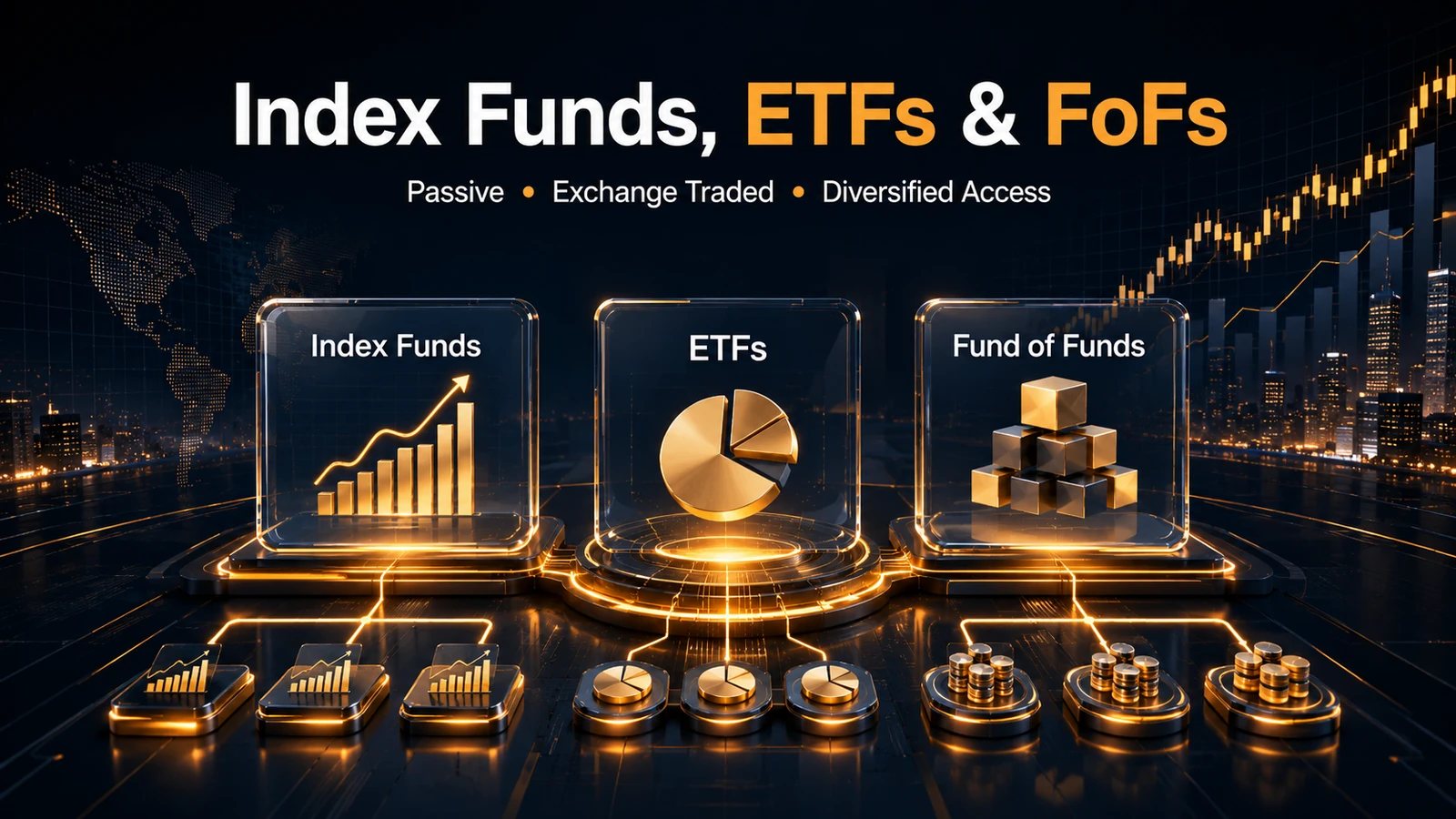
Index Funds, ETFs and Fund of Funds
SEBI’s “other schemes” group includes passive schemes such as index funds and ETFs, along with fund of funds.
Index Funds
An index fund attempts to replicate or track a stated index.
Under the revised framework, an index fund or ETF must invest at least 95% of total assets in the securities of the index being replicated or tracked, subject to applicable rules.
An index fund does not independently choose the “best” securities. Its job is to follow the index as closely as practical.
Important comparison points include:
- index construction;
- concentration;
- expense ratio;
- tracking difference;
- tracking error;
- replication method;
- fund size;
- portfolio turnover.
A low expense ratio is useful, but a scheme that tracks poorly can still disappoint.
Exchange-Traded Funds
An exchange-traded fund also tracks an index or defined exposure, but its units trade on a stock exchange.
The investor may need:
- a demat account;
- a trading account;
- awareness of the market price;
- understanding of bid-ask spread;
- sufficient trading liquidity;
- consideration of brokerage and transaction costs.
An ETF’s market price can differ from its NAV.
An index mutual fund is normally purchased or redeemed with the fund at the applicable NAV under mutual-fund transaction rules. An ETF is bought or sold in the market like an exchange-traded security.
Fund of Funds
A fund of funds invests in one or more underlying funds instead of directly building the entire securities portfolio.
Under the revised broad category, a fund of funds generally maintains at least 95% in the underlying fund or funds as prescribed.
A fund of funds can provide access to:
- overseas markets;
- gold or commodity-oriented funds;
- diversified underlying schemes;
- multi-manager strategies;
- asset-allocation structures.
The investor should examine layered costs. The fund of funds charges expenses, while the underlying schemes also incur expenses that affect performance.
A fund of funds may also create hidden duplication if the investor directly owns the same underlying exposures elsewhere.
Other Ways Mutual Funds Are Classified
The SEBI category is only one layer. Investors also encounter labels based on scheme structure, management style, plan, option and transaction method.
Open-Ended Funds
Open-ended funds generally allow purchases and redemptions on business days at the applicable NAV, subject to cut-off time, fund realisation, exit load and scheme rules.
Most commonly used retail mutual funds are open-ended.
Close-Ended Funds
A close-ended fund has a specified maturity and generally accepts subscriptions during its new fund offer.
Units may be listed on an exchange, but listing does not guarantee active trading or an exit at a fair price.
Interval Funds
Interval funds combine features of open-ended and close-ended structures. Transactions are available only during specified intervals.
Active Funds
An active fund manager selects securities and portfolio weights within the scheme mandate. The fund may seek to outperform a benchmark, manage downside risk or follow a defined style.
Active performance should be judged after expenses and over multiple market conditions, not only after one strong year.
Passive Funds
Passive funds attempt to track an index or defined portfolio.
They usually involve less portfolio-selection discretion and may have lower expenses, but they still carry the full risk of the tracked index. A concentrated or expensive index remains risky even when tracked accurately.
Direct and Regular Plans
Direct and regular plans generally hold the same underlying portfolio. Their NAVs and long-term returns differ because their expense structures differ.
A direct plan may suit an investor who can independently choose, monitor and manage schemes. A regular plan may be used by an investor who chooses distributor assistance.
A lower-cost plan cannot make an unsuitable category suitable.
Growth and IDCW Options
Under the growth option, portfolio returns remain within the scheme and are reflected in NAV.
Under the IDCW option, the scheme may distribute income when declared from available distributable surplus. IDCW is neither guaranteed nor an extra return on top of the NAV.
SIP and Lump-Sum Investments
A SIP invests a selected amount at regular intervals. A lump sum invests a larger amount at one time.
Use the SIP Calculator to test regular monthly contributions and the Lumpsum Calculator to test a one-time investment under multiple return assumptions.
These are mathematical illustrations, not forecasts.
For a specific target, the Goal SIP Calculator works backwards from the goal amount and time available.
For planned withdrawals from a corpus, use the SWP Calculator to test how withdrawal amount, return assumptions and duration may affect the remaining balance.
To measure the annualised growth of a one-time investment, use the CAGR Calculator. For SIPs or irregular dated cash flows, the XIRR Calculator is usually the more relevant measurement tool.
Equity vs Debt vs Hybrid vs Passive Funds
| Category | Main portfolio | Important risks | Possible portfolio role | What to examine |
|---|---|---|---|---|
| Equity fund | Shares and equity-related instruments | Market volatility, valuation, concentration | Long-term growth-oriented allocation | Market-cap, style, holdings and benchmark |
| Debt fund | Bonds and money-market instruments | Interest-rate, credit and liquidity risk | Short-, medium- or long-term fixed-income allocation | Duration, maturity, rating and issuer quality |
| Hybrid fund | Mix of equity, debt and permitted assets | Allocation, equity, credit and duration risk | Combined asset allocation | Actual net exposure and rebalancing policy |
| Life cycle fund | Multiple assets under a glide path | Goal-date, market and contribution risk | Target-date investing | Glide path and target assumptions |
| Index fund | Portfolio tracking an index | Index concentration and tracking difference | Passive market exposure | Index design, expense and tracking |
| ETF | Exchange-traded passive exposure | Index risk, spread and market liquidity | Tradable passive allocation | Bid-ask spread, volume and tracking |
| Fund of funds | Units of underlying funds | Layered cost, duplication and underlying risk | Access to underlying strategies | Total cost and underlying holdings |
No category is universally best.
A category becomes suitable only in relation to a goal, time horizon, risk capacity, liquidity need and existing portfolio.
A long-term equity fund can be unsuitable for money needed next year. A liquid fund may be useful for short-term parking but inadequate for a distant growth goal. An aggressive hybrid fund may be less volatile than a pure equity fund in some periods, but it remains heavily exposed to equity.
Start with the purpose, not the return ranking.
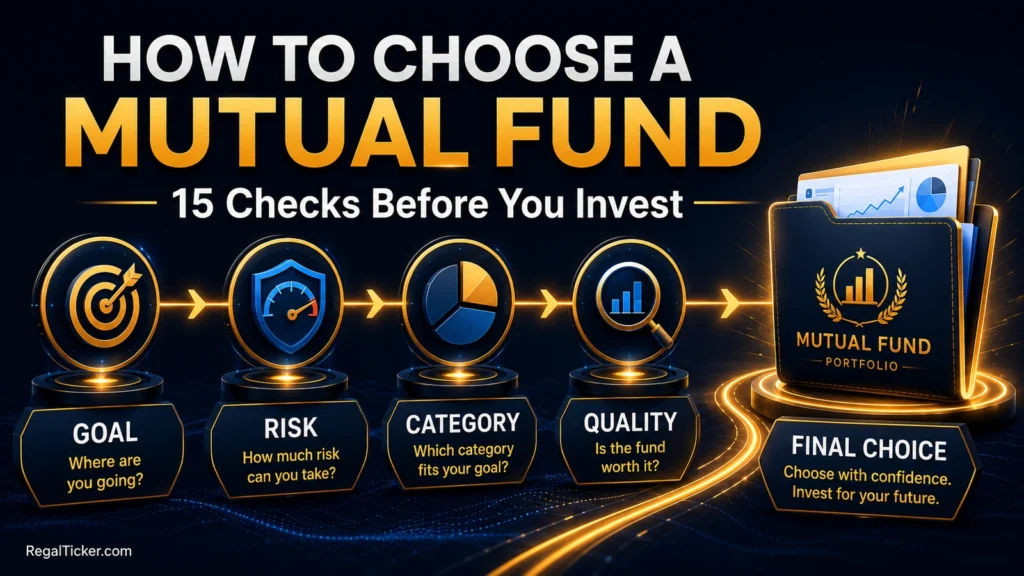
How to Choose a Mutual Fund Category
Choosing the category should happen before choosing the individual scheme.
1. Define the Goal
State the goal in rupees and time.
Examples include an emergency reserve, a home down payment, education, retirement, long-term wealth creation or a future withdrawal need.
A vague goal produces a vague portfolio.
2. Identify the Time Horizon
The time horizon is the period before the money is likely to be required.
A longer horizon can provide more time to recover from market declines, but it does not automatically justify maximum risk.
Short-horizon money should not depend on a volatile equity category merely because historical long-term returns appear attractive.
3. Measure Risk Capacity
Risk capacity is the financial ability to tolerate a loss.
It depends on:
- income stability;
- emergency reserves;
- insurance;
- debt obligations;
- goal flexibility;
- investment horizon;
- dependence on the corpus.
Risk appetite describes emotional comfort. Risk capacity describes what the financial plan can survive.
4. Choose the Asset Mix
After defining the goal, horizon and risk capacity, decide the required exposure to equity, debt, cash and other diversifiers.
Only then choose the specific subcategory.
5. Read the Scheme Documents
Check the latest:
- Scheme Information Document;
- Key Information Memorandum;
- factsheet;
- portfolio disclosure;
- riskometer;
- benchmark;
- expense ratio;
- exit load;
- fund-manager information.
Do not rely only on an app’s one-line label.
6. Compare Within the Same Category
Compare a large-cap fund with other large-cap funds, not with a small-cap fund simply because both publish five-year returns.
Compare debt funds with similar duration and credit mandates.
Compare passive funds that track the same index.
7. Check Portfolio Overlap
Owning many schemes does not guarantee diversification.
Three equity funds may own many of the same stocks. Two hybrid funds may duplicate similar equity and debt exposure. A fund of funds may invest in schemes already held directly.
Complexity is not the same as diversification.
8. Understand Costs
Costs reduce compounding.
Check:
- total expense ratio;
- direct versus regular plan;
- exit load;
- brokerage and spread for ETFs;
- layered expenses in fund of funds;
- applicable taxes.
Use the Capital Gains Tax Calculator as an educational estimate and verify current tax rules before making a decision.
9. Stress-Test Assumptions
Do not build a goal around one optimistic return.
Test:
- a lower return;
- higher inflation;
- a shorter horizon;
- missed contributions;
- a smaller annual SIP step-up;
- a market decline close to the goal.
The Goal SIP Calculator allows comparison of several planning scenarios. The calculated amount is not a return promise.
10. Review Without Chasing Performance
Review whether the scheme:
- continues to follow its mandate;
- remains suitable for the goal;
- has changed its process or benchmark;
- has developed excessive concentration;
- duplicates another holding;
- consistently lags for concerning reasons;
- still fits the intended asset allocation.
Frequent switching can create exit-load, tax and behavioural costs. Review deliberately rather than reacting to every return table.
Common Mistakes When Comparing Mutual Fund Types
Choosing the Highest Recent Return
A high one-year return may reflect a favourable sector, market-cap segment or interest-rate cycle rather than repeatable skill.
Recent winners often attract money after prices have already risen.
Treating Debt Funds as Guaranteed
Debt funds can lose money when yields rise, issuers are downgraded, payments are delayed or market liquidity weakens.
The absence of direct equity exposure does not mean the absence of risk.
Calling Every Hybrid Fund Balanced
A conservative hybrid fund and an aggressive hybrid fund have very different equity allocations.
Read the category and actual portfolio.
Confusing SIP with a Fund Type
A SIP is a contribution method.
A SIP into a small-cap fund still carries small-cap risk. Regular investing does not convert a risky portfolio into a guaranteed product.
Assuming a Lower NAV Is Cheaper
NAV is the per-unit value of a scheme. It does not reveal whether the underlying securities are cheap or expensive.
A fund with NAV ₹10 is not automatically cheaper than one with NAV ₹100.
Owning Too Many Similar Funds
More schemes can create overlap, difficult monitoring and false diversification.
The number of funds should follow the number of distinct portfolio roles.
Ignoring the Benchmark
The benchmark helps explain the intended opportunity set.
A scheme should be compared with a relevant benchmark and category, not an unrelated index that makes its return appear stronger.
Assuming Passive Means Risk-Free
A passive fund follows its index downward as well as upward.
Passive management removes active stock selection; it does not remove market, concentration or valuation risk.
Ignoring the 2026 Classification Change
Older content may still show solution-oriented schemes as a broad category or use the previous debt-category structure.
Check the publication date and latest official documents.
Selecting the Product Before the Goal
A mutual fund should serve the financial plan.
Do not construct a plan around a scheme selected because it is trending.
Mutual Fund Category Checklist
Before investing, answer these questions:
- What is the exact scheme category?
- What assets must the scheme hold?
- What is the minimum or permitted allocation?
- Is the fund active or passive?
- What benchmark does it use?
- What is the portfolio concentration?
- What are the main market, credit, duration and liquidity risks?
- Is the scheme open-ended, close-ended or interval?
- Am I selecting a direct or regular plan?
- Am I selecting growth or IDCW?
- Am I investing through SIP or lump sum?
- What is the expense ratio?
- Is there an exit load?
- Does the category match the goal and horizon?
- Does it duplicate existing holdings?
- Have I read the latest factsheet and Scheme Information Document?
- Am I relying too heavily on recent returns?
- Could the plan tolerate a significant temporary loss?
- Are the return assumptions conservative?
- What specific event would justify changing the investment?
If several answers are unclear, learn more before committing money.
Frequently Asked Questions
How many main types of mutual funds are there in India?
Under SEBI’s February 2026 categorisation framework, schemes are broadly grouped into equity schemes, debt schemes, hybrid schemes, life cycle funds and other schemes. Other schemes include passive products such as index funds and ETFs, along with fund of funds.
What are the main equity mutual fund categories?
The equity categories include multi-cap, large-cap, large and mid-cap, mid-cap, small-cap, flexi-cap, dividend yield, value, contra, focused, sectoral, thematic and ELSS tax saver funds.
What is the difference between multi-cap and flexi-cap funds?
A multi-cap fund must maintain at least 25% each in large-cap, mid-cap and small-cap companies. A flexi-cap fund must maintain the required overall equity allocation but can shift more freely across market-cap segments.
Are debt mutual funds safe?
Debt funds avoid direct stock-market exposure but are not risk-free. They can face interest-rate, credit, liquidity and reinvestment risks. Credit risk funds and long-duration funds can experience significant NAV volatility.
Which mutual fund category is best for beginners?
There is no universally best category. Suitability depends on the goal, time horizon, risk capacity, liquidity need and existing portfolio. A beginner should understand the category before comparing individual schemes.
Is a SIP a type of mutual fund?
No. A SIP is a method of investing a selected amount at regular intervals into a chosen mutual fund scheme.
Are index funds and ETFs the same?
Both can track an index, but their transaction methods differ. An index mutual fund is normally purchased or redeemed with the fund at the applicable NAV. An ETF trades on an exchange and can involve bid-ask spread, trading liquidity, brokerage and a market price that differs from NAV.
What is a life cycle fund?
A life cycle fund is a target-date-style fund with a predetermined maturity and glide path. Its asset allocation changes as the target date approaches, usually moving from a more growth-oriented allocation towards a relatively stable mix.
What happened to retirement and children’s solution-oriented funds?
SEBI’s February 2026 circular discontinued the solution-oriented scheme category. Existing schemes were required to stop fresh subscriptions and follow the prescribed transition and merger process, subject to regulatory approval.
Can one investor hold equity, debt and hybrid funds together?
Yes, when each scheme has a clear and distinct role in the asset allocation. Holding several overlapping funds can add complexity without adding useful diversification.
Final Takeaway
The words “mutual fund” describe the investment structure, not one standard level of risk.
The category reveals what the scheme is designed to own and how it may behave.
Equity funds invest predominantly in shares. Debt funds invest in bonds and money-market instruments. Hybrid funds combine asset classes. Life cycle funds follow a target-date glide path. Index funds and ETFs track defined benchmarks, while fund of funds invest through underlying schemes.
After identifying the category, examine the subcategory, benchmark, portfolio, expenses, liquidity and risks.
Do not compare unlike categories only by past returns.
Do not assume debt means guaranteed, hybrid means safe, SIP means low risk or passive means loss-free.
Choose the category according to the goal. Choose the scheme only after the category is clear. Then use calculators to test contribution, compounding, withdrawal and tax scenarios without treating projections as promises.
Official Sources
- SEBI: Categorization and Rationalization of Mutual Fund Schemes, February 26, 2026
- SEBI Circular PDF: Categorization and Rationalization of Mutual Fund Schemes
- AMFI Investor Education: Types of Mutual Fund Schemes
Educational disclaimer: This article is for education and information only. Regal Ticker is not a SEBI-registered investment adviser and does not provide personalised investment advice. Mutual fund investments are subject to market risks. Read all scheme-related documents carefully before investing.