

⚡ Quick answer
A mutual fund is a pooled investment vehicle. It collects money from multiple investors, issues units to them and invests the combined pool in assets such as shares, bonds, government securities, money-market instruments, gold-related assets or other permitted investments according to the scheme’s stated objective. The asset management company manages the portfolio, while trustees, a custodian and other regulated entities perform oversight, safekeeping and investor-service functions. Each investor’s holding is represented by units, and the per-unit value is called Net Asset Value or NAV. Mutual funds can provide diversification and professional management, but they remain market-linked products and do not guarantee returns.
Investor note
Key Takeaways
A mutual fund pools money from many investors. Investors receive units, not direct ownership of every underlying security. Each scheme has a stated investment objective. The AMC manages the portfolio on behalf of investors. Trustees oversee the mutual fund and protect unitholder interests. The custodian holds the scheme’s securities. NAV is the net value of the portfolio per outstanding unit. A low NAV does not mean that a fund is cheaper or better. Equity, debt and hybrid funds carry different risks. Open-ended schemes generally allow purchases and redemptions on business days. Direct and regular plans hold the same underlying portfolio but have different expense structures. Growth and IDCW options distribute returns differently. SIP is an investment method, not a separate mutual fund category. Mutual funds can lose value. Historical returns do not guarantee future performance. Expense ratio and exit load can reduce investor returns. The benchmark should match the scheme’s investment style. Riskometer and portfolio disclosures should be reviewed. Choose a scheme according to goal, time horizon and risk capacity. Do not invest only because a fund has recently delivered the highest return.
A mutual fund makes diversified investing accessible without requiring every investor to buy and monitor dozens of individual securities.
But the simplicity of the transaction can hide the complexity of the product.
An investor can open an application, choose a scheme and invest within minutes. The scheme may then hold:
large-company shares; small-company shares; government bonds; corporate debt; treasury bills; gold-related instruments; international securities; units of other funds.
These assets do not carry the same risk.
Two funds from the same asset management company can behave very differently because their:
objectives; portfolio; benchmark; duration; credit exposure; market-cap exposure; investment style; costs;
are different.
The correct question is not only:
“What is a mutual fund?”
The more useful questions are:
What does this particular scheme invest in? How does it attempt to generate returns? What can cause losses? How much does it cost? How long should the money remain invested? Does the scheme fit the investor’s goal and risk capacity?
This lesson explains the complete foundation.
What Is a Mutual Fund?
A mutual fund is a mechanism for pooling money by issuing units to investors and investing the collected money in securities according to the objective disclosed by the scheme.
Simple Example
Suppose four investors contribute:
- Investor A: ₹10,000
- Investor B: ₹20,000
- Investor C: ₹30,000
- Investor D: ₹40,000
Total pool:
₹1,00,000
The fund manager can invest the pool across several securities instead of each investor building a separate portfolio.
If the starting NAV is ₹10:
- Investor A receives 1,000 units
- Investor B receives 2,000 units
- Investor C receives 3,000 units
- Investor D receives 4,000 units
Total units:
10,000
Each investor owns a proportionate interest in the scheme through units.
What Does the Investor Own?
A mutual fund investor owns units of the scheme.
The investor does not directly own a specific share or bond inside the portfolio.
The value of the units changes with:
- the market value of portfolio assets;
- income earned;
- expenses;
- liabilities;
- units issued or redeemed.
Scheme Objective
Every scheme has an investment objective.
Examples:
- long-term capital growth through equities;
- regular income through debt instruments;
- a combination of growth and income;
- replication of a market index;
- liquidity through short-term instruments.
The investment objective helps define what the scheme is designed to do.
It does not guarantee that the objective will be achieved.
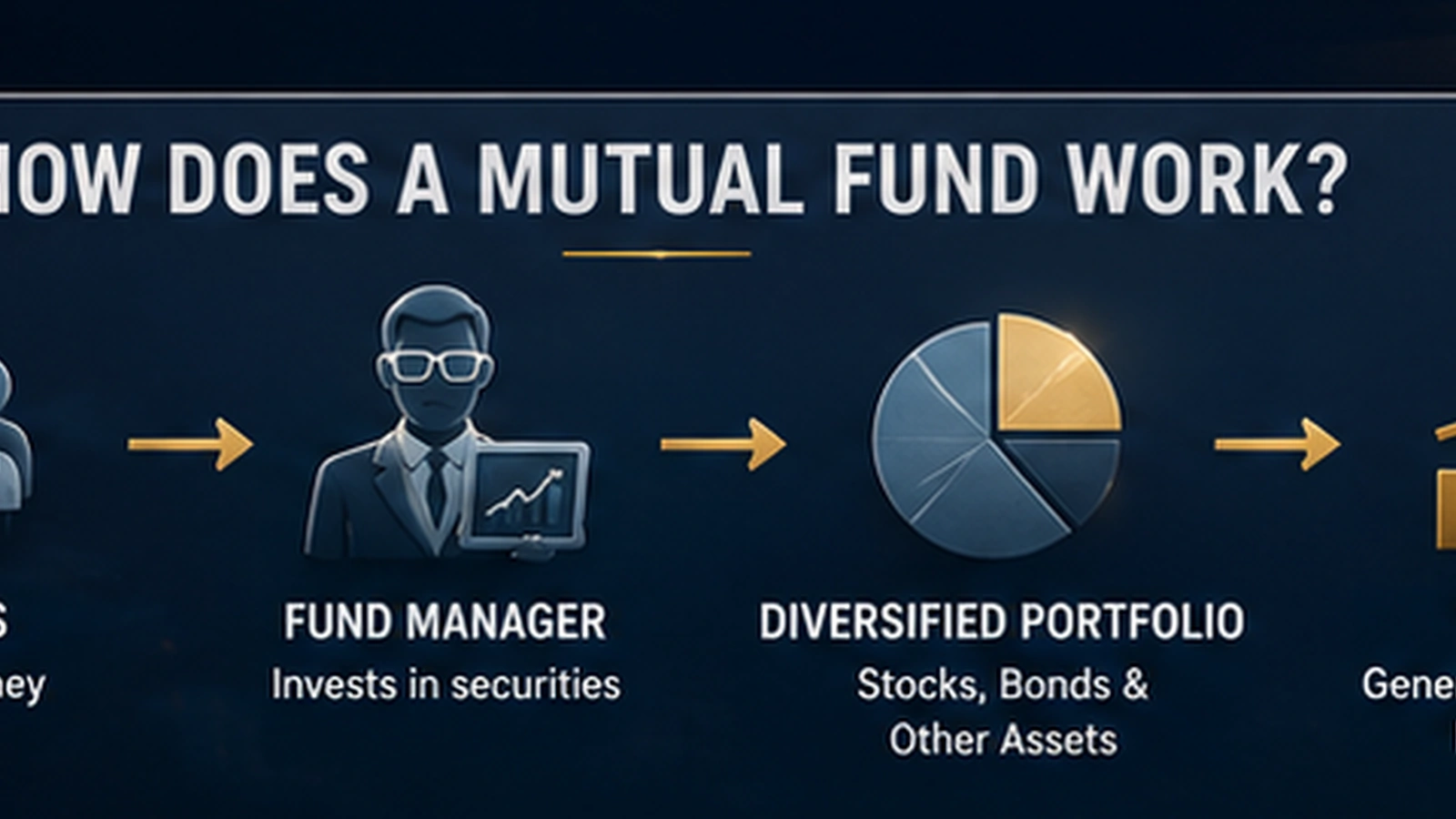
How a Mutual Fund Works
The process can be understood in seven steps.
Step 1: Investors Contribute Money
Investors purchase units through:
- lump-sum investments;
- Systematic Investment Plans;
- additional purchases;
- transfers from another scheme.
Step 2: Units Are Issued
The number of units depends on the applicable NAV and any permitted charges.
A simplified formula is:
Units allotted = Investment amount ÷ Applicable NAV
Suppose:
- investment: ₹25,000;
- applicable NAV: ₹50.
Units:
₹25,000 ÷ ₹50 = 500 units
Actual allotment can reflect applicable transaction processing and scheme rules.
Step 3: The AMC Invests the Pool
The fund manager invests according to:
- scheme objective;
- regulatory limits;
- asset-allocation rules;
- internal investment process;
- risk controls.
Step 4: Portfolio Value Changes
The value changes when:
- share prices rise or fall;
- bond prices change;
- interest income is earned;
- dividends are received;
- securities are bought or sold;
- expenses are charged;
- credit events occur;
- currency rates change.
Step 5: NAV Is Calculated
The scheme calculates its per-unit value.
Step 6: Investors Purchase or Redeem
Open-ended schemes generally permit transactions on business days at the applicable NAV, subject to:
- cut-off rules;
- fund-realisation rules;
- exit load;
- scheme restrictions;
- exceptional market conditions.
Step 7: Returns Appear Through NAV or Distribution
In a growth option, gains remain invested in the scheme and are reflected in NAV.
Under an IDCW option, the scheme can distribute income when declared, subject to available distributable surplus and applicable rules.
IDCW is not guaranteed interest.
Mutual Fund Structure in India
A mutual fund is not only an investment app or an AMC brand.
It operates through a regulated trust-based structure.
Sponsor
The sponsor establishes the mutual fund.
The role is comparable to a promoter, subject to regulatory eligibility requirements.
Mutual Fund Trust and Trustees
The mutual fund is constituted as a trust.
Trustees oversee the operations and monitor whether the AMC acts according to:
- regulations;
- trust deed;
- scheme documents;
- unitholder interests.
Asset Management Company
The AMC is appointed to manage the schemes.
Its functions can include:
- investment research;
- portfolio construction;
- trading;
- risk management;
- compliance;
- scheme administration;
- investor communication.
Custodian
The custodian safeguards the scheme’s securities and performs related custody functions.
This separation helps prevent the AMC from treating scheme assets as its own property.
Registrar and Transfer Agent
The RTA supports investor servicing such as:
- transaction records;
- folio maintenance;
- statements;
- redemptions;
- service requests;
- transmission and nomination processing.
Depositories and Demat Holding
Mutual fund units can be held in:
- statement-of-account form;
- demat form where available.
The operational route can affect how transactions and service requests are processed.
Mutual Fund Units and NAV
NAV means Net Asset Value.
It represents the net value of the scheme per outstanding unit.
NAV Formula
A simplified formula is:
NAV = (Market value of assets + Accrued income − Liabilities − Expenses) ÷ Outstanding units
Suppose a scheme has:
- portfolio assets: ₹110 crore;
- accrued income: ₹2 crore;
- liabilities and expenses: ₹2 crore;
- outstanding units: 10 crore.
Net assets:
₹110 crore
NAV:
₹110 crore ÷ 10 crore units = ₹11 per unit
NAV and Investor Value
Suppose an investor owns 2,000 units.
At NAV ₹11:
2,000 × ₹11 = ₹22,000
At NAV ₹12.50:
2,000 × ₹12.50 = ₹25,000
Is a ₹10 NAV Cheaper Than a ₹100 NAV?
No.
A fund with NAV ₹10 is not automatically cheaper than a fund with NAV ₹100.
NAV depends on:
- scheme age;
- past performance;
- unit history;
- distributions;
- portfolio value.
The investor should compare:
- valuation of underlying assets;
- portfolio quality;
- risk;
- cost;
- benchmark;
- suitability.
NAV vs Market Price
Open-ended mutual fund transactions generally occur at applicable NAV.
An ETF trades on the stock exchange and can trade at a market price that differs from its NAV.
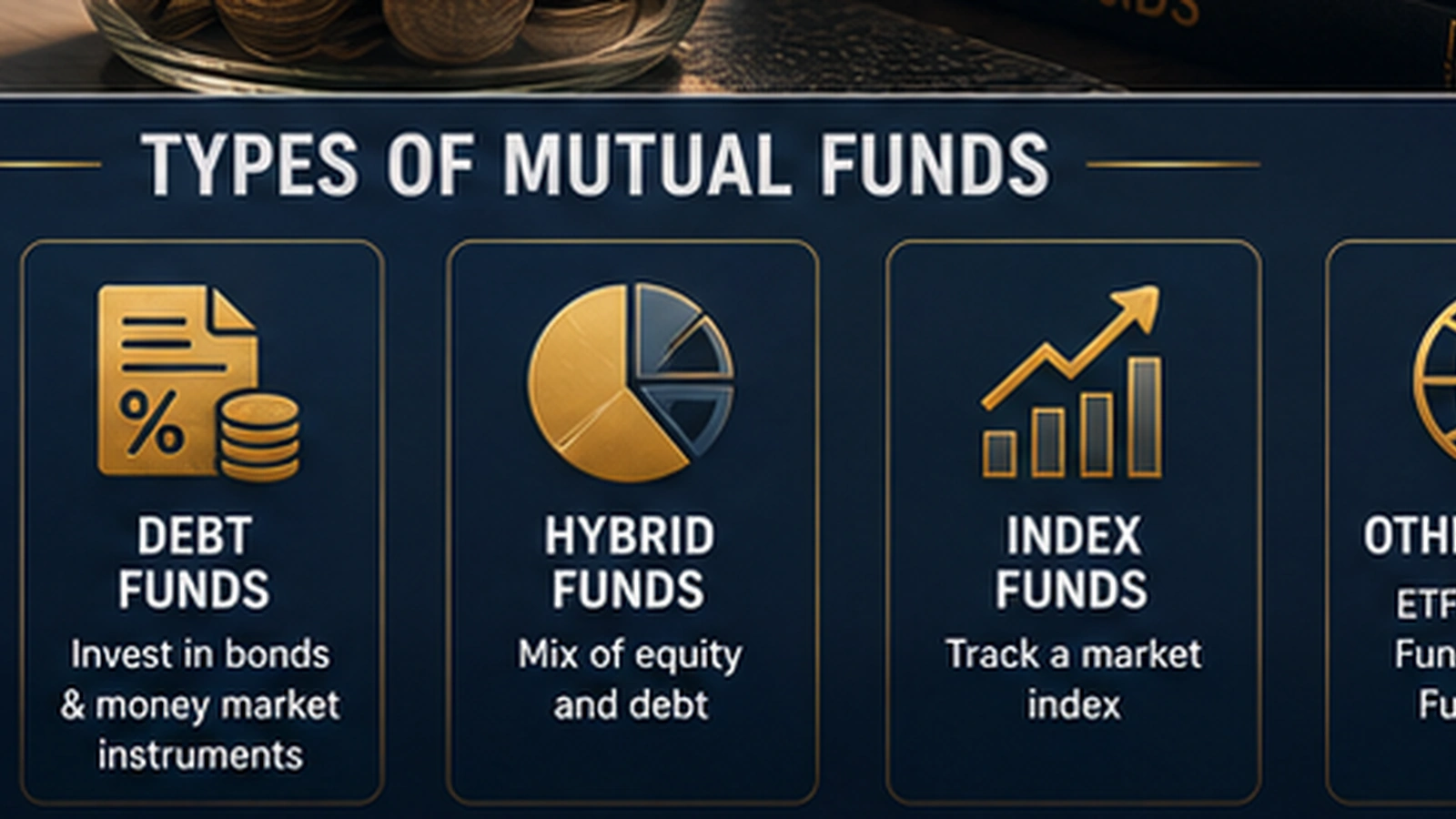
Major Types of Mutual Funds
Mutual funds can be classified in several ways.
Equity Mutual Funds
Equity funds invest primarily in equity and equity-related securities according to their category.
Examples can include:
- large-cap funds;
- mid-cap funds;
- small-cap funds;
- flexi-cap funds;
- multi-cap funds;
- value funds;
- focused funds;
- sectoral or thematic funds;
- ELSS.
Main risks include:
- market risk;
- volatility;
- concentration;
- valuation risk;
- business risk.
Equity funds are generally more suitable for longer investment horizons than short-term goals.
Debt Mutual Funds
Debt funds invest in instruments such as:
- government securities;
- treasury bills;
- corporate bonds;
- certificates of deposit;
- commercial paper;
- money-market instruments.
Their risks can include:
- interest-rate risk;
- credit risk;
- liquidity risk;
- reinvestment risk.
Debt funds are not fixed deposits and do not guarantee capital or returns.
Hybrid Mutual Funds
Hybrid schemes invest across more than one asset class.
Depending on the category, the portfolio can combine:
- equity;
- debt;
- gold;
- other permitted assets.
Hybrid does not automatically mean low risk.
The risk depends on the actual asset allocation.
Index Funds
An index mutual fund aims to replicate or track a specified index.
Its performance can differ from the index because of:
- expenses;
- cash holdings;
- tracking error;
- portfolio execution.
Exchange-Traded Funds
ETFs pool investments like mutual funds but trade on stock exchanges.
The investor generally needs:
- demat account;
- trading account;
- market liquidity;
- bid–ask spread awareness.
Fund of Funds
A fund of funds invests in other mutual funds or ETFs.
The investor should examine:
- underlying funds;
- layered costs;
- asset exposure;
- duplication;
- taxation.
Solution-Oriented and Other Schemes
Some schemes are designed around objectives such as retirement or children’s goals.
Investors should verify:
- lock-in;
- asset allocation;
- risk;
- exit conditions;
- costs.
Open-Ended, Close-Ended, Active and Passive Funds
These classifications describe how the scheme operates.
Open-Ended Fund
An open-ended scheme generally allows investors to purchase and redeem units on business days at the applicable NAV.
The number of outstanding units can increase or decrease as investors transact.
Close-Ended Fund
A close-ended scheme has a specified maturity and normally accepts subscriptions during its initial offer period.
Units may be listed on an exchange, but actual liquidity can be limited.
Interval Fund
An interval fund combines features of open-ended and close-ended structures and allows transactions during specified intervals.
Active Fund
An active fund manager selects securities and constructs the portfolio in an attempt to meet or outperform the scheme’s objective and benchmark.
Results depend on:
- fund-manager decisions;
- research quality;
- portfolio construction;
- costs;
- market conditions.
Passive Fund
A passive fund seeks to replicate or track an index or other defined portfolio.
The investor should examine:
- tracking error;
- tracking difference;
- expense ratio;
- liquidity for ETFs;
- index construction.
Passive does not mean risk-free.
Mutual Fund Plans and Investment Methods
Direct vs Regular Plans and Growth vs IDCW
Plan and option selection can materially affect the investment experience.
Direct Plan
A direct plan is purchased without a distributor commission being included in the plan’s expense structure.
It can be appropriate for investors who can independently:
- select a scheme;
- assess risk;
- review performance;
- manage transactions;
- maintain discipline.
Regular Plan
A regular plan is routed through a mutual fund distributor.
Its expense ratio is generally higher because distribution-related expenses are included.
The underlying portfolio and fund manager are normally the same as the corresponding direct plan.
Direct vs Regular Example
Suppose two plans earn the same gross portfolio return before expenses.
- Direct-plan expense ratio: 0.8%
- Regular-plan expense ratio: 1.6%
Difference:
0.8 percentage point per year
Over long periods, this difference can compound.
The lower-cost plan is not automatically suitable when an investor lacks the knowledge or discipline to manage the investment independently.
Growth Option
Returns remain invested and are reflected in NAV.
This is commonly used for accumulation.
IDCW Option
IDCW means Income Distribution cum Capital Withdrawal.
A distribution can reduce the scheme’s NAV because value leaves the scheme.
It is not additional free return.
The distribution is not guaranteed.
SIP vs Lump Sum
SIP and lump sum are investment methods.
They are not separate asset classes.
SIP
A Systematic Investment Plan invests a fixed amount at regular intervals.
Possible benefits include:
- disciplined investing;
- smaller periodic commitments;
- automatic transactions;
- reduced need to time one large entry;
- rupee-cost averaging.
SIP does not guarantee profit.
It can remain negative when markets fall or the selected scheme performs poorly.
Use the SIP Calculator to estimate how regular contributions can grow under an assumed return.
Lump Sum
A lump-sum investment places a larger amount at one time.
The result can depend strongly on:
- entry valuation;
- market movement;
- time horizon;
- investor behaviour.
Use the Lumpsum Calculator to test hypothetical return assumptions.
SIP Return Measurement
SIP cash flows occur on different dates.
XIRR is more suitable than simple CAGR for multiple irregular or periodic cash flows.
Use the XIRR Calculator.
Withdrawal Planning
A Systematic Withdrawal Plan allows periodic redemptions from a mutual fund.
Use the SWP Calculator to model withdrawals under assumed returns.
Mutual Fund Costs and Risks
Mutual Fund Costs
Costs reduce investor returns.
Total Expense Ratio
The expense ratio covers permitted scheme-management and operating expenses.
It is charged to the scheme and reflected in NAV.
A difference that looks small annually can become meaningful over many years.
Exit Load
An exit load can apply when units are redeemed within a specified period.
💡 Real example
redemption value: ₹1,00,000; exit load: 1%.
Exit load:
₹1,000
Net before tax and other adjustments:
₹99,000
The exact load structure varies by scheme.
Transaction and Platform Costs
Depending on the route, investors should understand:
- distributor commission through regular-plan expenses;
- demat or brokerage-related costs for ETFs;
- platform charges where applicable;
- bank or payment issues;
- tax consequences.
Portfolio Turnover and Hidden Friction
Higher trading activity can create portfolio-level transaction costs.
These may not appear as a separate debit in the investor’s account but can affect scheme performance.
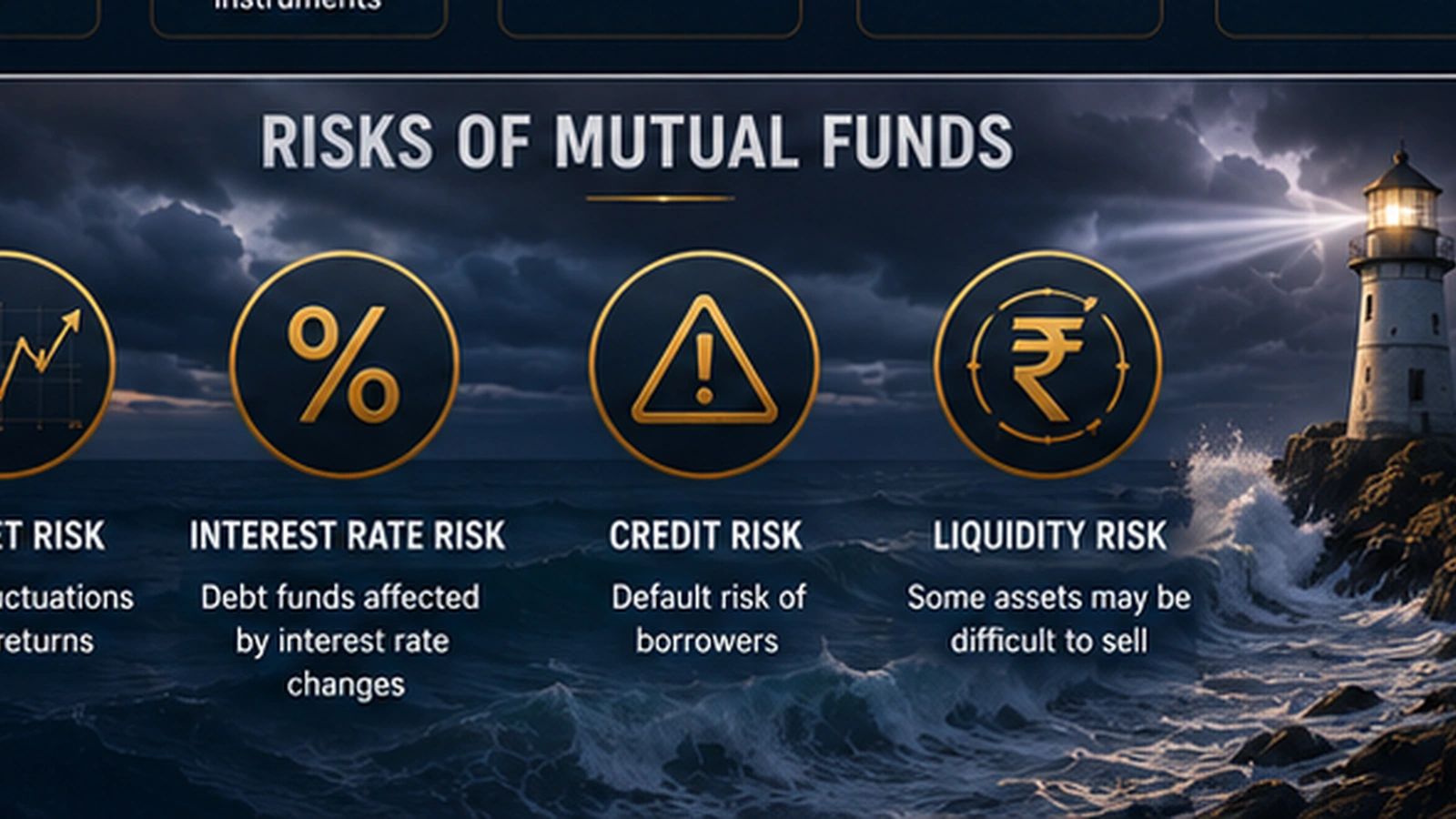
Risks of Mutual Funds
“Mutual funds are subject to market risks” is not a complete explanation.
Different schemes carry different combinations of risk.
Market Risk
Equity and bond prices can fall.
Interest-Rate Risk
Bond prices generally move inversely to changes in market interest rates.
Longer-duration debt can be more sensitive.
Credit Risk
A bond issuer can be downgraded, delayed or default.
Liquidity Risk
A scheme may face difficulty selling a security at a reasonable price.
Concentration Risk
Sectoral, thematic, focused and small portfolios can experience larger losses when their concentrated exposure performs poorly.
Currency and International Risk
International funds can be affected by:
- currency movement;
- overseas markets;
- geopolitical events;
- taxation;
- investment limits.
Tracking Risk
Index funds and ETFs can underperform their index because of costs and implementation differences.
Behavioural Risk
Investors can damage returns by:
- chasing recent winners;
- stopping SIPs during declines;
- switching frequently;
- redeeming in panic;
- investing without a goal.
How to Choose a Mutual Fund
Scheme selection should begin with the investor, not the return table.
Step 1: Define the Goal
Examples:
- emergency reserve;
- house purchase;
- education;
- retirement;
- long-term wealth creation.
Step 2: Set the Time Horizon
A short-term goal should not depend heavily on volatile equity assets.
Step 3: Assess Risk Capacity
Risk capacity depends on:
- income stability;
- emergency savings;
- debt;
- dependants;
- investment horizon;
- ability to tolerate loss.
Step 4: Select the Correct Category
Compare schemes within the same category.
Do not compare a liquid fund with a small-cap fund only by return.
Step 5: Read the Scheme Documents
Review:
- investment objective;
- asset allocation;
- benchmark;
- riskometer;
- load;
- expense ratio;
- portfolio;
- fund manager;
- strategy;
- material changes.
Step 6: Examine Performance Properly
Review:
- multiple periods;
- rolling returns;
- downside periods;
- benchmark performance;
- category comparison;
- risk-adjusted consistency.
Past performance does not guarantee future results.
Step 7: Check Portfolio Quality
Look for:
- concentration;
- credit quality;
- duration;
- market-cap exposure;
- sector exposure;
- turnover;
- cash position.
Step 8: Choose Direct or Regular Deliberately
Cost matters, but suitability and investor capability also matter.
Step 9: Decide SIP or Lump Sum
Match the method to:
- cash availability;
- valuation comfort;
- income pattern;
- behavioural discipline.
Step 10: Review Without Overreacting
Review periodically, not daily.
A review can be triggered by:
- goal change;
- risk change;
- persistent process deterioration;
- category change;
- fund-manager or mandate change;
- portfolio duplication.
Worked Mutual Fund Examples
Example 1: Unit Allotment
- investment: ₹60,000;
- NAV: ₹24.
Units:
₹60,000 ÷ ₹24 = 2,500 units
Example 2: Portfolio Value
- units: 2,500;
- current NAV: ₹29.
Value:
2,500 × ₹29 = ₹72,500
Gain:
₹12,500
Simple return:
₹12,500 ÷ ₹60,000 × 100 = 20.83%
Use the Stock Return Calculator only for a simplified percentage comparison; mutual-fund cash flows are better analysed with CAGR or XIRR depending on transaction pattern.
Example 3: CAGR
- starting investment: ₹1,00,000;
- ending value after five years: ₹1,75,000.
Use the CAGR Calculator.
Approximate CAGR:
11.84% per year
Example 4: Expense Difference
Assume a hypothetical gross return of 12% before expenses.
- Plan A cost: 0.8%
- Plan B cost: 1.8%
Approximate net return before other effects:
- Plan A: 11.2%
- Plan B: 10.2%
Compounding can widen the difference over time.
Example 5: NAV After Distribution
Suppose:
- NAV before IDCW: ₹25;
- distribution: ₹2 per unit.
The NAV can reduce approximately by the distributed amount, subject to portfolio movement and applicable adjustments.
The ₹2 is not created from nothing.
Common Mutual Fund Mistakes
Choosing the Highest Recent Return
Top rankings can change rapidly.
Believing Low NAV Means Cheap
NAV level does not show valuation attractiveness.
Treating Debt Funds Like Fixed Deposits
Debt-fund values can fluctuate and credit events can cause losses.
Investing Without a Time Horizon
The asset mix can become unsuitable for the goal.
Ignoring Costs
Expense ratio and exit load reduce returns.
Holding Too Many Similar Funds
Several schemes can own the same securities and create portfolio duplication.
Stopping SIPs During Market Declines
This can interrupt the discipline that SIP was meant to create.
Using Sector Funds as a Core Portfolio
Concentrated funds can be highly volatile.
Confusing IDCW with Guaranteed Income
IDCW is neither fixed nor guaranteed.
Ignoring Riskometer and Portfolio
The scheme name alone cannot explain the full risk.
Selecting Direct Only for Lower Cost
Direct plans require independent decision-making and ongoing review.
Selecting Regular Without Understanding Cost
Advice and distribution service should be evaluated against the additional cost.
Frequently Asked Questions
What is a mutual fund in simple words?
It is a pooled investment vehicle that collects money from many investors and invests it according to a stated objective.
Who manages a mutual fund?
The asset management company manages the scheme through its investment team and fund managers.
What does a mutual fund investor own?
The investor owns units of the scheme.
What is NAV?
NAV is the net value of a mutual fund scheme per outstanding unit.
Is a lower NAV better?
No. NAV level alone does not indicate value or future return.
Can mutual funds lose money?
Yes.
Are mutual funds guaranteed by SEBI?
No. SEBI regulates mutual funds but does not guarantee returns or capital.
What is an equity mutual fund?
It is a scheme that invests primarily in equity and equity-related securities according to its category.
What is a debt mutual fund?
It invests in debt and money-market instruments and carries interest-rate, credit and liquidity risks.
What is a hybrid mutual fund?
It combines more than one asset class, commonly equity and debt.
What is an index fund?
It seeks to replicate or track a specified market index.
What is an ETF?
It is a pooled investment product that trades on a stock exchange.
What is a direct mutual fund plan?
It is a plan purchased without distributor commission being included in its expense structure.
What is a regular mutual fund plan?
It is a plan purchased through a distributor and generally has a higher expense ratio.
What is the growth option?
Returns remain invested and are reflected in NAV.
What is IDCW?
It is Income Distribution cum Capital Withdrawal. Distributions are not guaranteed and can reduce NAV.
Is SIP a mutual fund?
No. SIP is a method of investing periodically in a mutual fund scheme.
Is lump sum better than SIP?
Neither is universally better. The choice depends on available capital, market risk, time horizon and investor behaviour.
How many mutual funds should I own?
There is no universal number. Each scheme should have a distinct role and unnecessary overlap should be avoided.
How should a beginner choose a mutual fund?
Start with the goal, time horizon, risk capacity and suitable scheme category, then compare costs, benchmark, portfolio and consistency.
Final Takeaway
A mutual fund:
- Pools money from investors.
- Issues units.
- Invests according to a disclosed objective.
- Uses an AMC for portfolio management.
- Uses trustees for oversight.
- Uses a custodian for safekeeping.
- Calculates a per-unit NAV.
- Provides several scheme categories.
- Charges expenses.
- Exposes investors to market-linked risks.
The most important beginner rules are:
- Do not select a scheme only by recent return.
- Do not treat low NAV as cheap.
- Do not assume debt funds are guaranteed.
- Do not confuse SIP with a fund category.
- Do not confuse IDCW with free income.
- Compare schemes within the same category.
- Match the asset class with the time horizon.
- Review expense ratio, exit load, riskometer and portfolio.
- Use direct or regular plans deliberately.
- Invest according to a written goal.
Use RegalTicker tools:
Official References
- SEBI Investor — Understanding Mutual Funds
- SEBI Investor — Net Asset Value
- SEBI Investor — Understanding Open-Ended Funds
- SEBI Investor — Direct and Regular Mutual Fund Plans
- AMFI — Introduction to Mutual Funds
- AMFI — Types of Mutual Fund Schemes
- AMFI — Categorisation of Mutual Fund Schemes
Educational disclaimer: This article is for general investor education only. It is not investment advice, tax advice, legal advice, a research recommendation or a guarantee of returns. Mutual fund values can rise or fall. Scheme features, costs, regulations and taxation can change. Read the current Scheme Information Document, Key Information Memorandum, Statement of Additional Information, portfolio disclosures and official AMC information before investing.