

⚡ Quick answer
Growth vs IDCW Mutual Funds: the 30-second answer
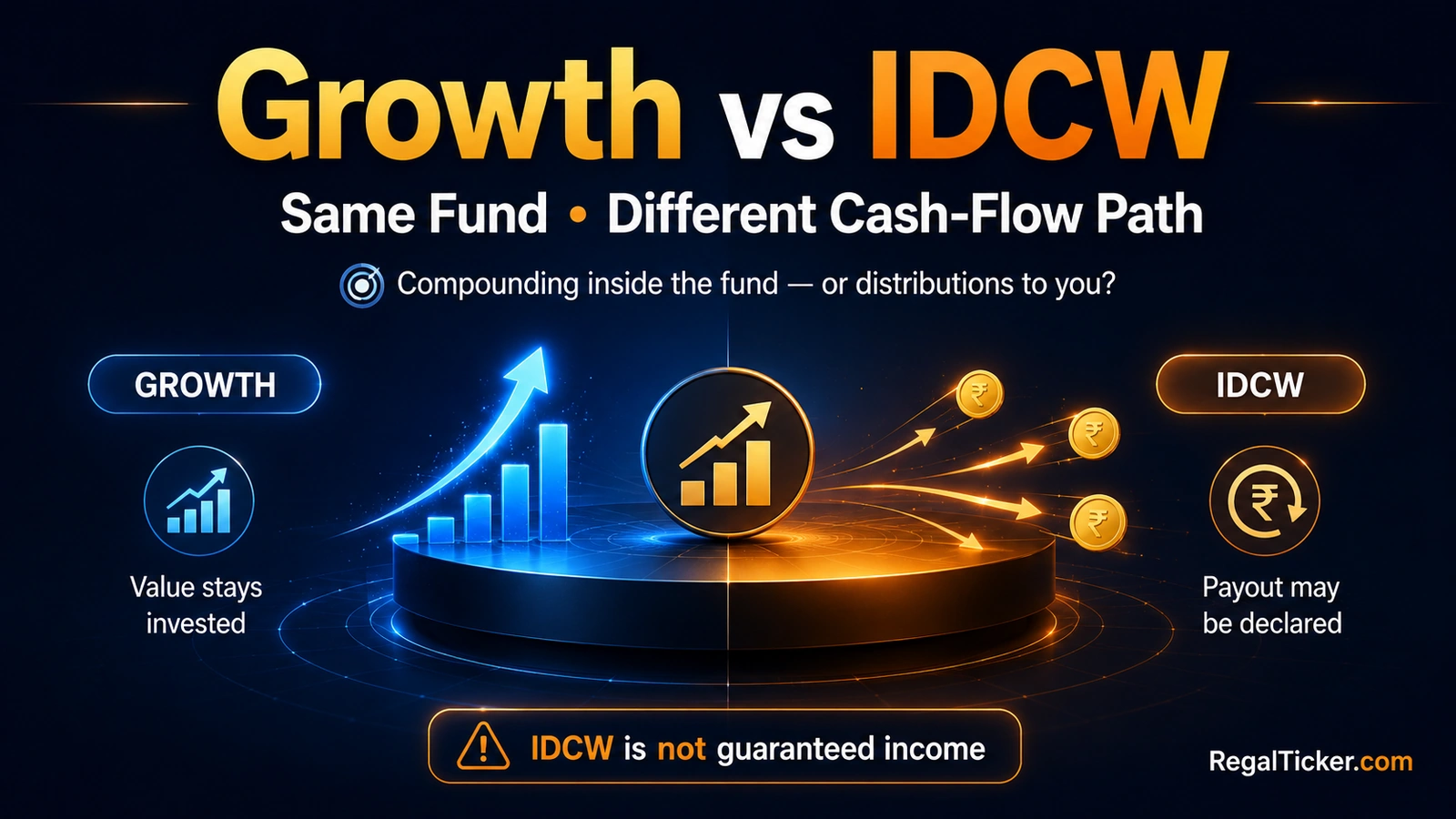
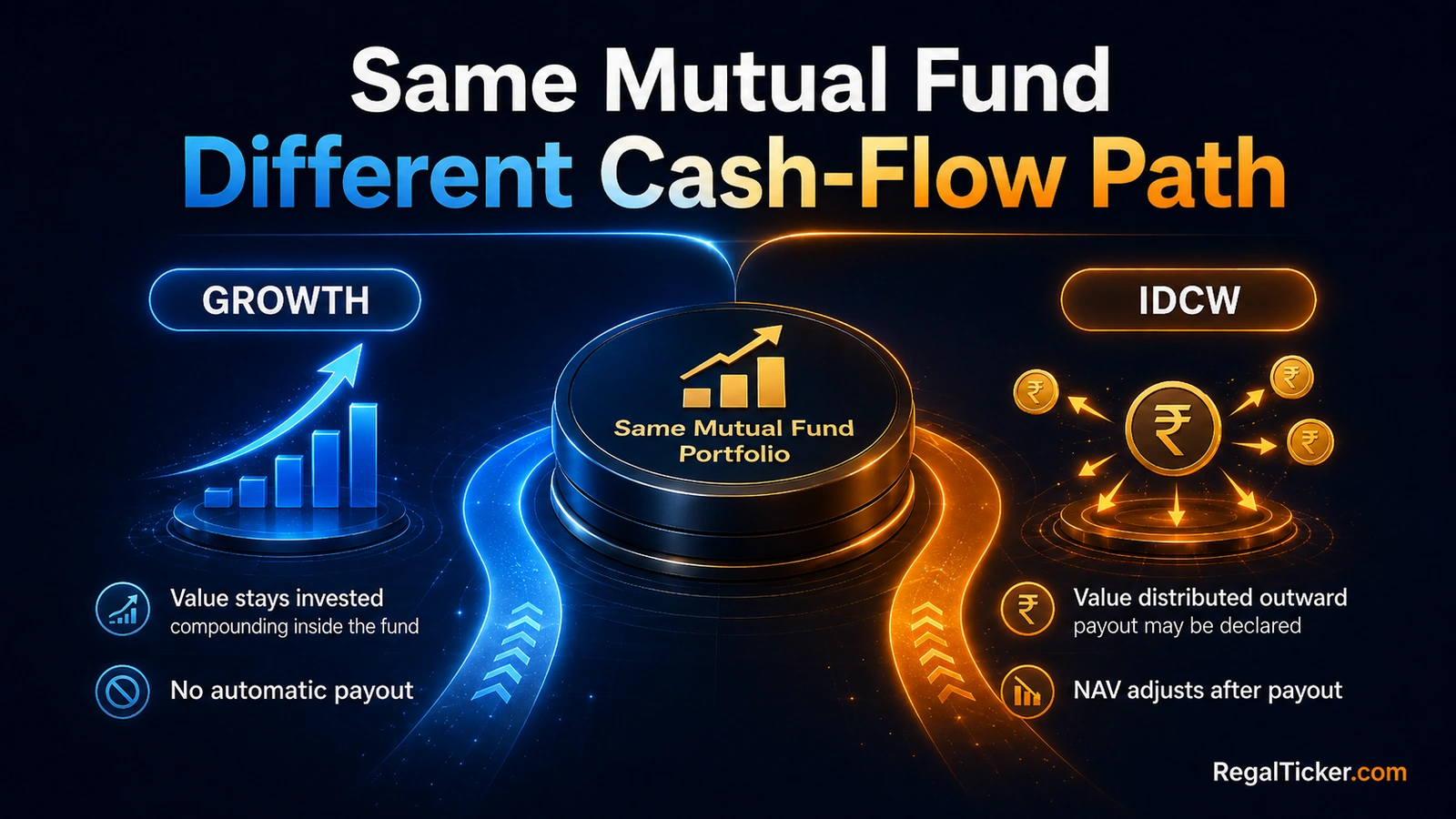
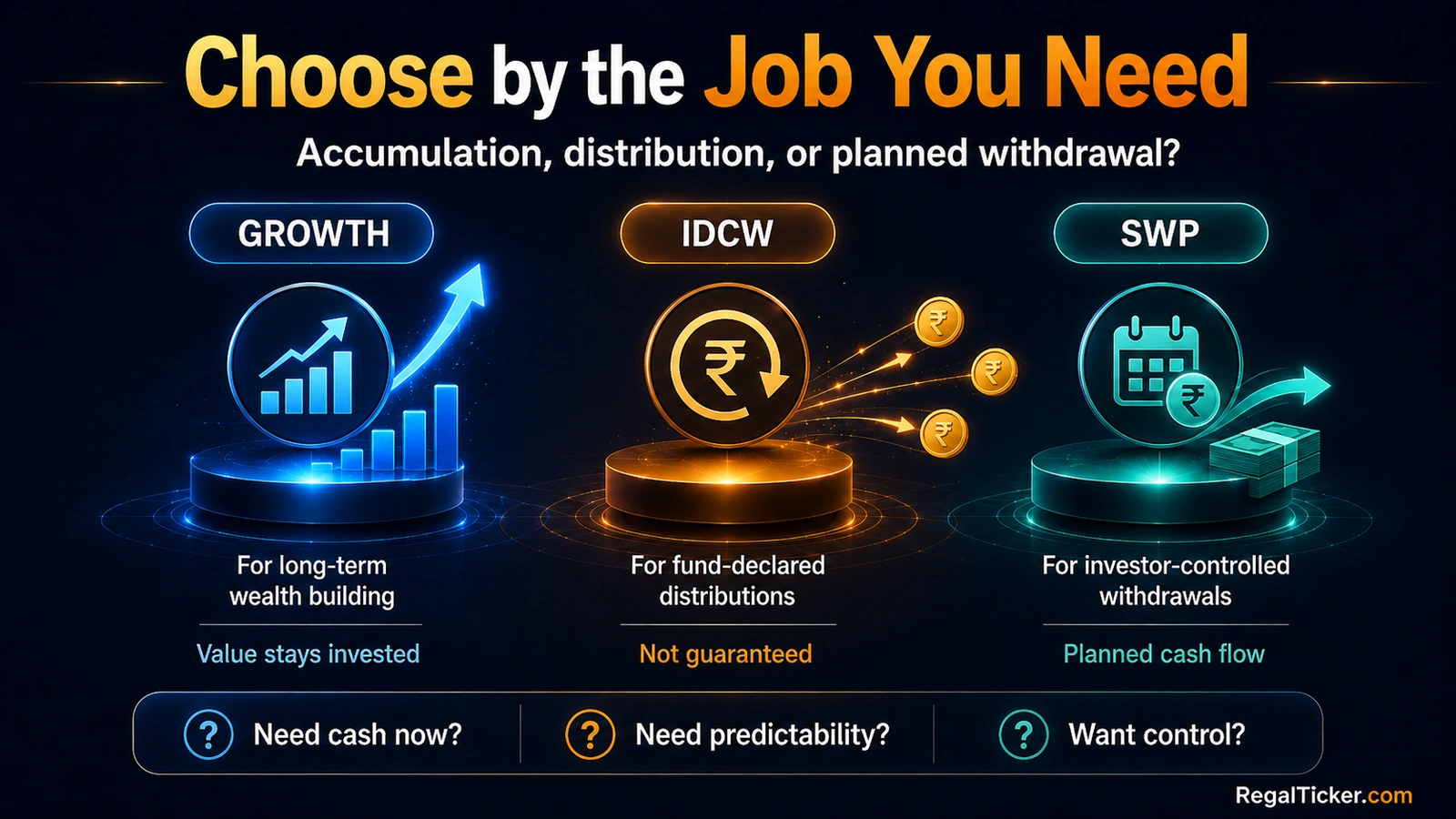
Growth and IDCW are usually options of the same mutual fund scheme, not two different investment strategies. Growth keeps the option’s income and gains invested, so the investor normally receives money only by redeeming units. IDCW can distribute money when distributable surplus is available and a distribution is declared. That payout is not guaranteed and is not a free bonus: the IDCW NAV falls to reflect the distribution and applicable statutory levy. For a long-term investor who does not need cash, Growth is generally the simpler accumulation option. If cash flow is required, compare IDCW with an investor-controlled SWP before deciding.
Key takeaways
Growth and IDCW can hold the same underlying portfolio; the main difference is how value reaches the investor.
Growth keeps more value inside the option until the investor chooses to withdraw.
IDCW is not guaranteed income and should not be confused with interest from a deposit.
When IDCW is paid, the option’s NAV adjusts downward to reflect the distribution.
IDCW income is taxable in the investor’s hands; current Section 194K TDS rules can also apply to resident investors.
A lower IDCW NAV does not make it cheaper than the Growth option.
If predictable cash flow is the objective, Growth plus SWP deserves comparison with IDCW.
Why Growth vs IDCW Mutual Funds Is a More Important Choice Than It Looks
When a beginner selects a mutual fund, the screen can present several choices that look deceptively similar:
Direct Growth. Direct IDCW. Regular Growth. Regular IDCW.
The names are short, but they answer two completely different questions.
Direct vs Regular asks: How are you accessing the scheme, and what cost structure applies?
Growth vs IDCW asks: What should happen to value generated inside the scheme—should it remain invested, or can part of it be distributed?
If you have not already covered the first decision, read Direct vs Regular Mutual Funds.
The most common mistake at the second decision is to think IDCW means “the fund pays me an extra dividend.”
That is not the right mental model.
SEBI renamed the old dividend option to Income Distribution cum Capital Withdrawal (IDCW) from April 1, 2021, specifically to reduce confusion around the nature of the payout. SEBI’s investor FAQ explains that the change was intended to distinguish mutual-fund distributions from company dividends and avoid the impression that the payout is a guaranteed bonus.
Investor note
Important point
The words “cum Capital Withdrawal” matter. An IDCW distribution is a movement of value out of the mutual fund option. It should be evaluated as a cash-flow choice, not as an extra return layered on top of the NAV.
This lesson therefore focuses on the decision investors actually need to make:
Do you want the value to remain invested for your goal, or do you deliberately want the fund to have the ability to distribute part of it?
Growth and IDCW: Same Investment Engine, Different Cash-Flow Design
What the Growth option does
Under the Growth option, the mutual fund does not make an IDCW payout from that option.
Income earned by the portfolio—such as interest, dividends received from underlying companies and realised gains—remains within the scheme and is reflected in the option’s NAV after expenses and market movements.
You continue to own the same number of units unless you transact.
You receive cash when you:
- redeem some or all units;
- make a switch that involves a redemption from the existing option; or
- use a withdrawal facility such as SWP.
For a long-term accumulation goal, this is operationally simple: money stays invested until you decide that it should leave.
What the IDCW option does
IDCW stands for Income Distribution cum Capital Withdrawal.
Under this option, a mutual fund may declare a distribution from available distributable surplus subject to the scheme documents, applicable regulations and trustee decision.
The word may is important.
A monthly, quarterly or other IDCW label does not turn the distribution into a guaranteed payment.
The amount can change. The frequency can change. A distribution may not be declared.
IDCW Payout vs IDCW Reinvestment
IDCW can be offered through sub-options such as Payout and Reinvestment, depending on the scheme.
Under IDCW Payout, the declared amount is paid to the eligible investor after applicable deductions.
Under IDCW Reinvestment, the declared amount is used to buy additional units at the applicable post-distribution NAV.
That can make IDCW Reinvestment look similar to Growth, but economically and tax-wise it is not identical. A distribution has still occurred, which can create taxable income even though the proceeds are reinvested.
⭐ Pro tip
If your only objective is to leave everything invested for long-term wealth creation, ask a simple question before choosing IDCW Reinvestment: “What problem am I solving that Growth does not already solve more simply?”
The One Concept to Remember: IDCW Is Not Free Extra Return
Suppose a mutual fund option is worth ₹1,20,000 immediately before an IDCW distribution.
If ₹10,000 of value is distributed to you, it would be incorrect to think:
₹1,20,000 investment + ₹10,000 bonus = ₹1,30,000
The correct economic idea is closer to:
part of the value that was inside the option has moved outside the option and into your bank account.
The investment value must adjust for that movement.
This is why the NAV of an IDCW option falls when a distribution is made.
💡 Did you know?
SEBI-published mutual fund notices routinely state that after an IDCW payment, the scheme NAV falls to the extent of the payout and statutory levy, if any.
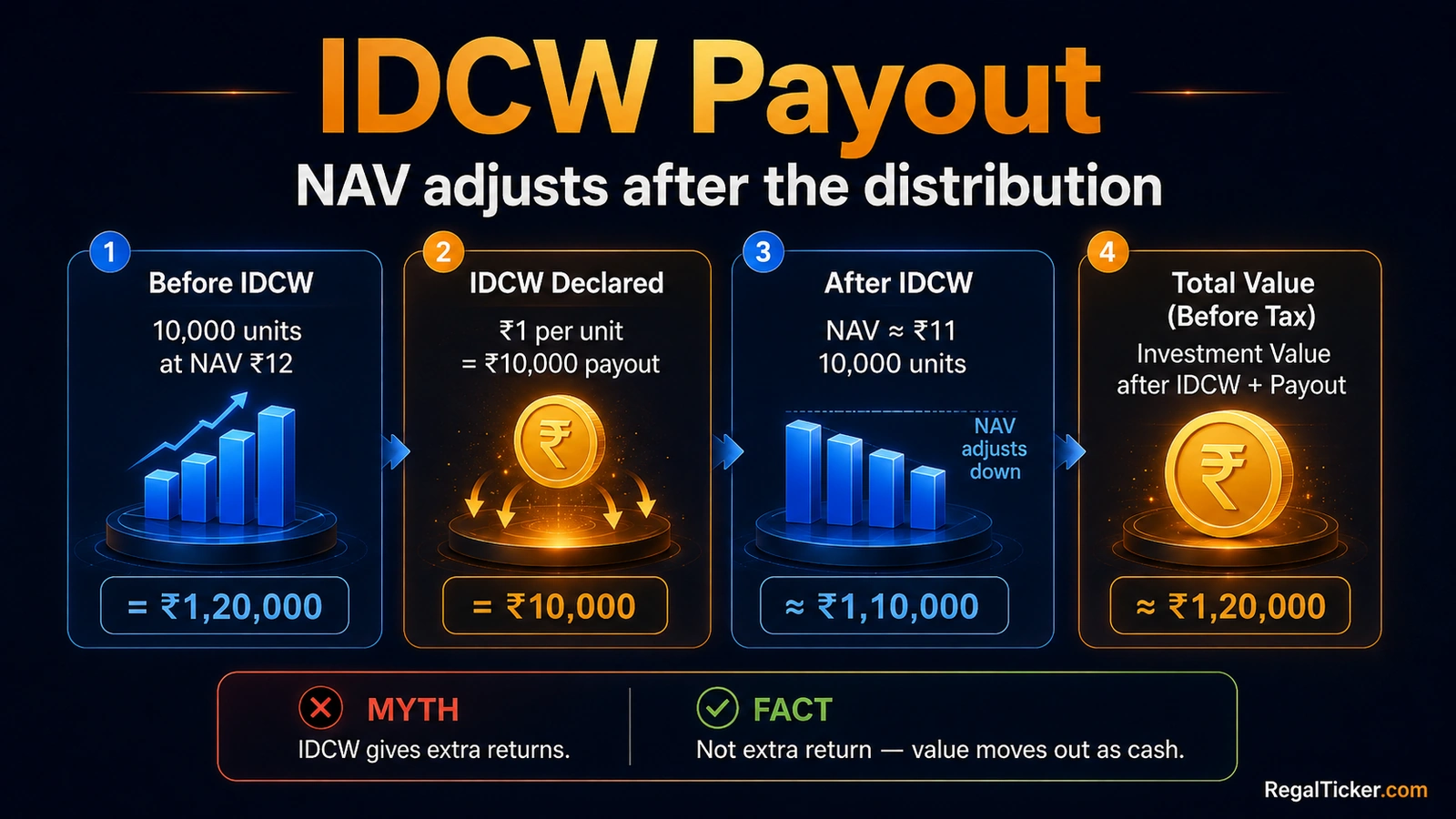
A simple ₹12 NAV example
Assume:
- Units held: 10,000
- IDCW NAV before distribution: ₹12
- Distribution declared: ₹1 per unit
- Statutory levy ignored only to keep the example simple
Before distribution:
10,000 × ₹12 = ₹1,20,000
IDCW distributed:
10,000 × ₹1 = ₹10,000
Illustrative post-distribution NAV:
₹12 − ₹1 = approximately ₹11
Remaining investment value:
10,000 × ₹11 = approximately ₹1,10,000
Economic position before tax:
- Investment: approximately ₹1,10,000
- Cash distribution: ₹10,000
- Combined: approximately ₹1,20,000
The distribution can be useful because you now have cash. But it has not magically created ₹10,000 of extra wealth.
💡 Real example
The “₹10,000 dividend” illusion
An investor sees ₹10,000 credited by the mutual fund and feels that the fund has paid a reward on top of the existing investment. If the investor ignores the corresponding NAV adjustment, the payout can look more attractive than it really is. Always compare the post-distribution investment value plus cash received—not the cash credit alone.
❌ Myth
IDCW gives me a payout while my mutual fund value remains unchanged.
✅ Fact
The IDCW option’s NAV is adjusted after the distribution, so value has moved from the investment to the investor.
Why Growth Usually Compounds More Cleanly
Compounding is not a special bonus given by a Growth option.
It is simply what happens when value stays invested and can participate in future returns.
Imagine two investors hold economically comparable options of the same scheme.
Investor A uses Growth and makes no withdrawal.
Investor B uses IDCW Payout and spends every distribution.
Even if the underlying portfolio performs similarly before the effect of distributions, Investor B repeatedly removes value that can no longer participate in future returns.
That is the compounding gap.
The effect becomes more visible over long periods
A single withdrawal may look small.
But repeated distributions can create three forms of drag:
- Less money remains invested.
- Tax may become payable on the distributed income.
- The investor may spend the payout instead of reinvesting it.
Over ten or twenty years, behaviour around those distributions can matter as much as the option label itself.
What if I reinvest IDCW?
IDCW Reinvestment keeps the distributed amount invested by purchasing additional units, but it does not necessarily remove tax drag.
Suppose an investor receives a taxable ₹10,000 IDCW distribution and then reinvests it.
If tax is due on that income, the investor may need to fund that tax from other money or ultimately reduce the amount available for long-term compounding.
Growth generally avoids creating an IDCW income event merely because the scheme has distributable surplus.
Investor note
This is a tax-timing advantage, not a promise that Growth will outperform the market. The underlying portfolio can still rise or fall, and tax on eventual redemption may apply.
Growth vs IDCW Tax in 2026: What Actually Changes
Tax is where many Growth-vs-IDCW comparisons become either oversimplified or misleading.
The first principle is easy:
Growth and IDCW can create tax at different times and in different forms.
IDCW taxation for a resident investor
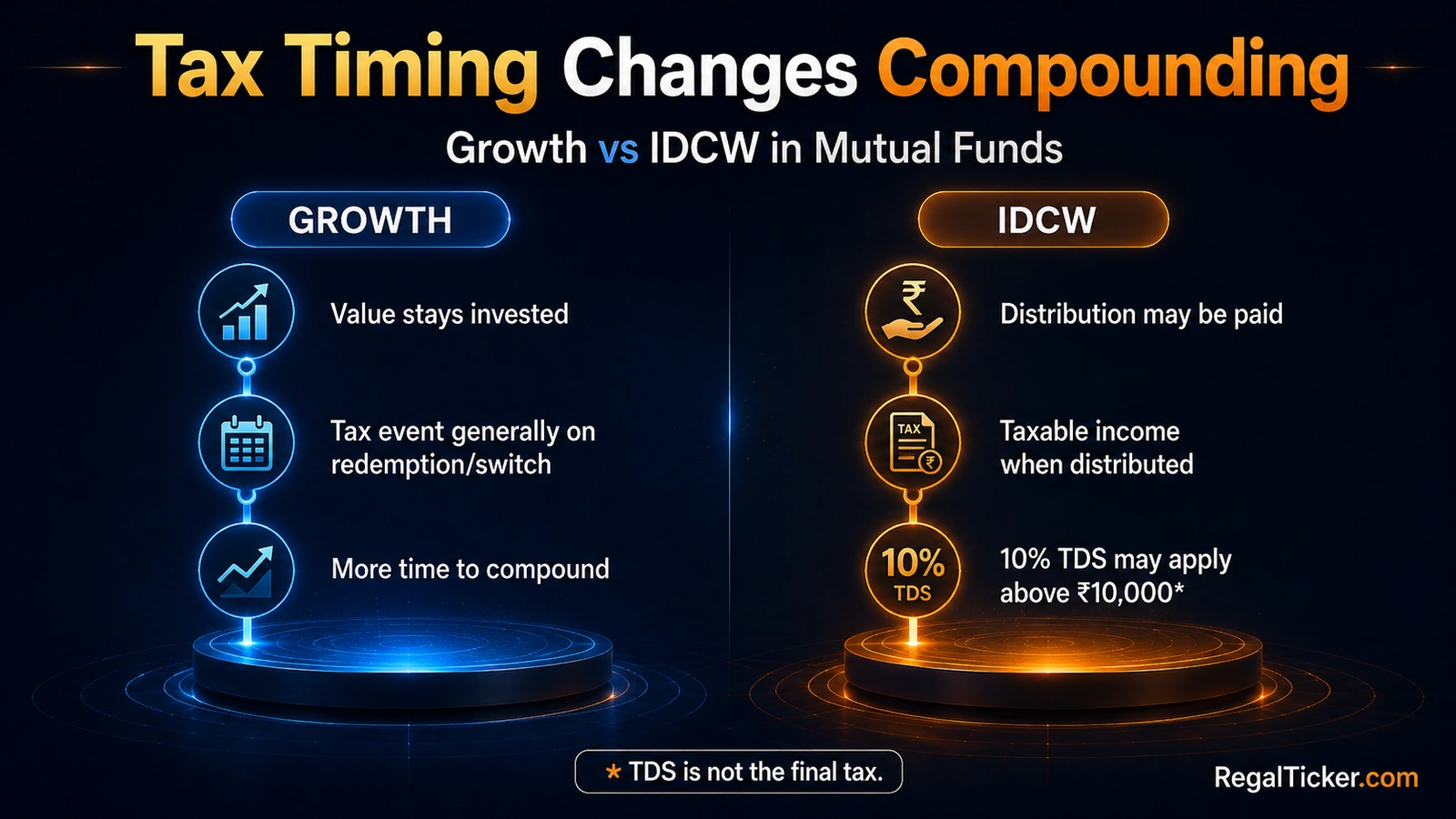
IDCW received by a resident investor is taxable as income at the applicable rate.
There can also be tax deduction at source.
The Income Tax Department’s current Section 194K text states that a payer of covered income in respect of mutual fund units to a resident deducts tax at 10%, except where the relevant aggregate income does not exceed ₹10,000 during the financial year or where the income is capital gains.
That ₹10,000 figure is a TDS threshold, not a tax-free IDCW allowance.
An investor can still have tax liability according to applicable law even where no TDS was deducted.
⚠ Important warning
Important risk
Never read “10% TDS” as “IDCW is finally taxed at 10%.” TDS is a collection mechanism. Final tax depends on the investor’s tax position.
Growth taxation
A rising Growth NAV does not itself create an IDCW income receipt.
A capital-gains event generally arises when units are redeemed, switched or otherwise transferred in a taxable transaction.
The actual capital-gains rule depends on the fund category, purchase date, holding period and current tax law.
That means there is no responsible single sentence such as “all Growth mutual funds are taxed at X%.”
Use the Capital Gains Tax Calculator for an educational estimate, then confirm the rule that applies to the specific fund and transaction.
Why tax deferral can matter
If an investor does not need cash, Growth can allow more control over when a taxable withdrawal happens.
That can be valuable because:
- the investor chooses when to redeem;
- the investor can align withdrawals with goals;
- value that has not been withdrawn can remain invested;
- there is no IDCW tax event merely because a distribution is declared elsewhere.
Tax deferral does not mean tax elimination.
It means the timing and character of the tax event can be different.
Is IDCW Really an Income Option?
IDCW can create cash flow.
That does not make it equivalent to a guaranteed income product.
A fixed deposit has a contractual interest structure. A pension or annuity can have its own defined payment terms. IDCW depends on distributable surplus and a distribution decision.
Current investor education from HDFC Mutual Fund, updated August 3, 2026, makes two useful points: IDCW is paid from distributable surplus, and a declaration reduces NAV to the extent of the distribution and applicable statutory levy. It also notes that the investor does not control how much the fund declares.
That leads to an important distinction.
Cash flow is not the same as predictable cash flow
An investor may want money from a mutual fund for one of three very different reasons:
- occasional spending;
- a fixed monthly household requirement;
- a planned drawdown during retirement.
IDCW can potentially address the first need when a distribution is declared.
It may be less suitable for the second or third if predictability and investor control are essential.
DECISION POINT: If you need ₹25,000 every month, “I want cash flow” is not enough information. You also need to ask, “Who controls the amount and schedule—the fund or me?”
IDCW vs SWP: The Comparison Many Investors Actually Need
A Systematic Withdrawal Plan (SWP) is a facility through which the investor instructs the fund to redeem units at a chosen schedule.
That is fundamentally different from IDCW.
With IDCW:
- the fund decides whether a distribution is declared;
- the amount can vary;
- NAV adjusts after the distribution;
- the entire IDCW income is subject to its applicable tax treatment.
With an SWP from Growth:
- the investor chooses the withdrawal amount;
- the investor chooses the frequency;
- units are redeemed to fund the withdrawal;
- the tax treatment relates to the gain component of the redeemed units under applicable capital-gains rules.
Neither is “free income.”
Both reduce the amount remaining invested when cash leaves the portfolio.
The difference is control and tax mechanics.
COMPARISON TABLE:
| Feature | Growth | IDCW | Growth + SWP |
|---|---|---|---|
| Main purpose | Accumulation | Fund-declared distributions | Investor-planned withdrawals |
| Automatic cash flow | No | When declared | Yes, once scheduled |
| Who decides the cash amount? | Investor at redemption | Fund/trustee declaration | Investor |
| Is cash guaranteed? | Not applicable | No | Schedule can be set, but corpus and market value are not guaranteed |
| NAV effect | Changes with portfolio and expenses | Adjusts for distribution plus normal market movement | Growth NAV continues; units are redeemed |
| Tax event during holding | Generally none merely from NAV growth | IDCW income event can arise | Capital-gains event can arise on each redemption |
| Cash-flow precision | High when investor redeems | Lower | High |
| Best question to ask | Do I want money to stay invested? | Do I deliberately want fund-declared payouts? | Do I need planned withdrawals? |
Use the SWP Calculator to test how different withdrawal rates can affect a corpus.
⚠ Important warning
An SWP can also erode capital. If withdrawals are too high relative to portfolio returns—or markets fall sharply—the number of remaining units can decline faster than planned.
Who Should Consider Growth—and When IDCW Can Still Make Sense
The goal is not to declare one option “good” and the other “bad.”
The goal is to match the mechanism to the investor’s job.
Growth is usually easier to justify when
- the objective is long-term wealth accumulation;
- you are investing for retirement that is still years away;
- you are building a child-education corpus;
- you are investing through SIP and do not need distributions;
- you want to decide your own withdrawal timing;
- you want fewer recurring taxable cash-flow events;
- you would reinvest every IDCW payout anyway.
A SIP investor can estimate long-term accumulation using the SIP Calculator or Goal SIP Calculator.
A one-time investor can model assumptions with the Lumpsum Calculator.
IDCW can still be a deliberate choice when
- you specifically want the scheme’s distribution mechanism;
- you understand that the payment is not guaranteed;
- you accept that the fund controls declaration;
- you understand the tax treatment;
- you understand the NAV adjustment;
- you have compared the option against an SWP and still prefer IDCW.
The key word is deliberate.
IDCW should not be chosen because a platform highlights “monthly payout,” because its NAV looks smaller, or because an earlier distribution looked attractive.
Retirement does not automatically mean IDCW
Retirees often need cash flow, but many retirees also need:
- predictable withdrawals;
- inflation protection;
- tax efficiency;
- preservation of the remaining corpus;
- different buckets for short-, medium- and long-term needs.
That is a planning problem, not merely an IDCW-selection problem.
A retiree may compare Growth + SWP with IDCW and with non-mutual-fund income assets rather than assuming IDCW is the default retirement option.
The Lower-NAV Trap: Why IDCW Does Not Become “Cheaper”
Consider two options of the same scheme:
- Growth NAV: ₹100
- IDCW NAV: ₹20
A beginner may think five IDCW units are “cheaper” than one Growth unit.
But mutual fund NAV is not a stock valuation multiple.
If you invest ₹10,000:
At NAV ₹100, you receive 100 units.
At NAV ₹20, you receive 500 units.
If the two options represent the same underlying portfolio economics before option-specific cash flows and expenses, the starting NAV does not by itself make one a better bargain.
The number of units changes so that the invested amount is still ₹10,000.
The IDCW option with NAV ₹20 is cheaper than the Growth option with NAV ₹100.
NAV determines how many units your investment buys. A lower NAV does not make the underlying portfolio cheaper. This is why investors should compare: – total return; – distributions received; – tax; – expenses; – goal fit; – withdrawal needs; —not the absolute NAV number. If NAV itself still feels confusing, read NAV in Mutual Funds.
A Better Way to Choose: Give the Investment One Job
Instead of asking, “Which option gives more return?”, use a decision sequence.
DECISION FRAMEWORK: STEP 1 — DEFINE THE JOB Is this money for future wealth or for cash you need now?
STEP 2 — CHECK THE CASH-FLOW NEED If you do not need money from the investment during accumulation, Growth becomes the natural option to examine first.
STEP 3 — CHECK PREDICTABILITY If you need a fixed amount on a schedule, compare IDCW with SWP. IDCW distribution is not guaranteed.
STEP 4 — CHECK TAX Understand how an IDCW receipt or a redemption will be taxed in your situation.
STEP 5 — CHECK CONTROL Do you want the fund to decide whether to distribute value, or do you want to decide when and how much to withdraw?
STEP 6 — CHECK BEHAVIOUR Will an IDCW credit tempt you to spend money that was meant for a long-term goal?
STEP 7 — CHECK THE SCHEME DOCUMENT Confirm which Growth/IDCW sub-options are actually available and read the current SID/KIM.
Three investor scenarios
SCENARIO 1: TITLE: Aarav, age 30 — retirement accumulation Aarav invests every month for a retirement goal more than 20 years away and does not need cash from the fund. Growth fits the job more directly because value can remain invested until a future withdrawal plan is required.
SCENARIO 2: TITLE: Meera, age 66 — needs ₹30,000 monthly Meera needs a planned monthly withdrawal. Instead of selecting IDCW only because it mentions monthly distribution, she compares Growth + SWP so that the withdrawal amount can be scheduled. She also checks whether the withdrawal rate is sustainable.
SCENARIO 3: TITLE: Rohan — likes IDCW because the NAV is lower Rohan sees Growth NAV at ₹96 and IDCW NAV at ₹18 and assumes the IDCW option has more upside. That conclusion is invalid. The NAV difference can largely reflect historical distributions and option history rather than cheapness.
Switching Between Growth and IDCW: Do Not Treat It as a Toggle
An investor may later decide that the existing option no longer matches the goal.
A switch may be possible, but it should not be treated like changing a display preference.
A mutual fund switch commonly involves:
- redemption or switch-out from the existing option; and
- purchase or switch-in into the destination option.
Depending on the scheme and tax rules, this can have consequences such as:
- capital gains or losses;
- exit load;
- a new acquisition date for the new units;
- different tax records;
- temporary cash-flow effects.
⚠ Important warning
Do not switch from IDCW to Growth merely because Growth has a higher NAV. The higher NAV does not create free value for you.
Before switching, check: exit load; unrealised gains; holding period; tax impact; why you are changing; whether the goal itself changed.
Use the Capital Gains Tax Calculator for an educational estimate before taking action.
Growth vs IDCW Mistakes That Cost More Than They Look
1. Treating IDCW as interest
Interest is not the right analogy. IDCW is a distribution from mutual fund value subject to the scheme’s rules.
2. Looking only at the cash credited
Always look at the post-distribution NAV and remaining value.
3. Assuming “monthly IDCW” means guaranteed monthly income
It does not.
4. Ignoring tax because TDS was not deducted
A TDS threshold is not the same as a tax exemption.
5. Assuming 10% TDS is the final tax rate
It is not necessarily the final liability.
6. Choosing IDCW because NAV is lower
Lower NAV does not mean cheaper.
7. Using IDCW during an accumulation SIP without a reason
If you are putting money in every month for a long-term goal while the option can distribute money out, question whether the cash-flow design matches the goal.
8. Assuming IDCW Reinvestment equals Growth
The market exposure can remain invested, but a distribution event and its tax consequences can still exist.
9. Comparing Growth NAV and IDCW NAV as performance
Use total return after considering distributions, not NAV level alone.
10. Switching without calculating the exit consequences
The change can be a taxable transaction.
FINAL CHECKLIST:
- I know whether my goal is accumulation or income.
- I understand that IDCW is not guaranteed.
- I understand that IDCW reduces NAV when distributed.
- I am not using NAV level to judge cheapness.
- I know my likely tax treatment.
- I have compared IDCW with SWP if regular cash flow is required.
- I understand switching can create tax or exit-load consequences.
- I have checked the latest scheme documents.
Frequently asked questions
What is the main difference between Growth and IDCW in mutual funds?
Growth keeps the option’s value invested until the investor withdraws, while IDCW can distribute part of the option’s value when a distribution is declared.
What does IDCW stand for?
IDCW stands for Income Distribution cum Capital Withdrawal.
Why did SEBI rename the dividend option to IDCW?
SEBI’s investor FAQ explains that the change was made to distinguish mutual fund distributions from company dividends and reduce the misconception that the payout is a guaranteed bonus.
Is IDCW guaranteed income?
No. IDCW depends on available distributable surplus, scheme terms and a distribution decision.
Does IDCW reduce NAV?
Yes. After IDCW is paid, the option’s NAV adjusts to reflect the distribution and applicable statutory levy, along with normal market movement.
Is IDCW an extra return over and above my mutual fund value?
No. The payout represents value moving out of the mutual fund option to the investor.
Are Growth and IDCW invested in different portfolios?
For the same scheme and plan they generally represent the same underlying scheme portfolio, while differing in how distributions are handled.
Why is Growth NAV often higher than IDCW NAV?
Growth retains value that IDCW may have historically distributed. A higher Growth NAV does not mean the option is more expensive.
Is a lower IDCW NAV better?
No. NAV level by itself does not tell you whether a mutual fund option is cheap, expensive or likely to produce a higher return.
Is IDCW taxable in 2026?
IDCW received by a resident investor is taxable according to applicable tax law. TDS under Section 194K can also apply in the relevant situation.
What is the current Section 194K TDS threshold?
The Income Tax Department’s current Section 194K text says 10% TDS applies to covered resident income in respect of units, with an exception where the relevant aggregate income does not exceed ₹10,000 during the financial year. Capital gains are excluded from that section.
Does no TDS mean no tax?
No. TDS and final tax liability are different concepts.
Is Growth tax-free?
No. Growth generally defers a tax event until redemption, switch or another taxable transfer, subject to the rules applicable to the fund and transaction.
Is IDCW Reinvestment the same as Growth?
No. IDCW Reinvestment can reinvest the distribution, but the distribution event can still have tax consequences.
Which is better for long-term wealth creation?
For an investor who does not need cash during the accumulation period, Growth is generally the simpler option to examine because value stays invested until withdrawal.
Which is better for a retiree?
There is no automatic answer. A retiree needing predictable cash flow should compare IDCW with an SWP and with the broader retirement-income plan.
What is the difference between IDCW and SWP?
IDCW depends on a fund distribution decision, while an SWP is an investor-instructed schedule of unit redemptions.
Can I switch from IDCW to Growth?
A switch may be available, but it can be treated as a redemption and purchase and may create tax or exit-load consequences.
Can I choose Growth with a SIP?
Yes. SIP describes how you invest money; Growth describes how the option handles value while you remain invested.
Can I choose Growth after a lumpsum investment?
Yes. SIP versus lumpsum and Growth versus IDCW are separate decisions.
Where can I verify the current rules?
Read the scheme’s latest SID/KIM, SEBI investor material, the SEBI mutual fund master circular and current Income Tax Department guidance.
Continue the Mutual Funds Learning Path
You now know three separate decisions that beginners often mix together:
How do I invest? → SIP vs Lumpsum
How do I access the scheme? → Direct vs Regular Mutual Funds
How should value leave the option? → Growth vs IDCW
Also review:
- What Is a Mutual Fund?
- Types of Mutual Funds in India
- NAV in Mutual Funds
- SIP Calculator
- Lumpsum Calculator
- Goal SIP Calculator
- SWP Calculator
- CAGR Calculator
- XIRR Calculator
- Capital Gains Tax Calculator
Verify through official sources
Official references
- SEBI — FAQs for Mutual Fund Investors: https://www.sebi.gov.in/sebi_data/faqfiles/sep-2024/1727242783639.pdf
- SEBI — Master Circular for Mutual Funds, March 20, 2026: https://www.sebi.gov.in/sebi_data/attachdocs/mar-2026/1774024028162.pdf
- Income Tax Department — Section 194K, current text downloaded July 2026: https://wmstatic-prd.incometaxindia.gov.in/documents/20117/42998/Section-194K_2026-07-08_02-13-38_bcffab_en.pdf/c1390e6f-ff06-bb8c-4441-1afd357e9a53
- HDFC Mutual Fund — IDCW vs SWP, updated August 3, 2026: https://www.hdfcfund.com/learn/deep-dives/weekend-bytes/idcw-or-swp-mutual-funds
Educational disclaimer: This article is for education and general information only. It is not investment, tax, legal or financial advice. Mutual fund investments are subject to market risks. Tax rules can change and can differ by fund category, purchase date, holding period, residential status and individual circumstances. Read the latest scheme documents and verify current tax rules before investing, switching or withdrawing money.