


⚡ Quick answer
The expense ratio in mutual funds is the annualised percentage of scheme assets used to meet permitted fund expenses. It is not usually taken from your bank account as a separate yearly charge. The cost is accrued within the scheme and reflected in its NAV, so published NAV-based returns are already after the expenses charged to that plan. Under India's 2026 framework, Total Expense Ratio, or TER, is disclosed as Base Expense Ratio plus permitted brokerage, transaction costs and statutory levies. A lower cost can improve the amount left to compound, but investors should compare similar funds and should never select a scheme on expense ratio alone.
Key takeaways
Cost through NAV
Expense ratio is an annualised cost percentage, but it is reflected through the scheme's NAV on an ongoing basis.
TER versus BER
Under the current SEBI framework, TER and BER are related but not identical.
Current TER formula
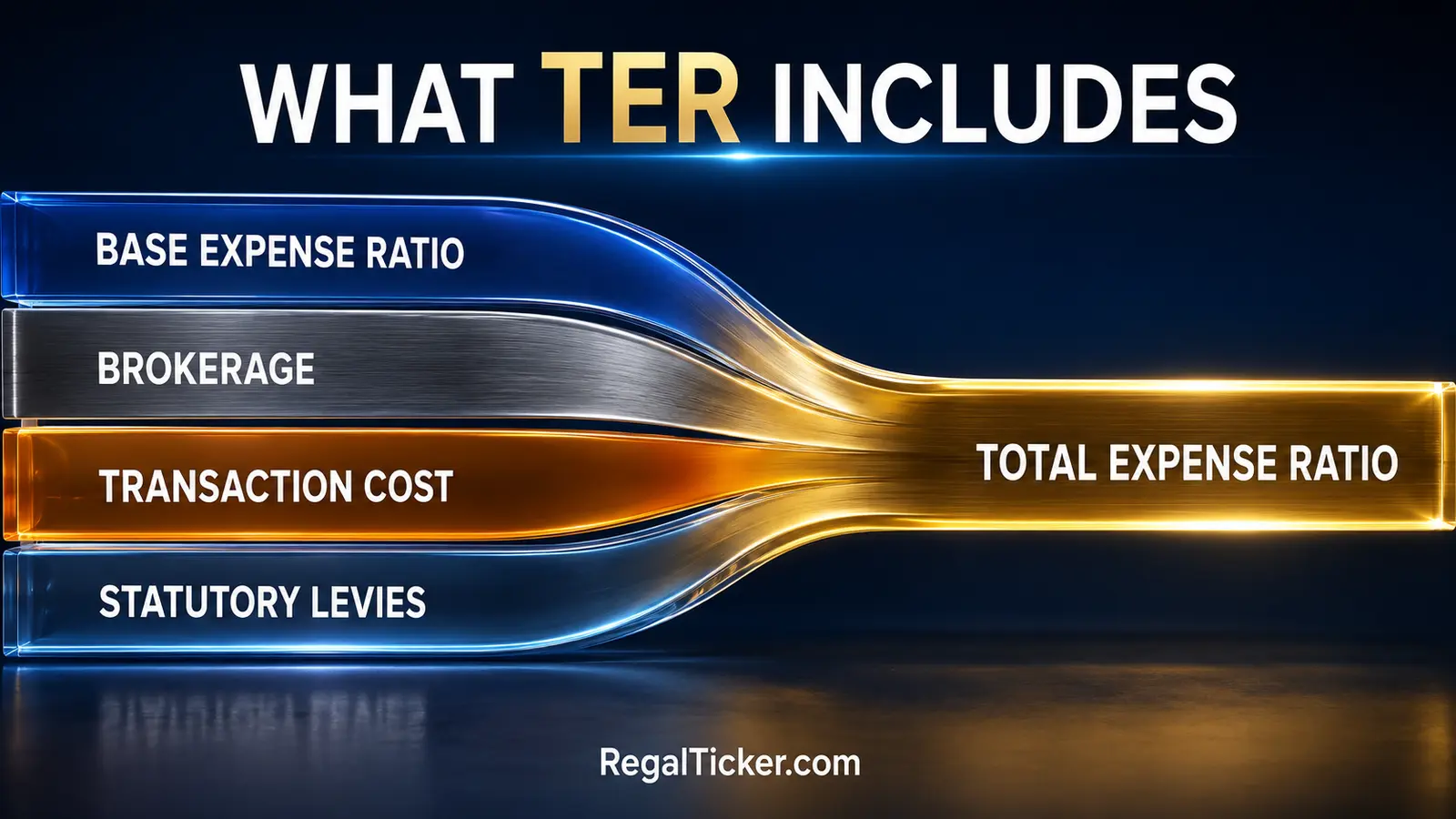
TER equals BER plus brokerage cost, transaction cost and statutory levies, including applicable GST.
Direct versus regular
The two plans of the same scheme can have different expense ratios and therefore separate NAVs and returns.
Compounding effect
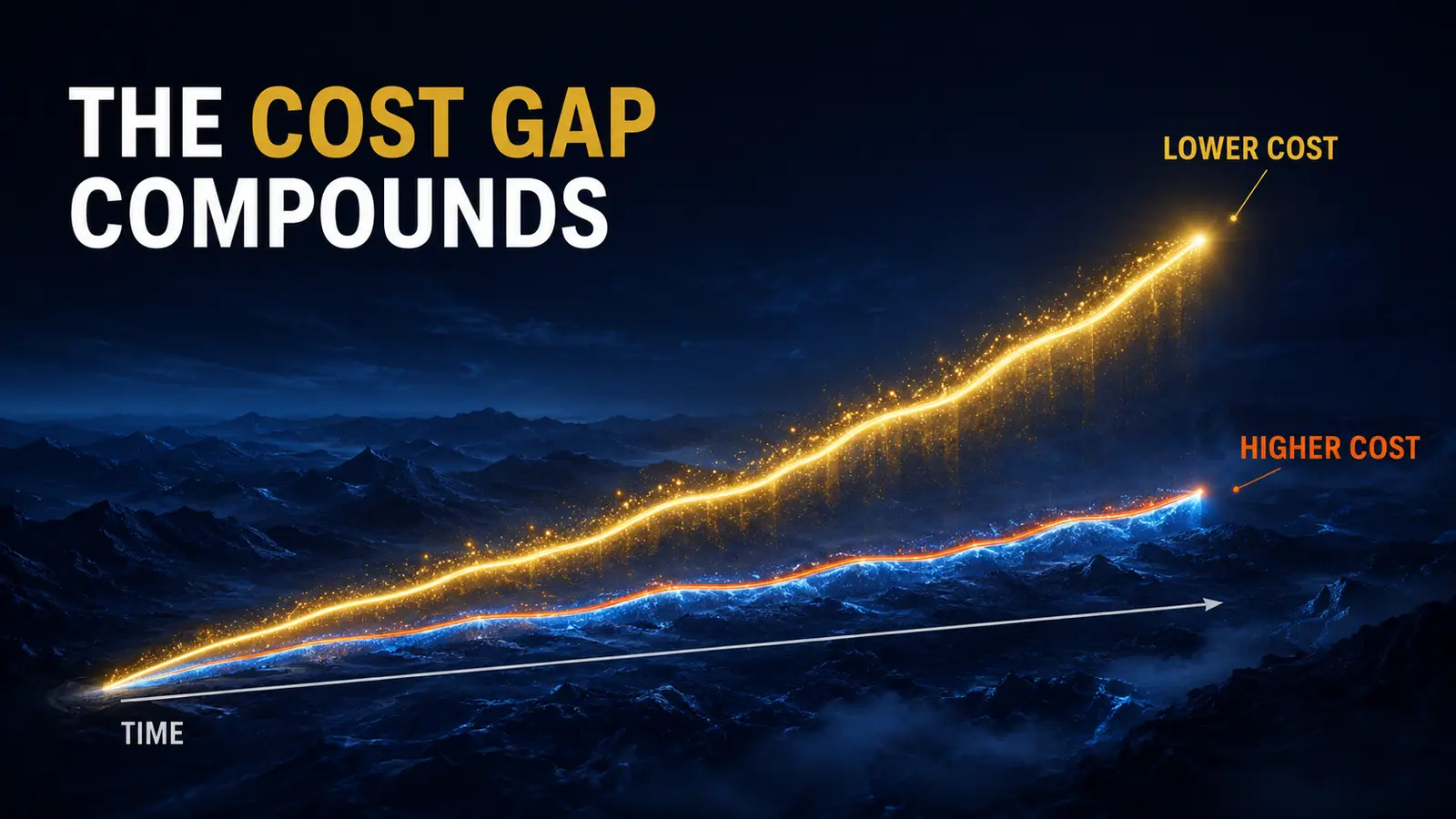
A 1% recurring cost gap can become meaningful over long holding periods because of compounding.
Published fund returns
NAV-based returns are generally net of scheme expenses but not necessarily net of investor tax or exit load.
Compare like with like
The lowest expense ratio is not automatically the best fund; match category, plan, strategy, risk and period.
Verify current TER
Check the latest plan-wise TER on the AMC or AMFI website because expense ratios can change.
Expense Ratio in Mutual Funds: Meaning and Why It Matters
The expense ratio in mutual funds can look too small to deserve serious attention.
One scheme may show 0.45%. Another may show 0.85%. A regular plan may cost one percentage point more than the direct plan of the same scheme. In a single year, the gap may not feel dramatic.
Over a long investment horizon, however, the effect is not limited to the fee deducted in one year. Money used to meet expenses is no longer inside the plan to earn future returns. The missed return on that money can also miss subsequent compounding. A small annual difference can therefore develop into a much larger corpus difference.
Cost still does not answer every investment question.
A low-cost fund can be unsuitable for your goal. A high-cost active fund may fail to justify its cost. A direct plan can save distribution expense but can still be a poor choice if the underlying scheme is wrong. An index fund with a low expense ratio can still have tracking difference, liquidity or concentration considerations.
The useful question is not simply:
Which mutual fund has the lowest expense ratio?
It is:
Among genuinely comparable and suitable choices, how much return is being consumed by recurring cost, and is the remaining investment proposition strong enough?
If you are new to mutual funds, first read What Is a Mutual Fund?, Types of Mutual Funds in India and NAV in Mutual Funds. Those lessons explain the pool, scheme structure, categories, units and NAV on which this cost concept depends.
What Is Expense Ratio in Mutual Funds?
An expense ratio is the annualised cost of running and operating a mutual fund scheme or plan, expressed as a percentage of the relevant assets.
Mutual funds require professional and operational infrastructure. Depending on the permitted framework and scheme structure, costs can relate to areas such as:
- investment management and advisory services;
- fund administration;
- registrar and transfer-agent services;
- custody of securities;
- audit and compliance;
- trusteeship;
- investor communication;
- distribution-related expenses in a regular plan;
- brokerage and trade execution;
- regulatory and statutory charges;
- other expenses permitted under the applicable rules.
The fund does not normally send each investor an annual invoice for a personal share of these scheme expenses.
Instead, permitted expenses are charged to the scheme or plan. They reduce the net assets available for unitholders and are therefore reflected in NAV.
This produces three important consequences:
- The expense ratio is not an entry price added to the amount you invest.
- The number is annualised, but the effect is accrued through the fund over time.
- The return calculated from the plan's NAV is already after the scheme expenses reflected in that NAV.
Expense Ratio Is a Rate, Not a Fixed Rupee Fee
Suppose a plan reports an annualised expense ratio of 1.20%.
That does not mean every investor pays a fixed ₹1,200 or receives one debit on March 31.
The cost is related to the plan's assets. Your investment value, the scheme's assets and the disclosed components can change. A 1.20% figure is therefore a rate used to understand recurring cost, not a promise of one exact personal rupee deduction.
Expense Ratio, TER and Mutual Fund Cost
In everyday investor conversations, “expense ratio” and “TER” are often used as if they mean the same thing.
That shorthand can be useful, but the current Indian disclosure framework makes a more precise distinction between Base Expense Ratio and Total Expense Ratio. Understanding that difference prevents investors from comparing an incomplete base cost with an all-in disclosed TER.
TER vs BER in Mutual Funds Under the 2026 Framework
India's mutual fund expense framework changed materially with the SEBI (Mutual Funds) Regulations, 2026 and the Master Circular for Mutual Funds dated March 20, 2026.
The current formula disclosed in the master circular is:
Total Expense Ratio = Base Expense Ratio + Brokerage Cost + Transaction Cost + Statutory Levies
The master circular specifically includes applicable GST within statutory levies for the TER disclosure format.
What Is Base Expense Ratio?
Base Expense Ratio, or BER, represents the base layer of permitted recurring scheme expenses under the applicable regulation.
In practical terms, BER covers the core investment-management and recurring operating expense structure. The direct plan must have a lower BER because distribution expense and commission are excluded from the direct route.
What Is Total Expense Ratio?
Total Expense Ratio, or TER, is the broader disclosed ratio of the expenses charged to investors of the scheme relative to its assets under management, following the current regulatory definition and format.
It brings together:
- BER;
- permitted brokerage cost;
- transaction cost incurred for executing trades;
- statutory levies, including applicable GST.
| Term | What it represents | Why it matters to investors |
|---|---|---|
| BER | Core permitted base and recurring scheme expenses | Helps separate the base cost from execution-related and statutory components |
| Brokerage cost | Permitted brokerage related to trade execution | Portfolio activity creates a cost that must be disclosed within the current TER structure |
| Transaction cost | Regulatory levies and other permitted exchange, clearing-corporation or clearing-house execution costs | These are connected with executing the scheme's trades |
| Statutory levies | Applicable government levies, including GST in the disclosure format | They can cause the all-in TER to differ from BER |
| TER | BER plus brokerage, transaction cost and statutory levies | This is the broader current cost disclosure investors should compare plan-wise |
Why Older Expense-Ratio Explanations Can Be Misleading
An older article may say only:
TER = annual operating expenses divided by average assets.
That describes the broad economic idea but misses the structure now used in India's 2026 disclosure framework.
For current Indian mutual funds, investors should distinguish the components shown in the latest plan-wise disclosure instead of treating BER and TER as interchangeable figures.
The official current sources are the SEBI (Mutual Funds) Regulations, 2026, the SEBI Master Circular for Mutual Funds dated March 20, 2026 and the AMFI scheme-wise TER facility.
What Costs Does the Expense Ratio Cover?
The expense ratio is intended to reflect permitted costs charged through the mutual fund scheme or plan. It should not be read as an unrestricted spending allowance for an AMC.
SEBI prescribes what may be charged, what must remain within base limits, what can appear as a separate TER component and what must be borne by the AMC, trustee or sponsor.
Investment Management and Advisory Cost
The AMC employs an investment team and operates the process used to manage the portfolio according to the scheme mandate.
This can involve:
- security research;
- portfolio construction;
- risk management;
- trading decisions;
- credit assessment for debt holdings;
- compliance with scheme and regulatory limits;
- monitoring corporate and market events.
This work is not a guarantee of outperformance. It is part of the operating structure for which the scheme pays permitted fees.
Administration, Custody, Audit and Records
A mutual fund also needs systems and regulated service providers to:
- hold securities safely;
- calculate and disclose NAV;
- maintain folios and transaction records;
- process purchases, switches and redemptions;
- perform audit and compliance work;
- communicate with investors;
- support statements, nominations and servicing.
These activities continue whether markets rise or fall.
Distribution Cost in Regular Plans
A regular plan can include permitted distribution-related expense or commission within its base cost. A direct plan excludes that distribution route and therefore has a lower base expense ratio.
Direct and regular are still plans of the same underlying scheme. They generally share the portfolio and fund manager but have separate cost structures, NAVs and returns.
Read Direct vs Regular Mutual Funds for the complete decision framework, including when distributor service may or may not justify the continuing cost.
Brokerage, Transaction Cost and Statutory Levies
Portfolio transactions create execution-related costs. The current TER format separately identifies brokerage, transaction cost and statutory levies rather than hiding the entire all-in figure inside one undifferentiated base percentage.
This distinction improves transparency, but it also means investors should compare like with like.
Do not compare one scheme's BER with another scheme's TER and conclude that the first is cheaper.
Expense Ratio Formula and Calculation
The simplified economic formula is:
Expense ratio = Annualised permitted expenses ÷ Average relevant net assets × 100
Under the current disclosure structure:
TER = BER + Brokerage Cost + Transaction Cost + Statutory Levies
Scheme-Level Calculation Example
Suppose a mutual fund plan has:
- average relevant net assets: ₹1,000 crore;
- annualised total disclosed cost rate: 1.20%.
A simplified annual cost equivalent is:
₹1,000 crore × 1.20% = ₹12 crore
This does not mean the scheme waits until year-end and removes ₹12 crore in one transaction.
The example translates a percentage into an annual rupee equivalent. In practice, assets change, the cost components can change and expenses are accrued through the fund over time.
Investor-Level Approximation
Suppose your holding remained exactly ₹2,00,000 for an entire year and the plan's annualised expense ratio remained exactly 1.20%.
A rough cost equivalent would be:
₹2,00,000 × 1.20% = ₹2,400
But your personal account would not normally show a separate ₹2,400 expense-ratio debit.
The amount is only an approximation because:
- your investment value changes with NAV;
- the expense ratio can change;
- purchases or redemptions change the holding period;
- expenses are accrued through the scheme, not calculated as one personal flat bill;
- actual returns are uneven.
Daily Approximation
For simple intuition, an annualised rate can be divided by 365:
1.20% ÷ 365 = approximately 0.00329% per day
If ₹10,00,000 remained constant, the simple daily equivalent would be about:
₹10,00,000 × 0.00329% = ₹32.88
This is an educational approximation, not the exact accounting entry for your folio. The AMC applies the regulatory valuation and accrual process at scheme or plan level.
How Is Expense Ratio Deducted From NAV?
Expense ratio is often described as being “deducted daily.” The phrase is useful if it is understood correctly.
The scheme accrues permitted expenses, which reduce the net assets available for unitholders. NAV is calculated after recognising the relevant assets, liabilities and expenses under the applicable valuation process.
You normally see the result as a slightly lower NAV than would have existed without those expenses.
You do not normally see:
- a separate annual invoice;
- units removed only to pay TER;
- one visible bank debit labelled “expense ratio”;
- a March-end lump-sum fee transaction in your folio.
Does the Number of Units Fall?
Ordinary expense accrual does not normally reduce the number of units you hold.
Instead, the value represented by each unit is affected through NAV.
For example, if you own 1,000 units, you generally continue to own 1,000 units unless you purchase, redeem, switch or another unit-changing event occurs. Expenses operate through the value of the plan, not through a routine daily cancellation of your units.
Are Mutual Fund Returns Before or After Expense Ratio?
NAV-based scheme returns are generally after the expenses already reflected in the plan's NAV.
If a platform reports the historical return of a direct-growth plan from its NAV, it should not subtract that plan's TER a second time.
However, the displayed return may still be before investor-specific costs such as:
- exit load at redemption;
- capital-gains tax;
- tax on relevant cash distributions;
- separately paid advisory fees;
- platform or account charges, where applicable.
This distinction is crucial when using calculators. Do not automatically take a published net historical return and subtract the expense ratio again.
How Expense Ratio Affects Mutual Fund Returns
The immediate relationship is simple:

Gross portfolio experience − expenses = net plan experience, before investor-specific taxes and redemption costs
For intuition, suppose a portfolio produces a hypothetical gross return of 12% in a year.
- At a 0.50% expense ratio, a simplified net assumption is 11.50%.
- At a 1.50% expense ratio, a simplified net assumption is 10.50%.
The actual relationship can differ slightly because expenses accrue through time, assets change, cash flows occur and the TER itself can change. Still, subtracting the cost rate is useful for an educational long-term illustration.
Worked Lumpsum Example: A 1% Cost Gap
Assume:
- initial investment: ₹5,00,000;
- hypothetical gross return: 12% every year;
- lower-cost illustration: 0.50% annual expense;
- higher-cost illustration: 1.50% annual expense;
- simplified net rates: 11.50% and 10.50%;
- no additional contribution, tax, exit load or changing expense ratio.
| Period | 0.50% cost illustration | 1.50% cost illustration | Approximate corpus gap |
|---|---|---|---|
| 10 years | ₹14,84,973 | ₹13,57,040 | ₹1,27,933 |
| 20 years | ₹44,10,292 | ₹36,83,117 | ₹7,27,175 |
| 30 years | ₹1,30,98,333 | ₹99,96,278 | ₹31,02,055 |
The 30-year gap is not simply ₹5,000 multiplied by 30 years.
The early cost difference also loses the opportunity to compound in later years. That is why the corpus gap accelerates over time.
This example is not a return forecast. Real mutual fund returns fluctuate, costs can change and an active fund's gross performance may differ from another fund's performance. The table isolates one variable—recurring cost—to show its mathematical effect.
Use the Lumpsum Calculator to test a one-time investment at different net return assumptions. For example, compare 11.5% and 10.5% instead of entering one gross return and assuming the tool will deduct TER automatically.
What About SIP Investments?
The same cost principle applies to SIPs, but each instalment has a different holding period.
The earliest instalments experience the cost difference for the longest time. The latest instalments experience it for a shorter period.
Use the SIP Calculator for a recurring-investment projection, the Goal SIP Calculator to work backward from a target and the XIRR Calculator for actual dated cash flows.
These tools do not automatically know your scheme's changing expense ratio. Use a reasonable net return assumption and stress-test the result at lower rates.
How Expense Ratio Differs Across Plans and Strategies
Direct vs Regular Expense Ratio
Direct and regular plans provide one of the clearest real-world examples of how expense ratio affects returns.
Both plans generally share:
- the same underlying scheme;
- the same portfolio;
- the same fund manager;
- the same investment objective;
- the same benchmark;
- the same category risk.
Their cost structures differ.
The direct plan excludes distribution expense or commission embedded in the regular route. It therefore has a lower base expense ratio. Over time, this normally produces a higher direct-plan NAV and a somewhat higher direct-plan return than the regular plan of the same scheme and option.
Fair Direct vs Regular Comparison
Option A
- Direct Growth with Regular Growth;
- the same scheme;
- the same dates;
- the same cash flows;
- the same return period.
- Do not compare Direct Growth with Regular IDCW and attribute the entire difference to expense ratio. Growth vs IDCW Mutual Funds explains why the option's cash-flow design and NAV behaviour also differ.
Option B
Does Lower Direct Cost Mean Everyone Must Choose Direct?
Not automatically.
Direct has a measurable cost advantage. But an investor must be able to select, monitor and manage the investment responsibly or obtain separately paid regulated advice.
A useful regular-plan service may help an investor avoid an unsuitable fund, maintain allocation, complete transactions correctly and stay disciplined. Poor distribution can add cost without adding value.
The decision is therefore not “cheap is always right.” It is whether the advice and service received are worth the recurring cost and whether the selected scheme is suitable in the first place.
Active vs Passive Fund Expense Ratio
Actively managed funds commonly have higher expense ratios than broad passive index funds because active management involves research, security selection and portfolio decisions intended to differ from an index.
Passive funds aim to track an index rather than beat it through discretionary selection. Their simpler mandate often supports a lower base cost.
Why Cost Is Especially Important in Index Funds
Two index funds tracking the same index begin with a similar gross objective.
Their realised investor experience can differ because of:
- expense ratio;
- tracking difference;
- tracking error;
- cash holdings;
- replication method;
- execution quality;
- securities lending policy;
- portfolio rebalancing;
- for ETFs, bid-ask spread and market liquidity.
A lower expense ratio is valuable, but it does not replace tracking analysis.
If Fund A charges 0.10% and Fund B charges 0.20%, Fund A is not automatically the better tracker. Check which fund has actually kept its return closer to the index after costs over a meaningful period.
Can a Higher-Cost Active Fund Be Worth It?
Possibly, but only if its complete net outcome justifies the cost and risk.
Evaluate:
- performance after expenses;
- comparison with the correct benchmark and category peers;
- consistency across market conditions;
- risk taken to generate the return;
- drawdowns and recovery;
- portfolio concentration and style drift;
- fund-manager process and tenure;
- tax and switching consequences of changing funds.
Past outperformance does not guarantee future outperformance. A higher expense ratio creates a recurring hurdle the active manager must overcome before the investor benefits.
SEBI Expense-Ratio Limits in 2026
SEBI does not impose one universal percentage for every mutual fund.
The 2026 framework uses different BER ceilings for different scheme structures and, for many open-ended funds, asset-based slabs. Larger assets move through lower marginal expense slabs.
The following table is a selected orientation, not a substitute for the complete regulation or a scheme's current plan-wise disclosure.
| Scheme structure | Selected maximum BER orientation under the 2026 framework |
|---|---|
| Open-ended index fund or ETF | 0.90% of daily net assets |
| Fund of funds investing in liquid schemes, index funds or ETFs | 0.90%, including the relevant weighted underlying expense under the prescribed structure |
| Other open-ended equity-oriented scheme | 2.10% on the first ₹500 crore slab, with lower marginal slabs as assets increase |
| Other open-ended non-equity-oriented scheme | 1.85% on the first ₹500 crore slab, with lower marginal slabs as assets increase |
| Close-ended equity-oriented scheme | 1.00% |
| Close-ended scheme other than equity-oriented | 0.80% |
Maximum BER Is Not the Same as Actual TER
This is one of the most important distinctions in the article.
The table shows selected BER ceilings. A scheme's actual BER may be lower. Its disclosed TER also includes the other components prescribed in the current formula.
Therefore:
- a regulatory ceiling is not the expense ratio every fund must charge;
- BER is not automatically the same number as TER;
- direct and regular plan BERs differ;
- actual ratios can change;
- investors should check the latest plan-wise disclosure.
For exact current requirements, read the official regulation and master circular rather than relying on an old screenshot or a static third-party table.
How to Check the Expense Ratio of a Mutual Fund
Expense ratio should be verified from a current source because the number can change.
1. Check the AMC Website
Mutual fund houses publish plan-wise expense information on their official websites.
Confirm:
- exact scheme name;
- direct or regular plan;
- growth or IDCW option where relevant to the display;
- BER components;
- total expense ratio;
- effective date or disclosure date.
2. Use AMFI's TER Facility
AMFI provides a Total Expense Ratio of Mutual Fund Schemes facility using the current disclosure structure.
Use it to verify the AMC, scheme and plan instead of relying on a search snippet that may be stale.
3. Read the Factsheet, SID and KIM
The factsheet can show current scheme information, while the Scheme Information Document and Key Information Memorandum explain the permitted expense framework and other material terms.
Do not assume the maximum expense printed in an offer document is the same as the ratio currently charged.
4. Check Notices of BER Change
Under the current framework, changes in BER are communicated through the prescribed notice process. Review relevant AMC notices when monitoring a scheme.
5. Confirm the Plan on Your Statement
An investor may believe a holding is direct while the statement shows regular, or compare a direct-plan website number with a regular-plan holding.
Verify the exact plan name on:
- account statement;
- consolidated account statement;
- AMC or registrar portal;
- transaction confirmation;
- current factsheet.
What Is a Good Expense Ratio—and Is the Lowest Always Best?
There is no universal “good expense ratio” that works across every category and strategy.
A fair comparison must match:
- scheme category;
- active or passive strategy;
- direct or regular plan;
- comparable investment mandate;
- similar risk and portfolio role;
- the same disclosure concept—TER with TER, not TER with BER.
A Practical Comparison Order
Use this sequence:
- Decide whether the category suits the goal and time horizon.
- Check risk, portfolio, liquidity and mandate.
- Compare funds within that category and strategy.
- Confirm direct or regular plan consistently.
- Compare current TER and its history.
- Evaluate net performance and risk against the correct benchmark.
- Check tracking difference for passive funds.
- Review tax and exit-load consequences before switching an existing holding.
Expense Ratio Matters More When Gross Returns Are Similar
If two suitable funds follow essentially the same strategy and produce similar gross outcomes, the lower cost has a clearer advantage because more return remains in the investor's plan.
If two funds have very different portfolios, risk, processes or mandates, cost alone cannot identify the better investment.
Is the Lowest Expense Ratio Always Best?
No.
Expense ratio is certain in the sense that cost reduces the value otherwise available to investors. Future performance is uncertain. That makes cost an important decision input—but not the only input.
A fund with the lowest expense ratio can still suffer from:
- unsuitable category risk;
- poor tracking difference;
- excessive concentration;
- low ETF liquidity and a wide bid-ask spread;
- weak execution;
- style drift;
- unstable process;
- a portfolio that duplicates existing holdings;
- a short or unrepresentative track record.
Likewise, a higher-cost fund should not receive a free pass merely because it once outperformed.
Ask whether the fund adds value after cost and after accounting for the risk taken.
Expense Ratio vs Other Mutual Fund Costs
TER does not automatically equal every rupee-level cost or tax an investor may face.
| Cost or impact | Is it the same as expense ratio? | Key point |
|---|---|---|
| Exit load | No | It may apply when units are redeemed within a scheme-specific period |
| Capital-gains tax | No | It is an investor-level tax consequence based on applicable law and transaction facts |
| IDCW tax | No | A distribution can create investor-level tax consequences under current law |
| Separately paid adviser fee | No | A fee paid to a registered adviser is outside a direct plan's embedded distribution cost |
| Platform or account charge | Not necessarily | Check the platform's own terms separately |
| ETF bid-ask spread | No | It is a market trading cost affected by liquidity |
| Portfolio brokerage and transaction cost | Component of current TER disclosure | It appears within the current all-in TER structure rather than as an investor folio invoice |
When evaluating a redemption, the Capital Gains Tax Calculator can provide a simplified educational estimate. Always verify current tax rules and the correct fund classification before acting.
Common Expense-Ratio Mistakes and Checklist
Mistake 1: Subtracting TER Twice
Historical NAV-based returns are already after scheme expenses reflected in NAV. Subtracting the current TER again can understate the reported return.

Mistake 2: Comparing Direct TER With Regular TER Without Checking the Plan
The difference may be real, but first confirm that both figures refer to the same scheme, option and date.
Mistake 3: Comparing BER With TER
Under the 2026 framework, they are not identical. Read the label and the component disclosure.
Mistake 4: Treating the Current Ratio as Permanent
Expense ratios can change. A long-term illustration using one constant rate is a scenario, not a forecast.
Mistake 5: Choosing the Cheapest Fund Across Different Categories
A low-cost small-cap fund and a low-cost liquid fund solve different problems and carry different risks. Suitability comes before cost comparison.
Mistake 6: Ignoring Tracking Difference
For an index fund, realised tracking difference can reveal the combined outcome of costs, cash drag, replication and execution better than expense ratio alone.
Mistake 7: Switching Only to Save a Small Fee
A switch can be treated as a redemption and fresh purchase. Tax, exit load, time out of market, operational error and portfolio suitability can outweigh a small cost saving.
Mistake 8: Assuming Higher Expense Means Better Management
Price is not proof of skill. Judge an active fund on its process, risk and performance after expenses.
12-Point Expense-Ratio Checklist Before You Invest
Use this checklist before selecting or reviewing a mutual fund:
- Is the fund category suitable for my goal and time horizon?
- Am I checking the exact scheme, plan and option?
- Is the displayed number BER or TER?
- What is the latest total expense ratio and disclosure date?
- How has the expense ratio changed over time?
- Is the plan direct or regular, and what service am I receiving for any distribution cost?
- For an active fund, has net performance justified the recurring cost and risk?
- For an index fund, what are the tracking difference and tracking error?
- Are exit load, tax, advisory fees or platform costs separate?
- Would switching create tax or exit-load consequences?
- Have I tested my goal at a lower net return assumption?
- Have I read the latest factsheet, SID/KIM and official TER disclosure?
Cost control is useful only when it sits inside a suitable, diversified and behaviourally sustainable investment plan.
Use RegalTicker Calculators With Expense Ratio
RegalTicker calculators are planning and measurement tools. They do not fetch or predict a scheme's future TER.
Use them as follows:
| Investor question | RegalTicker tool | How to include expense-ratio thinking |
|---|---|---|
| How might monthly investing grow? | SIP Calculator | Use a reasonable net return assumption and test a lower one |
| What SIP may be required for a goal? | Goal SIP Calculator | Reduce the assumed return if the original figure is gross of costs |
| How might one investment compound? | Lumpsum Calculator | Compare lower-cost and higher-cost net scenarios |
| What smooth annual rate connects two values? | CAGR Calculator | Use actual beginning and ending NAV-based values; do not subtract TER twice |
| What return applies to dated cash flows? | XIRR Calculator | Enter actual SIPs, withdrawals and ending value; XIRR reflects the realised cash-flow result |
| How may periodic withdrawals affect a corpus? | SWP Calculator | Stress-test withdrawals at conservative net return assumptions |
| What listed-investment tax may apply? | Capital Gains Tax Calculator | Treat tax as separate from TER and verify current fund-specific law |
For one starting value and one ending value, CAGR is appropriate. For multiple SIP instalments, switches, withdrawals or irregular cash flows, XIRR is usually the better measurement.
Frequently asked questions
What is the expense ratio in mutual funds?
The expense ratio is the annualised percentage of a mutual fund scheme or plan's assets used to meet permitted expenses. It is reflected through the scheme's net assets and NAV rather than normally being billed separately to each investor.
What is the full form of TER?
TER stands for Total Expense Ratio.
What is BER in mutual funds?
BER stands for Base Expense Ratio. Under the 2026 framework, it represents the base recurring expense layer. TER adds permitted brokerage, transaction cost and statutory levies to BER.
What is the current TER formula in India?
The SEBI Master Circular for Mutual Funds dated March 20, 2026 gives the disclosure formula as TER equals BER plus brokerage cost plus transaction cost incurred for trade execution plus statutory levies, including applicable GST.
Is expense ratio deducted daily or yearly?
Expense ratio is quoted as an annualised percentage, while permitted expenses are accrued through the fund and reflected in NAV on an ongoing basis. Investors normally do not receive one separate yearly expense-ratio bill.
Does expense ratio reduce my mutual fund units?
Ordinary expense accrual generally affects NAV rather than routinely reducing the number of units you hold. Units change when you purchase, redeem, switch or another unit-changing transaction occurs.
Are mutual fund returns shown after expense ratio?
NAV-based plan returns are generally after the scheme expenses already reflected in NAV. Exit load, investor taxes and separately paid fees may still be outside the displayed return.
Can a mutual fund expense ratio change?
Yes. BER and TER components can change under the permitted framework. Check the latest AMC and AMFI disclosures rather than assuming the current number is permanent.
Is a lower expense ratio always better?
Lower cost leaves more of a comparable gross return for investors, but the cheapest fund is not automatically the best. Compare the same category, plan and strategy, then evaluate risk, portfolio quality, net performance and tracking.
Why does a direct plan have a lower expense ratio?
A direct plan excludes distribution expense or commission embedded in the regular route. It therefore has a lower base expense ratio than the regular plan of the same scheme.
Is exit load included in the expense ratio?
No. Exit load is a separate charge that may apply when units are redeemed within a specified period under the scheme's load structure.
Is tax included in the expense ratio?
Statutory levies connected with scheme expenses and trade execution are part of the current TER disclosure structure. Investor-level capital-gains tax or tax on relevant distributions is separate.
How does expense ratio affect SIP returns?
Expenses reduce the NAV path experienced by every SIP instalment. Earlier instalments are exposed to the cost difference for longer, so a small recurring gap can become meaningful over a long SIP period.
Where can I find the latest expense ratio?
Check the official AMC website, AMFI's TER facility, the latest factsheet and the scheme's current disclosures. Confirm the exact direct or regular plan before comparing figures.
Final Takeaway
The expense ratio in mutual funds is easy to ignore because it is small, annualised and not normally presented as a separate personal bill.
Its long-term effect can still be large.
Expenses reduce the NAV otherwise available to investors. The amount used to meet a recurring cost also loses future compounding. This is why a 1% difference can produce a substantial corpus gap over 20 or 30 years.
Under India's current 2026 framework, investors should distinguish BER from TER:
TER = BER + Brokerage Cost + Transaction Cost + Statutory Levies
Use that current definition when comparing plan-wise disclosures.
Then apply four rules:
- compare only similar funds;
- confirm direct or regular plan;
- judge performance after cost and relative to risk;
- never switch without checking tax, exit load and suitability.
This is Lesson 7 in the Mutual Funds learning path. Before this lesson, review Growth vs IDCW Mutual Funds, Direct vs Regular Mutual Funds, SIP vs Lumpsum and NAV in Mutual Funds.
Verify through official sources
Official references
Educational disclaimer: This article is for education and general information only. It is not investment, tax, legal or financial advice. Regal Ticker is not a SEBI-registered investment adviser. Mutual fund investments are subject to market risks. Expense ratios, regulations, taxes, loads and scheme terms can change. Read the latest scheme-related documents and verify current official disclosures before investing, switching or redeeming.