
⚡ Quick answer
How should a beginner choose a mutual fund?
Start with the job the money must do, not with a fund name. Define the goal and time horizon, assess how much loss you can realistically tolerate, and then choose the appropriate mutual fund category. After that, compare funds within the same category using the SEBI Riskometer, benchmark-relative performance, rolling-return consistency, drawdowns, expenses, portfolio quality and—where relevant—tracking error. Finally, choose Direct or Regular and Growth or IDCW deliberately, check exit load and tax, and reject any fund that you cannot explain in one sentence. A good mutual fund is not the one with the highest recent return; it is the one that fits your goal and that you can hold through its normal bad periods.
Key takeaways
Goal first
decide what the money is for and when you will need it.
Category before scheme
compare funds only after choosing the right investment category.
Risk must be survivable
the best fund is useless if normal volatility makes you exit at the wrong time.
Use the Riskometer
check the scheme’s current risk level and compare it with your capacity for loss.
Do not chase one-year winners
compare consistency across market cycles and against an appropriate benchmark.
Costs matter
expense ratio, plan choice, exit load and tax all reduce what finally stays with you.
For index funds, check tracking quality as well as expense ratio.
Read the portfolio
concentration, sector exposure, credit quality and overlap can reveal hidden risks.
Direct vs Regular and Growth vs IDCW are separate decisions from choosing the scheme itself.
A simple, understandable portfolio is usually better than collecting many overlapping funds.
Review periodically, but do not replace funds merely because another scheme topped the latest ranking.
The Biggest Mutual Fund Selection Mistake: Starting With Returns
Search for “best mutual fund” and you will immediately see rankings.
Top one-year return.
Top three-year return.
Five-star funds.
Best SIP funds.
Best funds this month.
That feels useful because a return number is easy to compare.
But it reverses the correct decision process.
A mutual fund is a tool.
You should first decide what job the tool must perform.
A small-cap equity fund can be excellent at its job and still be completely inappropriate for money needed in two years.
A liquid or short-duration debt fund can be appropriate for a near-term goal and still look “bad” beside a booming equity fund in a return table.
The selection process should therefore be:
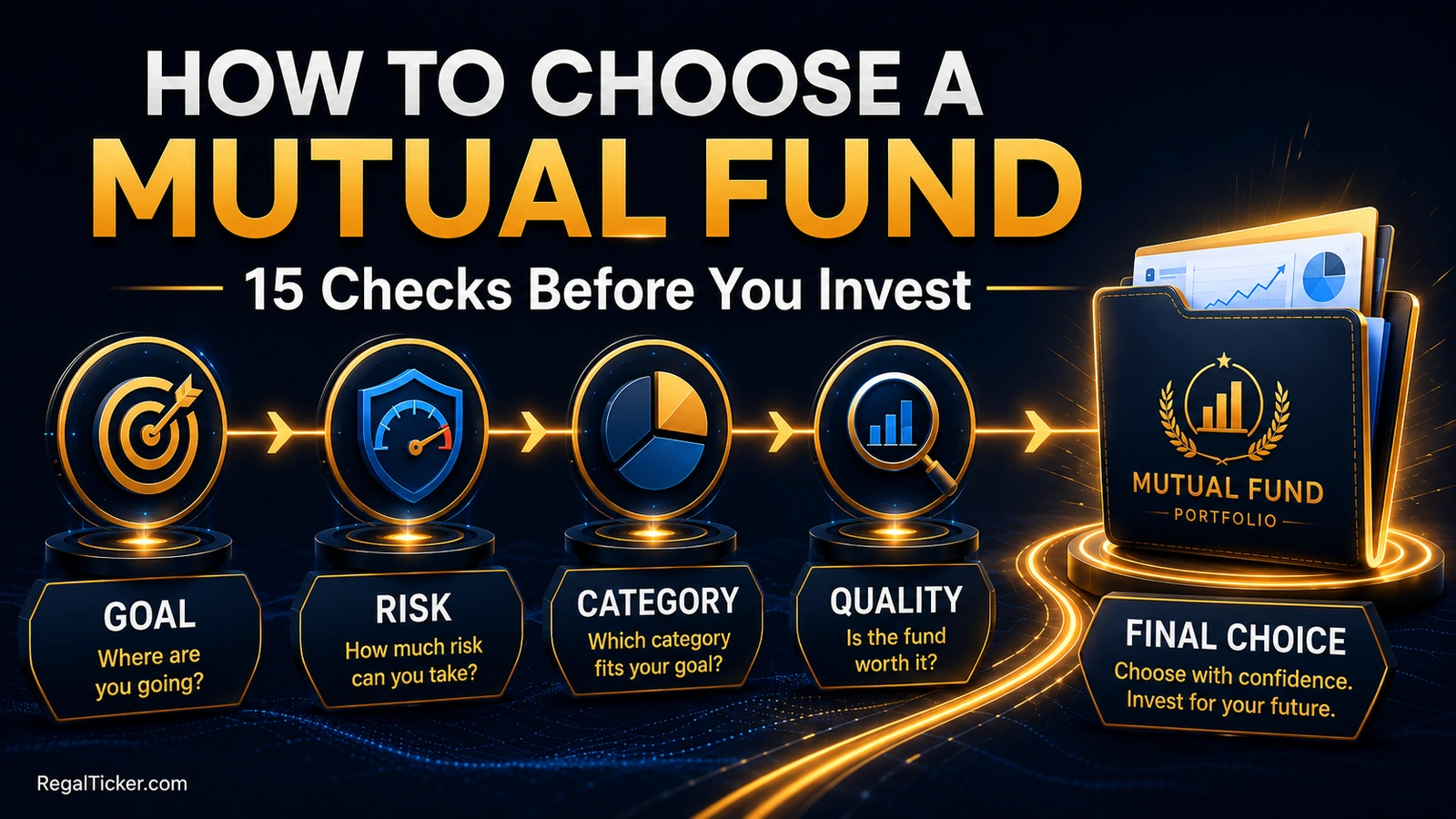
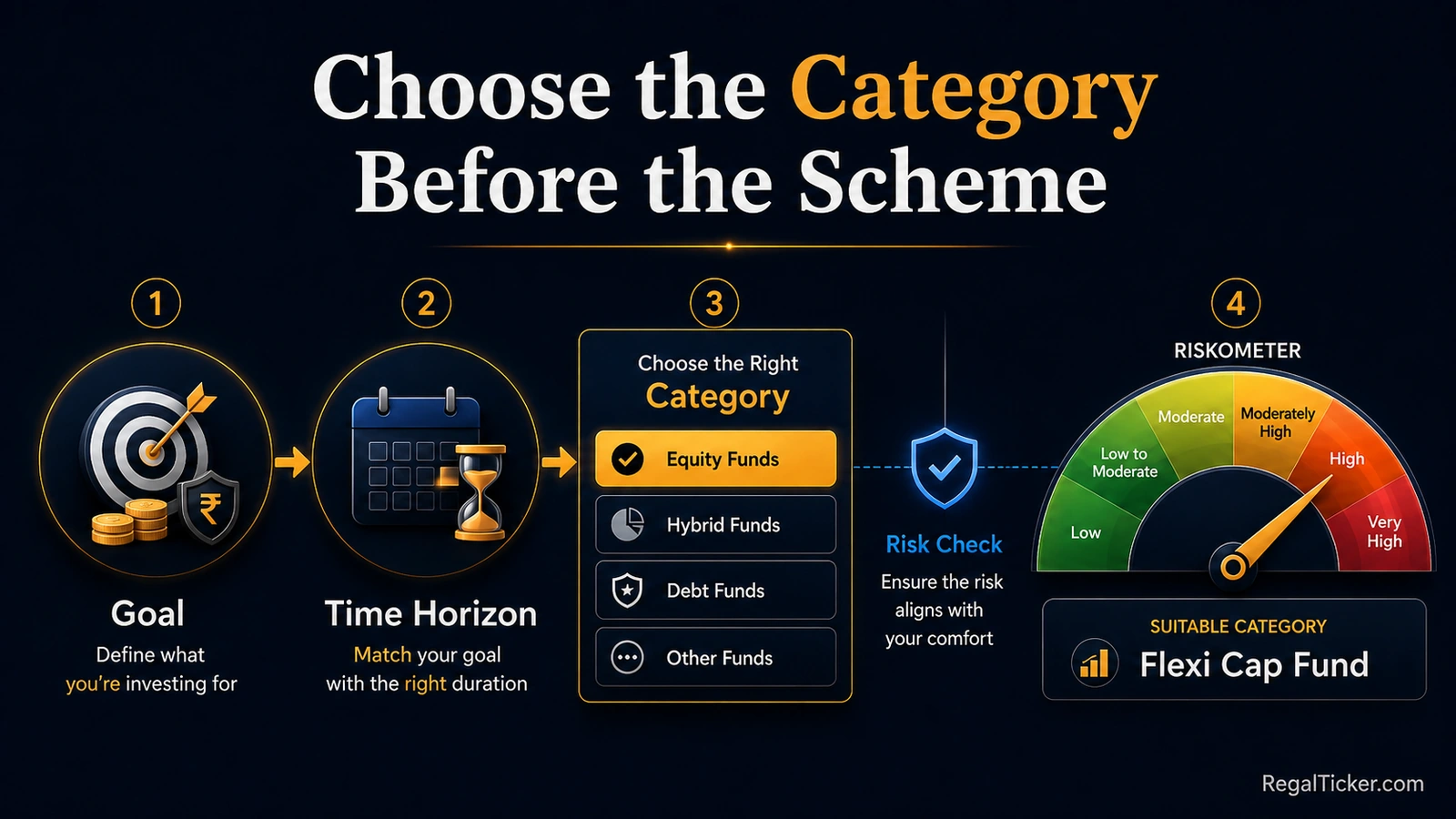
Investor → Goal → Time Horizon → Risk → Category → Scheme
not:
Highest Return → Scheme → Hope It Fits
Caution
Check this carefully
Do not select a mutual fund simply because it appears in a “top funds this month” list. Recent rankings are observations about the past, not a personalised investment plan.
This final Mutual Funds lesson brings together everything covered earlier:
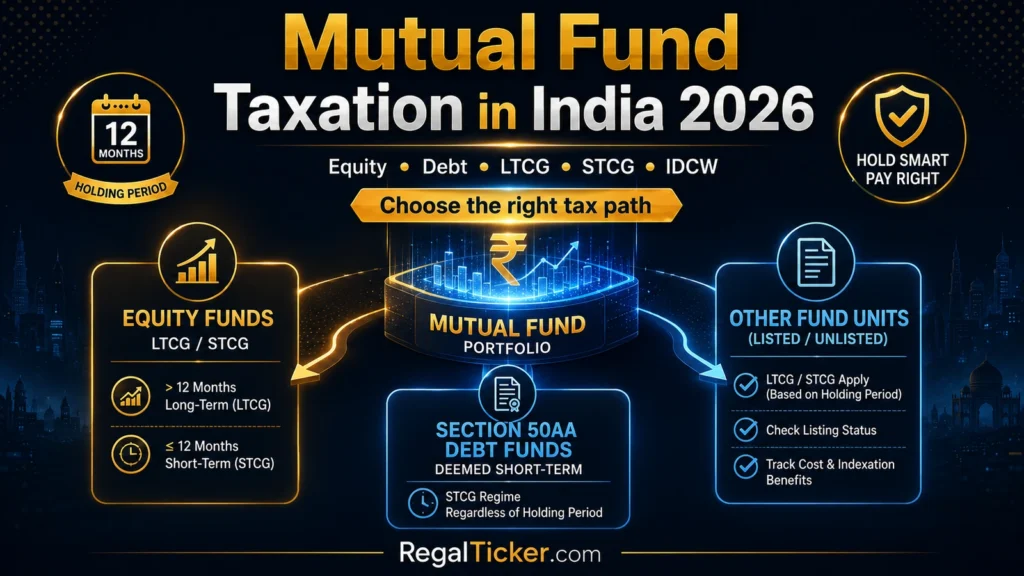
What Is a Mutual Fund? Types of Mutual Funds in India NAV in Mutual Funds SIP vs Lumpsum Direct vs Regular Mutual Funds Growth vs IDCW Mutual Funds Expense Ratio in Mutual Funds Exit Load in Mutual Funds Mutual Fund Taxation in India 2026
The goal now is to turn those concepts into one repeatable framework.
Phase 1: Match the Fund to Your Goal and Risk
Check 1: Define the Financial Goal
Do not begin with:
“I want a mutual fund.”
Begin with:
“I need ₹25 lakh for a house down payment in seven years.”
or:
“I am investing for retirement 20 years away.”
or:
“I need to park money that may be required within six months.”
A useful goal has four parts:
- purpose;
- target amount;
- target date;
- priority.
📖 Definition
Goal-based investing
Goal-based investing means selecting and managing investments according to a defined financial objective rather than investing only because an asset or fund currently looks attractive.
Why does the goal matter?
Because the goal determines how much uncertainty the portfolio can tolerate.
A retirement goal 25 years away can potentially recover from several equity-market cycles.
A tuition payment due in 18 months cannot depend on a small-cap recovery arriving on schedule.
💡 Real example
Same investor, different goals
An investor can reasonably use equity-oriented mutual funds for a retirement goal 20 years away while using a much lower-volatility approach for money required for a house payment next year. Risk tolerance belongs to the goal as well as the person.
Write the goal before looking at funds
Use one sentence:
“I need ₹_ in _ years for _.”
That sentence will eliminate more unsuitable funds than any star rating.
Check 2: Match the Time Horizon to the Asset Category
Time horizon is not a guarantee that an asset will perform well.
It is a measure of how long you can leave the money exposed to its normal risk.
A beginner-friendly principle is:
- shorter horizon → prioritise liquidity and capital stability;
- longer horizon → more capacity to accept equity volatility for growth.
This does not mean every investor should use the same fixed year rule.
The appropriate category also depends on:
- how essential the goal is;
- whether the date is flexible;
- whether other assets are available;
- how much loss can be tolerated;
- tax and liquidity requirements.
Why equity and short-term goals are a dangerous mix
Equity markets can fall sharply at exactly the wrong time.
If you need the money during that fall, “I will wait for recovery” may not be possible.
That makes time horizon a risk-management tool, not merely an expected-return input.
⭐ Pro tip
As a goal approaches, review whether the portfolio should gradually reduce dependence on volatile assets instead of waiting until the final month to move everything.
Check 3: Choose the Correct Mutual Fund Category
Once the goal and horizon are clear, choose the category before choosing the scheme.
SEBI’s 2026 mutual fund framework continues to define categories with investment mandates—for example, large-cap, mid-cap, small-cap, flexi-cap, hybrid, debt and other specialised structures. SEBI also revised and rationalised mutual fund categorisation in February 2026.
The category determines the investment universe and therefore a large part of the risk.
Examples:
| Investor Need | Category to Research First | Main Risk to Understand |
|---|---|---|
| Broad long-term equity exposure | Broad index / diversified equity categories | Market drawdowns |
| Flexible equity allocation across market caps | Flexi-cap | Manager/style decisions and equity risk |
| Higher mid/small-company exposure | Mid-cap / small-cap | Deep volatility and long recovery periods |
| Mix of equity and debt | Hybrid categories | Asset-allocation and both equity/debt risks |
| Short-term cash management | Liquid/overnight or suitable short-duration debt categories | Credit, interest-rate and liquidity risk |
| Passive benchmark exposure | Index fund / ETF | Tracking quality and market risk |
| Target-date style allocation | Life Cycle Fund, where appropriate | Glide-path design and asset-allocation risk |
Check 4: Match the SEBI Riskometer to Your Risk Capacity
The Riskometer is not decoration.
SEBI requires mutual fund schemes to display a Riskometer so investors can see the scheme’s assessed risk level.
The current scale runs from Low through Very High risk.
Riskometer levels can change as portfolio characteristics and market conditions change.
That is useful because a fund’s risk is not permanently frozen on launch day.
Risk tolerance vs risk capacity
These two ideas are often confused.
Risk tolerance is emotional:
“How comfortable am I seeing losses?”
Risk capacity is financial:
“How much loss can my plan survive without failing?”
An investor may emotionally enjoy risk but have low financial capacity because the goal date is near.
Another investor may dislike volatility but have a long horizon and stable finances.
Both dimensions matter.
❌ Myth
A “Very High Risk” Riskometer means the mutual fund is bad.
✅ Fact
It means the scheme carries a high level of investment risk. That may be appropriate for some long-term investors and inappropriate for others. Risk must be matched to the goal.
Ask the drawdown question
Do not ask only:
“Can I tolerate a 10% fall?”
Ask:
“If this fund falls 30% or 40% during a severe market decline, will I still be able to follow my plan?”
That answer is more useful than a risk-profile questionnaire completed during a bull market.
Phase 2: Judge Performance Quality, Not Just Returns
Check 5: Compare the Fund With the Right Benchmark
A mutual fund return without context tells you very little.
Suppose a fund earns 12%.
Is that good?
If its appropriate benchmark earned 7%, perhaps.
If the benchmark earned 18%, perhaps not.
The benchmark gives you a reference point.
SEBI scheme documents identify benchmarks intended to reflect the scheme’s category or strategy. Current scheme documents can also show both the scheme and benchmark Riskometers.
Use Total Return Index comparisons where applicable
A fair benchmark comparison should include the economic return of the benchmark, not just price movement where dividends or distributions are relevant.
The important question is not:
“Did the fund make money?”
It is:
“How did the fund perform relative to the opportunity set it claims to invest in, after costs and with what risk?”
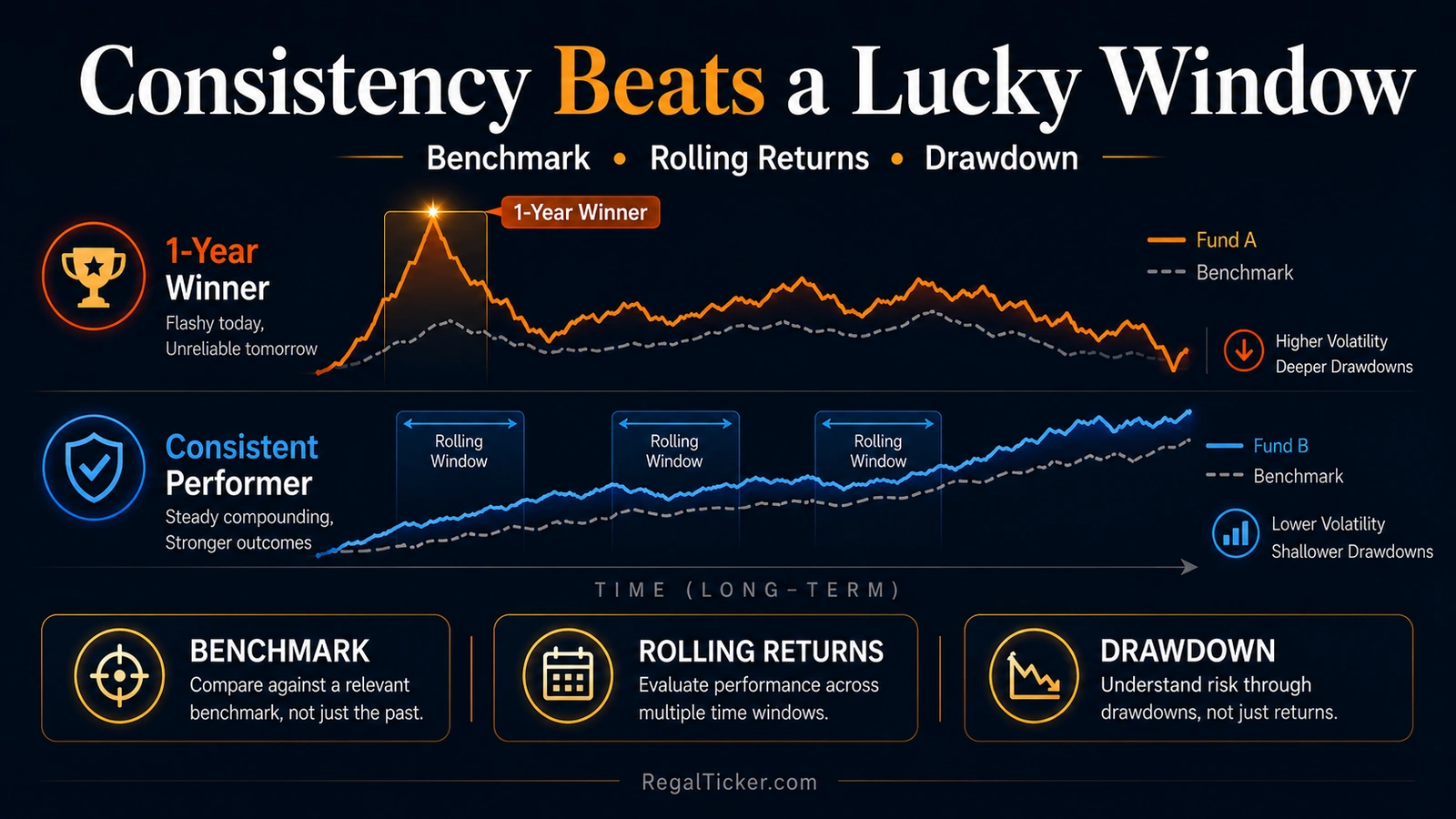
Check 6: Judge Consistency, Not Just Point-to-Point Returns
Point-to-point returns depend heavily on the start and end dates.
A five-year return measured today can look excellent because the starting date happened to be near a market low.
Change the start date by six months and the conclusion may change.
That is why rolling returns are useful.
📖 Definition
Rolling return
A rolling return measures performance repeatedly over many overlapping periods of the same length—for example, every possible five-year window—rather than using only one start date and one end date.
Rolling returns help answer:
How often did the fund outperform its benchmark? How wide was the range of outcomes? Was performance dependent on one exceptional period? How frequently did investors experience weak returns?
You do not need to become a quantitative analyst.
The purpose is to avoid choosing a fund because one convenient return window looks impressive.
💡 Did you know?
A fund can have an excellent five-year point-to-point return and still show poor consistency across many rolling five-year periods.
Check 7: Study Drawdowns and Downside Behaviour
Return tables show the destination.
Drawdowns show the journey.
📖 Definition
Drawdown
Drawdown is the decline from a previous portfolio peak to a subsequent low before recovery.
Two funds can produce similar long-term returns while giving investors very different experiences.
Fund A might fall 25% during a difficult market.
Fund B might fall 45%.
If those funds have similar mandates, that difference deserves investigation.
Why downside behaviour matters for real investors
The mathematical best fund is not useful if its volatility causes you to sell at the bottom.
This creates a behavioural reality:
The return you can stay invested for may matter more than the return you admire in a historical table.
Comparison should therefore include:
- maximum drawdown;
- recovery time;
- downside capture where available;
- volatility;
- consistency during weak markets.
Do not select solely on the lowest drawdown either. Lower risk often comes with different return potential.
The goal is to understand the trade-off.
Phase 3: Measure Cost and Passive-Fund Efficiency
Check 8: Check Expense Ratio—But Do Not Worship the Cheapest Fund
Expense ratio is one of the few investment variables known in advance.
Future returns are not.
That makes costs important.
The scheme’s NAV already reflects the expenses charged to the fund.
For the complete 2026 BER/TER framework, read Expense Ratio in Mutual Funds.
Compare costs within the same category and plan
A Nifty 50 index fund should be compared with other Nifty 50 tracking products.
A small-cap active fund should be compared with similar small-cap active funds.
Do not conclude that a liquid fund is “better” than a small-cap fund because its expense ratio is lower.
They have different jobs.
Costs matter especially for passive funds
Two passive funds tracking the same index start with a very similar investment objective.
That means differences in:
- expense ratio;
- tracking difference;
- tracking error;
- liquidity and implementation;
become especially important.
⭐ Pro tip
Cost is a strong tie-breaker when two funds offer essentially the same exposure. It is a weaker selection rule when the strategies are genuinely different.
Check 9: For Index Funds and ETFs, Check Tracking Quality
If an index fund is supposed to track the Nifty 50, the job is not to “beat” the Nifty 50 through active stock selection.
Its job is to replicate the index as closely as practical after costs.
SEBI’s investor education material describes tracking error as a measure of how much a portfolio’s return deviates from its benchmark.
📖 Definition
Tracking error
Tracking error measures the variability of the difference between the fund’s returns and its benchmark returns. Lower tracking error generally indicates more consistent tracking.
Also look at tracking difference—the actual return gap between the fund and its benchmark over a period.
For passive funds, ask:
Is the expense ratio competitive? Is tracking error controlled? What has the tracking difference been? Does the ETF have adequate trading liquidity, if using an ETF? Is the underlying index actually appropriate for my goal?
Caution
Do not select a thematic or sector index fund merely because it is “passive”. Passive describes how the portfolio follows an index; it does not mean the underlying index itself is diversified or low risk.
Phase 4: Inspect the Portfolio and Investment Process
Check 10: Read the Portfolio, Not Only the Fund Name
A mutual fund name can hide important portfolio differences.
Two flexi-cap funds can hold very different stocks.
Two debt funds can carry very different credit and maturity risks.
Two hybrid funds can use very different asset-allocation approaches.
Check the latest portfolio disclosure.
For equity funds, inspect
- top 10 holdings;
- sector concentration;
- market-cap mix;
- cash level;
- portfolio turnover;
- overlap with your other funds.
For debt funds, inspect
- credit quality;
- issuer concentration;
- maturity profile;
- duration;
- exposure to lower-rated instruments;
- liquidity characteristics.
For hybrid funds, inspect
- current equity/debt mix;
- hedged versus unhedged equity where relevant;
- rebalancing approach;
- asset-allocation range.
💡 Real example
Two funds with the same label can behave differently
Two flexi-cap funds can both satisfy the category rules while one holds a concentrated portfolio of 30 stocks and another holds a much broader portfolio. Their risk, style and performance behaviour can therefore differ materially even though the category name is identical.
Check 11: Check Portfolio Overlap Before Adding Another Fund
More mutual funds do not automatically mean more diversification.
If five funds own many of the same large stocks, you may simply be holding the same exposure through five wrappers.
Portfolio overlap becomes especially important when adding:
- multiple large-cap funds;
- multiple flexi-cap funds;
- active fund plus broad index fund;
- several thematic funds;
- multiple hybrid funds with similar equity books.
Ask:
What new exposure does this fund add?
If you cannot answer, the fund may be adding complexity rather than diversification.
The “collection” problem
Beginners often accumulate funds because:
- one was recommended by a friend;
- one topped a ranking;
- one had an NFO;
- one was suggested by a bank;
- one was purchased years ago and forgotten.
Eventually the portfolio becomes a mutual fund collection rather than a strategy.
A smaller number of clearly assigned funds is easier to monitor and rebalance.
Check 12: Review the Fund Manager and Investment Process
For active mutual funds, the fund manager and investment process matter.
But avoid celebrity-manager thinking.
A good selection process asks:
- How long has the current manager handled the scheme?
- Is there a repeatable investment philosophy?
- Has the portfolio style changed materially?
- Is performance dependent on one concentrated call?
- Does the AMC have a stable research and risk-management process?
- Has the scheme remained reasonably consistent with its stated mandate?
Manager change is not an automatic sell signal
A fund manager leaving does not instantly make a fund bad.
But it is a reason to monitor:
- portfolio changes;
- style changes;
- concentration;
- performance consistency;
- communication from the AMC.
For passive funds, manager skill is less central to stock selection, but operational execution and tracking quality remain important.
Phase 5: Choose the Right Implementation and Finalise the Decision
Check 13: Choose Direct vs Regular and Growth vs IDCW Deliberately
After selecting the scheme, two additional choices remain.
Direct vs Regular
Direct and Regular plans of the same scheme generally share the underlying portfolio, but Direct has a lower expense structure because distributor-related costs are excluded.
Read Direct vs Regular Mutual Funds before deciding.
Growth vs IDCW
Growth keeps value invested until you withdraw.
IDCW can distribute value when declared.
IDCW is not guaranteed income.
Read Growth vs IDCW Mutual Funds.
Scheme Selection
- Goal
- Category
- Risk
- Benchmark
- Portfolio
- Performance consistency
Plan & Option Selection
- Direct or Regular
- Growth or IDCW
- SIP or Lumpsum method
- Cash-flow requirement
- Do not mix these decisions.
- A good scheme can still be implemented through an unsuitable plan or option for your needs.
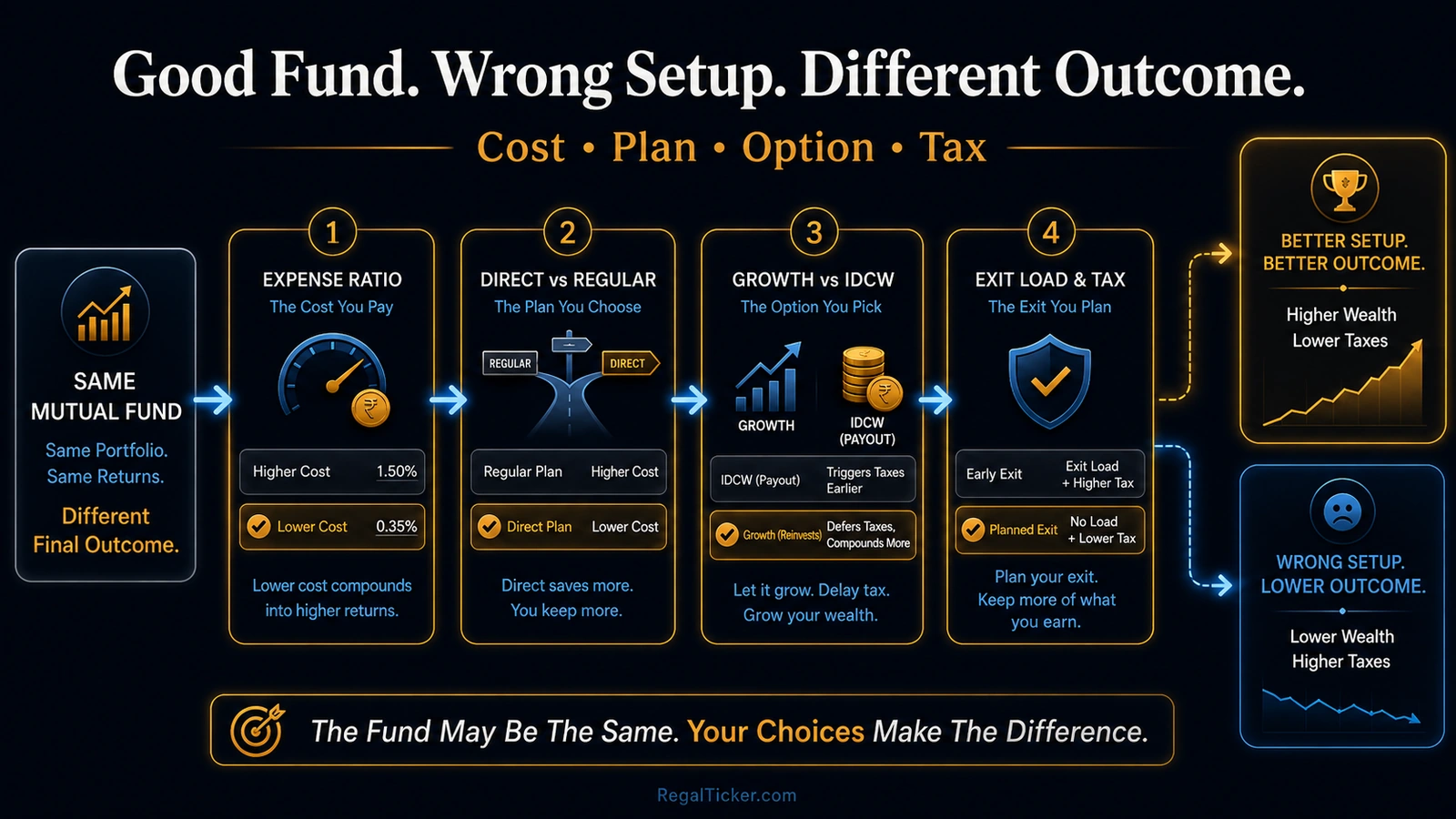
Check 14: Check Exit Load and Tax Before You Invest—Not Only When You Exit
Investors often investigate exit load and tax only when they want to redeem.
By then, the rules are already attached to the units you own.
Check them before investing.
Exit load
Understand:
- the load percentage;
- the holding period;
- whether SIP lots are tested separately;
- whether special redemption allowances exist.
Read Exit Load in Mutual Funds.
Tax
Tax can depend on:
- fund classification;
- acquisition date;
- holding period;
- listing status;
- transaction type;
- IDCW versus redemption;
- applicable capital-loss rules.
Read Mutual Fund Taxation in India 2026.
Do not let tax rescue a bad investment
Tax efficiency is useful.
But continuing to hold a fundamentally unsuitable fund only to avoid a tax bill can create a larger investment problem.
Evaluate the cost of changing versus the cost of staying.
Check 15: Use a Final Red-Flag Checklist Before Clicking Invest
A fund should survive one final filter.
RED FLAGS:
- I chose it because it was the top one-year performer.
- I cannot explain what category it belongs to.
- I do not know the Riskometer level.
- I have no defined goal for the investment.
- I may need the money much sooner than the fund’s risk allows.
- I am comparing its return with an inappropriate benchmark.
- I have not checked the current portfolio.
- I am adding it even though I already own several overlapping funds.
- I selected Regular because I did not notice the plan label.
- I selected IDCW because I thought it guaranteed income.
- I have not checked expense ratio.
- I have not checked exit load.
- I do not understand the tax category.
- I am relying on an NFO price of ₹10 as evidence that the fund is cheap.
- I would panic and sell if the category experienced a normal severe drawdown.
If several of these statements are true, pause before investing.
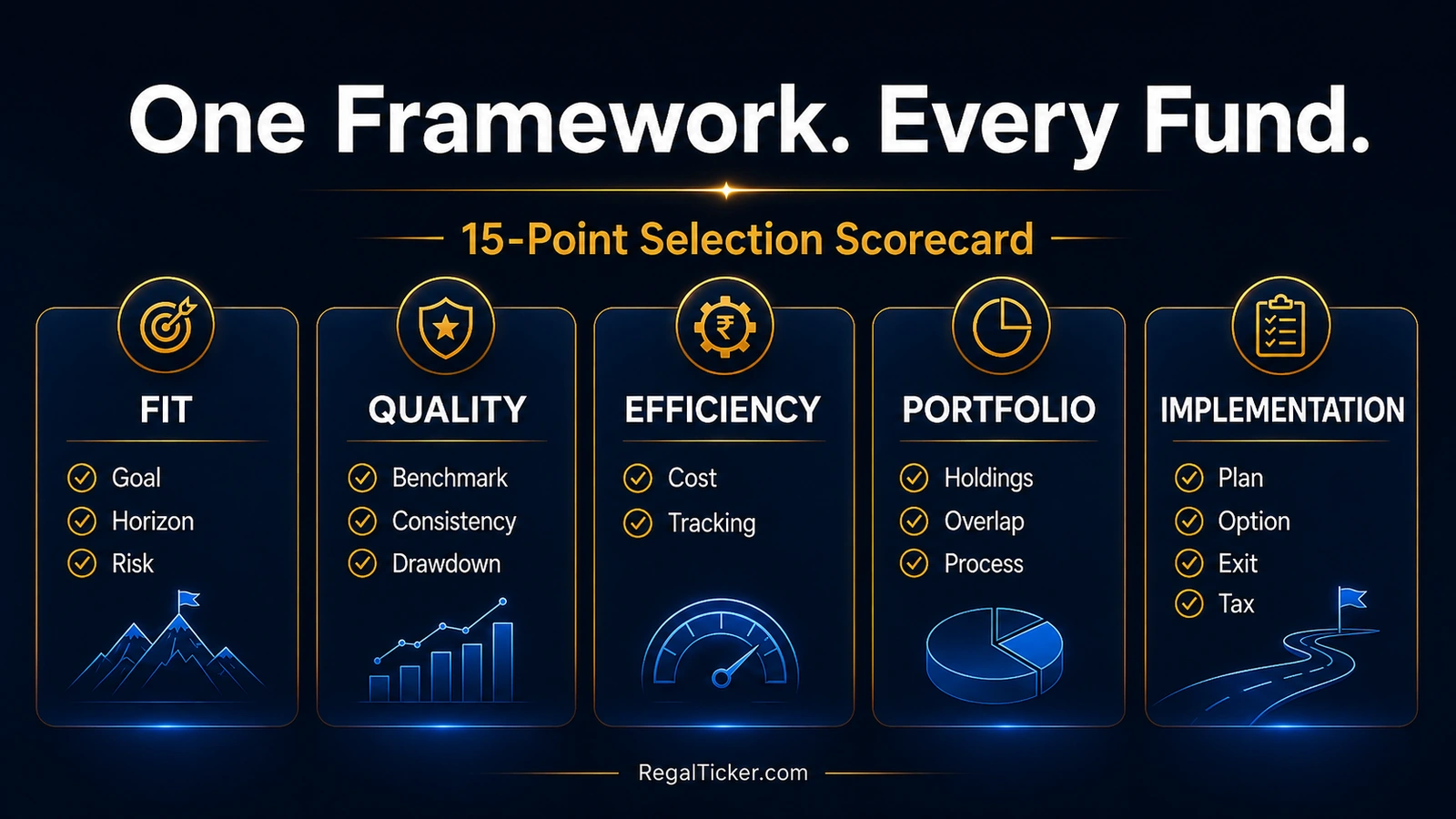
The RegalTicker 15-Point Mutual Fund Selection Scorecard
Use this scorecard for every fund you consider.
| Check | Question | Pass Condition |
|---|---|---|
| 1. Goal | What exact goal is this fund serving? | Goal and target date are written down |
| 2. Horizon | Can the money stay invested long enough? | Horizon matches the category’s normal risk |
| 3. Category | Is this the right category for the job? | Category selected before scheme |
| 4. Riskometer | Can I survive the current risk level? | Risk fits both tolerance and capacity |
| 5. Benchmark | Am I using the correct benchmark? | Appropriate benchmark identified |
| 6. Consistency | Is performance repeatable across periods? | Not dependent on one return window |
| 7. Drawdown | Do I understand bad-period behaviour? | Potential losses are survivable |
| 8. Cost | Is current expense competitive? | Cost reasonable versus similar funds |
| 9. Passive tracking | If passive, does it track efficiently? | Competitive tracking error/difference |
| 10. Portfolio | Do I understand what the fund owns? | Concentration and exposures are acceptable |
| 11. Overlap | Does it add something useful? | Limited unnecessary duplication |
| 12. Manager/process | Is the process credible and consistent? | Mandate and philosophy remain understandable |
| 13. Plan/option | Direct/Regular and Growth/IDCW chosen deliberately? | Choice matches service and cash-flow needs |
| 14. Exit/tax | Do I know the exit and tax consequences? | No major surprise at redemption |
| 15. Simplicity | Can I explain why I own this fund? | One-sentence role in portfolio is clear |
Common Mutual Fund Selection Decisions
What Metrics Should Beginners Actually Use?
Many mutual fund websites display:
- alpha;
- beta;
- standard deviation;
- Sharpe ratio;
- Sortino ratio;
- information ratio;
- capture ratios;
- R-squared.
These can be useful.
But beginners often make a new mistake: replacing return chasing with ratio chasing.
A higher Sharpe ratio does not automatically mean “buy”.
A higher alpha does not guarantee future alpha.
Beta can change.
Metrics are historical descriptions.
Use them to investigate behaviour, not to outsource the decision.
A practical beginner hierarchy
Start with:
- Goal
- Horizon
- Category
- Riskometer
- Benchmark
- Consistency
- Drawdown
- Cost
- Portfolio
- Plan/option
- Tax and exit
Only then use advanced ratios to deepen the comparison.
This order prevents precision from replacing relevance.
Should Beginners Choose Active or Passive Mutual Funds?
There is no universal answer.
Passive funds can offer
- transparent benchmark exposure;
- generally lower costs;
- less dependence on manager stock-selection skill;
- easier comparison among funds tracking the same index.
Active funds can offer
- discretionary security selection;
- differentiated portfolios;
- potential benchmark outperformance;
- tactical positioning within the mandate.
But potential outperformance is not guaranteed.
The investor should ask:
Do I have a strong reason to expect the active approach to justify its higher cost and complexity?
For a broad core allocation, many beginners value the simplicity of a broad-market passive fund.
For other roles, an active strategy may be considered after proper comparison.
Passive funds are always low risk.
A passive fund inherits the risk of the index it tracks. A passive small-cap or sector index can still carry very high market risk.
SIP Does Not Fix a Bad Fund Choice
SIP is an investment method.
It does not transform an unsuitable mutual fund into a suitable one.
A SIP can:
- automate contributions;
- spread purchase dates;
- reduce timing dependence;
- support disciplined saving.
It cannot:
- remove market risk;
- guarantee profit;
- repair the wrong category;
- make a concentrated thematic fund diversified;
- eliminate tax;
- ensure the fund beats its benchmark.
Choose the fund first.
Then decide whether SIP or Lumpsum is appropriate for deploying the money.
Use the SIP Calculator and Goal SIP Calculator for planning.
How Many Mutual Funds Should a Beginner Own?
There is no magic number.
The correct number is the smallest number needed to perform the portfolio’s required jobs without unnecessary duplication.
A beginner portfolio might need:
- one core equity exposure;
- perhaps another differentiated allocation if there is a clear reason;
- an appropriate debt allocation according to the goal;
- other assets only where they have a defined role.
The wrong question is:
“Is five funds too many?”
The better question is:
“What unique job does each fund perform?”
Five funds with five clear jobs may be understandable.
Three funds with nearly identical portfolios may already be redundant.
⭐ Pro tip
Write one sentence beside every fund in your portfolio: “I own this fund because __.” If two funds have the same sentence, investigate overlap.
When Should You Replace a Mutual Fund?
Do not replace a fund simply because:
- another fund performed better last year;
- a ranking changed;
- the market fell;
- the fund had a weak quarter;
- a social-media account suggested a new scheme.
Reasons worth reviewing include:
- the fund no longer matches your goal;
- material mandate or strategy change;
- persistent style drift;
- sustained benchmark-relative weakness across appropriate periods;
- unacceptable increase in risk;
- manager/process change that materially alters the thesis;
- costs become uncompetitive for equivalent exposure;
- portfolio overlap makes the fund redundant;
- your asset-allocation needs changed.
Review is not the same as churn
A good review asks:
“Has the reason I bought this fund changed?”
It does not ask:
“Which fund is ranked number one today?”
Excessive switching can create:
- taxes;
- exit loads;
- lost compounding;
- behavioural mistakes;
- a constantly changing portfolio with no stable strategy.
A Step-by-Step Mutual Fund Selection Workflow
1
Write the goal
Amount, purpose and date
2
Set the horizon
When can this money realistically be needed?
3
Assess risk capacity
What loss can the plan survive?
4
Select category
Choose the investment universe
5
Check Riskometer
Confirm scheme risk
6
Compare benchmark
Use an appropriate reference
7
Test consistency
Rolling periods and market cycles
8
Inspect downside
Drawdown and recovery behaviour
9
Compare costs
Expense ratio and passive tracking
10
Read portfolio
Holdings, sectors, credit, duration and concentration
Tools to Use Before Choosing a Mutual Fund
RegalTicker calculators can help with the planning side of the decision.
Use:
- Goal SIP Calculator — estimate the SIP required for a target.
- SIP Calculator — model regular investing assumptions.
- Lumpsum Calculator — model one-time investment scenarios.
- CAGR Calculator — calculate annualised point-to-point growth.
- XIRR Calculator — measure return across dated cash flows.
- SWP Calculator — model withdrawals.
- Capital Gains Tax Calculator — estimate tax scenarios.
CALCULATOR NOTE: A calculator can model the amount required for a goal, but it cannot decide whether a specific mutual fund is suitable. Fund selection still requires risk, category, portfolio and cost analysis.
Frequently asked questions
What is the first thing to check before choosing a mutual fund?
Define the financial goal and time horizon. The right fund depends on what the money is for and when it will be needed.
Should I choose the mutual fund with the highest return?
No. Recent return alone does not show suitability, risk, consistency, portfolio quality or whether the fund fits your goal.
How do beginners choose the right mutual fund category?
Start with the goal, time horizon and risk capacity, then research the category whose mandate fits that job. Only after that should you compare individual schemes.
What is the SEBI Riskometer?
The Riskometer is a standardised risk indicator required for mutual fund schemes. It helps investors understand the scheme’s assessed risk level, from Low through Very High.
Can a mutual fund’s Riskometer change?
Yes. The risk level is reviewed and can change as portfolio characteristics and market conditions change.
What benchmark should I use to compare a mutual fund?
Use the benchmark stated for the scheme and ensure it appropriately represents the fund’s mandate. Comparing unrelated categories or benchmarks can be misleading.
Are five-year returns enough to select a fund?
No. Point-to-point returns can depend heavily on start and end dates. Review consistency, rolling periods, drawdowns and benchmark-relative performance as well.
What are rolling returns?
Rolling returns measure many overlapping return periods of the same length, helping investors see how consistent a fund’s outcomes were across different starting dates.
What is drawdown?
Drawdown is the decline from a portfolio’s previous peak to a later low. It helps investors understand downside severity and recovery experience.
Is lower expense ratio always better?
Lower cost is beneficial, but it should be compared among funds with similar mandates. The cheapest fund is not automatically the best if the strategy, risk or implementation differs.
What should I check in an index fund?
Check the underlying index, expense ratio, tracking error, tracking difference and—in ETFs—trading liquidity and market-price behaviour.
What is tracking error?
Tracking error measures how consistently a fund’s returns differ from its benchmark. For a passive fund, lower tracking error generally indicates closer tracking.
Should I check a mutual fund’s portfolio?
Yes. Portfolio holdings can reveal concentration, sector exposure, market-cap mix, credit quality, duration and overlap with other funds you own.
Is it bad to own many mutual funds?
Not automatically, but many funds can create unnecessary overlap and complexity. Every fund should have a clear, distinct role.
How do I know if two mutual funds overlap?
Compare their top holdings, sector exposures and broader portfolio disclosures. If they own many of the same securities in similar weights, diversification may be lower than it appears.
Should beginners choose Direct or Regular mutual funds?
Direct has lower distribution-related costs, while Regular can include distributor support or service. Choose deliberately according to whether you need and value that service.
Is Growth better than IDCW for beginners?
Growth is generally simpler for investors accumulating wealth who do not need fund-declared cash distributions. IDCW has different cash-flow and tax implications and is not guaranteed income.
Should I check exit load before investing?
Yes. Exit load can affect short-horizon redemptions and SIP lots, so understand the rule before buying.
Should tax determine which mutual fund I choose?
Tax matters, but it should not override investment suitability. Choose an appropriate fund first, then understand the tax consequences of the structure and holding period.
Does SIP make every mutual fund safe?
No. SIP is a contribution method. It does not remove the underlying market, credit, concentration or category risk of the mutual fund.
Should I invest in an NFO because the NAV is ₹10?
No. A ₹10 NFO NAV does not make a new fund cheaper than an existing fund with a higher NAV. Evaluate the mandate, portfolio opportunity, costs and need for the fund.
How often should I review mutual funds?
Review periodically and when your goal, fund mandate, manager/process, cost or portfolio role changes. Avoid frequent switching based only on short-term rankings.
When should I replace a mutual fund?
Consider replacement when the original investment thesis no longer holds—for example, persistent mandate/style issues, redundancy, unsuitable risk, sustained appropriate-benchmark weakness or changed financial goals.
What is the simplest mutual fund selection rule?
Choose a fund only if you can clearly state the goal it serves, why its category is suitable, what risk it carries and why it is preferable to comparable alternatives.
🎯 Quiz yourself
What should come before choosing an individual mutual fund scheme?
The financial goal, time horizon, risk assessment and category selection.
Does the highest one-year return identify the best mutual fund?
No. It shows only one historical performance period and does not establish suitability or future performance.
Can a Very High Risk mutual fund still be appropriate?
Yes, for an investor and goal able to tolerate that level of risk. The label is a risk warning, not a quality rating.
Why are rolling returns useful?
They show performance across many starting dates rather than relying on one point-to-point period.
What is the key extra check for an index fund?
Tracking quality, including tracking error and tracking difference, in addition to cost and the underlying index.
Why can owning many mutual funds fail to diversify?
Multiple funds can hold many of the same securities and create portfolio overlap.
Is Direct vs Regular the same decision as choosing the fund category?
No. Category and scheme selection come first; Direct/Regular determines how the scheme is accessed and its cost structure.
Is IDCW guaranteed income?
No.
Should tax and exit load be checked only when you redeem?
No. Understand them before investing so the consequences are not a surprise.
What is the final one-sentence test?
“I own this fund because __.” If you cannot complete the sentence clearly, investigate further.
Final Summary
Choosing a mutual fund is not a search for the fund with the biggest return number.
It is a matching exercise.
Match:
- the investment to the goal;
- the category to the time horizon;
- the risk to your capacity for loss;
- the fund to the right benchmark;
- the performance to consistency;
- the cost to comparable alternatives;
- the portfolio to the exposure you actually need;
- the plan and option to the way you want to invest;
- the exit and tax rules to your likely behaviour.
The most important selection rule is simple:
Do not buy a mutual fund you do not understand for a goal you have not defined.
Once the goal and category are correct, fund comparison becomes much easier.
The final checklist is not designed to identify one universally “best” scheme.
It is designed to stop you from buying the wrong scheme for the wrong reason.
Verify through official sources
Official references
Educational disclaimer: This article is for education and general information only. It is not investment, tax, legal or financial advice and does not recommend any particular mutual fund scheme. Mutual fund investments are subject to market risks. Scheme risk, portfolio, expense ratio, benchmark, fund manager, tax treatment and other factors can change. Read the current Scheme Information Document, Key Information Memorandum, factsheet, Riskometer and official disclosures before investing. Consider consulting a SEBI-registered investment adviser if you need personalised advice.