

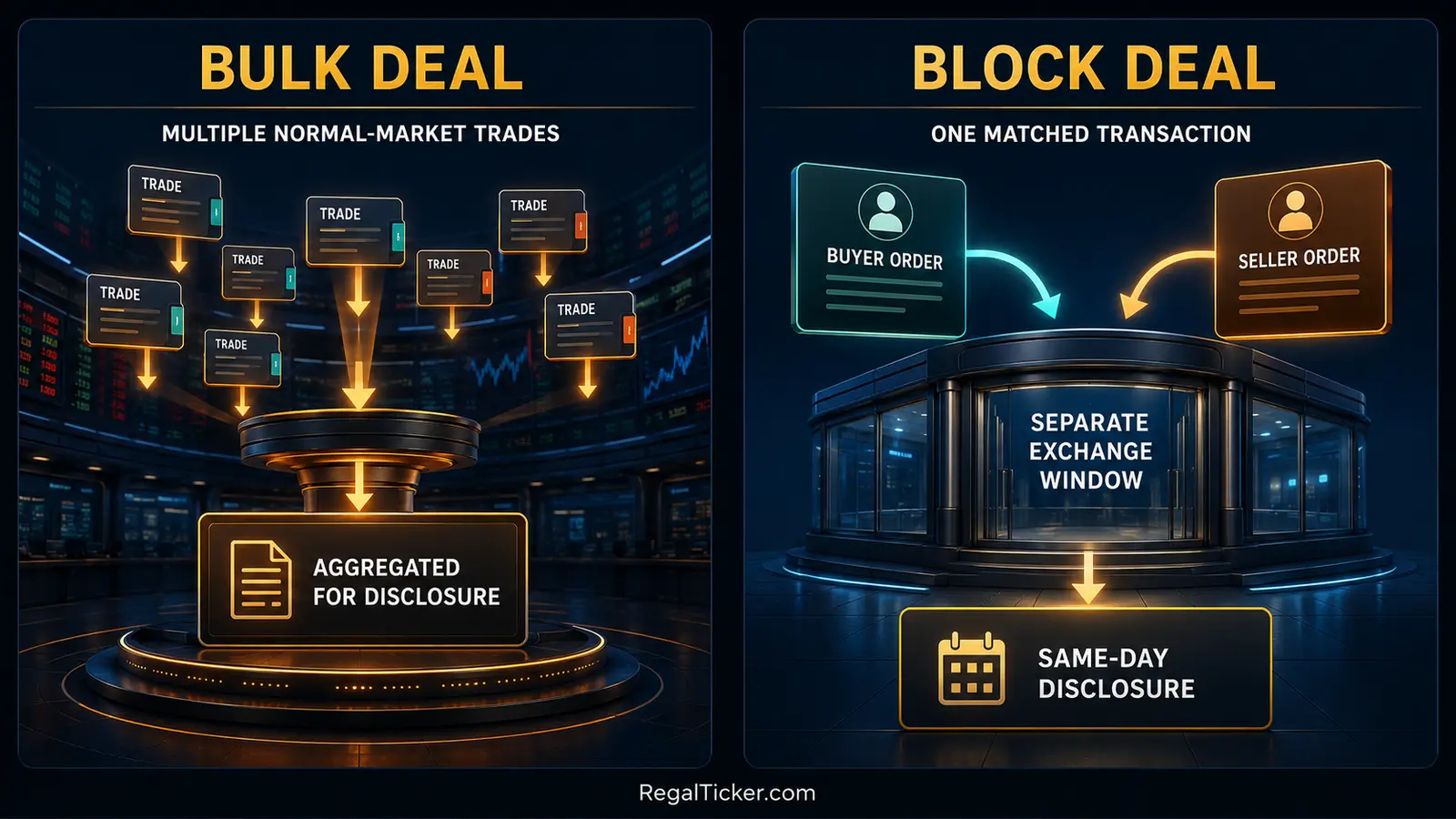
Bulk deal vs block deal is a comparison of two different ways in which large share transactions become visible to the market. A bulk deal is identified when one client’s aggregate purchases or aggregate sales in a listed company during a trading day cross the prescribed shareholding threshold. Those trades can occur through the normal market in several separate executions. A block deal, by contrast, is a single large transaction placed through a separate exchange window under special order-size, time and price-range rules.
The distinction matters because financial headlines often treat every large disclosed trade as the same event. It is not. A bulk deal can be built through many normal-market trades at different prices. A block deal requires a matching buyer and seller for one eligible large order in the special window. Both improve transparency, but neither tells an investor why the parties traded, whether they still hold other shares, whether they are hedged, or what the stock is worth.
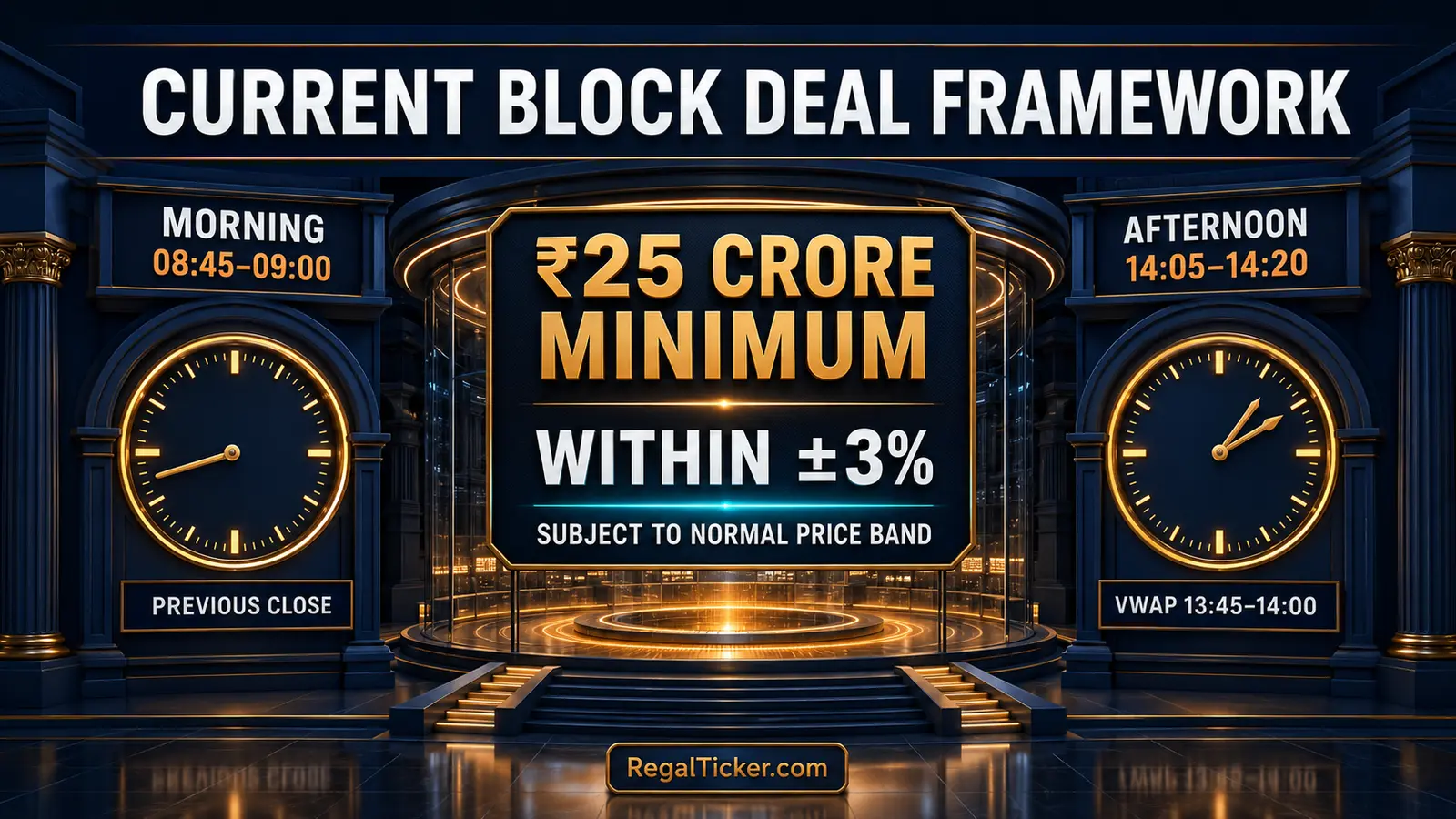
Current rules are especially important. Older web pages may still state that the block-deal minimum is ₹10 crore and the permitted price range is ±1%. Those values became outdated when the revised framework took effect on 8 December 2025. Under the current framework, the minimum block-deal order size is ₹25 crore, while orders are generally permitted within ±3% of the applicable reference price, subject to surveillance measures and the security’s normal price band.
This sixth lesson in the Market Terminology learning hub follows Stock Market Terminology: 50 Essential Terms, Face Value, Book Value and Market Value, Absolute Return vs CAGR vs XIRR, 52 Week High and Low and Upper Circuit and Lower Circuit. It focuses narrowly on large-deal classification, current exchange rules, disclosures and responsible interpretation.
Bulk Deal vs Block Deal: Quick Difference
The simplest answer is that bulk refers to the aggregate quantity traded by one client during the day, while block refers to the structure of one large transaction executed through a special exchange window.
| Point | Bulk deal | Block deal |
|---|---|---|
| Core test | Client’s aggregate buy or aggregate sell quantity crosses the prescribed percentage of listed equity shares | One eligible large transaction meets the minimum value and special-window rules |
| Current key threshold | More than 0.5% of the company’s listed equity shares during the day | Minimum order size of ₹25 crore from 8 December 2025 |
| Where it trades | Normal market | Separate block-deal window |
| Number of executions | Can be several trades during the day | One matched transaction; price and quantity must match |
| Price rule | Normal-market price discovery and applicable bands | Generally within ±3% of the reference price, subject to the normal price band and surveillance rules |
| Main reference | Number of listed equity shares | Previous close in the morning; specified VWAP in the afternoon |
| Disclosure | Qualifying client-level activity is reported after the market | Scrip, client, quantity and price are disseminated on the same day after market hours |
| Investor conclusion | Evidence of unusually large client activity | Evidence of one large negotiated-style exchange transaction |
Large Trade Does Not Mean Automatic Signal
A disclosed purchase is not automatically a buy signal. A fund may be rebalancing, a promoter may be transferring or reducing a stake, an early investor may be exiting, or two institutions may have different mandates. The buyer can be correct, wrong, hedged or simply operating under a time constraint.
Similarly, a disclosed sale is not automatically bearish. It may fund another investment, meet redemption requests, satisfy ownership limits, reduce concentration or complete a planned exit. The disclosure records the transaction; it does not publish the party’s full reasoning.
Read Who Participates in the Stock Market? to understand why retail investors, mutual funds, foreign investors, promoters, market makers and other institutions can act under very different objectives.
Deal Value Is Not Company Value
If a block transaction is worth ₹300 crore, that number is the consideration for the shares transferred. It is not the company’s market capitalisation, enterprise value, book value or intrinsic value. Read What Is Market Capitalisation? and Face Value, Book Value and Market Value before interpreting a large deal as a valuation conclusion.
Use the Stock Return Calculator to measure an actual investor’s holding return and the Brokerage Calculator to estimate transaction charges. Neither tool should treat a reported deal value as the return earned by ordinary shareholders.
What Is a Bulk Deal?
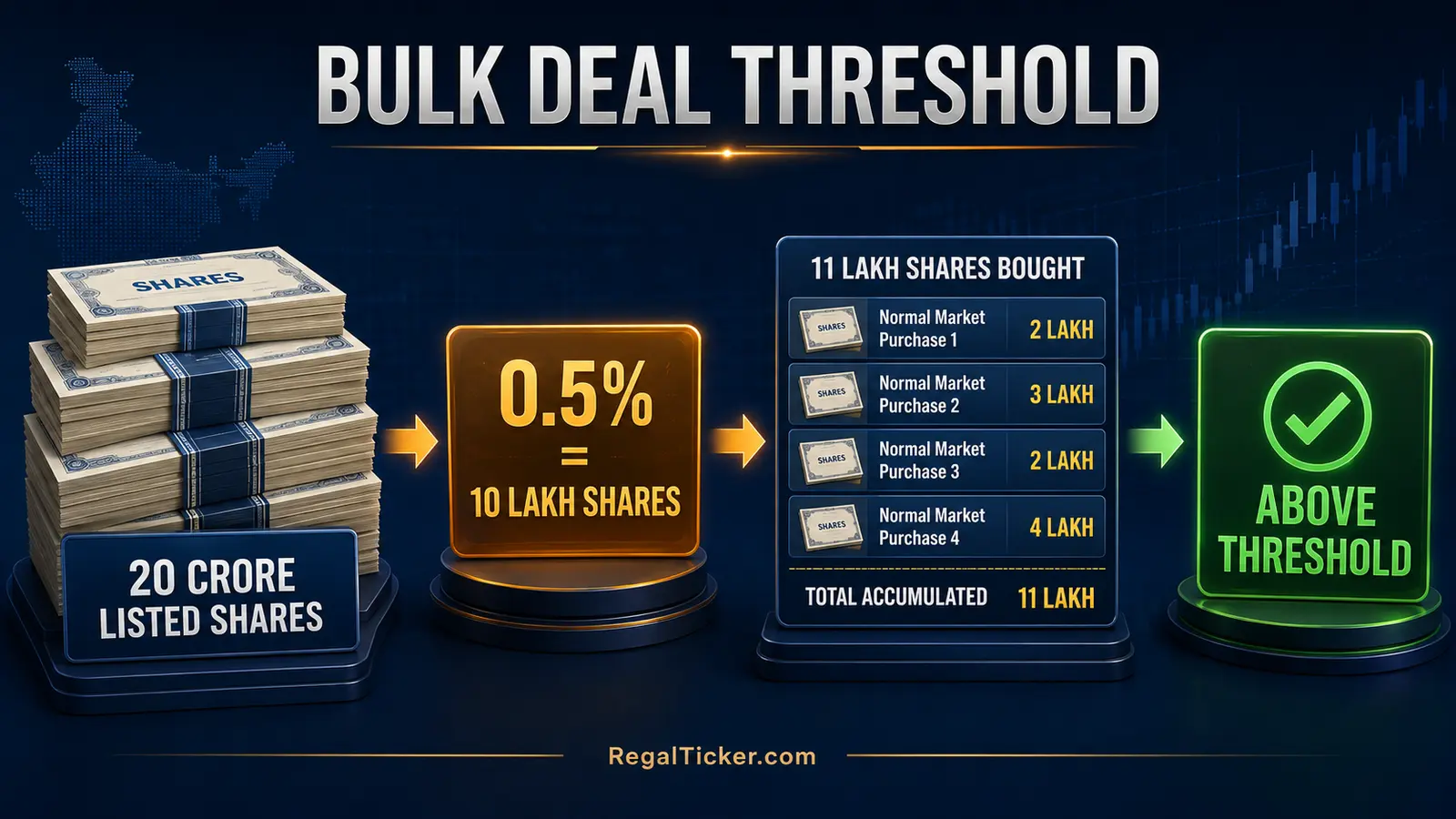
A bulk deal is a transaction or group of transactions in which the total quantity bought or sold by a client in a company during one trading day is more than 0.5% of the number of equity shares of that company listed on the stock exchange. The threshold is quantity-based, not rupee-value-based.
This means a relatively modest rupee trade can qualify in a small company with fewer listed shares, while a much larger rupee trade may fail to qualify in a company with an enormous equity base. The denominator is the number of listed equity shares, so investors must not substitute market capitalisation, public float or daily volume.
The official BSE bulk-deal page describes the 0.5% threshold and the purpose of transparent reporting. NSE provides a searchable bulk and block deal archive for the reported records.
Bulk Deal Formula
Use this educational formula:
Bulk-deal threshold quantity = Listed equity shares × 0.5%
Because the definition uses more than 0.5%, merely reaching exactly 0.5% is not the same as exceeding the threshold.
Suppose a fictional company has 20 crore listed equity shares.
0.5% threshold = 20 crore × 0.005 = 10 lakh shares
Assume one client buys shares through four normal-market executions:
| Execution | Quantity bought |
|---|---|
| Purchase 1 | 2 lakh shares |
| Purchase 2 | 3 lakh shares |
| Purchase 3 | 2 lakh shares |
| Purchase 4 | 4 lakh shares |
| Aggregate purchase | 11 lakh shares |
The client’s aggregate purchase of 11 lakh shares is 0.55% of 20 crore listed shares, so it is above the 0.5% threshold.
Purchases and Sales Are Aggregated Separately
The important word is aggregate. A client does not avoid bulk-deal reporting merely because the activity was divided into several smaller executions. The exchange and broker reporting process considers the client’s qualifying activity across the day under the applicable framework.
Do not calculate the threshold from only one trade ticket. Also do not net purchases against sales and assume the remaining quantity alone answers the reporting question. Bulk-deal reporting examines the applicable client-level buy and sell activity under exchange rules.
A Bulk Deal Is Not a Special Order Type
Retail investors cannot select “bulk deal” from a normal order-entry list as if it were a market, limit or stop-loss order. The term describes the scale of the client’s completed normal-market activity and the resulting disclosure obligation.
For order mechanics, use the existing Market Order, Limit Order, Stop-Loss and Stop-Limit lesson. For bid, ask, spread and market depth, read Bid Price, Ask Price, Spread and Order Book. Those concepts determine how ordinary orders seek execution; bulk-deal classification is applied after the relevant quantity is traded.
Worked Bulk-Deal Percentage
If a client buys 12 lakh shares in a company with 20 crore listed shares:
Percentage bought = 12 lakh ÷ 20 crore × 100 = 0.60%
The activity is above 0.5%. If the average purchase price is ₹240, the approximate gross transaction value is:
12,00,000 × ₹240 = ₹28.8 crore
The ₹28.8 crore value is informative, but it is not the classification test. The 0.60% quantity is what makes the example a bulk deal.
After confirmed purchases, the Stock Average Calculator can combine multiple executed quantities and prices. Use the Brokerage Calculator for estimated charges. Do not include pending or cancelled orders as completed purchases.
What Is a Block Deal Under Current Rules?
A block deal is one large transaction executed through a separate exchange window so that a substantial buyer and seller can match the same eligible quantity and price under the prescribed framework. It is not executed invisibly outside regulation: the trade occurs through the exchange mechanism and specified information is disseminated to the public after market hours.
SEBI revised the framework through its 8 October 2025 circular. NSE then issued its 20 November 2025 implementation circular, making the revised order size and price range effective from 8 December 2025.
Current Minimum Order Size: ₹25 Crore
The current minimum order size for a block-deal transaction is ₹25 crore. This is a value test for one block order, unlike the bulk-deal test, which is based on more than 0.5% of listed equity shares accumulated during the day.
Suppose the intended block price is ₹500 per share.
Minimum indicative quantity = ₹25 crore ÷ ₹500 = 5,00,000 shares
If the price is ₹1,000, a ₹25 crore block corresponds to 2,50,000 shares. The required number of shares therefore changes with the transaction price even though the minimum order value remains ₹25 crore.
Current Price Range: Generally ±3%
The revised rule permits orders generally within ±3% of the applicable reference price, subject to surveillance measures and the security’s normal-market price band.
Suppose the applicable reference price is ₹500.
Indicative lower block range = ₹500 × 0.97 = ₹485
Indicative upper block range = ₹500 × 1.03 = ₹515
However, if the security’s normal price band permits only ±2%, the block window cannot expand that security to ±3%. In that example, the operative range would remain constrained by the narrower normal-market band. The official live range must therefore override a manual calculation.
Morning and Afternoon Block Windows
The current framework retains two 15-minute windows:
- Morning window: 08:45 AM to 09:00 AM. The reference is the previous day’s closing price or the applicable adjusted/base price.
- Afternoon window: 02:05 PM to 02:20 PM. The reference is the volume-weighted average market price of cash-market trades from 01:45 PM to 02:00 PM, with the exchange calculating and disseminating the applicable figure between 02:00 PM and 02:05 PM.
NSE’s live block-deal market page identifies the dedicated session. Always use the current exchange display and circulars because operational rules can change.
Exact Match, Delivery and Disclosure
Under the NSE block-deal mechanism, the buyer and seller orders must match in price and quantity. Older NSE operational FAQs explain that block orders are limit orders, partial matching is not permitted, and unmatched orders are cancelled when the session ends. The latest NSE circular changed the minimum value and permitted range while stating that other provisions remained unchanged.
Every executed block transaction must result in delivery and cannot be squared off or reversed in the same session. Exchanges disseminate details such as the scrip, client name, quantity and traded price to the public on the same day after market hours.
Settlement and charges follow the applicable exchange and clearing framework. The Brokerage Calculator can estimate ordinary transaction charges from user-provided assumptions, but it does not reproduce institutional contracts, negotiated brokerage arrangements or every exchange-specific scenario.
Bulk Deal vs Block Deal: Transaction Flow and Comparison
The two events can involve similar rupee values yet follow very different paths.
Bulk-Deal Flow
- A client places ordinary eligible orders in the normal market.
- Orders execute against available counterparties, potentially at several prices and times.
- The client’s aggregate purchase or aggregate sale quantity is measured against listed equity shares.
- If the applicable quantity crosses more than 0.5%, the activity qualifies for bulk-deal reporting.
- The exchange publishes the reported information after market hours.
Block-Deal Flow
- A buyer and seller intend to transfer one eligible large block.
- Each side enters a compatible limit order in the dedicated block window.
- The price must remain within the exchange’s current permitted range.
- Price and quantity must match under the block mechanism.
- The resulting trade is delivered and disclosed under the applicable rules.
One Transaction Can Be Both Large and Meaningful Without Being Both Types
A ₹40 crore normal-market purchase is not automatically a block deal because it did not necessarily use the dedicated block window. It becomes a bulk deal only if the client’s quantity crosses the relevant 0.5% threshold.
Conversely, a ₹25 crore block transaction can qualify as a block deal even if the quantity represents far less than 0.5% of a very large company’s listed shares. The block label comes from the special-window transaction and current minimum value, not from the percentage threshold used for bulk reporting.
Bulk Deal, Block Deal and Insider Trade Are Not Synonyms
A public disclosure naming a promoter, director, institutional investor or large shareholder does not by itself prove insider trading. Insider-trading rules concern possession and use of unpublished price-sensitive information, communication restrictions, trading-window controls and specified exemptions or defences. A large disclosed trade is evidence of a trade, not evidence of illegality.
Do not convert suspicion into accusation. Use official company filings, exchange records and SEBI orders. If a regulatory breach is alleged, rely on the regulator’s published action rather than social-media interpretation.
Bulk or Block Deal Is Not an Open Offer
An open offer is governed by takeover regulations and gives eligible public shareholders an opportunity to tender shares under specified terms. A bulk or block deal transfers shares between market counterparties; it does not automatically create an offer to every shareholder.
Likewise, a tender buyback, rights issue, bonus issue, split or demerger follows its own corporate-action framework. Use the dedicated Corporate Actions learning hub rather than treating every large ownership change as one event type.
How to Read an Exchange Deal Disclosure
The official record is more useful than a headline because it separates the facts the exchange reports from assumptions added later.
Deal Type and Date
First confirm whether the record is identified as bulk or block. Then verify the trade date. A news article published the next morning may discuss the previous session’s disclosure, while the live market may already be reacting to new information.
Use NSE’s bulk and block deal archive rather than relying on a screenshot without a date or source.
Buyer, Seller and Client Name
Identify both sides where available. A headline that mentions only a prominent buyer may omit an equally important seller. The economic interpretation differs if a promoter sold to a long-only fund, one fund transferred to another, or an investor merely reduced a small portion of a much larger holding.
A recognisable name does not guarantee future performance. Institutions have different mandates, time horizons, liquidity needs and portfolio constraints. Some also hedge risk elsewhere, which the cash-market disclosure may not show.
Quantity and Percentage of Equity
Convert the disclosed quantity into a percentage of listed equity shares when the denominator is known:
Deal percentage = Shares traded ÷ Listed equity shares × 100
Then distinguish this result from the buyer’s resulting total holding. A client that buys 0.6% today may already own 4%, may be starting from zero or may have sold shares earlier. The deal percentage and post-deal ownership are different facts.
Corporate actions can change the share-count denominator. Use the Bonus Share Calculator for a declared bonus ratio and the Stock Split Calculator for split-adjusted share counts. For return comparison across either event, use the Bonus & Split Adjusted Return Calculator.
Deal Price Versus Market Price
Compare the disclosed price with the appropriate market reference at that time, not with a random later close. For a block deal, the permitted range is built around the specified morning or afternoon reference. A discount or premium inside that range can reflect size, timing, liquidity and the parties’ objectives.
Calculate carefully:
Price difference percentage = (Deal price − Reference price) ÷ Reference price × 100
If the reference is ₹500 and the deal is ₹490:
Difference = (₹490 − ₹500) ÷ ₹500 × 100 = −2%
That is a 2% discount to the selected reference. It is not proof that the company is 2% undervalued or that the next traded price must fall to ₹490.
Resulting Holding and Future Disclosures
One transaction rarely reveals the complete ownership story. Check subsequent shareholding patterns, promoter disclosures, substantial-acquisition filings and company announcements where applicable. A buyer may continue accumulating, stop, transfer internally or later sell.
The Stock Average Calculator can model a weighted cost only when you know the quantities and prices for the holding being analysed. It cannot infer an institution’s undisclosed historical cost or remaining position.
What Large Deals Can and Cannot Tell Investors
Large-deal data is useful, but only within defined limits.
What the Disclosure Can Confirm
It can confirm that a named client bought or sold a stated quantity at a stated price under the reported classification. A block disclosure can also confirm that the transaction met the special-window mechanism. The record can help investors study ownership movement, liquidity, unusual volume and the timing of a large transfer.
Read Trading Volume in Stock Market to compare a deal with the stock’s normal activity. A large trade in an illiquid small company can be proportionally more important than a larger rupee trade in a highly liquid company.
What It Cannot Confirm
The disclosure normally cannot confirm:
- the complete investment thesis of either party;
- the buyer’s intended holding period;
- the seller’s reason for exiting or reducing;
- undisclosed hedges or related positions;
- whether another trade will follow;
- whether the company is undervalued or overvalued;
- the next day’s price direction;
- whether a retail investor should copy the trade.
This is why “big investor bought” is incomplete analysis. Size creates attention, not certainty.
Possible Short-Term Price Effects
A large deal may influence sentiment, turnover and available float. A block transaction can transfer a meaningful quantity without forcing the entire order through the visible normal-market order book. After disclosure, other participants may reprice the stock based on the counterparties, price and perceived information.
However, the price can rise, fall or remain stable. If the market expected the sale, the event may already be reflected. If the seller’s exit removes a known overhang, sentiment can improve. If the buyer paid a discount, headlines may focus on weakness even when the transfer has little effect on business value.
Read How Are Share Prices Decided? for the broader interaction of orders, information and expectations. Use 52 Week High and Low only as historical range context, not as a prediction.
Long-Term Value Still Comes From the Business
Over longer periods, revenue quality, profitability, cash flow, balance-sheet strength, capital allocation and valuation matter more than a single disclosed trade. Use the Fundamental Analysis learning hub for that work.
If a dividend contributes to return, use the Dividend Calculator. Measure holding return with the Stock Return Calculator, annualise a simple start-to-end investment with the CAGR Calculator, and use the XIRR Calculator when dated cash flows are irregular. A deal headline cannot replace these investor-specific calculations.
Seven Checks Before Acting on a Bulk or Block Deal
The correct response to a large-deal headline is a repeatable investigation, not an immediate order.
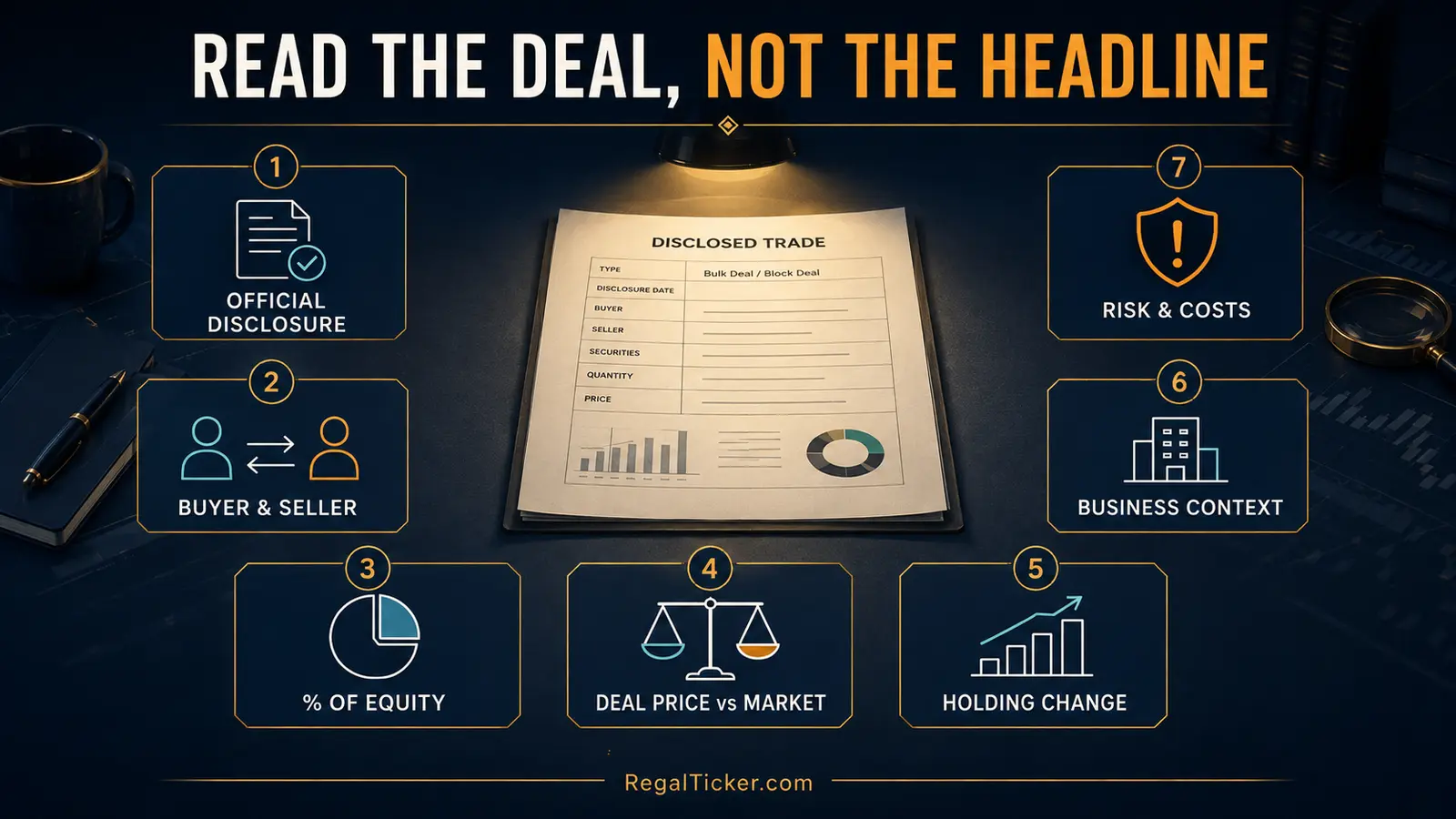
Check 1: Verify the Official Disclosure
Open the exchange record. Confirm the scrip, series, date, deal type, client, quantity and price. Ignore cropped screenshots that remove the source or combine data from different days.
Check 2: Read Both Counterparties
Do not focus only on the famous buyer. Ask who sold, how the transaction changes each party’s stake and whether the parties may be related. A transaction always has two sides with potentially different objectives.
Check 3: Calculate the Percentage Correctly
Use listed equity shares for the bulk-deal threshold. Do not use free float, daily traded volume or market capitalisation as the denominator. Adjust the share count for completed corporate actions when necessary.
If the company completed a rights issue, the Rights Issue Calculator can illustrate entitlement and theoretical ex-rights price from the official terms. If a demerger changed the holdings, the Demerger Cost Basis Calculator helps allocate original cost using stated proportions.
Check 4: Compare the Deal Price With the Correct Reference
Use the relevant price and time. For a block deal, distinguish the morning previous-close reference from the afternoon VWAP reference. For a bulk deal, remember that multiple executions can produce a weighted average.
Do not label a deal “at 5% discount” unless the comparison base is stated and the arithmetic is correct.
Check 5: Examine the Holding Change
Determine whether the trade creates a new position, increases an existing stake, reduces it or completes an exit. Compare the quantity with later shareholding disclosures rather than assuming the entire ownership story from one day.
For your own confirmed purchases, update the Stock Average Calculator. Do not attempt to reconstruct another investor’s full cost from one disclosed price.
Check 6: Reassess the Business and Event Context
Look for results, corporate announcements, promoter transactions, capital raising, index rebalancing, lock-in expiry, insolvency developments or other public events near the trade date. Correlation is not causation, but timing can suggest which official documents deserve attention.
If the transaction relates to a tender buyback, use the Buyback Acceptance Ratio Calculator only with the announced entitlement assumptions. A market purchase and a tender acceptance are different mechanisms.
Check 7: Define Risk, Costs and Exit Liquidity
Even if the deal strengthens your research thesis, decide position size independently. A large investor can tolerate volatility, negotiate liquidity or diversify across hundreds of positions in ways a retail investor cannot copy.
Use the Risk-Reward Calculator for planned entry, invalidation and target arithmetic. Estimate charges with the Brokerage Calculator. After a taxable sale, the Capital Gains Tax Calculator can provide an educational estimate from the inputs you supply. None of these tools guarantees liquidity or a future return.
Use All 18 Regal Ticker Calculators Wisely
The 18 calculators form one internal decision network. The strongest tools for this lesson are the stock average, brokerage, return, tax and risk-reward calculators. Corporate-action tools help when the share-count denominator or cost basis changed. Planning tools keep one headline trade in proportion to a long-term portfolio.
Stocks, Returns, Costs and Risk
| Question | Calculator | Correct use |
|---|---|---|
| What is my weighted purchase price after executed buys? | Stock Average Calculator | Combine confirmed quantities and prices; exclude pending orders. |
| What return did my holding produce? | Stock Return Calculator | Measure investor-specific price and income return. |
| What annual rate connects one start and end value? | CAGR Calculator | Annualise a multi-year lump-sum result. |
| What is the annualised return from irregular dated flows? | XIRR Calculator | Measure purchases, sales and receipts on different dates. |
| What dividend income and yield apply? | Dividend Calculator | Add cash income to the holding analysis. |
| What is the planned reward relative to loss? | Risk-Reward Calculator | Test an entry and invalidation without treating the deal as a signal. |
| What transaction charges may apply? | Brokerage Calculator | Estimate break-even and net proceeds from your trade assumptions. |
| What may the capital-gains tax be? | Capital Gains Tax Calculator | Estimate tax after identifying the actual gain and holding inputs. |
A practical workflow is to calculate planned loss with the Risk-Reward Calculator, estimate costs with the Brokerage Calculator, and record the executed weighted cost in the Stock Average Calculator. Later, compare the realised outcome through the Stock Return Calculator and Capital Gains Tax Calculator.
Corporate-Action Calculators
| Corporate-action question | Calculator | Connection to large-deal analysis |
|---|---|---|
| How many bonus shares and what theoretical ex-bonus price? | Bonus Share Calculator | Updates share count before percentage and price comparisons. |
| How do quantity, face value and price adjust after a split? | Stock Split Calculator | Prevents pre-split and post-split quantities from being mixed. |
| What are entitlement, TERP and subscription economics? | Rights Issue Calculator | Helps interpret ownership after new shares are issued. |
| What quantity might a tender buyback accept? | Buyback Acceptance Ratio Calculator | Separates tender assumptions from an exchange large-deal disclosure. |
| What is return after a bonus or split adjustment? | Bonus & Split Adjusted Return Calculator | Preserves economic comparability across share-count changes. |
| How is original cost allocated after a demerger? | Demerger Cost Basis Calculator | Supports cost tracking when one holding becomes multiple holdings. |
Use the Bonus Share Calculator and Stock Split Calculator before comparing quantities across corporate-action dates. Use the Bonus & Split Adjusted Return Calculator for return continuity. For rights, buybacks and demergers, enter only the official terms in the Rights Issue Calculator, Buyback Acceptance Ratio Calculator and Demerger Cost Basis Calculator.
Long-Term Planning Calculators
| Planning question | Calculator | Appropriate role |
|---|---|---|
| What may monthly investing grow to? | SIP Calculator | Model disciplined periodic investing instead of copying one disclosed trade. |
| What monthly SIP may target a future goal? | Goal SIP Calculator | Connect a goal, horizon and assumed return. |
| What may a one-time investment grow to? | Lumpsum Calculator | Test compounding assumptions for long-term capital. |
| How may regular withdrawals affect a corpus? | SWP Calculator | Model planned withdrawals; it does not promise market liquidity. |
The SIP Calculator, Goal SIP Calculator, Lumpsum Calculator and SWP Calculator do not analyse a bulk or block transaction. Their role is strategic: they keep one attention-grabbing event within a diversified, goal-based financial plan.
Explore the complete Regal Ticker Investor Tools hub whenever the question changes. Choose the calculator that matches the cash-flow pattern, corporate action or risk decision rather than forcing every event into one return figure.
Frequently Asked Questions and Final Takeaway
What is the meaning of a bulk deal?
A bulk deal occurs when the aggregate quantity bought or sold by one client during a trading day is more than 0.5% of the number of equity shares of the company listed on the exchange. It can consist of multiple normal-market executions.
What is the meaning of a block deal?
A block deal is one eligible large transaction executed through a dedicated exchange window. Under the current framework effective from 8 December 2025, the minimum order size is ₹25 crore and the permitted range is generally ±3% of the applicable reference price, subject to the normal price band and surveillance rules.
What is bulk deal vs block deal in simple words?
Bulk-deal classification depends on a client’s aggregate buy or sell quantity relative to listed equity shares. Block-deal classification depends on executing one large matched transaction through the separate block window under current value, time and price rules.
Is the block-deal minimum still ₹10 crore?
No. That is an outdated rule. NSE’s November 2025 circular implemented a revised minimum of ₹25 crore effective from 8 December 2025.
Is the block-deal price range still ±1%?
No. The revised framework generally permits ±3% around the applicable reference price, subject to surveillance measures and the security’s normal price band. A narrower normal-market band still constrains the block range.
What are the block-deal window timings?
The morning window operates from 08:45 AM to 09:00 AM. The afternoon window operates from 02:05 PM to 02:20 PM. The morning reference is the previous close or applicable adjusted/base price; the afternoon reference is the specified 01:45 PM to 02:00 PM cash-market VWAP.
Can a bulk deal happen in several trades?
Yes. Several normal-market executions can be aggregated for one client during the day. If the aggregate qualifying purchase or sale quantity crosses more than 0.5% of listed equity shares, the activity can meet the bulk-deal threshold.
Can a block deal be partially executed?
Under NSE’s block mechanism, buyer and seller orders must match in both price and quantity, and partial trading is not permitted. Unmatched block orders are purged at the end of the session under the operational framework.
Does a large institutional purchase mean the stock will rise?
No. The disclosure confirms a trade, not the buyer’s full thesis or future price direction. The stock may rise, fall or remain unchanged. Evaluate the company, valuation, liquidity, ownership change and your own risk independently.
Does a bulk or block sale mean something is wrong with the company?
Not necessarily. A seller may rebalance, meet redemptions, reduce concentration, satisfy a mandate or complete a planned exit. Check official filings and business evidence before drawing a conclusion.
Where can investors check bulk and block deals?
Use the official NSE bulk and block deal archive, NSE block-deal market page and the applicable exchange disclosures. Verify the date, security, client, quantity, price and deal type.
Are bulk deals and block deals illegal or suspicious?
No. They are recognised exchange-market events with disclosure and surveillance requirements. A large trade should not be described as manipulation or insider trading without evidence and an official regulatory finding.
Final Takeaway
The correct bulk deal vs block deal distinction is simple but powerful. A bulk deal is identified from one client’s aggregate normal-market quantity crossing more than 0.5% of listed equity shares. A block deal is one large matched transaction in a dedicated window, currently requiring at least ₹25 crore and generally operating within ±3% of the applicable reference price, subject to the normal price band.
Treat the disclosure as a verified fact—not as a ready-made investment recommendation. Read both counterparties, calculate the equity percentage, compare the price with the correct reference, examine the resulting holding and return to company fundamentals. For current operational rules, prefer the latest SEBI block-deal circular, NSE implementation circular and official NSE deal archive over older summaries.