
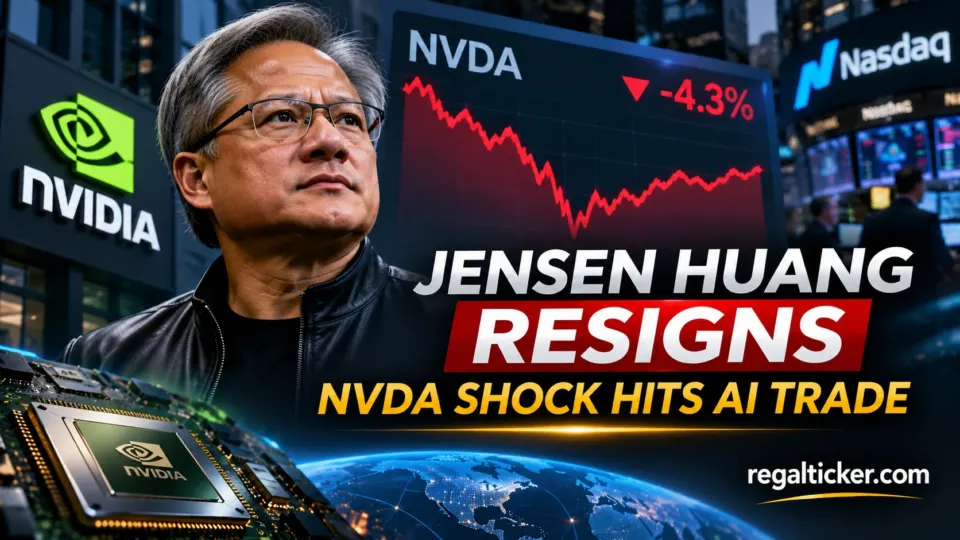
Nvidia has moved from a governance scandal into a full leadership transition
Jensen Huang is no longer Nvidia’s chief executive.
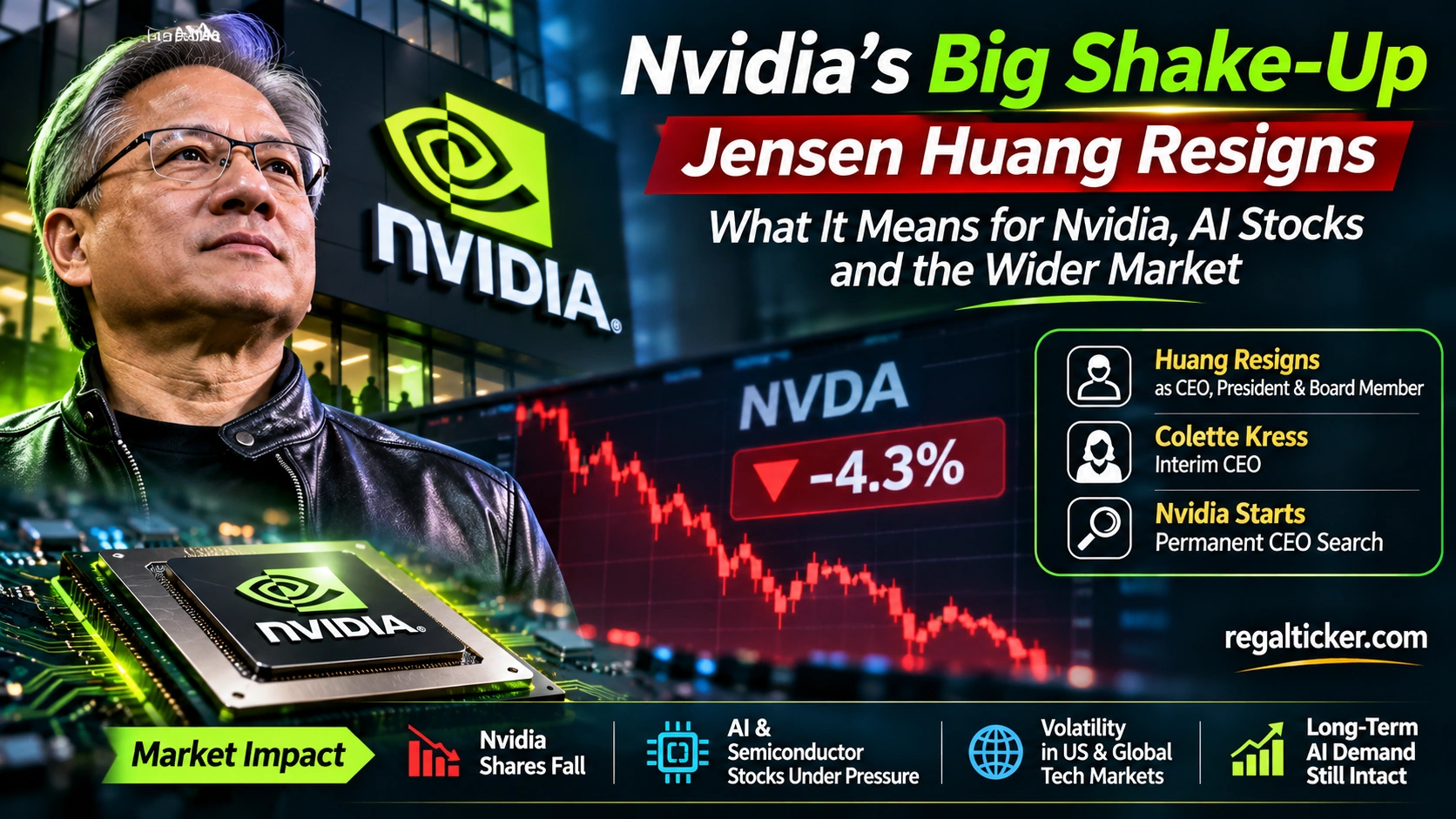
Nvidia confirmed on 12 November that its co-founder resigned as president, CEO and board member with immediate effect. Chief Financial Officer Colette Kress has taken over as interim CEO while the board searches for a permanent successor. Long-time director Harvey C. Jones has become Nvidia’s first independent board chair.
For the stock market, this is much bigger than another executive departure.
Huang was not simply the public face of Nvidia. He shaped the company’s product strategy, customer relationships, government engagement and unusually aggressive approach to financing parts of the AI ecosystem.
The market reaction reflected that dependence.
Nvidia fell as much as 14.3% intraday before recovering much of the loss. The stock eventually closed down about 4.3% at roughly $166.19. The S&P 500 fell 0.35%, the Nasdaq lost 0.39%, and several Nvidia-linked AI infrastructure companies dropped much more sharply.
At the same time, rivals AMD and Broadcom rose.
That split tells investors something important.
The market is not pricing the end of AI demand.
It is pricing a new question: how much of Nvidia’s extraordinary valuation and ecosystem power depended on Jensen Huang himself?
⚡ Quick answer
Does Jensen Huang’s resignation break the Nvidia investment case?
Not automatically. Nvidia still dominates high-end AI accelerators, demand remains strong and analysts expect another quarter of extraordinary revenue and profit growth. But Huang’s exit creates a genuine key-man, governance and capital-allocation risk. The stock can remain volatile until investors understand Colette Kress’s strategy, the permanent CEO search and whether Nvidia continues Huang’s aggressive practice of investing in customers and AI infrastructure partners.
Key takeaways
Jensen Huang resigned as Nvidia president, CEO and board member effective immediately.
CFO Colette Kress is serving as interim CEO while Nvidia searches internally and externally for a permanent successor.
Harvey C. Jones became Nvidia’s first independent board chair.
NVDA fell as much as 14.3% intraday before recovering to close down about 4.3%.
The S&P 500 fell about 0.35%, while the Nasdaq lost about 0.39%.
Nvidia-backed Nebius and CoreWeave fell sharply as investors questioned the broader AI-financing ecosystem.
AMD and Broadcom gained about 5.9% and 5.5%, showing that money rotated within semiconductors rather than abandoning the sector entirely.
Nvidia is now more than 30% below its October record high.
Reuters says Nvidia’s forward P/E has fallen to roughly 12 times expected earnings, its lowest valuation since 2012.
Analysts still expect October-quarter revenue to rise about 92% year on year and net profit to exceed $60 billion.
Nvidia reports earnings on 17 November, making the next results and outlook unusually important.
U.S. lawmakers are still seeking testimony from Huang over national-security and export-control questions.
For India, Nvidia is mainly a global risk-sentiment and AI-valuation transmission channel; current Indian weakness is being driven more directly by higher crude and inflation.
1. Huang’s resignation changes the Nvidia story immediately
Nvidia’s board did not announce a planned succession.
It announced an immediate exit.
That distinction matters.
A carefully managed CEO transition gives investors time to understand the next leadership team.
This one arrives while Nvidia is already dealing with a board investigation, U.S.-China export-policy pressure and questions about the financing structure of the AI ecosystem.
Huang also leaves the board.
That removes him from formal governance at the same time that investors are trying to understand how much influence he will continue to have as a large shareholder and co-founder.
The uncertainty is therefore not only operational.
It is strategic.
2. What is confirmed about the investigation—and what is still alleged
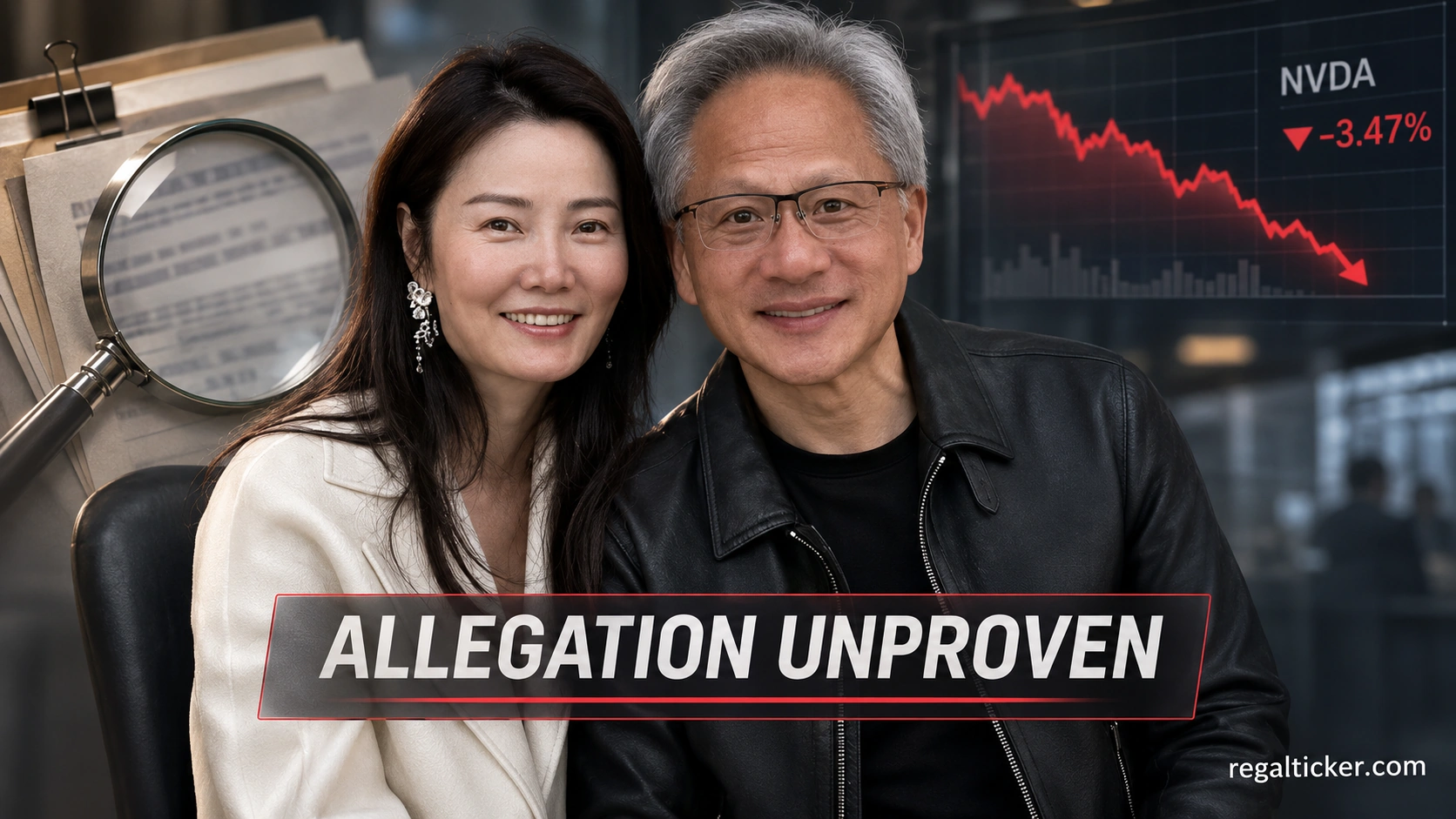
Huang previously acknowledged that he had been unfaithful to his wife.
The more serious allegation is that Alice Huang, the woman at the centre of one reported relationship, may have had links to Chinese intelligence.
That allegation has not been established as fact.
China denies that she was a spy, and U.S. Attorney General Todd Blanche said the Justice Department had not reached a conclusion on that question.
That distinction remains important even after Huang’s resignation.
The corporate event is confirmed.
The espionage allegation remains unresolved.
3. Nvidia stock crashed because Huang was more than a normal CEO
NVDA initially fell more than 14% during Thursday trading before recovering.
The stock closed around $166.19, down about 4.3%.
That is a large move for a company with a market value around $4 trillion.
The reaction reflects “key-man risk.”
Huang co-founded Nvidia and spent decades building its technical culture, product roadmap and external relationships.
Investors were effectively valuing not only GPUs and earnings.
They were also valuing Huang’s ability to see around corners and keep Nvidia at the centre of the next computing cycle.
His abrupt exit forces the market to put a price on that missing certainty.
4. The broader U.S. market took a hit—but did not collapse
The Dow fell about 0.36%.
The S&P 500 lost about 0.35%.
The Nasdaq declined roughly 0.39%.
Those moves were meaningful but far smaller than Nvidia’s own selloff.
That is useful information.
Nvidia is one of the largest stocks in the world and a major index weight.
Yet the wider market absorbed the shock.
Energy stocks and parts of the non-AI market held up better.
That suggests diversification inside the S&P 500 is beginning to matter more as the AI trade becomes less one-directional.
5. AI stocks split into losers and potential beneficiaries
The market reaction was not simply “AI down.”
Nvidia-linked infrastructure companies were hit hard.
Reuters reported Nebius fell sharply after cutting its 2026 revenue forecast, while CoreWeave also declined as investors questioned the financing relationships that supported the AI buildout.
Super Micro Computer came under pressure as well.
But AMD and Broadcom rose about 5.9% and 5.5%.
That is the more interesting part of the reaction.
If investors believe Nvidia loses some strategic momentum without Huang, rivals can gain.
The AI spending pool does not have to shrink for Nvidia’s share of value creation to change.
Investor note
Nvidia risk is not the same thing as AI demand risk
A CEO shock can reduce confidence in Nvidia without reducing demand for AI compute. If hyperscalers still need accelerators, networking and custom silicon, some spending may rotate toward competitors rather than disappear.
6. Nvidia’s valuation has reset dramatically
Reuters says Nvidia is now trading at roughly 12 times expected earnings.
That is its lowest forward P/E since 2012.
A low multiple sounds attractive.
But a collapsing P/E can mean two very different things.
Either the market has become too pessimistic.
Or investors no longer trust the earnings estimates.
That is why the next earnings report matters so much.
Nvidia has fallen more than 30% from its October record.
The stock is cheaper.
The uncertainty is also much higher.
7. Earnings on 17 November may matter more than usual
Nvidia reports fiscal third-quarter results on Tuesday, 17 November.
Analysts surveyed by LSEG still expect extraordinary numbers.
Revenue is expected to rise about 92% year on year.
Net profit is expected to increase about 89% to more than $60 billion.
If Nvidia delivers those numbers and Kress gives investors confidence about demand and strategy, the stock could stabilise quickly.
If guidance disappoints, the market may conclude that the leadership shock arrived at the same time as an operating slowdown.
That would be much more serious.
The key question is no longer only “How strong is Blackwell demand?”
It is also “Who is setting Nvidia’s strategy now?”
8. Colette Kress could change Nvidia’s risk appetite
Kress has been Nvidia’s CFO since 2013.
Reuters reports that she sometimes acted as an internal counterweight to Huang’s more aggressive financing decisions.
That matters because Nvidia has not only sold chips into the AI boom.
It has also invested in customers, infrastructure companies and projects that use those chips.
Critics have argued that this can create a circular ecosystem in which Nvidia helps finance the demand for its own products.
Reuters reported that Kress pushed back on some of those arrangements.
If she reduces that financing activity, investors may see a more conservative Nvidia.
That could improve balance-sheet discipline.
It could also remove financial support from parts of the AI ecosystem that have grown around Nvidia.
9. This creates a second-order risk for AI infrastructure stocks
Nvidia’s influence extends beyond semiconductor supply.
It has invested in cloud providers, startups and data-centre projects.
If the next management team becomes less willing to fund customers aggressively, highly leveraged AI infrastructure companies may have to rely more heavily on external debt and equity markets.
That is why CoreWeave and similar names can react more violently than Nvidia itself.
RegalTicker’s AI Capex and CoreWeave analysis already highlighted the danger of an AI boom financed through increasingly complex capital structures.
Huang’s departure can accelerate that reassessment.
10. The China and Washington risk has not disappeared with Huang
Resigning does not end the political investigation.
U.S. Senate Banking Committee Chairman Tim Scott has asked Huang and Commerce Secretary Howard Lutnick to testify.
House committees have also demanded interviews related to national-security and export-control concerns.
Huang was one of Nvidia’s most important voices arguing for continued access to the Chinese market.
His departure therefore creates uncertainty around Nvidia’s China strategy at the same time that Washington is debating tighter controls on advanced chips.
This is one reason the market cannot treat the event as a simple CEO succession.
11. What does this mean for Indian markets?
India is affected mainly through sentiment and global asset allocation.
Indian IT, AI, semiconductor and data-centre-linked stocks can react when Nvidia volatility changes the global valuation of technology themes.
Some Indian mutual funds and ETFs also hold Nvidia directly.
Moneycontrol identified 13 Indian schemes with direct NVDA exposure in October portfolios, with allocations ranging from below 1% to above 10% in some U.S.-focused products.
But the broader Indian market has a different structure from the Nasdaq.
Banks, financials, industrials, energy and domestic consumption have much larger weights.
That is why an Nvidia shock does not automatically translate into an equivalent Nifty shock.
12. Today’s India weakness is mainly oil and inflation—not Nvidia
Indian equities are lower this morning.
Around 10:00 IST, Nifty was down about 0.35% near 25,211.
It would be easy to blame the move on Nvidia.
That would be misleading.
Reuters points to two more direct domestic pressures.
Brent crude has jumped back toward $96 a barrel.
India’s October CPI rose to 6.09%, above the RBI’s 6% upper tolerance limit.
Those factors hit India through inflation, the rupee, interest rates and corporate margins.
The Nvidia crisis adds global risk aversion, especially for technology-linked names, but it is not the main reason Nifty is lower.
13. India may actually benefit if the global AI trade becomes less concentrated
This is the counterintuitive part.
When Nvidia and AI-heavy markets dominate global returns, India can lose benchmark weight and foreign attention.
We saw that earlier in 2026 when Taiwan and South Korea gained dramatically inside emerging-market indexes.
A more selective AI market can redirect capital toward banks, consumption, industrials and markets with different earnings drivers.
India’s recent MSCI comeback is part of that story.
Foreign investors have already returned strongly to Indian equities in November.
So Nvidia volatility can be negative for Indian technology sentiment while still being positive for India’s relative global allocation.
14. What should investors watch next?
The first event is Nvidia’s 17 November earnings report.
Second, watch Kress’s language around capital allocation and customer financing.
Third, watch whether AMD and Broadcom keep outperforming Nvidia.
Fourth, watch Nvidia’s forward valuation.
If earnings estimates remain intact while the stock stabilises, the selloff may begin to look like a key-man discount.
If estimates fall, the market will treat the event as something more serious.
Fifth, watch Indian technology and data-centre proxies separately from the Nifty.
Finally, watch foreign flows into India.
The broader opportunity may not be “buy the Nvidia dip.”
It may be understanding where global capital goes if the AI trade becomes less concentrated.
Frequently asked questions
Has Jensen Huang officially resigned from Nvidia?
Yes. Nvidia announced that Huang resigned as president, CEO and board member effective immediately on 12 November 2026.
Who is Nvidia’s interim CEO?
Colette Kress, Nvidia’s long-serving CFO, is serving as interim CEO while the board searches for a permanent successor.
How much did Nvidia stock fall?
Nvidia fell as much as 14.3% intraday before recovering to close down about 4.3% at roughly $166.19.
What happened to the Nasdaq?
The Nasdaq Composite fell about 0.39% on Thursday. The S&P 500 lost roughly 0.35%.
Did all AI stocks fall?
No. Nvidia-linked infrastructure names fell sharply, but AMD and Broadcom rose as investors considered whether rivals could benefit from Nvidia’s leadership uncertainty.
Is Nvidia now cheap?
Reuters says Nvidia’s forward P/E has fallen to roughly 12 times expected earnings, its lowest since 2012. Whether that is cheap depends on whether future earnings estimates remain achievable.
When does Nvidia report earnings?
Nvidia is scheduled to report fiscal third-quarter results on 17 November 2026.
Does Huang’s resignation mean AI demand is collapsing?
No. The immediate issue is leadership and governance. Analysts still expect strong chip demand, but investors are reassessing Nvidia’s strategic premium.
How does this affect India?
Indian technology and AI-linked stocks can feel global valuation pressure, while the broader Indian market is less dependent on the AI hardware trade. Current India weakness is being driven more directly by higher oil and inflation.
Do Indian mutual funds own Nvidia?
Yes. Moneycontrol identified 13 Indian mutual fund schemes and ETFs with direct Nvidia holdings in their October 2026 portfolios.
Verify through official sources
Official references
- NVIDIA — CEO Transition — Official confirmation of Jensen Huang’s resignation, Colette Kress’s interim appointment and Harvey C. Jones becoming board chair.
- Reuters — Jensen Huang Resigns — Leadership transition, Huang’s ownership, AI ecosystem role and broader strategic context.
- Reuters — Global AI Stocks React — Nvidia intraday selloff, AI infrastructure declines and rival semiconductor gains.
- Reuters — Wall Street Close — Nvidia closing move and Dow, S&P 500 and Nasdaq reactions.
- Reuters — Nvidia Valuation Reset — Nvidia’s 12-times forward P/E, more-than-30% drawdown from its record and analyst earnings expectations.
- Reuters — Colette Kress Profile — Kress’s history at Nvidia and reported disagreements over aggressive AI financing arrangements.
- Reuters — Senate Testimony Request — Congressional testimony requests and unresolved national-security questions.
- Reuters — Indian Market 13 November — Nifty weakness, Brent near $96, inflation at 6.09% and continued foreign buying in India.
- Moneycontrol — Indian Funds With Nvidia Exposure — Direct Nvidia exposure reported in Indian mutual funds and ETFs.
Final takeaway
Nvidia’s biggest risk has changed from valuation to leadership
For most of the AI boom, the main argument around Nvidia was price.
Was the stock too expensive?
Could chip demand justify the valuation?
Those questions still matter.
But Huang’s resignation introduces something investors could not model cleanly in a spreadsheet.
Leadership.
Nvidia still has extraordinary products.
Demand remains strong.
Its next quarterly numbers may still be spectacular.
But the market is no longer willing to assume that the company’s strategy, financing appetite and political influence continue exactly as before.
That is why the stock can look statistically cheap and still remain volatile.
And it is why the broader market reaction matters.
AMD and Broadcom rising while Nvidia falls tells us the AI trade is not disappearing.
It is becoming less concentrated.
For India, that may be uncomfortable for technology-linked stocks but helpful for the broader global-allocation story.
The next decisive test comes on 17 November.
Educational disclaimer: This article discusses an abrupt CEO resignation, an ongoing corporate investigation and unresolved national-security allegations. The claim that Alice Huang was connected to Chinese intelligence has not been established as fact; China denies it, and the U.S. Justice Department has said it has not reached a conclusion. This article is for education and general market information only and is not investment advice or a recommendation to buy or sell Nvidia, AMD, Broadcom, Indian technology stocks or any fund.