


The bigger story is not four new names. It is India moving back up the global allocation table.
MSCI’s November 2026 review gave Indian markets an important signal.
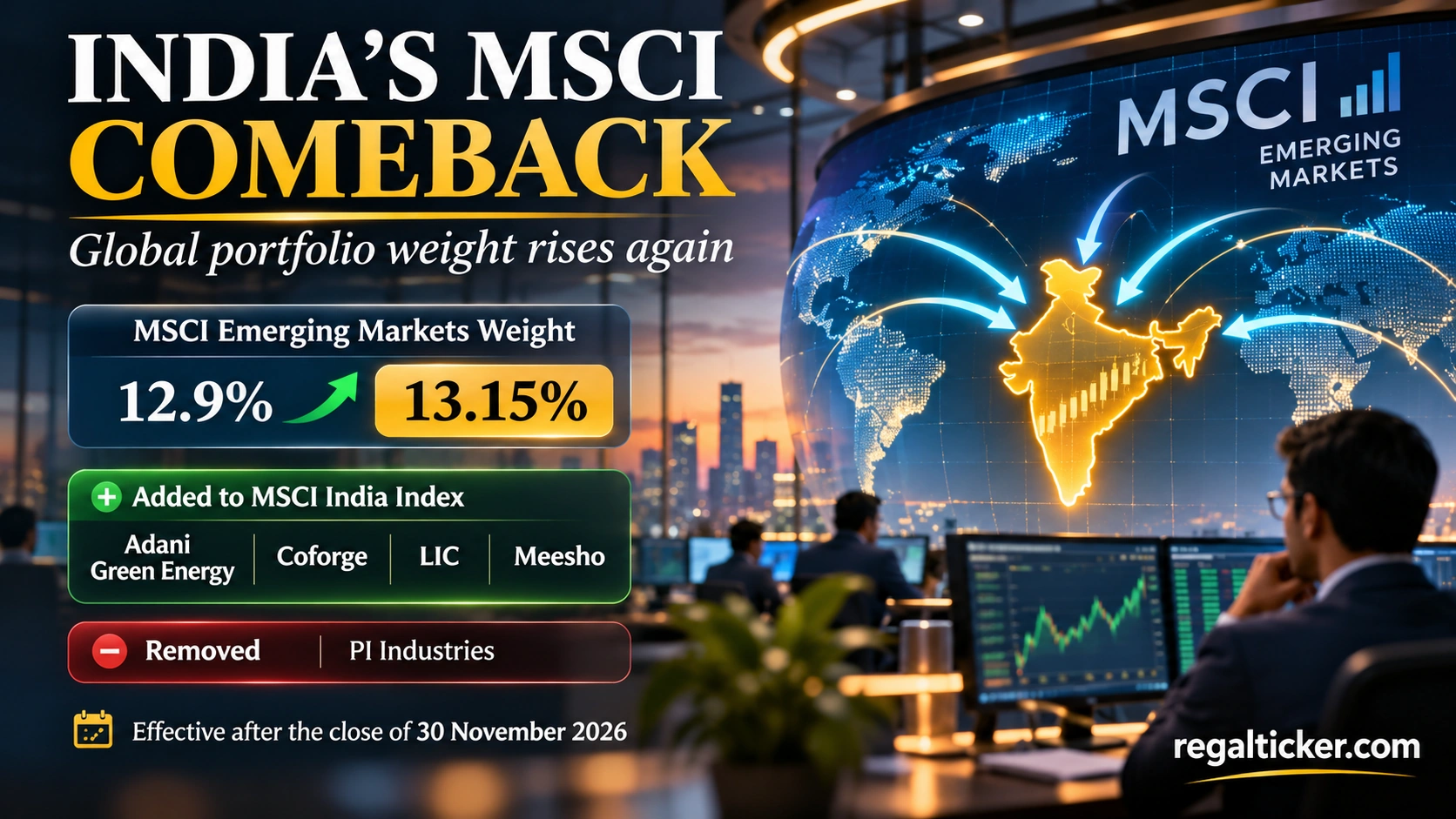
Adani Green Energy, Coforge, Life Insurance Corporation of India and Meesho will be added to the MSCI India Standard Index after the close on 30 November. PI Industries will be removed.
Those changes matter to the individual stocks because index-tracking funds will have to adjust their holdings.
But the more interesting part is India’s overall weight.
Reuters reported that India’s share of the MSCI Emerging Markets Index will rise from 12.9% to 13.15%. That may look like a small move, but it follows a much larger reversal. India’s weight had fallen from about 20% in 2024 to nearly 11% in May 2026 as AI-heavy Taiwan and South Korea dramatically outperformed.
Now the balance is beginning to shift again.
Foreign investors have already bought about $6.43 billion of Indian equities in November, their strongest monthly buying since September 2024.
That makes the MSCI review more than a technical rebalance.
It is another sign that India is starting to regain a place in global portfolios after losing ground during the AI-driven rally elsewhere in Asia.
⚡ Quick answer
Why does the MSCI India weight increase matter?
Because large global funds benchmarked to MSCI emerging-market indexes often have to keep their portfolios close to index weights. When India’s weight rises, more capital can be allocated to Indian equities mechanically and strategically. The four stock additions matter, but the broader significance is that India’s relative importance inside global emerging-market portfolios is increasing again.
Key takeaways
MSCI added Adani Green Energy, Coforge, LIC and Meesho to the MSCI India Standard Index.
PI Industries will be removed.
The changes take effect after the market close on 30 November 2026.
India’s weight in the MSCI Emerging Markets Index will rise from 12.9% to 13.15%.
India’s weight had fallen from roughly 20% in 2024 to nearly 11% by May 2026.
That earlier decline reflected the huge AI-led rally in Taiwan and South Korea.
MSCI also increased weights for 11 other Indian stocks, including Groww, Lenskart, Coal India and Paytm.
Foreign portfolio investors have bought about $6.43 billion of Indian equities in November.
That is the strongest monthly FPI buying since September 2024.
LIC was one of the three largest additions to the MSCI Emerging Markets Index by full company market capitalisation.
Index inclusion can create mechanical demand, but long-term returns still depend on earnings, valuation and execution.
The broader market signal is that India is regaining benchmark relevance at a time when the global AI trade is becoming less one-sided.
1. What MSCI actually changed
MSCI’s November review added four Indian stocks to its Global Standard universe.
Adani Green Energy.
Coforge.
Life Insurance Corporation of India.
Meesho.
PI Industries was deleted.
MSCI’s official announcement says all changes will be implemented as of the close of 30 November.
That timing matters because index-tracking funds normally rebalance around the effective date.
LIC also stood out globally: MSCI listed it among the three largest additions to the Emerging Markets Index by full company market capitalisation.
2. Why the four additions can see mechanical buying
An MSCI inclusion does not automatically make a company better.
It does change who may need to own it.
Passive funds and index-aware active managers benchmarked to MSCI often adjust positions when securities enter or leave an index.
That can create buying demand around the effective date.
The exact flow into each stock depends on its free-float market capitalisation, final index weight, fund tracking assets and how investors position ahead of the rebalance.
That is why it is better to think in terms of mechanical demand rather than a single guaranteed inflow number.
3. India’s weight increase is the more important signal
India’s MSCI Emerging Markets weight rises from 12.9% to 13.15%.
On its own, that is a modest change.
In context, it is more important.
Reuters reported that India’s weight peaked around 20% in 2024 before sliding to nearly 11% by May 2026.
The reason was not simply that India performed badly.
Taiwan and South Korea became much larger inside the benchmark because AI and semiconductor stocks surged.
India was effectively crowded out by the extraordinary performance of another part of Asia.
The new review suggests that process is beginning to reverse.
Investor note
Benchmark weight is relative, not absolute
India can gain weight because Indian stocks rise, because competing markets weaken, or because MSCI changes constituent weights. Investors should distinguish index mechanics from fundamental improvement.
4. The global AI reset is helping India’s relative position
The timing is important.
The AI trade has become more volatile.
Semiconductor and infrastructure names have faced questions around financing, valuations and governance.
That does not mean the AI boom is over.
It does mean the gap between AI-heavy markets and the rest of emerging Asia is narrowing.
India benefits when global investors become less willing to concentrate portfolios in one theme.
The Global AI Reset and Indian IT analysis explained why India can attract capital even if its own IT sector is not the main beneficiary.
Banks, industrials, consumer companies and domestic-growth stocks give India a very different earnings profile from Taiwan or South Korea.
5. Foreign money is already returning
The MSCI shift is happening alongside a real change in investor flows.
Reuters reported that foreign portfolio investors bought about $1.34 billion of Indian equities on Wednesday alone.
That took November inflows to about $6.43 billion.
It is the strongest monthly foreign buying since September 2024.
This matters because index changes are more powerful when they coincide with improving sentiment.
If India’s benchmark weight rises while active foreign investors are also adding exposure, the flow story becomes broader than a one-day passive rebalance.
6. LIC’s inclusion is symbolically important
LIC is not just another constituent.
It is one of India’s largest financial institutions and one of the largest listed companies by market capitalisation.
Its addition to the MSCI Emerging Markets Index increases the representation of Indian financials and domestic savings inside a global benchmark.
MSCI also identified LIC as one of the three largest additions to the Emerging Markets Index by full company market capitalisation.
That should increase its visibility among large international investors that may previously have had limited exposure.
Still, index inclusion does not remove the usual questions around valuation, growth, margins and capital allocation.
7. Adani Green’s return to the Standard Index has a different significance
Adani Green Energy’s inclusion carries a different message.
The stock has been highly volatile and politically sensitive.
Its addition reflects size, liquidity and investability under MSCI methodology, not an endorsement of the company’s business model or governance.
That distinction matters.
An index provider decides whether a security qualifies for inclusion.
An investor still has to decide whether the risk-reward is attractive.
The Fundamental Analysis framework remains relevant here because index membership should never replace company-level analysis.
8. Coforge and Meesho broaden the India story
Coforge brings more technology-services exposure into the index.
Meesho adds a younger digital-commerce business.
Those additions matter because India’s global market representation is gradually becoming more diversified.
The benchmark is no longer only banks, energy majors and legacy industrials.
It increasingly includes digital platforms, newer technology companies and domestic consumer businesses.
That improves the range of India exposures available to global funds.
It also raises a new question: whether investors are paying too much for growth.
9. MSCI also changed the weights of existing Indian names
The review was not limited to additions and deletions.
Reuters reported that MSCI increased the index weights of 11 other Indian stocks.
Among the names mentioned were Groww, Lenskart, Coal India and Paytm.
These changes can matter because passive flows are driven by weight changes as well as constituent changes.
A company already inside an index can still receive incremental demand if its benchmark weight rises.
That is another reason the overall India allocation matters more than a simple list of four additions.
10. What happens around 30 November?
The implementation occurs after the close on 30 November.
That is when index-tracking funds will need their portfolios aligned with the new composition.
In practice, markets often anticipate the rebalance.
Stocks expected to receive passive demand can move before the effective date.
That creates an important risk.
Investors who buy only because of expected index flows can end up chasing a move that has already been priced in.
The better question is whether the company still looks attractive after the rebalancing effect fades.
11. Why India’s rising weight matters for the whole market
India’s MSCI weight is a measure of its importance in the global emerging-market opportunity set.
A higher weight can influence asset allocation across sovereign wealth funds, pension funds, ETFs and active emerging-market portfolios.
It can also affect how global fund managers think about being underweight or overweight India.
When India’s benchmark weight rises, a manager holding less India than the index is taking a larger active bet against the market.
That can encourage some investors to reduce underweight positions.
The effect is gradual, but strategically important.
12. What should investors watch next?
First, watch foreign flows after the 30 November rebalance.
If buying continues into December, the story is broader than index mechanics.
Second, watch the four new constituents after inclusion.
A stock that holds gains after passive demand fades may have stronger underlying support.
Third, watch India’s weight against Taiwan, South Korea and China.
That relative competition is becoming increasingly important.
Fourth, watch crude oil and the rupee.
India’s current foreign-flow recovery has been helped by a better macro backdrop.
Finally, watch earnings.
Benchmark weight can bring capital in.
Only earnings and cash flow can keep it there.
Frequently asked questions
Which Indian stocks were added to the MSCI Standard Index in November 2026?
Adani Green Energy, Coforge, Life Insurance Corporation of India and Meesho.
Which Indian stock was removed?
PI Industries.
When do the changes take effect?
After the market close on 30 November 2026.
What will India’s MSCI Emerging Markets weight become?
Reuters reported that India’s weight will rise from 12.9% to 13.15%.
Why had India’s MSCI weight fallen earlier?
AI and semiconductor rallies in Taiwan and South Korea caused those markets to gain much more weight inside the MSCI Emerging Markets Index.
How much have foreign investors bought in India this month?
Reuters reported about $6.43 billion of net foreign equity purchases in November as of 12 November.
Does MSCI inclusion guarantee a stock will rise?
No. Inclusion can create passive demand, but the stock can still fall if valuation, earnings or market sentiment deteriorate.
Why does the India weight matter beyond these four stocks?
A higher country weight can influence how global passive and active emerging-market funds allocate capital across the entire Indian market.
Verify through official sources
Official references
- MSCI — November 2026 Equity Index Review — Official review summary and implementation date.
- MSCI — Global Standard Index Additions and Deletions — Official list showing Adani Green Energy, Coforge, LIC and Meesho added to MSCI India, with PI Industries removed.
- Reuters — MSCI Adds Four Indian Stocks — India weight increase, additional Indian weight changes and historical benchmark context.
- Reuters — Indian Shares and Foreign Inflows — November foreign inflows, market reaction and LIC/Meesho response to MSCI inclusion.
Final takeaway
India’s comeback is about allocation, not just index membership
The four additions will get most of the headlines.
They are not the most important part of the story.
The real change is that India’s weight in global emerging-market portfolios is rising again after a sharp decline during the AI-led boom in Taiwan and South Korea.
Foreign investors are already returning.
The rupee has strengthened.
Indian banks and domestic-growth sectors are attracting capital.
And the MSCI rebalance now reinforces that shift.
That does not mean every newly included stock is automatically attractive.
It does mean that global investors who benchmark against emerging markets may need to pay more attention to India again.
That is a much bigger development than four names entering an index.
Educational disclaimer: This article is for education and general market information only. It is not investment advice or a recommendation to buy or sell Adani Green Energy, Coforge, LIC, Meesho, PI Industries or any other security. MSCI index inclusion can create short-term passive flows but does not guarantee positive investment returns. Verify current company, exchange and index-provider disclosures before making financial decisions.


