Nvidia’s numbers are huge, but the India read-through is not simple
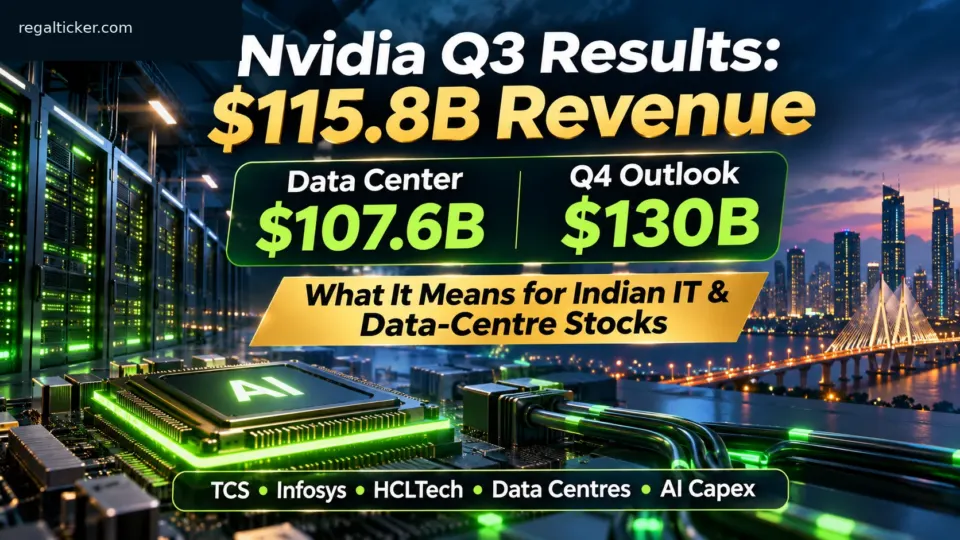
Nvidia has delivered another extraordinary quarter at a moment when investors were beginning to question whether the artificial-intelligence infrastructure boom had run too far, too fast. Revenue for the fiscal third quarter reached $115.8 billion, more than double the level a year earlier, while Data Center revenue climbed to $107.6 billion. The company also guided to about $130 billion of revenue for the fourth quarter, plus or minus 3%.
Those numbers are a powerful confirmation that demand for AI compute remains intense. They do not, however, mean that every company carrying an AI label should rise together.
That distinction matters for Indian investors. Nvidia sells the scarce computing infrastructure at the centre of the AI build-out. Indian IT-services companies generally make money by helping enterprises implement, integrate, modernise and operate technology systems. Indian data-centre, power, cooling and hardware companies sit somewhere between those two worlds.
The question is therefore not whether Nvidia’s quarter is good for AI. It clearly is. The more useful question is which parts of the Indian market can convert that global spending cycle into sustainable revenue, margins and cash flow.
⚡ Quick answer
What do Nvidia’s results mean for Indian investors?
Nvidia’s results strengthen the case that global AI infrastructure spending remains robust. That is structurally supportive for data-centre equipment, power, cooling, networking and AI implementation demand. But the read-through for Indian IT services is mixed: AI can create new consulting and transformation revenue while also reducing labour intensity, increasing pricing pressure and changing traditional outsourcing economics. Investors should separate direct infrastructure beneficiaries from services companies that still need to prove monetisation.
Key takeaways
Nvidia Q3 FY27 revenue reached $115.8 billion, up 103% year on year.
Data Center revenue was $107.6 billion, up 110% year on year.
Q4 revenue guidance is $130 billion, plus or minus 3%, with no Data Center compute revenue from China assumed.
Strong Nvidia demand supports the global AI-capex cycle but does not guarantee gains for Indian IT-services stocks.
Indian IT shares were weak in early trade on 18 November despite Nvidia’s beat, showing that investors still distinguish AI infrastructure demand from IT-services earnings.
Data-centre hardware, power, cooling and related infrastructure may have a more direct demand linkage than traditional outsourcing businesses.
Leadership transition, China exposure, margins and AI-capex returns remain important risks.
1. Nvidia’s quarter was far stronger than a normal earnings beat
Nvidia reported fiscal Q3 FY27 revenue of $115.8 billion for the quarter ended 25 October 2026. That was 20% higher sequentially and 103% higher than a year earlier.
The scale of the Data Center business is even more striking. Data Center revenue reached $107.6 billion, up 110% year on year. In other words, the overwhelming majority of Nvidia’s revenue now comes from the infrastructure required to train and run advanced AI systems.
GAAP net income reached $65.3 billion, while GAAP diluted earnings per share was $2.70. Gross margin remained very high at 74.8% despite the speed of the company’s expansion.
For investors, the central signal is simple: the AI infrastructure cycle has not collapsed. Customers are still deploying enormous amounts of capital into accelerated computing.
2. The $130 billion Q4 outlook matters even more than the Q3 beat
Backward-looking results tell investors what happened. Guidance tells them whether management believes demand is continuing.
Nvidia expects Q4 FY27 revenue of approximately $130 billion, plus or minus 3%. That implies another substantial step up from the already huge Q3 base.
The outlook is particularly notable because Nvidia said it is assuming no Data Center compute revenue from China in the forecast. That means the guidance is being supported by demand elsewhere rather than depending on a recovery in one of the company’s most politically sensitive markets.
The company also said its Vera Rubin platform has begun shipping and described the product ramp as exceptionally strong. A successful transition from Blackwell-era systems into Rubin is important because AI infrastructure spending ultimately depends on customers believing each generation delivers enough productivity to justify another round of capital expenditure.
3. Why Indian IT stocks did not simply rally on the Nvidia beat
The immediate Indian-market reaction illustrates the difference between chip demand and IT-services economics.
In early trading on 18 November, major Indian IT shares including TCS, Infosys, Wipro, HCLTech and Tech Mahindra were weak even after Nvidia’s better-than-expected results and guidance. TCS was down roughly 2.5% at one point, while several peers also traded lower.
That is not necessarily a contradiction.
Nvidia benefits when hyperscalers, enterprises and AI labs buy more computing infrastructure. Indian IT companies benefit only when that spending turns into projects where they can earn attractive revenue and margins.
Those projects can include cloud migration, model integration, cybersecurity, data engineering, enterprise AI deployment and managed services. But AI can also automate coding, testing, support and other labour-intensive work that historically supported the industry’s billing model.
So stronger AI spending can be positive for demand and disruptive for pricing at the same time.
Investor note
Nvidia is a demand signal, not a direct proxy for Indian IT earnings
A stronger Nvidia quarter tells investors that AI compute demand remains powerful. It does not tell them how much of that spending will become high-margin revenue for TCS, Infosys, HCLTech, Wipro or other Indian IT companies. For those businesses, investors still need evidence from deal wins, AI revenue, pricing, utilisation, margins and free cash flow.
4. HCLTech shows what a more direct AI-services opportunity can look like
The distinction is visible in HCLTech’s recent disclosures.
HCLTech reported advanced-AI revenue of $219 million in Q2 FY27, up 78% year on year in constant currency. It has also been building partnerships around enterprise and sovereign AI, including its recently announced work with Cohere in Canada and Germany.
That is the kind of evidence investors should look for across the Indian IT sector: not simply partnerships or AI announcements, but measurable revenue conversion.
If global AI infrastructure spending continues at Nvidia’s current pace, implementation demand should keep growing. The companies that can turn that demand into repeatable services revenue without sacrificing margins will be better positioned than those relying mainly on narrative.
5. Data-centre infrastructure has a more direct link to Nvidia’s demand cycle
The read-through is clearer for businesses exposed to the physical infrastructure around AI.
Large AI clusters require power systems, transformers, switchgear, cooling, networking, racks, backup power, high-density electrical infrastructure and data-centre construction. If Nvidia’s customers continue expanding compute capacity, demand for these supporting systems can remain strong even when individual AI software valuations fluctuate.
This is why India’s AI opportunity should not be viewed only through traditional IT-services companies.
Indian investors increasingly track data-centre operators, electrical-equipment manufacturers, cooling specialists, engineering firms and other infrastructure providers connected to the build-out.
The opportunity is real, but valuation discipline matters. A company can be positioned in the right theme and still be a poor investment if expectations already assume flawless execution.
6. India’s data-centre thesis still needs local execution
Strong global AI capex does not automatically translate into Indian revenue.
India still needs reliable power, land, fibre connectivity, cooling systems, capital and customer commitments to convert the AI infrastructure boom into local earnings. Project delays, expensive power, low utilisation or overbuilding can reduce returns even when global demand remains healthy.
That is why Nvidia’s quarter should be treated as evidence that the underlying AI-compute market is strong—not as proof that every Indian data-centre project will earn attractive returns.
The best local opportunities are likely to be companies with visible orders, credible customers, manageable leverage and the ability to execute complex infrastructure on time.
7. China remains an important risk even though Q4 guidance excludes it
Nvidia’s decision to exclude Data Center compute revenue from China in its Q4 outlook is both reassuring and a reminder of geopolitical risk.
It is reassuring because the company can still guide to $130 billion without relying on China Data Center compute sales.
But it also highlights how export controls, national-security policy and technology restrictions can affect one of the world’s most important semiconductor companies.
For Indian investors, this matters because sudden changes in US-China technology policy can alter global chip supply chains, hyperscaler spending plans and risk appetite across technology stocks.
8. Leadership uncertainty is now separate from operating momentum
Nvidia’s results arrive during an unusual leadership transition following Jensen Huang’s departure.
The company’s operating performance remains extraordinarily strong, but investors are now evaluating the business and the leadership question separately. Reuters reported that Nvidia’s board does not plan to reinstate Huang and that investors remain focused on the CEO search, governance and export-control oversight.
That creates a new kind of risk. The earnings engine remains strong, but leadership uncertainty can still affect valuation, strategic confidence and market sentiment.
For Indian markets, the main transmission channel is sentiment rather than direct earnings. Sharp moves in Nvidia can influence global technology valuations, semiconductor stocks and the appetite for AI-related themes worldwide.
9. What should Indian investors watch next?
The first signal is Nvidia’s Q4 revenue trajectory. If the company continues to deliver near or above the $130 billion midpoint, the AI infrastructure cycle remains difficult to dismiss as a short-lived bubble.
Second, watch Nvidia’s gross margin as the Rubin ramp accelerates. Revenue growth matters, but margins help show whether growth is translating into durable economics.
Third, watch Indian IT deal commentary. Investors should look for actual AI bookings, measurable AI revenue, pricing and productivity improvements rather than only the number of partnerships announced.
Fourth, watch the Indian data-centre supply chain. Order books, utilisation, power availability, project commissioning and leverage will matter more than broad AI labels.
Fifth, watch the gap between infrastructure winners and services companies. If AI capex remains strong while Indian IT stocks struggle, the market may be signalling that automation risk is outweighing near-term implementation revenue.
Finally, watch valuation. Nvidia’s earnings can validate the AI theme without validating every price paid for an AI-linked stock.
10. Nvidia’s quarter strengthens the AI thesis—but raises the bar for everyone else
The most important message from Nvidia’s Q3 report is not that AI enthusiasm is back.
It is that the underlying demand for compute remains extraordinarily strong even after a period of sharp market volatility and leadership uncertainty.
For Indian investors, that strengthens the long-term case for AI infrastructure, data centres, power equipment, cooling and implementation services.
But it also raises the standard of proof.
Companies can no longer rely on mentioning AI to justify premium valuations. They need to show orders, revenue, margins and cash flow.
That is particularly important for Indian IT services, where AI is both a revenue opportunity and a productivity force that can compress the labour-based economics of traditional outsourcing.
The Nvidia beat therefore looks more clearly bullish for the global AI-capex cycle than for every Indian technology stock.
Frequently asked questions
How much revenue did Nvidia report in Q3 FY27?
Nvidia reported $115.8 billion of revenue for fiscal Q3 FY27, up 103% from a year earlier.
How large was Nvidia’s Data Center business?
Data Center revenue was $107.6 billion in Q3 FY27, up 110% year on year.
What is Nvidia’s Q4 revenue guidance?
Nvidia expects approximately $130 billion of Q4 FY27 revenue, plus or minus 3%.
Does Nvidia’s guidance include China Data Center compute revenue?
No. Nvidia said its Q4 outlook assumes no Data Center compute revenue from China.
Are Nvidia’s results automatically positive for Indian IT stocks?
No. Strong AI infrastructure demand can create implementation opportunities for Indian IT companies, but AI can also automate labour-intensive work and increase pricing pressure. Investors need to examine actual AI revenue, deals and margins company by company.
Which Indian businesses may have a more direct AI-infrastructure linkage?
Data-centre operators and companies supplying power equipment, cooling, networking, electrical systems and other physical infrastructure can have a more direct connection to AI-capacity expansion, although execution and valuation risks remain.
Why did Indian IT shares weaken even after Nvidia’s strong results?
The market distinguishes semiconductor and infrastructure demand from IT-services economics. Investors remain concerned about AI monetisation, pricing, automation and the pace of enterprise technology spending.
Verify through official sources
Official references
- Nvidia Q3 FY27 earnings release — Official revenue, Data Center, margin, EPS and Q4 outlook figures.
- Reuters Nvidia earnings reaction — Market reaction, analyst expectations, leadership transition and China assumptions.
- Economic Times Indian IT reaction — Early 18 November trading reaction in TCS, Infosys, Wipro, HCLTech and Tech Mahindra.
- Moneycontrol India AI-enabler estimates — Context on earnings-estimate upgrades among Indian AI infrastructure and data-centre enablers.
Final takeaway
Nvidia proves the AI spending cycle is alive; Indian companies still have to prove monetisation
Nvidia’s $115.8 billion quarter and $130 billion Q4 outlook are powerful evidence that global AI-compute demand remains strong. For India, the opportunity is real across IT implementation, data centres, power, cooling and infrastructure. But the investment case is now becoming more selective. The winners will be the companies that convert the AI boom into visible orders, durable margins and free cash flow—not simply those that carry an AI label.
Educational disclaimer: This article is for investor education and general market information only. It is not investment advice or a recommendation to buy, sell or hold Nvidia, TCS, Infosys, HCLTech, Wipro, Tech Mahindra or any other security. Intraday stock moves can change materially before the close. AI spending, technology regulation, leadership developments and company guidance can also change quickly. Verify current exchange filings, company disclosures and regulatory information before making financial decisions.