December has become a genuine policy-risk event
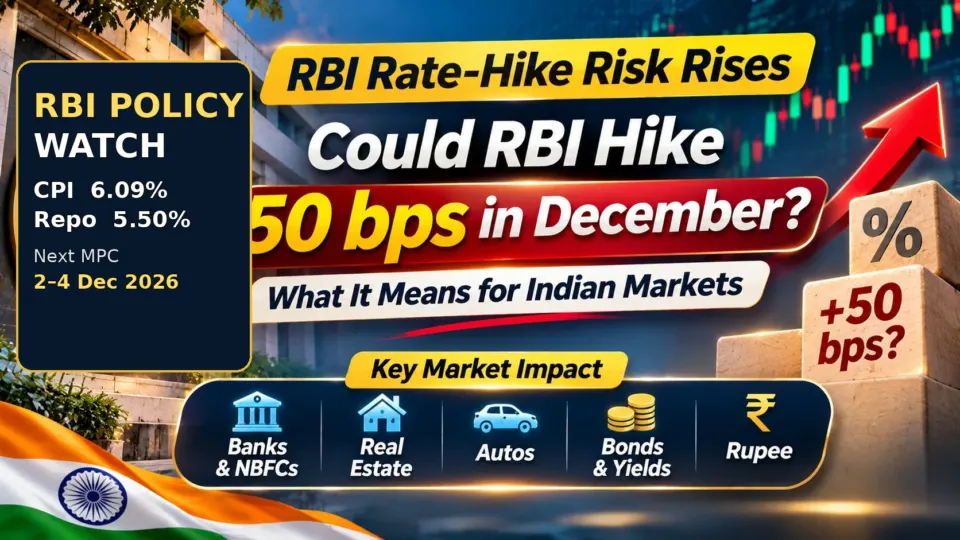
India’s inflation problem has moved back to the centre of the market debate. October retail inflation rose to 6.09%, above the Reserve Bank of India’s 2%–6% tolerance band, while food inflation accelerated to 8.94%. The RBI had already raised the repo rate by 25 basis points to 5.50% in October and shifted its policy stance to calibrated tightening.
That combination means the 2–4 December Monetary Policy Committee meeting is no longer a routine event for equity investors. A further hike is widely expected by economists, but there is disagreement over the size. ICRA expects another 25-bps increase, while JPMorgan has flagged a possible 50-bps move in December and sees as much as 75 bps of cumulative tightening by April if inflation remains persistent.
For investors, the distinction matters. A 25-bps hike would reinforce the existing tightening cycle. A 50-bps move would send a stronger signal that the RBI is worried about inflation becoming broader and more entrenched. Banks, NBFCs, real estate, autos, bonds, the rupee and richly valued growth stocks would not react in the same way.
⚡ Quick answer
Is a 50-bps RBI hike confirmed?
No. The RBI has not announced a December decision. The current repo rate is 5.50%, and the next MPC meeting is scheduled for 2–4 December 2026. A 50-bps move is a hawkish scenario discussed by some economists, including JPMorgan, while several forecasters still expect a 25-bps hike. Investors should treat 50 bps as a risk scenario, not as an official outcome.
Key takeaways
October 2026 CPI inflation rose to 6.09%, above the RBI’s 6% upper tolerance level.
Food inflation accelerated to 8.94%, increasing the risk that headline inflation remains elevated in the near term.
The RBI raised the repo rate by 25 bps to 5.50% in October and changed its stance to calibrated tightening.
The next MPC meeting is scheduled for 2–4 December 2026.
ICRA expects a 25-bps December hike, while JPMorgan has flagged a possible 50-bps move and 75 bps of tightening by April.
Banks can benefit from faster asset repricing, but deposit costs and bond-book losses can offset that advantage.
NBFCs are generally more exposed to higher funding costs, especially where liabilities reprice faster than assets.
Real estate and autos can face demand pressure as mortgage and vehicle-loan EMIs rise.
Bond yields can rise and prices fall when markets price a more aggressive tightening path.
A firmer rate path can support the rupee by improving relative yields, although global dollar moves and oil prices still matter.
1. Why the December RBI meeting suddenly matters more
The inflation backdrop has changed quickly enough to make monetary policy a direct equity-market variable again.
Under the new CPI series, headline inflation rose from 5.54% in September to 6.09% in October. Rural inflation was 6.63%, urban inflation 5.41%, and food inflation accelerated from 7.74% to 8.94%.
The RBI had already anticipated a difficult inflation period. In October, the MPC raised the repo rate by 25 basis points to 5.50% and changed the policy stance from neutral to calibrated tightening. The RBI explicitly said that, under that stance, the next policy move could be a hike or a pause rather than a cut.
That makes December a test of how aggressively the central bank wants to respond now that headline inflation has moved above the upper tolerance boundary.
Investors following the broader market can compare this policy risk with RegalTicker’s 17 November Indian market review, where banking strength, foreign inflows and a firmer rupee were important supports for the indices.
2. Why 50 bps is being discussed
A 50-bps increase would be unusually forceful relative to the RBI’s October move, which is why the scenario is attracting attention.
JPMorgan expects inflation to remain above 6% through June 2027 and sees the possibility of 75 basis points of tightening by April, including a possible 50-bps increase in December. ICICI Securities has also said a larger move is possible.
The argument for acting more aggressively is that inflation is no longer only a single-item shock. Food remains the largest immediate pressure, but economists are also watching whether higher energy, commodity and wage costs feed into a wider set of goods and services.
There is also a credibility consideration. Inflation above the tolerance ceiling can increase inflation expectations among households and businesses. If those expectations become embedded, bringing inflation back toward the 4% target can become more expensive later.
But this is not a one-way argument. Supply-driven food inflation does not respond quickly to higher interest rates, and an unnecessarily aggressive hike can weaken interest-sensitive demand without immediately increasing food supply.
That is why a 25-bps step remains a credible alternative.
3. The 25-bps case is still very much alive
ICRA expects the RBI to raise the repo rate by another 25 basis points in December. Several other economists surveyed after the October CPI release have also favoured a second consecutive 25-bps move.
The logic is straightforward. The RBI has already started tightening, and monetary policy operates with a lag. A measured 25-bps increase would allow the MPC to reinforce its anti-inflation message without assuming that the recent spike will persist unchanged for many quarters.
The October CPI increase was materially driven by food, while the RBI itself has emphasised that the future path depends on whether price pressures broaden, whether second-round effects appear and how underlying inflation evolves.
For markets, a 25-bps move would probably be easier to absorb if it comes with guidance suggesting that the RBI remains data-dependent. A 50-bps move would be more likely to trigger an immediate repricing of the expected terminal policy rate.
4. What higher rates could mean for bank stocks
Banks are not automatically losers when policy rates rise.
Many floating-rate loans reprice relatively quickly after a repo-rate increase. That can lift lending yields before the full increase in deposit costs passes through, temporarily supporting net interest margins for some lenders.
But the benefit depends heavily on funding structure. Banks with a strong low-cost CASA deposit franchise are generally better placed than banks that rely more heavily on expensive term deposits or wholesale funding.
There are also two offsets.
First, deposit competition can intensify as savers demand higher returns. Second, rising bond yields reduce the market value of existing fixed-rate bonds, which can create treasury pressure depending on portfolio classification and hedging.
So the better question for investors is not “Are rate hikes good for banks?” It is “Which banks can reprice assets faster than liabilities while protecting credit quality?”
That distinction becomes more important if the tightening cycle extends beyond December.
5. Why NBFCs could feel more pressure
NBFCs often face a less comfortable rate-hike equation than large deposit-taking banks.
Many non-bank lenders fund themselves through bank borrowings, bonds, securitisation and other market-linked liabilities. If those funding costs rise quickly while their loan books reprice more slowly, spreads can compress.
The impact varies widely by business model. A lender with short-duration assets and strong pricing power can pass through higher costs faster. A lender operating in intensely competitive consumer segments may not be able to do so without hurting loan growth.
Higher EMIs can also affect borrower affordability, making credit-cost trends important to watch alongside margins.
For NBFC investors, December policy commentary could therefore matter as much as the headline repo-rate move.
6. Real estate and autos are directly exposed to EMI sensitivity
Real estate and automobiles are two of the clearest interest-sensitive equity sectors.
A higher repo rate can eventually push up home-loan and vehicle-loan rates. Even a modest increase in monthly EMI can change affordability for buyers already stretching household budgets.
Premium housing can be more resilient because wealthier buyers rely less heavily on leverage, while mass-market housing is generally more sensitive to financing costs.
In autos, the impact differs by segment. Two-wheelers and entry-level passenger vehicles can be more sensitive to household cash flow, while premium buyers may absorb moderate rate changes more easily.
This does not mean a 25-bps hike automatically causes a collapse in demand. Employment, wage growth, festive demand, product cycles and fuel prices remain important. But the direction of financing conditions becomes less supportive as the rate cycle tightens.
7. Bond investors would feel the change immediately
Bond prices and yields move in opposite directions.
If traders begin pricing a 50-bps December move and a higher terminal repo rate, government-bond yields can rise before the RBI actually meets. Existing bonds with lower coupons then lose value in the secondary market.
The magnitude depends on maturity. Longer-duration bonds are generally more sensitive to changes in interest-rate expectations than short-duration securities.
This matters to equity investors too because the government-bond yield is an important reference point for corporate borrowing costs and valuation models. A higher risk-free rate can reduce the present value investors are willing to pay for distant future cash flows.
That is one reason expensive long-duration growth stocks can struggle even when their near-term earnings estimates have not changed.
8. A more hawkish RBI could support the rupee
Higher domestic interest rates can make rupee assets relatively more attractive to global investors, all else equal.
That can help the currency by improving real-rate differentials and reducing some pressure on the RBI to defend the rupee through liquidity or foreign-exchange operations.
But monetary policy is only one part of the currency equation.
Oil prices remain important because India imports a large share of its crude. A renewed energy shock can widen the trade deficit and increase dollar demand even if domestic rates are rising. RegalTicker’s analysis of Strait of Hormuz risk and Indian markets explains that transmission channel.
Foreign portfolio flows also matter. November has seen unusually strong foreign buying of Indian equities, and the existing FPI flow analysis tracks why those flows can support both equities and the currency.
9. What a 50-bps surprise could do to the stock market
Markets respond most aggressively to the difference between an outcome and what was already priced in.
If investors enter the December meeting expecting 25 bps and the RBI raises 50 bps, the immediate reaction could include higher bond yields, pressure on rate-sensitive sectors and a stronger rupee.
Bank reactions could be mixed rather than uniformly negative. Strong-liability franchises may be treated more favourably, while lenders with funding-cost pressure could lag.
Real estate, autos and highly valued growth companies would probably face the clearest valuation headwind from a surprise hawkish move.
On the other hand, if the RBI delivers only 25 bps after markets have increasingly priced 50, some rate-sensitive assets could experience a relief move.
That is why investors should watch expectations in the days before the meeting rather than focusing only on the final headline.
Investor note
The bigger signal may be the terminal rate, not December alone
A single 25- or 50-bps move matters less than the path the RBI signals afterward. If the MPC indicates inflation is likely to stay above target for longer, markets may price additional tightening even after a smaller December increase. Conversely, a hawkish December move accompanied by confidence that inflation will peak soon could shorten the expected cycle. Watch the inflation forecast, liquidity commentary and language around underlying price pressures alongside the repo decision.
10. What investors should monitor before 4 December
Five variables deserve particular attention before the policy decision.
First is the November inflation trajectory, especially food prices and signs of broadening core pressures.
Second is crude oil. Softer oil reduces imported inflation pressure; another geopolitical spike does the opposite.
Third is the rupee. A disorderly currency decline can strengthen the case for tighter policy, while a stable or firmer rupee gives the RBI more flexibility.
Fourth is government-bond pricing. A sharp increase in yields before the meeting would indicate that markets are already preparing for a more hawkish outcome.
Fifth is credit and demand data. The RBI has highlighted strong monetary and credit aggregates as a potential risk even though demand-driven inflation remains less obvious than the supply shock.
Investors should also separate monetary-policy risk from global central-bank risk. RegalTicker’s Fed rate analysis for Indian markets provides the external side of the equation.
Frequently asked questions
Will the RBI definitely hike rates by 50 bps in December 2026?
No. A 50-bps move is a scenario discussed by some economists, including JPMorgan. Other forecasters, including ICRA, expect a 25-bps hike. The RBI has not announced its decision.
What is the RBI repo rate currently?
The policy repo rate is 5.50% after the RBI raised it by 25 basis points in October 2026.
When is the next RBI MPC meeting?
The next Monetary Policy Committee meeting is scheduled for 2–4 December 2026.
Why is the RBI considering further tightening?
October CPI inflation rose to 6.09%, above the 6% upper tolerance level, while food inflation reached 8.94%. The RBI is also watching whether price pressures broaden and create second-round effects.
Are rate hikes positive or negative for bank stocks?
The impact is mixed. Loan yields can reprice upward, but deposit costs and bond-book losses can also rise. Banks with strong low-cost deposits and pricing power can be better placed.
Why are NBFCs sensitive to higher rates?
Many NBFCs depend on bank and market borrowing. If their funding costs rise faster than loan yields, margins can come under pressure.
How do higher rates affect real estate and auto stocks?
Higher borrowing rates increase home-loan and vehicle-loan EMIs, which can reduce affordability and demand at the margin.
What happens to bonds when interest rates rise?
Existing bond prices generally fall as yields rise, with longer-duration bonds usually more sensitive to changes in rate expectations.
Can an RBI rate hike strengthen the rupee?
Higher domestic yields can support the rupee, but oil prices, global dollar moves, trade flows and foreign portfolio flows can override that effect.
Should investors change their portfolio before the RBI meeting?
A policy meeting alone is not a reason for automatic portfolio changes. Investors should evaluate balance-sheet quality, leverage, funding structure, valuation and their own risk horizon rather than trying to predict one meeting precisely.
Verify through official sources
Official references
- Reserve Bank of India — October 2026 MPC resolution and policy stance — RBI raised the repo rate to 5.50%, adopted calibrated tightening and scheduled the next MPC meeting for 2–4 December 2026.
- Ministry of Statistics and Programme Implementation — October 2026 CPI release — Official CPI release showing 6.09% headline inflation and 8.94% food inflation.
- Reuters — Wanted: A proactive RBI to tame inflation — Reports JPMorgan’s possible 50-bps December scenario and 75 bps of tightening by April, alongside the broader policy debate.
- ICRA — October inflation breaches MPC tolerance band — ICRA expects a 25-bps December hike and details the broadening October inflation picture.
Final takeaway
December is now a policy-risk event, not a foregone conclusion
India’s October inflation print makes another RBI hike in December increasingly plausible, but the size remains uncertain. A 25-bps increase would extend the tightening cycle; a 50-bps move would signal substantially greater concern about inflation persistence. For equity investors, the best preparation is not to guess the exact number but to understand which businesses can withstand higher funding costs, weaker EMI-sensitive demand and a higher discount rate. Banks with strong funding franchises, conservatively financed companies and businesses with pricing power are likely to handle a longer tightening cycle better than highly leveraged or rate-sensitive peers.
Educational disclaimer: This article is for educational and informational purposes only and does not constitute investment advice, a recommendation to buy or sell securities, or a prediction of the RBI’s December decision. Monetary-policy expectations can change quickly with inflation, growth, oil prices, currencies and financial-market conditions. Investors should evaluate their own objectives, risk tolerance and financial circumstances before making investment decisions.