India is turning LPG diversification into a longer-term strategy
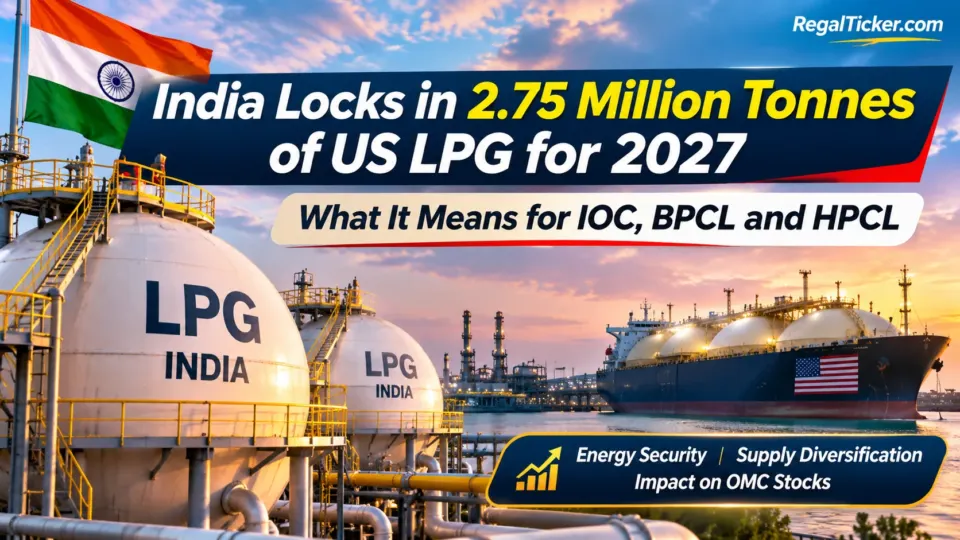
India’s state-run oil marketing companies are taking another significant step away from excessive dependence on Middle Eastern LPG supply. Indian Oil Corporation, Bharat Petroleum Corporation and Hindustan Petroleum Corporation have awarded a joint tender covering about 2.75 million metric tonnes of US LPG for delivery during 2027.
For investors, the important point is not simply that India is buying more American fuel. The deal comes after a year in which West Asian disruptions repeatedly exposed how vulnerable India’s LPG supply chain can become when too much imported product relies on the same geography and shipping routes. A larger US supply base can improve resilience and bargaining flexibility, but it does not automatically guarantee cheaper LPG or stronger OMC margins.
⚡ Quick answer
What changed?
IOC, BPCL and HPCL have jointly secured around 2.75 million tonnes of US LPG for 2027. The contracted cargoes involve Saudi Aramco, Chevron, TotalEnergies Trading and Vitol. The move builds on India’s first structured US Gulf Coast LPG contract for 2026 and could lift the United States to roughly one-quarter of India’s LPG import sourcing in 2027 if the government’s diversification objective is achieved.
Key takeaways
IOC, BPCL and HPCL have awarded a joint tender for about 2.75 million tonnes of US LPG for 2027.
The contracted suppliers include Saudi Aramco, Chevron, TotalEnergies Trading and Vitol.
Reuters reported that India sourced roughly 90% of its LPG imports from the Middle East in 2025.
India is targeting up to one-quarter of LPG imports from the US in 2027.
The 2027 arrangement expands on India’s first structured US Gulf Coast LPG contract of about 2.2 MTPA for 2026.
Diversification reduces geographic concentration risk but does not guarantee lower landed LPG costs.
Freight, benchmark pricing, cargo terms and domestic pricing policy remain crucial for OMC profitability.
IndianOil has recently highlighted rising domestic LPG under-recovery as international propane and butane benchmarks strengthened.
The shift also supports the broader India-US energy and trade relationship.
For IOC, BPCL and HPCL investors, supply security is positive, but margin economics matter more than headline import volumes.
1. What the 2027 US LPG deal actually covers
The three state-owned oil marketing companies have used a joint tender to secure about 2.75 million metric tonnes of LPG for delivery during calendar year 2027.
According to current reporting, Saudi Aramco and Chevron are each expected to supply one delivered cargo per month. TotalEnergies Trading is expected to supply two delivered cargoes per month, while Vitol will provide one monthly cargo on a free-on-board basis.
A typical very large gas carrier can carry roughly 46,000 tonnes, so the tender represents a sustained stream of cargoes rather than a one-off spot purchase.
That distinction matters. Long-term or structured procurement gives the OMCs more visibility over supply and reduces the need to rely entirely on spot-market availability during periods of geopolitical stress.
2. Why India is deliberately reducing Middle East concentration
India’s LPG market has historically depended heavily on the Middle East.
Reuters reported that the region supplied about 90% of India’s 21.85 million tonnes of LPG imports in 2025. Separately, the Indian government said during the West Asia disruption in March 2026 that India imports roughly 60% of the LPG it consumes and that around 90% of those imports were exposed to the Strait of Hormuz route at that time.
That concentration became a strategic weakness when shipping through the Gulf was disrupted.
The problem was not that Middle Eastern suppliers suddenly became structurally unreliable. The problem was concentration: too much supply, shipping and pricing exposure could be affected by the same geopolitical event.
The US Gulf Coast offers a geographically separate supply source. That does not eliminate risk, but it reduces the probability that one regional disruption affects almost the entire import portfolio at once.
RegalTicker’s earlier analysis of the Strait of Hormuz risk for Indian markets explains why energy-route concentration can quickly spill into inflation, the rupee and equity-sector performance.
3. The shift started before the new 2027 tender
The 2027 contract is not India’s first move toward structured US LPG purchases.
In November 2025, the Ministry of Petroleum and Natural Gas announced India’s first major structured LPG import arrangement with the United States. IOC, BPCL and HPCL concluded a one-year contract for about 2.2 million tonnes per annum from the US Gulf Coast for 2026.
At the time, the government said that volume represented close to 10% of India’s annual LPG imports.
The new 2.75 million-tonne tender therefore looks less like an experiment and more like a widening of the diversification strategy.
If the US eventually supplies around one-quarter of India’s LPG imports in 2027, the sourcing mix would look materially different from the Middle East-heavy structure that prevailed only two years earlier.
4. What this means for IOC, BPCL and HPCL
All three OMCs benefit strategically from having more sourcing options.
A more diversified supplier base can improve negotiating flexibility, reduce emergency spot purchases and lower the operational risk associated with disruptions in a single region.
That can be especially valuable for LPG because household cooking-gas supply is politically and socially important in India. The OMCs cannot treat shortages in the same way an industrial buyer might respond to a temporary feedstock problem.
However, investors should separate supply security from profitability.
The fact that IOC, BPCL and HPCL can access more US cargoes does not mean each imported tonne is automatically more profitable. The financial outcome depends on the landed cost of LPG and how much of that cost can ultimately be recovered through retail pricing or government support.
5. US LPG does not automatically mean cheaper LPG
This is the most important caution for investors.
US LPG can be attractive because the US has deep natural-gas-liquids production and export infrastructure. But India is much farther from the US Gulf Coast than from major Middle Eastern loading ports.
The final landed cost depends on several moving parts:
- the benchmark price used for the cargo;
- freight from the loading port to India;
- shipping availability and insurance;
- terminal and handling costs;
- whether the cargo is delivered or bought free on board;
- propane and butane mix;
- currency movements; and
- domestic retail pricing and compensation mechanisms.
A supply-diversification decision can therefore be strategically sensible even if an individual US cargo is not always the cheapest cargo available on a particular day.
The benefit should be judged across the full portfolio rather than by comparing one shipment with one Middle Eastern cargo.
6. LPG under-recovery remains the key margin question
For equity investors, OMC economics still matter more than the headline country of origin.
IndianOil’s management recently said domestic LPG under-recovery had increased from about ₹184 per cylinder in September to ₹229 in October, with an expectation of around ₹309 in November and potentially ₹370 in December if then-prevailing benchmark conditions continued.
Management linked that pressure to a rise in the Saudi contract price for propane and butane.
Those figures are company-specific estimates and can change with international prices, government policy and retail-price decisions. But they illustrate the core issue.
If imported LPG becomes more expensive while domestic cylinder prices do not adjust proportionately, the OMCs can carry substantial under-recoveries even when physical supply is secure.
That means investors should not interpret the US procurement deal as a direct earnings upgrade.
7. Why the OMCs still need a diversified supply portfolio
A diversified portfolio can protect the OMCs in several ways even when it does not immediately improve margins.
First, it reduces the need to scramble for replacement cargoes when one route is disrupted.
Second, it gives procurement teams more benchmark and supplier alternatives.
Third, it can improve negotiating power by reducing dependence on a concentrated group of suppliers.
Fourth, it can support inventory planning because more structured term cargoes provide greater visibility than repeated spot-market purchases.
And fifth, it provides India with more geopolitical flexibility in managing energy relationships across the Middle East, United States and other suppliers.
This matters because energy security is increasingly becoming a portfolio-management problem rather than a simple search for the cheapest molecule.
8. There is also an India-US trade angle
The LPG contracts sit inside a broader trade relationship.
India has been increasing energy purchases from the United States, while the two countries continue discussions around trade and market access.
Buying more US energy can help narrow India’s merchandise trade surplus with the United States without requiring India to cut demand for strategically important energy products.
For investors, however, this geopolitical angle should remain secondary to commercial economics.
The three OMCs ultimately need competitive landed supply. If trade-policy objectives push procurement materially above alternative market prices, that would weaken the financial benefit. The best outcome is where strategic diversification and competitive economics reinforce each other.
9. What could go wrong with the strategy
The first risk is freight.
A longer voyage from the US Gulf Coast can increase shipping expense, especially if tanker rates rise.
The second risk is benchmark volatility. US and Middle Eastern LPG prices can move differently, so the relative advantage can reverse from one period to another.
The third risk is currency. A weaker rupee increases the local-currency cost of dollar-denominated energy imports regardless of origin.
The fourth risk is domestic pricing policy. Even a well-negotiated cargo can create under-recovery if retail LPG prices are held below cost.
The fifth risk is infrastructure and logistics. More geographically diverse sourcing still has to fit Indian terminal capacity, coastal logistics, storage and distribution networks.
And finally, geopolitical risk does not disappear simply because cargoes originate in the United States. Shipping routes, global sanctions, insurance markets and energy prices remain interconnected.
Investor note
The deal reduces concentration risk, not earnings risk
The strongest investment takeaway is improved supply resilience. IOC, BPCL and HPCL now have a broader procurement base, but the earnings impact will still be determined by landed LPG cost, domestic pricing policy, under-recoveries and the wider refining-and-marketing cycle.
10. What investors should monitor next
The first number to watch is the actual share of US LPG in India’s 2027 import mix.
The second is landed cost versus competing Middle Eastern supply. The procurement strategy only becomes financially powerful if diversification can be achieved without paying a persistent premium.
Third, watch domestic LPG under-recovery disclosures from IOC, BPCL and HPCL.
Fourth, monitor government decisions on compensation, subsidies or retail-price changes.
Fifth, keep an eye on the Strait of Hormuz and other shipping routes. If Gulf risk remains elevated, the strategic value of non-Gulf supply rises even if freight is higher.
Finally, compare LPG economics with the wider earnings engines of each OMC: refining margins, petrol and diesel marketing margins, petrochemicals, pipeline operations and capital expenditure.
The 17 November Indian market review provides useful context on how foreign flows, crude and the rupee are currently influencing broader Indian equities.
Frequently asked questions
How much US LPG have Indian oil companies secured for 2027?
IOC, BPCL and HPCL have jointly awarded a tender covering about 2.75 million metric tonnes of US LPG for delivery in 2027.
Which companies are supplying the LPG?
Current reporting identifies Saudi Aramco, Chevron, TotalEnergies Trading and Vitol among the suppliers under the joint tender.
Why is India buying more LPG from the United States?
The main strategic reason is supply diversification. India has historically depended heavily on Middle Eastern LPG imports, so US supply reduces geographic and shipping-route concentration.
Will US LPG reduce prices for Indian consumers?
Not necessarily. Consumer prices depend on landed import cost, freight, currency movements, domestic pricing policy and any government compensation or subsidy mechanism.
Is the deal automatically positive for IOC, BPCL and HPCL profits?
No. It is positive for supply resilience, but profitability still depends on procurement cost, under-recovery, retail pricing, refining margins and marketing economics.
Has India imported US LPG under long-term arrangements before?
Yes. India announced its first major structured US LPG import contract in November 2025 for about 2.2 million tonnes per annum for the 2026 contract year.
What should OMC investors watch most closely?
Landed LPG costs, domestic under-recoveries, government pricing decisions, crude and LPG benchmarks, freight rates and the mix of supply sources are the most relevant indicators.
Verify through official sources
Official references
- Reuters – Indian companies to buy US LPG in 2027 from Aramco, Chevron, Vitol and Totsa — Current report on the 2.75 million-tonne joint tender, suppliers, import concentration and India’s 2027 US-sourcing objective.
- Press Information Bureau – India Concludes First-Ever Major LPG Import Deal with US — Government source for the 2.2 MTPA US Gulf Coast LPG contract for 2026 and the original diversification strategy.
- Press Information Bureau – Inter-Ministerial Briefing on Recent Developments in West Asia — Government context on India’s LPG import dependence and exposure to Strait of Hormuz disruption during 2026.
- IndianOil – Q2 FY27 Analyst Conference Call Transcript — Primary company source for current LPG under-recovery commentary and benchmark-price sensitivity.
- IndianOil – H1 FY27 Performance — Primary source for recent IndianOil operating and financial context.
Final takeaway
Diversification is strategically positive, but margins will decide the investment outcome
India’s 2.75 million-tonne US LPG tender is a meaningful step in reducing dependence on a Middle East-heavy import structure. For IOC, BPCL and HPCL, a broader supplier base can improve supply security and procurement flexibility after a year of severe Gulf disruption. But investors should resist treating the deal as an automatic earnings catalyst. The decisive variables remain landed cost, freight, currency, domestic LPG pricing and under-recovery. The strategic benefit is clearer than the immediate profit impact.
Educational disclaimer: This article is for education and general market information only. It is not investment advice or a recommendation to buy or sell Indian Oil Corporation, Bharat Petroleum Corporation, Hindustan Petroleum Corporation or any other security. LPG procurement economics, international prices, freight, exchange rates, government policy and company under-recoveries can change quickly. Investors should review the latest exchange filings and company disclosures before making decisions.