
What Are Corporate Actions in the Stock Market? Meaning, Types and Examples
Learn corporate actions in the stock market through clear examples of dividends, bonus shares, stock splits, rights issues, buybacks and…
Master the shareholder events that can change your cash, share quantity, ownership cost and investment decisions through an ordered, expandable curriculum and practical calculators.
Education-first guidanceAlways verify the final terms in the official company or exchange filing.
Start with the event affecting your holding, then follow the linked lesson for its dates, mechanics and investor implications.
A company distributes part of its earnings or reserves to eligible shareholders.
Understand this action 02 Share quantityAdditional shares are allotted in a declared ratio without a fresh purchase.
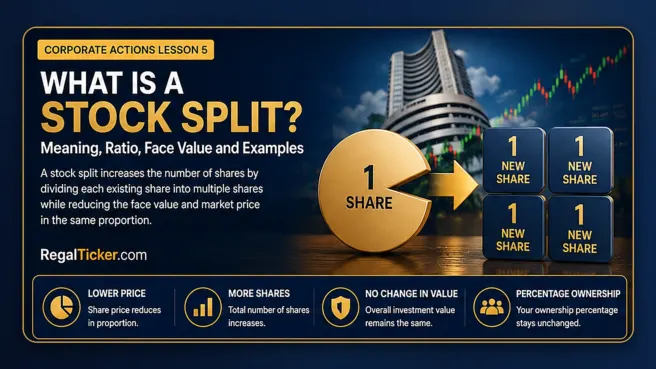
Understand this action 03 Units and priceThe face value and number of shares change while the proportional holding remains.
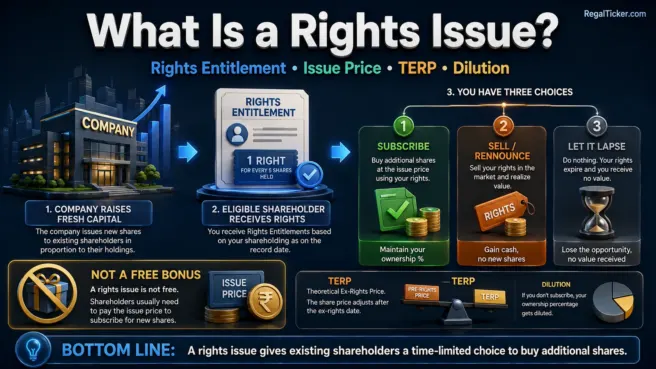
Understand this action 04 Investor choiceEligible shareholders receive an opportunity to buy shares on stated terms.
Understand this action 05 Exit opportunityA company offers to repurchase shares, subject to the route, terms and acceptance.
Understand this action 06 Ownership structureDemergers, amalgamations and spin-offs can reshape what shareholders own.
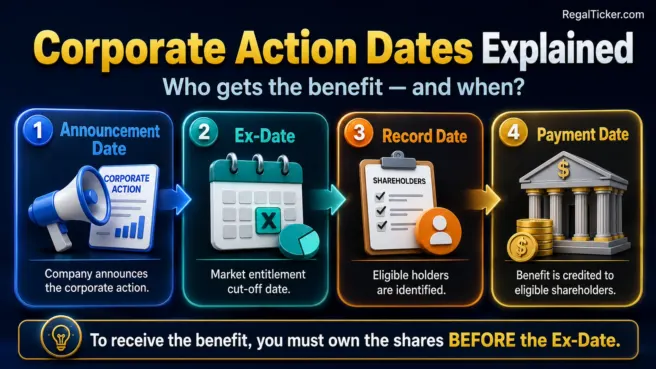
Understand this actionThe announcement tells you what is proposed. The ex-date and record date help determine eligibility, while the final date tells you when the benefit or payment is completed.
Learn Ex-Date and Record DateThe action, ratio, amount and timetable are disclosed.
The share begins trading without the upcoming entitlement.
Eligible holders are identified from the company records.
Cash, shares or another entitlement reaches eligible holders.
Move from the basic meaning and important dates to rewards, investor decisions and complex business restructuring.
Learn corporate actions in the stock market through clear examples of dividends, bonus shares, stock splits, rights issues, buybacks and…
Understand ex-date vs record date, announcement date and payment date with simple eligibility examples and current India-focused corporate-action guidance.
Learn what a dividend is, how it works, interim vs final dividends, ex-date, record date, dividend yield, payout ratio and…
Learn what bonus shares are, how bonus ratios work, why companies issue them, what record date means and how bonus…
Learn what a stock split is, how split ratios change share quantity and face value, why companies split shares, and…
Learn what a rights issue is, what Rights Entitlement means, what happens if you do nothing, how TERP works and…
Learn what a share buyback is, how tender offers and acceptance ratios work, small-shareholder rules, examples and current Indian tax…
Learn what a demerger is, how share entitlement and record date work, how value and cost basis are divided, and…
Learn what an amalgamation is, how share-exchange ratios work, what happens to old shares, and how accounting, tax and cost…
Learn what a corporate spin-off is, how shareholders receive new-company shares, how entitlement and cost allocation work, and how it…
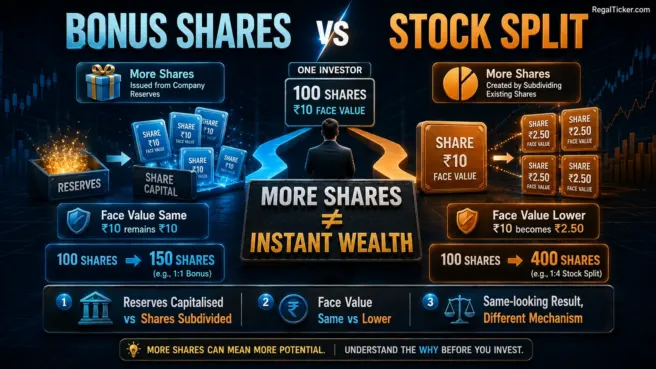
Compare bonus shares vs stock split with simple examples. Learn the effect on share count, face value, price, reserves, cost…
Estimate the effect on shares, cost, proceeds and returns using calculators connected directly to the lessons.
Calculate dividend income, current yield and yield on cost.
Open calculator 02Calculate bonus-share entitlement, revised holdings and theoretical ex-bonus price for Indian bonus issues.
Open calculator 03Calculate revised shares, theoretical adjusted price and comparable cost after an Indian face-value stock split or consolidation.
Open calculator 04Calculate entitlement, subscription cost, TERP and RE value.
Open calculator 05Calculate buyback entitlement, acceptance scenarios, returned shares and tender-offer outcomes for India.
Open calculator 06Reconstruct true stock returns across dated bonus issues, splits and consolidations with demat reconciliation.
Open calculator 07Allocate original cost between parent and resulting-company shares.
Open calculator 08Calculate merger or amalgamation share entitlement, fractions and indicative consideration.
Open calculatorUse this simple sequence whenever a dividend, rights issue, buyback or restructuring appears in your portfolio.
Official terms come first.Calculators provide estimates; the company and exchange filings remain the final reference.
Confirm the action type, ratio or amount, timetable and conditions.
Separate the announcement, ex-date, record date and payment or allotment date.
Some benefits are automatic; others require an application or decision.
Use the relevant calculator to test shares, cash, cost and return outcomes.
Check the demat or bank entry and retain documents needed for your records.
Compare bonus shares vs stock split with simple examples. Learn the effect on share count, face value, price, reserves, cost records and investor wealth.
Short answers to the questions investors commonly ask before opening a detailed lesson.
Begin the full courseIt is an event or decision by a company that can affect its securities or shareholders, such as a dividend, bonus issue, split, rights issue, buyback or restructuring.
No. Some benefits are processed automatically for eligible holders, while actions such as rights issues or buybacks may require a choice or application. Always read the official terms.
They are part of the timetable used to determine which shareholders are entitled to the announced benefit. Lesson 2 explains how the dates work together.
Not by itself. The number of shares and the reference price adjust in relation to the declared ratio, so investors should compare the total holding value rather than only the share count.
Use the company announcement and the relevant stock-exchange filing for the final dates, ratios, conditions and subsequent updates.
No. The calculators are educational estimates. Tax treatment can depend on the action, transaction date and investor circumstances, so verify the current rules for your case.