

⚡ Quick answer
A dividend is a distribution made by a company to eligible shareholders, most commonly as cash paid for each share held. A company may declare an interim, final or special dividend when its board decides that part of the available profit or reserves should be returned to shareholders. The declared amount, ex-date, record date and payment date must all be checked because a dividend is not guaranteed and buying a share after it turns ex-dividend normally does not provide entitlement to that announced payment.
Key takeaways
A dividend is usually paid as a rupee amount per eligible share and provides cash income without requiring the investor to sell shares.
Interim, final and special dividends differ in timing, approval process and purpose.
The announcement date, ex-date, record date and payment date perform different functions in the dividend process.
Buying a share on or after the ex-date normally does not provide entitlement to that announced dividend.
Dividend yield measures dividend income relative to market price, while the dividend payout ratio compares dividends with company earnings.
A high dividend yield is not automatically attractive; it can rise because the share price has fallen or because the payout may be difficult to sustain.
The share price can adjust when the dividend entitlement separates, so a dividend is not free money or a guaranteed trading profit.
Sustainable dividends depend on profit, cash flow, debt, reinvestment needs and the company’s capital-allocation policy.
Always verify the official company or stock-exchange announcement before using a dividend amount, ex-date, record date or payment date.
Use the Dividend Calculator to estimate dividend income and yield, but evaluate dividend sustainability separately.
What Is a Dividend in the Stock Market?
📖 Definition
Dividend
A dividend is a distribution declared by a company for eligible shareholders. For listed equity shares, it is usually expressed as a rupee amount per share and credited in cash to the registered bank account. Whether a dividend is paid, how much is paid and when it is paid depend on the company’s financial position, board decision, approvals, applicable law and the official announcement.
Suppose a company declares a dividend of ₹6 per equity share. An investor who holds 250 eligible shares has a gross entitlement of:
FORMULA: Gross dividend = Dividend per share × Eligible shares
💡 Real example
Simple example
₹6 × 250 shares = ₹1,500 gross dividend
The final amount credited may differ if tax is deducted or the investor’s eligible quantity is different from the quantity currently visible in the portfolio.
What a Dividend Can Do
A dividend may:
- return part of the company’s cash to shareholders;
- provide income without selling shares;
- form part of the investor’s total return;
- demonstrate a consistent capital-allocation policy;
- attract investors who value periodic cash flow.
What a Dividend Does Not Prove
A dividend does not automatically prove that:
- the company is financially strong;
- the share is undervalued;
- the dividend will continue next year;
- total shareholder wealth has increased by the amount paid;
- the share price cannot fall;
- the highest-yielding share is the best investment.
A company can report accounting profit but still face weak cash flow, heavy debt or major investment requirements. The quality and sustainability of the payout matter more than the headline amount.
Why Companies Pay Dividends
Companies may distribute dividends for several reasons:
- sharing profits with shareholders;
- returning surplus cash not needed immediately;
- maintaining a predictable shareholder-return policy;
- balancing reinvestment with cash distribution;
- signalling confidence in recurring cash generation;
- meeting the preferences of income-oriented investors.
A company may also avoid or reduce dividends when it is expanding rapidly, repaying debt, preserving liquidity, facing uncertain demand or funding a major capital-expenditure programme.
A business that does not pay dividends is not necessarily weak. When management can reinvest at attractive returns, retaining profits may create more value than distributing them. Conversely, an unusually large payout can indicate that the company has limited reinvestment opportunities or has received a one-time cash inflow.
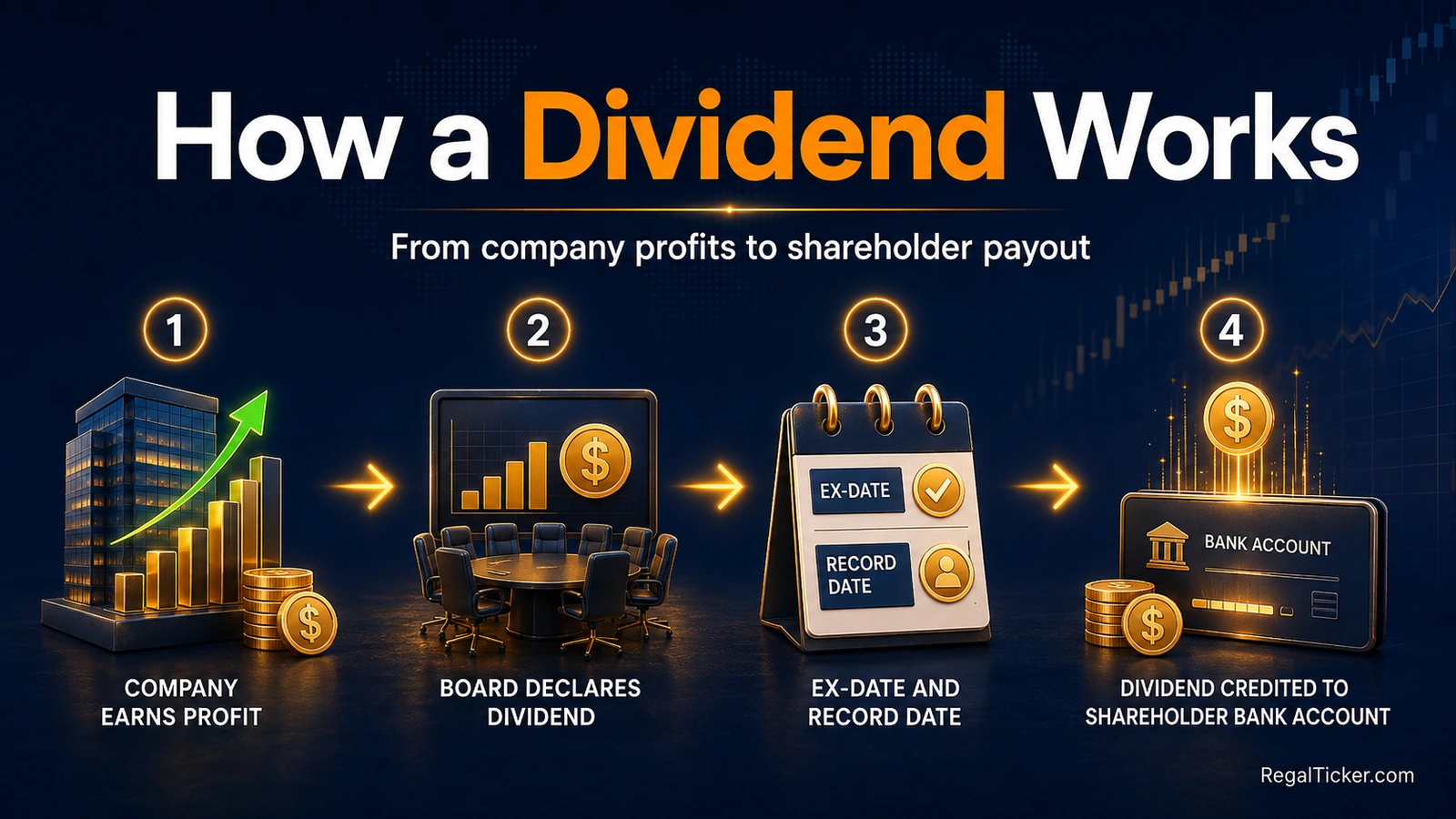
How a Dividend Works from Declaration to Payment
A dividend is not completed the moment a headline appears. It passes through a sequence of company decisions, exchange disclosures, eligibility checks and payment processing.
Step 1: The Company Earns and Allocates Capital
A sustainable dividend generally begins with profits and cash generation. The board considers:
- current and accumulated profits;
- available cash;
- debt obligations;
- future expansion plans;
- regulatory or contractual restrictions;
- working-capital requirements;
- expected business conditions.
The board then decides whether distributing cash is appropriate.
Step 2: The Board Declares or Recommends the Dividend
The company announces the amount per share and the relevant conditions. Depending on the type of dividend, the action may be declared by the board or recommended subject to the required approval.
The announcement may include:
- dividend per share;
- whether it is interim, final or special;
- face value of the share;
- ex-date and record date;
- approval status;
- expected payment schedule;
- tax and documentation information.
Step 3: The Market Reaches the Eligibility Dates
The ex-date separates the dividend entitlement from the share. The record date is used to identify eligible shareholders from the company and depository records.
An investor who buys after the share turns ex-dividend normally does not receive that announced dividend. The exact dates must be verified from the exchange filing rather than assumed from a generic rule.
Step 4: The Company or Registrar Processes Payment
The company and its registrar use the beneficiary information received through the depository system. They calculate the entitlement, apply any required deduction and remit the amount to the registered bank account.
⭐ Pro tip
The dividend normally comes from the company, not the broker
A broker may display the announcement, but the payment is generally processed by the company or its registrar using depository and bank records. A missing payment should therefore be checked against the company filing, registrar details and registered bank information.
Keep Your Records Updated
Investors should keep these details current:
- bank account linked to the Demat holding;
- PAN and KYC status;
- email address and mobile number;
- nomination and address details;
- correct name and account information.
Incorrect or outdated information can delay payment or create a rejected transaction.
Types of Dividends Investors Commonly See
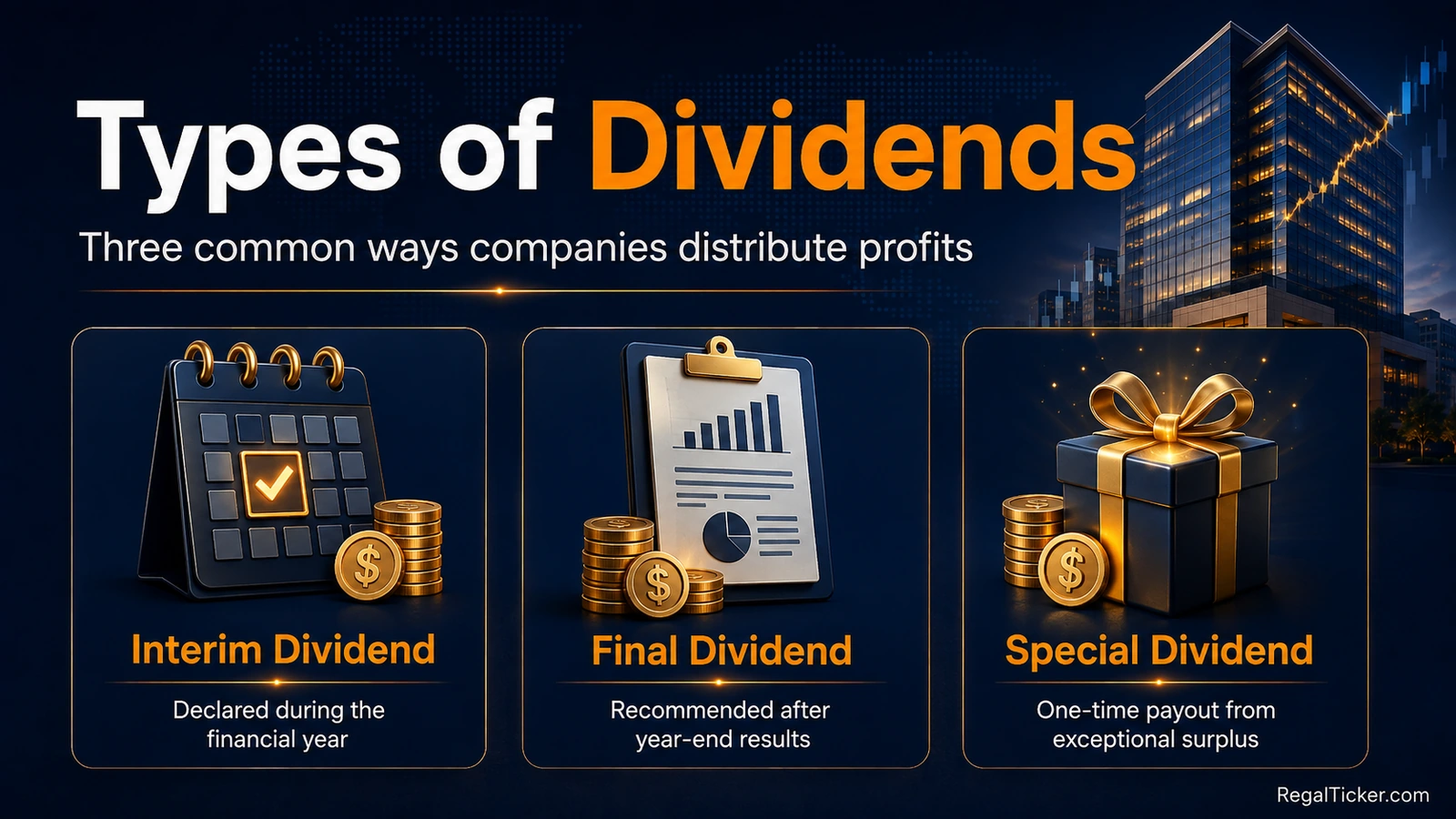
The word dividend can refer to distributions made at different times and for different reasons.
Interim Dividend
An interim dividend is declared during the financial year before the final annual accounts and annual shareholder process are completed.
It may be based on:
- performance during part of the year;
- available cash;
- the company’s normal distribution schedule;
- the board’s assessment at that time.
A company may pay more than one interim dividend in a year, but previous frequency does not guarantee future payments.
Final Dividend
A final dividend is generally recommended after the financial year and is associated with the completed annual results. It proceeds through the approvals applicable to that company.
When one or more interim dividends have already been paid, investors should add them to the final dividend to calculate the total annual distribution.
💡 Real example
A company pays an interim dividend of ₹3 per share and later approves a final dividend of ₹5 per share.
Total dividend for the year = ₹3 + ₹5 = ₹8 per share
Special Dividend
A special dividend is an additional or exceptional distribution outside the normal recurring pattern.
It may follow:
- sale of a major asset or business;
- unusually strong cash generation;
- accumulated surplus cash;
- a restructuring event;
- a deliberate return of excess capital.
A special dividend should not automatically be used to estimate next year’s income because the source may be non-recurring.
Dividend in Kind and Share-Based Distributions
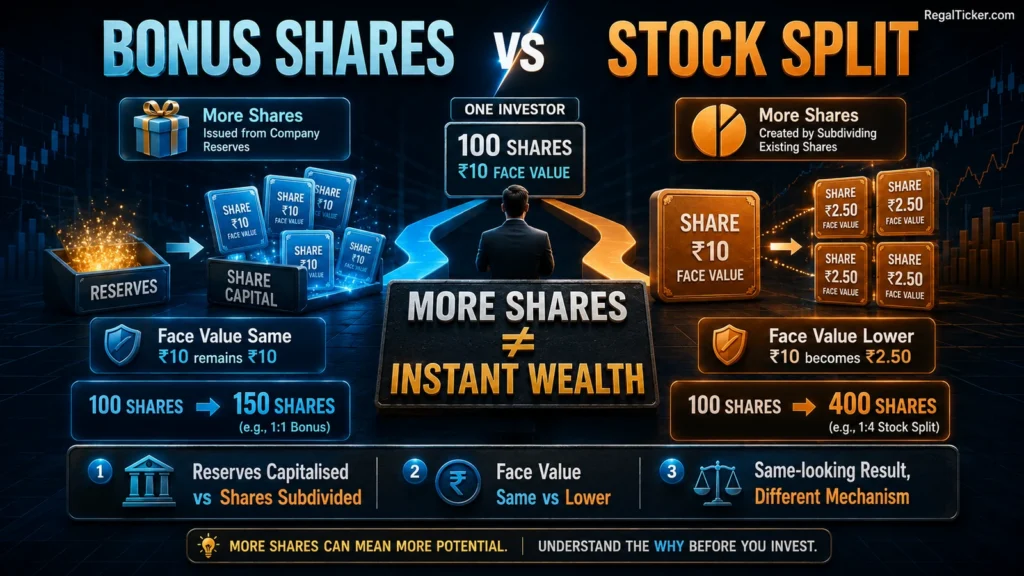
Some markets and instruments may use non-cash distributions. Indian investors should read the official terms carefully and distinguish a cash dividend from bonus shares or another corporate action.
A cash dividend transfers money. A bonus issue credits additional shares and normally changes share quantity and the theoretical per-share price structure. They are not the same action.
| Point | Cash dividend | Bonus shares |
|---|---|---|
| Benefit received | Cash | Additional shares |
| Company cash outflow | Yes | Normally no direct cash payment to shareholders |
| Share quantity | Unchanged | Increases |
| Common investor focus | Income and eligibility dates | Ratio, adjusted quantity and price |
| Primary RegalTicker tool | Dividend Calculator | Bonus Share Calculator |
Important Dividend Dates Every Shareholder Should Know
The dates attached to a dividend determine whether an investor is eligible and when the cash may arrive.
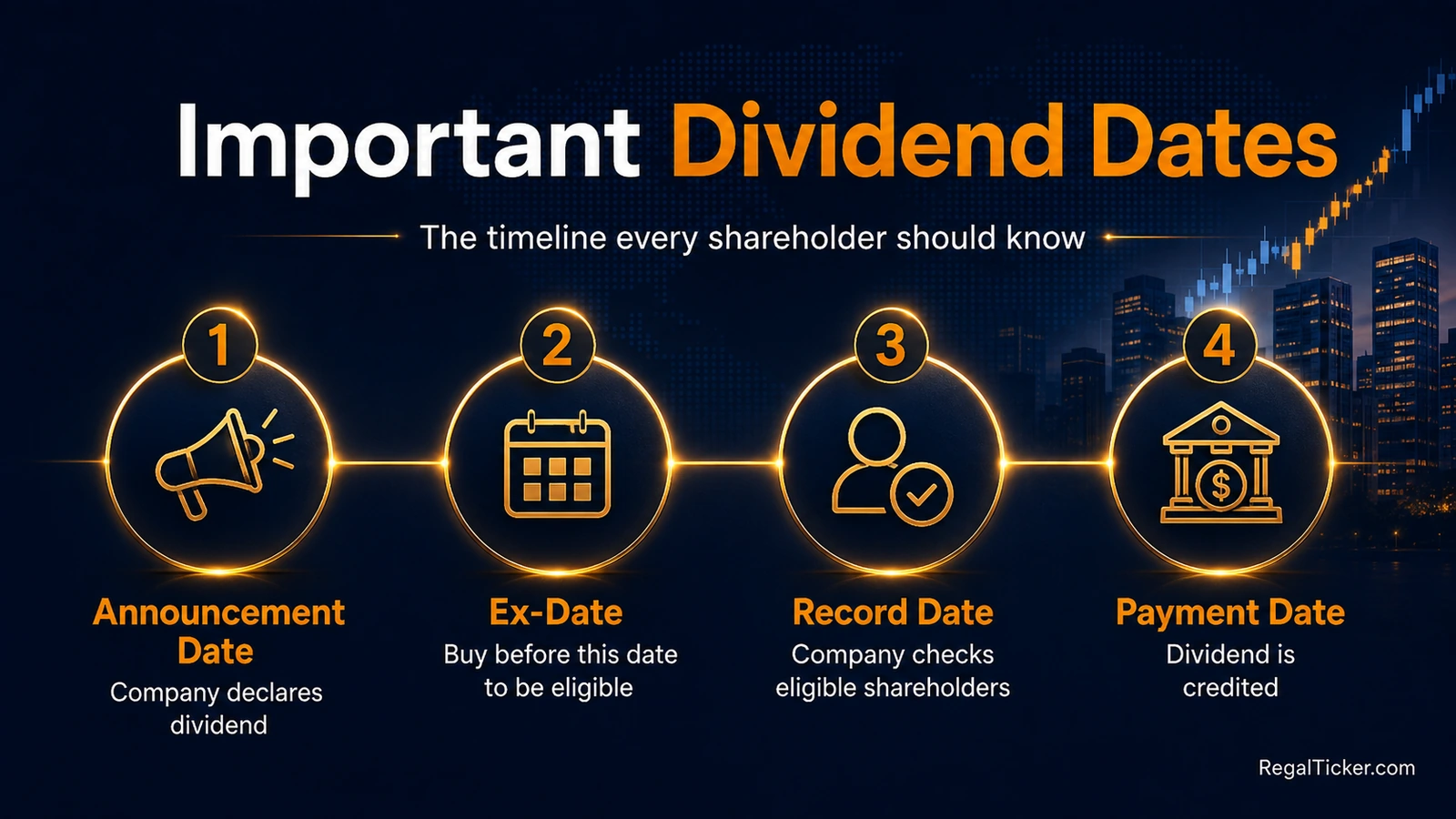
Announcement or Declaration Date
This is when the company communicates the dividend decision or recommendation.
The investor should check:
- rupee amount per share;
- type of dividend;
- whether approval is still required;
- ex-date;
- record date;
- expected payment conditions.
A recommendation is not identical to a completed payment. Read the wording in the filing.
Ex-Date
The ex-date is the date from which a buyer of the share is no longer entitled to the declared dividend.
In simple terms:
- buy sufficiently before the ex-date and you may be eligible, subject to settlement and official terms;
- buy on or after the ex-date and you normally do not receive that declared dividend;
- sell on or after the ex-date and an entitlement already attached to the eligible holding is normally retained.
The ex-date is the most important date for market trading behaviour because the share begins trading without the dividend benefit.
Record Date
The record date is the date used by the company to identify eligible shareholders.
Depository and registrar records are used to prepare the beneficiary list. Under the current settlement framework, the ex-date and record date may often fall on the same day, but the exact company announcement is always the source of truth.
Payment Date
The payment date is when the company distributes the dividend after completing beneficiary checks, tax processing and bank validation.
It can occur after the record date because the company or registrar needs time to:
- finalise eligible holdings;
- calculate individual entitlements;
- apply required deductions;
- validate bank details;
- process rejected or returned payments.
Caution
Do Not Buy Only to Capture the Dividend
A dividend is not a risk-free trading profit. Once the share trades without the announced entitlement, the market price can adjust, while normal market movement, tax and transaction costs can outweigh the cash dividend received. Evaluate the company and total-return outlook rather than buying only because the ex-date is approaching.
How Dividend Income, Yield and Payout Ratio Are Calculated
Dividend analysis involves several numbers that beginners often confuse.
Dividend Per Share and Gross Dividend
A company normally states the dividend as a rupee amount per share.
FORMULA: Gross dividend = Dividend per share × Eligible number of shares
💡 Real example
Dividend income for 250 shares
An investor holds 250 eligible shares. The company declares ₹6 per share.
Eligible shares: 250 Dividend per share: ₹6 Gross dividend: ₹1,500
Use the Regal Ticker Dividend Calculator for this calculation. Enter the eligible share quantity and dividend per share to estimate the gross cash amount instantly.
Calculate Your Dividend Income
- Confirm the number of shares eligible for the announced dividend.
- Enter the dividend per share from the official company or exchange announcement.
- Calculate the estimated gross dividend income.
- Compare the cash dividend with the value of your holding if you want to assess dividend yield.
- Check the ex-date and record date separately to confirm eligibility.
- Review any applicable TDS or tax treatment separately.
- Verify the final payment against the company or registrar communication.
Dividend Percentage on Face Value
A company may describe a dividend as a percentage of face value.
Suppose:
- face value = ₹10;
- dividend announced = 60% of face value.
Dividend per share = 60% × ₹10 = ₹6
The 60% is not a 60% return on the market price. A share with ₹10 face value may trade at ₹150, ₹500 or another price.
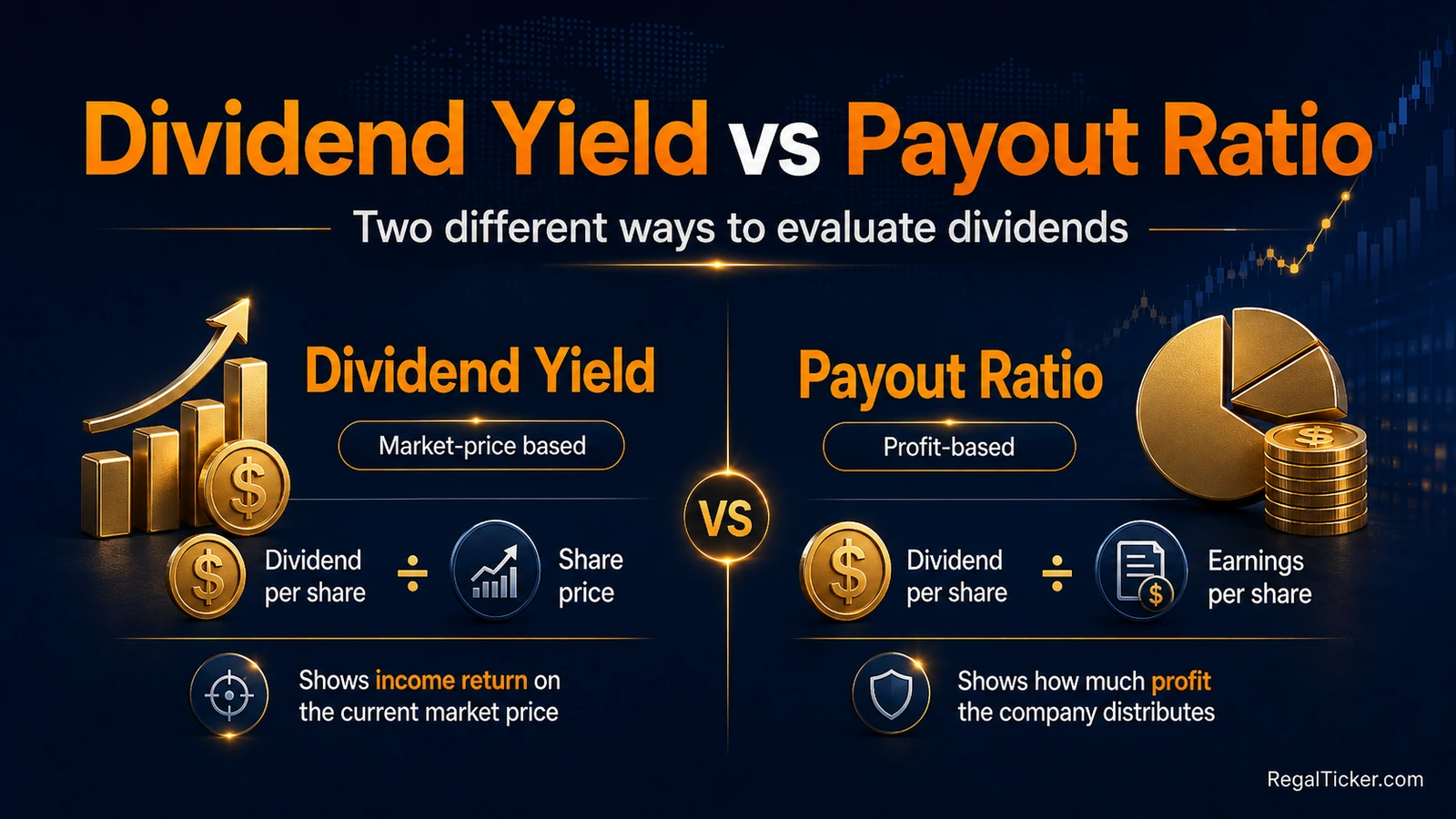
Dividend Yield
Dividend yield compares annual dividend per share with the current market price.
FORMULA: Dividend yield = Annual dividend per share ÷ Current market price × 100
💡 Real example
Annual dividend per share = ₹12 Current share price = ₹300
Dividend yield = ₹12 ÷ ₹300 × 100 = 4%
A rising yield can result from a higher dividend, a lower share price or both. A very high yield may therefore be a warning sign when the market expects weaker profit or a future cut.
Dividend Payout Ratio
The payout ratio compares dividend per share with earnings per share.
FORMULA: Dividend payout ratio = Dividend per share ÷ Earnings per share × 100
💡 Real example
Dividend per share = ₹8 Earnings per share = ₹20
Payout ratio = ₹8 ÷ ₹20 × 100 = 40%
This means the company distributed an amount equal to 40% of earnings per share and retained the remaining portion, subject to accounting and timing differences.
| Measure | What it compares | Main question |
|---|---|---|
| Dividend per share | Distribution with each eligible share | How much is declared per share? |
| Dividend yield | Annual dividend with market price | What is the income relative to today’s price? |
| Payout ratio | Dividend with earnings | How much of earnings is distributed? |
| Dividend cover | Earnings with dividend | How comfortably do earnings cover the payout? |
Why Yield and Payout Ratio Must Be Read Together
Dividend yield is market-price based. Payout ratio is profit based.
A company can have:
- a high yield because its price has fallen;
- a low yield because its share price has risen strongly;
- a high payout ratio because most earnings are being distributed;
- a low payout ratio because cash is being retained for growth or debt repayment.
Investors should combine these ratios with the company’s income statement, cash flow and debt position. The guides on revenue, profit and profit margins and how to read an income statement provide the foundation for that review.
Why the Share Price May Adjust After the Ex-Date
A dividend transfers cash from the company to eligible shareholders. Once the share trades without that entitlement, a theoretical adjustment may occur.
💡 Real example
Share price before ex-date = ₹100 Dividend per share = ₹4 Simple theoretical ex-dividend price = ₹100 − ₹4 = ₹96
The actual market price does not have to open at exactly ₹96. It can be affected by:
company news; market and index movement; demand and supply; interest rates; business expectations; global events; normal price volatility.
The eligible investor receives the cash entitlement, while the share now trades without that benefit. The final economic result depends on the actual price movement, taxes, costs and future business performance.
Dividend Is Only One Part of Total Return
Total return can include:
- capital appreciation or depreciation;
- dividends received;
- other distributions;
- transaction costs;
- taxes.
A company with a modest yield and strong long-term earnings growth may produce a better total return than a company with a high yield and a declining business.
How to Judge Whether a Dividend Is Sustainable
A good dividend analysis examines the business behind the payment.
Check Profit Quality
Ask whether the profit comes from normal operations or a one-time source.
A special dividend funded by an asset sale should not be projected as recurring annual income.
Check Free Cash Flow
Accounting profit does not always equal available cash. Cash may be absorbed by:
- receivables;
- inventory;
- capital expenditure;
- debt repayment;
- working capital;
- regulatory requirements.
Recurring dividends are stronger when they are supported by recurring operating cash flow after necessary investment.
Check the Payout Ratio Over Several Years
A payout ratio should be reviewed across a business cycle. A ratio that looks comfortable during peak earnings can become unsustainable when profit falls.
Check Debt and Future Capital Needs
A company paying large dividends while borrowing heavily may be weakening its balance sheet.
Review:
- debt and interest burden;
- upcoming repayments;
- expansion plans;
- maintenance capital expenditure;
- acquisition commitments;
- liquidity reserves.
Check the Reason for a High Yield
A high yield may represent:
- a genuinely strong cash distribution;
- a one-time special dividend;
- a falling share price;
- market expectation of weaker earnings;
- an expected dividend reduction.
The reason matters more than the headline percentage.
⚠ Important warning
Yield trap
A yield trap occurs when historical dividend yield appears attractive but profit, cash flow or the business outlook are deteriorating. The share price may continue to fall and the dividend may be reduced.
Dividend Payment, Missing Credits and Investor Records
For Demat holdings, dividend payments are usually sent to the registered bank account using beneficiary information supplied through the depository system.
If a Dividend Is Not Received
Follow this sequence:
- Confirm that the holding was eligible before the ex-date.
- Verify the dividend amount and payment status in the official filing.
- Check the bank account linked to the Demat holding.
- Review email and tax communication from the company or registrar.
- Contact the registrar and transfer agent.
- Contact the company’s investor-relations or grievance channel.
- Use the official exchange or SEBI grievance route where appropriate.
Never share an OTP, trading password or banking password with someone claiming to recover a dividend.
Unpaid and Unclaimed Dividends
Amounts that remain unpaid or unclaimed are handled under the applicable company-law and Investor Education and Protection Fund framework. When relevant, use only the official IEPF Authority website and the company’s published nodal or registrar contacts.
Tax Records
Investors should preserve:
- dividend statements;
- bank-credit records;
- tax deduction certificates where applicable;
- company communication;
- Demat holding records.
Dividend income is generally taxable in the shareholder’s hands, but the final treatment depends on the investor’s residential status and the type of security. For a resident individual receiving dividend from an Indian company, current Section 194 guidance generally provides for 10% TDS when the applicable company-wise dividend threshold exceeds ₹10,000 during the financial year, subject to PAN status, valid declarations or certificates, and other statutory conditions.
TDS is only a tax deduction at source, not the investor’s final income-tax liability. Preserve the dividend statement, bank-credit record, Form 16A or other TDS record where applicable, and the company’s tax communication. Non-residents and investors with special circumstances should verify the rate and treaty provisions applicable to them rather than applying the resident-individual example.
Use RegalTicker Calculators Before You Act
A calculator should support the analysis at the point where the arithmetic matters.
Workflow 1: Estimate the Declared Cash Amount
Use the Dividend Calculator immediately after reading the company announcement.
Enter:
- eligible share quantity;
- dividend per share;
- market price where required by the tool.
Review the estimated dividend and yield, then verify the official dates separately.
Workflow 2: Compare Cash with Holding Value
A ₹1,500 gross dividend may sound attractive, but the investor should compare it with:
- total value of the holding;
- possible ex-date adjustment;
- company earnings and cash flow;
- tax and transaction considerations.
Workflow 3: Continue Through Investor Tools
The Regal Ticker Investor Tools hub contains tools for returns, portfolio averages, corporate actions, costs and taxes. Use only the calculator relevant to the decision and treat its output as an estimate rather than advice.
Common Dividend Mistakes
Investors frequently make these errors:
- confusing face-value percentage with dividend yield;
- buying only because the ex-date is close;
- assuming a special dividend will repeat;
- ignoring the possible price adjustment;
- comparing yields calculated from different periods;
- treating a high yield as proof of low valuation;
- ignoring debt and free cash flow;
- assuming a previous dividend guarantees the next one;
- failing to update bank and KYC records;
- relying on social-media posts instead of official filings.
Frequently asked questions
What is the difference between ex-date and record date for a dividend?
The ex-date is when the share begins trading without entitlement to the announced dividend, while the record date is used by the company to identify eligible shareholders. Always verify the dates in the official company or stock-exchange announcement.
How do I calculate the dividend amount I may receive?
Multiply the number of eligible shares by the dividend declared per share. For example, 250 eligible shares with a ₹6 dividend give an estimated gross dividend of ₹1,500. You can also use the RegalTicker Dividend Calculator for the arithmetic.
Is a high dividend yield always good?
No. A high yield can result from a falling share price, a one-time special dividend or an unsustainable payout. Check profit, free cash flow, debt and the payout ratio before treating a high yield as attractive.
Is dividend TDS the same as my final tax liability?
No. TDS is only tax deducted at source. The final tax treatment depends on the investor’s residential status, applicable tax rate, total income, documentation and other relevant conditions.
Dividend Checklist for Investors
Before acting on a dividend announcement, verify:
- Is the dividend interim, final or special?
- What is the exact rupee amount per share?
- Is it declared or only recommended?
- What are the ex-date and record date?
- How many shares will be eligible?
- What gross amount does the Dividend Calculator estimate?
- Is the payout supported by recurring profit and cash flow?
- What is the payout ratio over several years?
- Does the company have heavy debt or major investment needs?
- Is the yield high because the share price has fallen?
- Are bank and Demat records current?
- Have you read the complete exchange announcement?
Conclusion
A dividend is a company’s declared distribution to eligible shareholders. It can provide useful cash income, but the amount alone does not reveal whether the underlying investment is attractive.
A careful investor checks:
- the official dividend per share;
- ex-date and record date;
- whether the payment is recurring or exceptional;
- profit and cash-flow support;
- payout ratio and debt;
- possible share-price adjustment;
- tax and record-keeping requirements.
Use the Regal Ticker Dividend Calculator in the first worked example, again when evaluating the holding and before completing the final checklist. The calculator handles the arithmetic; the company filing determines eligibility, and business analysis determines whether the dividend appears sustainable.
Continue learning through the Corporate Actions hub and review Corporate Actions in the Stock Market whenever you need the broader connection between dividends, bonus shares, splits, rights issues and buybacks.
Verify through official sources
Official references
- Income Tax Department — Section 194: Dividends — current Section 194 guidance showing the standard 10% dividend TDS rate and the applicable ₹10,000 company-wise threshold for an individual, subject to the statutory conditions.
- NSE India — Corporate Actions — verify the company’s actual dividend amount, ex-date, record date and other announced corporate-action details.
- SEBI — LODR Master Circular, January 30, 2026 — current consolidated disclosure and compliance framework for listed entities.
- SEBI — Listing Obligations and Disclosure Requirements Regulations, 2015, updated January 2026 — current listed-company regulatory framework relevant to corporate-action disclosures.
- Investor Education and Protection Fund Authority — IEPF — official route and guidance for eligible claims involving unpaid or unclaimed dividends transferred to the Investor Education and Protection Fund.
- RegalTicker — Dividend Calculator — estimate dividend income, current yield and yield on cost after verifying the official dividend amount and your eligible holding.
RISK DISCLOSURE: Investments in securities markets are subject to market risks. This article is for general education and does not constitute investment, tax or legal advice. Verify current information through official sources and consult a qualified professional where appropriate.