

⚡ Quick answer
A corporate spin-off is a restructuring in which a company separates a business, division or subsidiary into an independent company and distributes shares of that new company to eligible existing shareholders. The parent company and the spin-off company then operate as separate businesses. In India, “spin-off” is usually a market or business term rather than a separate statutory label; the transaction is commonly implemented through a demerger or scheme of arrangement under the Companies Act.
Investor note
Key Takeaways
A spin-off creates a separately operated company from part of an existing business. Eligible parent-company shareholders may receive shares in the spin-off company. The record date determines which shareholders receive the distribution. The distribution ratio may be expressed as 1:1, 1:5, 2:7 or another approved ratio. Shareholders normally do not pay fresh cash merely to receive distributed spin-off shares. The new shares are not economically free because part of the parent’s business value moves into the new company. The parent-company share price normally adjusts after separation. The original purchase cost must be divided between the parent and spin-off holdings. Listing can occur after the shares are credited, so demat credit does not always mean immediate trading. In India, the legal and tax framework may treat a qualifying spin-off as a demerger. Use the Demerger Cost Basis Calculator only after obtaining the official ratio and cost-allocation percentage.
A spin-off can simplify a complex group, improve management focus and allow investors to value each business independently. It can also create duplicated costs, weaker standalone companies, poor liquidity or execution risk.
This is Lesson 10 in the Regal Ticker Corporate Actions Learning Hub. Read What Is a Demerger? before this lesson because Indian spin-offs are commonly implemented through a demerger or scheme of arrangement. Also review Corporate Action Dates Explained before analysing eligibility.
What Is a Corporate Spin-Off?
📖 Definition
Corporate Spin-Off
A corporate spin-off is a restructuring in which a parent company separates a business, subsidiary or division into an independently operated company and distributes ownership in that company to eligible existing shareholders.
After the transaction:
the parent company continues as one business; the separated business becomes an independent company; eligible shareholders may hold shares in both; each company has its own management, financial statements and market valuation; the two companies can pursue different strategies.
Simple Example
A listed company operates:
- a mature consumer-products business;
- a fast-growing financial-technology division.
Management decides that investors cannot properly value both businesses inside one company.
The fintech division is separated into a new listed entity.
An eligible investor who held the parent company on the record date receives shares in the new fintech company according to the approved ratio.
The investor now owns:
- shares in the continuing consumer-products company; and
- shares in the independently listed fintech company.
Is a Spin-Off a Legal Term in India?
“Spin-off” is widely used in finance, business and international markets.
Indian company and tax law more commonly use terms such as:
- scheme of arrangement;
- reconstruction;
- division;
- demerger;
- transfer of an undertaking;
- resulting company.
A transaction described commercially as a spin-off may therefore be legally implemented as a demerger under Sections 230–232 of the Companies Act, 2013 and may need to satisfy the applicable income-tax definition of demerger for tax-neutral treatment.
Investor note
Read the Scheme, Not Only the Headline
A company may describe a restructuring as a spin-off, demerger, separation or value-unlocking exercise. The approved scheme determines the actual legal structure, shareholder entitlement, tax treatment, cost allocation and implementation dates.
Why Do Companies Create Spin-Offs?
Unlock Independent Business Value
Different businesses inside one group can receive different valuation multiples.
For example:
- a stable utility may be valued for predictable cash flow;
- a technology business may be valued for growth;
- a financial business may be valued using book value and return ratios;
- a consumer brand may be valued using margins and market share.
Separating them can improve price discovery.
Improve Management Focus
A standalone management team can concentrate on one business.
The spin-off company can create its own:
- strategy;
- budgets;
- performance targets;
- hiring plan;
- capital-allocation policy;
- risk controls.
Create Independent Capital Structures
The parent and spin-off company may have different capital needs.
One may require:
- low debt;
- large growth investment;
- research spending;
- working capital;
- acquisitions.
The other may produce excess cash and pay dividends.
Improve Transparency
Investors can see separate:
- revenue;
- profit;
- debt;
- cash flow;
- return ratios;
- management performance.
This can make comparison with sector competitors easier.
Separate Business Risks
A regulated, cyclical or litigation-sensitive division may be separated from a stable operation.
The risk is not removed. It becomes easier to identify and value separately.
Prepare the New Company for Strategic Growth
The spin-off entity may gain flexibility to:
- raise capital;
- issue employee shares;
- acquire businesses;
- form joint ventures;
- attract specialist investors;
- create a sector-specific brand.
⚠ Important warning
Separation does not automatically create value
A spin-off can reveal value, but it can also expose weak economics, high costs, poor management or excessive debt. The structure changes; business quality must still be analysed.
How a Corporate Spin-Off Works
A listed-company spin-off can require a detailed legal and regulatory process.

1. Management Identifies the Business to Separate
The company decides which undertaking, subsidiary or division should become independent.
The proposal normally defines:
- business operations;
- assets;
- liabilities;
- employees;
- contracts;
- intellectual property;
- debt;
- cash;
- inter-company arrangements.
2. Board Approves the Restructuring
The board approves a proposal or draft scheme.
The disclosure may explain:
- commercial rationale;
- expected benefits;
- resulting structure;
- share-distribution ratio;
- approvals required;
- proposed timetable.
3. Valuation and Fairness Review
Independent valuers may assess the separated business and recommend a share-entitlement ratio.
The ratio can reflect:
- earnings;
- cash flow;
- assets;
- liabilities;
- market comparables;
- growth prospects;
- capital structure.
4. Stock-Exchange and SEBI Review
A listed entity submits the draft scheme and required documents through the stock-exchange process.
The applicable scheme-of-arrangement framework can require:
- valuation reports;
- fairness opinion;
- audit committee recommendation;
- complaints report;
- public-shareholder approval in specified cases;
- accounting confirmation;
- exchange observation letter.
5. Shareholder and Creditor Approval
The scheme may require approval by members and creditors according to the Companies Act and NCLT directions.
6. NCLT Sanction
The National Company Law Tribunal considers the scheme.
A sanctioned scheme can transfer the specified undertaking, assets, liabilities, employees and obligations to the resulting company according to its terms.
7. Effective Date
The scheme becomes effective after the stated conditions and filings are completed.
The appointed date and effective date may not be the same.
8. Record Date
The company announces a record date to identify eligible shareholders.
9. Distribution of Spin-Off Shares
The new company allots shares according to the approved ratio.
The investor normally does not submit a purchase application or pay fresh subscription money merely to receive the basic distribution.
10. Listing and Independent Trading
The new shares begin trading after exchange and listing approvals.
There can be a waiting period between:
- effective date;
- record date;
- demat credit;
- listing;
- first trading day.
⚠ Important warning
Do not assume immediate liquidity
A new company can be credited into the demat account before trading begins. Wait for the official exchange listing notice.
Spin-Off Share Entitlement Ratio
The entitlement ratio tells an eligible investor how many new-company shares will be received.
Formula
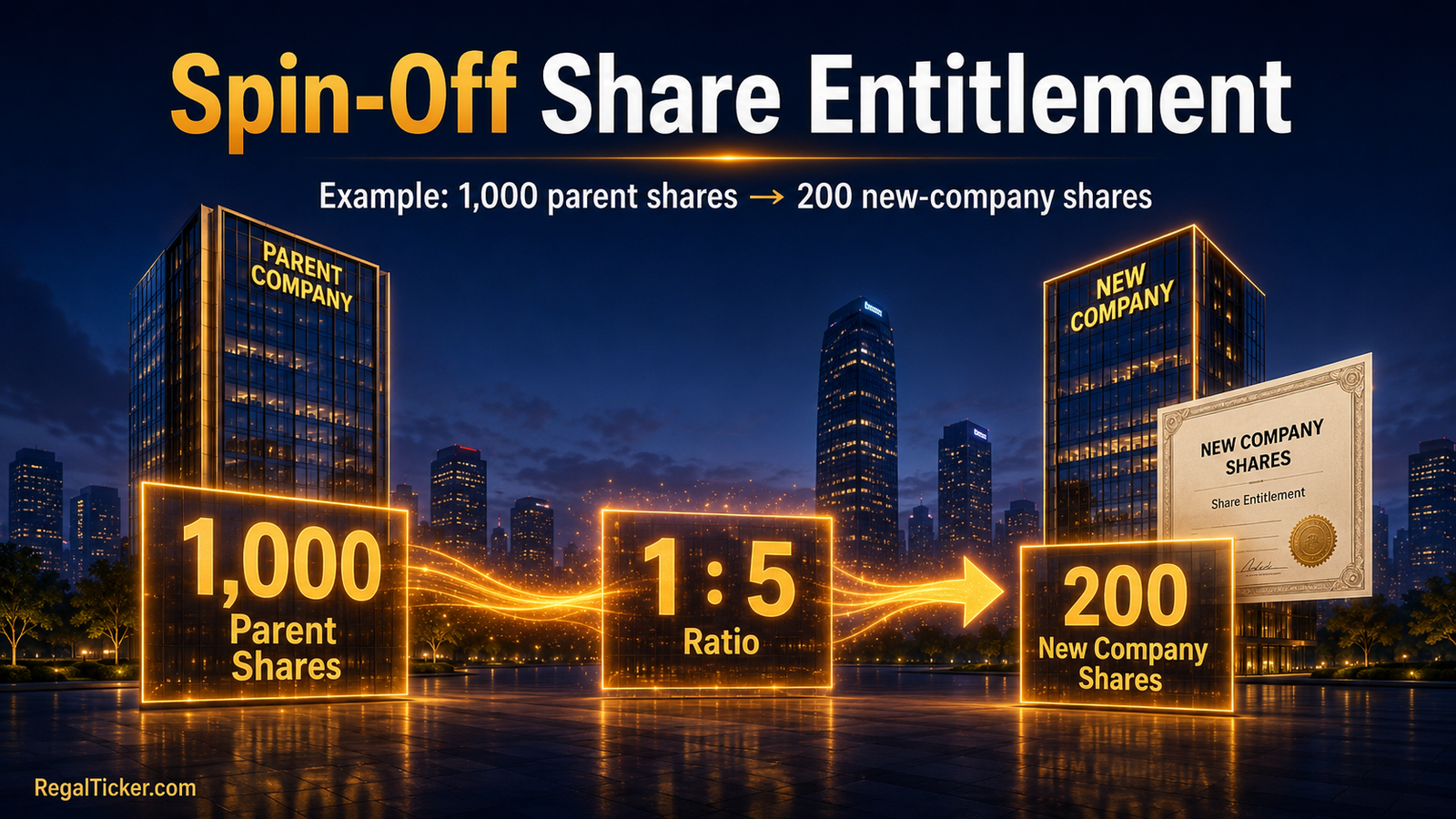
FORMULA: Spin-off shares received = Eligible parent shares × New-company shares in ratio ÷ Parent shares in ratio
Example: 1 Share for Every 5 Parent Shares
Assume:
- eligible parent-company shares: 1,000;
- distribution ratio: 1:5.
FORMULA: 1,000 × 1 ÷ 5 = 200 spin-off shares
The investor continues to hold the parent shares and receives 200 shares in the new company, subject to the approved scheme.
| Item | Result |
|---|---|
| Eligible parent shares | 1,000 |
| Distribution ratio | 1:5 |
| Spin-off shares received | 200 |
| Fresh cash payment | Usually none for basic distribution |
| Parent shares cancelled | No, unless scheme states otherwise |
| New company separately valued | Yes, after separation |
Ratio Wording Can Be Confusing
A ratio can be expressed as:
- 1 new share for every 5 parent shares;
- 2 new shares for every 7 parent shares;
- 3 shares in the resulting company for every 10 held;
- another scheme-specific format.
Always read which number refers to:
- the parent company; and
- the spin-off company.
Fractional Entitlements
Suppose an investor holds 1,003 parent shares under a 1:5 ratio.
The mathematical entitlement is:
FORMULA: 1,003 ÷ 5 = 200.6 shares
The investor does not automatically receive 0.6 of a listed share.
The scheme may provide for:
- aggregation by a trustee;
- sale of aggregated fractions;
- cash payment;
- rounding;
- another treatment.
Caution
Never Round the Entitlement Yourself
If the share-entitlement calculation produces a fraction, do not round it on your own. The approved scheme determines whether fractions are aggregated, sold, paid in cash, rounded or handled in another way. Preserve the company or registrar communication showing the final quantity credited.
What Happens to the Parent Company?
The parent company loses the separated business, assets, liabilities and earnings specified in the scheme.
It may continue as:
- a smaller focused company;
- a holding company;
- an operating business;
- a company with a retained stake in the spin-off entity;
- another structure defined by the scheme.
Does the Parent Retain Shares in the Spin-Off?
The answer depends on the transaction.
In a pure shareholder-distribution spin-off, the parent may distribute ownership in the new company to its shareholders.
In other structures, the parent may initially retain:
- a controlling stake;
- a minority stake;
- transitional ownership;
- no stake.
Do not assume the ownership outcome from the word “spin-off” alone.
Parent-Company Price Adjustment
The parent no longer owns the same combination of businesses after separation.
Its market price usually adjusts.
A simplified relationship is:
FORMULA: Post-spin-off parent value + Spin-off company value ≈ Pre-spin-off combined value
Actual prices can differ due to:
- market sentiment;
- debt allocation;
- listing liquidity;
- management quality;
- sector valuation;
- selling pressure;
- earnings outlook.
Are Spin-Off Shares Free?
The shares may be distributed without a fresh payment.
Economically, however, they are not free.
Part of the value previously contained inside the parent company has moved into the spin-off company.
That is why:
- the parent price can adjust;
- the investor’s original cost must be divided;
- combined value matters more than share quantity;
- tax records must be updated.
⚠ Important warning
Two shareholdings do not automatically double wealth
A spin-off changes the form of ownership. It does not automatically double the economic value of the underlying businesses.
Cost Basis and Tax After a Spin-Off
The original purchase cost must normally be divided between:
- the continuing parent-company shares; and
- the new spin-off company shares.
Why Cost Allocation Matters
Accurate allocation is required for:
- portfolio returns;
- average purchase cost;
- future capital-gain calculation;
- tax records;
- performance comparison;
- sale decisions.
Use the Official Allocation
The company can publish a cost-allocation communication after the transaction.
💡 Real example
parent-company allocation: 72%; spin-off company allocation: 28%.
Do not estimate the allocation from the first traded prices unless the applicable official guidance specifically requires a market-value method.
Cost Allocation Formula
Under Section 73 of the Income-tax Act, 2025, the cost allocated to shares of the resulting company in a qualifying demerger is based on the proportion of the net book value of assets transferred in the demerger to the net worth of the demerged company immediately before the demerger.
Cost of resulting-company shares = Original cost of demerged-company shares × Net book value of assets transferred ÷ Net worth of demerged company immediately before the demerger
The cost remaining with the original demerged-company shares is:
Remaining parent-company cost = Original total cost − Cost allocated to resulting-company shares
In practice, the company may publish the resulting allocation percentage for shareholders. Use that official communication for your records rather than estimating the percentage from market prices.
Worked Example
Assume:
- 1,000 parent shares;
- average original cost: ₹500;
- total original cost: ₹5,00,000;
- spin-off allocation: 28%;
- parent allocation: 72%;
- spin-off shares received: 200.
FORMULA: Spin-off total cost = ₹5,00,000 × 28% = ₹1,40,000
FORMULA: Parent total cost = ₹5,00,000 × 72% = ₹3,60,000
FORMULA: Adjusted parent cost per share = ₹3,60,000 ÷ 1,000 = ₹360
FORMULA: Spin-off cost per share = ₹1,40,000 ÷ 200 = ₹700

| Holding | Quantity | Total allocated cost | Cost per share |
|---|---|---|---|
| Continuing parent | 1,000 | ₹3,60,000 | ₹360 |
| Spin-off company | 200 | ₹1,40,000 | ₹700 |
| Combined historical cost | — | ₹5,00,000 | — |
Tax Treatment of a Spin-Off in India
The word “spin-off” does not by itself determine tax treatment.
Tax treatment depends on the legal structure and whether the scheme satisfies the applicable definition and conditions of a demerger.
Qualifying Demerger Framework
Under the Income-tax Act, 2025, a restructuring must satisfy the statutory conditions for a demerger before the related tax provisions can apply. Key conditions generally include:
- transfer of the undertaking’s property;
- transfer of related liabilities;
- transfer according to the prescribed structure;
- issue of resulting-company shares to demerged-company shareholders on a proportionate basis;
- required shareholder continuity;
- transfer on a going-concern basis.
When those demerger conditions are satisfied, Section 70 of the Income-tax Act, 2025 provides specified non-transfer treatment for qualifying transfers of assets to an Indian resulting company and for the issue or transfer of resulting-company shares to shareholders of the demerged company. The commercial label “spin-off” does not by itself determine the tax result; the approved legal scheme and the statutory conditions do.
Tax Is Often Deferred, Not Eliminated
Receiving shares can be tax neutral at the restructuring stage.
A later sale of:
- parent shares; or
- spin-off shares
can create a capital gain or loss.
The original cost is allocated to determine future gain.
Holding Period
Special rules can allow the earlier holding history to remain relevant for the new shares.
The exact treatment should be verified using current tax law and the company’s scheme communication.
Investor note
Preserve Transaction-Level Records
Keep the original contract notes, Demat statements, approved scheme document, record-date holding, share-credit statement, official cost-allocation communication, listing notice and future sale records. These documents may be needed to reconstruct entitlement, acquisition cost, holding period and capital gains later.
Consult a qualified tax professional where the scheme, residency or holding structure is complex.
Spin-Off vs Related Corporate Actions
In everyday investing language, the terms can overlap.
Spin-Off
A spin-off usually describes the economic outcome:
- a business becomes independent;
- existing shareholders receive ownership in it;
- parent and new company continue separately.
Demerger
A demerger is the legal and tax framework commonly used in India to transfer an undertaking into a resulting company.
A transaction can therefore be:
- commercially described as a spin-off; and
- legally implemented as a demerger.
| Point | Spin-off | Demerger |
|---|---|---|
| Primary usage | Business and market term | Legal and tax term in India |
| Independent company created | Usually | Often |
| Shares distributed to parent holders | Common | Common under qualifying structure |
| Undertaking transferred | Yes | Yes |
| Scheme of arrangement | Common in India | Core mechanism |
| Cost allocation required | Yes | Yes |
| Tax neutrality automatic | No | Only if conditions are satisfied |
Spin-Off vs Split-Off
These terms are not the same.
Spin-Off
In a spin-off:
- eligible shareholders generally keep parent shares;
- they also receive shares in the new company;
- ownership is distributed proportionately under the scheme.
Split-Off
In a split-off:
- participating shareholders exchange some or all parent shares;
- they receive shares in the separated business;
- investors may choose between continued parent ownership and the new company;
- the parent’s share count can reduce.
A split-off therefore involves an exchange rather than a universal proportionate distribution.
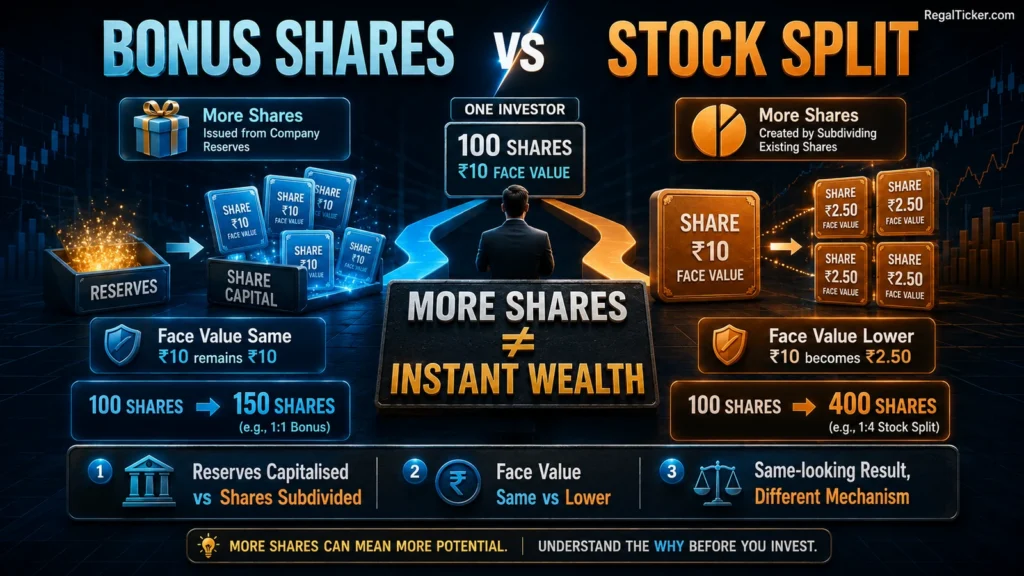
Spin-Off vs Stock Split
A stock split changes:
- number of shares;
- face value;
- market price per share.
It does not separate a business.
A spin-off creates a separate company or holding in a separated business.
Read What Is a Stock Split?.

| Event | Main change | Investor receives | Parent shares retained |
|---|---|---|---|
| Spin-off | Business becomes independent | New-company shares | Usually yes |
| Demerger | Undertaking transferred under scheme | Resulting-company shares | Usually yes |
| Split-off | Ownership exchanged | New-company shares in exchange | Not always |
| Stock split | Existing shares subdivided | More shares in same company | Existing shares adjusted |
| Bonus issue | Additional shares issued | More shares in same company | Yes |
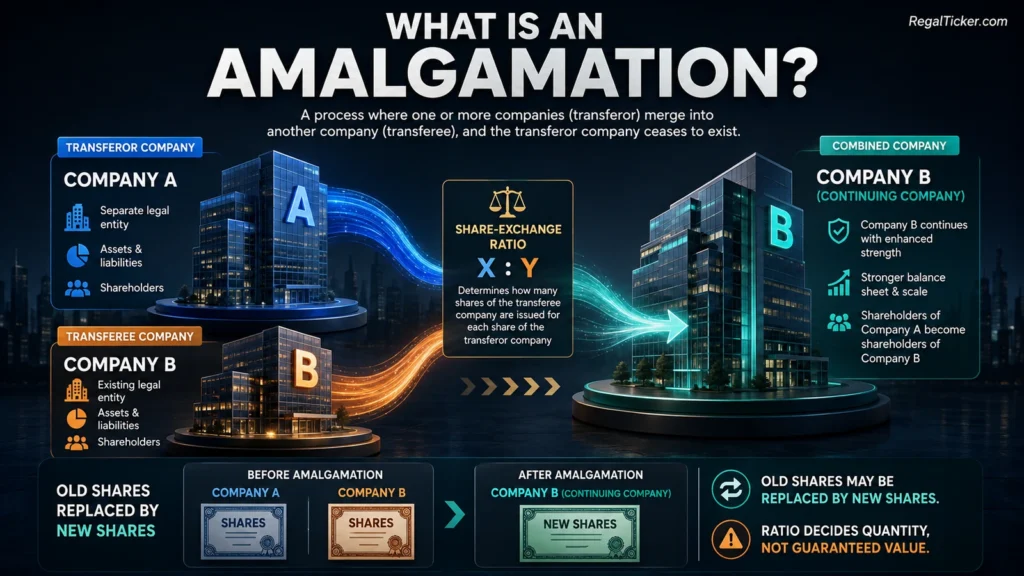
A spin-off and an amalgamation move businesses in opposite structural directions. A spin-off separates part of a company into an independent business, while an amalgamation combines companies or businesses under one continuing structure. In an amalgamation, investors may receive replacement shares based on a share-exchange ratio, whereas a spin-off normally leaves the parent holding intact while adding shares of the separated company. For the complete comparison, read What Is an Amalgamation? Meaning, Share-Exchange Ratio, Accounting, Tax and Examples.
What Happens in the Demat Account?
An eligible investor may see:
- spin-off company shares credited under a new ISIN;
- a temporary security line before listing;
- zero or missing cost in the broker portfolio;
- parent shares continuing under the existing ISIN;
- value distortions before price discovery.
Credit and Listing Are Separate
Demat credit confirms quantity.
It does not confirm:
- active trading;
- correct cost;
- tax treatment;
- listing date;
- market value.
Update the Portfolio Manually Where Necessary
Use the official:
- entitlement ratio;
- credited quantity;
- allocation percentage;
- effective date;
- listing date.
Benefits, Risks and Evaluation
Potential advantages include:
- clearer business focus;
- independent management accountability;
- sector-specific valuation;
- simpler financial reporting;
- independent capital raising;
- strategic flexibility;
- focused employee incentives;
- better acquisition currency;
- improved investor choice.
Risks and Limitations
Duplicate Corporate Costs
Each company may need separate:
- management;
- board;
- finance team;
- technology;
- compliance;
- investor relations;
- listing expenses.
Loss of Group Support
The new company may lose:
- purchasing power;
- brand strength;
- cash support;
- shared systems;
- cross-selling;
- financing access.
Debt Allocation Risk
The scheme may place heavy debt in one company.
Selling Pressure
Investors who do not want the spin-off company may sell immediately after listing.
This can cause price volatility.
Weak Liquidity
The new company may have:
- limited free float;
- low trading volume;
- wide bid-ask spreads;
- little analyst coverage.
Management Complexity
Transitional arrangements between the parent and spin-off can create conflicts.
Value-Destructive Separation
A combined group may have genuine synergies that disappear after separation.
⚠ Important warning
Analyse both companies independently
Do not keep both holdings merely because both came from one original investment. Review each company’s earnings, debt, management, cash flow and valuation.
How to Evaluate a Spin-Off
1. Understand the Business Being Separated
Identify:
- products;
- customers;
- revenue;
- profits;
- margins;
- assets;
- liabilities;
- competitive position.
2. Study the Separation Rationale
Ask whether the objective is:
- focus;
- value discovery;
- debt separation;
- regulatory clarity;
- capital raising;
- eventual sale.
3. Review Debt and Cash Allocation
Option A
- net debt;
- interest cost;
- cash reserves;
- working capital;
- future funding needs.
- 4. Review Management and Governance
- Check:
- leadership;
- board composition;
- promoter ownership;
- related-party transactions;
- shared-service agreements;
- brand licensing.
- 5. Estimate Standalone Earnings
- Reported segment profit may not equal standalone profit.
- Adjust for:
- central costs;
- new listing costs;
- financing;
- tax;
- duplicated staff;
- transitional service fees.
- 6. Review the Distribution Ratio
- Check:
- valuation report;
- fairness opinion;
- scheme explanation;
- fractional treatment.
- 7. Save Cost-Basis Information
- This can be needed years later.
Option B
Regal Ticker Workflow and Common Mistakes
Step 1: Identify the Legal Structure
Confirm whether the event is implemented as a:
- demerger;
- scheme of arrangement;
- distribution of subsidiary shares;
- split-off;
- another structure.
Step 2: Read the Scheme
Record:
- parent company;
- resulting company;
- transferred undertaking;
- distribution ratio;
- effective date;
- record date;
- listing terms.
Step 3: Calculate Entitlement
Use the approved ratio and eligible quantity.
Step 4: Track Fractional Treatment
Do not round independently.
Step 5: Confirm Demat Credit
Check the new ISIN and quantity.
Step 6: Wait for Official Listing
Do not assume immediate liquidity.
Step 7: Obtain the Cost Allocation
Use only the official communication.
Step 8: Update Portfolio Records
Allocate the original cost.
Step 9: Evaluate Both Companies
Decide whether each remains suitable independently.
Browse all Regal Ticker Investor Tools for related calculators.
Common Spin-Off Mistakes
Mistake 1: Treating the Shares as Free Wealth
The value was previously inside the parent.
Mistake 2: Confusing Spin-Off With Stock Split
One separates a business; the other subdivides shares.
Mistake 3: Ignoring the Parent Price Adjustment
The parent loses the separated undertaking.
Mistake 4: Using an Incorrect Ratio
Check which side of the ratio represents each company.
Mistake 5: Rounding Fractional Shares
Use the scheme’s method.
Mistake 6: Assuming Credit Means Trading
Listing can happen later.
Mistake 7: Leaving the Full Cost Under the Parent
The cost must be allocated.
Mistake 8: Using First-Day Price as Official Cost
Use company guidance.
Mistake 9: Assuming Tax Neutrality From the Word Spin-Off
Legal conditions matter.
Mistake 10: Ignoring Standalone Costs
The new company may be less profitable after separation.
Spin-Off Investor Checklist
Verify:
- What business is being separated?
- What is the legal structure?
- Which company is the parent?
- Which is the spin-off or resulting company?
- What is the record date?
- What is the distribution ratio?
- What happens to fractions?
- Does the parent retain a stake?
- When do shares become effective?
- When are shares credited?
- When does trading begin?
- What debt goes to each company?
- What cash goes to each company?
- What shared-service agreements remain?
- What cost-allocation percentage is published?
- Does the scheme qualify for tax-neutral treatment?
- Is the broker cost correct?
- Do I want to own both companies?
Conclusion
A corporate spin-off separates a business from a parent company and creates an independent company.
Eligible shareholders commonly receive shares in the new entity according to an approved ratio.
The main investor tasks are:
- understand the legal structure;
- verify the record date;
- calculate entitlement;
- track listing;
- allocate original cost;
- analyse both companies separately.
The new shares are not economically free, and the term “spin-off” alone does not determine tax treatment.
Use the Regal Ticker Demerger Cost Basis Calculator after obtaining the official ratio and allocation percentage.
Frequently asked questions
What is a corporate spin-off in simple words?
A corporate spin-off separates a business from a parent company into an independently operated company. Eligible shareholders may receive shares in the new company while continuing to hold their parent-company shares, subject to the approved scheme.
What does a 1:5 spin-off ratio mean?
It generally means one share of the spin-off or resulting company for every five eligible parent-company shares held on the applicable record date. Always confirm which side of the ratio refers to each company and how fractional entitlements are handled.
How is cost basis divided after a spin-off?
When the transaction qualifies as a demerger under the Income-tax Act, 2025, the original acquisition cost is allocated between the parent-company shares and the resulting-company shares under the applicable Section 73 rules. In practice, use the company’s official cost-allocation communication rather than estimating from market prices.
Why can spin-off shares appear in Demat before they can be traded?
Demat credit and stock-exchange listing are separate steps. Shares may be credited before trading begins, so investors should wait for the official exchange listing notice before assuming the new shares are immediately saleable.
Verify through official sources
Official references
- India Code — Companies Act, 2013, Section 230 — compromises and arrangements used in restructuring schemes.
- India Code — Companies Act, 2013, Section 232 — merger, amalgamation and restructuring provisions relevant to scheme implementation.
- SEBI — LODR Master Circular, January 30, 2026 — current consolidated listed-company compliance framework.
- NSE India — Corporate Filings: Scheme Documents — verify the actual scheme, exchange observation documents and company implementation filings.
- Income Tax Department — Income-tax Act, 2025, Section 70 — current non-transfer provisions relevant to qualifying demerger transactions.
- Income Tax Department — Income-tax Act, 2025, Section 73 — current acquisition-cost allocation rules for resulting-company shares and the remaining original holding.
- RegalTicker — Demerger Cost Basis Calculator — use after confirming the official scheme inputs and cost-allocation information.
Educational disclaimer: This article is for investor education and general information only. It is not investment, legal, accounting or tax advice. Spin-off structures, entitlement ratios, listing dates, fractional treatment, cost allocation and tax consequences vary by scheme. Verify the approved scheme, company filings, exchange notices, official cost-allocation communication and current tax law before taking action.