
⚡ Quick answer
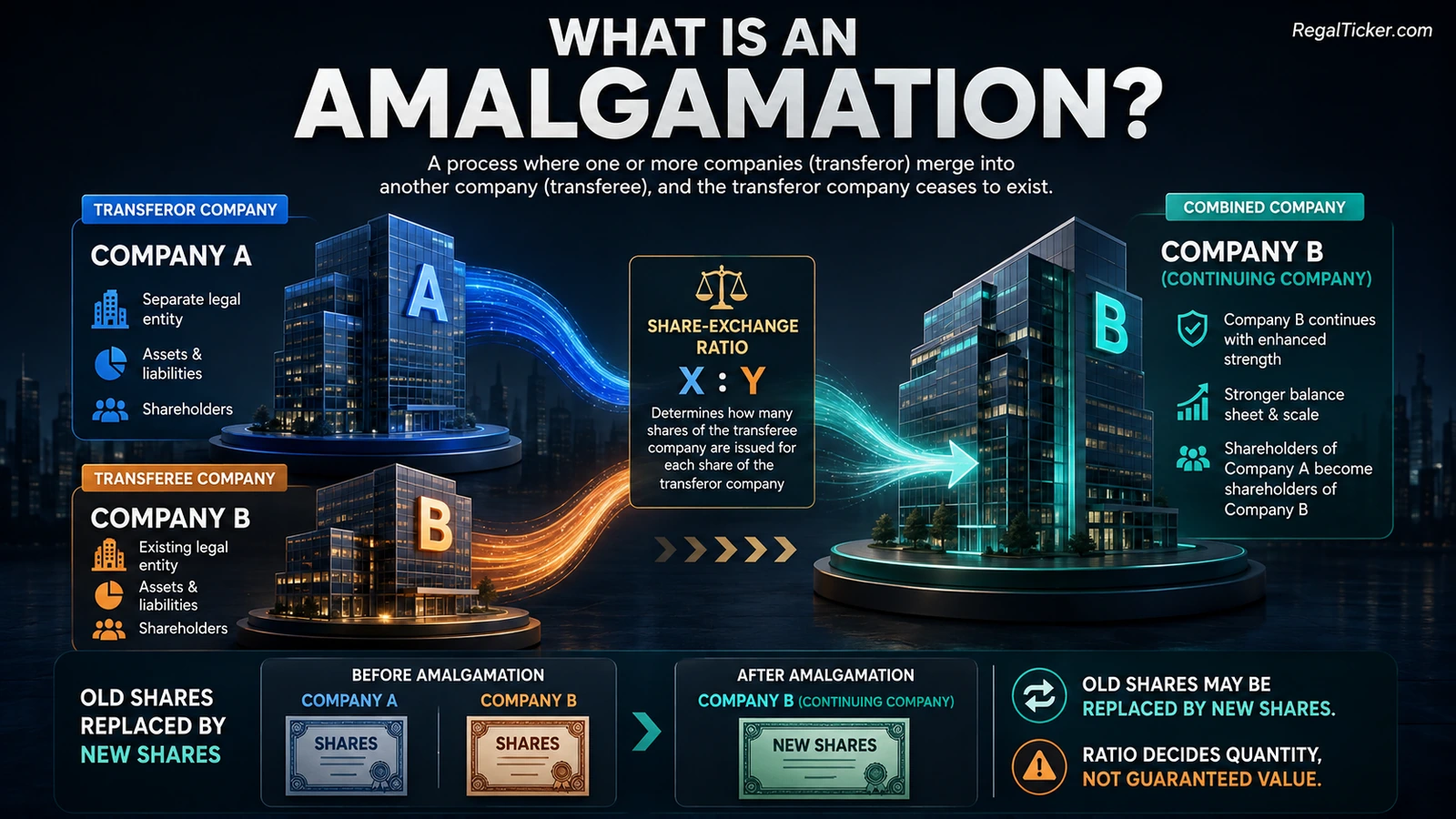
An amalgamation is a corporate restructuring in which one or more companies combine with another company, or two or more companies combine to form one company, under an approved scheme. The company that transfers its business, assets and liabilities is commonly called the amalgamating or transferor company; the company that receives them is the amalgamated or transferee company. For shareholders, the most important question is usually the share-exchange ratio: how many shares of the continuing company will replace the old holding? The ratio determines quantity, not guaranteed value. Investors should also track the effective date, record date, treatment of fractions, Demat credit, tax cost and the quality of the combined business.
Key takeaways
An amalgamation combines companies or businesses under one continuing or newly formed company.
The transferor or amalgamating company may cease to exist after the scheme becomes effective.
Eligible shareholders may receive replacement shares based on the final share-exchange ratio.
The exchange ratio determines share quantity, not investment return.
A draft ratio can change before final approval; use the final sanctioned scheme and company communication.
Appointed date, effective date and record date serve different purposes.
The old shares may stop trading before the replacement shares become visible or tradable, causing temporary broker-portfolio distortions.
For tax years from April 1, 2026, the Income-tax Act, 2025 is the current tax law; do not rely on outdated Section 47/49 references from the repealed 1961 Act without checking the transition.
In a qualifying share-for-share amalgamation into an Indian company, current law can treat the shareholder exchange as not being a taxable transfer and can carry the old acquisition cost into the replacement shares, subject to conditions.
Use the Share Exchange Ratio Calculator for arithmetic; the final sanctioned scheme decides the actual entitlement and treatment of fractional shares.
Amalgamation at a Glance
| Question | Simple answer | What an investor should verify |
|---|---|---|
| What combines? | One or more companies or undertakings | Exact transferor and transferee entities |
| What happens to assets and liabilities? | They move under the approved scheme | Which assets, debt, guarantees and obligations transfer |
| What happens to old shares? | They may be cancelled or extinguished | Effective date and exchange notices |
| What do shareholders receive? | Often replacement shares; sometimes other consideration or adjustments | Final exchange ratio and fractional treatment |
| Does a 3:5 ratio mean 60% value? | No | Ratio gives quantity, not guaranteed market value |
| When does it become effective? | After the required conditions and filings are completed | Appointed date, effective date and record date |
| Is it automatically tax-free? | No | Whether the transaction satisfies the current tax-law conditions |
| What matters after completion? | Combined earnings, debt, dilution, integration and valuation | Whether the business creates value after the legal combination |
What Is an Amalgamation?
📖 Definition
Amalgamation
For an investor, an amalgamation can be understood as a legal combination in which the assets, liabilities and business of one or more companies move into another existing company or a newly formed company, with the old corporate structure being reorganised under an approved scheme.
The Companies Act, 2013, particularly Sections 230 to 232, provides the core scheme-of-arrangement and merger/amalgamation framework. For listed companies, the scheme also interacts with the applicable SEBI listing framework and stock-exchange process.
Transferor / Amalgamating Company
This is the company whose business, assets and liabilities are transferred under the scheme.
After the scheme becomes effective, the transferor company can be dissolved without a separate winding-up process if the sanctioned scheme provides for it.
Transferee / Amalgamated Company
This is the existing or newly formed company that receives the transferred business.
Its shareholders after the transaction can include:
- its original shareholders; and
- eligible former shareholders of the transferor company who receive replacement shares.
Simple Example: Company A Disappears; Company B Continues
Assume Company A and Company B operate related businesses.
The sanctioned scheme provides that:
- Company A transfers its undertaking to Company B.
- Company B takes over the specified assets and liabilities.
- Eligible Company A shareholders receive Company B shares under the approved exchange ratio.
- Company A’s old shares are extinguished when the scheme is implemented.
- Company B continues as the combined listed company.
For a Company A shareholder, the practical problem is not the legal label. It is: How many Company B shares will I receive, when will they be credited, and what will those shares represent economically?
Share-Exchange Ratio: The Number Investors Need to Understand
The share-exchange ratio, also called a swap or entitlement ratio in everyday discussion, states how many shares of the transferee company are issued for a specified number of shares in the transferor company.
The ratio is normally derived from relative valuation and the approved scheme. It is not simply a comparison of the two companies’ stock prices on one trading day.
💡 Real example
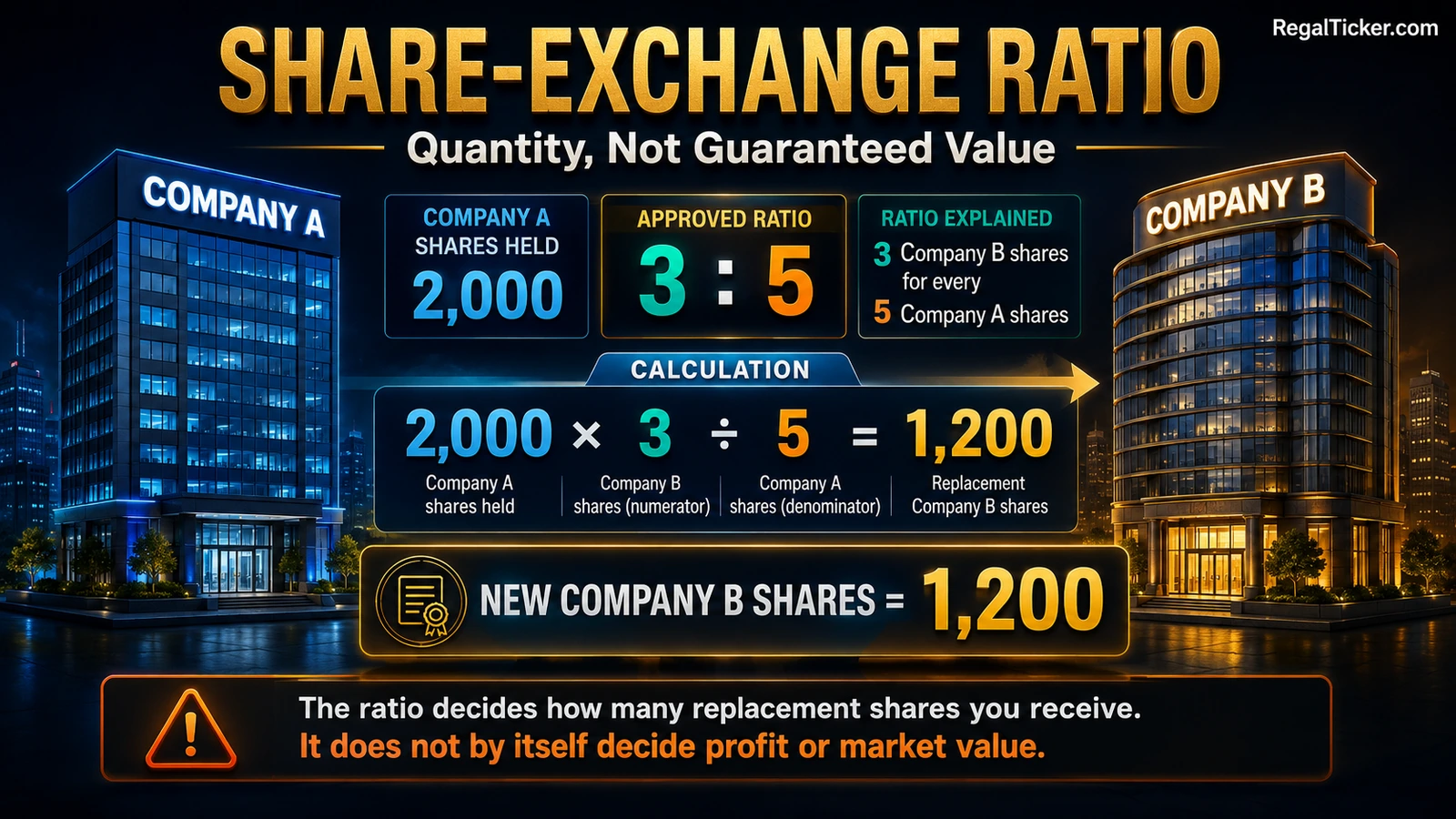
3 transferee shares for every 5 transferor shares
Suppose the final sanctioned scheme gives:
3 shares of Company B for every 5 shares of Company A
You hold 2,000 eligible Company A shares.
Your mathematical entitlement is:
2,000 × 3 ÷ 5 = 1,200 Company B shares
| Item | Result |
|---|---|
| Eligible old shares | 2,000 Company A shares |
| Approved ratio | 3 Company B shares for every 5 Company A shares |
| Mathematical new quantity | 1,200 Company B shares |
| Old Company A shares | Extinguished / cancelled according to the scheme |
| Fractional entitlement | Governed by the final scheme, not by personal rounding |
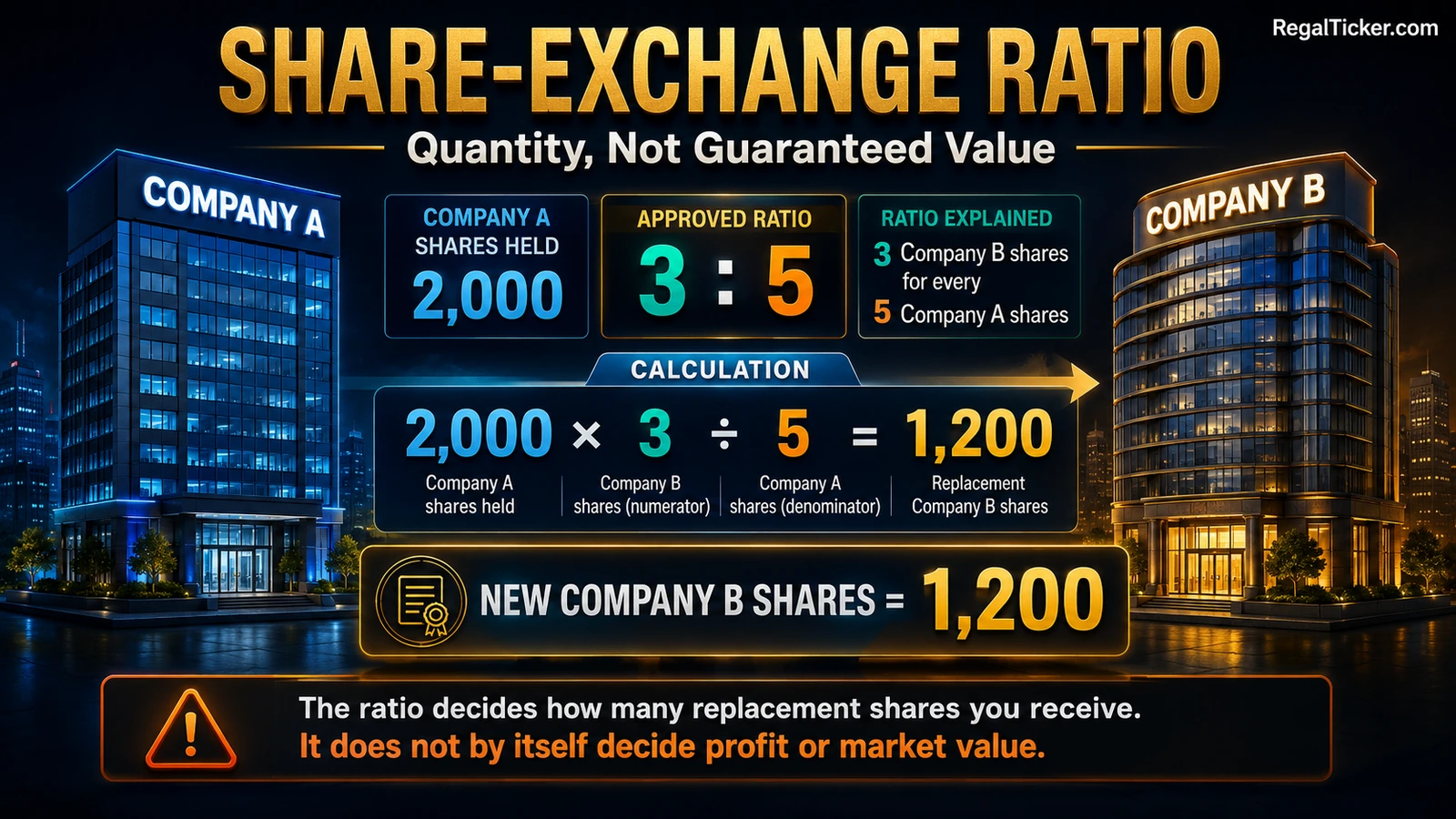
A 3:5 ratio does not mean that Company A shareholders receive only 60% of their old wealth. It only tells you the number of replacement shares. Economic value depends on the combined company’s market value after the scheme.
Use the calculator
Calculate the replacement-share quantity
Use the Share Exchange Ratio Calculator after you have verified the final sanctioned ratio. It can calculate expected replacement-share quantity and show the arithmetic clearly. It cannot verify the legal scheme, eligibility, tax treatment or fractional-share method.
Why a 1:1 Ratio Can Still Be Unequal
Suppose Company A has 10 crore shares outstanding and Company B has only 2 crore shares outstanding.
Even if a scheme used a 1:1 shareholder exchange for a particular class or structure, the companies would not automatically have equal total equity value. The ratio reflects the valuation framework and capital structure used in the scheme.
What Happens to Fractions?
If the ratio creates a fraction—for example, 127.5 replacement shares—the scheme may prescribe:
- aggregation and sale through a trustee;
- cash in lieu;
- rounding under an approved method;
- another specific treatment.
Caution
Never round a share-exchange ratio yourself
Fractional treatment is part of the scheme. Rounding 127.5 to 128 because it looks convenient can produce the wrong entitlement.
How an Amalgamation Works
A listed-company amalgamation is not completed when the board first announces it.
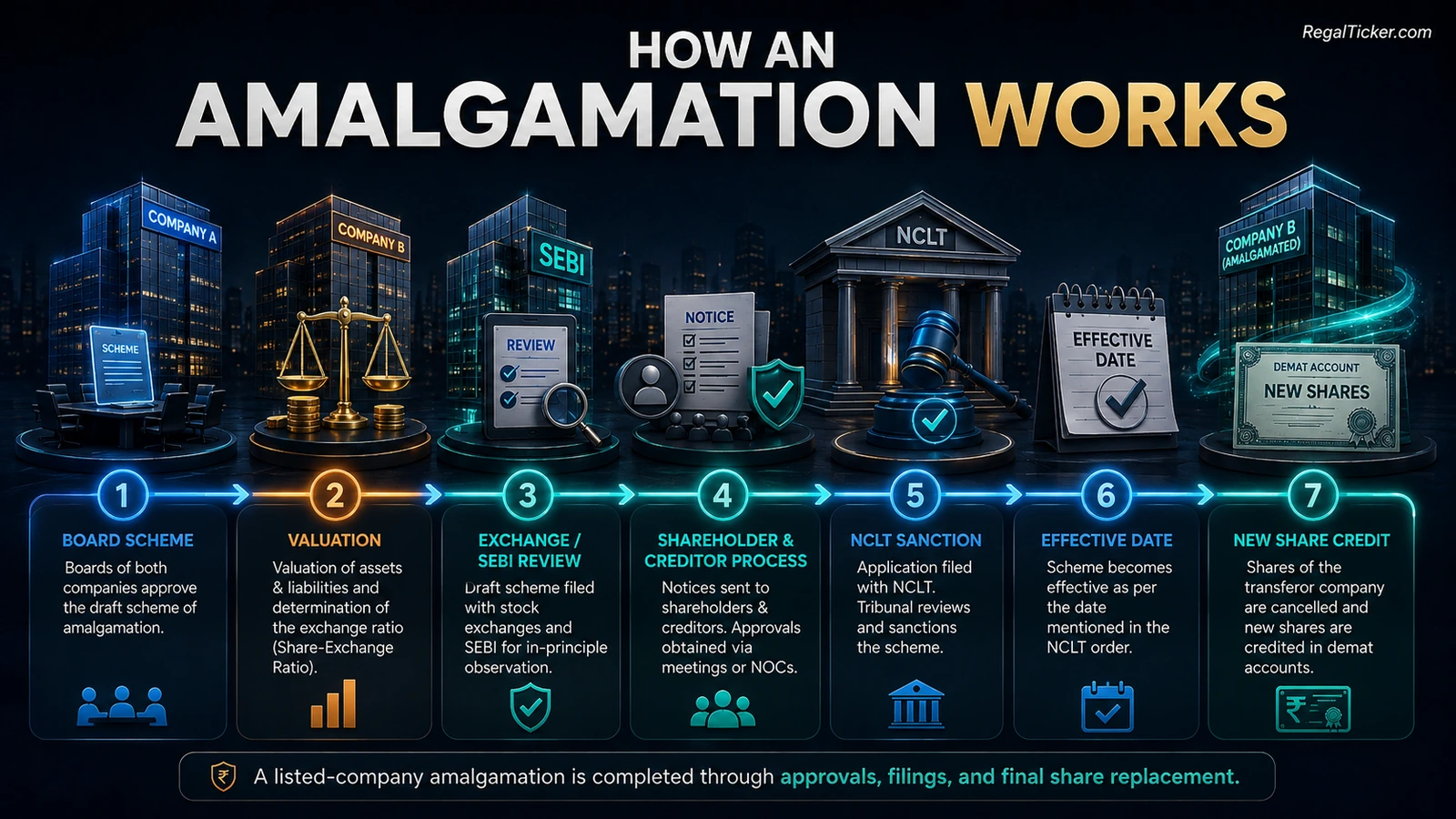
1
Board and scheme proposal
The participating companies approve a draft scheme and explain the business rationale.
2
Valuation and exchange ratio
Valuers determine relative value and the proposed share-exchange ratio; listed transactions may also involve a fairness opinion.
3
Stock-exchange / SEBI process
The listed entity submits the draft scheme and required documents under the applicable listing framework.
4
Shareholder and creditor process
Required classes of shareholders and creditors consider the scheme according to law and tribunal directions.
5
NCLT sanction
The Tribunal considers the scheme and the required approvals and compliance.
6
Effective implementation
After required conditions and filings are completed, the scheme becomes effective.
7
Record date and allotment
Eligible shareholders are identified and replacement shares are allotted according to the final scheme.
8
Demat credit and trading
Old shares are extinguished and the new listed shares become tradable after the applicable exchange process.
9
NSE’s current Scheme Document page shows that listed companies continue to file amalgamation and arrangement documents, complaint reports and observation letters through the exchange process. The current SEBI LODR Master Circular, issued January 30, 2026, consolidates the listed-entity compliance framework that applies to schemes where relevant.
Appointed Date, Effective Date and Record Date
These three dates can look similar but solve different problems.
| Date | What it generally does | Investor question |
|---|---|---|
| Appointed date | Date from which the scheme is treated as operative for the purposes stated in the scheme | From what date are the transferred business effects recognised under the scheme? |
| Effective date | Date on which the final required conditions / filings make the scheme operative | When does the legal combination actually take effect? |
| Record date | Date used to identify eligible holders for replacement shares or other entitlement | Which shareholders are considered for the share exchange? |
What Happens to Your Old Shares and Demat Account?
After an amalgamation becomes effective, an investor can temporarily see confusing portfolio data.
The old shares may:
- stop trading;
- remain visible with no current price;
- disappear before the replacement shares appear;
- show an outdated average cost;
- temporarily create an incorrect gain/loss figure in a broker interface.
The replacement shares may be credited only after the allotment and exchange process is complete.
Do not judge the transaction from a temporary broker screen.
⭐ Pro tip
Preserve the four records that matter
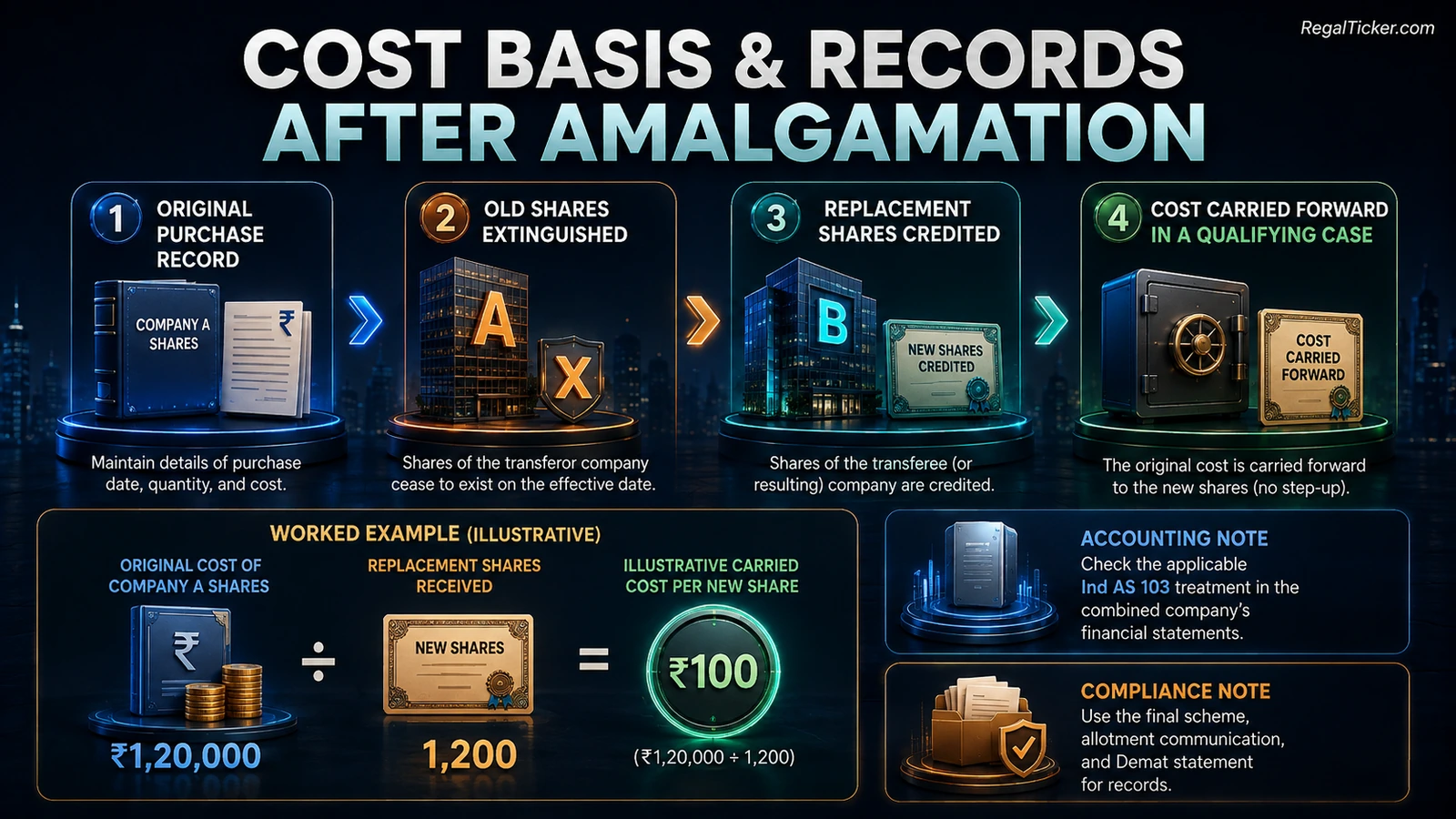
Save the original purchase record, final sanctioned scheme, company allotment communication and Demat statement. These documents are more reliable than a temporary broker average-price field if you later need to reconstruct quantity or acquisition cost.
Accounting Treatment: What an Investor Actually Needs to Know
Accounting treatment depends on the nature of the business combination.
Under Ind AS 103, business combinations are generally accounted for using the acquisition method. Appendix C of Ind AS 103 specifically deals with combinations of entities or businesses under common control.
For an investor, the important point is not to memorise accounting journal entries. It is to understand what accounting treatment can change in the financial statements:
- goodwill or capital reserve;
- carrying value of assets and liabilities;
- reserves;
- depreciation or amortisation;
- earnings per share;
- comparability with previous periods.
An amalgamation between companies under the same ultimate control can therefore produce different accounting presentation from an acquisition of an unrelated business.
Investor note
Do not compare post-amalgamation profit blindly with the old company
After a combination, reported revenue, profit, assets and share count may all change. Check whether prior periods have been restated, whether the accounting is common-control or acquisition accounting, and whether one-time integration costs affect the first few reporting periods.
Tax Treatment and Cost Basis Under the Current Income-tax Act, 2025
This section needs special care because India’s tax code changed.
The Income-tax Act, 2025 came into force on April 1, 2026 for the new tax-year framework. That means an article updated in August 2026 should not present the Income-tax Act, 1961 as the current primary law for a fresh transaction.
Under Section 70(1)(f) of the Income-tax Act, 2025, a shareholder’s exchange of shares in an amalgamating company can be treated as a transaction not regarded as transfer when the statutory conditions are satisfied, including that the consideration is allotment of shares in the amalgamated company and the amalgamated company is an Indian company.
Under Section 73, where shares in an Indian amalgamated company are received in such a qualifying transaction, the cost of acquisition of the replacement shares is deemed to be the cost of the shares in the amalgamating company.
Example: Carrying the Old Acquisition Cost Into Replacement Shares
Assume:
- Original total cost of Company A shares = ₹1,20,000
- Replacement Company B shares received = 1,200
- The transaction satisfies the applicable qualifying conditions
- No special cash or fractional adjustment changes the investor’s calculation
For record-keeping, the carried cost works out to:
₹1,20,000 ÷ 1,200 = ₹100 per replacement share
This is an educational illustration, not a tax filing instruction. Cash consideration, fractional payments, non-resident status, non-qualifying schemes and other facts can change the result.
Tax neutrality is conditional, not automatic. Current law also contains a statutory definition of amalgamation and other conditions that matter to company-level and shareholder-level treatment.
Risk
Do not use an old tax article as your final source
The Income-tax Act, 2025 replaced the 1961 Act from April 1, 2026, subject to transition and savings provisions. For an actual amalgamation, verify the law applicable to the relevant tax year and transaction, and obtain professional advice where the amounts are material.
Amalgamation vs Merger vs Acquisition vs Demerger
These terms overlap in business news but can create very different shareholder outcomes.
- Companies combine under an approved scheme
- Transferor company may cease to exist
- Replacement shares can be issued under a swap ratio
- Assets and liabilities move under the scheme
- Listed-company scheme process can involve exchange / SEBI / NCLT steps
Acquisition
- Buyer obtains control of a target
- Target can continue as a separate subsidiary
- Consideration can be cash, shares or another structure
- Target shares do not necessarily disappear
- Full legal integration may or may not follow
| Structure | Direction of change | Typical shareholder effect |
|---|---|---|
| Amalgamation | Two or more companies / businesses combine | Old holding may be replaced by shares of the combined company |
| Merger | Broad term for combining entities | Depends on the legal route and consideration |
| Acquisition | One party obtains control | Target can remain a separate legal company |
| Demerger | One undertaking is separated | Investor may hold the original company plus a resulting company |
| Spin-off | Business becomes a separate holding | Investor may receive shares in the separated business |
How to Evaluate an Amalgamation as an Investor
The share-exchange ratio is only the mechanical starting point.
Amalgamation Investor Checklist
- Identify the exact transferor and transferee companies.
- Read the scheme rationale instead of relying on the press headline.
- Confirm the final share-exchange ratio.
- Check whether the ratio is still draft or has been sanctioned.
- Read the valuation report and fairness opinion where available.
- Calculate your expected replacement-share quantity.
- Check the treatment of fractional entitlements.
- Note the appointed date, effective date and record date.
- Check when the old shares stop trading and when new shares are expected to be credited.
- Compare the combined company’s debt, cash flow and share count with the pre-amalgamation companies.
- Examine expected synergies and the cost or time needed to achieve them.
- Check promoter ownership and governance after the combination.
- Preserve original acquisition records for future tax and cost-basis work.
- Reassess valuation after the new shares begin trading.
Three Questions That Matter More Than “Is the Ratio Good?”
1. What am I receiving economically? A mathematically fair quantity can still become a poor investment if the combined company is overvalued or highly leveraged.
2. What risks move into the surviving company? Debt, litigation, weak business units, guarantees and integration costs can transfer with the assets.
3. Can management actually deliver the promised synergy? Savings on a presentation slide are not cash until they appear in margins and cash flow.
Common Amalgamation Mistakes
- Treating the exchange ratio as the investment return.
- Assuming a larger company is automatically a stronger company.
- Ignoring dilution for existing transferee-company shareholders.
- Confusing appointed date with effective date.
- Ignoring fractional-share treatment.
- Trusting the broker’s temporary average cost after the swap.
- Using old Income-tax Act, 1961 references as if they were the current 2026 law.
- Looking only at combined revenue and ignoring debt, margins and return on capital.
- Assuming all combinations use the same accounting method.
- Losing original purchase and scheme records.
Quick Knowledge Check
🎯 Quiz yourself
A scheme gives 3 transferee-company shares for every 5 transferor-company shares. If you hold 2,000 eligible old shares, how many new shares do you mathematically receive before any fractional adjustment?
1,200 shares, because 2,000 × 3 ÷ 5 = 1,200.
Does a 3:5 share-exchange ratio mean you receive only 60% of your old investment value?
No. The ratio determines replacement-share quantity. Economic value depends on the market value and fundamentals of the combined company.
Can a qualifying share-for-share amalgamation into an Indian company be treated as not being a taxable transfer for the shareholder under current law?
Yes, when the conditions in the Income-tax Act, 2025 are satisfied. The treatment is conditional, so the actual scheme and current tax law must be checked.
Final takeaway
The ratio is only the beginning
An amalgamation changes what company you own, not just how many shares appear in your Demat account. Start with the final sanctioned scheme, calculate the replacement quantity, confirm the dates and fractional treatment, then analyse the combined company’s debt, earnings, dilution and integration risk. Preserve your original cost records because they may remain relevant under the current tax rules. The best question is not “Is 3:5 a good ratio?” but “What business and value do my replacement shares represent after the combination?”
Frequently asked questions
What is an amalgamation in simple words?
An amalgamation combines one or more companies with another company, or combines companies into a newly formed company, under an approved restructuring scheme. Assets and liabilities move into the amalgamated company and eligible shareholders may receive replacement shares.
What is a share-exchange ratio in an amalgamation?
It states how many shares of the transferee or amalgamated company are issued for a specified number of shares in the transferor or amalgamating company. It determines quantity, not guaranteed market value.
Is an amalgamation automatically tax-free for shareholders?
No. Under the current Income-tax Act, 2025, qualifying share-for-share exchanges can receive non-transfer treatment when statutory conditions are met, but cash components, non-resident situations, non-qualifying schemes and other facts can change the tax result.
Verify through official sources
Official references
- India Code — Companies Act, 2013, Sections 230–232 — Core statutory framework for compromises, arrangements, mergers and amalgamations.
- SEBI — Master Circular for compliance with SEBI Listing Obligations and Disclosure Requirements Regulations, January 30, 2026 — Current consolidated listed-entity compliance framework.
- NSE India — Corporate Filings: Scheme Document — Current exchange repository for listed-company scheme documents, complaint reports and observation letters.
- Income Tax Department — Income-tax Act, 2025, Section 70 — Current rules for transactions not regarded as transfer, including qualifying shareholder exchanges in amalgamations.
- Income Tax Department — Income-tax Act, 2025, Section 73 — Current cost-of-acquisition treatment for replacement shares in qualifying amalgamations.
- ICAI — Ind AS 103, Business Combinations — Accounting framework for business combinations, including Appendix C for common-control combinations.
Educational disclaimer: This article is for investor education and general information only. It is not investment, legal, accounting or tax advice. Amalgamation structures, share-exchange ratios, tax treatment, fractional-entitlement rules, accounting treatment, listing dates and cost-basis consequences differ by scheme. Verify the final sanctioned scheme, current company and exchange filings, depository records and the Income-tax Act, 2025 applicable to the relevant tax year before acting.