
⚡ Quick answer
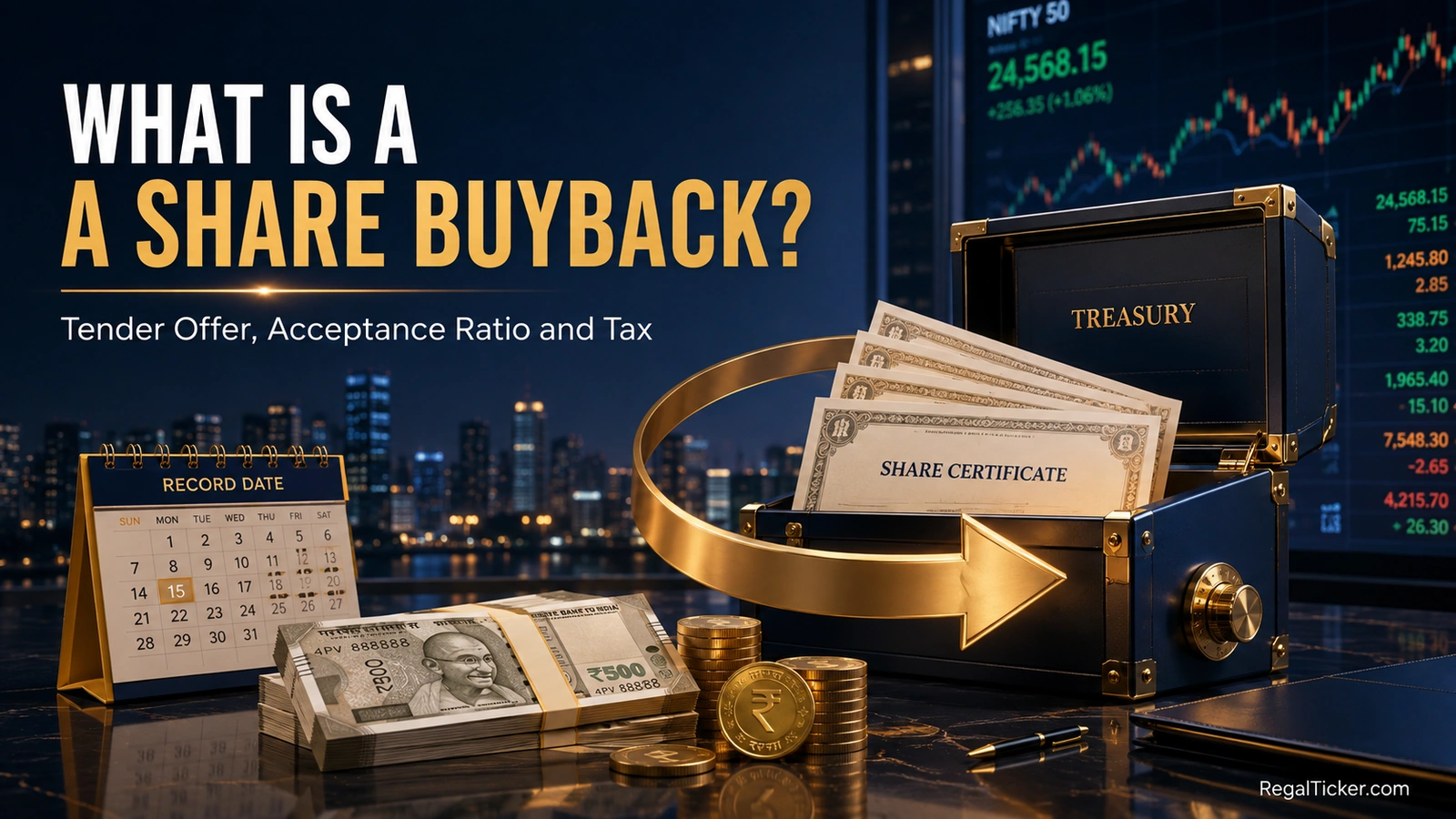
A share buyback is a corporate action in which a company purchases its own shares or other permitted securities from shareholders. The company pays cash for accepted shares and then extinguishes them according to the applicable process. In a tender offer, eligible shareholders may submit shares at the announced buyback price, but not every tendered share is guaranteed to be accepted. Final acceptance depends on the shareholder category, entitlement, valid tenders and the total size of the offer.
Investor note
Key Takeaways
A buyback reduces the number of outstanding shares after accepted shares are extinguished. A tender buyback uses a record date and proportionate acceptance. Buyback entitlement and final acceptance ratio are different. Shareholders may tender more than their entitlement, but extra acceptance is not guaranteed. Tender offers maintain a reserved portion for eligible small shareholders. The buyback premium alone does not determine the investor’s final return. Returned shares remain exposed to the post-buyback market price. SEBI reintroduced open-market buybacks through stock exchanges from August 1, 2026 under the amended framework. Current tax rules generally treat buyback proceeds as capital gains for public shareholders, subject to the applicable law and individual facts. Use the Buyback Acceptance Ratio Calculator for entitlement, acceptance scenarios and gross proceeds.
A buyback can return surplus cash, improve capital efficiency or signal management confidence. It can also be poorly timed, overvalued or funded at the expense of future growth. The announcement alone is not enough to decide whether the action creates value.
This is Lesson 7 in the Regal Ticker Corporate Actions Learning Hub. Begin with What Are Corporate Actions in the Stock Market? and review Corporate Action Dates Explained before analysing an actual buyback.
What Is a Share Buyback?
📖 Definition
Share Buyback
A share buyback is the purchase by a company of its own shares or other specified securities using funds and methods permitted under company law and securities regulations.
When accepted shares are extinguished, the total number of shares outstanding falls.
Simple Meaning
Suppose a company has 10 crore equity shares outstanding.
It buys back and extinguishes 50 lakh shares.
After completion:
- shares outstanding reduce to 9.5 crore;
- successful participating shareholders receive cash;
- accepted shares cease to exist;
- non-participating shareholders continue to hold their shares;
- each remaining share represents a slightly larger fraction of the company than before, assuming no other issuance.
A buyback is not free money. A shareholder gives up accepted shares in exchange for cash.
Legal Foundation in India
Section 68 of the Companies Act, 2013 permits a company to purchase its own shares or specified securities from permitted sources such as free reserves, the securities-premium account or eligible issue proceeds, subject to legal conditions.
The provision also requires safeguards relating to:
- authorisation;
- approval limits;
- solvency;
- debt and capital position;
- fully paid securities;
- completion timetable;
- extinguishment;
- filing and record keeping.
Listed-company buybacks must also comply with the current SEBI Buy-Back Regulations.
Why Do Companies Buy Back Shares?
A company may announce a buyback for several reasons.
Return Surplus Cash
A mature company may have more cash than it can deploy productively in the near term.
A buyback can return part of that cash to shareholders who choose to participate.
Improve Capital Efficiency
A company with excess equity and low leverage may use a buyback to change its capital structure.
Possible effects include:
- lower share count;
- higher earnings per share if earnings remain unchanged;
- higher return-on-equity measures because equity reduces;
- altered cash and debt ratios.
A stronger ratio after buyback does not always mean the operating business improved.
Signal That Management Believes Shares Are Undervalued
Management may believe the market price is below the company’s long-term value.
The signal is more credible when:
- the balance sheet remains strong;
- the buyback does not weaken necessary investment;
- management explains valuation and capital-allocation logic;
- promoters and insiders act consistently with the stated rationale.
Offset Employee Share Issuance
Companies may issue shares through employee stock-option or compensation programmes.
A buyback can partly offset dilution from those issuances.
Increase the Ownership Percentage of Remaining Shareholders
When accepted shares are extinguished, shareholders who do not sell may own a larger percentage of the reduced share capital.
This percentage increase occurs without those investors purchasing additional shares.
Provide an Exit at an Announced Price
A tender offer can provide eligible shareholders an opportunity to sell accepted shares at the announced buyback price.
The actual benefit depends on:
- acceptance ratio;
- market price;
- tax;
- transaction costs;
- future performance of shares retained.
⚠ Important warning
A premium buyback price is not automatically attractive
The company may announce a price above the current market price, but only accepted shares receive that price. The market price can fall, acceptance can be limited and the investor gives up future participation on accepted shares.
Methods of Share Buyback in India
Current SEBI rules recognise more than one buyback route.
Tender Offer Route
A tender offer is an offer to purchase shares from eligible holders on a proportionate basis through a Letter of Offer.
The tender route normally involves:
- board or shareholder approval;
- public announcement;
- record date;
- shareholder categories;
- Letter of Offer;
- tendering through the stock-exchange mechanism;
- proportionate acceptance;
- payment;
- return or release of unaccepted shares;
- extinguishment of accepted shares.
Tender offers are especially relevant to individual investors because they include a separate reserved category for eligible small shareholders.
Open-Market Buyback Through Stock Exchange
SEBI reintroduced open-market buybacks through stock exchanges from August 1, 2026 under the amended regulations.
Under the reintroduced framework:
- the company purchases shares through the stock exchange;
- the route operates differently from a record-date tender offer;
- promoter and associated holdings are restricted or frozen according to the framework;
- the offer must be completed within the prescribed period;
- utilisation and disclosure requirements apply.
SEBI’s 2026 framework provides a maximum completion period of 66 working days from the opening of the buyback and requires at least 40% of earmarked funds to be used during the first half of the offer period.
Open-Market Buyback Through Book Building
The regulations also recognise an open-market book-building route.
The company specifies the route in its public announcement and regulatory documents.
Investor note
Check the Buyback Method Before Calculating
Entitlement and acceptance-ratio calculations mainly apply to a tender offer. An open-market buyback works differently because the company purchases shares through market transactions rather than using a record-date tender entitlement.
How a Tender Buyback Works
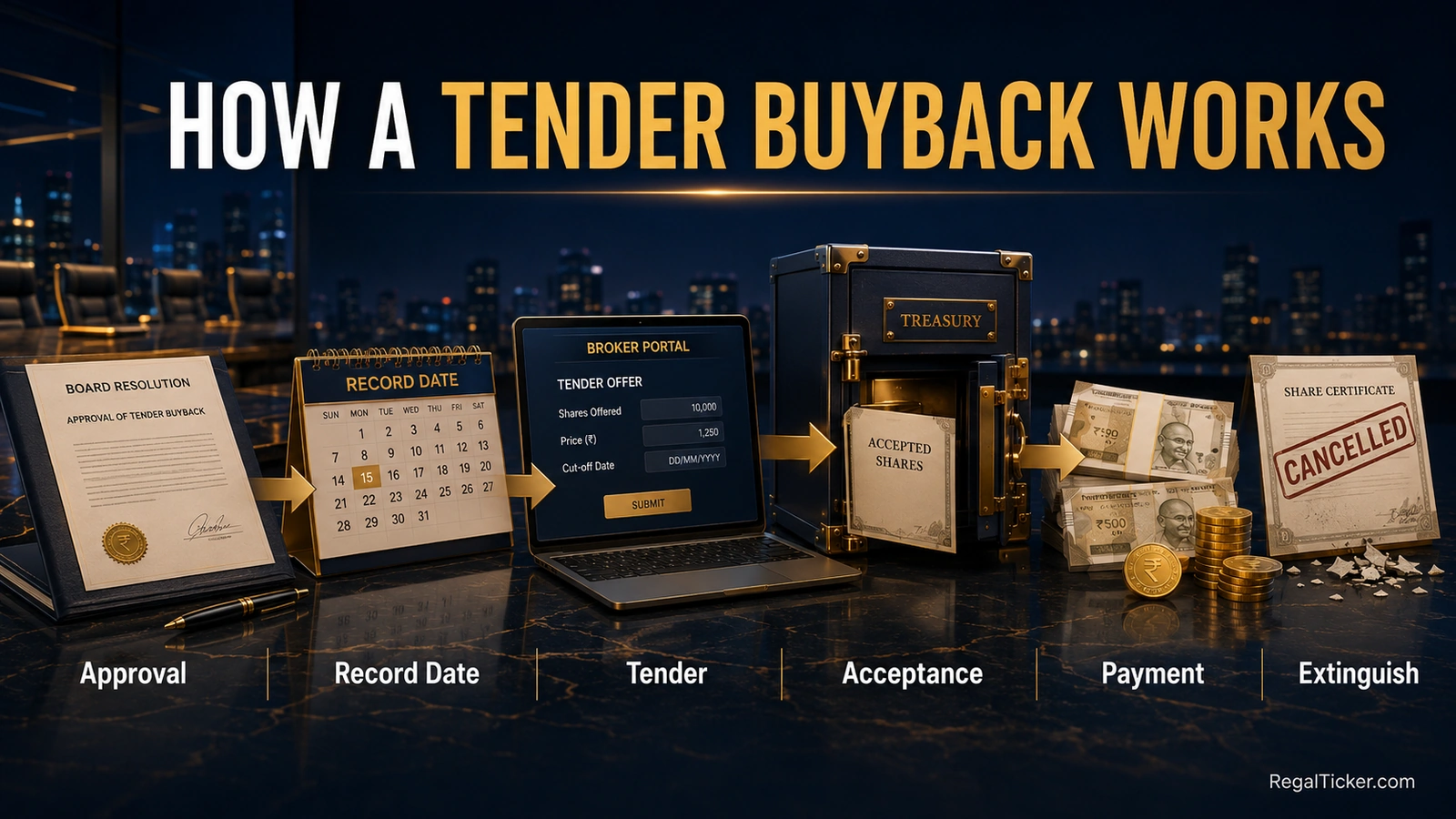
1. Approval
The company’s board approves the proposal.
A buyback within the applicable board-approval limit may not require a shareholder special resolution. A larger proposal requires shareholder approval according to the Companies Act and SEBI rules.
2. Public Announcement
The company discloses key information such as:
- buyback size;
- number of shares;
- buyback price;
- route;
- maximum offer amount;
- purpose;
- funding source;
- approvals;
- process and timetable;
- expected impact on shareholding.
3. Record Date
The record date identifies shareholders eligible to participate in a tender offer.
The market value of the holding on the record date is also relevant for small-shareholder classification.
4. Letter of Offer and Tender Form
The Letter of Offer contains the detailed terms.
It normally explains:
- eligibility;
- category;
- indicative entitlement;
- offer dates;
- tender procedure;
- documents;
- settlement;
- tax considerations;
- risk factors.
5. Tender Through a Broker
A demat shareholder normally submits the tender instruction through a stock broker during the offer period.
The broker places the bid on the exchange tender platform.
Tendering shares is not the same as selling them immediately. Final acceptance is determined after the offer closes.
6. Proportionate Acceptance
Valid tenders are processed on a proportionate basis.
Shares tendered within entitlement receive priority under the applicable process. Additional tendered shares can also be accepted if capacity remains.
7. Payment and Return of Unaccepted Shares
The investor receives cash for accepted shares.
Unaccepted shares are returned or released back into the demat account according to the settlement process.
8. Extinguishment
The company cancels or extinguishes accepted shares.
The reduction in outstanding share count is a defining feature of a completed buyback.
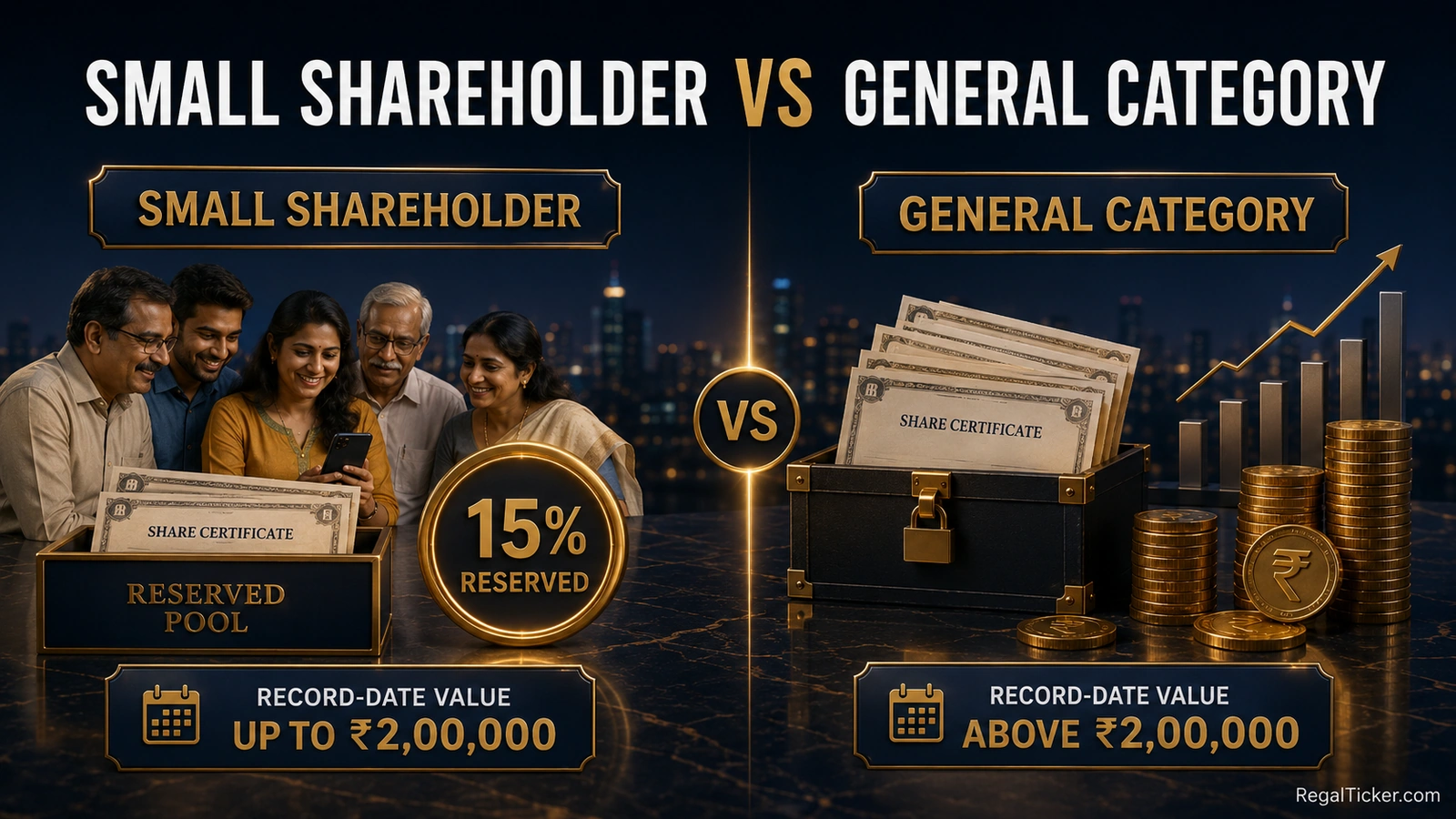
Small Shareholder Category in a Tender Buyback
A small shareholder is a specific regulatory category.
Under the current framework, it generally refers to an eligible shareholder whose market value of shares in the company does not exceed ₹2,00,000 on the record date, calculated using the applicable exchange price methodology.
Fifteen Percent Reservation
Tender-offer rules reserve the higher of:
- 15% of the number of shares proposed to be bought back; or
- the number of shares to which small shareholders are entitled based on their shareholding.
This reservation creates a separate small-shareholder pool.
It does not guarantee 100% acceptance.
General Category
Eligible shareholders who do not meet the small-shareholder definition participate in the general category.
Each category has its own:
- total eligible holding;
- entitlement factor;
- valid tender pool;
- final acceptance.
Caution
Classification Depends on Record-Date Market Value
The small-shareholder category is based on the market value of the eligible holding on the record date, not simply on the number of shares owned. A shareholder with fewer high-priced shares can exceed the applicable ₹2 lakh threshold, while another investor with more lower-priced shares may remain within it. Always verify the Letter of Offer, registrar entitlement page and the final company communication.
Buyback Entitlement and Acceptance Ratio
These terms are related but different.
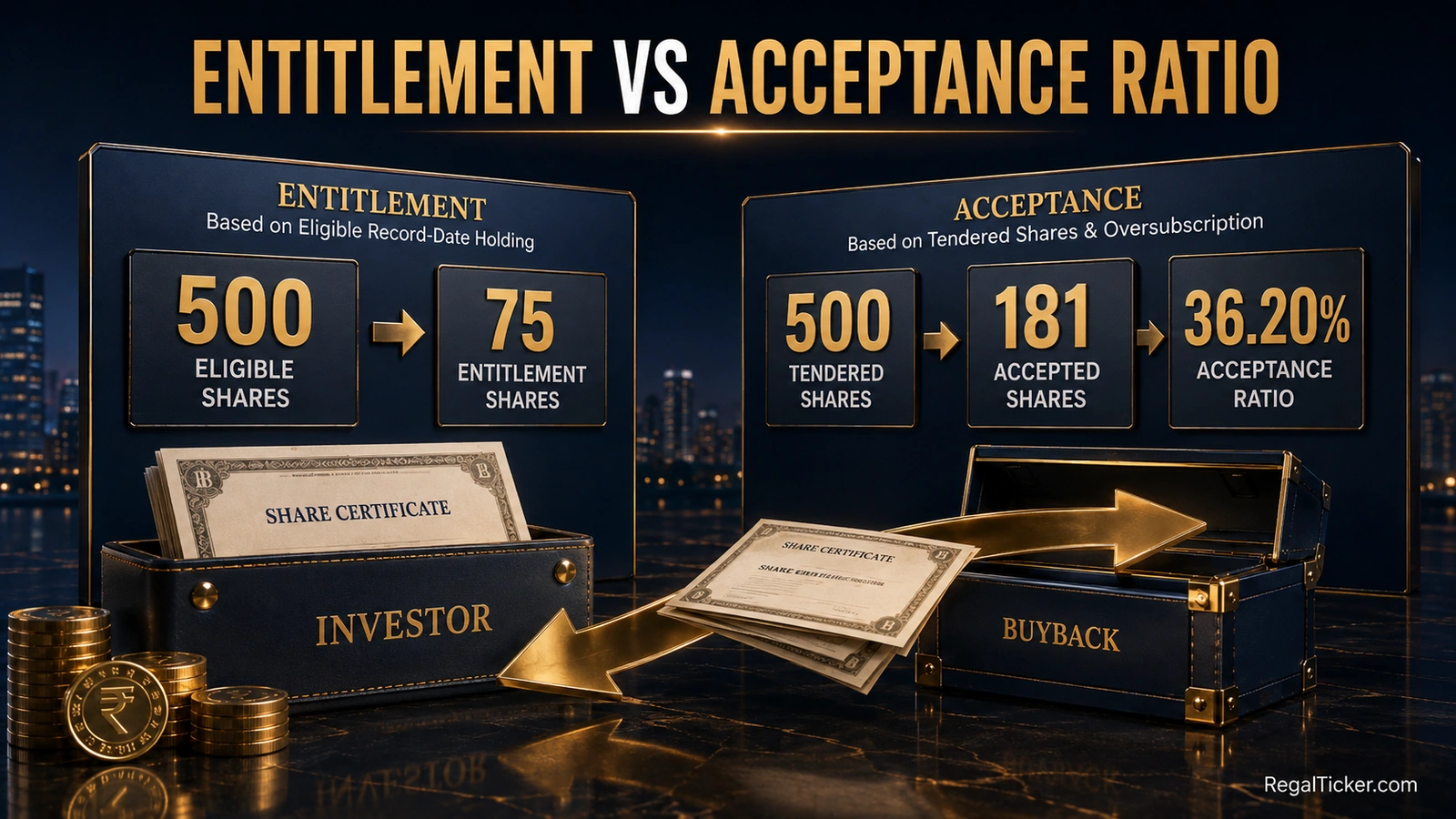
Buyback Entitlement
Buyback entitlement is the indicative number of shares that may receive priority, based on:
- shareholder category;
- record-date holding;
- total shares reserved for that category;
- total eligible shares held in that category;
- rounding rules.
FORMULA: Indicative entitlement shares = Record-date holding × Category entitlement percentage
The Letter of Offer may instead express entitlement as a ratio, such as 15 shares for every 100 shares held.
Shares Tendered
Shares tendered are the number of shares the investor submits into the offer.
The investor may tender:
- fewer than entitlement;
- exactly entitlement;
- more than entitlement;
- the full eligible holding.
Shares Accepted
Shares accepted are the number the company actually purchases.
Accepted shares can include:
- entitlement shares;
- additional shares accepted from the remaining tender pool.
Effective Acceptance Ratio
FORMULA: Effective acceptance ratio = Accepted shares ÷ Tendered shares × 100
💡 Real example
Simple example
Shares tendered = 500 Shares accepted = 181
Acceptance ratio = 181 ÷ 500 × 100 = 36.20%
Entitlement Is Not the Final Acceptance Ratio
An entitlement of 15 shares for every 100 held does not necessarily mean the final acceptance ratio will be 15%.
Final acceptance can be higher when:
- some eligible shareholders do not participate;
- some tender fewer shares;
- category capacity remains;
- additional shares are accepted proportionately.
It can also be affected by invalid tenders and rounding.
Worked Tender-Offer Example
Suppose an investor:
- holds 500 eligible shares on the record date;
- tenders all 500 shares;
- has category entitlement of 15 shares for every 100 held;
- uses an additional-acceptance scenario of 25%;
- buyback offer price is ₹1,600;
- reference market price is ₹1,400;
- average acquisition cost is ₹900.
Step 1: Calculate Entitlement
FORMULA: 500 × 15 ÷ 100 = 75 entitlement shares
Step 2: Calculate Shares Above Entitlement
FORMULA: 500 tendered − 75 entitlement = 425 additional shares tendered
Step 3: Estimate Additional Acceptance
FORMULA: 425 × 25% = 106.25
For a simple scenario estimate, use 106 additional shares.
Step 4: Estimate Total Accepted Shares
FORMULA: 75 + 106 = 181 accepted shares
Step 5: Calculate Effective Acceptance Ratio
FORMULA: 181 ÷ 500 × 100 = 36.20%
Step 6: Calculate Returned Shares
FORMULA: 500 − 181 = 319 shares returned or released
Step 7: Calculate Gross Proceeds
FORMULA: 181 × ₹1,600 = ₹2,89,600
Step 8: Calculate Premium Over Reference Price
FORMULA: (₹1,600 − ₹1,400) × 181 = ₹36,200
| Measure | Result |
|---|---|
| Record-date holding | 500 shares |
| Shares tendered | 500 shares |
| Entitlement ratio | 15 for every 100 |
| Entitlement shares | 75 shares |
| Additional-acceptance scenario | 25% |
| Estimated additional accepted | 106 shares |
| Estimated total accepted | 181 shares |
| Estimated effective acceptance ratio | 36.20% |
| Estimated returned shares | 319 shares |
| Buyback price | ₹1,600 |
| Gross proceeds | ₹2,89,600 |
| Premium over ₹1,400 reference price | ₹36,200 |
Tax on Share Buybacks in India
Buyback taxation changed more than once in recent years.
Current Framework From April 1, 2026
Under Section 69 of the Income-tax Act, 2025, consideration received by a shareholder when a company purchases its own shares or other specified securities is subject to the capital-gains framework. Broadly, the gain is determined by comparing the buyback consideration with the applicable cost of acquisition, subject to the other capital-gains provisions of the Act.
For an investor, the practical calculation therefore depends on the number of shares actually accepted, buyback consideration, acquisition cost, holding period and the capital-gains provisions applicable to that security and shareholder.
The Act also contains additional tax provisions for promoters in specified buyback cases. Promoters, non-residents and investors with unusual or high-value circumstances should verify the treatment applicable to their transaction rather than applying a general retail-shareholder example.
Why Older Articles May Show a Different Rule
From October 1, 2024 until the new framework took effect, domestic-company buyback consideration was generally treated as dividend income in the shareholder’s hands under the earlier rules, with separate treatment of acquisition cost.
That historical rule should not be copied into a current 2026 calculation without checking the transaction date.
Investor note
Confirm the Tax Law Applicable on the Actual Buyback Date
Buyback taxation has changed more than once in recent years. The applicable treatment can depend on the buyback date, shareholder status, residential status, holding period, security type and other transaction facts. Preserve your original purchase records, tender and acceptance statements, contract notes and tax documents instead of applying a rule from an older buyback article to a current transaction.
Simple Capital-Gain Illustration
Assume:
- accepted shares: 100;
- buyback price: ₹1,500;
- acquisition cost: ₹900 per share.
FORMULA: Gross consideration = 100 × ₹1,500 = ₹1,50,000
FORMULA: Cost of acquisition = 100 × ₹900 = ₹90,000
FORMULA: Illustrative capital gain = ₹1,50,000 − ₹90,000 = ₹60,000
The final tax depends on the applicable capital-gains rules and the investor’s facts.
Caution
Calculator Output Is Not Personal Tax Advice
The Buyback Acceptance Ratio Calculator is designed mainly to estimate entitlement, acceptance scenarios and gross proceeds. It does not determine your final capital-gains tax. Tax treatment can depend on the buyback date, holding period, acquisition cost, shareholder category, residential status and the law applicable to the transaction.
How a Buyback Affects the Company and Investors
Shares Outstanding Decrease
Accepted shares are extinguished.
The denominator used for per-share calculations becomes smaller.
Earnings Per Share May Increase
FORMULA: EPS = Profit attributable to equity shareholders ÷ Weighted average shares outstanding
If profit remains unchanged while the number of shares falls, EPS can rise.
This is a mathematical effect. It does not prove operating profit grew.
Cash and Net Worth Reduce
The company pays cash to shareholders.
This reduces cash resources and normally reduces equity or reserves according to the accounting treatment.
Debt Ratios Can Worsen
If cash and equity fall, leverage ratios may increase.
A company should not weaken financial stability merely to improve per-share metrics.
Ownership Percentage of Remaining Holders Can Rise
A non-participating shareholder’s number of shares stays the same while total shares outstanding fall.
The ownership percentage can therefore rise.
Market Price Can React in Either Direction
A buyback can be interpreted positively when:
- the company has genuine surplus cash;
- the price is sensible;
- the balance sheet remains strong;
- management has a disciplined capital-allocation record.
It can be viewed negatively when:
- growth investment is being sacrificed;
- the company overpays;
- debt increases;
- the action mainly supports short-term metrics;
- governance concerns arise.
⭐ Pro tip
Compare the buyback price with business value, not only market price
A premium over the current quote may still be unattractive if the company is overvalued. A modest premium can still be sensible if the shares are materially undervalued and the balance sheet remains strong.
Tender Buyback vs Open-Market Buyback
| Point | Tender offer | Open-market buyback through stock exchange |
|---|---|---|
| Eligibility | Based on record date | Market sellers whose orders match company purchases |
| Buyback price | Fixed announced price | Market-linked purchases within permitted limits |
| Entitlement | Yes | No tender entitlement |
| Acceptance ratio | Relevant | Not used in the same way |
| Small-shareholder reservation | Yes | No comparable tender reservation |
| Investor action | Tender through broker | Sell normally in the market |
| Promoter participation | Subject to tender rules | Restricted under the amended framework |
| Completion period | Offer-specific regulated timetable | Prescribed open-market period |
| Primary Regal Ticker tool | Buyback Acceptance Ratio Calculator | Standard market-sale analysis |
Share Buyback vs Other Corporate Actions
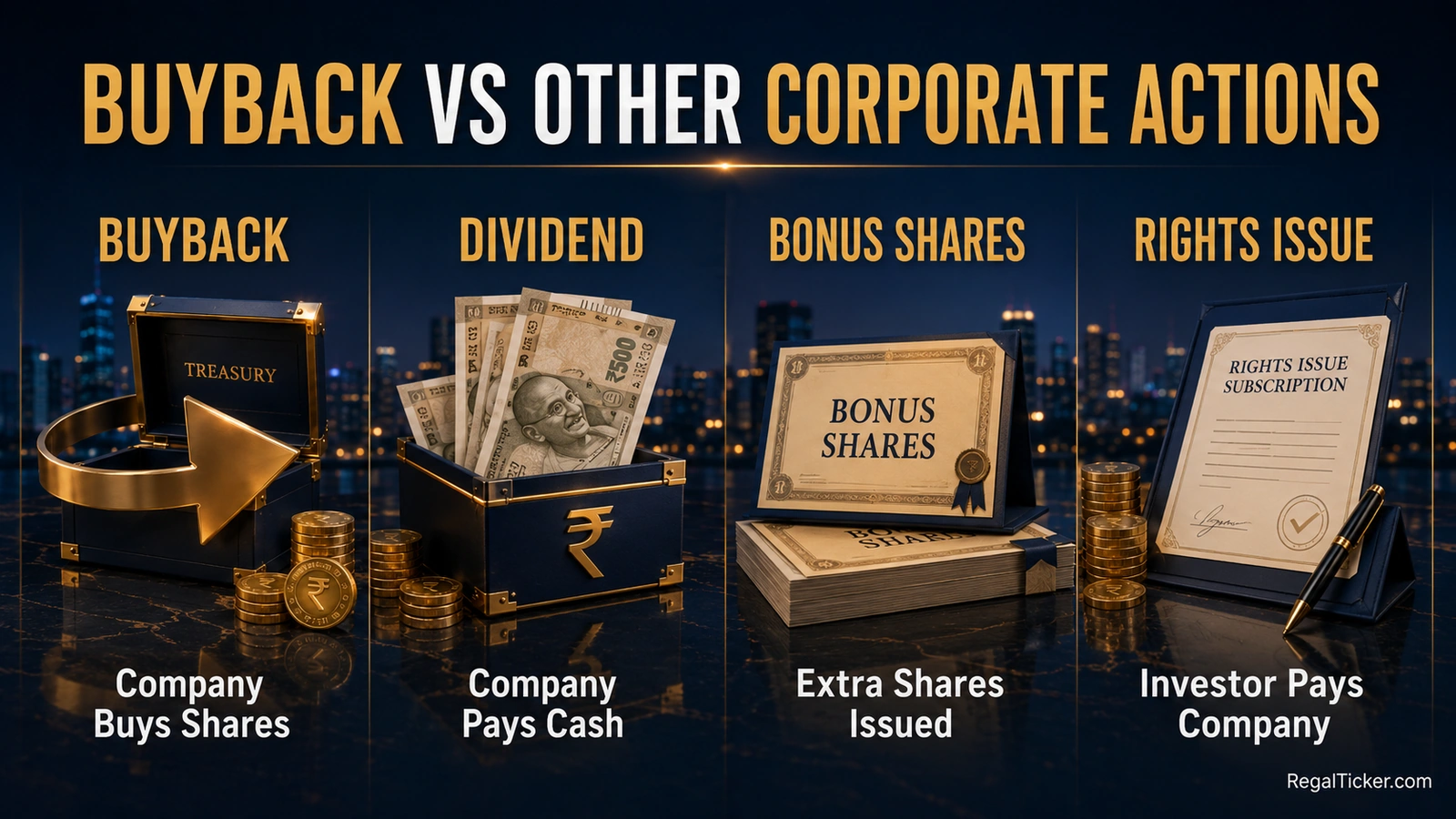
Buyback vs Dividend
A dividend distributes cash while the shareholder generally keeps all shares.
A buyback pays cash only for accepted shares surrendered to the company.
Read What Is a Dividend? for the dividend process.
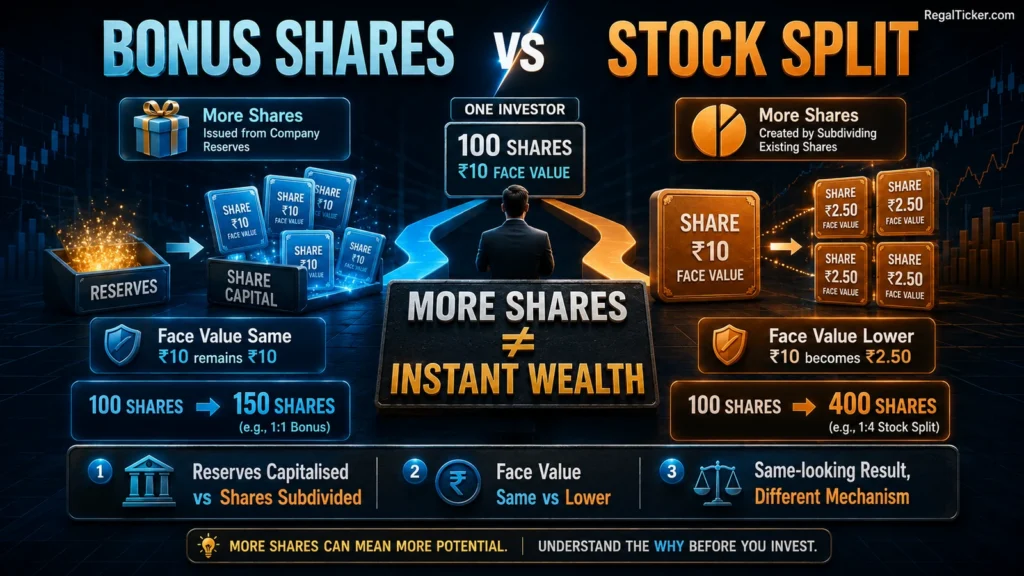
Buyback vs Bonus Shares
A bonus issue increases share count without asking the shareholder to pay cash.
A buyback reduces outstanding share count by purchasing and extinguishing shares.
Read What Are Bonus Shares? for the bonus-share mechanics.
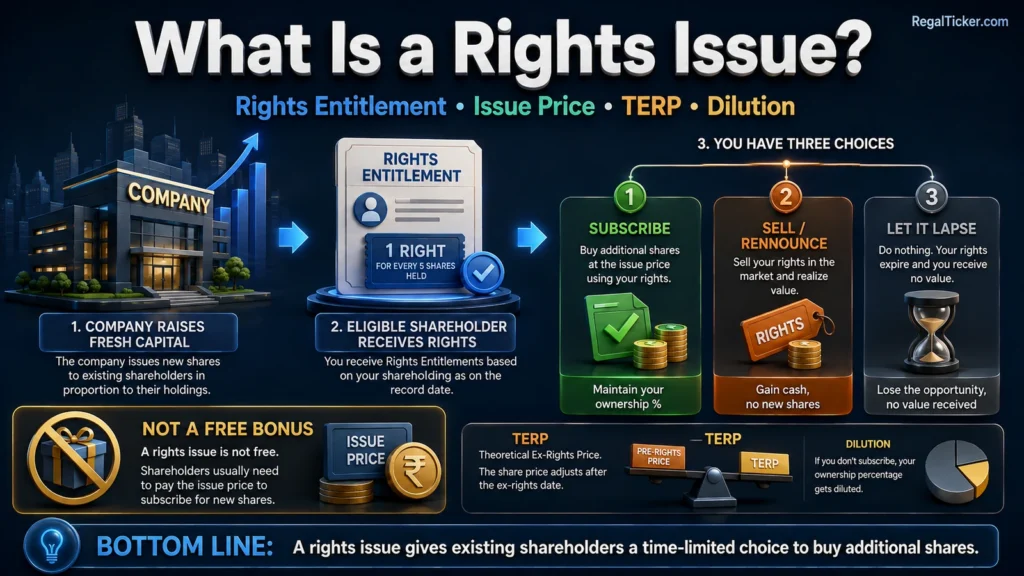
Buyback vs Rights Issue
A rights issue raises fresh capital by offering additional shares to eligible holders.
A buyback returns capital by purchasing existing shares.
Buyback vs Stock Split
A stock split increases the number of shares by subdividing each share and reducing face value.
A buyback reduces the number of outstanding shares by cancelling accepted shares.
Read What Is a Stock Split? for the split calculation.
| Corporate action | Cash flow | Share count | Investor action |
|---|---|---|---|
| Dividend | Company pays cash | Usually unchanged | Hold through eligibility |
| Buyback | Company pays cash for accepted shares | Decreases | Tender, sell in market or continue holding |
| Bonus shares | No subscription payment | Increases | Normally automatic for eligible holders |
| Rights issue | Investor pays company | Increases after allotment | Subscribe, transfer or lapse |
| Stock split | No cash exchange | Increases | Normally automatic adjustment |
How to Evaluate a Share Buyback
1. Understand the Purpose
Ask whether the company is:
- returning genuine surplus cash;
- improving an inefficient capital structure;
- offsetting dilution;
- supporting the share price;
- changing ownership dynamics;
- avoiding productive investment.
2. Compare Buyback Price With Business Value
The premium over market price is not enough.
Review:
- earnings quality;
- cash flow;
- balance sheet;
- debt;
- return ratios;
- growth opportunities;
- valuation;
- governance.
3. Check the Funding Source
A buyback funded from strong internal cash can be very different from one that leaves the company financially stretched.
4. Estimate Acceptance
Use:
- record-date holding;
- category;
- entitlement ratio;
- shares you plan to tender;
- several additional-acceptance scenarios.
5. Consider the Shares You Will Retain
If many tendered shares are returned, the investor remains exposed to the post-buyback market price.
6. Check Current Tax
Use the law applicable on the actual transaction date, not an old article or outdated calculator label.
7. Review Promoter Participation
Promoter participation or non-participation can affect:
- offer supply;
- acceptance;
- post-buyback ownership;
- governance interpretation.
⚠ Important warning
Buyback arbitrage is not risk free
Buying only to tender into a premium-priced offer exposes the investor to market-price risk, uncertain acceptance, tax, costs and time. Model conservative, moderate and optimistic acceptance scenarios.
Use the Regal Ticker Buyback Calculator
Use the Buyback Acceptance Ratio Calculator in this sequence:
Step 1: Verify the Route
Confirm whether the buyback is:
- tender offer;
- open market through stock exchange;
- open market through book building.
Step 2: Note the Dates
For a tender offer, record:
- record date;
- offer opening;
- offer closing;
- settlement date.
Step 3: Identify Your Category
Check whether you qualify as a small shareholder or general shareholder.
Step 4: Enter Your Entitlement
Use the Letter of Offer or registrar entitlement page.
Step 5: Model Multiple Acceptance Scenarios
Test conservative, moderate and optimistic additional-acceptance assumptions.
Step 6: Compare Gross Proceeds and Returned Shares
Do not evaluate only the accepted shares. The retained position matters too.
Step 7: Calculate Gain or Loss Separately
Use accepted quantity, buyback price, acquisition cost and current tax rules.
Buyback Calculation Workflow
- Verify whether the official buyback uses the tender-offer route.
- Confirm the record date and your eligible holding.
- Identify whether you fall under the small-shareholder or general category.
- Enter the entitlement ratio from the Letter of Offer or registrar communication.
- Enter the number of shares you plan to tender.
- Model conservative, moderate and optimistic additional-acceptance scenarios.
- Compare estimated accepted shares, returned shares and gross proceeds.
- After settlement, verify the actual acceptance and calculate tax separately under the rules applicable to the transaction.
Browse all Regal Ticker Investor Tools for related calculators.
Common Buyback Mistakes and Investor Checklist
Common Mistakes
- Assuming entitlement equals final acceptance.
- Assuming every tendered share will be bought.
- Ignoring the small-shareholder definition.
- Buying only for the announced premium.
- Using an outdated tax rule.
- Ignoring returned shares.
- Treating higher EPS as business growth.
- Ignoring the funding cost.
- Using only one optimistic acceptance scenario.
- Not reading the Letter of Offer.
Investor Checklist
Before tendering, check:
- What is the buyback route?
- What is the offer price?
- What is the current market price?
- What is the record date?
- What is my eligible holding?
- Am I in the small-shareholder or general category?
- What is my entitlement?
- How many shares will I tender?
- What acceptance scenarios have I modelled?
- What happens if most shares are returned?
- What is my acquisition cost?
- Which tax rules apply on the transaction date?
- How strong is the post-buyback balance sheet?
- Is the company overpaying?
- What will promoters do?
- Have I read the Letter of Offer?
- Am I acting on fundamentals or only on the announced premium?
Conclusion
A share buyback is a regulated purchase of a company’s own shares.
In a tender offer:
- the record date identifies eligible shareholders;
- shareholders tender through the prescribed mechanism;
- entitlement gives priority;
- additional shares may be accepted;
- accepted shares are purchased for cash;
- unaccepted shares return to the investor;
- accepted shares are extinguished.
The most important calculation is not the announced premium alone. It is the combination of:
- entitlement;
- possible additional acceptance;
- final accepted quantity;
- gross proceeds;
- retained shares;
- market risk;
- current tax.
Use the Regal Ticker Buyback Acceptance Ratio Calculator after reading the Letter of Offer. Model several acceptance scenarios and verify the current tax rules separately.
Frequently asked questions
What is the difference between buyback entitlement and acceptance ratio?
Buyback entitlement is the indicative number of shares that receive priority based on your record-date holding and shareholder category. The final acceptance ratio is the percentage of your tendered shares that the company actually accepts after all valid tenders are processed.
Can I tender more shares than my buyback entitlement?
Yes, if the Letter of Offer permits it. Shares within your entitlement receive the applicable priority, while additional shares may be accepted only if capacity remains after processing valid tenders.
What is the small-shareholder category in a tender buyback?
It generally covers an eligible shareholder whose market value of shares in the company does not exceed ₹2 lakh on the record date under the applicable methodology. The category has a reserved tender pool, but it does not guarantee that every tendered share will be accepted.
How are share-buyback proceeds taxed in 2026?
Under the current Income-tax Act, 2025 framework, buyback consideration is generally dealt with under the capital-gains provisions for public shareholders, subject to the transaction date, acquisition cost, holding period, shareholder status and other applicable conditions. The Buyback Acceptance Ratio Calculator should be used for entitlement and proceeds modelling, not as a personal tax calculator.
Verify through official sources
Official references
- India Code — Companies Act, 2013, Section 68 — statutory framework for a company purchasing its own shares or specified securities.
- SEBI — Buy-Back of Securities Regulations, 2018, updated through July 2026 — current listed-company buyback framework covering tender offers, open-market routes, disclosures and implementation requirements.
- SEBI — Operationalisation of Promoter-Holding Freeze, July 21, 2026 — current operational guidance following the 2026 amendments, including treatment of promoter and promoter-group holdings during the buyback period.
- NSE India — Tender Offer: Buyback — exchange guidance on tender-offer buybacks, proportionate participation and the reserved small-shareholder category.
- Income Tax Department — Income-tax Act, 2025, Section 69 — current capital-gains provision for consideration received when a company purchases its own shares or other specified securities.
- RegalTicker — Buyback Acceptance Ratio Calculator — estimate tender entitlement, acceptance scenarios, returned shares and gross proceeds after checking the official buyback terms.
Educational disclaimer: This article is for investor education and general information only. It is not investment, tax, legal or personalised financial advice and is not a recommendation to tender, sell or hold any security. Buyback terms, routes, dates, prices, entitlement, acceptance, settlement and tax consequences can differ. Verify the current public announcement, Letter of Offer, SEBI and exchange filings, registrar information, demat records and applicable tax law, and consult an appropriately qualified professional where necessary.