

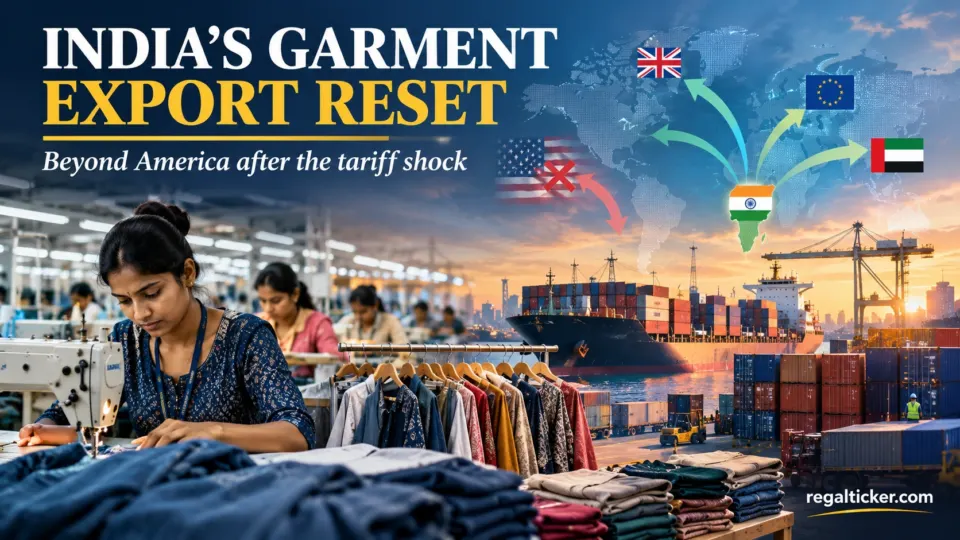
What began as a tariff problem is turning into a permanent change in export strategy
For years, the United States was the obvious market for Indian garment exporters.
It was large, predictable and already connected to Indian factories through buyers such as Gap, JCPenney and other global retailers.
Then tariffs changed the calculation.
Reuters reported that U.S. tariff increases of up to 50% in 2025 triggered order cancellations, demands for discounts and pressure on exporter margins. The immediate response was defensive. Companies tried to protect customers and absorb some of the pain.
The longer-term response is more interesting.
Indian garment makers are now redesigning where they sell.
Orient Craft has cut the U.S. share of its sales from 84% to below 10%. Gokaldas Exports is working to raise Europe to 25–30% of revenue over the next three to five years while reducing its U.S. dependence. Exporters are also pushing harder into the UK, UAE and India’s own domestic market.
That does not mean America is becoming irrelevant.
It means the tariff shock has exposed the risk of relying too heavily on one buyer market.
⚡ Quick answer
Are Indian garment exporters permanently reducing reliance on the U.S.?
Increasingly, yes. Exporters still want U.S. customers, but many are treating diversification as a lasting strategy rather than a temporary response. Reuters reported that Indian textile, apparel and home-furnishing exports to the U.S. fell 9.8% from April to August while shipments to other markets rose 3.7%. New trade access in the UK, the concluded India-EU FTA negotiations and the existing UAE trade agreement are giving exporters more alternatives.
Key takeaways
U.S. tariff increases of up to 50% in 2025 disrupted Indian garment exporters.
Reuters says U.S.-bound textile, apparel and home-furnishing exports fell 9.8% from April to August.
Shipments to markets outside the U.S. rose 3.7% over the same period.
Orient Craft reduced the U.S. share of sales from 84% to below 10%.
Gokaldas Exports is targeting Europe at 25–30% of revenue over the next three to five years.
Gokaldas also wants to reduce its U.S. dependence rather than abandon the market.
India-UK CETA entered into force on 15 July 2026 and gives nearly 99% of Indian exports zero-duty access to the UK.
India-EU FTA negotiations concluded in January 2026, with textiles identified as a major potential beneficiary.
India-UAE CEPA is already supporting stronger market access.
Official data shows India’s textile, apparel and handicraft exports to the U.S. fell in FY2025-26, while exports to the UAE and UK increased.
The biggest strategic change is diversification of customers, not relocation of Indian manufacturing.
The investment opportunity depends on whether exporters can protect margins while building new buyer relationships.
1. The tariff shock exposed how concentrated the industry had become
Export concentration is comfortable until policy changes.
For some Indian garment manufacturers, America had become so important that a tariff decision in Washington could materially change factory economics in India.
That is exactly what happened.
Reuters reported that higher U.S. tariffs triggered cancellations, bargaining over prices and pressure on margins.
For exporters with thin manufacturing margins, a large tariff cannot always be absorbed.
Either the buyer pays more.
The exporter accepts lower profitability.
Or the order moves somewhere else.
That forced Indian manufacturers to ask a more difficult question: how much U.S. dependence is too much?
2. Orient Craft shows how dramatic diversification can become
Orient Craft is one of the clearest examples.
Reuters reported that the company once generated about 84% of sales from the U.S.
That figure is now below 10%.
The company has redirected business toward Britain, continental Europe and India.
That is not a small adjustment.
It is a complete rebalancing of customer geography.
The significance goes beyond one exporter.
If other companies follow even part of that path, the structure of India’s apparel-export industry can become much less sensitive to a single country’s trade policy.
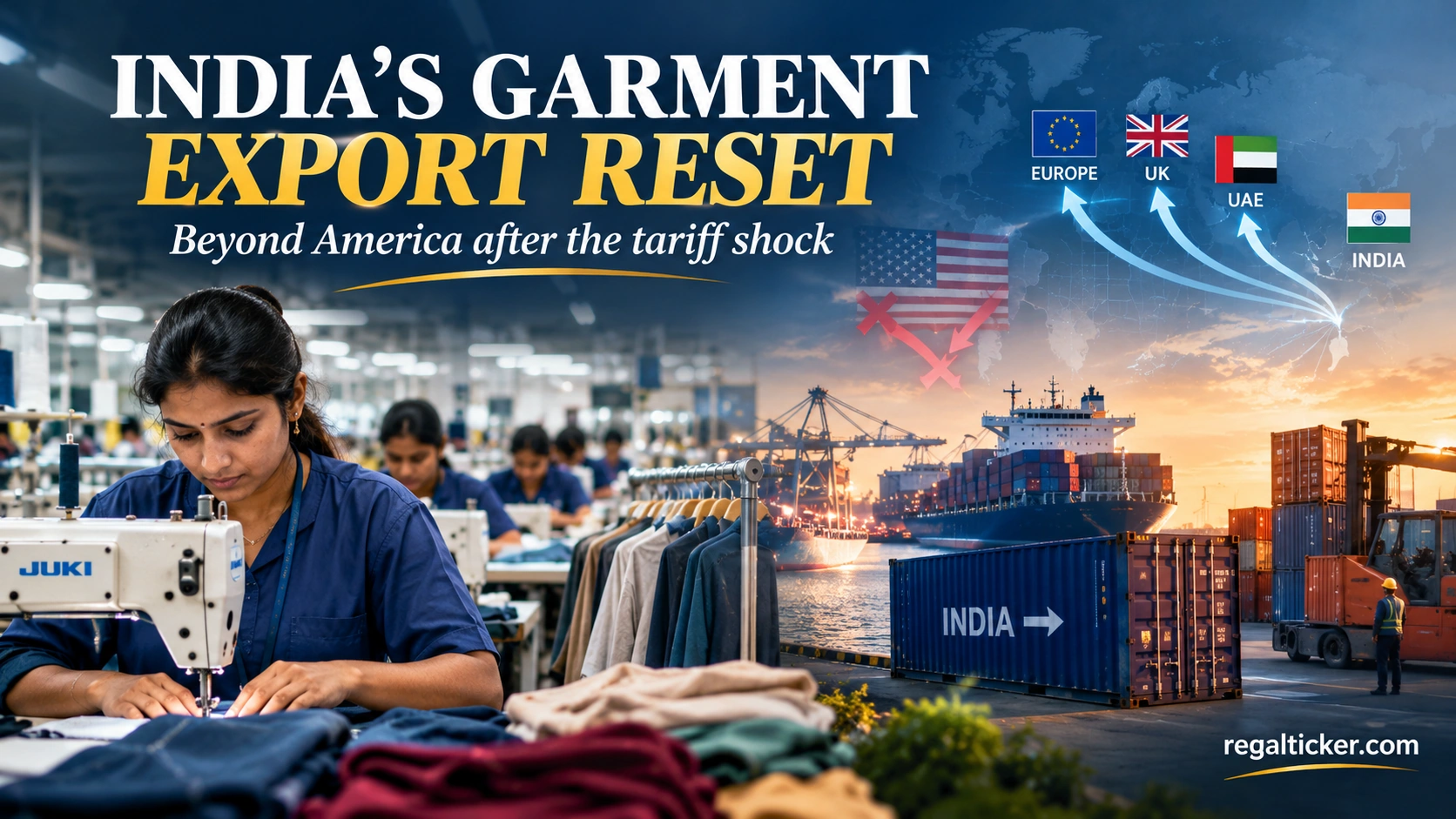
3. Gokaldas is taking a slower but equally important path
Gokaldas Exports is not walking away from the United States.
Instead, it is trying to make America one major market rather than the dominant one.
Reuters reported that management wants Europe to contribute roughly 25–30% of revenue over the next three to five years.
That expansion is being pursued while the company maintains relationships with major U.S. customers.
This approach may be more realistic for many large exporters.
The U.S. remains too valuable to abandon.
But adding meaningful European business can reduce the risk that one tariff decision hits the entire order book.
Investor note
Diversification is not the same as replacing the U.S.
The U.S. remains one of the world’s largest apparel-import markets. The stronger strategy is likely to be a balanced customer base across America, Europe, the UK, the Gulf and India rather than betting everything on one replacement market.
4. The trade data already shows the shift
The change is visible beyond company interviews.
Reuters reported that Indian textile, apparel and home-furnishing exports to the U.S. declined 9.8% from April to August, while shipments to other destinations increased 3.7%.
Official Indian data tells a similar longer-term story.
Textile, apparel and handicraft exports to the U.S. fell from about ₹92,571 crore in FY2024-25 to ₹85,910 crore in FY2025-26.
At the same time, exports to the UAE rose from roughly ₹18,252 crore to ₹20,775 crore.
Exports to the UK increased from about ₹18,287 crore to ₹19,652 crore.
Germany, Spain, France and Italy also recorded higher values in the official country data.
The U.S. is still by far the biggest individual destination.
But the direction of travel is changing.
5. The UK trade deal arrived at exactly the right time
The India-UK Comprehensive Economic and Trade Agreement entered into force on 15 July 2026.
The government says nearly 99% of Indian exports now receive zero-duty access to the UK under the agreement.
Textiles and apparel are among the labour-intensive sectors expected to benefit.
For garment exporters trying to reduce concentration risk, that timing is useful.
A company does not diversify simply because management wants to.
It needs competitive tariffs, buyers, logistics and product-market fit.
The UK agreement removes one important barrier.
That does not guarantee orders.
But it gives Indian exporters a much stronger starting position.
6. Europe could become the bigger prize
The European Union is an even larger opportunity.
India and the EU concluded FTA negotiations in January 2026.
The Ministry of Textiles said the agreement could give Indian textile and apparel exporters zero-duty access to an EU import market worth about $263.5 billion based on 2024 data.
Implementation details still matter.
Rules of origin matter.
Product coverage matters.
And European buyers often impose demanding sustainability and compliance standards.
But the scale is difficult to ignore.
If Indian manufacturers can win larger European programmes, the industry’s dependence on the U.S. could fall without reducing total export growth.
7. The UAE is becoming more than a nearby market
The UAE is another useful part of the diversification story.
India-UAE CEPA has been in force since May 2022.
Government data shows India’s textile, apparel and handicraft exports to the UAE reached about $2.16 billion in FY2024-25, up 6.8% from the previous year.
By FY2025-26, the rupee value had increased again.
The UAE matters for two reasons.
It is a growing consumer market.
It is also a regional trade and distribution hub.
That makes it useful for exporters seeking access to the wider Gulf and Middle East.
For Indian manufacturers, the region is no longer just a secondary destination.
8. India’s domestic market provides another layer of protection
One advantage Indian garment manufacturers have over some export-focused competitors is the size of the domestic market.
India has a large and growing middle class, rising formal retail penetration and expanding online fashion demand.
That does not mean every export factory can simply switch to domestic brands.
Products, pricing and distribution can be different.
But a strong home market gives the industry another route to growth.
Orient Craft’s shift toward Indian customers shows how domestic demand can become part of an export-risk strategy.
That is strategically valuable during periods of global trade uncertainty.
9. This could make Indian garment companies stronger rather than smaller
Tariffs are usually discussed as a negative shock.
In the short term, they are.
Orders can fall.
Margins can compress.
Factories can lose utilisation.
But shocks can also force businesses to fix weaknesses they had ignored during easier periods.
For Indian garment exporters, overdependence on America was one of those weaknesses.
If the industry emerges with a broader customer base, better product mix and deeper European and Gulf relationships, the long-run business model may become more resilient.
That does not make the tariff damage irrelevant.
It means the response can create value.
10. Cost competitiveness will still decide who wins
Diversification does not eliminate competition.
Indian exporters still compete with Bangladesh, Vietnam, China, Turkey and other manufacturing hubs.
Labour cost matters.
Factory efficiency matters.
Logistics matter.
Product complexity matters.
Compliance matters.
Reuters reported that some exporters are looking at lower-cost production locations such as Ranchi as they try to protect margins.
That is a reminder that market diversification alone is not enough.
If India becomes more expensive than competing manufacturing bases, buyers can still move orders elsewhere.
11. What should investors watch?
The first signal is geographic revenue mix.
For listed exporters, watch whether Europe and other non-U.S. markets are actually becoming larger.
Second, watch margins.
A company can grow exports while destroying profitability if it wins orders through aggressive discounting.
Third, watch capacity utilisation.
Diversification is most valuable when it keeps factories full.
Fourth, watch the implementation of India’s trade agreements.
The UK deal is already in force. The EU agreement could become much more important once implemented.
Fifth, watch working capital.
New markets and new buyers can increase receivables and inventory requirements.
Finally, watch valuation.
A good structural story is not automatically a good stock at any price.
The Fundamental Analysis framework remains useful for comparing exporters on margins, balance sheets and return on capital.
Frequently asked questions
Why are Indian garment exporters reducing reliance on the U.S.?
Higher U.S. tariffs increased costs, triggered cancellations and created margin pressure, exposing the risk of depending too heavily on one market.
Is the U.S. still important for Indian apparel exporters?
Yes. It remains India’s largest individual textile and apparel export market. The shift is toward diversification, not abandonment.
What happened to Orient Craft’s U.S. exposure?
Reuters reported that the U.S. share of Orient Craft’s sales fell from 84% to below 10%.
What is Gokaldas Exports planning?
Reuters reported that Gokaldas wants Europe to reach about 25–30% of revenue over three to five years while reducing U.S. concentration.
Are Indian exports to the U.S. already falling?
Reuters reported that textile, apparel and home-furnishing exports to the U.S. fell 9.8% from April to August, while exports to other destinations rose 3.7%.
How does the India-UK trade agreement help?
The India-UK CETA, in force since 15 July 2026, provides zero-duty access for nearly 99% of Indian exports, including labour-intensive sectors such as textiles.
What about the European Union?
India-EU FTA negotiations concluded in January 2026. Textiles and apparel are expected to be major beneficiaries once the agreement is implemented.
Is the UAE important for Indian textile exporters?
Yes. India-UAE CEPA gives preferential market access, and official data shows textile, apparel and handicraft exports to the UAE have been rising.
Verify through official sources
Official references
- Reuters — India Garment Makers Rethink U.S. Reliance — Orient Craft diversification, Gokaldas strategy, U.S. tariff impact and April–August export trends.
- Reuters — Gokaldas Eyes Larger Europe Share — Gokaldas Europe expansion strategy, U.S. concentration and capacity-investment plans.
- Press Information Bureau — Country-Wise Textile and Apparel Exports — Official FY2023-24 to FY2025-26 textile, apparel and handicraft export values by destination.
- Press Information Bureau — India-UK CETA Enters into Force — Official details on zero-duty UK access and the 15 July 2026 implementation date.
- Press Information Bureau — India-EU Textile Opportunity — Official textile-sector assessment following conclusion of India-EU FTA negotiations.
- Press Information Bureau — India-UAE Textile Trade — Official textile and apparel export data to the UAE and CEPA market-access context.
- Department of Commerce — Trade Intelligence Portal — Official destination and commodity trade data with latest DGCIS availability.
Final takeaway
The tariff shock may leave India’s garment industry less dependent and more resilient
The U.S. tariff shock hurt Indian garment exporters.
That part is straightforward.
The more important question is what happens after the shock.
If companies simply wait for tariffs to fall, the same concentration risk remains.
If they build meaningful businesses in Europe, the UK, the Gulf and India, the industry becomes structurally different.
That transition is already visible.
Orient Craft has moved dramatically.
Gokaldas is planning a broader customer mix.
Trade data shows non-U.S. markets gaining importance.
And India now has more trade agreements helping labour-intensive exports reach new buyers.
America will remain important.
But the next phase of Indian apparel exports may be defined by something healthier than one dominant market: choice.
Educational disclaimer: This article is for education and general market information only. It is not investment advice or a recommendation to buy or sell Gokaldas Exports, any textile company or any export-related stock. Tariff policy, trade agreements, buyer orders and company revenue mixes can change. Verify current company, exchange and government disclosures before making financial decisions.