


NRI Investing
NRI Demat Account in India
How to open the correct NRI Demat, trading and bank-account setup in 2026.
⚡ Quick answer
How does an NRI open a Demat account in India?
An NRI can open a Demat account in India to hold eligible securities electronically, but the account must reflect non-resident status and be connected to the correct banking and trading route. In practice, you normally need an NRE or NRO banking relationship, NRI-compliant KYC, a Demat account with a Depository Participant and a trading account with a broker if you want to buy and sell exchange-traded securities. A repatriable setup and a non-repatriable setup can use different bank-account and Demat classifications. PIS remains relevant in specific repatriable stock-investing structures, but it should not be treated as a universal requirement for every NRI investment product or every account.
Key takeaways
A Demat account holds securities; it does not hold your investment cash or place market orders.
Your NRE or NRO banking route should be decided before the broker account is opened.
CDSL’s 2026–27 guidance distinguishes NRI repatriable and NRI non-repatriable Demat classifications.
PAN is a core securities-market KYC requirement for Demat account holders.
Foreign address proof is important for an NRI Demat profile, and a foreign address can be used as the correspondence and permanent address.
PIS is relevant to specific NRI stock-market routes, especially repatriable exchange investing, but is not required for every product such as IPOs, mutual funds, ETFs, bonds or debt securities.
Broker and bank onboarding policies can be narrower than the general depository framework, so confirm the route before sending documents.
If you became an NRI after already holding Indian shares, do not continue using an old resident setup without updating your residential status.
Opening an Indian Demat account after becoming an NRI is not simply a matter of changing your address on a broker app.
Your residential status changes the way your bank account, securities account, KYC profile, repatriation route and trading setup need to work together. If the structure is wrong, the problem may not appear when you buy your first share. It can surface later when you sell, transfer money, update KYC, repatriate proceeds or try to explain the source and status of an investment.
The practical goal is therefore not just to “open a Demat account.” It is to build the correct NRI investing chain from the beginning.
What Is an NRI Demat Account?
A Demat account is an electronic account used to hold securities such as shares and other eligible dematerialised investments.
For an NRI, the basic purpose is the same as for a resident investor: securities are held electronically instead of through physical certificates.
The important difference is classification and money route.
An NRI account needs to reflect the fact that the investor is a person resident outside India. Depending on whether the investment is being held on a repatriable or non-repatriable basis, the linked bank account and Demat classification can differ.
CDSL’s current 2026–27 audit and compliance FAQ expressly refers to NRI – Repatriable and NRI – Non-Repatriable Demat accounts. It also states that an NRE bank account may be accepted for an NRI-repatriable account and an NRO bank account for an NRI non-repatriable account.
IMPORTANT: Do not confuse “NRI Demat account” with “NRE account” or “NRO account.” NRE and NRO are bank-account categories. Demat is the securities-holding account. The trading account is another separate layer used for placing market orders.
If you still need to decide between NRE, NRO and PIS, read RegalTicker’s NRE vs NRO vs PIS guide: https://regalticker.com/nre-vs-nro-vs-pis-account
NRE/NRO Bank Account vs Trading Account vs Demat Account
The easiest way to understand an NRI investing setup is to assign one job to each account.
| Account | Main job | What it does not do |
|---|---|---|
| NRE/NRO bank account | Holds and routes money | Does not hold shares |
| Trading account | Sends eligible buy and sell orders to the market | Does not act as the final securities vault |
| Demat account | Holds securities electronically | Does not work like a savings account |
| PIS-linked banking arrangement, where applicable | Supports eligible reporting and money routing for a PIS-based investment structure | Is not a substitute for the Demat or trading account |

A simple transaction can therefore involve three different systems:
Bank account → Trading account → Stock exchange → Demat account
When you sell, the direction broadly reverses:
Demat securities → Market sale → Settlement → Linked bank route
This is why an NRI should choose the account architecture first rather than choosing a broker only on headline brokerage.
Which NRI Demat Route Do You Need?
There is no single account structure that is automatically correct for every NRI.
Start with two questions:
- Where is the investment money coming from?
- Do you need the investment and eligible sale proceeds to retain a repatriable route?
NRE / repatriable-oriented setup
- Typical funding focus: eligible foreign remittance / repatriable money
- Bank account commonly linked: NRE
- Demat classification: NRI – Repatriable
- PIS can be relevant depending on the bank/broker route
- Best reason to choose: you specifically need the eligible investment route to preserve repatriability
NRO / non-repatriable-oriented setup
- Typical funding focus: Indian-source funds and non-repatriable route
- Bank account commonly linked: NRO
- Demat classification: NRI – Non-Repatriable
- Do not assume the same PIS structure; confirm the permitted non-repatriable setup
- Best reason to choose: you are investing through the non-repatriable route or using eligible Indian-source money

📖 Definition
Repatriable
Repatriable means the money is being held and invested through a route under which eligible funds or proceeds can be remitted outside India subject to the applicable rules, documentation and taxes.
📖 Definition
Non-repatriable
Non-repatriable does not mean the money can never leave India under any circumstance. NRO balances have a separate remittance framework and documentation requirements. It means you should not treat the investment as though it was made through the same freely repatriable structure as an eligible NRE-based investment.
For the deeper banking decision, use: https://regalticker.com/nre-vs-nro-vs-pis-account
Does Every NRI Need PIS to Open a Demat Account?
No. This is one of the most important points in the entire guide.
PIS stands for Portfolio Investment Scheme. SEBI’s NRI investor-education material explains that a PIS permission letter is relevant for buying and selling shares on a stock exchange on a repatriable basis under a PIS structure. The same material also states that a PIS permission letter is not required for products such as IPOs, ESOPs, rights issues, mutual funds, ETFs, bonds and debt securities.
That makes two blanket statements unsafe:
- “Every NRI needs PIS.”
- “PIS is obsolete and no NRI needs it.”
The practical answer depends on what you are investing in, whether the investment is repatriable or non-repatriable, and the exact bank/broker operating model.
NSE continues to maintain an NRI Trading Account FAQ that refers to PIS-based NRI exchange investing and delivery-based settlement. At the same time, brokers may support different operational structures for repatriable and non-repatriable NRI accounts.
Caution
Check this carefully
Never select “PIS” or “Non-PIS” only because a broker webpage makes one route look easier. First confirm what bank account will fund the investment, where sale proceeds will go, whether the holding is repatriable, and which products you actually plan to buy.
A better question than “Do I need PIS?”
Ask your bank or broker:
- Is this account NRI-repatriable or NRI-non-repatriable?
- Which NRE or NRO account will be linked?
- Is a PIS permission/designated PIS banking relationship required for the exact stock-investing route being offered?
- Where will sale proceeds be credited?
- Can this account also be used for IPOs, ETFs, mutual funds and other products, or do those follow separate flows?
- What records will I receive for tax and repatriation purposes?
Those answers tell you far more than the marketing name of the account.
Documents Required to Open an NRI Demat Account
The exact checklist varies by intermediary and by country of residence, but there is a common regulatory core.
CDSL states that PAN is mandatory for opening a Demat account, subject to specified exemptions for certain categories. SEBI’s NRI investor material identifies PAN, passport/status documents, overseas-address proof, photograph and bank-account proof among the key NRI trading and Demat KYC documents.

Checklist before you act
- Valid PAN card
- Valid Indian passport, where applicable
- Valid visa, work permit, student permit or residence permit for an Indian-passport holder living abroad
- OCI documentation where applicable
- Foreign / overseas address proof
- Current photograph
- Proof of the linked NRE or NRO bank account
- FATCA/CRS and tax-residency declarations as requested
- PIS permission or designated banking documents where the chosen route specifically requires them
- Additional broker/DP declarations for NRI status, repatriability and market segments
- Attested/certified copies where the intermediary requires certification
What can be used as overseas address proof?
SEBI’s NRI educational material gives examples such as a foreign driving licence, foreign passport, utility bill, bank statement and eligible tenancy/property documents.
CDSL’s 2026–27 FAQ adds an important practical point: an NRI may provide a foreign address as both the correspondence and permanent address. It also states that foreign-address proof is mandatory under the cited SEBI framework.
⭐ Pro tip
Use the same spelling, initials and date format across PAN, passport, bank, Demat and trading applications wherever possible. A technically valid document can still cause an onboarding delay when names or account details do not match cleanly.
Who can attest NRI documents abroad?
CDSL’s current FAQ recognises attestation by specified entities, including authorised officials of overseas branches of Scheduled Commercial Banks registered in India, a Notary Public, Court Magistrate, Judge, and the Indian Embassy or Consulate General in the country where the client resides.
The exact certification requirement still depends on the intermediary and the onboarding method.
IMPORTANT: SEBI issued fresh relaxations in KYC norms for individual persons resident outside India—including NRIs and OCIs—on 14 August 2026. Because intermediaries may be updating digital onboarding and verification procedures following this change, verify the current KYC method with your selected broker/DP before assuming that an older paper or physical-verification process is still required.
How to Open an NRI Demat and Trading Account Step by Step
The cleanest process is to work from legal/status classification toward the market account—not the other way around.
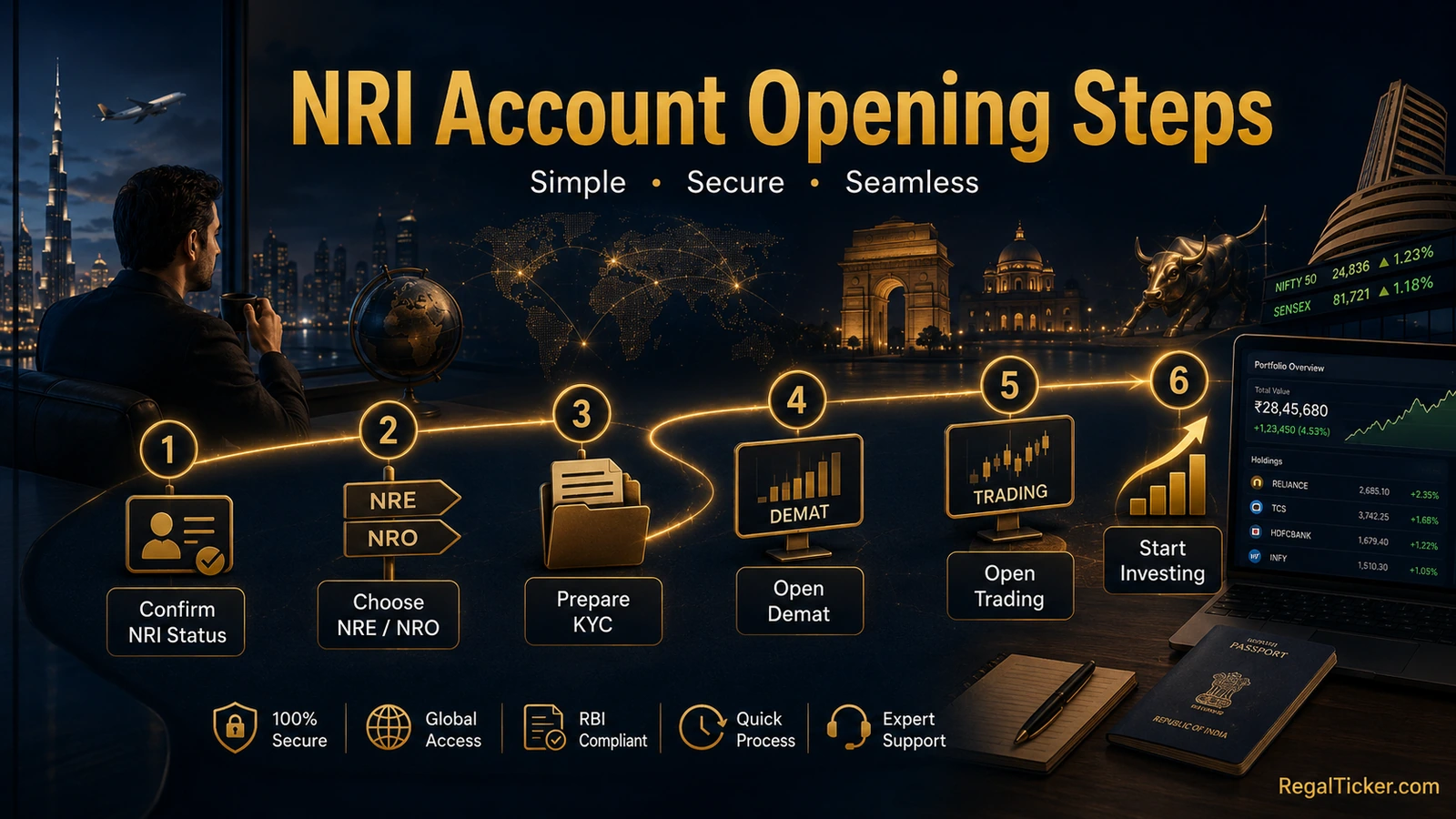
Step 1: Confirm that your Indian financial accounts reflect NRI status
If you moved abroad after previously living and investing in India, review the status of your existing Indian bank, Demat and trading accounts.
Do not open a new NRI trading relationship while continuing to operate an old resident investment setup as though your residential status never changed.
SEBI’s NRI investor material states that an investor who became non-resident can continue to hold securities acquired while resident, but the status and repatriation treatment matter. Your DP and broker should be informed and the account structure updated as required.
Step 2: Decide whether the intended investment route is repatriable or non-repatriable
This decision affects the bank account, Demat classification and possibly the PIS/broker structure.
If you have not decided this, stop here and use the NRE/NRO/PIS guide first: https://regalticker.com/nre-vs-nro-vs-pis-account
Step 3: Keep the correct NRE/NRO banking relationship ready
For a repatriable Demat setup, CDSL states that the DP may accept NRE bank details. For a non-repatriable account, NRO bank details may be used.
This does not mean every bank and broker offers the same combination. Some providers package bank, Demat and trading into a three-in-one model; others require separate institutions.
Step 4: Prepare PAN, passport, overseas address and status documents
Do this before beginning the broker form.
A large part of NRI onboarding friction is not the form itself—it is discovering halfway through the process that a passport copy needs certification, the foreign address proof is too old for the intermediary’s policy, or the bank proof does not show the same holder name.
Step 5: Complete NRI securities-market KYC
Your KYC record needs to reflect the appropriate status and current address information.
CDSL’s investor guidance lists six core KYC attributes for investors: name, PAN, address, mobile number, email ID and income range. NRIs may also have additional foreign-address, FATCA/CRS and residency information.
SEBI has continued to modify KYC processes, including recent NRI-specific relaxations, so the exact digital steps can change faster than the underlying account structure.
Step 6: Open the correct Demat account classification
Tell the DP whether the intended holdings are being maintained on a repatriable or non-repatriable basis.
Do not rely only on the app label. Check the account-opening form or welcome documents for the actual client/Demat classification.
Step 7: Open the NRI trading account
The broker uses the trading account to place eligible exchange orders.
Confirm:
- cash/equity segment availability;
- whether your route is PIS-linked or non-PIS;
- whether derivatives are supported and under what conditions;
- whether intraday/short-selling restrictions apply to your NRI setup;
- how contract notes and tax information are delivered;
- where sale proceeds are settled.
For most beginners, start by understanding the delivery-based equity route before considering additional market segments.
Step 8: Link and verify the correct bank account
Before placing the first trade, verify both funding and withdrawal details.
The most dangerous operational mistake is funding from one account type while assuming sale proceeds will automatically retain another repatriation status.
Step 9: Test the account with a small transfer and verify statements
Once activated:
- check the client category;
- verify the linked bank;
- verify Demat holdings access;
- check contract-note delivery;
- download your first account/holding statement;
- confirm that names and PAN match across systems.
You are testing the plumbing, not the investment strategy.
Step 10: Keep a permanent NRI investment record folder
Save:
- account-opening confirmation;
- Demat client master/report;
- bank-link confirmation;
- contract notes;
- annual capital-gains reports;
- PIS/bank statements if applicable;
- proof of inward remittance where relevant;
- corporate-action records;
- tax/TDS certificates;
- repatriation documents.
Good records are far easier to build transaction by transaction than reconstruct years later.
Worked Example 1: NRE / Repatriable-Oriented Setup
💡 Real example
Arjun invests from Dubai through a repatriable-oriented route
Arjun works in Dubai and wants to invest overseas earnings in Indian listed shares while preserving an eligible repatriable route.
His decision sequence should look like this:
1. Confirm NRI status and update old resident financial accounts. 2. Maintain the appropriate NRE banking relationship. 3. Ask the chosen bank/broker whether its repatriable exchange-share route uses a designated PIS structure. 4. Open the corresponding NRI-repatriable Demat and trading setup. 5. Fund only through the permitted bank route. 6. Keep bank, contract-note and tax records supporting the investment. 7. When he sells, confirm that the net proceeds follow the designated route after applicable taxes and reporting.
The key point is not that “NRE is always better.” It is that Arjun chose repatriability first, then built the accounts around that requirement.
For a UAE-specific account-opening checklist, also read: https://regalticker.com/nri-account-opening-uae-gulf-checklist
Worked Example 2: NRO / Non-Repatriable Setup
💡 Real example
Meera invests Indian-source money through an NRO-oriented route
Meera lives in Singapore but receives rent and other eligible income in India. She wants to invest part of her Indian-source rupee funds without building the investment around an NRE-repatriable route.
Her sequence may look like this:
1. Use the appropriate NRO banking relationship for Indian-source funds. 2. Open an NRI non-repatriable Demat classification. 3. Use the broker structure permitted for that non-repatriable route. 4. Confirm product and segment restrictions before trading. 5. Keep tax records separately from the bank-account decision. 6. If she later wants to remit eligible NRO balances abroad, treat that as a separate remittance/compliance process rather than assuming the investment was freely repatriable from day one.
The lesson is the same: money source and repatriation goal come before broker choice.
What If You Already Have a Resident Demat Account?
This is common.
Someone opens a bank, Demat and trading account while living in India, later moves overseas for employment, and continues using the same broker login.
That is not a good “do nothing” strategy.
SEBI’s investor material states that securities acquired while resident can continue to be held after becoming non-resident in a non-repatriable status, but the investor’s changed status needs to be reflected in the relevant financial relationships.
Caution
Do not sell old resident-acquired shares first and ask about status later. Contact the bank, broker and DP and establish how the existing holdings should be redesignated or transferred under their current process.
The exact process can involve account conversion, closure/reopening or transfer between Demat classifications depending on the intermediary.
For a broader comparison of what changes after becoming NRI, read: https://regalticker.com/nri-vs-resident-indian-investing-stocks
Can an NRI and a Resident Indian Hold a Joint Demat Account?
CDSL’s 2026–27 FAQ says a DP can open an account where the first holder is NRI and the second holder is Resident Indian, or vice versa. It also states that the status of the account follows the status of the first holder.
That is the depository-level framework.
However, a particular broker or DP may impose operational limitations on the account types or trading links it supports.
IMPORTANT: Separate “what the depository framework permits” from “what this broker supports.” If you need a joint account, ask the broker specifically about the first-holder status, trading-account linkage, nomination and repatriation classification before applying.
Can You Open an NRI Demat Account From Abroad?
In many cases, the practical process can be completed while you are overseas, but the exact remote onboarding method depends on the intermediary, KYC record, document certification and country of residence.
This area is also changing.
SEBI relaxed the India geo-tagging requirement for NRIs undertaking re-KYC in December 2025, and on 14 August 2026 announced further relaxations in KYC norms for individual persons resident outside India.
Therefore, avoid publishing or relying on a permanent claim such as:
- “Every NRI must visit India.”
- “Every NRI account is now 100% paperless.”
- “Video KYC is available in exactly the same way at every broker.”
The safer approach is to verify the broker’s current new-client onboarding process at the time you apply.
If you are based in the UAE, RegalTicker has a separate practical checklist covering the UAE/Gulf workflow: https://regalticker.com/nri-account-opening-uae-gulf-checklist
What Can You Hold in an NRI Demat Account?
A Demat account can hold several types of eligible dematerialised securities. SEBI’s NRI investor material lists categories including equity shares, ETFs, bonds and other eligible securities.
However, holding capability is not the same as investment permission or broker access.
A product can be:
- capable of being held in Demat;
- permitted under Indian rules;
- but unavailable through a specific broker route;
- or subject to country-of-residence restrictions outside India.
This distinction becomes especially important for NRIs living in jurisdictions with additional securities, tax or fund-distribution rules.
For the broader NRI investing roadmap, use: https://regalticker.com/nri-investing-indian-stock-market-guide
NRI Trading Restrictions You Should Check Before the First Order
Do not assume an NRI trading account behaves exactly like a resident retail account.
NSE’s NRI Trading Account FAQ states that cash-market NRI transactions are delivery based and that intraday cash transactions and short selling are not permitted under the described NRI framework. It also discusses derivatives separately.
⭐ Pro tip
If your goal is long-term equity investing, confirm the delivery-based cash-equity workflow first. Do not activate additional segments merely because they appear in the broker onboarding form.
Also remember that investment limits are a separate topic from account opening. RegalTicker maintains a dedicated guide so this article does not duplicate or freeze changing numeric limits: https://regalticker.com/budget-2026-nri-investment-limit-change
Charges to Check Before Choosing the Account
Do not compare NRI brokers using only “₹X per order.”
The total operating cost can include multiple layers.
- Demat account opening charge, if any
- Annual maintenance charge
- Brokerage
- DP/debit transaction charges
- Bank/PIS-related charges where applicable
- Settlement/reporting charges
- Call-and-trade charges
- Currency/remittance costs
- Tax/TDS-related bank processing charges where applicable
- Account closure or transfer-out charges
Tax Is Separate From Demat Account Type
Choosing NRE, NRO, PIS or non-PIS does not replace Indian tax analysis.
Tax depends on the type of income, security, holding period, applicable law and investor status. TDS may also affect the cash actually received on sale or distribution.
Do not use the bank-account label as a shortcut for questions such as:
- Is the capital gain taxable?
- What is the holding period?
- Will tax be deducted at source?
- Can excess TDS be claimed back?
- Does a DTAA matter?
RegalTicker covers those questions separately in: https://regalticker.com/nri-capital-gains-tax-tds-indian-shares
You can also model eligible scenarios with the Capital Gains Tax Calculator: https://regalticker.com/capital-gains-tax-calculator
Common NRI Demat Account Mistakes
1. Opening the broker account before choosing the money route
This reverses the correct order.
First decide repatriable versus non-repatriable, then the bank account, then the broker/Demat structure.
2. Treating every NRI investment as a PIS transaction
PIS is not required for every security or every NRI investment flow.
3. Assuming PIS is irrelevant everywhere
The opposite blanket claim is also unsafe. PIS continues to appear in current exchange/bank operating structures for relevant NRI stock-market routes.
4. Keeping an old resident trading setup unchanged after moving abroad
Your residential status matters. Update it rather than assuming the old account can continue indefinitely without modification.
5. Using the wrong bank account with the wrong Demat classification
NRE and NRO are not interchangeable labels. They carry different money-source and repatriation implications.
6. Ignoring foreign address and KYC consistency
Your overseas address, passport, PAN and bank information need to fit one coherent NRI profile.
7. Assuming “online” means identical at every intermediary
NRI digital onboarding is evolving quickly, including SEBI’s latest KYC relaxations. The implementation can differ by broker/DP.
8. Choosing solely on brokerage
For an NRI, bank integration, reporting, repatriation, service support and document workflow can matter as much as the per-order fee.
9. Mixing account-opening and investment-limit rules
The fact that an account is open does not mean every security can be purchased without checking applicable foreign-investment limits.
10. Failing to keep records
Cross-border investing creates a longer audit trail. Save your statements before you need them.
Pre-Submission Checklist for Your NRI Demat Application
- My resident/NRI status is correctly updated with my existing Indian bank and investment providers.
- I know whether I want a repatriable or non-repatriable investing route.
- I know which NRE or NRO account will fund the setup.
- I have asked whether the broker’s route is PIS-based, non-PIS or product-specific.
- My PAN and passport names match or I have supporting documentation for differences.
- My visa/residence permit is valid.
- My foreign address proof meets the broker/DP’s current age and certification requirements.
- My bank proof clearly shows the correct account holder and account details.
- I have completed FATCA/CRS and tax-residency declarations where requested.
- I understand which market segments the NRI account supports.
- I understand brokerage, AMC, DP, bank and PIS-related charges.
- I know where sale proceeds will be credited.
- I know how to obtain contract notes, capital-gains reports and account statements.
- I have saved copies of every signed form and declaration.
Final Summary
An NRI Demat account is only one part of an NRI stock-investing setup.
The safest sequence is:
NRI status → repatriation decision → NRE/NRO bank account → KYC → Demat classification → trading account → PIS/non-PIS route where applicable → funding → investing → tax and records
Do not begin with the question, “Which broker is cheapest?”
Begin with:
“What is the correct legal and money-flow structure for the way I want to invest?”
Once that answer is clear, the Demat account becomes much easier to choose and operate.
Frequently asked questions
Can an NRI open a Demat account in India?
Yes. NRIs can open Demat accounts in India through a Depository Participant, with the account classified according to the investor’s non-resident status and applicable repatriable or non-repatriable route.
Is PAN mandatory for an NRI Demat account?
PAN is a core Demat-account KYC requirement. CDSL’s current FAQ states that PAN is mandatory for opening a Demat account, subject to specified exemptions for limited categories.
Does an NRI need an NRE or NRO account for a Demat account?
The correct bank account depends on the investment route. CDSL’s 2026–27 guidance says an NRE bank account may be used for an NRI-repatriable Demat account and an NRO bank account for an NRI non-repatriable account.
Is PIS compulsory for every NRI Demat account?
No. PIS should not be treated as compulsory for every NRI investment. It remains relevant in specific stock-market and repatriable structures, while SEBI’s NRI investor material states that PIS permission is not required for products including IPOs, mutual funds, ETFs, bonds and debt securities.
Can an NRI open a Demat account from outside India?
Remote onboarding is possible through many intermediaries, but the exact process depends on the broker/DP, KYC record, country, certification and current digital-verification rules. SEBI has issued recent NRI-specific KYC relaxations, so confirm the current onboarding method before applying.
Can an NRI use a foreign address for a Demat account?
Yes. CDSL’s 2026–27 FAQ states that an NRI may use a foreign address as both correspondence and permanent address, with foreign-address proof required.
Can an NRI and resident Indian hold a joint Demat account?
CDSL says a Demat account can have an NRI first holder and resident Indian second holder, or vice versa. The status of the account follows the first holder. Individual brokers may still have their own operational restrictions.
What happens to my resident Demat account when I become an NRI?
Do not leave the account unchanged. Inform the intermediary and follow its current process for redesignation, transfer, closure/reopening or conversion to an appropriate NRI structure. Securities acquired while resident may continue to be held subject to the applicable non-resident treatment.
Can an NRI do intraday trading in Indian shares?
NSE’s NRI Trading Account FAQ describes NRI cash-market transactions as delivery based and states that intraday cash transactions and short selling are not permitted under the NRI framework it describes. Confirm the current segment permissions with your broker.
Is an NRI Demat account taxable?
The Demat account itself is an account for holding securities. Tax arises from income and transactions such as capital gains, dividends and other taxable receipts, according to the applicable rules. Use the dedicated NRI tax guide rather than inferring tax from the Demat-account label.
Verify through official sources
Official references
- SEBI Investor — Investment by Non-Resident Indians (NRIs) in Indian Securities Market
- SEBI — Relaxations in KYC norms for individual Persons Resident Outside India, 14 August 2026
- CDSL — FAQ for Audit & Compliance 2026–27
- CDSL — Open a Demat Account / KYC attributes
- NSE — FAQs: NRI Trading Account
- RBI — Accounts in India by Non-residents
Educational disclaimer: The information in this article is provided solely for general education and awareness. It is not investment, legal, banking or tax advice. NRI onboarding procedures, KYC methods, broker support, charges and bank operating models can change. Verify the current account-opening and repatriation route with the relevant bank, broker, Depository Participant and official regulatory material before acting.