


NRI Investing
Current NRI and PROI shareholding limits, what changed in 2026, how the individual and aggregate caps work, and what happens if a limit is crossed.
⚡ Quick answer
What is the current NRI investment limit in Indian shares?
For the Schedule III portfolio-investment route discussed in this guide, an individual person resident outside India (PROI) must keep the relevant holding in a listed Indian company below 10% of the company’s paid-up equity capital on a fully diluted basis. The combined holding of all individual PROIs under this route can be up to 24%. The framework is no longer limited only to NRIs and OCIs. Budget 2026 announced the reform, the Ministry of Finance notified the FEMA (Non-Debt Instruments) (Third Amendment) Rules, 2026 on 12 June 2026, and RBI operationalised the amended framework through A.P. (DIR Series) Circular No. 14 on 15 June 2026. These limits do not override sectoral caps, company-specific restrictions, ownership/control rules or other applicable FEMA/SEBI requirements.
Key takeaways
The key individual threshold is below 10% per listed company, not “10% or less.”
The aggregate ceiling is 24% for all individual PROIs together under the relevant Schedule III route.
The investor pool is broader now
it includes individual persons resident outside India, not only NRIs and OCIs.
Budget 2026 announced the policy; the June 2026 FEMA amendment and RBI circular implemented it.
The 24% aggregate ceiling is not the same thing as a sectoral FDI cap and does not override stricter sector-specific rules.
If the individual portfolio threshold is breached, the amended framework provides a short divestment window; otherwise the holding may move into the FDI framework.
Splitting investments across brokers, Demat accounts or routes does not create a fresh personal limit.
Before building a large position, verify the current company headroom and route-specific restrictions through the authorised dealer bank, broker and current official rules.
Why this article needed a complete rewrite
The original page was written around the Budget 2026 announcement. That was useful when the policy was new, but a Budget speech is not the final operational rulebook.
The legal position moved forward in June 2026.
On 5 June 2026, the Ministry of Finance said the Government was implementing the Budget measure that would widen the Schedule III route from NRIs/OCIs to individual persons resident outside India and raise the investment limits. The Department of Economic Affairs then notified the Foreign Exchange Management (Non-Debt Instruments) (Third Amendment) Rules, 2026 on 12 June 2026. RBI followed with A.P. (DIR Series) Circular No. 14, RBI/2026-27/114, dated 15 June 2026, to operationalise the amended framework.
A later Ministry of Finance update in July 2026 expressly stated that the Budget announcement had been implemented through the Third Amendment Rules.
That means the useful question is no longer:
“What did Budget 2026 propose?”
The useful question is:
“What are the current rules now, and how do I stay within them?”
This guide answers that question.
Old rule vs new rule: what changed in 2026?
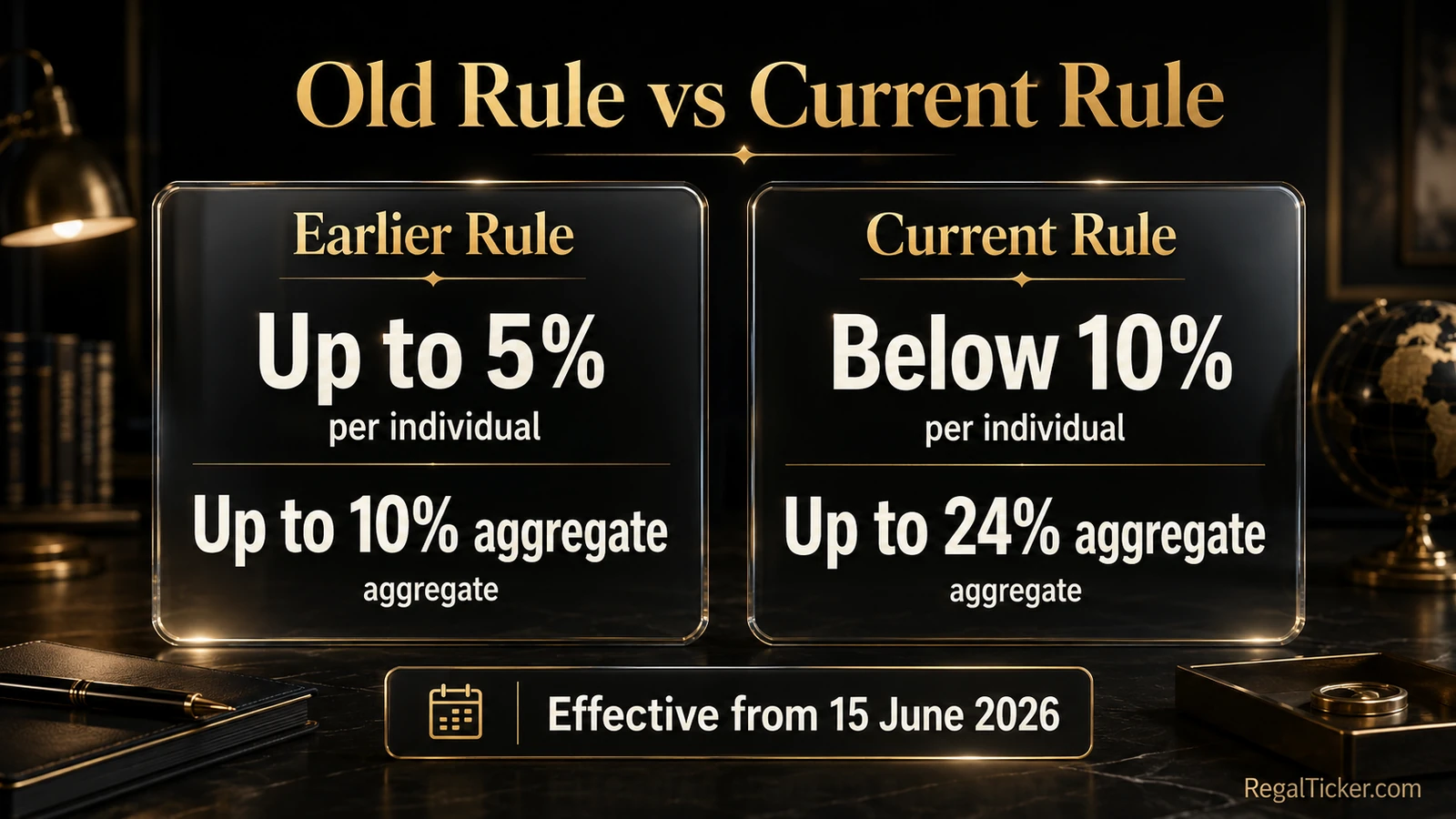
Before the June 2026 amendment, the repatriation-basis portfolio route under Schedule III was principally framed for NRIs and OCIs.
The commonly applied individual limit was 5% per NRI/OCI in a listed Indian company. The aggregate NRI/OCI ceiling was generally 10%, with an older mechanism allowing the company to raise that aggregate ceiling up to 24% through the required corporate approval process.
The 2026 reform changed two important things.
Change 1: the eligible investor class became wider
Schedule III is no longer limited only to an NRI or OCI. The amended framework uses the broader category of an individual person resident outside India, which includes NRIs and OCIs but is not confined to them.
For RegalTicker readers, this matters because an NRI is now one subset of a wider individual-PROI portfolio framework.
Change 2: the investment thresholds changed
The new structure uses:
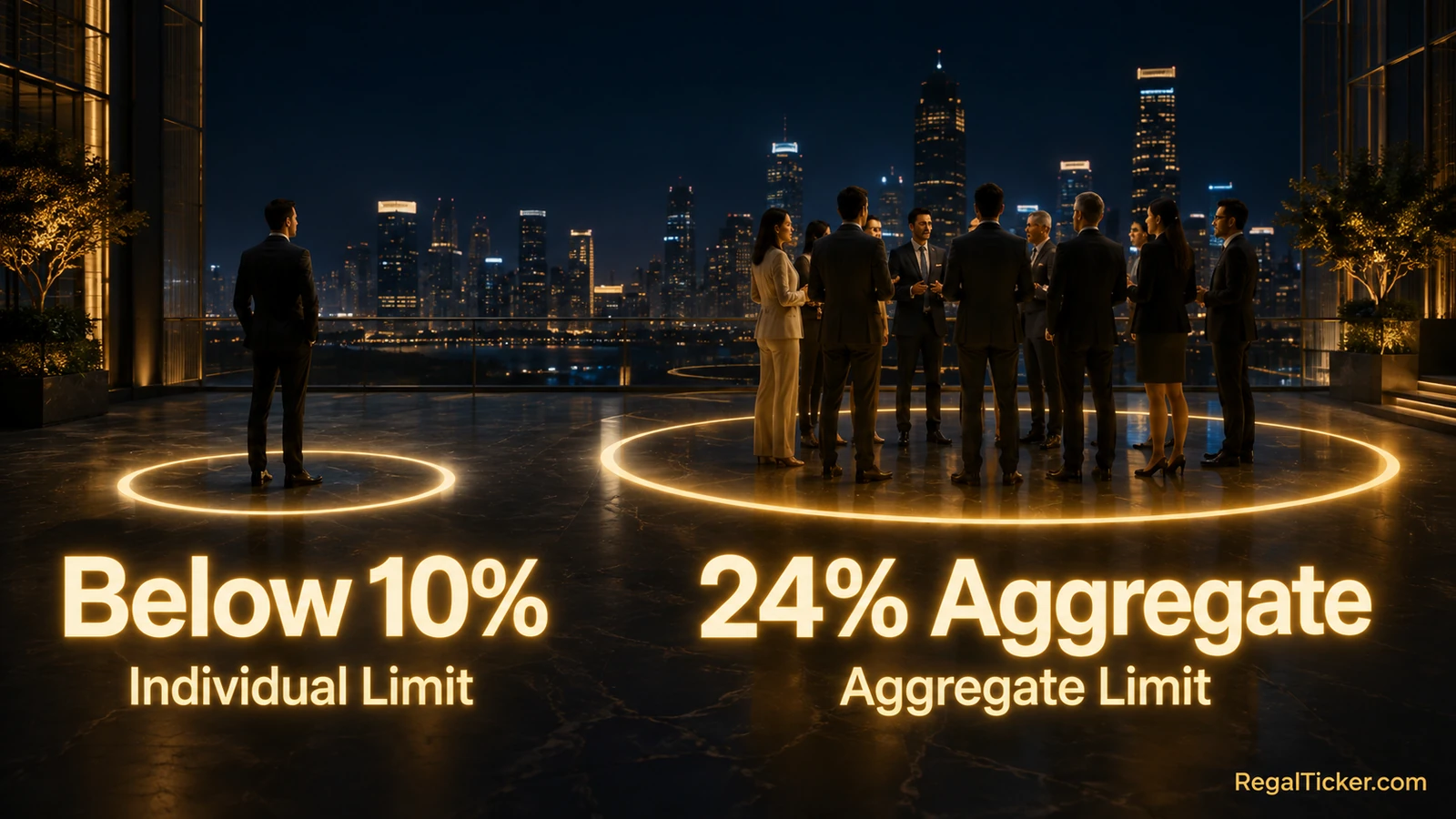
- below 10% as the individual portfolio-investment threshold in a listed Indian company; and
- 24% as the aggregate ceiling for all individual PROIs together under the relevant route.
The new 24% aggregate ceiling is built into the amended framework rather than relying on the old 10%-to-24% company-resolution mechanism.
Old vs new at a glance
Earlier framework
- Investor class — primarily NRI/OCI under Schedule III.
- Individual holding — up to 5% under the old NRI/OCI portfolio framework.
- Aggregate holding — generally 10% for all NRIs/OCIs together, with an older route to increase the aggregate ceiling to 24% through company approval.
- Main problem for readers — many old articles still quote these numbers as if they remain the current general rule.
Current framework after June 2026
- Investor class — individual person resident outside India, including NRI/OCI.
- Individual holding — must remain below 10% under the relevant Schedule III portfolio framework.
- Aggregate holding — up to 24% for all individual PROIs together.
- Regulatory basis — FEMA (Non-Debt Instruments) Third Amendment Rules, 2026 plus RBI operational directions.
Who is a PROI, and why does that term matter now?
PROI means person resident outside India under FEMA terminology.
The June 2026 amendment is important because it did not merely give NRIs a higher percentage. It widened the listed-equity portfolio route to individual PROIs more generally, subject to the terms, limits and safeguards of the amended framework.
For an NRI reader, the practical lesson is simple:
You are still an NRI for many banking, tax and identity questions, but the investment-limit provision discussed here now sits inside a wider individual-PROI framework.
That is why the aggregate cap is better described as the aggregate holding of all individual PROIs under the route, not simply “the NRI family limit.”
NRI, OCI and PROI are not interchangeable labels
An NRI is an Indian citizen resident outside India for the relevant FEMA purpose.
An OCI is a foreign citizen holding Overseas Citizen of India status.
A PROI is the wider FEMA residence concept used here for an individual resident outside India.
The amended route can therefore cover an individual PROI who is neither an NRI nor an OCI, subject to the applicable restrictions.
For a deeper explanation of the broader investing structure, start with NRI Investing in the Indian Stock Market.
What does “below 10%” actually mean?
This is the most important wording in the entire article.
Do not read the new rule as:
“An overseas individual can freely hold 10%.”
The portfolio threshold is framed as less than 10%.
That means a holding such as 9.5% can be below the threshold, while a holding that reaches the 10% boundary is no longer safely inside the sub-10% portfolio bucket.
Why the wording matters
At high ownership levels, the distinction between portfolio investment and foreign direct investment becomes important.
A portfolio investor is expected to remain below the ownership threshold prescribed for the route. Once that threshold is crossed, the holding may need to be cured or reclassified under the FDI framework, where sectoral caps, entry routes, pricing, reporting and other conditions can become relevant.
Worked example: individual limit
Assume a listed Indian company has 100 crore fully diluted equity shares.
A single eligible individual PROI owns:
- 6 crore shares → 6% → below the individual threshold.
- 9.5 crore shares → 9.5% → below the individual threshold.
- 9.99 crore shares → 9.99% → still below 10%.
- 10 crore shares → 10% → no longer below the portfolio threshold.
The exact operational calculation should be confirmed against the current rules and the company’s fully diluted capital. Do not use a rough percentage from an old annual report if the position is large enough to approach the threshold.
What does the 24% aggregate cap mean?
The second limit applies to all individual PROIs together in the same listed Indian company under the relevant framework.
It is not 24% per investor.
Suppose four eligible overseas individuals hold:
- Investor A — 7%
- Investor B — 6%
- Investor C — 5%
- Investor D — 4%
Their combined holding is 22%.
Each investor is below the individual 10% threshold, and the group is also below the 24% aggregate ceiling.
If another individual PROI tries to buy a large enough stake to push the combined Schedule III holding above the permitted aggregate limit, the aggregate test becomes the constraint even if that new investor’s personal holding is small.
Individual and aggregate limits must both be satisfied
Think of the two tests as separate gates:
Checklist before you act
- Gate 1 — Is my own holding below 10%?
- Gate 2 — Are all individual PROIs together within the 24% aggregate ceiling?
- Gate 3 — Are the company’s sectoral, ownership and other regulatory limits also satisfied?
Does the 24% cap override the sectoral FDI cap?
No.
This is a common and potentially expensive misunderstanding.
The 24% figure is an aggregate ceiling for the individual-PROI portfolio route. It is not a universal permission allowing 24% foreign ownership in every listed Indian company regardless of sector.
Different sectors can have:
- statutory ownership caps,
- sectoral FDI caps,
- approval requirements,
- regulator-specific ownership rules,
- beneficial-ownership restrictions,
- or company-specific constraints.
Private-sector banking and other regulated financial businesses are obvious examples where separate ownership rules can matter.
Therefore, never use this shortcut:
“24% is allowed under FEMA, so the company definitely has 24% room.”
The correct approach is:
portfolio limit + sector rule + company headroom + investor-specific restrictions.
What happens if an individual PROI crosses the 10% threshold?
The amended framework contains a cure mechanism rather than treating every accidental threshold crossing as an irreversible event on day one.
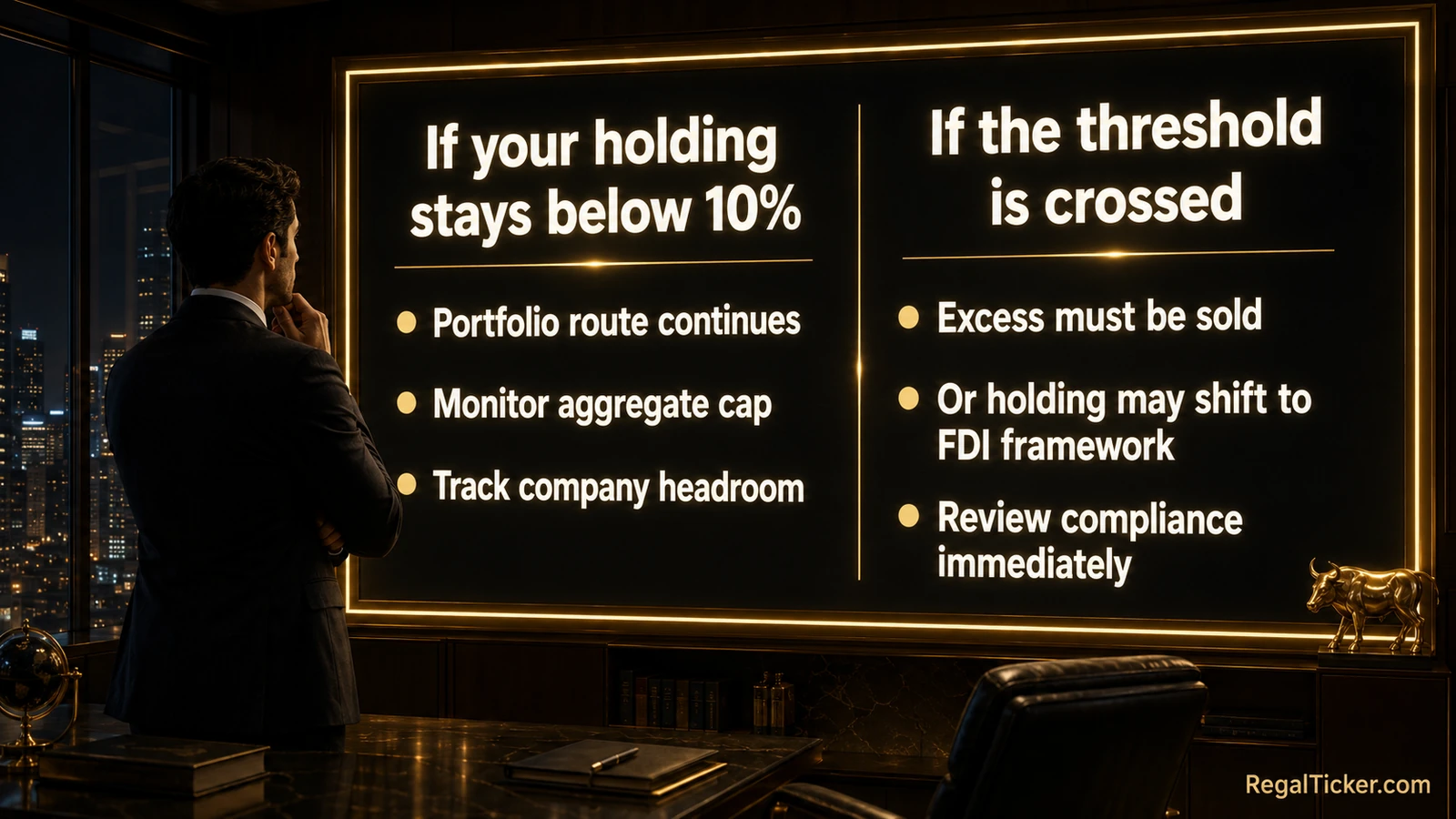
Under the current framework, if the prescribed individual portfolio threshold is breached, the excess is expected to be divested within the specified five trading day window counted from the relevant settlement event.
If the breach is not cured in time, the holding can be reclassified as foreign direct investment rather than portfolio investment.
RBI’s June 15 operational circular states that reclassification from portfolio investment to FDI upon breach of the prescribed limits is to follow RBI’s FPI-to-FDI reclassification framework.
Why reclassification matters
FDI is not simply “the same investment with a different label.”
Depending on the company and sector, the investor may then face additional requirements involving:
- sectoral caps,
- automatic vs government route,
- pricing rules,
- reporting,
- beneficial ownership,
- regulatory approval,
- and other FDI conditions.
The safest approach is not to plan around the cure window. Treat the threshold as a limit to remain comfortably below.
Caution
Do not deliberately buy to 10% and assume you can fix it later
The five-trading-day mechanism is a cure provision, not a recommended investment strategy. Execution, settlement, corporate actions and aggregation across holdings can create compliance complications. If you are building a large position, involve the authorised dealer bank, broker and professional adviser before the order is placed.
Do holdings across different accounts or brokers get separate limits?
No investor should assume that opening another Demat account, using another broker or routing a transaction differently creates a new 10% allowance.
The amended framework is designed around the investor’s total holding, not the number of apps, accounts or intermediaries used.
For a material position, the investor needs a consolidated view of the holding across relevant investment routes.
This is especially important for an NRI who has changed brokers over time or who holds shares through more than one NRI investing structure.
For the banking and investing-route distinction, read NRE vs NRO vs PIS for NRIs.
Does this rule apply to every NRI investment?
No. This article focuses on the Schedule III listed-company portfolio-investment framework affected by the 2026 amendment.
NRIs can invest in India through multiple permitted routes and products. The rules for:
- mutual funds,
- ETFs,
- IPOs,
- bonds,
- non-repatriation investments,
- FDI,
- inherited holdings,
- or other instruments
can differ.
Do not carry the 10%/24% numbers from this article into every asset class.
The NRI Specialist Academy is designed to separate those routes instead of forcing every NRI rule into one article.
How does PIS fit into the investment-limit framework?
The term PIS is often used in NRI investing conversations because banks and brokers historically used the Portfolio Investment Scheme structure for certain repatriable exchange transactions.
The 2026 legal change is broader than the old “NRI PIS limit” language. The amended Schedule III framework now applies to individual persons resident outside India subject to its conditions.
Your practical setup can still involve a designated bank and broker process, and intermediaries may use PIS/non-PIS terminology in their onboarding and trading systems.
The important point is:
the legal ownership limit attaches to the investor and the applicable investment route — not to the marketing name of the account.
For account choice and route selection, use the dedicated NRE vs NRO vs PIS guide instead of trying to solve the banking question from this ownership-limit article.
Practical examples: how the limits work together
Example 1: one NRI owns 8%
Priya is an NRI and holds 8% of a listed Indian company under the relevant portfolio route.
Her individual holding is below 10%.
If the aggregate holding of all individual PROIs is also within 24%, and the company/sector has sufficient foreign-investment headroom, the individual threshold is not the problem.
Example 2: one NRI reaches 10.2%
Arjun’s holding rises to 10.2% after a purchase.
The position has crossed the sub-10% portfolio threshold.
He should not assume that only the 0.2% excess can be ignored. The cure/reclassification rules become relevant, and the broker/AD bank should be contacted immediately.
Example 3: your holding is only 2%, but the aggregate is nearly full
Meera wants to buy a 2% stake.
Her proposed individual holding is comfortably below 10%.
However, other individual PROIs already hold 23% in aggregate.
Her full 2% purchase could push the combined figure above the permitted aggregate ceiling.
That means aggregate headroom, not her personal limit, becomes the controlling issue.
Example 4: the sectoral cap is lower
Suppose a company’s applicable sector/regulatory framework permits less foreign headroom than the generic 24% Schedule III aggregate ceiling would suggest.
The lower applicable constraint wins.
The investor cannot rely on the 24% number to override the sector rule.
Example 5: a corporate action changes the percentage
Ownership percentages can change without a normal market purchase.
Buybacks, capital reduction, mergers, demergers, conversions and other corporate actions can change the denominator or the number of shares held.
That means a large holder should monitor percentage ownership after material corporate actions, not only after buy orders.
RegalTicker’s Corporate Actions Hub can help with the mechanics of those events.
How can an NRI check investment headroom before buying?
There is no single beginner-friendly percentage displayed on every broker screen that can replace a proper compliance check.
Before taking a large position, use a layered process.
1. Calculate your existing percentage accurately
Use the company’s current fully diluted paid-up equity capital where the rule requires that basis.
Do not calculate from the face value of shares or the rupee value of your portfolio.
2. Include all relevant holdings
Do not look only at one broker account.
Consolidate holdings across relevant accounts and routes where the rules require aggregation.
3. Check current company foreign shareholding
Exchange shareholding-pattern filings and company disclosures can provide useful context, but they are periodic disclosures and may not be a real-time headroom calculator.
For a large proposed transaction, confirm the current position through the authorised dealer bank/broker and the monitoring process applicable to the route.
4. Check the sectoral and regulator-specific ceiling
Do not stop at the 24% Schedule III number.
A sector-specific law or regulator may impose a lower or differently structured constraint.
5. Leave a safety margin
If your investment strategy does not require strategic ownership, there is little reason to operate at the edge of a regulatory threshold.
A small buffer can reduce the risk created by settlement, corporate actions or denominator changes.
- Current personal holding checked.
- Fully diluted company capital checked.
- Aggregate individual-PROI headroom checked.
- Sectoral/regulator cap checked.
- Land-border/beneficial-ownership restrictions checked where relevant.
- Broker and authorised dealer route confirmed.
- Proposed post-trade holding leaves a compliance buffer.
Budget 2026 announcement vs June 2026 implementation
This timeline matters because search results can continue showing outdated articles long after a proposal becomes law.
1 February 2026 — Union Budget announcement
The Union Budget FY2026-27 announced that individual persons resident outside India would be allowed into the listed-equity portfolio route that had been available to NRIs/OCIs, and that the investment limits would be liberalised.
At that stage, it was a policy announcement.
5 June 2026 — Ministry of Finance implementation announcement
The Ministry of Finance publicly stated that the Department of Economic Affairs was notifying the Third Amendment Rules to implement the Budget measure.
12 June 2026 — FEMA Third Amendment Rules notified
The Department of Economic Affairs notified S.O. 3030(E), Foreign Exchange Management (Non-Debt Instruments) (Third Amendment) Rules, 2026.
That was the key legal-rule change.
15 June 2026 — RBI operational circular
RBI issued RBI/2026-27/114, A.P. (DIR Series) Circular No. 14, titled Liberalisation of Foreign Portfolio Investment under Schedule III of the Foreign Exchange Management (Non-Debt Instruments) Rules, 2019.
The operational framework applied immediately under the amended rules.
July 2026 — Ministry confirms implementation
A Ministry of Finance parliamentary update stated that the Budget announcement had been implemented through the Foreign Exchange Management (Non-Debt Instruments) Third Amendment Rules, 2026.
This is why the current article should no longer say merely “Budget 2026 proposed a 10% limit.”
The correct reader-facing message is:
Budget 2026 announced the reform; the June 2026 FEMA amendment and RBI circular implemented the new framework.

What the 2026 reform does not change
A higher portfolio threshold does not remove the rest of the rulebook.
The investor still needs to consider:
- FEMA eligibility and route,
- KYC,
- bank and broker requirements,
- sectoral foreign-investment policy,
- ownership/control conditions,
- reporting,
- tax,
- and country-of-residence obligations.
The reform gives overseas individuals more room under the relevant portfolio route. It does not turn a regulated cross-border investment into an unrestricted domestic trade.
Tax is separate from the ownership limit
The 10% and 24% rules are foreign-investment ownership limits, not tax rates.
Your capital-gains treatment, TDS, DTAA and return-filing position need a separate analysis.
Use NRI Capital Gains Tax on Indian Shares for the NRI-specific tax layer.
If you want a basic educational estimate of eligible listed-equity capital gains, you can also use the Capital Gains Tax Calculator, remembering that the calculator does not model every NRI TDS, treaty or cross-border reporting issue.
Common mistakes to avoid
Mistake 1: treating “10%” as an inclusive portfolio allowance
The safe wording is below 10%.
Mistake 2: thinking 24% belongs to each NRI
It is an aggregate ceiling for all individual PROIs together under the relevant route.
Mistake 3: quoting the February Budget speech as the current legal source
The Budget announcement was followed by the June FEMA amendment and RBI operational circular.
Mistake 4: ignoring the sectoral cap
The Schedule III limit does not override sector-specific restrictions.
Mistake 5: splitting the position across brokers
Multiple accounts do not create multiple personal thresholds.
Mistake 6: relying on an old article that still says 5%/10%
Those figures describe the earlier framework, not the current June 2026 position discussed here.
Mistake 7: assuming the rule applies only to NRIs
The amended eligibility is broader and uses the individual-PROI concept.
Mistake 8: assuming a small personal holding guarantees room
Aggregate headroom can be the limiting factor.
A practical checklist before building a large NRI shareholding
Before a large purchase in a listed Indian company, ask:
- What is my current fully diluted percentage holding?
- What will my holding be after settlement?
- Am I definitely below the individual 10% threshold?
- What is the aggregate holding of all individual PROIs under the relevant route?
- Is there sufficient room under the 24% aggregate ceiling?
- Does the company operate in a sector with a stricter ownership cap?
- Does another regulator impose separate ownership conditions?
- Are there land-border-country or beneficial-ownership approval issues?
- Have I consolidated holdings across brokers and accounts?
- Has the authorised dealer bank/broker confirmed the route for a material transaction?
- Could an upcoming corporate action change my percentage?
- Have I kept records showing the source, route and acquisition of the position?
If several of those answers are uncertain, resolve the compliance position before placing a large order.
Frequently asked questions
What is the current NRI investment limit in one listed Indian company?
Under the amended Schedule III portfolio framework discussed here, an individual person resident outside India must keep the relevant holding below 10% of the listed company’s paid-up equity capital on a fully diluted basis, subject to the other applicable conditions.
Is exactly 10% allowed under the portfolio route?
The current framework uses a less-than-10% threshold. Treat reaching the 10% boundary as a compliance event rather than assuming 10.00% is safely inside the portfolio limit.
What is the 24% NRI aggregate limit?
It is the aggregate ceiling for all individual PROIs together under the relevant Schedule III framework in the same company. It is not 24% for each investor.
Did Budget 2026 really change the NRI investment limit?
Yes, but the Budget announcement was only the first step. The Ministry of Finance notified the FEMA Third Amendment Rules on 12 June 2026 and RBI operationalised the amended Schedule III framework on 15 June 2026.
Are the old 5% and 10% limits still current?
They describe the earlier NRI/OCI portfolio framework. The June 2026 amendment introduced the wider individual-PROI framework and the new limits explained in this guide.
What happens if my holding crosses 10%?
The amended framework provides a limited divestment window for curing the breach. If the prescribed cure is not completed, the holding may be reclassified from portfolio investment to FDI, bringing FDI conditions into play.
Does the 24% aggregate cap override the company’s sectoral cap?
No. Sectoral, statutory and regulator-specific ownership limits continue to apply. The lower or more restrictive applicable condition can control the transaction.
Can I avoid the individual limit by using two brokers?
No. The threshold is about the investor’s relevant aggregate holding, not the number of brokerage accounts used.
Does the 10%/24% framework apply to mutual funds?
Do not apply these listed-company ownership percentages to every NRI product. Mutual funds, ETFs, debt securities and other assets can have different rules and structures.
Is the new framework only for NRIs and OCIs?
No. The 2026 amendment widened eligibility to individual persons resident outside India, including NRIs and OCIs, subject to the applicable conditions and restrictions.
Official sources and verification links
Verify through official sources
Official references
- Press Information Bureau — Ministry of Finance, 5 June 2026: foreign-investment reform announcement
- [Department of Economic Affairs — Gazette Notifications](https://dea.gov.in/documents-gazette-notification) — see S.O. 3030(E), Foreign Exchange Management (Non-Debt Instruments) (Third Amendment) Rules, 2026, dated 12 June 2026.
- Reserve Bank of India — RBI/2026-27/114, A.P. (DIR Series) Circular No. 14, 15 June 2026
- Union Budget 2026-27 — Budget Speech
- Department of Economic Affairs — July 2026 Parliamentary update confirming implementation
Investor note
Important point
This guide explains the general 2026 Schedule III framework for education. Foreign-investment law can depend on the investor, sector, beneficial ownership, route, instrument and transaction. For a material holding or a position approaching a regulatory threshold, verify the current notified rules and RBI directions and obtain transaction-specific guidance from the authorised dealer bank, regulated intermediary and qualified legal/tax professional.
Final takeaway
The new limit gives more room, but not unlimited room
The 2026 reform materially widened access to listed Indian equities and increased the portfolio headroom available to overseas individuals. The practical rule is still disciplined: stay below the individual 10% threshold, remain within the 24% aggregate ceiling, and check sector/company restrictions before the trade. Treat Budget headlines as history; use the current FEMA and RBI framework for the actual decision.
What to learn next
Continue through the NRI Investing Specialist Academy.
- NRI Investing in the Indian Stock Market — the complete foundation.
- NRI vs Resident Indian Investing in Stocks — what changes when you invest as a non-resident.
- NRE vs NRO vs PIS for NRIs — choose the right banking and investing route.
- NRI Capital Gains Tax on Indian Shares — understand STCG, LTCG, TDS and filing.