


An NRI can invest in far more than Indian shares—but the important question is not simply “Is this investment allowed?”
For an overseas Indian, every investment has several layers:
Is the product permitted? Which bank account funds it? Does it require Demat? Is PIS relevant? Can the proceeds remain repatriable? Will the broker or fund house accept investors from your country? And how will India and your country of residence tax or report it?
That is why a list of “10 best NRI investments” is not enough.
A mutual fund, an ETF, a listed share, an NRE fixed deposit and a government bond may all be available to NRIs, but they do not use the same account structure. And some products commonly mentioned in investment lists—such as new Sovereign Gold Bond subscriptions or National Small Savings Scheme accounts—have important NRI eligibility restrictions.
This guide is designed as an investment eligibility map. It helps you understand what NRIs can invest in India and what you need to verify before choosing a product.
⚡ Quick answer
NRIs can generally invest in eligible Indian shares, domestic mutual funds, ETFs, IPOs and rights issues, government securities, eligible bonds and debt instruments, REITs/InvITs, NPS Tier I, NRE/NRO/FCNR bank deposits and permitted residential or commercial property. The correct route depends on the product, whether the investment is repatriable or non-repatriable, and the NRE/NRO banking structure. PIS is not a universal requirement for every NRI investment. SEBI’s investor material specifically says PIS permission is not required for products such as IPOs, rights issues, mutual funds, ETFs, bonds and debt securities. NRIs should also check host-country and intermediary rules before investing.
Key takeaways
“NRI eligible” does not mean every product uses the same bank, Demat or repatriation route.
Listed shares normally need an NRI-compatible Demat and trading setup.
Mutual funds can generally be purchased after NRI KYC using an eligible NRE/NRO route, and Demat is not compulsory for the normal AMC folio route.
ETFs trade on an exchange and normally need Demat/trading access, but SEBI does not treat an ETF investment as automatically requiring a PIS permission letter.
Government securities are an NRI investment avenue, and eligible non-resident retail investors can also use RBI Retail Direct subject to FEMA eligibility.
NRIs can invest in eligible listed bonds/debt securities and units of investment vehicles such as REITs/InvITs under applicable rules.
NPS Tier I is available to eligible NRI/OCI subscribers; PFRDA says NRI/OCI Tier I subscribers cannot activate Tier II.
NRE/NRO/FCNR deposits are banking products, not Demat investments.
NRIs are not eligible to newly invest in every government savings product: SGB eligibility is based on being resident in India, and India Post says NRIs are not eligible for National (Small) Savings Scheme accounts.
Indian eligibility is only one layer. Your country of residence and the intermediary’s onboarding policy can still affect access.
How to Read NRI Investment Eligibility
A major source of NRI confusion is treating these four questions as if they mean the same thing.
They do not.
1. Is the investment permitted?
This is the eligibility question.
SEBI’s NRI investor-education material lists equity shares, government dated securities, domestic mutual funds, ETFs, eligible bonds and debt instruments among securities in which NRIs can invest.
2. Which account or platform do you need?
This is the operational route question.
A listed share usually involves an NRI-compatible bank, Demat and trading setup. A mutual fund can normally be held directly in an AMC folio without requiring a Demat account. An NRE fixed deposit is opened with a bank rather than a broker.
3. Can the money or sale proceeds be repatriated?
This is the money-flow question.
The answer can depend on whether the investment was funded through an eligible repatriable route or a non-repatriable route and on the documentation available when money needs to leave India.
4. What tax applies?
This is the tax question.
Tax depends on the asset, income type, holding period, transaction and the law applicable to the investor—not simply on whether the investor used NRE or NRO.
A product can be permitted for an NRI but still have a different tax, repatriation or onboarding treatment from another permitted product. Never use the word “allowed” as a shortcut for all four questions.
For the banking layer, read the NRE vs NRO vs PIS guide.
For the tax layer, use the NRI Capital Gains Tax and TDS guide.
NRI Investment Options at a Glance
The following table is a practical route map—not a substitute for the latest product documents or intermediary rules.
| Investment | NRI access | Demat normally needed? | Trading account normally needed? | Is PIS universally required? | Main issue to verify |
|---|---|---|---|---|---|
| Listed Indian shares | Yes, subject to applicable rules | Yes | Yes | No universal answer; route-specific for relevant repatriable share investing | Banking route, current ownership limits, broker setup |
| Domestic mutual funds | Generally yes after KYC | No for normal folio; optional Demat holding exists | No for direct AMC folio | No | AMC/country eligibility, NRE/NRO source |
| ETFs | Yes | Yes for exchange-traded units | Yes | No general PIS requirement for ETF itself | Broker access, funding/repatriation route |
| IPOs | Generally yes subject to issue/category rules | Yes to receive listed shares | Not always required for the application itself | No general PIS requirement | Issue eligibility, bank/ASBA route, Demat |
| Rights issues / ESOP shares | Permitted subject to applicable conditions | Usually yes for listed/dematerialised holdings | Depends on transaction | PIS permission not generally required for the subscription event | Offer terms and later sale route |
| Government securities / T-Bills | Permitted routes exist | Depends on access route | Depends | No | FEMA eligibility, platform/account route |
| Listed bonds / NCDs / eligible debt | Yes for eligible instruments | Usually for listed demat securities | Often for exchange purchase | No general PIS requirement | Instrument eligibility, credit/liquidity risk |
| REITs / InvITs | Permitted subject to applicable investment-vehicle rules | Normally yes for listed units | Normally yes for exchange purchase | Do not treat as an equity-share PIS rule by default | FEMA route, broker support, distributions/tax |
| NPS Tier I | Available to eligible NRI/OCI subscribers | No normal Demat account | No | No | NPS eligibility, contribution/exit/tax rules |
| NRE/NRO/FCNR bank deposits | Yes, subject to bank/account eligibility | No | No | No | Currency, tax, repatriation, premature closure |
| Residential/commercial property | Generally permitted for NRI/OCI under FEMA rules | No | No | No | Property type, payment route, tax/repatriation |
| Sovereign Gold Bonds — new subscription | NRI cannot newly subscribe merely as NRI | N/A | N/A | No | FEMA residential eligibility |
| National Small Savings Schemes | NRIs are not eligible to newly open these accounts | No | No | No | Resident-status eligibility |
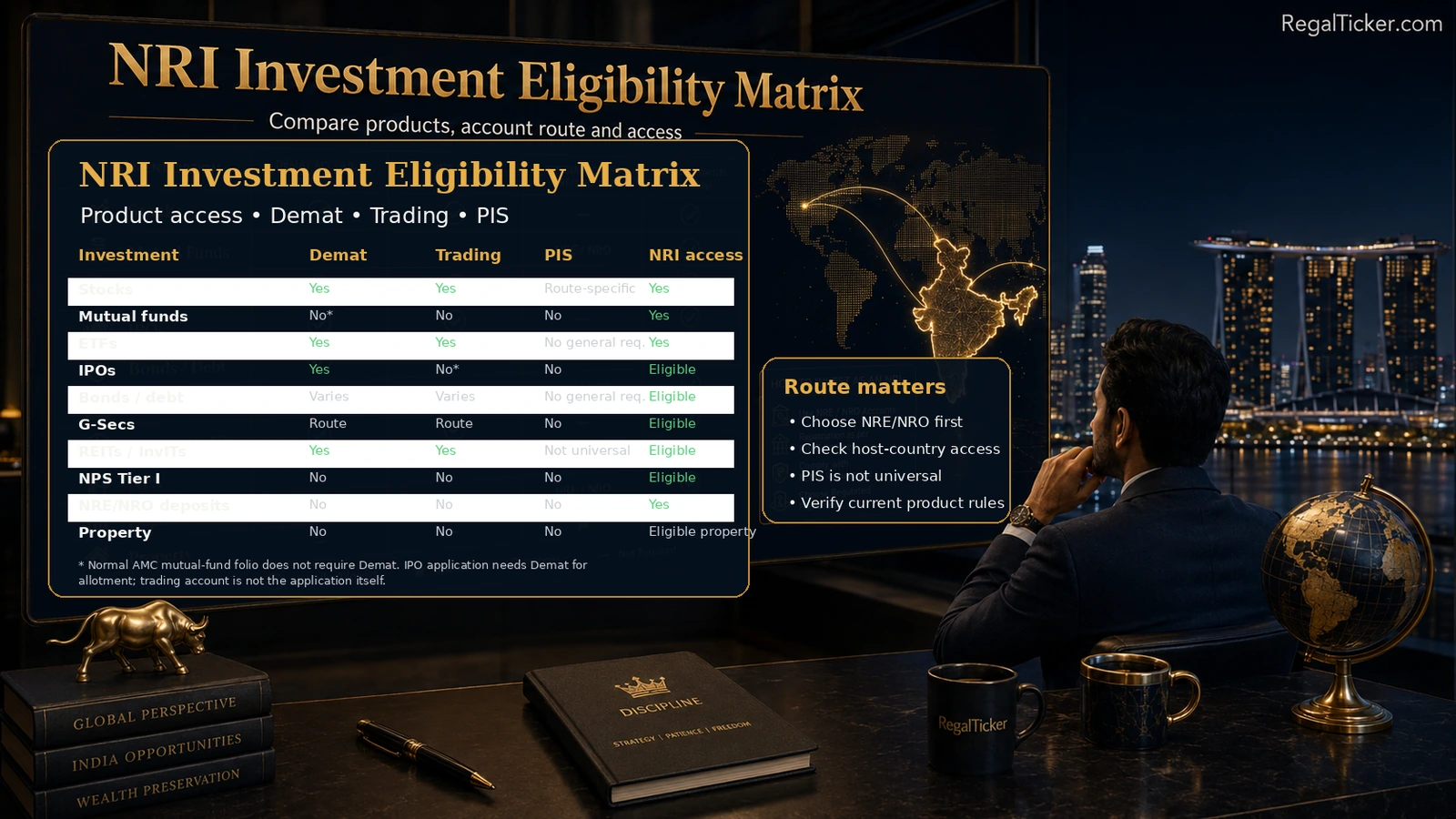
Product eligibility and intermediary availability are not identical. A broker, AMC, bank or platform can support a narrower set of NRI countries, account types or products than the general regulatory framework permits.
Equity and Market Investments
Can NRIs Invest in Indian Stocks?
Yes. NRIs can invest in eligible Indian equity shares subject to the applicable FEMA, SEBI, banking, account and foreign-investment rules.
For a normal exchange-traded share investment, an NRI typically needs the appropriate NRE/NRO banking structure, NRI-compliant KYC, the correct NRI Demat account, an NRI trading account, and the broker/bank route appropriate to repatriable or non-repatriable investing.
SEBI’s NRI education material also makes an important trading distinction: cash-market NRI transactions are delivery based under the framework it describes. Intraday cash trading and short selling are not permitted there, while equity derivatives have a separate non-repatriation framework.
Do not freeze an old shareholding-limit table into this guide
NRI/overseas investment limits are particularly update-sensitive. The applicable limit can depend on the current foreign-investment framework, investor category, company and aggregate holdings.
This evergreen guide therefore does not hard-code a permanent percentage table.
Use RegalTicker’s dedicated NRI Investment Limits guide instead.
Does every NRI stock investor need PIS?
Do not use a blanket answer.
SEBI’s investor material describes PIS permission as mandatory for buying and selling shares on an exchange on a repatriable basis under the PIS structure. The practical bank/broker structure must still be checked route by route.
The better approach is:
Choose repatriable or non-repatriable → choose NRE/NRO money route → confirm the broker/bank structure → then trade.
For the account and money-route framework, use the NRE vs NRO vs PIS guide.
Can NRIs Invest in Mutual Funds in India?
Yes. Indian mutual funds are one of the clearest NRI investment routes.
SEBI’s NRI investor material states that an NRI with an NRE/NRO bank account can invest in Indian mutual funds after completing KYC, on a repatriable or non-repatriable basis.
An investor can generally use a direct plan through the fund house, a regular plan through a distributor/intermediary, lumpsum investing, or SIPs where supported.
Does an NRI need a Demat account for mutual funds?
Not for the normal mutual-fund folio route.
Mutual-fund units can also be held in Demat where supported, but an NRI does not need to open a stock-trading Demat account simply because they want a standard mutual-fund folio.
This makes mutual funds operationally different from ETFs.
Does an NRI need PIS for mutual funds?
SEBI explicitly lists mutual funds among products for which a PIS permission letter is not required.
That point matters because some old articles still describe PIS as a general gatekeeper for every NRI market investment.
US, Canada and other country restrictions
Caution
Check this carefully
Indian law allowing an NRI to invest does not force every AMC to accept investors from every country.
SEBI’s material notes that some fund houses may not accept applications from US- and Canada-based NRIs. The reason is not that Indian mutual funds are universally prohibited for those NRIs; it is that host-country regulatory and compliance requirements can affect AMC onboarding and distribution policies.
Never create a permanent list of “AMCs that accept US/Canada NRIs” inside an evergreen article. Fund-house policies can change. Check the current AMC application policy when you actually invest.
Use the calculator
Compare SIP and lumpsum scenarios
If you are comparing a periodic investment with a one-time investment, model the assumptions using RegalTicker’s SIP Calculator and Lumpsum Calculator. Calculator outputs are educational scenarios, not return forecasts.
Can NRIs Invest in ETFs in India?
Yes. SEBI includes units of Exchange Traded Funds among securities in which NRIs can invest.
An ETF is a fund structure, but its units trade on an exchange like a security. That creates an important operational difference from a normal mutual-fund folio.
For exchange-traded ETF units, you normally need an NRI-compatible Demat account, a trading account/broker that supports the product, the appropriate linked NRE/NRO money route, and completed NRI KYC.
Is PIS compulsory for ETFs?
SEBI’s NRI investor material specifically says that a PIS permission letter is not required for ETFs.
That does not make the bank route irrelevant. It means “ETF” should not automatically be placed inside the same PIS box as a repatriable exchange-share purchase.
An ETF and an index mutual fund may track a similar index, but they do not use the same transaction mechanism. ETFs trade during market hours and normally sit in Demat; index mutual funds can be purchased/redeemed with the AMC through a mutual-fund folio.
Can NRIs Apply for IPOs and Rights Issues?
NRIs can participate in eligible IPOs and rights issues subject to the issue terms, investor category, FEMA conditions and application route.
SEBI’s NRI education material says a PIS permission letter is not required for IPOs, ESOPs or rights issues.
That is another reason to avoid the statement “NRI stock investing always requires PIS.”
Even where PIS is not the application requirement, an NRI still needs to check the issue category, repatriable/non-repatriable basis, eligible bank account, ASBA/application process, correct Demat account, and treatment when allotted shares are eventually sold.
The IPO subscription route and the later secondary-market sale route are two different stages. A product not requiring PIS for subscription does not mean the eventual sale can ignore the NRI bank/Demat structure.
Fixed Income, Retirement and Deposits
Can NRIs Invest in Government Securities?
Yes. Government securities are a permitted NRI investment avenue under applicable FEMA rules.
SEBI’s NRI material lists Government Dated Securities among NRI-investable securities.
RBI’s Retail Direct FAQ also states that non-resident retail investors who are eligible to invest in Government Securities under FEMA can open a Retail Direct Gilt account, subject to the scheme’s eligibility conditions.
This gives NRIs another route beyond a normal stockbroker for eligible government securities.
Government securities are not the same as a bank FD
A Government Security is a tradable debt instrument. Its market value can change with interest rates and maturity.
An FD is a bank deposit with different liquidity, deposit-insurance, interest and premature-closure characteristics.
Do not label both simply as “safe fixed return” and assume they behave the same way.
Can NRIs Invest in Bonds, NCDs and Other Debt Securities?
Yes—subject to the instrument and applicable rules.
SEBI’s NRI education material includes bonds issued by Public Sector Undertakings, bonds issued by Infrastructure Debt Funds, listed non-convertible or redeemable preference shares/debentures, and debt instruments issued by banks.
It also states that a PIS permission letter is not required for bonds or debt securities as a general product category.
Before buying any bond or NCD, an NRI should still assess issuer credit quality, secured vs unsecured status, maturity, coupon and yield, call/put features, liquidity, exchange listing, taxation and repatriation route.
Do not compare a corporate NCD with a Government Security using only the coupon. Credit risk and liquidity can be materially different.
Real Assets and Advanced Investments
Can NRIs Invest in REITs and InvITs?
NRIs can invest in eligible units of investment vehicles under the applicable foreign-investment framework. RBI has expressly permitted NRIs to purchase or sell units of an investment vehicle on repatriation and non-repatriation bases under the relevant FEMA framework.
REITs and InvITs are regulated investment vehicles under SEBI rules.
For a listed REIT or InvIT, the practical investor setup normally resembles other exchange-traded units: NRI-compatible Demat, broker/trading access, correct funding route, product/country eligibility, and tax review.
A listed REIT or InvIT can generate both market-price gain/loss on the units and periodic distributions whose tax character can contain different components.
Treat REIT and InvIT distributions as a specialist tax topic. The tax character can depend on the distribution component and current law. This broad eligibility guide intentionally does not freeze a tax-rate table.
Can NRIs Invest in NPS?
Eligible NRIs and OCIs can participate in the National Pension System under the applicable PFRDA framework.
PFRDA’s current All Citizen Model page states an important restriction:
NRIs/OCIs with Tier I accounts are not permitted to activate Tier II.
That means a generic statement such as “NPS has Tier I and Tier II, so an NRI can choose either” is incorrect.
NPS is a retirement-oriented framework with its own contribution, allocation, withdrawal and exit rules. It should be evaluated based on retirement location, access to money before retirement, Indian tax, host-country tax, exit rules and currency exposure.
NPS eligibility does not mean NPS receives the same tax treatment in your country of residence as it does in India. Cross-border retirement-account tax recognition is a separate question.
NRE, NRO and FCNR Fixed Deposits
Bank deposits are among the most commonly searched NRI investment options in India, but they should be separated from securities-market investing.
RBI recognises the major non-resident banking structures: NRE accounts, NRO accounts and FCNR(B) accounts.
NRE deposits
NRE is a rupee-denominated repatriable account for eligible non-resident funds. The depositor carries rupee currency risk if the ultimate spending currency is different.
NRO deposits
NRO is commonly used for legitimate rupee income and funds in India. Tax and repatriation treatment is different from NRE.
FCNR(B) deposits
FCNR(B) is maintained in permitted foreign currencies and is useful when the investor wants to avoid direct INR principal exposure at the deposit-account level.
| Deposit route | Deposit currency concept | Typical purpose | Repatriation framework | Key risk to compare |
|---|---|---|---|---|
| NRE | INR | Eligible overseas funds in India | Repatriable subject to applicable rules | INR exchange-rate risk |
| NRO | INR | Indian income / rupee funds | Different remittance framework | Tax + repatriation paperwork |
| FCNR(B) | Permitted foreign currency | Foreign-currency term deposit | Repatriable subject to rules | Bank rate + currency choice |
Can NRIs Buy Residential or Commercial Property in India?
Yes, NRIs/OCIs can generally acquire eligible immovable property in India under the FEMA framework.
RBI’s current property FAQ permits NRI/OCI purchase of immovable property other than agricultural land, farmhouse or plantation property, subject to the applicable rules.
Payment can be made through permitted banking channels, including eligible NRE/FCNR(B)/NRO funds.
Property adds risks that simple investment listicles often ignore: title/legal due diligence, concentration, transaction costs, maintenance, vacancy, local management, tax withholding on sale, repatriation documentation and illiquidity.
A permitted asset is not automatically a suitable asset.
Advanced NRI Investment Options: AIFs and PMS
Some NRIs with larger portfolios also consider SEBI-regulated Alternative Investment Funds (AIFs) or Portfolio Management Services (PMS).
These are specialist products/services and should not be placed in the same beginner bucket as a mutual-fund SIP.
SEBI’s published AIF statistics explicitly track investment from categories including NRIs. SEBI also regulates PMS and describes it as a higher-ticket personalised portfolio-management framework.
Before using either, verify investor eligibility, current minimum commitment/investment, liquidity and lock-in, fee structure, strategy risk, custody, tax reporting, repatriation and country-of-residence treatment.
Caution
“Professional management” does not remove investment risk. AIF and PMS structures can be more concentrated, less liquid, more complex and more expensive than broad retail products.
Investments NRIs Commonly Misunderstand or Cannot Newly Access
A strong NRI portfolio begins by knowing not only what is available, but also what is not automatically available.
Sovereign Gold Bonds: can an NRI newly invest?
RBI’s SGB FAQ says eligibility is for persons resident in India under FEMA.
If an individual bought SGB while eligible as a resident and later becomes non-resident, RBI says the investor may continue to hold the SGB until early redemption or maturity.
That is different from saying “NRIs can subscribe to a new SGB issue.”
PPF, NSC, KVP and National Small Savings Schemes
India Post’s current savings guidance states that NRIs are not eligible for National (Small) Savings Scheme accounts.
Existing accounts affected by a later change of residential status can have scheme-specific transition rules, but that should not be converted into the claim that an NRI can freely open a fresh PPF/NSC/KVP account.
Agricultural land and farmhouses
An NRI/OCI cannot simply purchase agricultural land, plantation property or a farmhouse under the ordinary general-permission route available for residential/commercial property.
Currency derivatives
SEBI’s NRI investor material distinguishes equity derivatives from currency derivatives and states that NRIs are not permitted to trade in the currency derivative segment under the framework it describes.
Restrictions are often product-specific. Do not infer that because one investment type is available, a similar-sounding product is also available.
NRE vs NRO: Choose the Money Route
Do not choose NRE or NRO based only on which account has a better headline feature.
Start with money source and repatriation goal.

NRE-oriented route
Often relevant when eligible overseas earnings are remitted to India and the investor wants the investment to retain an eligible repatriable character.
NRO-oriented route
Often relevant for Indian-source income and non-repatriable investment structures, with separate RBI remittance rules for eligible balances and assets.
One product may support more than one route. For example, SEBI states that an NRI can invest in Indian mutual funds on repatriable and non-repatriable bases after completing KYC.
So the question is not “Are mutual funds NRE or NRO?”
The better question is:
“What money is funding this investment and how do I want eligible redemption proceeds to be treated?”
For a full decision tree, use: NRE vs NRO vs PIS guide
Demat, Trading and PIS: What Each Investment Needs
These three concepts should never be used interchangeably.

Demat
Demat holds eligible securities electronically.
Common examples where Demat is central include listed shares, ETFs, listed REITs/InvITs, many listed bonds/NCDs, and IPO shares after allotment.
Trading account
A broker trading account is used to place exchange orders.
It is normally relevant when you buy/sell a listed security on an exchange.
PIS
PIS is a foreign-exchange/banking investment route relevant to specified NRI share transactions—not a synonym for “NRI trading account.”
SEBI specifically says a PIS permission letter is not required for IPOs, ESOPs, rights issues, mutual funds, ETFs, bonds or debt securities.
A product not needing PIS can still need Demat and a trading account. ETFs are the clearest example.
Repatriation and Country-of-Residence Rules
An investment may be economically identical but operationally different depending on the route used to fund it.
Two NRIs buy the same Indian investment.
Investor A funds it through an eligible repatriable structure from overseas funds.
Investor B uses Indian-source rupee funds under a non-repatriable route.
Both may own the same economic asset.
But when they sell, the bank records and route supporting remittance can differ.
This is why repatriation should be planned before the investment, not only after a large sale.
RBI’s NRE/NRO guidance makes the broad distinction clear: NRE is repatriable, while NRO balances and asset-sale proceeds follow a different remittance framework and documentation process.
Country-of-Residence Access Can Still Differ
This is the layer many “NRI investment options” articles understate.
Indian rules answer:
Can a person with NRI/OCI status invest under Indian law?
Your country of residence may separately ask:
Can this product be marketed or distributed to you here? How must you report it? > Is it treated as a foreign fund, pension or financial asset? Does the platform need a local licence?
SEBI itself warns NRIs to consider local guidelines in their country of residence and gives mutual-fund distribution as an example.
US and Canada
Some Indian AMCs do not onboard US/Canada-based NRIs for particular schemes or routes because of compliance requirements.
UAE and other Gulf countries
Local promotion/distribution rules can matter even where the underlying Indian investment is permitted.
Keep the article evergreen
Do not create a fixed “country whitelist” unless you are prepared to maintain it continuously.
Instead, use this three-step check:
Checklist before you act
- Is the investment permitted for an NRI/OCI under Indian rules?
- Does the Indian intermediary currently accept residents of my country?
- What does my country require for tax/reporting/financial-product access?
Which NRI Investment Fits Which Goal?
There is no universally “best investment option for NRIs.”
The useful comparison is goal → risk → liquidity → currency → account route.
| Investor need | Options commonly researched | What matters more than the product name |
|---|---|---|
| Long-term India equity exposure | Direct shares, equity mutual funds, equity ETFs | Diversification, valuation, time horizon, volatility |
| Lower-maintenance market exposure | Diversified mutual funds / index funds | Scheme risk, cost, country eligibility |
| Exchange-traded passive exposure | ETFs | Liquidity, tracking, Demat/broker route |
| Rupee fixed-income exposure | G-Secs, eligible bonds, NRE/NRO deposits | Credit risk, duration, liquidity, tax |
| Foreign-currency bank deposit | FCNR(B) | Deposit currency, rate, bank terms |
| Retirement-focused investing | NPS Tier I | Lock-in/exit, tax, retirement country |
| Income-producing real assets | REIT/InvIT, property | Distribution quality, leverage, liquidity, tax |
| Direct property exposure | Residential/commercial property | Title, management, concentration, repatriation |
| HNI specialist strategies | PMS/AIF | Fees, strategy, liquidity, manager risk |
Practical Decision Framework
Do not start by asking, “Which investment has the highest return?”
Start with the structure.

Step 1: Define the goal
Examples include long-term India equity exposure, retirement in India, future home purchase, rupee income, diversification away from your country of residence, or funds needed for family in India.
Step 2: Define the future spending currency
If you earn in USD/AED/GBP but the future goal is outside India, INR currency movement matters.
A 10% rupee return is not automatically a 10% return in your home currency.
Step 3: Decide the money route
Ask whether this is overseas income or Indian-source income, whether eligible proceeds should retain a repatriable structure, and whether NRE, NRO, FCNR(B) or a combination is appropriate.
Step 4: Choose the product category
Only now compare equity, funds, ETFs, fixed income, pension, property or specialist investments.
Step 5: Check the required account
Do you need bank only, mutual-fund KYC/folio, Demat, trading, a PIS-linked route, RBI Retail Direct, or an NPS account?
Step 6: Check India + host-country tax
Indian tax is only one side of a cross-border investment.
Step 7: Check repatriation before buying
Do not wait until the money is needed abroad.
Step 8: Keep records
Preserve source-of-funds evidence, bank statements, contract notes, mutual-fund statements, Demat statements, tax/TDS records, property documents and remittance documents.
Worked Examples
Arjun in Dubai wants long-term Indian equity exposure without selecting individual stocks
Arjun earns in the UAE and expects his long-term financial life to remain partly outside India.
Instead of immediately opening a share-trading account, he asks whether he needs direct stock selection, whether an eligible diversified Indian mutual fund or ETF better matches the goal, whether the chosen AMC/broker accepts UAE-resident investors, which NRE/NRO route will fund it, whether the product needs Demat, and what Indian/UAE reporting applies.
If he chooses a normal mutual-fund folio, Demat and PIS are not automatically required.
If he chooses an ETF, Demat/trading becomes part of the setup.
Same India exposure goal—different operational route.
Meera in Singapore has rental income in India
Meera receives legitimate Indian-source rental income and wants to invest part of it.
Her first question is not “which stock?”
Her first question is whether the investment should be funded through her NRO structure and what that means for future remittance.
She can then compare eligible mutual funds, securities or deposits based on risk and goal.
The NRO money source does not automatically determine which asset is “best.” It determines an important part of the money trail.
Rohan bought SGBs before moving overseas
Rohan subscribed to Sovereign Gold Bonds while he was resident in India.
Later he becomes NRI.
RBI permits an individual investor whose residential status subsequently changes to non-resident to continue holding the SGB until early redemption or maturity.
That does not mean Rohan should conclude that he can subscribe to a fresh SGB issue as an NRI.
This is why “can hold” and “can newly invest” must be separated.
Common Mistakes and Final Checklist
Looking for the “best NRI investment” before fixing the account structure
Wrong order. Account and money route first. Product selection second.
Assuming every investment needs PIS
Mutual funds, ETFs, IPOs, rights issues, bonds and debt securities should not be placed inside a universal PIS rule.
Assuming no investment needs PIS anymore
The opposite blanket statement can also mislead. PIS remains relevant to specified repatriable exchange-share structures.
Thinking NRE means tax-free investment returns
NRE bank-interest treatment does not convert every share, fund or property gain funded from NRE into tax-free income.
Ignoring currency risk
An investment can rise in INR and deliver a weaker return in your spending currency if INR moves adversely.
Copying resident-investor product lists
PPF, NSC, SGB and property restrictions are examples where residential status changes eligibility.
Ignoring country-of-residence rules
Indian permission does not guarantee that every intermediary can onboard you from every jurisdiction.
Treating “government-backed” as “no price risk”
Government securities can fluctuate in market value before maturity.
Choosing a bond only by coupon
Credit, liquidity, maturity and call risk matter.
Mixing tax and repatriation
Tax paid in India does not automatically prove that funds are ready for unrestricted remittance. Banking/FEMA documentation can still matter.
Final NRI Investment Checklist
- My Indian banking and investment relationships correctly show my non-resident status.
- I know whether the investment money is foreign-source or Indian-source.
- I know whether I need a repatriable or non-repatriable investment route.
- I understand why I am using NRE, NRO or FCNR(B).
- I have completed the KYC required for the chosen product.
- I know whether the product needs Demat.
- I know whether it needs a broker/trading account.
- I have verified whether PIS is actually relevant to this product and route.
- I have checked whether my broker, AMC, bank or platform accepts residents of my country.
- I have checked current product eligibility instead of relying on an old NRI article.
- I understand the asset’s risk—not only its advertised return.
- I understand the Indian tax layer.
- I have considered my country-of-residence tax/reporting layer.
- I know how eligible proceeds can be repatriated later.
- I will preserve source-of-funds, transaction and tax records.
Final Takeaway: Build the Structure Before the Portfolio
India offers NRIs access to a wide range of banking, securities, retirement and real-asset investments.
But the strongest NRI investing decision is rarely:
> “Which product has the highest return?”
It is:
> “Which product fits my goal, and can I hold it through the correct account, tax and repatriation structure?”
Use a simple sequence:
Goal → Currency → Money source → NRE/NRO route → Product eligibility → Demat/PIS requirement → Risk → Tax → Repatriation
That framework remains useful even when interest rates, tax rates, brokers and product offerings change.
Continue through the NRI Investing Specialist Academy for the full learning sequence.
Frequently asked questions
What are the main NRI investment options in India?
NRIs can generally access eligible Indian shares, mutual funds, ETFs, IPOs, government securities, bonds and debt instruments, REITs/InvITs, NPS Tier I, NRE/NRO/FCNR deposits and permitted residential/commercial property. The account and repatriation route differs by product.
Can an NRI invest in Indian stocks?
Yes, subject to the applicable NRI banking, Demat, trading, FEMA and foreign-investment rules. Exchange-traded share investing uses an NRI-compatible securities setup, and the exact PIS/non-PIS structure should be confirmed for the chosen route.
Can an NRI invest in mutual funds in India?
Yes. SEBI states that an NRI with an NRE/NRO bank account can invest in Indian mutual funds after completing KYC, on repatriable or non-repatriable bases. Individual fund houses can have country-specific onboarding policies.
Does an NRI need a Demat account for mutual funds?
Not for the normal mutual-fund folio route. Mutual-fund units can also be held in Demat, but Demat is not compulsory simply to invest directly with an AMC in a standard folio.
Can an NRI invest in ETFs in India?
Yes. SEBI lists ETFs among securities available to NRIs. Because ETF units trade on an exchange, an NRI normally needs Demat and trading access for the exchange route.
Is PIS required for mutual funds, ETFs or IPOs?
SEBI’s NRI investor material says a PIS permission letter is not required for IPOs, ESOPs, rights issues, mutual funds, ETFs, bonds or debt securities. PIS remains relevant in specified repatriable exchange-share structures.
Can an NRI invest in government bonds?
Eligible NRIs can invest in permitted Government Securities under applicable FEMA routes. RBI Retail Direct also allows non-resident retail investors who are eligible to invest in Government Securities under FEMA to use the scheme, subject to its conditions.
Can an NRI invest in REITs or InvITs?
NRIs are permitted to invest in eligible units of investment vehicles on repatriation or non-repatriation bases under the applicable framework. Listed REIT/InvIT units normally use Demat and exchange trading access.
Can an NRI invest in NPS?
Eligible NRI/OCI subscribers can use NPS Tier I. PFRDA states that NRIs/OCIs with Tier I accounts are not permitted to activate Tier II.
Can an NRI open an NRE, NRO or FCNR fixed deposit?
Eligible non-residents can use NRE, NRO and FCNR(B) banking/deposit structures subject to RBI and bank rules. They differ in currency, tax and repatriation treatment.
Can an NRI invest in Sovereign Gold Bonds?
A fresh SGB investment requires the investor to be a person resident in India under FEMA. RBI says a resident investor who later becomes non-resident may continue holding existing SGBs until early redemption or maturity.
Can an NRI open a PPF, NSC or KVP account?
India Post states that NRIs are not eligible for National (Small) Savings Scheme accounts. Existing accounts after a change in residential status can have scheme-specific rules, so do not treat continued holding of an old account as permission to open a fresh one.
Can NRIs buy property in India?
NRIs/OCIs can generally purchase eligible residential and commercial property under FEMA. RBI excludes agricultural land, plantation property and farmhouses from the ordinary purchase permission.
Which is the best investment option for an NRI in India?
There is no universal best option. The appropriate choice depends on the goal, risk tolerance, liquidity, currency exposure, country of residence, money source, tax position and repatriation requirement. Compare the structure first, then the investment.
Does an NRE account make investment income tax-free?
No. The tax treatment of NRE bank interest does not automatically extend to capital gains, mutual-fund gains, dividends, bond income or property income. Each income type follows its own tax rules.
Verify through official sources
Official references
- Securities and Exchange Board of India — Investments by NRIs in the Indian Securities Market — NRI securities access, PIS distinctions, mutual funds, ETFs, IPOs, rights issues, bonds and host-country considerations
- Reserve Bank of India — Accounts in India by Non-residents — NRE, NRO and FCNR(B) account structure, permitted credits and repatriation concepts
- Reserve Bank of India — Retail Direct Scheme — Eligibility and access to Government Securities through RBI Retail Direct
- Reserve Bank of India — Sovereign Gold Bond FAQ — Residential-status eligibility and continued holding after a status change
- Reserve Bank of India — Acquisition and Transfer of Immovable Property by NRI/OCI — Permitted residential/commercial property and restrictions on agricultural land, plantation property and farmhouses
- Pension Fund Regulatory and Development Authority — NPS All Citizen Model — NPS eligibility and current NRI/OCI Tier II restriction
- Department of Posts — Savings Schemes — Eligibility and restrictions relevant to NRI access to Post Office small-savings products
Educational disclaimer: This article is for investor education and general information only. It is not personalised investment, tax, legal, banking or foreign-exchange advice. FEMA provisions, tax rules, product eligibility, intermediary policies and country-of-residence requirements can change. Verify material decisions with the relevant regulator, authorised dealer bank, regulated intermediary and appropriately qualified professional.