


NRI Investing
A practical guide to tax on listed Indian shares for NRIs, including 20% STCG, 12.5% LTCG, TDS, refunds, DTAA, capital-loss rules and repatriation.
⚡ Quick answer
How are capital gains on Indian shares taxed for an NRI?
For qualifying listed equity shares, a gain is generally short-term when the shares are held for 12 months or less and long-term when held for more than 12 months. Qualifying short-term gains covered by Section 111A are taxed at 20%, while qualifying long-term gains under Section 112A are taxed at 12.5% on aggregate gains above ₹1.25 lakh, subject to the applicable Securities Transaction Tax conditions. An NRI can also face TDS/withholding, but the amount deducted is not automatically the final tax liability. Filing an Indian tax return can be necessary or useful to reconcile TDS, claim a refund, preserve capital losses or claim treaty treatment where available.
Key takeaways
Listed Indian equity normally uses a 12-month holding-period test for short-term versus long-term classification.
Qualifying Section 111A short-term capital gains are taxed at 20%.
Qualifying Section 112A long-term capital gains are taxed at 12.5% on aggregate gains above ₹1.25 lakh.
The resident-only ability to use an unused basic exemption limit against Section 112A gains does not generally extend to a non-resident.
TDS under the non-resident withholding framework is not the same as final tax payable.
If excess tax has been deducted, filing a return may allow the investor to claim the available TDS credit and refund, subject to the final computation.
A short-term capital loss can generally offset short-term or long-term capital gains; a long-term capital loss can generally offset only long-term capital gains.
Eligible unused capital losses can generally be carried forward for eight years if the return is filed within the prescribed conditions.
NRE versus NRO account choice does not itself set the capital-gains tax rate.
Repatriation is a separate FEMA/RBI question from income-tax liability.
Start with the correct question: what exactly did you sell?
NRI tax articles often become confusing because they begin with a rate and then apply it to every investment.
That is backwards.
Before calculating tax, identify:
- the asset sold;
- whether it is listed or unlisted;
- the holding period;
- whether the transaction satisfies the STT conditions for the concessional listed-equity provisions;
- the cost of acquisition;
- sale-related expenses allowed in the capital-gain computation;
- current-year and brought-forward capital losses;
- whether a DTAA provision is relevant; and
- how much tax has already been withheld.
This article focuses mainly on listed equity shares of Indian companies where the Section 111A / 112A framework is relevant.
If you are still deciding which bank and investment setup to use, first read NRE vs NRO vs PIS for NRIs.
STCG vs LTCG for listed Indian shares
For listed shares, the holding period is usually the first important tax decision.
The Income Tax Department’s current share-sale guidance treats listed securities such as listed equity shares as long-term when held for more than 12 months. A holding of 12 months or less is therefore short-term for this purpose.

Short-term capital gain — qualifying listed equity
- Holding period — 12 months or less.
- Main provision — Section 111A where the prescribed conditions are met.
- Current base tax rate — 20% for qualifying transfers under the current framework.
- ₹1.25 lakh LTCG threshold — does not apply to STCG.
- STT conditions — relevant to the concessional Section 111A treatment.
Long-term capital gain — qualifying listed equity
- Holding period — more than 12 months.
- Main provision — Section 112A where the prescribed conditions are met.
- Current base tax rate — 12.5%.
- Threshold — tax applies to qualifying aggregate Section 112A gains above ₹1.25 lakh for the financial year.
- STT conditions — normally apply as prescribed for the listed-equity concession.
Why “listed shares are taxed at 20% or 12.5%” is still an incomplete statement
Those headline rates are useful, but they are not a complete tax return.
The final amount can also be affected by:
- whether the transaction actually qualifies under Section 111A or 112A;
- surcharge;
- health and education cess;
- capital losses;
- treaty relief where applicable;
- other special-rate income;
- TDS already deducted; and
- the tax law applicable to the particular tax year.
So treat 20% and 12.5% as the core base rates for qualifying transactions, not as a promise that every NRI stock sale produces exactly that final percentage.
How the 20% NRI short-term capital-gains rate works
Assume you buy listed shares and sell them within 12 months.
If the sale falls within the qualifying Section 111A framework, the short-term gain is taxed at the 20% base rate under the current rules.
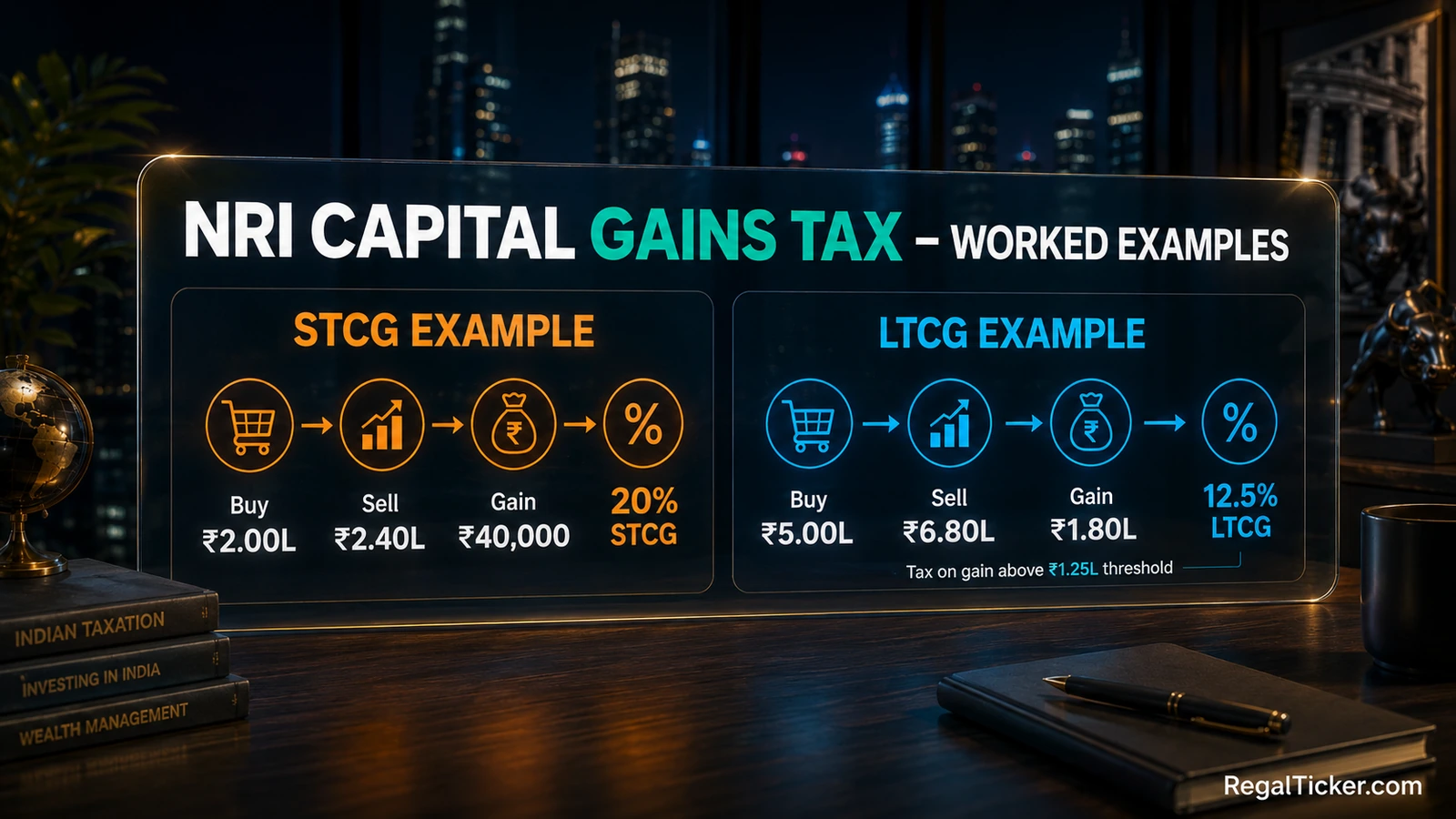
Worked example: short-term gain
Suppose an NRI buys 500 listed shares for ₹400 each.
- Purchase cost: 500 × ₹400 = ₹2,00,000
- Sale price: 500 × ₹500 = ₹2,50,000
- Illustrative capital gain: ₹50,000
If this is a qualifying Section 111A short-term gain:
FORMULA: Base STCG tax = ₹50,000 × 20% = ₹10,000
This illustration deliberately excludes surcharge, cess, allowable transfer expenses, loss set-off and transaction-specific withholding.
That is why the final tax statement can differ from ₹10,000 even though the core tax rate is 20%.
How the 12.5% NRI long-term capital-gains rate works
For qualifying Section 112A listed-equity gains, the current base rate is 12.5% on aggregate gains above ₹1.25 lakh.
The ₹1.25 lakh figure is an annual aggregate threshold for qualifying Section 112A gains. It is not a separate exemption for each share, each Demat account, each broker or each sale.
Worked example: long-term gain
Suppose your qualifying aggregate long-term gain from Section 112A assets during the financial year is ₹2,00,000.
- Aggregate qualifying LTCG: ₹2,00,000
- Section 112A threshold: ₹1,25,000
- Amount above threshold: ₹75,000
FORMULA: Base LTCG tax = ₹75,000 × 12.5% = ₹9,375
Again, the final liability can include other tax components and adjustments.
The basic-exemption trap for NRIs
A resident individual or resident HUF can have a special adjustment where other income is below the applicable basic exemption limit.
The Income Tax Department’s current Section 112A guidance specifically identifies the resident individual/HUF exception.
That means an NRI should not copy a resident taxpayer’s calculation and automatically reduce Section 112A gain by an unused basic exemption amount.
Caution
Do not use a resident-only capital-gains shortcut for an NRI return
Residential status changes the availability of some tax benefits. Calculate the share gain under the rules applicable to a non-resident rather than copying a resident-investor tax example from a generic calculator or article.
TDS on an NRI share sale: deduction is not final tax
This is the part that causes the most confusion.
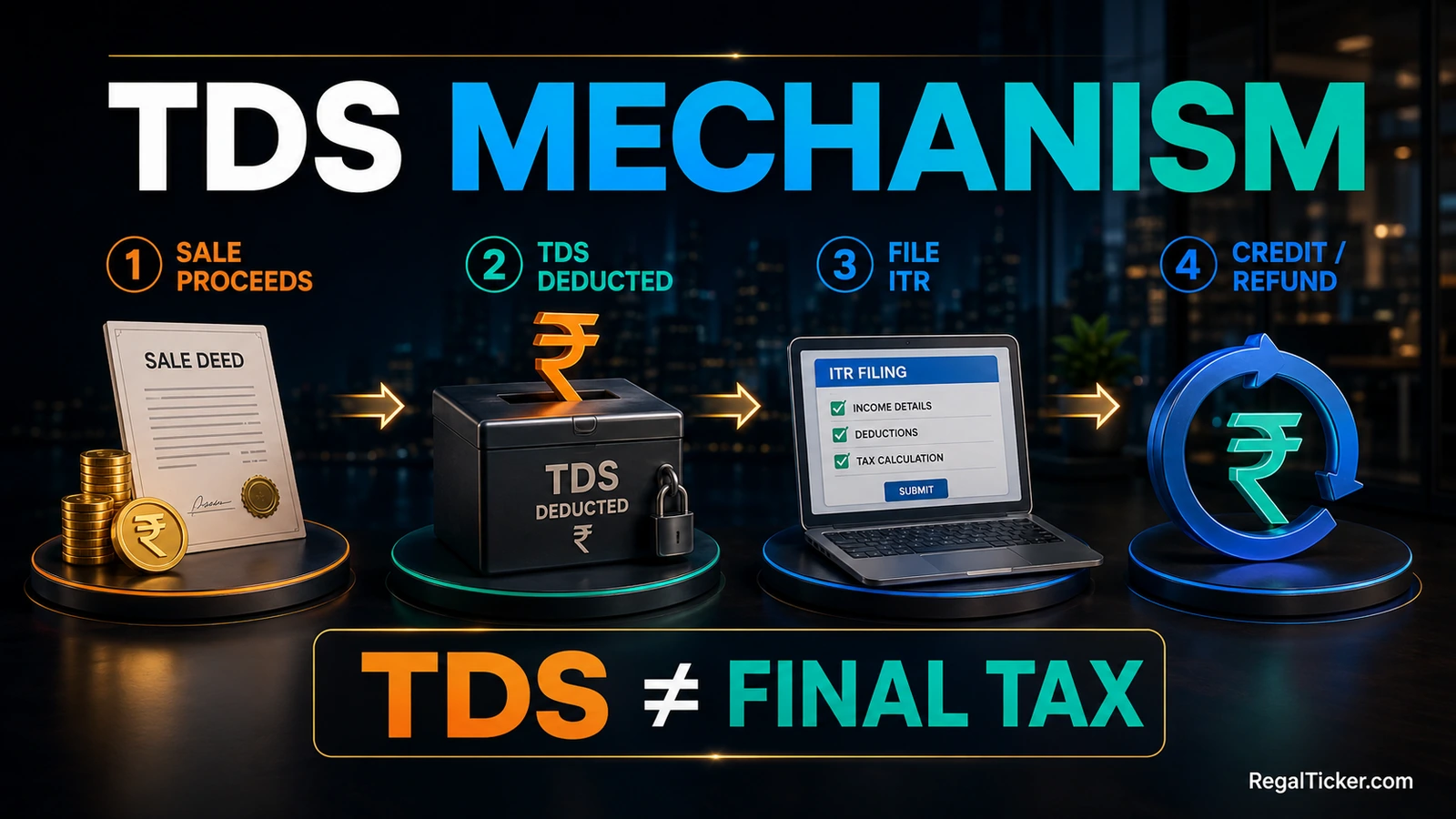
Tax deducted at source is a collection mechanism.
For payments chargeable to tax in the hands of a non-resident, the withholding framework can operate under Section 195 and related provisions depending on the payment and transaction.
The important investor lesson is:
TDS deducted ≠ final tax liability.
The amount withheld may be:
- equal to the final liability;
- lower than the final liability; or
- higher than the final liability.
The correct result is known only after the gain, applicable rate, losses, treaty position and other relevant tax items are reconciled.
Why you should not publish or rely on one universal “NRI share TDS rate”
The applicable withholding can depend on:
- the nature of the payment;
- whether the gain is short-term or long-term;
- the security;
- the applicable domestic provision;
- surcharge and cess;
- treaty claims and documentation;
- the paying/intermediary arrangement; and
- the investor’s facts.
That is why this guide does not tell every NRI that “your broker will deduct exactly X%.”
What to do when TDS is higher than your final tax
If valid TDS credit exceeds the final Indian tax liability after the return is computed, the excess may be refundable through the Indian income-tax return process.
Keep the withholding evidence and reconcile it against the tax information available on the Income Tax portal.
Checklist before you act
- Check the amount actually credited as TDS.
- Check which payment/income it relates to.
- Reconcile it against your capital-gain statement.
- Apply eligible loss set-off.
- Check treaty relief if relevant.
- Compute final tax including applicable surcharge and cess.
- Claim eligible TDS credit in the return.
- Review the resulting tax payable or refund.
Do NRIs always have to file an Indian income-tax return after selling shares?
Not every NRI has an identical filing obligation.
The Income Tax Department currently explains a limited relief under Section 115G of the Income-tax Act, 1961, and notes that similar relief is retained under Section 216 of the Income Tax Act, 2025. Broadly, certain NRIs whose total income consists only of specified investment income or long-term capital gains and on which the required tax has been deducted can qualify for filing relief.
But this is a narrow relief, not a reason to avoid filing whenever you sold a share.
Filing can still be valuable even where a narrow exemption might exist
You may need or want to file when you have:
- excess TDS and want a refund;
- capital losses you want to carry forward;
- additional Indian income;
- a DTAA claim that needs to be reflected correctly;
- tax still payable after withholding;
- discrepancies in tax-credit information; or
- other reporting requirements.
Investor note
Important point
A return can be useful even when the tax has already been withheld. For an NRI investor, the return is often the place where withholding, capital gains, losses and treaty positions are finally reconciled.
Capital losses can materially change the final tax
A good NRI tax guide should explain losses, not only profitable trades.
Under the current capital-loss framework:
- short-term capital loss can generally be set off against short-term capital gains or long-term capital gains;
- long-term capital loss can generally be set off only against long-term capital gains; and
- eligible unabsorbed capital losses can generally be carried forward for eight years.
For carry-forward treatment, timely filing conditions matter.
Why the filing deadline matters after a bad year
An investor may think:
“I made a loss, so there is no tax and no reason to file.”
That can destroy future value.
If you want to preserve eligible capital losses for future set-off, the return generally needs to satisfy the prescribed timely-filing conditions.
💡 Real example
A loss can be worth more than zero tax today
Assume you realise a ₹1,00,000 short-term capital loss this year and later realise eligible capital gains in a future year. If the loss is validly carried forward, it may reduce future taxable capital gains subject to the applicable set-off rules. If you ignore the filing conditions, you may lose the ability to use that loss later.
How FIFO affects your cost and holding period in a Demat account
When you bought the same share multiple times at different prices, you cannot simply choose whichever purchase lot gives the lowest tax.
For securities held in Demat form, the Income Tax Department explains the First-In-First-Out (FIFO) method for identifying the securities treated as sold and for determining the period of holding/cost basis.
Simple FIFO example
You buy:
- 100 shares at ₹200;
- later 100 shares at ₹300.
You then sell 100 shares.
Under FIFO, the first 100 shares that entered the Demat account are generally treated as the first sold for the relevant tax identification.
That can affect both:
- the acquisition cost; and
- whether the lot is short-term or long-term.
For a large portfolio, preserve broker contract notes and Demat records rather than relying only on an app’s current average purchase price.
Corporate actions can change the cost record even when no cash is received
Bonus shares, stock splits, rights issues, mergers, demergers and buybacks can affect quantity, cost basis or the later tax computation.
They should not all be treated the same way.
For example:
- a stock split changes the number of shares and per-share cost while preserving the overall economic cost basis subject to the applicable rules;
- rights shares generally have an acquisition cost linked to the price paid for the rights shares;
- bonus-share cost rules require separate treatment; and
- demergers can require an allocation of the original cost between the resulting holdings.
Rather than turning this NRI guide into a corporate-action tax manual, use RegalTicker’s dedicated learning pages and calculators:
NRE vs NRO does not decide the capital-gains rate
This deserves a separate section because it is repeatedly misunderstood.
Your NRE or NRO account is primarily part of the banking/fund-flow and repatriation structure.
The capital-gains rate is determined by the asset, holding period, transaction and tax provisions.
So this shortcut is wrong:
“NRE trade = one tax rate; NRO trade = another tax rate.”
Account route can affect operational withholding, money movement and documentation, but it does not replace the capital-gains provisions themselves.
Read NRE vs NRO vs PIS for NRIs for the banking/investing-route decision.
DTAA: can an NRI avoid being taxed twice?
Potentially, but DTAA treatment is country-specific.
An NRI can be taxable in India on Indian-source capital gains and may also have reporting or tax obligations in the country of residence.
A Double Taxation Avoidance Agreement can allocate taxing rights, cap tax in some cases or provide a mechanism for relief, depending on the treaty article and the investor’s facts.
Do not assume every DTAA eliminates Indian capital-gains tax
Treaties differ.
The correct questions are:
- Which country are you tax-resident in?
- What does the India treaty with that country say about capital gains on the relevant security?
- Does India retain taxing rights?
- What tax was actually paid in India?
- What credit or exemption does the residence country permit?
- What documentation is required to claim treaty treatment?
For many NRIs, the foreign-tax-credit claim is primarily made in the country of residence under that country’s rules because the Indian-source gain has already been taxed in India.
Do not automatically use an Indian Form 67 foreign-tax-credit process simply because you are an NRI; that form is designed for specified Indian-resident taxpayers claiming credit in India for foreign taxes.
Keep treaty documents before you sell
Depending on the claim, documentation can include tax-residency evidence and prescribed treaty forms/information.
Because treaty documentation and the new Income Tax Act transition can change form numbers and procedures, confirm the current Income Tax portal requirements for the tax year in which the transaction occurs.
Income Tax Act, 2025: what changes for this guide?
India’s tax law is transitioning to the Income Tax Act, 2025 for tax years beginning on or after 1 April 2026.
The Income Tax Department’s current non-resident guidance says that important NRI reliefs and compliance concepts continue under the new Act, including the filing-relief concept corresponding to old Section 115G.
For a practical investor, the key lesson is:
Do not rely only on an old section number when filing a 2026-27 or later tax-year return.
The economic concepts in this guide — capital-gain classification, special-rate treatment, TDS reconciliation, losses and filing — continue, but the new Act can renumber provisions and forms.
Use the live Income Tax portal for the return year rather than an outdated PDF or blog screenshot.
Tax before repatriation: do not confuse two separate systems
Income tax and FEMA repatriation are connected operationally, but they answer different questions.
Income tax asks: what tax is due on the gain?
FEMA/RBI asks: can this money be remitted abroad and under what route/conditions?
Residential status sits one step before this distinction. An investor can have a FEMA status that differs from the Indian income-tax result for the same period. If that status is unclear, first read FEMA vs Income Tax Residency for NRIs to determine the separate FEMA and NR/RNOR/ROR frameworks before applying NRI tax or repatriation rules.
For eligible NRO balances and other eligible assets, RBI’s current NRI account guidance describes a remittance facility of up to USD 1 million per financial year, subject to the applicable conditions and documentation.
That is a remittance ceiling/framework — not a capital-gains tax exemption.

A simple sequence after selling shares
- Determine the capital gain correctly.
- Identify tax already withheld.
- Compute the final Indian tax position.
- Pay any remaining tax or claim eligible credit/refund through the return process.
- Keep bank and tax documentation.
- Follow the authorised dealer bank’s applicable remittance process if moving eligible money abroad.
Use the Capital Gains Tax Calculator carefully
CALCULATOR: TITLE: Estimate the listed-equity base tax before adding the NRI layer Use the RegalTicker Capital Gains Tax Calculator to understand the basic Section 111A / Section 112A mechanics for an eligible listed-equity transaction. For an NRI, treat the result as a base educational estimate because the calculator does not determine NRI-specific withholding, DTAA treatment, foreign tax credit, surcharge/cess or repatriation eligibility. BUTTON: Open Capital Gains Tax Calculator URL: https://regalticker.com/tools/capital-gains-tax-calculator
You can also use the Brokerage Calculator to separate transaction costs from tax.
Worked example: sale, TDS and final reconciliation
Assume an NRI has a qualifying short-term listed-equity gain of ₹50,000.
Base Section 111A tax at 20% is ₹10,000 before applicable additional tax components.
Now suppose ₹18,000 of valid tax has already been withheld/credited in relation to the taxable transaction.
The investor should not conclude that the tax rate was 36%.
Instead:
- calculate the final Indian tax liability under the applicable provisions;
- add applicable surcharge/cess where relevant;
- apply eligible capital losses or treaty treatment;
- claim the valid TDS credit; and
- determine whether tax remains payable or a refund is due.
The TDS figure and the final tax figure solve different problems.
Year-end NRI share-tax checklist
- Download your broker’s realised capital-gain statement.
- Reconcile sales with Demat transactions and contract notes.
- Separate holdings of 12 months or less from holdings of more than 12 months.
- Confirm which transactions qualify under Section 111A / 112A treatment.
- Aggregate Section 112A long-term gains before applying the ₹1.25 lakh threshold.
- Check FIFO where the same security was acquired in multiple lots.
- Capture bonus, split, rights, demerger and other corporate-action cost adjustments correctly.
- Reconcile TDS/tax credits with the Income Tax portal records.
- Set off current-year capital losses correctly.
- File on time if you need to carry forward eligible capital losses.
- Review DTAA treatment based on your country of tax residence.
- Keep tax records needed for any later NRO remittance.
- Do not use the NRE/NRO account type as a substitute for the actual tax rule.
Common NRI capital-gains tax mistakes
Mistake 1: treating TDS as the final tax
TDS is advance collection. Always reconcile it against the final return computation.
Mistake 2: applying ₹1.25 lakh separately to every stock
The Section 112A threshold applies to qualifying aggregate long-term gains, not separately to each company or trade.
Mistake 3: using the resident basic-exemption adjustment
The special resident individual/HUF adjustment under the Section 112A framework should not be automatically copied into a non-resident calculation.
Mistake 4: ignoring losses because “there is no tax this year”
A properly preserved capital loss may reduce future capital-gains tax.
Mistake 5: trusting the broker’s average price without checking FIFO/corporate actions
Tax cost can differ from the simplified average price shown in a portfolio dashboard.
Mistake 6: assuming NRO repatriation is automatic once tax is paid
Tax compliance is necessary, but outward remittance still follows the applicable banking/FEMA process.
Frequently asked questions
What is the NRI short-term capital-gains tax rate on listed Indian shares?
For a qualifying listed-equity transaction covered by Section 111A under the current framework, the base STCG rate is 20%, subject to the prescribed conditions and applicable surcharge/cess.
What is the NRI long-term capital-gains tax rate on listed Indian shares?
For qualifying Section 112A gains, the base LTCG rate is 12.5% on aggregate gains above ₹1.25 lakh, subject to the relevant conditions.
When does a listed share become long-term?
Listed equity shares are generally treated as long-term when held for more than 12 months. A holding period of 12 months or less is generally short-term for this classification.
Is the ₹1.25 lakh threshold available to an NRI?
The Section 112A framework taxes qualifying aggregate LTCG above ₹1.25 lakh. However, do not confuse this threshold with the separate resident-only basic-exemption adjustment.
Is TDS the final capital-gains tax for an NRI?
No. TDS is tax deducted at source. Final tax must be computed using the applicable gain, rate, losses, treaty position and other tax components, after which valid TDS credit is applied.
Can an NRI get a refund of excess TDS?
If valid TDS credit exceeds the final Indian tax liability after the return is computed, an eligible refund can generally be claimed through the tax-return process.
Does an NRI need to file a return if all tax was deducted?
Not always. A narrow filing relief exists for certain NRIs with only specified investment income/long-term capital gains and the required withholding, but many investors still need or benefit from filing for refunds, loss carry-forward, additional income or treaty treatment.
Can an NRI carry forward capital losses?
Eligible capital losses can generally be carried forward for eight years, subject to the prescribed filing conditions. Long-term losses are generally set off only against long-term gains; short-term losses can generally be set off against short-term or long-term gains.
Does an NRE account make capital gains tax-free?
No. NRE banking benefits do not make a taxable share-sale gain tax-free. The capital-gains tax treatment follows the asset and tax rules.
Can an NRI repatriate share-sale proceeds from an NRO account?
Eligible NRO balances/assets can fall within RBI’s remittance framework of up to USD 1 million per financial year, subject to conditions, tax compliance and bank documentation.
Verify through official sources
Official references
- Income Tax Department — Tax on Sale of Shares in India
- Income Tax Department — Non-resident: Benefits Allowable
- Income Tax e-Filing — Non Resident guidance and Income Tax Act, 2025 transition
- Income Tax Department — Tax Deduction at Source
- Income Tax Department — Capital Gain / FIFO guidance
- Income Tax Department — Set off and Carry Forward of Losses
- Reserve Bank of India — Accounts in India by Non-residents
Investor note
NRI taxation is high-stakes and fact-specific. This guide explains the general listed-equity framework for education; it is not a substitute for transaction-specific tax advice. Treaty treatment, withholding, surcharge, cess, residential status, security type and return-year rules can materially change the final result.
Final takeaway
Calculate the gain first, then reconcile TDS, filing and repatriation
For an NRI selling qualifying listed Indian shares, the core framework is straightforward: 20% base STCG for qualifying Section 111A gains and 12.5% base LTCG on qualifying Section 112A gains above ₹1.25 lakh. The complexity comes after that — TDS can differ from final tax, losses can reduce taxable gains, treaty rules can matter, and moving the money abroad is a separate FEMA/RBI process. Keep the records, use the correct residential-status rules and reconcile everything in the appropriate tax return when required or beneficial.