


NRI Investing
A practical guide to NRE and NRO banking, PIS and non-PIS investing routes, repatriation, tax and real-life account choices.
⚡ Quick answer
NRE vs NRO vs PIS — what does an NRI actually need?
An NRI does not normally choose between NRE, NRO and PIS as if they were three equivalent bank accounts. NRE and NRO are bank accounts. PIS is a regulated portfolio-investment route used in certain NRI stock-market arrangements, while brokers may also support non-PIS setups for permitted transactions. Use NRE when eligible money should retain a repatriable character; use NRO to manage legitimate rupee income and other permitted funds in India; then choose the PIS or non-PIS investing setup supported for the product, bank, broker and repatriation basis you need. Many NRIs use more than one account because overseas salary, Indian rent and stock-market proceeds are different money flows.
Key takeaways
Separate the decisions
NRE vs NRO is about where money sits and how it can move; PIS vs non-PIS is about the investing route.
NRE is repatriable
eligible NRE balances can generally be remitted abroad under the applicable FEMA/RBI framework.
NRO is more flexible for Indian receipts
it can receive legitimate dues in India and inward remittances, but repatriation follows a separate framework.
NRO is not simply “non-repatriable”
current income can be remitted subject to conditions, and eligible balances/assets may use the RBI USD 1 million annual facility.
PIS remains relevant
NSE continues to describe PIS for NRI exchange investing through a designated authorised dealer bank.
Non-PIS exists in current broker setups
the exact products, bank link and repatriation treatment vary by intermediary and must be checked before opening the account.
Tax and FEMA are different layers
NRE interest exemption depends on FEMA/RBI eligibility, while investment gains and other income follow the applicable tax law.
NRE vs NRO vs PIS in 30 seconds
The easiest way to avoid confusion is to stop putting all three terms in the same bucket.
NRE = bank account for eligible non-resident funds, generally repatriable.
NRO = bank account for legitimate rupee income and other permitted funds in India, with a different repatriation framework.
PIS = Portfolio Investment Scheme / investment-routing framework used for certain NRI purchases and sales of Indian shares through a designated banking arrangement.
Non-PIS = an alternative NRI investing setup offered by intermediaries for permitted transactions outside the PIS route.
That means your actual question is usually not:
“Should I open NRE, NRO or PIS?”
It is:
“Which NRE/NRO banking structure fits my money, and which PIS/non-PIS investment route fits what I want to buy?”
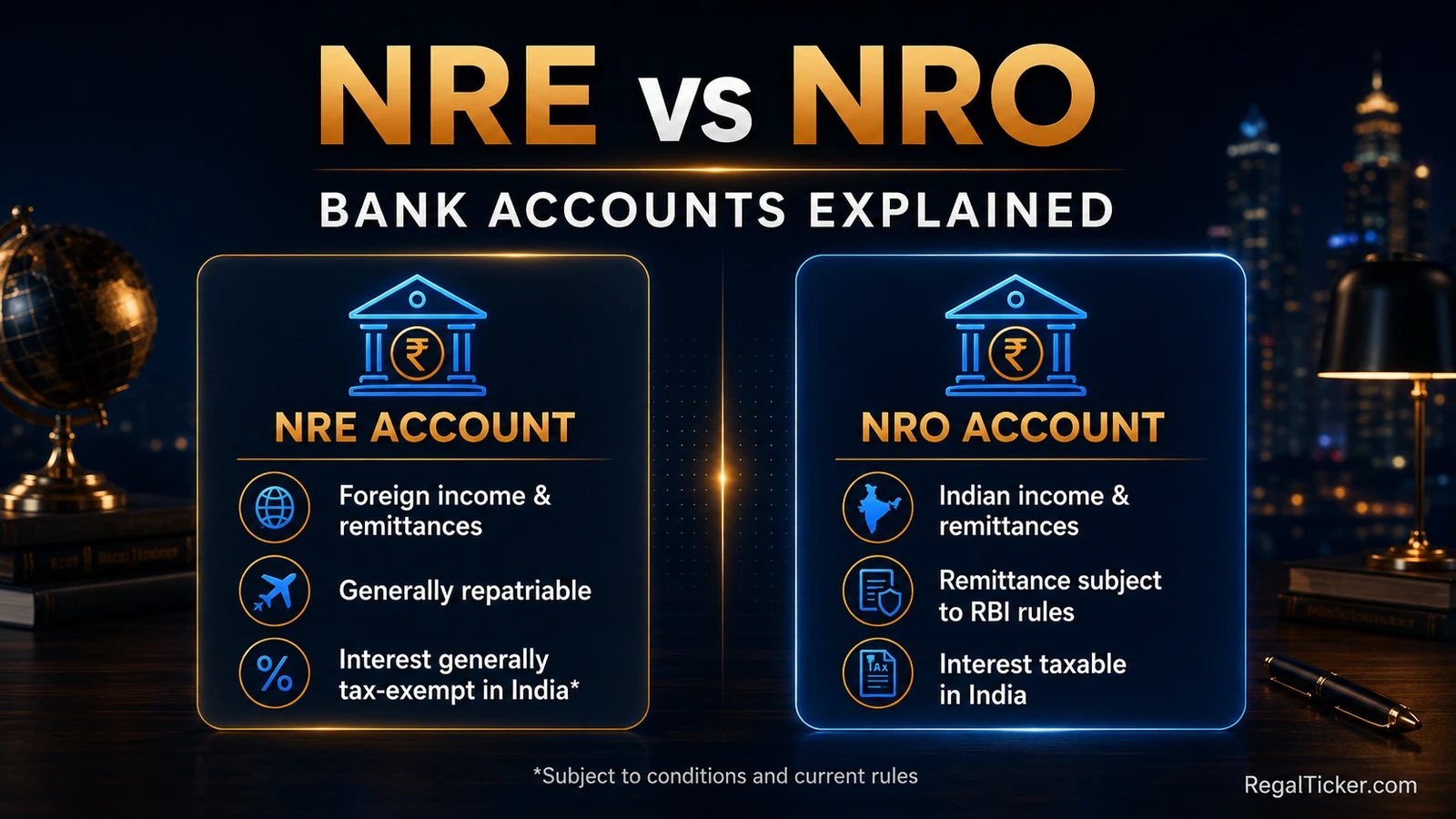
NRE account
- Main job — hold eligible non-resident funds in Indian rupees.
- Typical funding — inward remittance and other permitted repatriable credits.
- Repatriation — generally repatriable under RBI/FEMA rules.
- Interest — generally exempt in India while the statutory FEMA/RBI conditions are satisfied.
- Best mental model — money that should retain its foreign/repatriable character.
NRO account
- Main job — manage legitimate rupee income and permitted funds in India.
- Typical funding — rent, pension, dividend, interest, other legitimate dues, inward remittance and permitted transfers.
- Repatriation — current income may be remitted subject to requirements; other eligible balances/assets can use the applicable USD 1 million annual facility.
- Interest — taxable in India.
- Best mental model — your main rupee account for Indian money flows and local obligations.
First decision: NRE or NRO bank account?
This decision begins with the source and future destination of the money.
Ask two questions:
- Where did the money come from?
- Do I need the principal and future eligible proceeds to remain freely repatriable?
Those questions are more useful than memorising a generic NRE-vs-NRO table.
What is an NRE account?
NRE stands for Non-Resident External account. It is an Indian-rupee account maintained by eligible non-residents under the RBI framework.
RBI’s current NRI account FAQ lists inward remittances, interest, transfers from other NRE/FCNR(B) accounts, maturity proceeds of qualifying investments and certain current income among permissible NRE credits, provided the money has not lost its repatriable character.
That detail matters because “NRE = only foreign salary” is too narrow.
An NRE account can be useful when your priority is maintaining a clean repatriable money trail for eligible funds.
What can be credited to an NRE account?
Examples under RBI guidance include:
- inward remittances from outside India,
- interest accruing on the account,
- interest on eligible investments,
- transfers from other NRE/FCNR(B) accounts,
- maturity proceeds from investments funded through eligible repatriable money,
- and qualifying current income such as rent, dividend, pension or interest where the credit has not lost its repatriable character.
The last condition is important. Do not assume every rupee received in India can simply be deposited into NRE and become freely repatriable.
Is NRE fully repatriable?
RBI describes the NRE account as repatriable.
For an investor, that means the account can be valuable when the investment is intended to remain on a repatriation basis and the chosen bank/broker structure supports that route.
But “NRE account exists” and “every investment funded from it will always be repatriable without further checks” are not the same statement. The underlying transaction must also comply with the applicable rules.
Is NRE interest tax-free in India?
The Income Tax Department’s current guidance confirms that the NRE interest exemption continues under the Income Tax Act, 2025. The substantive condition remains linked to the individual being a person resident outside India under FEMA or otherwise permitted by RBI to maintain the account.
So the useful wording is:
NRE interest is generally exempt in India while the applicable FEMA/RBI eligibility conditions are satisfied.
Do not turn that into the broader claim that every return from every investment made through an NRE account is tax-free. Stock-market gains, dividends and other investment income have their own tax treatment.
Do not use the NRE account label itself as proof of income-tax non-resident status. FEMA residence and Indian tax residency are separate tests. RegalTicker’s FEMA vs Income Tax Residency for NRIs guide explains when FEMA status and tax NR, RNOR or ROR status can differ, including leaving-India and returning-to-India cases.
Investor note
NRE is a money route, not a tax-free investment wrapper
The tax treatment of NRE bank-account interest should not be confused with the tax treatment of shares, ETFs, mutual funds, bonds or other securities purchased using NRE funds.
Can an NRE account be held jointly with a resident Indian?
Yes, subject to RBI conditions.
RBI permits an NRE account to be held jointly with a resident relative on a “former or survivor” basis. This corrects a common outdated statement that an NRE account can never include a resident relative.
The resident joint holder’s ability to operate the account is subject to the applicable RBI conditions, so this is not the same as an ordinary resident joint savings account.
What is an NRO account?
NRO stands for Non-Resident Ordinary account.
If an Indian resident becomes non-resident, RBI guidance says the existing resident account should be redesignated as an NRO account. That alone makes NRO central to many NRI financial setups.
NRO is often associated with rent, dividends, pension and other Indian receipts, but “NRO = Indian income only” is also too simplistic.
RBI permits inward remittances from outside India, legitimate dues in India and transfers from other NRO accounts, among other permitted credits.
What is an NRO account useful for?
Common uses can include:
- receiving rent from Indian property,
- pension and other legitimate rupee receipts,
- dividends and interest,
- receiving permitted inward remittances,
- paying Indian expenses and taxes,
- funding permitted investments through an NRO-linked structure,
- and receiving proceeds that are required to remain in the NRO/non-repatriable route.
Is an NRO account non-repatriable?
Calling NRO simply “non-repatriable” hides important detail.
RBI distinguishes current income and other account balances/assets.
Current income such as rent, dividend, pension and interest can be remitted subject to the applicable conditions and tax requirements. In addition, eligible NRO balances and certain other qualifying assets of NRIs/PIOs may be remitted up to USD 1 million per financial year, subject to the Foreign Exchange Management remittance framework, documentation and authorised-dealer bank checks.
RBI also allows funds to be transferred from NRO to NRE within this USD 1 million facility, subject to the applicable conditions.
Caution
USD 1 million is a facility, not an automatic entitlement
Do not treat the USD 1 million figure as a no-questions-asked withdrawal limit. The authorised dealer bank must verify eligibility, source of funds and applicable tax/documentation requirements.
Is NRO interest taxable?
RBI’s current comparison states that NRO income is taxable. Your actual tax, withholding and return-filing position depends on the applicable law and your circumstances.
For NRI tax planning on securities, use NRI Capital Gains Tax on Indian Shares rather than assuming the bank-account tax rule answers the investment-tax question.
NRE vs NRO: detailed comparison
| Question | NRE | NRO |
|---|---|---|
| What is it? | Non-Resident External rupee account | Non-Resident Ordinary rupee account |
| Main use | Eligible repatriable non-resident funds | Legitimate rupee income and other permitted funds in India |
| Inward remittance allowed? | Yes | Yes |
| Indian current income possible? | Permitted when conditions are satisfied and repatriable character is retained | Yes, legitimate dues such as rent, dividend, pension and interest are common uses |
| Repatriation | Generally repatriable | Current income remittable subject to conditions; other eligible balances/assets up to USD 1 million per FY under the applicable framework |
| Interest tax | Generally exempt in India when FEMA/RBI eligibility conditions are satisfied | Taxable in India |
| Resident-relative joint holding | Permitted on former-or-survivor basis subject to RBI conditions | Joint holding with residents/non-residents is permitted subject to account rules |
| Typical investor question | “I earn abroad and want repatriable funds.” | “I receive/manage money in India or need an NRO investment route.” |
The correct answer is often both, not one or the other.
An NRI who earns salary in Dubai but also receives rent from Bengaluru has two separate money flows. Trying to force both into one mental bucket creates unnecessary confusion.
Second decision: PIS or non-PIS investing route?
Once the bank-account question is clear, decide how the investment itself will be routed.

What is PIS?
PIS means Portfolio Investment Scheme.
NSE’s current NRI trading FAQ describes PIS as the scheme through which NRIs can purchase and sell shares/convertible debentures of Indian companies on stock exchanges through a designated authorised dealer bank. Transactions under the PIS structure are routed through the designated branch.
NSE also states that an NRI using the PIS framework can select only one authorised dealer bank for that purpose.
The key point for a beginner is:
PIS is an investing route, not a third savings account that replaces NRE or NRO.
A PIS setup is normally linked to the relevant NRE/NRO banking arrangement used for routing the transactions.
Why does PIS exist?
The structure gives the authorised dealer bank a defined mechanism to route and monitor eligible NRI exchange transactions under the applicable foreign-exchange rules.
Operationally, the bank/broker combination can matter because PIS-linked trades may involve bank reporting and charges that do not exist in a resident trading account.
What is non-PIS?
“Non-PIS” is an industry term used by banks and brokers for permitted NRI investment setups that do not route the transaction through the traditional PIS mechanism.
Current broker offerings demonstrate that NRI Demat/trading relationships may be categorised into PIS and non-PIS accounts. For example, ICICI Securities currently describes NRE-PIS, NRE-non-PIS and NRO-non-PIS account categories for different investment purposes.
Do not infer from that example that every broker offers the same categories or permits the same products. Non-PIS support is intermediary-specific.
PIS vs non-PIS is not simply “old vs new”
Avoid the claim that PIS is obsolete.
NSE continues to publish PIS as the formal route in its NRI trading FAQ, and brokers continue to support PIS as one account category while also offering non-PIS arrangements.
The practical choice therefore depends on:
- what you want to invest in,
- repatriation basis,
- NRE or NRO funding,
- broker support,
- designated-bank requirements,
- and the current regulatory/operational process.
PIS route
- Formal portfolio-investment route described by NSE for eligible NRI exchange investments.
- Routed through the designated authorised dealer bank.
- Relevant to specific NRI secondary-market structures.
- Can involve additional banking/reporting workflow.
Non-PIS route
- Broker/bank investment setup outside the traditional PIS routing mechanism.
- Commonly appears in NRO-based and some NRE-based product setups depending on the intermediary.
- Product eligibility varies; do not assume every security/segment is supported.
- Verify repatriation and bank-credit treatment before opening the account.
Which route is used for shares, ETFs, mutual funds, IPOs and F&O?
There is no universal one-line answer because product access and broker architecture differ.
Listed equity shares
NSE states that NRIs can purchase shares through stock exchanges under the PIS framework on repatriation and/or non-repatriation basis. In practice, current brokers may offer PIS and non-PIS variants for different NRI equity arrangements.
Before opening the account, ask the broker to identify exactly which of its NRE/NRO/PIS/non-PIS combinations is used for secondary-market equity in your case.
ETFs
NSE explicitly states that NRIs may invest in ETFs on repatriation as well as non-repatriation basis.
The operational account used to place the ETF trade depends on the intermediary’s NRI setup.
Mutual funds
NSE lists units of domestic mutual funds among securities in which NRIs/PIOs may invest. Mutual fund purchases are not identical to exchange equity under the PIS banking mechanism, and fund-house/country restrictions can add another layer.
Do not open a PIS account solely because you want to buy an Indian mutual fund without first checking the actual fund and platform process.
IPOs
IPO/primary-market applications can use different operational routes from secondary-market share purchases. Current broker account classifications include non-PIS arrangements for primary-market products.
Always follow the offer document and your bank/broker’s NRI application process for the specific IPO.
Futures and options
NSE currently states that NRIs may participate in the futures and options segment using rupee funds held in India on a non-repatriation basis, subject to SEBI-prescribed limits.
Current broker setups commonly use an NRO non-PIS arrangement for NRI derivatives. Product availability, eligibility and position limits should be confirmed with the broker and exchange rules before trading.
Caution
Do not choose the account from a product list on an old blog
NRI product permissions and broker architectures change. Confirm the current route directly with the regulated broker and authorised dealer bank before funding the account.
How money actually flows: two practical examples

💡 Real example
Example 1 — overseas salary and a repatriable investment goal
Meera works in Singapore and wants to invest part of her overseas salary in Indian listed shares while preserving the ability to move eligible sale proceeds back overseas. She first sends the money through an eligible NRE banking route. Her bank and broker confirm the NRI trading structure available for repatriable secondary-market equity—whether PIS or another permitted NRE-linked route supported by that provider. She invests, preserves the bank/trade records and follows the authorised dealer process when eligible proceeds are remitted abroad.
The important lesson is not the broker label. It is that source of funds + investment route + sale-proceeds destination are aligned from the beginning.
💡 Real example
Example 2 — rent in India and an NRO investment route
Rohit lives in the United Kingdom and receives rent from an apartment in India. The rent is credited to his NRO account. He wants to invest some of that money rather than immediately remit it overseas. His broker supports an NRO non-PIS investing setup for the products he wants. He links the correct NRO account, invests through that route and keeps tax and bank records. If he later wants to remit eligible money abroad, he treats the NRO remittance as a separate compliance step rather than assuming the investment proceeds are automatically freely repatriable.
💡 Real example
Example 3 — overseas salary plus Indian rent
Asha has salary savings abroad and rental income in India. She keeps both NRE and NRO because the money has different origins and repatriation characteristics. She does not try to simplify the setup by mixing everything into one account. Her repatriable investment money follows the NRE-linked route supported by her provider; Indian receipts and local obligations remain organised through NRO.
This is often the most useful reason to hold both NRE and NRO: clarity of money flow.
Which setup do you actually need?
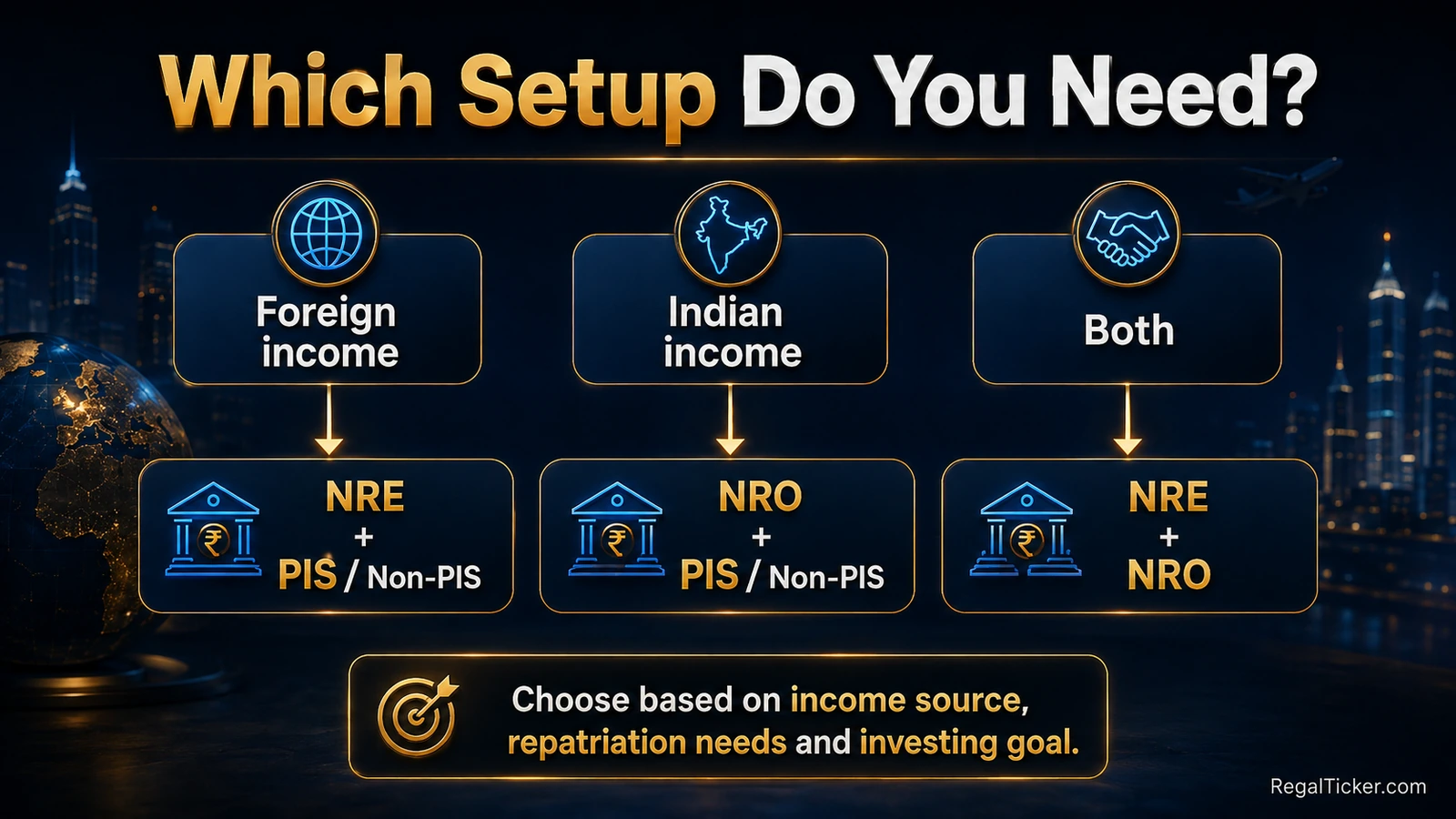
Start with these five questions
- Is the money coming from outside India, from India, or both?
- Do I need the investment and eligible proceeds to remain repatriable?
- Am I buying secondary-market shares, ETFs, mutual funds, IPOs, F&O or more than one product?
- Which PIS/non-PIS combinations does my broker currently support for those products?
- Which bank account will receive sale proceeds and what is required to remit them abroad later?
Scenario: only overseas salary, no Indian income
You may primarily need an NRE account for the repatriable banking side plus the NRI Demat/trading route supported for your intended products.
Do not assume this means NRO is permanently unnecessary. Your situation may change if Indian-source receipts arise later.
Scenario: rent, pension or other Indian receipts
NRO is normally central to managing legitimate Indian rupee income and local expenses. If you invest these funds, choose the NRO-linked investment route supported for the relevant product.
Scenario: both overseas and Indian income
Using both NRE and NRO usually makes the source and repatriation character of money easier to track.
Scenario: only mutual funds
You may not need the same PIS setup used for secondary-market shares. Check the fund/platform onboarding route and whether your country of residence creates restrictions.
Scenario: active F&O trading
Current NSE guidance allows NRI F&O participation from rupee funds held in India on a non-repatriation basis, subject to position limits. Current broker practice commonly uses NRO non-PIS for this purpose.
Tax: NRE vs NRO vs investment income
The account name does not determine the tax rate for every investment made through it.
This is where many comparison articles become misleading.
NRE interest
Current Income Tax Department guidance says the NRE bank-interest exemption has been retained in the Income Tax Act, 2025, subject to FEMA/RBI eligibility.
NRO interest
NRO account income is taxable in India under the applicable rules and withholding framework.
Stock-market gains
Capital gains from shares or other securities are governed by the tax rules applicable to the asset and transaction—not simply by whether the money came from NRE or NRO.
For the detailed NRI layer, including capital gains, TDS and filing, continue to NRI Capital Gains Tax on Indian Shares.
DTAA does not make the account choice irrelevant
A Double Taxation Avoidance Agreement may affect the final cross-border tax position, but it does not replace FEMA banking rules, the correct NRE/NRO classification or the investment-route requirements.
Tax treaty planning and bank routing solve different problems.
Use the calculator
Estimate the Indian listed-equity tax mechanics before a sale
Use the Capital Gains Tax Calculator to understand the basic Indian listed-equity calculation. For an NRI, treat the output as an educational base estimate because actual TDS, DTAA, surcharge, cess, foreign-tax credit and country-of-residence reporting may differ.
Repatriation: the account structure matters most when money needs to leave India
Repatriation is often the reason an NRI should choose the structure before investing.
NRE
RBI describes NRE balances as repatriable. That makes NRE useful where eligible funds should retain a repatriable character.
NRO current income
RBI permits remittance of current income such as rent, dividend, pension and interest subject to the applicable conditions.
Other NRO balances/assets
Eligible NRO balances and qualifying assets can use the RBI remittance facility up to USD 1 million per financial year, subject to the prescribed conditions, documentation and tax compliance.
Why records matter
Keep a clean chain of:
- inward remittance or source-of-funds evidence,
- NRE/NRO statements,
- broker ledger,
- contract notes,
- Demat statements,
- tax/TDS documents,
- sale proceeds,
- and remittance paperwork.
The bank may need these records years after the original investment was made.
Demat and trading accounts still matter
NRE and NRO manage the money. They do not hold your shares or place market orders.
A Demat account holds eligible securities electronically, while the trading account is used through the broker to execute market transactions.
If that distinction is unclear, read:
- What Is a Demat Account?
- What Is a Trading Account?
- Demat Account vs Trading Account vs Bank Account
The complete NRI structure is therefore closer to:
Banking route → Trading account → Demat account → Investment product → Sale proceeds → Tax/repatriation
rather than “open a PIS account and start investing.”
What happens to your old resident bank account after you become NRI?
RBI’s current FAQ is explicit: when a resident Indian becomes a person resident outside India, the existing resident account should be redesignated as an NRO account.
That means someone who has just moved abroad should review the status of:
- savings/current accounts,
- fixed deposits,
- Demat account,
- trading account,
- mutual-fund KYC,
- and other investment relationships.
Do not continue a resident trading setup indefinitely merely because the mobile app still allows login.
NSE also states that when the client category changes between resident and NRI, the trading member needs to open/upload the trading account under the new client category.
What happens when an NRI returns to India?
RBI states that NRE accounts should be redesignated as resident accounts or the funds may be transferred to an RFC account, where eligible, when the account holder returns to India and the residential status changes.
NRO accounts may also be redesignated as resident accounts when the individual returns to India with an intention to stay for an uncertain period.
Your bank, broker, Demat and tax profile should therefore be reviewed again when you become resident. For the complete transition workflow, including NRE/NRO/FCNR changes, RFC accounts, Demat and KYC updates, RNOR/ROR status, foreign assets and your first 90 days after the move, follow RegalTicker’s NRI Returning to India: Investment, Tax & RNOR Checklist.
Investor note
NRI account planning is a lifecycle, not a one-time form
Moving abroad, receiving Indian income, changing country, investing, repatriating funds and returning to India can each require account or KYC updates. Review the structure whenever your residential status or money flow changes materially.
Common NRE, NRO and PIS mistakes to avoid
Mistake 1: treating PIS as a bank account equivalent to NRE/NRO
PIS is an investment-routing scheme/framework. NRE and NRO are banking accounts.
Mistake 2: saying NRE can receive only overseas salary
RBI permits a wider set of credits, provided the money retains the required repatriable character.
Mistake 3: saying NRO can never be repatriated
Current income can be remitted subject to conditions, and eligible balances/assets can access the USD 1 million annual remittance facility.
Mistake 4: assuming every NRI must use PIS for every investment
Different products and current intermediary architectures can use PIS and non-PIS arrangements. Confirm the specific setup.
Mistake 5: assuming non-PIS always means “no repatriation”
Do not infer the repatriation character from the label alone. Broker account categories can include different NRE/NRO non-PIS structures. Confirm the bank funding and withdrawal rules.
Mistake 6: keeping an old resident savings/trading structure after moving abroad
Account status should reflect the change in residential status.
Mistake 7: choosing based only on brokerage cost
Bank reporting fees, PIS charges, repatriation process, product access and tax administration can be more important than a small brokerage difference.
Mistake 8: mixing personal money flows
Keep overseas savings, Indian income, investment proceeds and tax/remittance records traceable.
A practical account-selection checklist
Before opening or changing an NRI investing account
- Confirm your FEMA residential status with the bank/intermediary.
- Identify every source of money: overseas salary, Indian rent, pension, dividend, savings or other receipts.
- Decide whether each investment needs repatriation flexibility.
- Ask the broker which products are supported under NRE-PIS, NRE-non-PIS, NRO-PIS or NRO-non-PIS, if those categories are offered.
- Ask which authorised dealer bank is required for a PIS setup.
- Confirm where dividends, sale proceeds and redemption proceeds will be credited.
- Confirm whether F&O or other segments require an NRO non-PIS route.
- Check bank and broker fees beyond headline brokerage.
- Keep PAN, passport, visa/residence proof and overseas address current.
- Understand Indian tax/TDS before a major sale or remittance.
- Keep contract notes, broker ledgers and bank statements.
- Recheck the setup when you move country or return to India.
Which account is “best” for an NRI?
There is no universally best account.
The best structure is the one that correctly reflects:
source of money + investment product + repatriation goal + tax/compliance needs.
If your money is largely earned abroad and you want eligible funds and proceeds to remain repatriable, an NRE-based banking structure can be important.
If you receive Indian income or need a practical local rupee account, NRO is usually central.
If you buy eligible secondary-market shares through a PIS structure, the designated bank route becomes part of the workflow.
If your broker supports a permitted non-PIS route for the product you need, understand exactly how it is funded and how proceeds are treated before choosing it.
That is the answer a useful NRE-vs-NRO-vs-PIS article should give—not “Account A is always better than Account B.”
Final takeaway
Choose the money account first, then choose the investing route
NRE and NRO answer the money-flow question. PIS and non-PIS answer the investment-routing question. Start by identifying where the money comes from and whether it needs to remain repatriable. Then choose the broker/bank route that supports the products you actually intend to use. A clean structure makes future investing, tax records and repatriation easier to manage.
Frequently asked questions
What is the main difference between NRE and NRO?
NRE is generally used for eligible repatriable non-resident funds, while NRO is commonly used for legitimate rupee income and other permitted funds in India. NRO repatriation follows a different framework.
Is PIS a bank account?
PIS is the Portfolio Investment Scheme, an investment-routing framework used for certain NRI purchases and sales of Indian shares through a designated authorised dealer bank. Banks may maintain a PIS-linked account for the transactions, but PIS should not be treated as a third equivalent to NRE and NRO.
Does every NRI need both NRE and NRO?
No. It depends on the source of funds and how you use money in India. Many NRIs use both because overseas savings and Indian-source receipts are separate money flows.
Can Indian rent be credited to an NRE account?
RBI lists current income such as rent among permissible NRE credits where the money has not lost its repatriable character and the applicable conditions are met. In practice, NRO is commonly used for Indian income because it simplifies local receipts and obligations. Confirm the correct treatment with your authorised dealer bank.
Can an NRE account have a resident joint holder?
RBI permits joint holding with a resident relative on a former-or-survivor basis, subject to the applicable conditions.
Can an NRO account receive money from abroad?
Yes. RBI permits inward remittances from outside India to an NRO account in addition to legitimate dues in India and other permitted credits.
Can NRO money be repatriated?
Current income may be remitted subject to conditions. Eligible NRO balances and certain qualifying assets may also be remitted up to USD 1 million per financial year under the applicable RBI/FEMA framework, subject to documentation and tax compliance.
Is NRE interest tax-free in India?
Current Income Tax Department guidance confirms the exemption for NRE interest has been retained under the Income Tax Act, 2025, with eligibility linked to FEMA/RBI conditions.
Is PIS mandatory for NRI share trading?
NSE continues to describe PIS for NRI exchange investments, while current brokers also offer permitted non-PIS account categories. The exact route depends on the product, repatriation basis, bank and broker setup. Confirm the current route with your provider.
Can NRIs trade futures and options?
NSE says NRIs may participate in the futures and options segment using rupee funds held in India on a non-repatriation basis, subject to SEBI-prescribed limits and broker eligibility. Current brokers commonly use NRO non-PIS setups for this segment.
What happens to my resident savings account when I become NRI?
RBI says the existing resident account should be redesignated as an NRO account when a resident Indian becomes a person resident outside India.
Should I choose NRE or NRO for stock investing?
Choose based on the source of funds, repatriation objective and broker route. NRE may be relevant for eligible repatriable overseas funds, while NRO is central for Indian income and non-repatriation arrangements. The trading route must also support your intended product.
Verify through official sources
Official references
- Reserve Bank of India — Accounts in India by Non-residents
- NSE — FAQs for NRI Trading Account
- SEBI Investor Education — Investments by NRIs in Indian Securities Market
- SEBI — Operational Efficiency in Monitoring NRI Position Limits in Exchange-Traded Derivatives
- Income Tax Department — Non Resident guidance under Income Tax Act, 2025
- ICICI Securities — Current NRI PIS / Non-PIS Account Categorisation
Educational disclaimer: This guide explains NRE, NRO, PIS and non-PIS concepts for education. Banking, FEMA, tax and intermediary procedures can change and may depend on your country of residence, source of funds, product and personal circumstances. Verify material decisions with the relevant RBI-regulated authorised dealer bank, SEBI-regulated intermediary and qualified tax/legal professional before acting.