


⚡ Quick answer
How are mutual funds taxed in India in 2026?
Mutual fund tax in 2026 depends first on the tax category of the fund. Equity-oriented mutual funds can qualify for 20% short-term capital gains tax when sold within 12 months and 12.5% long-term capital gains tax on qualifying gains above the ₹1.25 lakh annual Section 112A threshold when held for more than 12 months. Specified mutual funds covered by Section 50AA—now focused mainly on funds investing more than 65% in debt and money-market instruments—can have gains deemed short-term regardless of holding period for covered units acquired on or after April 1, 2023. Other mutual fund units can follow the general capital-gains framework. IDCW is taxed separately as income in the investor’s hands.
Key takeaways
Classify the fund first; tax cannot be calculated correctly from the fund name alone.
Equity-oriented mutual funds use a 12-month holding-period test for capital-gains classification.
Qualifying equity-fund STCG is taxed at 20% under Section 111A when the required conditions are met.
Qualifying equity-fund LTCG above the ₹1.25 lakh annual Section 112A threshold is taxed at 12.5%.
From April 2026, Section 50AA mainly covers mutual funds investing more than 65% in debt and money-market instruments, plus certain fund-of-funds structures.
Gains on covered specified mutual fund units acquired on or after April 1, 2023 are deemed short-term regardless of holding period.
IDCW is not capital gain; resident investors generally include it in taxable income, and Section 194K TDS can apply.
Every SIP instalment has its own purchase date, so one redemption can contain units with different tax holding periods.
A switch between options or schemes can create a taxable redemption even when the money stays within the mutual fund platform.
Capital losses have their own set-off and carry-forward rules and should not be ignored.
Why Mutual Fund Taxation Became More Complicated in 2026
Mutual fund taxation used to be explained with a simple two-box formula:
Equity fund → equity tax rules.
Debt fund → debt tax rules.
That shortcut is no longer enough.
The modern tax framework contains several layers:
- equity-oriented mutual funds;
- specified mutual funds under Section 50AA;
- other listed mutual fund units;
- other unlisted mutual fund units;
- IDCW income;
- switches;
- SIP instalments purchased on different dates;
- legacy units acquired under older tax rules.
The April 2026 change to the definition of Specified Mutual Fund makes correct classification even more important.
The Income Tax Department’s current Section 50AA defines a specified mutual fund, broadly, as a mutual fund investing more than 65% of its total proceeds in debt and money-market instruments, or a fund investing 65% or more of its proceeds in units of such a fund. The percentage is computed using annual-average daily closing figures.
That means a beginner should not simply read “hybrid”, “gold”, “international”, “debt” or “fund of funds” in the product name and assume a tax rate.
Investor note
Important point
Tax classification and SEBI scheme category are related concepts, but they are not always identical. For tax, use the applicable Income-tax provisions and the fund’s actual qualifying structure—not only the marketing label.
Before this lesson, you should understand Types of Mutual Funds in India, Growth vs IDCW Mutual Funds and Exit Load in Mutual Funds.
Step One: Classify the Mutual Fund Before Calculating Tax
The first tax question is not:
“How much profit did I make?”
It is:
“What kind of mutual fund unit did I sell?”
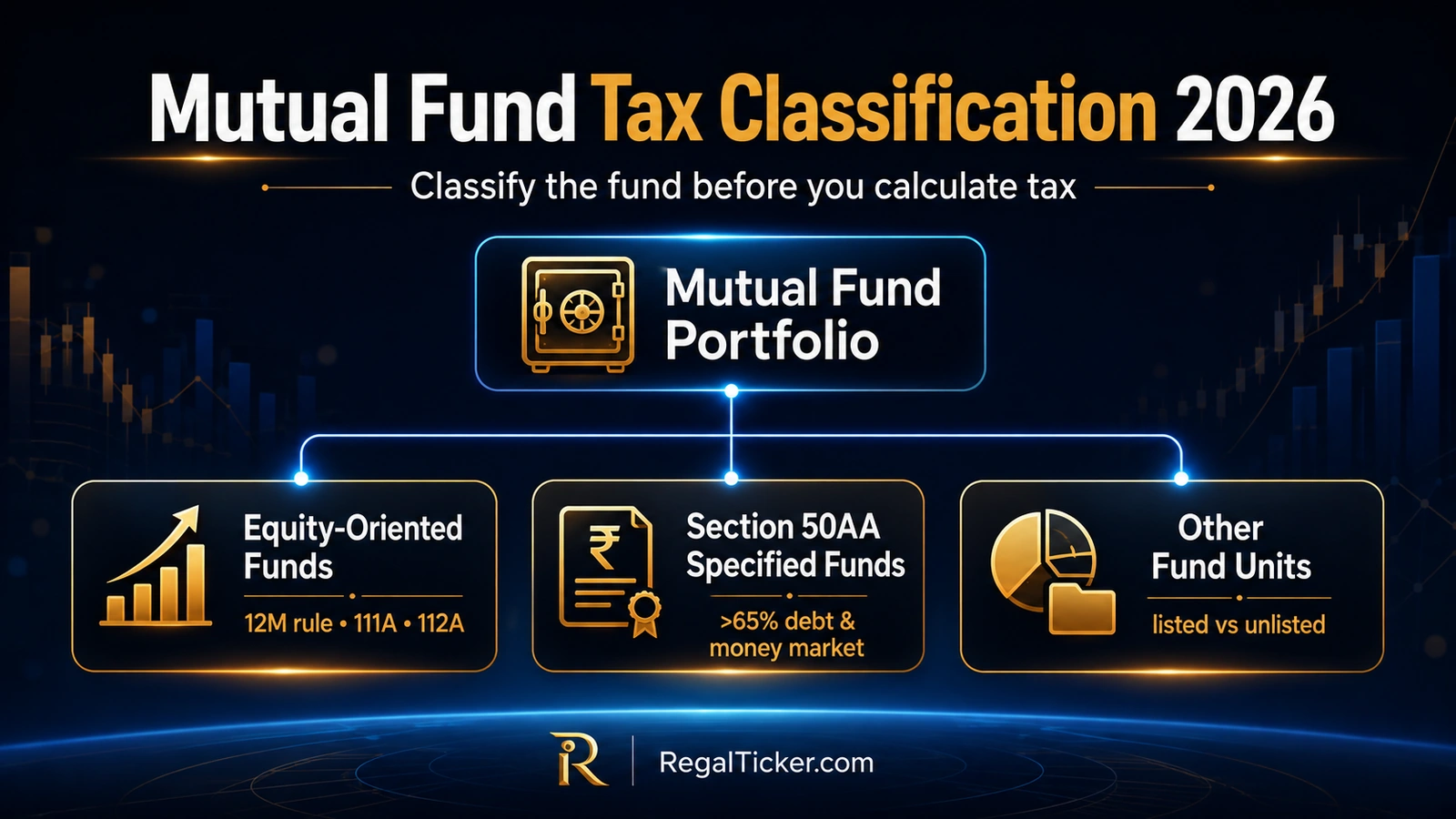
A useful 2026 framework has three broad buckets.
1. Equity-Oriented Mutual Funds
Equity-oriented mutual funds meeting the tax definition can qualify for the special capital-gains provisions under Sections 111A and 112A.
These are the familiar rules involving:
- 12-month holding period;
- 20% qualifying STCG rate;
- 12.5% qualifying LTCG rate above the annual ₹1.25 lakh threshold;
- securities transaction tax conditions.
2. Specified Mutual Funds Under Section 50AA
From April 1, 2026, the definition focuses mainly on:
- a mutual fund investing more than 65% of total proceeds in debt and money-market instruments; or
- a fund investing 65% or more in units of such a fund.
For covered specified mutual fund units acquired on or after April 1, 2023, gains on transfer, redemption or maturity are deemed to arise from a short-term capital asset.
The holding period does not convert such a covered gain into long-term capital gain.
3. Other Mutual Fund Units
Not every non-equity mutual fund is automatically a Section 50AA specified mutual fund.
Some funds can fall into the broader “other units” capital-gains framework.
For transfers on or after July 23, 2024, the Income Tax Department’s current capital-gains guidance shows:
- listed “other units”: generally long-term after more than 12 months;
- unlisted “other units”: generally long-term after more than 24 months.
Long-term capital gains under the general framework are generally taxed at 12.5% without indexation for transfers on or after July 23, 2024, subject to the applicable law and investor circumstances.
Caution
Check this carefully
Do not use a three-year-old blog table for a 2026 mutual fund tax decision. Purchase date, transfer date and the April 2026 Section 50AA definition can materially change the answer.
Equity Mutual Fund Tax in 2026
Equity-oriented mutual funds have the clearest mainstream tax framework.
Short-Term Capital Gains on Equity Mutual Funds
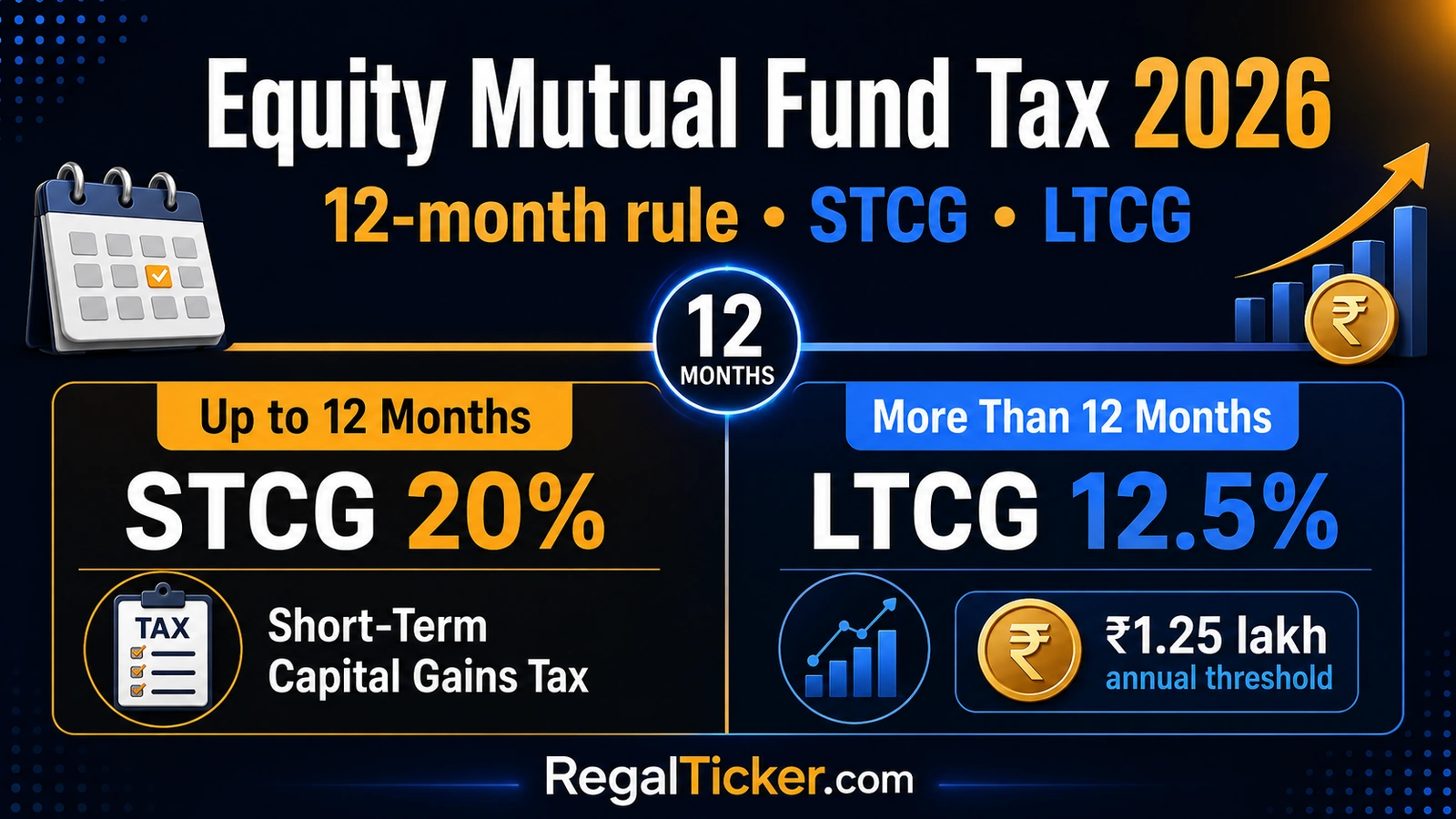
If qualifying equity-oriented mutual fund units are held for 12 months or less, gains can fall under Section 111A when the statutory conditions are met.
For transfers on or after July 23, 2024, the Section 111A rate is 20%.
Surcharge and health and education cess can apply in addition to the base rate.
💡 Real example
Equity fund sold after eight months
An investor puts ₹5,00,000 into an equity-oriented mutual fund and redeems the qualifying units eight months later for ₹5,70,000. The capital gain is ₹70,000. Because the units were held for only eight months, the gain is short-term. If Section 111A conditions are satisfied, the ₹70,000 STCG is taxed at the applicable 20% special rate, plus applicable surcharge and cess.
Long-Term Capital Gains on Equity Mutual Funds
If qualifying units are held for more than 12 months, the gain can fall under Section 112A.
For transfers on or after July 23, 2024:
- qualifying LTCG is taxed at 12.5%;
- the tax applies to the amount of qualifying Section 112A LTCG exceeding ₹1.25 lakh in the financial year.
The ₹1.25 lakh threshold is not “per mutual fund”.
It applies to the aggregate qualifying Section 112A long-term capital gains covered by the provision.
₹3 Lakh LTCG Example
Suppose an investor has total qualifying Section 112A LTCG of ₹3,00,000 in the year.
Threshold:
₹1,25,000
Taxable LTCG:
₹3,00,000 − ₹1,25,000 = ₹1,75,000
Base tax:
₹1,75,000 × 12.5% = ₹21,875
Applicable surcharge and cess can be additional.
💡 Did you know?
The ₹1.25 lakh Section 112A threshold is an annual threshold for qualifying gains, not a deduction that resets for every scheme or redemption.
Debt Mutual Fund Tax and Section 50AA in 2026
This is the section where many online explanations become outdated.
Section 50AA was introduced for specified mutual funds acquired on or after April 1, 2023.
The definition changed with effect from April 1, 2026.
Current 2026 Specified Mutual Fund Definition
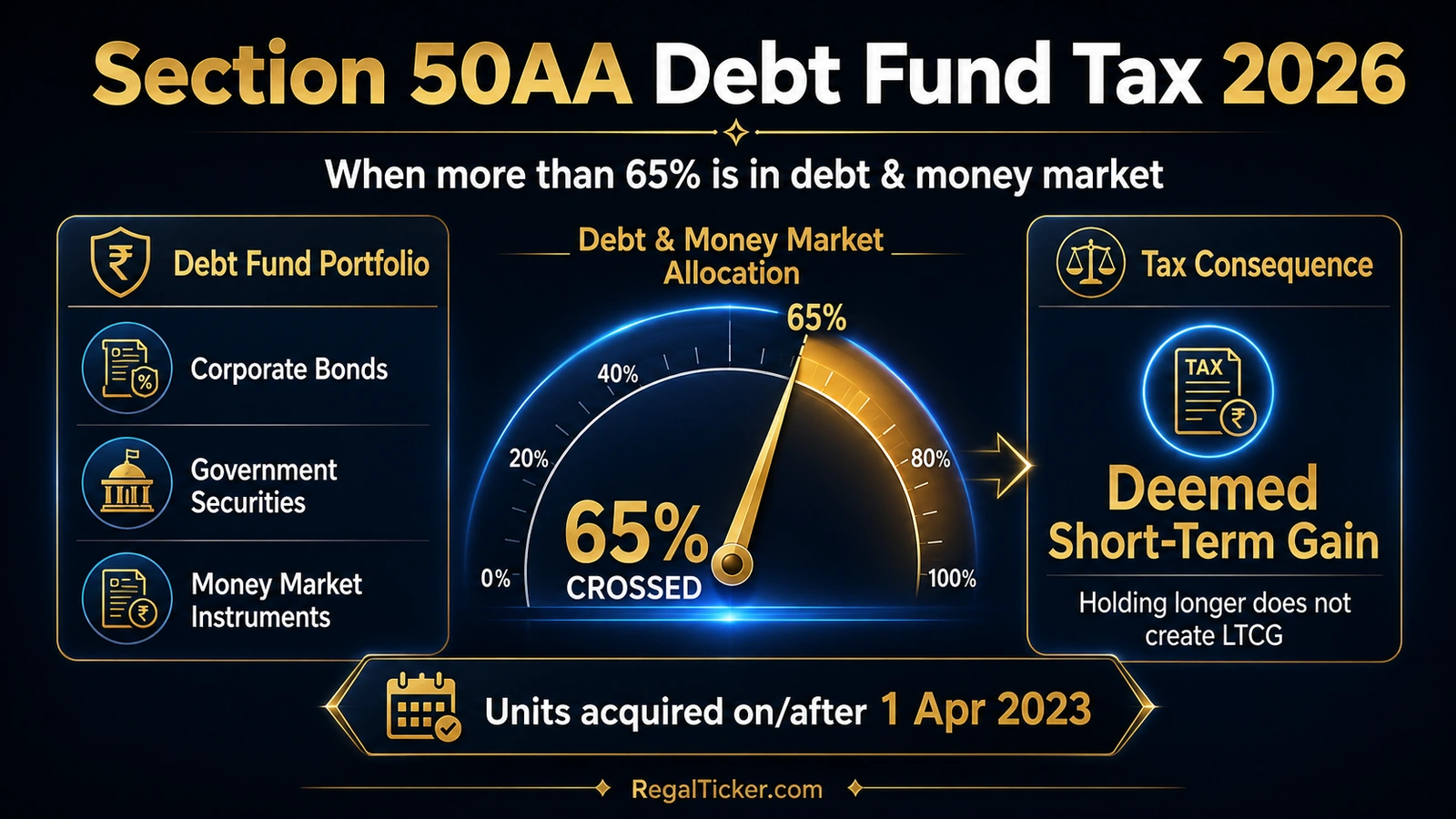
The Income Tax Department’s current Section 50AA text defines a Specified Mutual Fund as, broadly:
- a mutual fund investing more than 65% of its total proceeds in debt and money-market instruments; or
- a fund investing 65% or more of its total proceeds in units of a fund described above.
The percentages are based on the annual average of daily closing figures.
What Section 50AA Does
For covered specified mutual fund units acquired on or after April 1, 2023, capital gains on transfer, redemption or maturity are deemed to arise from a short-term capital asset.
That treatment applies regardless of how long the investor holds the covered units.
In practical terms, a three-year holding period does not automatically turn such a covered debt-oriented mutual fund gain into LTCG.
Debt-Fund Example
Assume an investor bought covered specified mutual fund units after April 1, 2023 for:
₹5,00,000
After three years the units are redeemed for:
₹6,20,000
Capital gain:
₹1,20,000
If Section 50AA applies, the ₹1,20,000 is deemed short-term capital gain despite the three-year holding period.
It is taxed at the assessee’s applicable rate rather than receiving the Section 112A equity-fund concessional treatment.
❌ Myth
If I hold every debt mutual fund for more than two years, the gain automatically becomes LTCG.
✅ Fact
Covered specified mutual funds under Section 50AA can have gains deemed short-term irrespective of holding period.
What About Gold, International, Hybrid and Fund-of-Funds?
This is where broad internet tables can become dangerous.
These funds should not all be placed into one tax bucket.
Hybrid Mutual Funds
An equity-heavy hybrid fund that satisfies the tax definition of an equity-oriented fund can receive equity-fund taxation.
A debt-heavy hybrid fund may fall within Section 50AA if it satisfies the specified-mutual-fund definition.
A hybrid fund that is neither equity-oriented for tax nor a specified mutual fund can fall into the general “other units” framework.
Gold Mutual Funds and Gold ETFs
A gold-oriented product can be structured as:
- an exchange-traded fund;
- an unlisted mutual fund;
- a fund of funds investing in another fund.
The holding-period rule can therefore depend on whether the unit is listed and whether Section 50AA applies.
Do not assume every “gold fund” has the same tax treatment.
International Mutual Funds
International equity exposure does not automatically make a mutual fund “equity-oriented” for Indian tax purposes.
The domestic-equity conditions in the tax definition matter.
Depending on the structure and listing status, an international fund can fall under the general other-unit framework or another applicable provision.
Fund of Funds
A fund of funds requires special attention after April 2026.
Section 50AA expressly includes a fund that invests 65% or more of its proceeds in units of a qualifying specified mutual fund described by the provision.
⭐ Pro tip
Before redeeming a non-equity fund, check the AMC tax note or capital-gains statement and verify the fund’s tax classification for the relevant year. Do not rely only on the category name shown in an investment app.
Other Mutual Fund Units: 12-Month vs 24-Month Holding Period
The Income Tax Department’s current capital-gains guidance separates listed and unlisted “other units” for transfers on or after July 23, 2024.
Broadly:
| Type of Unit | Long-Term Holding Test |
|---|---|
| Listed other mutual fund unit | More than 12 months |
| Unlisted other mutual fund unit | More than 24 months |
| Equity-oriented mutual fund | More than 12 months |
| Specified mutual fund covered by Section 50AA | Gain deemed short-term for covered units, irrespective of holding period |
SIP Taxation: Every Instalment Has Its Own Tax Clock
A SIP is not one single purchase for capital-gains purposes.
Each instalment buys a fresh lot of units on a different date.
That means each lot has its own:
- acquisition date;
- purchase NAV;
- cost;
- holding period;
- capital gain or loss.
Suppose you invest ₹10,000 each month into an equity-oriented mutual fund for two years and then redeem part of the investment.
The oldest units may have crossed the 12-month threshold.
The newer units may still be short-term.
So one redemption can contain both:
- LTCG units; and
- STCG units.
FIFO and Lot Identification
Mutual fund capital-gains statements generally identify the units being redeemed using the applicable lot-order rules, commonly following the first-in-first-out approach within the relevant holding.
The practical lesson is simple:
Do not count the age of your SIP from the date the SIP started.
Count the holding period of each unit lot.
💡 Real example
A 24-month SIP does not make every unit long-term
If your first SIP instalment is 24 months old but your latest instalment is only one month old, the two unit lots do not share the same holding period. A partial redemption can therefore trigger different capital-gains classifications within the same folio.
IDCW Tax in 2026
IDCW stands for Income Distribution cum Capital Withdrawal.
The taxation of IDCW is different from capital gains.
For a resident investor, IDCW income is generally taxable in the investor’s hands at the applicable rate.
This is one reason the choice between Growth vs IDCW Mutual Funds can have a tax-timing impact.
Section 194K TDS
The current Section 194K provides for TDS at 10% on covered income in respect of mutual fund units paid to a resident.
The section also provides that TDS does not apply under it where the relevant aggregate covered income does not exceed ₹10,000 during the financial year.
Capital gains are excluded from Section 194K.
Caution
The ₹10,000 figure is a TDS threshold, not a tax-free IDCW exemption. Final tax liability can still depend on the investor’s applicable tax position.
IDCW Reinvestment Is Still a Distribution
Choosing IDCW Reinvestment does not make the distribution disappear for tax purposes.
A distribution can still be recognised even though the money is used to purchase additional units.
If the investor’s objective is simply long-term accumulation, Growth can be operationally simpler.
Are Mutual Fund Switches Taxable?
A switch can look harmless because no cash enters your bank account.
But tax law looks at the transaction, not only the cash movement.
A normal switch from one scheme or option to another commonly involves:
- redemption or switch-out of the existing units; and
- purchase or switch-in of new units.
The redemption leg can create a capital gain or loss.
This can apply to switches such as:
- one mutual fund scheme to another;
- Regular to Direct;
- Direct to Regular;
- Growth to IDCW;
- IDCW to Growth.
Some specific statutory reorganisations or consolidations can receive different treatment, but an ordinary investor-directed switch should not automatically be assumed tax-free.
⭐ Pro tip
Before switching a large mutual fund holding, calculate three separate effects: exit load, capital gains tax and the future benefit of the destination option.
Use the Capital Gains Tax Calculator for an educational estimate.
Capital Losses: The Tax Rule Many Investors Ignore
Not every mutual fund redemption produces a profit.
Losses can also have tax value.
Under the current capital-loss rules:
- short-term capital loss can generally be set off against short-term or long-term capital gains;
- long-term capital loss can generally be set off only against long-term capital gains;
- unabsorbed capital losses can generally be carried forward for up to eight assessment years, subject to the applicable filing requirements.
Capital losses cannot simply be used against salary income.
Why timely filing matters
The Income Tax Department’s current guidance states that carrying forward capital losses generally requires filing the return of income/loss on or before the applicable due date, subject to the law and any permitted relief.
Investor note
A tax statement showing a mutual fund loss is not useless paperwork. Preserve transaction records and capital-gains statements because the loss may affect current or future capital-gains tax.
Mutual Fund Tax and Exit Load Are Separate
Tax and exit load are often confused because both can reduce what the investor ultimately keeps.
But they are not the same.
Exit load is a scheme-level redemption charge under the fund’s terms.
Capital-gains tax is an investor-level tax consequence under income-tax law.
A redemption can have:
- exit load but no taxable gain;
- taxable gain but no exit load;
- both;
- neither.
💡 Real example
Simple example
You invest ₹1,00,000.
You redeem at ₹98,000 within an exit-load period.
The fund can potentially apply an exit load according to its scheme terms, yet you may also have a capital loss rather than a capital gain.
Tax analysis and exit-load analysis must therefore be performed separately.
Read Exit Load in Mutual Funds for the full load calculation.
Mutual Fund Tax and Expense Ratio Are Also Separate
Expense ratio is already reflected in scheme NAV.
Capital-gains tax is calculated when the relevant taxable transaction occurs.
You should not add the expense ratio to your capital gain as though it were a separate investor-paid annual tax.
Similarly, do not subtract the current expense ratio again from a published NAV-based return before calculating historical performance.
Read Expense Ratio in Mutual Funds for the detailed cost framework.
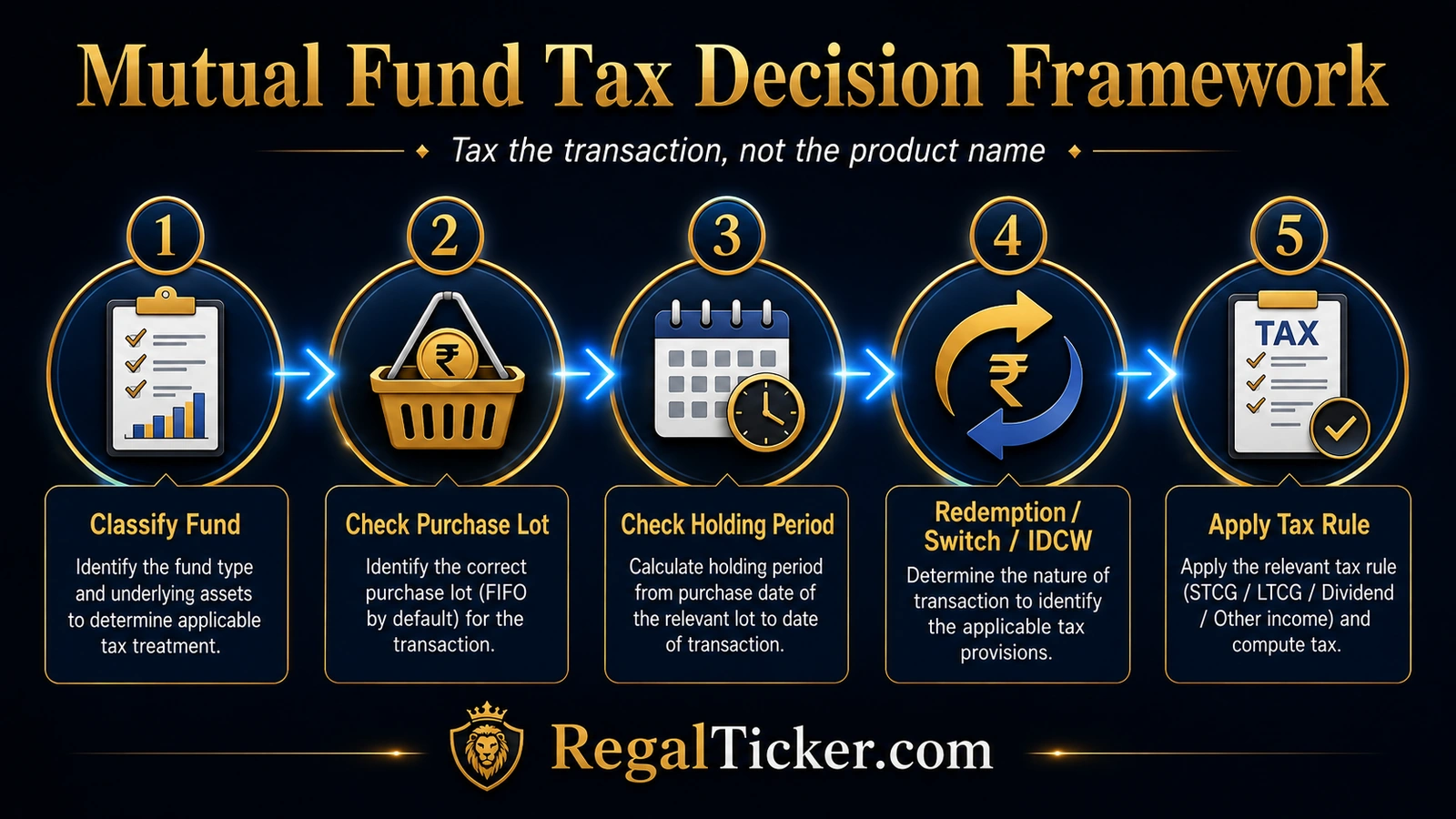
A Practical 2026 Mutual Fund Tax Decision Framework
Use this sequence before trying to calculate the tax.
1
Identify the fund
Equity-oriented, Section 50AA specified mutual fund, or other units?
2
Check purchase date
Rules can differ for older and newer unit lots.
3
Check transfer date
Current capital-gains rates and holding-period rules depend on the transfer date.
4
Check listing
Listed and unlisted other units can have different holding-period tests.
5
Measure holding period
For SIPs, test each purchase lot separately.
6
Identify transaction
Redemption, switch, IDCW or another event?
7
Calculate gain or loss
Sale/redemption value minus applicable cost and eligible transfer expenses.
8
Apply the correct section
Section 111A, 112A, 50AA or general capital-gains rules.
9
Check losses
Set-off or carry-forward may change the final taxable amount.
10
Add surcharge and cess
The base tax rate may not be the final tax payable.
Worked Examples: Four Different Mutual Fund Tax Outcomes
Example 1: Equity Fund Sold Within 12 Months
Investment cost: ₹4,00,000
Sale value after eight months: ₹4,60,000
Gain: ₹60,000
If Section 111A conditions are satisfied:
STCG rate: 20%
Base tax:
₹12,000
plus applicable surcharge and cess.
Example 2: Equity Fund Held for More Than 12 Months
Investment cost: ₹8,00,000
Sale value: ₹11,00,000
Qualifying LTCG: ₹3,00,000
Annual Section 112A threshold: ₹1,25,000
Taxable portion:
₹1,75,000
Base tax at 12.5%:
₹21,875
plus applicable surcharge and cess.
Example 3: Section 50AA Specified Mutual Fund
Cost: ₹7,00,000
Redemption after four years: ₹8,50,000
Gain: ₹1,50,000
If the units are covered by Section 50AA:
The gain is deemed short-term despite the four-year holding period.
The applicable investor rate is then used rather than the Section 112A equity LTCG treatment.
Example 4: Unlisted “Other Unit” Held Beyond 24 Months
Assume a mutual fund unit:
- is not equity-oriented for tax;
- is not covered as a Section 50AA specified mutual fund;
- is unlisted;
- is transferred after July 23, 2024;
- has been held for more than 24 months.
It can fall into the long-term “other unit” framework, with the general current LTCG rate of 12.5% without indexation, subject to the applicable law.
The exact fund structure must be verified before using this result.
Common Mutual Fund Tax Mistakes
Mistake 1: Assuming all non-equity funds are taxed identically
The 2026 Section 50AA definition makes this especially dangerous.
Mistake 2: Using the SIP start date for every unit
Every instalment has its own acquisition date.
Mistake 3: Treating the ₹1.25 lakh threshold as per fund
The Section 112A threshold applies to aggregate qualifying gains covered by that provision.
Mistake 4: Assuming no TDS means no tax
TDS is only a collection mechanism.
Mistake 5: Treating a switch as tax-free
A normal switch can involve a taxable redemption.
Mistake 6: Confusing IDCW with capital gains
IDCW is taxed under a different income framework.
Mistake 7: Ignoring capital losses
Losses can affect current and future capital-gains tax.
Mistake 8: Using an outdated debt-fund definition
The Section 50AA definition changed from April 1, 2026.
Mistake 9: Applying the equity 12-month rule to every mutual fund
Some other units can use a 24-month test when unlisted, while Section 50AA can override holding-period treatment entirely for covered units.
Mistake 10: Forgetting surcharge and cess
A base tax calculation is not always the final tax payable.
RegalTicker Calculators for Mutual Fund Tax Planning
Use the Capital Gains Tax Calculator to estimate taxable gains.
Then combine it with:
- SIP Calculator for accumulation scenarios;
- Lumpsum Calculator for one-time investments;
- SWP Calculator for planned withdrawals;
- CAGR Calculator for annualised growth;
- XIRR Calculator for dated cash flows.
Investor note
Use Tax Calculators as Estimates
Tax calculators are educational tools. A correct result still depends on accurate fund classification, unit purchase dates, transaction dates, investor status, capital losses, surcharge, cess and the tax law applicable to the transaction. Verify the fund category and current tax rules before relying on the calculation.
Mutual Fund Tax Checklist Before Redemption
Before redeeming or switching, confirm:
- I know the exact tax category of the fund.
- I checked whether Section 50AA applies.
- I know the acquisition date of the units being redeemed.
- For SIP investments, I checked each lot separately.
- I know whether the units are listed or unlisted where relevant.
- I calculated the capital gain, not just the redemption amount.
- I checked the Section 112A annual threshold where applicable.
- I checked whether IDCW income is involved.
- I checked exit load separately from tax.
- I checked whether I have capital losses available for set-off.
- I reviewed the AMC capital-gains statement.
- I preserved the transaction statement and tax records.
- I included surcharge and cess where applicable.
- I verified current official rules before taking a large tax-sensitive action.
Frequently asked questions
How are equity mutual funds taxed in 2026?
Qualifying equity-oriented fund gains held for 12 months or less can be taxed at 20% under Section 111A when the statutory conditions are met. Qualifying gains held for more than 12 months can be taxed at 12.5% under Section 112A on the amount above the ₹1.25 lakh annual threshold, subject to applicable conditions.
What is the LTCG exemption limit for equity mutual funds?
Section 112A currently provides a ₹1.25 lakh annual threshold for aggregate qualifying long-term capital gains covered by that provision.
Is the ₹1.25 lakh LTCG threshold available separately for every mutual fund?
No. It is an aggregate annual threshold for qualifying gains covered by Section 112A, not a separate threshold for every fund.
What is the STCG tax rate on equity mutual funds?
For qualifying transfers on or after July 23, 2024, Section 111A provides a 20% rate when the required conditions are satisfied.
How are debt mutual funds taxed in 2026?
Debt-oriented funds covered by the current Section 50AA specified-mutual-fund definition can have gains on covered units acquired on or after April 1, 2023 deemed short-term regardless of holding period and taxed at the applicable investor rate.
What changed in Section 50AA from April 2026?
The specified-mutual-fund definition now mainly covers funds investing more than 65% in debt and money-market instruments and certain funds investing 65% or more in such funds.
Are all non-equity mutual funds taxed at slab rates?
No. Some non-equity funds can fall into the general “other units” capital-gains framework rather than Section 50AA. Classification, listing and holding period must be checked.
What is the holding period for other mutual fund units?
Under current guidance for transfers on or after July 23, 2024, listed other units generally use a 12-month long-term test and unlisted other units generally use a 24-month test, unless another provision such as Section 50AA applies.
Is IDCW taxable?
Yes. For resident investors, IDCW income is generally taxable at the applicable rate in the investor’s hands.
What is the TDS rule on IDCW?
Section 194K currently provides for 10% TDS on covered income to a resident, subject to the ₹10,000 annual threshold and other conditions. Capital gains are excluded from Section 194K.
Is a mutual fund switch taxable?
A normal investor-directed switch commonly involves a redemption and new purchase, so the redemption leg can create capital gains or losses.
Is switching from Regular to Direct taxable?
It can be, because a normal switch can involve redemption of the existing units and purchase of the new plan units. Verify the exact transaction and applicable rules.
How is SIP tax calculated?
Each SIP instalment is a separate purchase lot with its own acquisition date, cost and holding period. A single redemption can therefore contain both short-term and long-term units.
Can mutual fund capital losses be carried forward?
Subject to applicable filing rules, unabsorbed capital losses can generally be carried forward for up to eight assessment years. Short-term capital loss can generally offset STCG or LTCG, while long-term capital loss can generally offset only LTCG.
Is exit load deductible from mutual fund tax?
Exit load and capital-gains tax are different concepts. The actual capital-gain computation should use the transaction values and eligible transfer expenses according to tax law; do not treat exit load and tax as the same charge.
Is expense ratio deductible when calculating mutual fund capital gain?
Expense ratio is already reflected through the scheme’s NAV and is not normally added again as a separate investor-level annual deduction in the capital-gains calculation.
Are gold mutual funds taxed like debt mutual funds?
Not automatically. Tax depends on product structure, listing status and whether the fund falls within Section 50AA or the general other-unit rules.
Are international mutual funds taxed like Indian equity mutual funds?
Not automatically. Domestic-equity conditions matter for the tax definition of an equity-oriented fund, so international funds must be classified carefully.
Should I use the AMC capital-gains statement?
Yes. It is a useful starting point for unit-level dates, costs and gains, but the investor remains responsible for applying the correct tax law and reconciling the return.
Can mutual fund tax rules change again?
Yes. Tax rules, rates, definitions and thresholds can change through Finance Acts and other amendments. Verify the current official position for the year of redemption.
Final Summary
Mutual fund tax in 2026 cannot be reduced to one rate.
The reliable sequence is:
- classify the fund;
- identify the purchase lot;
- measure the holding period;
- determine whether Section 111A, 112A, 50AA or the general capital-gains framework applies;
- separate IDCW from capital gains;
- separate exit load from tax;
- account for capital losses;
- verify the current official rules.
For equity-oriented mutual funds, the 12-month distinction remains central.
For specified mutual funds, the April 2026 Section 50AA definition is now essential.
And for SIP investors, every instalment carries its own tax clock.
The biggest tax mistake is not choosing the “wrong tax-saving strategy”.
It is applying the wrong rule to the wrong mutual fund.
Verify through official sources
Official references
Educational disclaimer: This article is for education and general information only. It is not tax, legal, investment or financial advice. Tax treatment depends on the exact mutual fund structure, acquisition date, transfer date, listing status, residential status, income level, losses, surcharge, cess and other facts. Tax law can change. Verify the latest Income Tax Department, SEBI, AMFI and AMC disclosures or consult a qualified tax professional before taking a material tax-sensitive action.