


One heavyweight changed the mood on Dalal Street
The most important number in Monday’s rally was not simply the Nifty’s closing gain. It was how much of that gain came from Reliance Industries.
Reliance closed at ₹1,300 on the NSE on 2 November 2026, up 11.6% from ₹1,164.90 in the previous session. Reuters described it as the stock’s strongest day since April 2020. The move followed a September-quarter earnings release that gave investors a reason to reassess the group’s profitability.
That reassessment travelled through the benchmarks. Nifty 50 rose 387.70 points to 23,440.80, while Sensex gained 1,233.25 points to 75,692.78. Reported contribution estimates put Reliance behind roughly half of the Nifty’s advance and an even larger share of the Sensex’s gain.
For market bulls, the attraction was the combination of a heavyweight earnings surprise and an improving oil backdrop. For investors looking beyond one session, the harder questions remain: which earnings can last, how much investment they require, and whether the rest of the market can carry more of the recovery.
⚡ Quick answer
Why did Reliance shares rally so sharply?
Strong oil-to-chemicals earnings and continued Jio growth gave buyers a firmer operating story, while lower crude prices supported sentiment toward India more broadly. Reliance’s large index presence magnified the effect on Nifty and Sensex. Retail profitability remained a weaker part of the results, so the rally should not be read as evidence that every business concern has disappeared.
Key takeaways
Reliance closed at ₹1,300 on the NSE, up 11.6%, after its September-quarter earnings release.
Rounded contribution estimates imply about 51% of Nifty’s net point gain and 62% of Sensex’s came from Reliance.
Oil-to-chemicals supplied the largest operating-growth impulse, while Jio added a second earnings stream.
Profit attributable to Reliance shareholders and the wider group profit measure use different bases and growth rates.
Retail’s weaker earnings and the group’s investment requirements remain relevant after the share-price jump.
A heavyweight-led rally can coincide with improving breadth; the two observations should be examined separately.
Investor note
A strong earnings reaction is the start of the valuation question
Monday shows that investors were willing to pay more for Reliance after the results. It does not establish a fair price for a particular investor or prove that the next quarter will repeat the same operating conditions. The analysis below separates disclosed performance from interpretation and the conditions that would strengthen or weaken the case.
How Reliance gave the bulls so much index power
Moneycontrol reported that Reliance contributed about 198 points to Nifty and 762 points to Sensex. Dividing those rounded estimates by each benchmark’s net daily gain gives the comparison below.
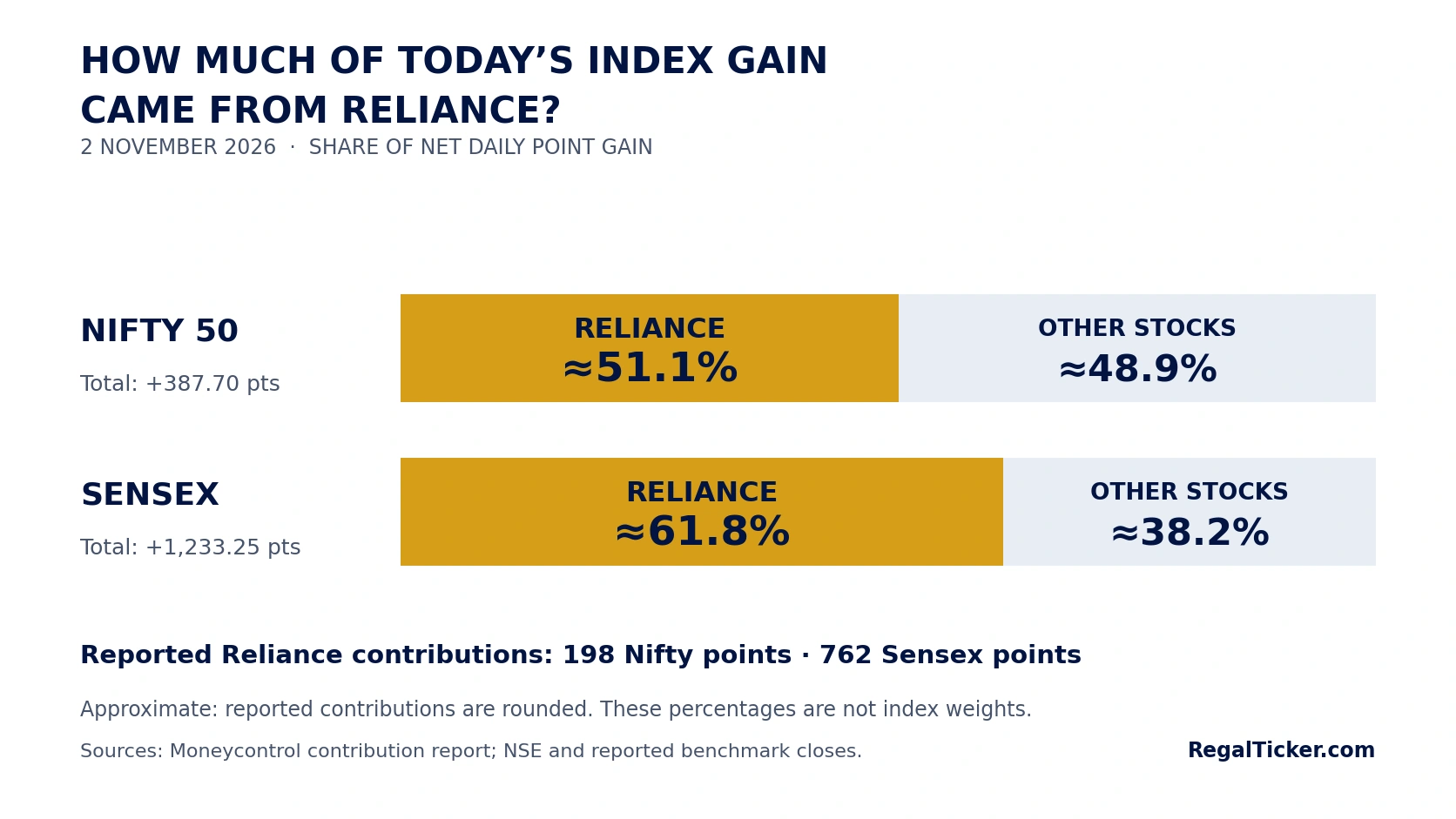
The chart describes Reliance’s estimated share of that day’s net point gain. It does not show the stock’s weight in either index, the percentage of investors buying it, or a suggested portfolio allocation. The other stocks’ portion is their combined net contribution, after gains and losses offset one another.
The mechanics are straightforward. In an index weighted by free-float market value, a large constituent can exert much more influence than a smaller one. A substantial move in that heavyweight can therefore make the benchmark look stronger than an equally weighted basket of shares.
That influence can also change how the market feels. A heavyweight moving decisively after results gives traders a visible earnings story around which to organise the session. That is a reasonable interpretation of Monday’s price action; it is not proof that every buyer shared the same motive.
There is an equally important limit to the calculation. Subtracting Reliance’s reported contribution from the day’s index gain would be an arithmetic decomposition, not a forecast of where the market would have traded without it. Prices, positioning and sentiment interact.
What changed in Reliance’s earnings story
The results released on October 30 contained two profit figures that deserve careful labelling. Net profit attributable to owners of Reliance Industries was ₹25,548 crore, against ₹18,165 crore a year earlier—growth of about 40.6%.
The wider group profit after tax, including the share of associates and joint ventures, was ₹29,550 crore, up 33.8%. This measure also includes profit attributable to non-controlling interests. Using the shareholder profit figure with the group growth rate would mix two different comparisons.
The operating figures help explain where the confidence came from:
| Q2 FY27 measure | Reported amount | Year-on-year change |
|---|---|---|
| Group EBITDA | ₹62,409 crore | +23.9% |
| Oil-to-chemicals EBITDA | ₹25,203 crore | +67.9% |
| Jio Platforms EBITDA | ₹21,879 crore | +16.6% |
| Retail EBITDA before one-time impairment | ₹6,228 crore | −8.6% |
These measures have different scopes. The subsidiary and segment amounts should not be added on top of group EBITDA. Retail’s row is specifically the measure before its one-time impairment charge.
EBITDA describes earnings before interest, tax, depreciation and amortisation. It is useful for comparing operating performance, but it is not the cash available to equity holders. Finance costs, tax, investment and working-capital needs still matter.
The company-analysis checklist provides a way to connect those items rather than stopping at the headline profit-growth rate.
O2C and Jio strengthened the case in different ways
Refining strength brought a cyclical earnings lift
Reliance’s release attributed the oil-to-chemicals improvement to stronger transportation-fuel cracks and downstream petrochemical margins. It also identified higher crude premiums, freight and other costs as offsets.
The key relationship is between the value of products sold and the full cost of producing and delivering them. A refinery can benefit when product margins widen even while crude itself is expensive. Its earnings then depend on how much of that margin it can capture through sourcing, operations and its product mix.
This helps explain why stronger Reliance results and falling crude could support the market together. The results described a completed quarter’s operating performance. Monday’s oil move changed expectations about the macro backdrop. Those are different time horizons.
The India refining and Jamnagar analysis explains the industrial economics. For the bull case, the question is how much of the unusually favourable margin environment can be sustained. If product tightness eases, analysts will need to reassess the earnings that belong in a normal year.
Jio offered another source of earnings
Jio’s disclosed growth came from subscriber additions, revenue per user and operating leverage. Its customer base reached 542.4 million, while monthly average revenue per user was ₹218.80.
The operating questions here differ from refining. Investors need to judge customer economics, network investment and the conversion of revenue growth into cash, rather than assuming that the energy cycle determines the entire group’s prospects.
Jio’s separate stock-market listing also makes it important to distinguish the subsidiary’s value from Reliance’s economic interest in it. The Jio Platforms background article offers the earlier listing context. A group valuation needs consistent assumptions about ownership, debt and the other businesses; counting the same subsidiary value twice would inflate the conclusion.
Retail and investment spending keep the debate open
Retail’s top line grew, but its profitability did not follow the same direction. The release reported a 7.8% EBITDA margin before impairment, down 120 basis points year on year. A basis point is one-hundredth of a percentage point, so that represents a 1.2-percentage-point change.
Management pointed to digital-commerce investment, cost absorption and the shift of the festive calendar into the third quarter. Those explanations are relevant, but they also create a test for future results: whether revenue growth translates into stronger operating earnings as the investment and calendar effects evolve.
The broader group’s capital expenditure was ₹38,153 crore for the quarter, excluding spectrum. That spending supports future capacity and services, while also requiring financing and eventual returns.
A useful shareholder analysis follows operating cash flow through working capital and capital expenditure before arriving at a view on cash generation. Subtracting the capex figure directly from EBITDA would skip several important items and would not produce a valid free-cash-flow calculation.
This is where a convincing growth story can still become a demanding valuation. Better earnings help; the price paid for those earnings and the capital needed to sustain them remain part of the same decision.
Was Monday a broad bull-market signal?
The rally was not confined to Reliance. The exchange snapshot showed 38 Nifty 50 constituents rising and 12 falling. Nevertheless, Bank Nifty gained only 0.58%, compared with Nifty 50’s 1.68%.
That combination supports a measured reading. Participation improved, while the benchmark’s strongest impulse still came from a particular heavyweight. Neither observation cancels the other.
Reuters’ session coverage also cited easing crude and expectations around possible equity-tax relief as supporting factors. The tax story concerned reported recommendations, rather than an enacted change. It should not be treated as a new rule when calculating investment returns.
For India, sustained oil relief could improve the outlook for import costs and some corporate margins. The Hormuz and crude-oil explainer sets out why that channel remains exposed to negotiations and shipping conditions. A change in headlines can move the market faster than it changes the physical supply situation.
The next stage of a stronger recovery would be easier to assess if more earnings streams contributed to it. Banks, consumer businesses and smaller companies need to be examined on their own evidence, rather than assumed to inherit Reliance’s improvement.
The diversification guide is relevant here: an investor can own several securities and still depend heavily on one business cycle, sector or market factor.
The tests that matter after the celebration
Can energy earnings hold up under less exceptional conditions? Investors should examine product margins, operating reliability and the assumptions used to normalise profits across a cycle. A strong quarter raises the evidence base; it does not remove cyclicality.
Can retail growth produce better earnings? Future disclosures need to show whether the current investment phase and calendar effects give way to stronger cash and profit conversion. Revenue alone will not answer that question.
Does Jio’s operating growth translate into shareholder value? Customer growth and usage matter, alongside the cost of serving that demand and the economic interest retained by Reliance.
Does the wider market contribute more? A rally would have broader support if other large sectors added their own earnings evidence. Heavyweight leadership is helpful, but relying on one company leaves the index sensitive to that company’s next disappointment.
For an existing holding, the stock-return calculator can separate a one-day headline return from the return on an investor’s actual purchase price and holding period. For a proposed trade, the risk-reward calculator makes the assumed upside and downside explicit. Neither tool supplies a forecast.
Investor note
The market’s return and your return are different records
Use the correct exchange, purchase price, dates and corporate-action adjustments when reviewing a holding. A headline daily gain does not describe an investor’s personal profit. If a security has undergone a demerger, acquisition-cost records need their own adjustment; the related calculator below serves that separate bookkeeping task.
Frequently asked questions
Why did Reliance Industries rally on 2 November 2026?
The market reacted strongly to its September-quarter earnings, with O2C and Jio supplying operating support. An easing oil backdrop helped sentiment toward Indian equities more broadly.
Did Reliance account for half of Nifty’s gain?
Reported rounded contribution estimates imply a little over half of the Nifty’s net daily point gain. That is a share of one day’s movement, not Reliance’s index weight.
Why are there two different profit-growth figures for the quarter?
Profit attributable to Reliance shareholders and the wider group profit measure cover different ownership bases. Each amount should be compared with its matching prior-year figure.
Does this rally confirm a new bull market?
One session cannot establish that on its own. Earnings durability, valuation, broader participation and the external environment need continued assessment.
Is the 11.6% gain a recommendation to buy?
No. It records the session’s share-price move. The appropriate decision depends on the business assessment, valuation, concentration and the investor’s circumstances.
Verify through official sources
Official references
- NSE — Security-wise price, volume and deliverable report — RELIANCE, EQ series, dated 2 November 2026: closing price ₹1,300 and previous close ₹1,164.90; daily return calculated from those prices.
- NSE — Daily index closing report — Official November 2 Nifty 50 closing level, point gain and return, and the Bank Nifty comparison.
- NSE — Index snapshot — November 2 snapshot used for the Nifty 50’s named-index constituent breadth; this is not an entire-exchange advance-decline total.
- Reliance Industries — Q2 FY27 financial and operating release — October 30 release and accompanying financial statements: owners’ profit, group profit, segment and subsidiary measures, retail margin, capex and Jio operating data.
- Reliance Industries — Results presentation transcript — Management’s explanations of refining, feedstock flexibility, digital services and retail investment; forward-looking views remain management views.
- Moneycontrol — Reliance’s index-point contribution — Rounded reported Reliance contributions of 198 Nifty points and 762 Sensex points; percentage shares in the article are derived estimates.
- Reuters — Reliance and the Indian market close — Reported Sensex closing level and gain, Reliance’s strongest session since April 2020, and the wider oil and policy-sentiment backdrop.
- Upstox — November 2 market wrap — Independent corroboration of the benchmark closes and Reliance’s closing percentage move.
Educational disclaimer: This article provides financial information and investor education, not personalised investment or tax advice or a recommendation to buy, sell or hold a security. Company earnings, market prices and reported contribution estimates must be assessed with their dates, definitions and limitations. Consider valuation, liquidity, diversification and your circumstances before making an investment decision.
Final takeaway
Reliance gave bulls an earnings argument; the next results must sustain it
Monday’s move had a business foundation as well as an index effect. Investors responded to stronger operating earnings, and Reliance’s size amplified the result across Nifty and Sensex. The useful follow-up is to test the durability of those earnings, the returns on continuing investment and the participation of other businesses in the market recovery. That evidence will matter longer than the celebration of a single session.


