

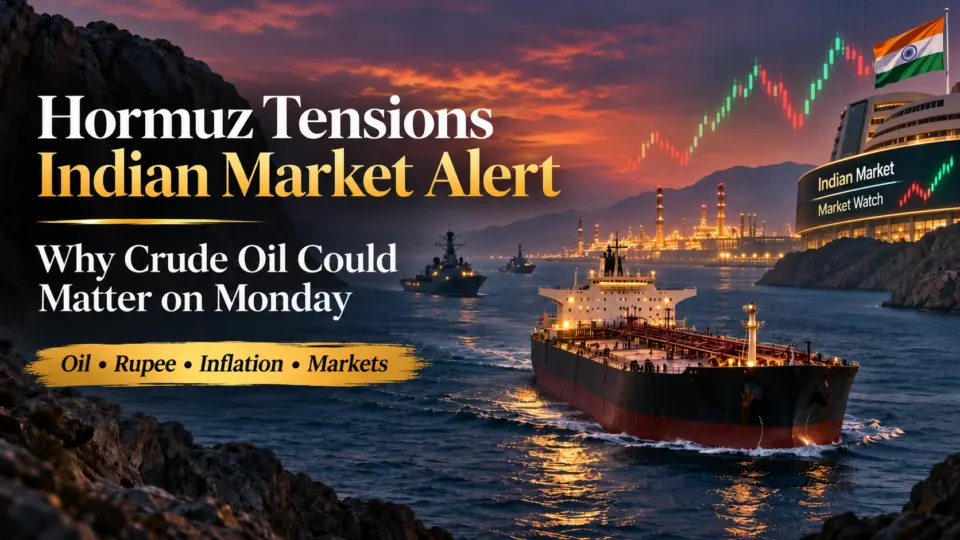
This is not just a Middle East headline for Indian investors
On Sunday, the UK Maritime Trade Operations issued a verified warning after receiving a report from Indian Shipping Authorities of an attack on a tanker eastbound before entering the Strait of Hormuz. The crew was reported safe, but the warning was enough to remind markets that Hormuz remains one of the world’s most sensitive energy chokepoints. For India, that matters immediately. When investors see fresh risk around Hormuz, the market usually starts thinking through the chain reaction: crude oil, the rupee, inflation, RBI expectations and sector rotation across the equity market. Monday’s open will not depend on headlines alone, but this is the kind of geopolitical development that can quickly become an Indian market story.
⚡ Quick answer
Why should Indian investors care about Hormuz right now?
Because the Strait of Hormuz is critical to global oil and LNG flows, and India remains heavily dependent on imported crude oil. A renewed security risk near Hormuz can raise the oil risk premium even before a full supply disruption occurs. That can affect Indian inflation expectations, the rupee, oil marketing companies, paint and aviation stocks, and the broader market mood at the start of the week.
Key takeaways
UKMTO issued a verified warning on 15 November after a reported tanker attack prior to entering the Strait of Hormuz.
The Strait of Hormuz is one of the world’s most important oil chokepoints.
EIA estimates that about 20.9 million barrels per day of oil flowed through Hormuz in 1H25.
EIA also says Asian markets are the biggest destination for Hormuz crude flows, with India among the top destinations.
Official PPAC data shows India remains highly dependent on imported crude oil.
An RBI Bulletin study suggests a 10% rise in global crude oil prices could add roughly 20 basis points to inflation.
For Indian equities, the first market transmission channels are crude, the rupee, inflation expectations and sector-level margin risk.
Investor note
Watch the transmission chain, not just the headline
The most common mistake in geopolitical market coverage is stopping at the event. Investors usually benefit more by following the transmission chain. If Hormuz risk pushes crude meaningfully higher, the next questions are whether the rupee weakens, whether inflation expectations reprice, whether RBI-rate expectations shift and which sectors gain or lose from that sequence.
1. What happened on Sunday
The fresh trigger came from UK Maritime Trade Operations. In Warning 205-26, UKMTO said it was aware of a report by Indian Shipping Authorities of an attack on a tanker while transiting through the Arabian Gulf eastbound prior to entering the Strait of Hormuz. The crew was accounted for and safe, while the damage assessment and environmental impact were still unknown at the time of the warning.
That matters because Hormuz is not an abstract geopolitical map point. It is an active shipping artery, and even a limited incident can change how traders think about risk, insurance, freight and near-term energy prices.
Reuters also reported that Gulf markets fell on Sunday as traders weighed disruption in the Strait of Hormuz together with wider regional tensions. For Indian investors, that is a reminder that the story is already being priced as a market event rather than as a distant diplomatic headline.
2. Why the Strait of Hormuz matters so much
The U.S. Energy Information Administration describes the Strait of Hormuz as one of the world’s most important oil chokepoints.
According to EIA, total oil flows through the strait averaged 20.9 million barrels per day in the first half of 2025, equal to about 20% of global petroleum-liquids consumption and roughly one-quarter of total global maritime traded oil. EIA also notes that alternatives can move only a portion of those volumes if Hormuz faces a serious disruption.
That is the global context behind why even a single verified warning can matter for markets.
3. Why India is especially exposed
India is not exposed to Hormuz because of headline sensitivity alone. It is exposed because energy import dependence remains structurally high.
PPAC’s official published data shows India continues to rely heavily on imported crude oil, with import dependency remaining in the high-80% range on a consumption basis in recent years. That means India is more vulnerable than a domestic-energy-heavy economy to any sharp increase in crude prices or shipping disruptions.
There is also a direct Asia link. EIA estimates that 89% of the crude oil and condensate moving through Hormuz in 1H25 went to Asian markets, with China, India, Japan and South Korea accounting for most of the major destinations.
In other words, this is not only a Gulf-market story. It is an Asia story, and India sits inside that transmission channel.
4. The first thing Indian markets will watch: crude oil
The fastest transmission mechanism is crude itself.
A geopolitical event does not need to shut Hormuz to move oil prices. Sometimes a higher security risk premium is enough. Traders start pricing a greater chance of disruption, tighter freight availability, longer routing, higher insurance costs or retaliatory escalation.
If crude moves higher, Indian market participants usually start repricing a familiar set of implications: oil-import costs, current-account concerns, inflation sensitivity and pressure on sectors where fuel is a direct cost input.
This is why Monday’s market conversation is likely to begin with crude, even before any broader macro discussion starts.
5. The second market channel: rupee and inflation expectations
The next link is macro.
The RBI Bulletin paper “Revisiting the Oil Price and Inflation Nexus in India” says a 10% rise in global crude oil prices could increase inflation by around 20 basis points. The same paper also notes that rising crude import dependence can have inflationary consequences over time.
For Indian investors, that matters in two ways.
First, higher oil can pressure the rupee by worsening the import bill. Second, higher inflation sensitivity can influence how the market thinks about future interest rates, bond yields and the rate-sensitive parts of the equity market.
Even if the RBI does not respond immediately to a single episode, the market often moves on expectations before policy itself changes.
6. Which sectors could react first in India
Sector impact is never uniform.
Potential pressure areas
- Aviation and other high fuel-cost businesses can face margin concerns.
- Paints, chemicals and some consumer businesses can face crude-linked input-cost pressure.
- Logistics and transport-related names can face concerns over fuel and freight costs.
- Oil marketing companies can come under scrutiny depending on how domestic pricing and margins are expected to behave.
Potential relative beneficiaries or defensives
- Upstream energy producers can sometimes gain from higher crude realizations.
- Refiners may not move in one straight line because the market also evaluates inventory effects, refining margins and export dynamics.
- Defensive pockets of the market can attract flows if broader risk sentiment turns cautious.
The key point is that “higher oil” is not a one-trade story. Indian investors need to separate direct beneficiaries, direct victims and businesses where the impact is more mixed.
7. What this could mean for Nifty and Sensex on Monday
It is too early to claim a precise market outcome, but the playbook is familiar.
If crude risk escalates and global risk sentiment weakens, the Indian market may open with caution, especially in sectors that are oil-sensitive or richly valued. If the situation stabilizes quickly and oil does not hold higher levels, the market reaction could also fade just as quickly.
So the more useful framework for Monday is not prediction. It is monitoring.
Investors should watch:
- whether crude moves sharply or only briefly;
- whether the rupee comes under pressure;
- whether bond yields react;
- whether oil-sensitive sectors underperform;
- whether the broader market treats the event as temporary noise or as a bigger risk reset.
8. Why this is different from a normal commodity story
Hormuz is not just about commodity demand and supply. It is a geopolitical chokepoint where market psychology can change rapidly.
That is important because markets can price risk before the physical disruption is fully measurable. A verified security warning can alter market behaviour even when final damage assessments are incomplete.
This is one reason investors should avoid overconfidence in either direction. The event can fade. But it can also become the starting point for a larger repricing if more incidents follow.
9. What long-term investors should do
Long-term investors do not need to treat every geopolitical headline as a reason to overhaul their portfolio.
But they do need to understand exposure.
This is a good moment to review whether your portfolio is too concentrated in sectors that are vulnerable to input-cost shocks or macro-rate repricing. It is also a good reminder that macro risk often reaches stock portfolios indirectly rather than through a single obvious channel.
RegalTicker’s risk management guide is especially relevant here. Position sizing, diversification and cash-flow quality matter most when markets are processing uncertainty rather than clean earnings data.
10. The Indian market question for Monday is simple
The biggest question is not whether Hormuz is important. It clearly is.
The real question is whether Sunday’s security warning becomes a brief sentiment wobble or the start of a larger oil-risk repricing.
For Indian investors, the checklist is straightforward: track crude first, then the rupee, then inflation expectations, then sector rotation. If those channels stay calm, the market may absorb the story. If they start moving together, Hormuz can become a genuine Indian market event very quickly.
Investor note
Separate market reaction from market opportunity
A sharp Monday reaction, if it comes, is not automatically an investing opportunity in every energy-linked stock. Some names may already reflect optimism; others may face offsetting risks. Use the event to sharpen analysis, not to suspend it.
Frequently asked questions
Why does the Strait of Hormuz matter for India?
It matters because Hormuz handles a large share of global oil and LNG flows, Asian markets are key destinations for those flows, and India remains heavily dependent on imported crude oil.
Did Sunday’s incident shut the Strait of Hormuz?
No. The verified UKMTO warning referred to a reported tanker attack prior to entering the Strait of Hormuz. It did not say the strait was closed.
What is the most important market variable to watch first?
Crude oil. It is usually the fastest transmission channel from a Hormuz security event into Indian market expectations.
How can higher crude affect Indian equities?
It can affect margins in fuel-sensitive sectors, pressure the rupee, alter inflation expectations and change how the market thinks about RBI policy and valuations.
Does a Hormuz warning always mean Indian stocks will fall?
No. The market reaction depends on whether oil prices rise meaningfully and whether the event escalates or stabilizes quickly.
Why mention inflation in this story?
Because RBI research suggests that a 10% rise in global crude oil prices could increase inflation by around 20 basis points, making oil a macro variable as well as a commodity variable.
Verify through official sources
Official references
- UK Maritime Trade Operations — Verified warning dated 15 November 2026 reporting an attack on a tanker prior to entering the Strait of Hormuz.
- U.S. Energy Information Administration — Official analysis of global oil chokepoints including oil and LNG volumes moving through the Strait of Hormuz.
- U.S. Energy Information Administration — EIA analysis explaining Hormuz’s role in global oil trade and the importance of Asian destination markets including India.
- Petroleum Planning & Analysis Cell — Official PPAC portal publishing India oil and gas data and import/consumption indicators.
- Reserve Bank of India — RBI Bulletin article estimating the inflation impact of global crude oil price increases on India.
- Reuters — Current reporting on Gulf market reaction to Sunday’s Hormuz tensions and regional security escalation.
Final takeaway
For India, Hormuz is really an oil-risk story first
The Sunday warning matters because it puts a live security issue back onto one of the world’s most important energy routes. For Indian markets, the practical implication is not to panic over the headline, but to follow the oil transmission chain carefully. If crude, the rupee and inflation expectations stay contained, the market may move on. If they all start reacting together, Hormuz can become Monday’s most important Indian market risk signal.
Educational disclaimer: This article is for education and general market information only. It is not investment advice, not a recommendation to buy or sell any security, and not a prediction of Monday’s market direction. Geopolitical stories can change quickly, and investors should verify the latest shipping, energy, market and company information before acting.


