October looked better on the index screen than it felt in the broader market
October finally broke India’s two-month benchmark losing streak.
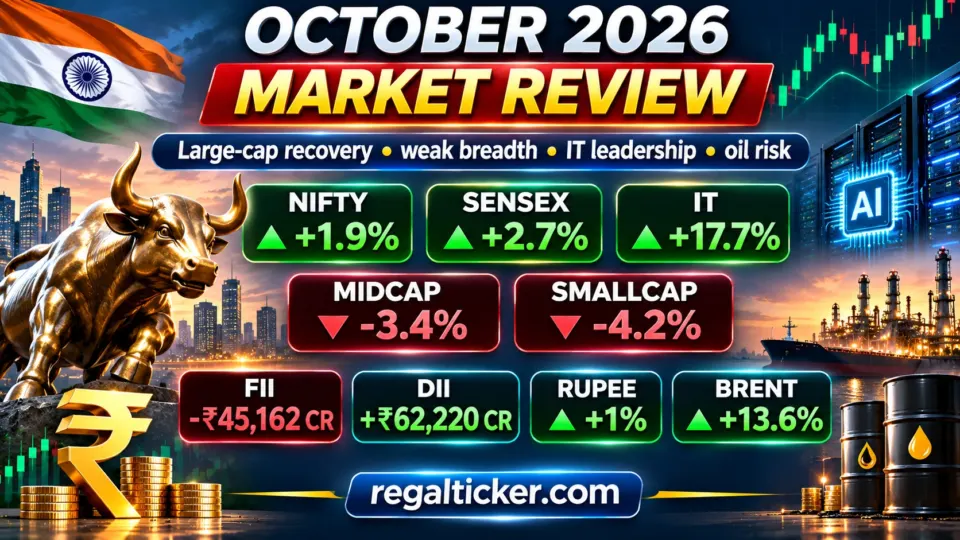
The Nifty 50 ended the month at 23,053.10, up 1.9%, while the Sensex finished at 74,459.53, up 2.7%. That was a meaningful recovery after September’s 6.1% fall in the Nifty and 5.8% decline in the Sensex.
But the headline numbers hide an important split.
The Nifty Midcap 100 fell 3.4% in October and the Nifty Smallcap 100 declined 4.2%. Foreign institutional investors still sold roughly ₹45,162 crore of Indian shares in the cash market, while domestic institutions bought about ₹62,220 crore.
The market’s strongest engine was information technology. The Nifty IT index surged 17.7%, its best monthly performance in more than six years, as better-than-feared earnings, AI-linked revenue optimism and attractive relative valuations pulled investors back into large technology names.
At the same time, Brent crude climbed 13.6% during October, the rupee strengthened about 1% to 94.95 per dollar, and geopolitical risk remained high.
So October was not a clean risk-on month.
It was a large-cap and IT-led recovery inside a market that still showed weak breadth, heavy foreign selling and oil-driven macro risk.
⚡ Quick answer
How did the Indian stock market perform in October 2026?
The Nifty 50 gained 1.9% in October to close at 23,053.10, while the Sensex rose 2.7% to 74,459.53. IT was the standout sector with a 17.7% gain, but broader markets remained weak: Midcap 100 fell 3.4% and Smallcap 100 lost 4.2%. FIIs sold about ₹45,162 crore during the month, while DIIs bought about ₹62,220 crore. The rupee strengthened around 1%, but Brent crude surged 13.6%, leaving oil and global risk as major constraints heading into November.
Key takeaways
Nifty 50 rose 1.9% in October to 23,053.10.
Sensex gained 2.7% to 74,459.53.
October snapped a two-month losing streak for the benchmark indexes.
Nifty IT surged 17.7%, its strongest monthly gain in more than six years.
TCS, Infosys, HCLTech and Tech Mahindra gained roughly 16%–22% during the month.
Midcap 100 fell 3.4%.
Smallcap 100 declined 4.2%.
FIIs sold about ₹45,162 crore in the NSE cash market during October.
DIIs bought about ₹62,220 crore, more than offsetting the monthly foreign outflow.
The rupee gained about 1% in October and ended near 94.95 per dollar.
Brent crude rose 13.6% during the month and settled at a six-month high on 30 October.
RBI raised the repo rate by 25 basis points to 5.5% early in the month.
The Federal Reserve held rates at 3.75%–4.00% late in October.
Jio Platforms’ listing became one of the month’s biggest corporate-market events.
The central message from October is that large-cap recovery did not equal broad-market strength.
1. October started with fear, not recovery
The month did not begin like a winning month.
India entered October after a brutal September. The Nifty 50 had fallen 6.1% in September to 22,620.45, while the Sensex had dropped 5.8% to 72,480.29.
Oil was high, the rupee was weak, global bond yields were elevated and foreign investors were still selling aggressively.
By 8 October, the pressure intensified.
The Nifty fell to 22,231.80, its lowest close in 18 months, while the Sensex dropped to 71,593.24, its lowest close in 32 months.
Brent had moved above $104 per barrel, foreign selling was accelerating and the RBI had just raised its repo rate by 25 basis points to 5.5%.
That combination created a difficult macro mix:
higher oil → imported inflation risk → weaker rupee → tighter monetary policy → foreign outflows → equity valuation pressure.
RegalTicker’s crude-oil and Hormuz analysis remains the right background for understanding why oil was such a persistent drag on India through October.
2. The benchmark recovery was real—but narrow
From the early-October low, large-cap benchmarks recovered strongly enough to finish the month in positive territory.
The Nifty moved from 22,620.45 at the end of September to 23,053.10 at the end of October.
The Sensex moved from 72,480.29 to 74,459.53.
That translated into monthly gains of 1.9% and 2.7%, respectively.
The problem was breadth.
The Midcap 100 lost 3.4% and the Smallcap 100 fell 4.2% during October.
This matters because a healthy market recovery usually broadens beyond a handful of heavyweight sectors.
October did the opposite.
Large caps and IT carried the index while a large part of the broader market remained under pressure.
That divergence is one reason investors should avoid reading the headline Sensex or Nifty return as a complete picture of portfolio performance.
Investor note
Benchmark recovery does not mean every portfolio recovered
If a portfolio was concentrated in small- and mid-cap stocks, October may still have been a negative month even though Nifty and Sensex finished higher. Market breadth and portfolio composition matter as much as benchmark direction.
3. IT was the defining sector of October
No sector shaped the month more than information technology.
The Nifty IT index surged 17.7%, its strongest monthly performance in more than six years.
Large IT companies were the biggest Nifty winners:
- Tata Consultancy Services;
- Infosys;
- HCL Technologies; and
- Tech Mahindra
rose roughly 16% to 22% during the month.
Several forces came together.
First, September-quarter earnings were better than investors feared.
Second, visible AI-related revenue started to support the argument that Indian IT companies can benefit from enterprise AI adoption rather than simply lose business to automation.
Third, valuations had become more reasonable after earlier weakness.
And fourth, global investors temporarily reconsidered some expensive pure-play AI trades, making established Indian IT companies look relatively defensive.
This was not the same thing as saying every IT company had entered a new structural bull market.
The AI-capex and hyperscaler analysis remains relevant because AI spending still has to convert into sustainable client budgets, margins and cash flow.
4. Foreign investors kept selling even as the market rose
One of October’s biggest contradictions was the flow picture.
Foreign institutional investors sold approximately ₹45,161.71 crore in the NSE cash market during the month.
Domestic institutions bought approximately ₹62,220.11 crore.
FIIs were sellers in 14 of the month’s 20 trading sessions and buyers in only six.
That means the benchmark recovery happened despite persistent foreign selling.
Domestic institutions absorbed more than the entire monthly FII outflow.
This is a powerful reminder that India’s equity market is no longer driven only by foreign money.
Mutual funds, insurance companies, retirement flows and domestic savings are increasingly important shock absorbers.
But that does not make foreign flows irrelevant.
Persistent FII selling can still affect:
- the rupee;
- large-cap valuations;
- financial stocks;
- market liquidity; and
- relative performance versus other emerging markets.
The October FPI outflow analysis explains why oil, global yields and competing AI markets kept foreign investors cautious.
5. The rupee quietly delivered one of October’s better surprises
The rupee ended October near 94.95 per dollar, gaining about 1% during the month.
That was its strongest monthly performance since February.
The move is important because it happened while oil remained expensive and foreign portfolio flows were negative.
RBI intervention and policy measures helped.
The central bank took steps to reduce spot-market dollar demand from oil companies, supplied dollars directly to public oil marketers and tightened parts of the currency-hedging framework.
It also raised its policy rate during the month.
The result was a stronger rupee than the equity-flow picture alone would have suggested.
But investors should not interpret that as the end of currency risk.
High crude prices still threaten India’s current account and imported inflation.
The rupee’s October strength was partly a policy success, not evidence that the underlying oil vulnerability disappeared.
6. Crude oil remained the biggest macro warning
Brent crude rose 13.6% in October.
On 30 October, the expiring December Brent contract settled at $117.64 per barrel, while WTI ended at $104.12.
That was the highest oil settlement level since late April.
The month’s rise was driven by escalating Middle East supply concerns, attacks on oil infrastructure and renewed fear around the Strait of Hormuz.
For India, high oil matters more than it does for many other equity markets.
India is a major crude importer.
Sustained high oil can:
- widen the trade deficit;
- pressure the rupee;
- raise transport and logistics costs;
- increase inflation;
- squeeze margins in fuel-sensitive industries; and
- limit the RBI’s room to support growth.
This was the main reason October’s equity rebound never became a straightforward risk-on move.
7. Earnings helped stabilise the market
September-quarter earnings were another important support.
Reuters reported that results broadly met or exceeded expectations and did not produce the kind of negative surprise that could have extended September’s sell-off.
Trent gained 15.1% during the month on steady demand and upbeat results.
Kotak Mahindra Bank rose 10.7% after stronger-than-expected profit and improving expectations around loan growth and margins.
IT results supported the sector’s large re-rating.
At month-end, Reliance Industries added another major data point: quarterly net profit rose 40.6% year on year to ₹25,548 crore, helped by refining and Jio.
Reliance released those results after the final trading session of October, so the earnings belong more to the November setup than October’s traded return.
That distinction matters.
A monthly review should separate what moved the market during the month from information released after the last closing bell.
8. Jio Platforms changed the corporate landscape
Jio Platforms was one of October’s most important corporate-market events.
Trading in Jio shares began on 28 October 2026.
The stock listed strongly and had risen about 28% from its issue price by the end of the month, according to Reuters.
Jio quickly became India’s second-largest company by market value.
That matters beyond one IPO.
Its listing changes:
- benchmark composition expectations;
- telecom-sector valuation comparisons;
- Reliance Industries’ sum-of-the-parts debate;
- passive-fund flows; and
- the visibility of India’s digital-consumer platform businesses.
RegalTicker’s Jio Platforms IPO analysis provides the deeper valuation and business-model context.
9. Global rates stopped getting worse—but did not become easy
The U.S. Federal Reserve held its benchmark rate at 3.75%–4.00% on 28 October.
That followed a rate increase in September.
For emerging markets such as India, the Fed matters because high U.S. rates can keep Treasury yields and the dollar attractive relative to emerging-market assets.
The hold helped remove one immediate source of pressure.
But the Fed did not signal that inflation risk had disappeared.
Two officials preferred another quarter-point increase.
So the global-rate environment remains restrictive.
The Fed and Indian market impact guide remains useful because the transmission still runs through bond yields, the dollar, FII flows and equity valuation multiples.
10. October’s real message was market concentration
October’s most important lesson was not that the Indian market “recovered.”
It was how it recovered.
Nine of 16 major sectors finished higher, but IT produced an outsized share of the positive index move.
Large caps outperformed broader markets.
Domestic investors absorbed foreign selling.
The rupee improved because of active policy support.
And oil remained a major macro threat.
That means the market entered November with a stronger headline index but without a fully repaired internal structure.
A healthier next phase would require some combination of:
- better mid- and small-cap breadth;
- reduced FII selling;
- lower crude prices;
- sustained earnings delivery; and
- less pressure from global yields.
Until then, index strength should be read together with breadth and flows.
The Risk Management guide is especially relevant in this environment because sector concentration can make an index look stronger than the average stock.
11. What investors should watch in November
November begins with several unresolved October themes.
Oil: Brent’s 13.6% October rise remains the biggest macro threat.
Foreign flows: FIIs ended the month as heavy net sellers despite buying on several late-October sessions.
Market breadth: Mid- and small-cap participation needs to improve if the rally is to become healthier.
IT: After a 17.7% monthly surge, expectations are now much higher.
Reliance and Jio: Both enter November with fresh earnings and a new listed-market structure.
Global AI trade: October showed that capital can rotate quickly between expensive global AI names and more traditional technology exposure.
Federal Reserve: Inflation remains elevated and further tightening is still possible.
Rupee: The RBI has stabilised the currency, but oil can test that progress.
The market may rebound further, but October does not justify complacency.
The better approach is to watch whether the next leg of gains becomes broader and more flow-supported rather than simply extrapolating one strong IT month.
Frequently asked questions
How much did Nifty gain in October 2026?
The Nifty 50 gained 1.9% during October and closed at 23,053.10 on 30 October.
How did Sensex perform in October 2026?
The Sensex rose 2.7% during the month and closed at 74,459.53.
Which sector performed best in October?
Nifty IT was the standout, gaining 17.7%, its strongest monthly performance in more than six years.
Did the broader market also rise?
No. Midcap 100 fell 3.4% and Smallcap 100 declined 4.2%, so October’s recovery was concentrated in large caps and selected sectors.
How much did FIIs sell in October?
NSE cash-market data shows FIIs sold a net ₹45,161.71 crore during the month.
How much did DIIs buy?
DIIs bought a net ₹62,220.11 crore during October, more than offsetting the foreign selling.
What happened to the rupee in October?
The rupee strengthened about 1% month on month and closed near 94.95 per dollar, its best monthly gain since February.
How much did Brent crude rise in October?
Brent crude rose 13.6% during October, with the expiring December contract settling at $117.64 per barrel on 30 October.
What was the biggest risk to Indian equities in October?
Elevated crude oil, foreign outflows and global rate pressure were the main macro risks, while weak mid- and small-cap breadth remained an internal market warning.
What should investors watch in November?
Oil, FII flows, market breadth, IT valuations, Reliance/Jio earnings, the rupee and further Fed policy signals are the major variables.
Verify through official sources
Official references
- Reuters — India shares end October higher — Primary month-end market report for Nifty, Sensex, sector performance, breadth, earnings and major stock moves.
- Reuters — September month-end baseline — Prior month-end benchmark levels and September performance used to frame October’s recovery.
- Reuters — October 8 market low — Early-October benchmark lows, oil pressure, FII selling and RBI rate-hike context.
- Reuters — Rupee October performance — Month-end rupee close, 1% monthly gain and RBI currency-support measures.
- Reuters — Oil month-end — Brent and WTI month-end settlements, October gains and Middle East supply-risk context.
- Moneycontrol — October FII and DII flows — NSE cash-market monthly FII and DII totals through the final October session.
- Reuters — November setup — Market positioning, oil/AI risks, breadth and November-series context.
- Reuters — Reliance Q2 results — Reliance month-end earnings released after the final October session.
- Reuters — Federal Reserve October decision — Reuters report on the Fed holding its benchmark rate at 3.75%–4.00%.
Educational disclaimer: RegalTicker provides educational and informational content only. This monthly review is not investment advice or a recommendation to buy, sell or hold any security, sector or index. Market data, institutional-flow figures, commodity prices and currency levels can change or be revised. Verify current exchange, regulator and company disclosures before making financial decisions and consider valuation, liquidity, diversification and your own risk tolerance.
Final takeaway
October repaired the headline index, not the whole market
October ended better than it began.
Nifty and Sensex returned to monthly gains, IT delivered a spectacular rebound, earnings were resilient and the rupee strengthened.
But the broader market remained weak.
Mid- and small-caps fell, FIIs sold another ₹45,000-plus crore, and crude oil surged more than 13%.
Domestic institutions kept the market stable, but that does not remove the underlying pressure from oil, global rates and weak breadth.
So the right reading of October is neither “bull market restored” nor “recovery failed.”
It was a selective repair.
November will show whether that repair spreads across sectors and market capitalisations—or remains concentrated in a small group of large-cap winners.