



Why This Matters
An NRI can have the right passport, the right Indian bank account and even a foreign Tax Residency Certificate — and still apply the wrong tax treaty rule.
DTAA relief is not a single “NRI tax rate.” It is a claim made for a particular item of income under a particular treaty article.
If you receive Indian dividends, interest, rent, salary, professional income or investment gains while living abroad, the practical sequence is to establish treaty residence, obtain the correct TRC, file the current Indian Form 41 when treaty relief is claimed, identify the treaty article that covers the income, satisfy any conditions such as beneficial ownership or permanent-establishment tests, and then compare the treaty position with Indian domestic law.
If you are not yet sure whether you are non-resident for Indian income-tax purposes, start with RegalTicker’s FEMA vs Income Tax Residency guide. If you need the broader investing structure first, use the complete NRI stock-market guide.
⚡ Quick answer
A Double Taxation Avoidance Agreement can reduce, limit or reallocate tax on certain Indian-source income of an eligible non-resident, but treaty relief is not automatic. For tax years beginning on or after 1 April 2026, a non-resident claiming Indian DTAA benefits should use Form 41, which replaced the old Form 10F under the Income-tax Act, 2025 framework. A valid foreign Tax Residency Certificate is required, and the treaty claim must still satisfy the article that applies to the income. The correct result is usually found by comparing Indian domestic law with the applicable treaty and using the treatment that is legally available and more beneficial.
Key takeaways
Form 41 replaced Form 10F under the Income-tax Act, 2025 / Income-tax Rules, 2026 framework for treaty claims from tax year 2026-27 onward.
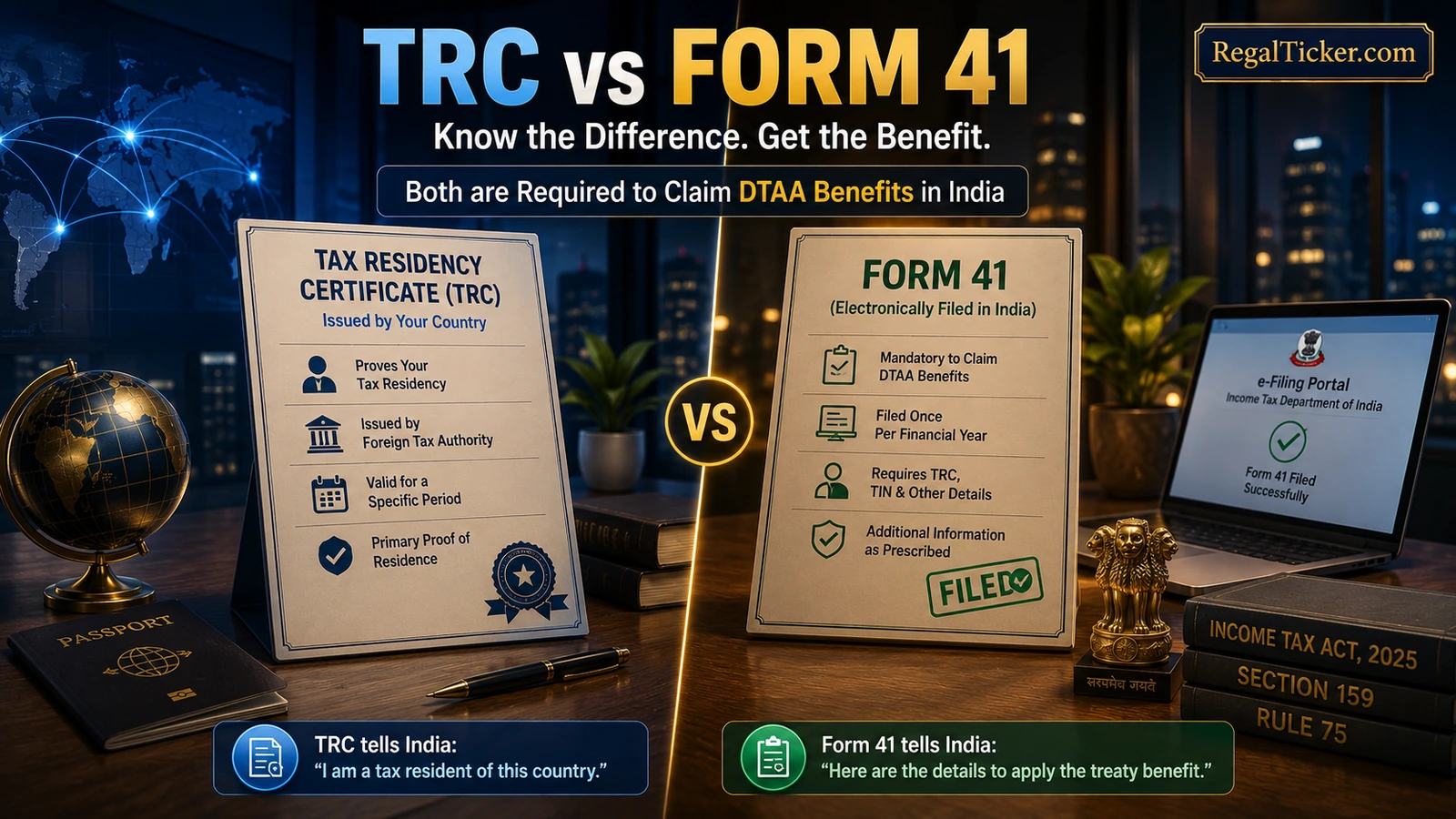
A TRC and Form 41 do different jobs
the TRC establishes residence evidence; Form 41 provides prescribed treaty-claim information to India.
The Income Tax Department states that Form 41 is mandatory when a non-resident claims DTAA benefits and is generally filed once per tax year when treaty benefits are claimed.
PAN is not always required merely to file Form 41; a qualifying non-resident without PAN can use the special non-resident registration route on the e-Filing portal.
A DTAA does not create one universal tax rate. Dividends, interest, capital gains, property income, employment income and business income can fall under different treaty articles.
Domestic law can be more beneficial than the treaty. Do not use a treaty rate simply because one exists.
Lower or nil TDS usually depends on giving the payer the documentation it needs before payment. Excess withholding may instead have to be reconciled through the Indian return/refund process.
TRC + Form 41 does not automatically satisfy every treaty condition. Beneficial ownership, permanent establishment, fixed base, limitation-of-benefits or principal-purpose tests can still matter.
For UAE residents, the India-UAE DTAA provides a useful example: Indian dividends can be capped by the treaty where conditions are met, while gains on shares of an Indian company can still be taxable in India under the treaty.
DTAA determines tax treatment. It does not determine FEMA account status or whether money can be repatriated. For that, use the dedicated NRI repatriation framework covered later in this guide.
What DTAA Actually Does for an NRI
A DTAA is an agreement between India and another country or specified territory that coordinates how cross-border income is taxed. It can do several different things depending on the treaty and the type of income.
A treaty may:
- give only one country the primary taxing right;
- allow both countries to tax but cap the source-country rate;
- allow the residence country to provide a foreign-tax credit;
- define when business profits can be taxed through a permanent establishment;
- provide tie-breaker rules for dual residence; or
- prevent treaty benefits where an arrangement fails anti-abuse conditions.
The practical mistake is to search for “DTAA rate for NRI” as if every rupee of Indian income receives the same answer.
It does not.
Suppose an NRI living in Dubai receives four Indian cash flows during the year:
- dividend from an Indian listed company;
- NRO fixed-deposit interest;
- rent from a flat in Bengaluru; and
- capital gain from selling Indian listed shares.
Those four amounts can fall under different treaty articles and different Indian domestic provisions. The documentation can also differ. A treaty rate that is relevant to dividend income does not automatically apply to the rent or share sale.
Investor note
Start with the income, not the form
Before asking whether you need a TRC or Form 41, write down exactly what India is paying you: dividend, interest, rent, salary, professional fee, royalty, business income, pension, capital gain or something else. The correct treaty article comes before the rate calculation.
The five-question DTAA test
For most individual NRI cases, a useful first-pass framework is:
- Are you a treaty resident of the other country for the relevant period?
- What is the exact Indian-source income?
- Which article of the applicable treaty covers that income?
- Do you satisfy the article’s conditions and the prescribed Indian documentation?
- Is the treaty result actually more beneficial than Indian domestic law?
If any of these questions is unanswered, do not jump straight to a treaty percentage.
TRC vs Form 41: What Each Document Actually Proves
A Tax Residency Certificate and Form 41 are related, but they are not substitutes for each other.
Tax Residency Certificate: evidence from the foreign jurisdiction
A TRC is issued by the government or tax authority of the country or territory where you claim to be tax resident. For an NRI claiming treaty relief in India, Section 159(8) of the Income-tax Act, 2025 requires a certificate of residence from the relevant foreign government, together with other prescribed information.
The certificate is important because a treaty applies to residents as defined by that treaty. Merely living abroad, holding a foreign visa or having an overseas salary does not by itself prove treaty residence for every purpose.
Form 41: prescribed information filed with India
Form 41 is the Indian self-declaration prescribed for a non-resident claiming DTAA benefits under the new framework. The Income Tax Department’s current user manual requires information such as the foreign Tax Identification Number and a copy of the residence certificate.
The form is filed electronically through the Income Tax e-Filing portal.
Think of the difference this way
| Document | Main job | Issued/filed where? | Does it replace the other? |
|---|---|---|---|
| Foreign TRC | Evidence that you are resident of the treaty country/territory for the relevant period | Foreign tax authority/government | No |
| Form 41 | Prescribed Indian information/self-declaration for the DTAA claim | Indian Income Tax e-Filing portal | No |
Caution
A TRC by itself is not the complete Indian treaty filing
The Income Tax Department’s 2026 Form 41 FAQ says DTAA benefit is not available in the absence of a valid electronically filed Form 41 together with the TRC and other required documents. Do not rely on an old checklist that says “TRC alone is enough if it contains all details.”
Form 10F vs Form 41: What Changed from 1 April 2026
This is where many older NRI tax articles are now stale.
India’s Income-tax Act, 2025 came into force on 1 April 2026, replacing the Income-tax Act, 1961 for the new framework. The Income-tax Rules, 2026 also came into force from that date.
For DTAA information supplied by a non-resident:
- old Form 10F → current Form 41
- old Section 90(5)/90A(5) framework → Section 159(8)
- old Rule 21AB → Rule 75
The Income Tax Department itself now labels the portal page “Form 10F / Form 41”, which is useful during the transition because taxpayers will continue to search the old form name.
Should an NRI still search for Form 10F?
Yes, as a legacy term — especially when reading old bank emails, tax articles, broker instructions or professional checklists.
But for a tax year beginning on or after 1 April 2026, use the current Income-tax portal and current form set rather than copying a pre-2026 filing instruction.
Does the change alter the basic policy of DTAA relief?
The new Act was designed primarily as a structural and drafting simplification rather than a wholesale change in tax policy. The important practical change here is the new numbering and form framework.
That is why an NRI should understand both names during the transition:
> Form 41 is the current form; Form 10F is the legacy name you will still encounter in older material.
Who Should File Form 41 and When?
The Income Tax Department’s Form 41 FAQ says the form is for non-resident individuals, companies or other entities receiving Indian income and seeking DTAA benefits.
This includes cases where an Indian payer is considering a lower or nil treaty withholding rate and cases where the treaty position is claimed in the Indian tax return.
Is Form 41 mandatory?
For a non-resident claiming DTAA benefit under the current framework, the Department’s FAQ answers yes.
How often is Form 41 filed?
The official guidance says it is generally filed once per tax year when treaty benefits are being claimed.
There is no single fixed annual filing date stated in the FAQ. Instead, the form is needed when the treaty benefit is claimed — for example, when a withholding issue arises on an Indian payment or when the benefit is claimed in the return.
A practical timing rule
If you want an Indian bank, company, broker, fund, tenant or other payer to apply treaty treatment at source, do not wait until after payment to prepare the documentation.
Ask the payer before the payment or withholding event:
- which TRC period it accepts;
- whether it wants the Form 41 acknowledgement;
- whether it wants a beneficial-owner declaration;
- whether it wants a no-PE/fixed-base declaration;
- whether it has a prescribed declaration format; and
- whether PAN/TIN or other details are required for its withholding process.
The payer must be comfortable applying the treaty. A document submitted after the tax has already been withheld may be more useful for return/refund reconciliation than for preventing the withholding itself.
How to File Form 41 Online
The Income Tax Department provides an online Form 41 filing workflow.
Step 1: obtain the foreign TRC
Use the tax authority of your treaty-residence country. The certificate should cover the period relevant to the Indian treaty claim.
Investor note
Use the UK issuer-side application guide
UK residents can use our UK certificate of residence application guide to prepare the HMRC request and compare the actual certified period with the Indian recipient’s requirements.
Step 2: have your foreign TIN ready
The Form 41 user manual lists the Tax Identification Number allotted in the country or region of residence among the prerequisites.
Step 3: register or log in to the Indian e-Filing portal
If you have an Indian PAN, use the normal registered-user route.
If you do not hold PAN and are not required to hold one, the Income Tax Department provides a separate non-resident taxpayer registration/login route using an NR ID.
Step 4: choose the current Act/form set
On the e-Filing portal, go to the income-tax forms area, select the forms under the Income-tax Act, 2025 and choose Form 41 for the applicable tax year.
Step 5: complete applicant and residential information
Check names, addresses, foreign tax-residence details and identification numbers carefully. The official FAQ says the submitted form cannot simply be edited after acknowledgement is generated.
Step 6: upload the TRC
The current framework requires the certificate to be furnished with the claim information.
Step 7: verify and preserve the acknowledgement
PAN users can use the applicable e-verification methods. A qualifying non-resident using the no-PAN registration route can verify using OTPs sent to the registered mobile number and email, according to the current user manual.
Keep a treaty-year evidence folder
- For every tax year in which you claim DTAA relief, preserve the TRC, Form 41 acknowledgement, payer declaration forms, withholding certificates, contract notes or income statements, Indian tax credit records and the treaty article/rate analysis used for the claim.
Can You File Form 41 Without PAN?
Possibly, yes.
This is one of the most useful improvements in the current official guidance because older articles often imply that an NRI must first obtain PAN merely to access the treaty form.
The Income Tax Department says a non-resident who does not hold PAN and is not required to have PAN can register in the special non-resident taxpayer category and file Form 41 using the NR ID route.
That does not mean PAN is irrelevant to every Indian payment or tax obligation.
PAN requirements can arise separately from:
- the nature and size of the Indian transaction;
- return-filing obligations;
- broker, bank or KYC requirements;
- property transactions;
- securities accounts; or
- withholding/reporting rules applicable to the payer.
So use this narrower conclusion:
> PAN is not an absolute prerequisite merely to file Form 41 where the taxpayer qualifies for the no-PAN non-resident route.
Do not convert that into “an NRI never needs PAN.”
How Treaty Rates and Indian Domestic Tax Work Together
The Income-tax Act, 2025 states that where an applicable tax treaty grants relief, the provisions of the Act apply to the extent they are more beneficial to the assessee.
This is the practical comparison rule.
Do not assume the treaty always wins
Suppose domestic Indian law gives an exemption or a rate below the treaty ceiling. In that case, using the domestic-law outcome may be more beneficial.
For example, eligible NRE interest can have a domestic-law exemption subject to the applicable conditions. A treaty article that permits India to tax interest up to a certain percentage is not a reason to abandon a more favourable domestic exemption.
Do not assume a treaty ceiling is the final effective tax rate
A treaty may say India shall not tax above X% on a particular gross payment if the recipient is the beneficial owner. That does not mean every payment is taxed at exactly X%.
Domestic law might be lower. The income might be exempt. The article might not apply. Another article might take over because the income is effectively connected with a permanent establishment. Or the taxpayer may fail the documentation/anti-abuse conditions.

A practical comparison table
| Question | Domestic-law check | Treaty check |
|---|---|---|
| Is the income taxable in India? | Indian charging and exemption provisions | Applicable treaty article |
| What rate applies? | Domestic rate for that income/person | Treaty ceiling/allocation rule |
| Is there withholding? | Indian TDS framework | Treaty can affect applicable withholding where conditions are met |
| What documents are needed? | PAN/KYC/transaction-specific requirements | TRC, Form 41 and any payer/treaty declarations |
| Which result should be claimed? | Compare legally available outcomes | Use treaty only when eligible and beneficial |
Which NRI Income Can Receive DTAA Treatment?
A treaty should be read by income category.
The exact article numbering and wording varies from treaty to treaty, but common categories include:
Dividends
A treaty may cap the tax that the source country can impose on dividends, often subject to the recipient being the beneficial owner and meeting any other treaty conditions.
For an NRI investor, this matters when an Indian company pays a dividend to a resident of a treaty country.
If you want to estimate the investment cash flow itself, RegalTicker’s Dividend Calculator can model dividend income and yield. It does not determine the treaty rate, residential status or TDS eligibility.
Interest
Treaties commonly contain a separate interest article. The rate can depend on the treaty and sometimes on the type of lender or recipient.
Do not assume that NRO bank interest, bond interest and every other debt payment receives one identical treaty rate without checking the article and payer facts.
Capital gains
Capital-gains articles are especially easy to misunderstand.
Some treaties allow India to tax gains from shares of Indian companies. Others contain different historical or asset-specific rules. Property-rich company shares can also receive separate treatment.
For the Indian listed-equity domestic calculation, use the NRI Capital Gains Tax guide and RegalTicker’s Capital Gains Tax Calculator. The calculator is only a domestic-law educational estimate; it does not decide treaty eligibility.
Immovable-property income
Rent and gains from Indian immovable property are commonly allowed to be taxed in India under treaty provisions because the property is situated in India.
This is why “I live in a zero-income-tax country” does not mean Indian property income automatically becomes tax-free in India.
Salary and employment income
Treaties usually look at where employment is exercised, with conditions for short-term presence, employer residence and whether remuneration is borne by a permanent establishment.
Professional or independent services
Depending on the treaty, professional income can depend on a fixed base, duration of stay or other conditions.
Business profits
A central treaty concept is the permanent establishment (PE). Business profits of an overseas enterprise are commonly taxable in India only to the extent allowed by the treaty, often where a PE exists and profits are attributable to it.
For a normal retail NRI investor, PE may not be central to a personal dividend or share-sale claim. For a consultant, founder, partnership, family office or business owner, it can be crucial.
Pension, royalties and other income
These can have their own treaty articles. Always classify the income first rather than borrowing a rate from a different category.
DTAA and TDS: How to Get Treaty Treatment at Source
For many NRIs, DTAA becomes real only when an Indian payer is about to deduct tax.
The practical question is:
> Can the payer legally apply the treaty position now, or will I have to claim the difference later through the tax return?
What the payer may ask for
Depending on the income and payer, the documentation pack can include:
- foreign TRC;
- Form 41 acknowledgement;
- foreign TIN;
- PAN or the prescribed alternative details where applicable;
- beneficial-owner declaration;
- no-PE or no-fixed-base declaration;
- declaration regarding eligibility under the treaty;
- principal-purpose / limitation-of-benefits confirmations where relevant;
- supporting income or ownership records; and
- the payer’s own tax declaration form.
Do not treat the payer’s checklist as bureaucratic noise. The payer can face consequences for applying an incorrect lower withholding rate.

What if full TDS was already deducted?
Treaty relief may still matter when you calculate the final Indian tax position.
If valid tax deducted at source exceeds the final liability after applying the correct domestic/treaty treatment, the excess can generally be reconciled through the appropriate Indian return/refund process, subject to the filing rules and facts.
For share-related withholding and final-tax reconciliation, use RegalTicker’s NRI capital-gains and TDS framework after identifying the treaty position.
Caution
TDS is not the same as final tax
A bank, company or intermediary may deduct tax using the information available at payment time. Your final liability is determined after the correct income classification, treaty eligibility, domestic-law comparison, credits and return treatment are considered.
Beneficial Ownership, PE, PPT and LOB: Why Documents Are Not Enough
Treaty relief is not purely a paperwork exercise.
Beneficial ownership
Dividend, interest and royalty articles often make reduced source-country rates conditional on the recipient being the beneficial owner of the income.
In simple terms, the treaty does not necessarily protect a person who is merely receiving the money as an agent, nominee or conduit for someone else.
Permanent establishment or fixed base
A treaty rate that applies to passive interest or dividend income can stop being the relevant article where the holding or debt claim is effectively connected with a business PE or fixed base in India.
Principal Purpose Test
Modern treaties modified by the Multilateral Instrument can contain a Principal Purpose Test (PPT). The India-UAE synthesised treaty text, for example, includes an anti-abuse rule under which a treaty benefit can be denied where obtaining that benefit was one of the principal purposes of an arrangement or transaction, unless granting the benefit would still be in accordance with the object and purpose of the treaty provisions.
Limitation of Benefits
Some treaties contain specific limitation-of-benefits provisions. Their tests vary.
The people-first lesson is straightforward:
> A TRC proves a residence fact. Form 41 supplies prescribed information. Neither document turns an otherwise ineligible arrangement into an eligible treaty claim.
India-UAE DTAA: A Practical NRI Worked Example
The UAE is a useful example because many Indian citizens work and invest from Dubai, Abu Dhabi and the wider Emirates.
The UAE Federal Tax Authority currently provides a Tax Residency Certificate service specifically for DTA purposes through EmaraTax. Eligibility and supporting evidence depend on the relevant treaty and the applicant’s facts.
For an individual seeking an India-UAE treaty claim, do not assume that a UAE residence visa alone is the treaty-residence document. Use the FTA’s current DTA-purpose TRC process and verify that you satisfy the relevant India-UAE treaty residence definition for the period. If you are still setting up your Indian banking/KYC structure from the Emirates, RegalTicker’s NRI Account Opening from UAE guide covers that separate operational layer.

Example 1: Indian dividend received by a UAE treaty resident
Assume Meera lives in Dubai, is eligible to be treated as a UAE resident under the India-UAE treaty and receives a dividend from an Indian company.
Under Article 10 of the India-UAE treaty, India may tax the dividend, but where the recipient is the beneficial owner, the treaty caps the Indian tax at 10% under the article.
Meera should not stop at “10%.” She should check:
- whether she is actually a UAE treaty resident for the period;
- whether she is the beneficial owner;
- whether any PE/fixed-base connection changes the treatment;
- whether current Indian domestic law is more beneficial;
- whether the payer has the TRC, Form 41 and required declarations before withholding; and
- how the income is treated in the UAE under applicable UAE law.
Example 2: NRO interest received by a UAE resident
The India-UAE treaty has a separate interest article. It provides different ceilings for specified bank/similar-institution lending and for other interest.
That does not mean every personal NRO deposit should automatically be labelled with the first percentage you see in the treaty.
The payer and taxpayer must identify the exact nature of the interest, beneficial owner, domestic-law rate/exemption, and article conditions.
Example 3: UAE NRI sells shares of an Indian company
This is where generic DTAA marketing can mislead investors.
Article 13(4) of the India-UAE treaty says gains from shares, other than the property-rich share category described separately, in a company resident in a contracting state may be taxed in that state.
So if a UAE-resident NRI sells shares of an Indian company, the treaty does not simply remove India’s taxing right because the investor lives in the UAE.
The investor should calculate the Indian capital gain under the applicable domestic rules and then test the treaty article correctly.
For listed Indian shares, calculate the domestic-law layer first and then test the treaty article against that result.
Example 4: UAE NRI owns rental property in India
Treaties commonly allow the country where immovable property is located to tax property income. The India-UAE treaty follows this broad source-country approach.
Living in Dubai does not turn Indian rent into automatically tax-free Indian income.
Example 5: Same investor, four income types
Meera therefore cannot give her bank or tax adviser one instruction saying:
> “I am a UAE NRI, apply DTAA 10% to everything.”
She needs an income-by-income map.
| Indian income | First treaty question |
|---|---|
| Dividend | Dividend article + beneficial ownership |
| Bank/bond interest | Interest article + nature of interest |
| Rent | Immovable-property article |
| Share capital gain | Capital-gains article for that asset |
That is the correct way to use a treaty.
Five Practical NRI DTAA Scenarios
Scenario 1: NRI has a TRC but has not filed Form 41
The taxpayer has foreign residence evidence but has not completed the prescribed Indian treaty information filing.
Action: file Form 41 under the current framework before relying on the DTAA claim, and give the payer any additional documents it requires.
Scenario 2: NRI filed Form 41 but the TRC period is wrong
A form acknowledgement cannot repair a residence certificate that does not support the relevant period.
Action: obtain the correct TRC or clarify the residence period before claiming treaty relief.
Scenario 3: Treaty rate is higher than a domestic exemption
The investor sees a treaty rate and assumes it must be used.
Action: compare the domestic-law outcome. Section 159’s beneficial-treatment framework means the treaty should not be used to make the taxpayer worse off where domestic law is legally more favourable.
Scenario 4: Payer deducted full Indian TDS before receiving treaty papers
The paperwork arrives after the payment.
Action: obtain the TDS certificate/tax-credit evidence, calculate the final treaty/domestic position and determine whether an Indian return/refund claim is appropriate.
Scenario 5: NRI wants to remit the post-tax money abroad
The taxpayer successfully settles the Indian tax question and assumes the bank must now remit the money.
Action: treat repatriation as a separate FEMA/RBI process. Continue with RegalTicker’s NRI Repatriation from India guide, which covers NRE/NRO routes, the USD 1 million facility and current Form 145/146 remittance documentation.
DTAA Is Separate from FEMA, NRE/NRO and Demat Rules
Tax treaties do not replace the banking or securities structure that an NRI must use.
This distinction is fundamental.
DTAA answers
- which country can tax a particular income;
- whether the source-country tax is capped;
- whether double-tax relief/credit may apply; and
- what treaty conditions must be satisfied.
FEMA and banking rules answer
- whether you are a person resident outside India for foreign-exchange purposes;
- which bank account can hold the money;
- whether NRE/NRO/FCNR treatment applies;
- how investments are funded; and
- how eligible money can be repatriated.
Demat/trading rules answer
- how securities are held and traded;
- which bank route is linked to the investment setup; and
- what the broker/depository requires for NRI onboarding.
If the account structure is unclear, read NRE vs NRO vs PIS for NRIs and the NRI Demat Account guide.
If you are still deciding what NRIs can hold in India, use the NRI Investment Options guide.
Common DTAA Mistakes NRIs Should Avoid
Mistake 1: using “NRI” as proof of treaty residence
NRI is not a universal treaty-residence certificate. Establish residence under the applicable treaty and obtain the foreign TRC.
Mistake 2: filing old Form 10F for a 2026-27 treaty claim without checking the current portal
For the current Income-tax Act, 2025 framework, Form 41 is the relevant form.
Mistake 3: assuming one DTAA rate applies to every Indian income
Dividend, interest, capital gains, rent and salary can use different treaty articles.
Mistake 4: treating the TRC as the entire claim
The current Indian process also requires the prescribed Form 41 information and can require additional payer/treaty declarations.
Mistake 5: assuming the treaty is always cheaper
Compare the domestic-law result. A domestic exemption or lower rate can be more favourable.
Mistake 6: ignoring beneficial ownership or PE conditions
Paperwork does not override substantive treaty conditions.
Mistake 7: preparing treaty documents after the payer has already withheld
If you want lower treaty withholding at source, prepare the documentation before the payment event whenever possible.
Mistake 8: confusing treaty relief with repatriation
Paying the correct Indian tax does not by itself establish that the money is freely remittable abroad.
Mistake 9: relying on a country-rate table without reading the actual treaty
Treaties are amended by protocols and, in many cases, the Multilateral Instrument. Use the current synthesised/official text where available.
Mistake 10: using a calculator to decide legal eligibility
RegalTicker calculators can model investment returns or Indian tax mechanics. They cannot establish treaty residence, beneficial ownership, PE status or DTAA entitlement.
NRI DTAA Yearly Checklist
Before the first Indian payment for which you want treaty treatment:
- confirm your Indian tax residential status;
- confirm treaty residence in the foreign country;
- obtain the foreign TRC for the relevant period;
- keep the foreign TIN ready;
- file Form 41 for the tax year when treaty benefits are claimed;
- save the acknowledgement;
- identify the correct treaty article for each Indian income source;
- compare the domestic-law and treaty outcomes;
- prepare beneficial-owner / no-PE / PPT / LOB declarations if relevant;
- give the payer its required documents before withholding where possible;
- reconcile actual TDS with Form 26AS/AIS or other applicable tax records;
- file an Indian return where required or useful for refund, treaty claim or other reporting;
- preserve evidence for the full record-retention period applicable to you; and
- handle outward remittance separately under the correct FEMA/bank route.
Investor note
The simplest safe rule
Do not ask “What is my NRI DTAA rate?” Ask: What income did I receive, which treaty article covers it, do I qualify for that article, what documents are required, and is the treaty outcome better than Indian domestic law?
Frequently asked questions
What is DTAA for an NRI?
A Double Taxation Avoidance Agreement coordinates how India and another country or territory tax cross-border income. For an NRI, the result depends on treaty residence, the type of Indian income, the relevant treaty article and the documentation required to claim the benefit.
Is Form 10F still used by NRIs in 2026?
For the Income-tax Act, 2025 framework applying from 1 April 2026, the current prescribed treaty-information form is Form 41. Form 10F is the legacy form name under the old Income-tax Act, 1961 framework and remains a common search/reference term.
Is Form 41 mandatory for claiming DTAA benefits?
The Income Tax Department’s current Form 41 FAQ states that Form 41 is mandatory for a non-resident claiming DTAA benefits under the current framework, together with a valid TRC and other required documents.
How many times does an NRI need to file Form 41?
Current official guidance says Form 41 is generally filed once per tax year when the non-resident is seeking DTAA benefits. It should be in place when the treaty benefit is being claimed, including where relevant to TDS or the tax return.
Can an NRI file Form 41 without PAN?
Yes, in qualifying cases. The Income Tax Department provides a special registration route for non-residents who do not hold PAN and are not required to obtain one. They can file using an NR ID. This does not mean PAN is unnecessary for every Indian transaction or tax obligation.
Is a Tax Residency Certificate enough to claim DTAA in India?
No. A TRC is essential residence evidence, but the current Indian process also requires Form 41 for a non-resident claiming DTAA relief and can require additional transaction- or treaty-specific documents.
Does DTAA mean an NRI pays tax only in the country of residence?
Not necessarily. Many treaty articles allow India, as the source country, to tax Indian income while limiting the rate or requiring the residence country to provide relief. The exact rule depends on the income and treaty article.
Does every DTAA have the same dividend or interest rate?
No. Treaty rates and conditions differ by country and by income category. Always use the current treaty text for your country rather than a generic NRI rate table.
Can DTAA reduce TDS for an NRI?
It can where the treaty provides a more favourable source-country treatment and the taxpayer satisfies the conditions and gives the payer the required documentation in time. If excess tax is already withheld, the final treaty position may need to be reconciled through the Indian return/refund process.
Does DTAA reduce capital-gains tax on Indian shares for every NRI?
No. Capital-gains articles differ across treaties. Some treaties preserve India’s right to tax gains on shares of Indian companies. The India-UAE treaty, for example, allows India to tax gains from shares of an Indian resident company under its capital-gains article.
Does Form 41 decide whether I am an NRI under FEMA?
No. Form 41 is an income-tax treaty document. FEMA residential status and NRE/NRO/repatriation rules are separate legal questions.
Is DTAA needed for NRE interest?
Not automatically. Eligible NRE interest can have favourable domestic Indian tax treatment subject to the applicable conditions. Compare domestic law with the treaty instead of assuming the treaty rate should always be used.
What is beneficial ownership in DTAA?
In treaty articles such as dividends and interest, a reduced rate may depend on the recipient being the beneficial owner rather than merely an agent, nominee or conduit receiving money for another person.
Does a UAE residence visa automatically qualify me for India-UAE DTAA benefits?
No. Treaty residence must be established under the India-UAE treaty and supported by the appropriate UAE Tax Residency Certificate for the relevant period. Visa or immigration residence alone should not be treated as a substitute for the treaty test.
Can I use RegalTicker’s tax calculator to determine my DTAA rate?
No. The Capital Gains Tax Calculator can estimate domestic listed-equity tax mechanics, and the Dividend Calculator can model dividend income. Neither tool determines treaty residence, Form 41 compliance, beneficial ownership, PE status or the treaty rate applicable to you.
Investor note
Related tool: preserve the demerger cost trail
For an Indian shareholding affected by a demerger, the Demerger Cost Basis Calculator helps organise the original cost between the retained and resulting holdings using the company’s official allocation. Keep the allocation letter and the resulting working with your investment records.
Verify through official sources
Official references
- Income Tax Department — Section 159, Income-tax Act 2025 — treaty authority, beneficial-treatment rule and TRC requirement
- Income Tax Department — Form 41 User Manual — Form 41 purpose, prerequisites, PAN/NR-ID login and filing steps
- Income Tax Department — Form 41 FAQs — mandatory filing, timing, once-per-tax-year rule, TRC/TIN and no-PAN route
- Income Tax Department — Rule 75 / Form 41 educational brochure — Form 10F to Form 41 transition and current documentation
- Income Tax Department — Income-tax Act 2025 as amended by Finance Act 2026 — commencement and statutory framework
- Income Tax Department — Income-tax Rules 2026 — current rules from 1 April 2026
- Income Tax Department — India-UAE DTAA synthesised text — UAE treaty residence, dividends, interest, capital gains, double-tax relief and PPT
- UAE Federal Tax Authority — Tax Residency Certificate for DTA purposes — UAE DTA-purpose TRC eligibility, documents and EmaraTax process
- For the complete NRI learning path — from residential status and account setup to investing, taxation and repatriation — continue with the [NRI Investing Specialist Academy](https://regalticker.com/nri-investing).