
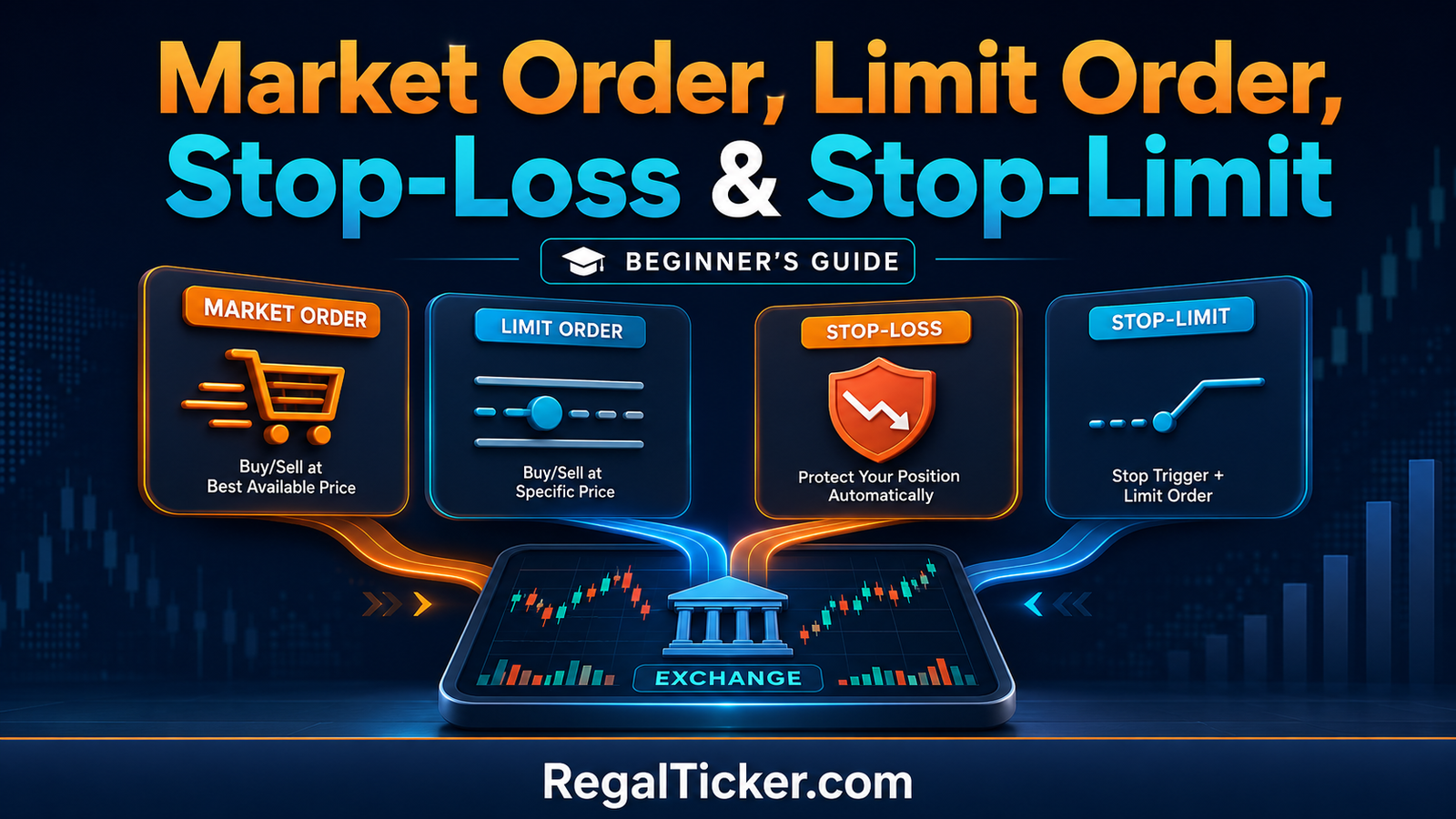
Placing a stock-market order involves more than pressing Buy or Sell. You must also tell your broker how the order should behave. Should it execute quickly at the best available price? Should it wait until a price chosen by you becomes available? Or should it activate only after the market reaches a trigger?
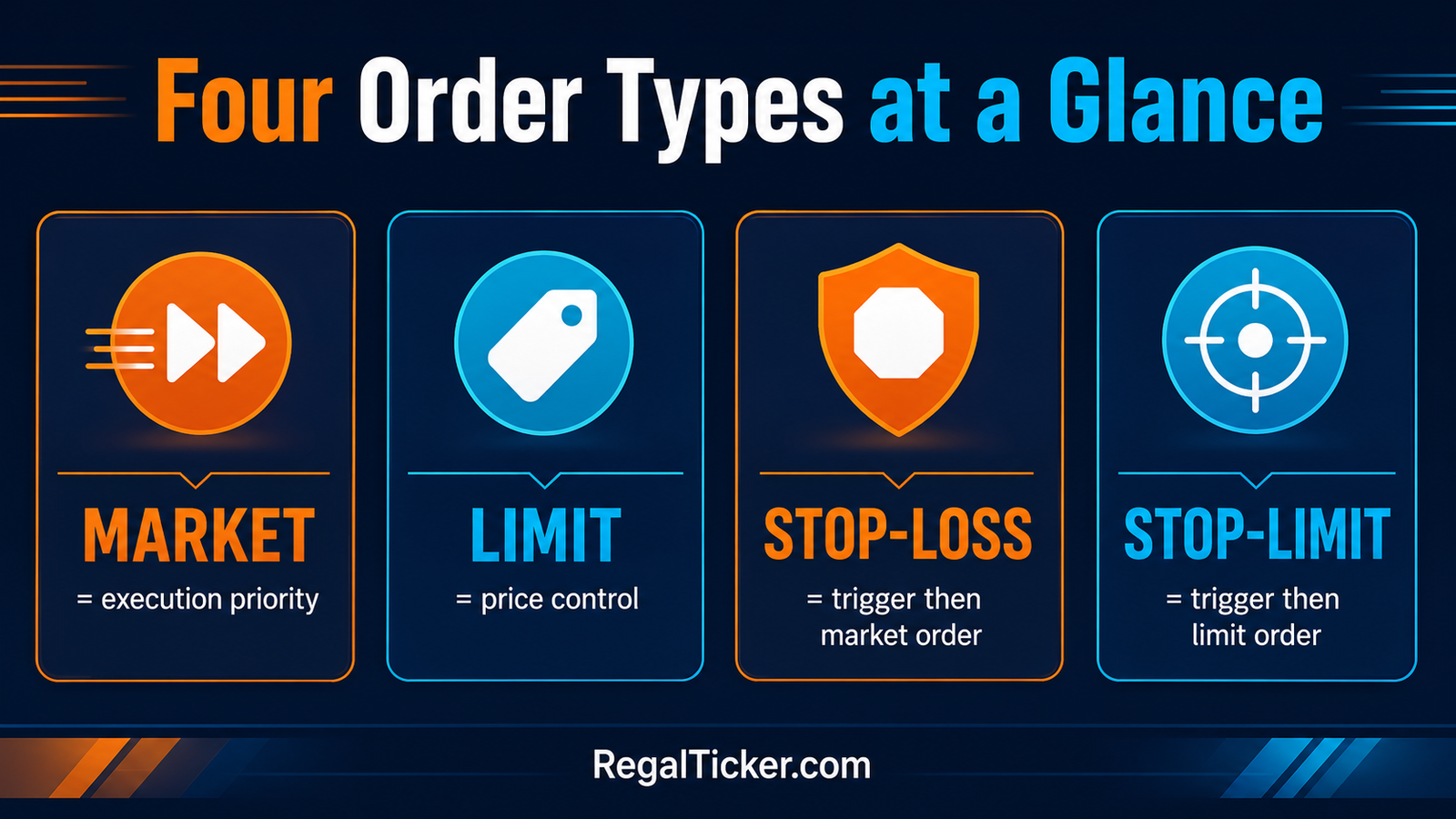
These decisions are expressed through order types. The four most useful types for a beginner are market order, limit order, stop-loss order and stop-limit order. Each balances two competing goals: certainty of execution and control over price.
Before using them, make sure you understand how a trading account works and the difference between a Demat account, trading account and bank account. The trading account sends the instruction; the exchange attempts to match it; the Demat account later receives or delivers the shares.
What Is a Stock-Market Order?
A stock-market order is an instruction to buy or sell a stated quantity of a security under specified conditions. The exchange’s electronic trading system compares your instruction with available opposite-side orders.
A buy order needs a seller. A sell order needs a buyer. The available bids, asks and quantities are displayed in the order book. Understanding that companion lesson is essential because an order type tells the exchange what you want, while the order book shows what the market can currently provide.
What Is a Market Order?
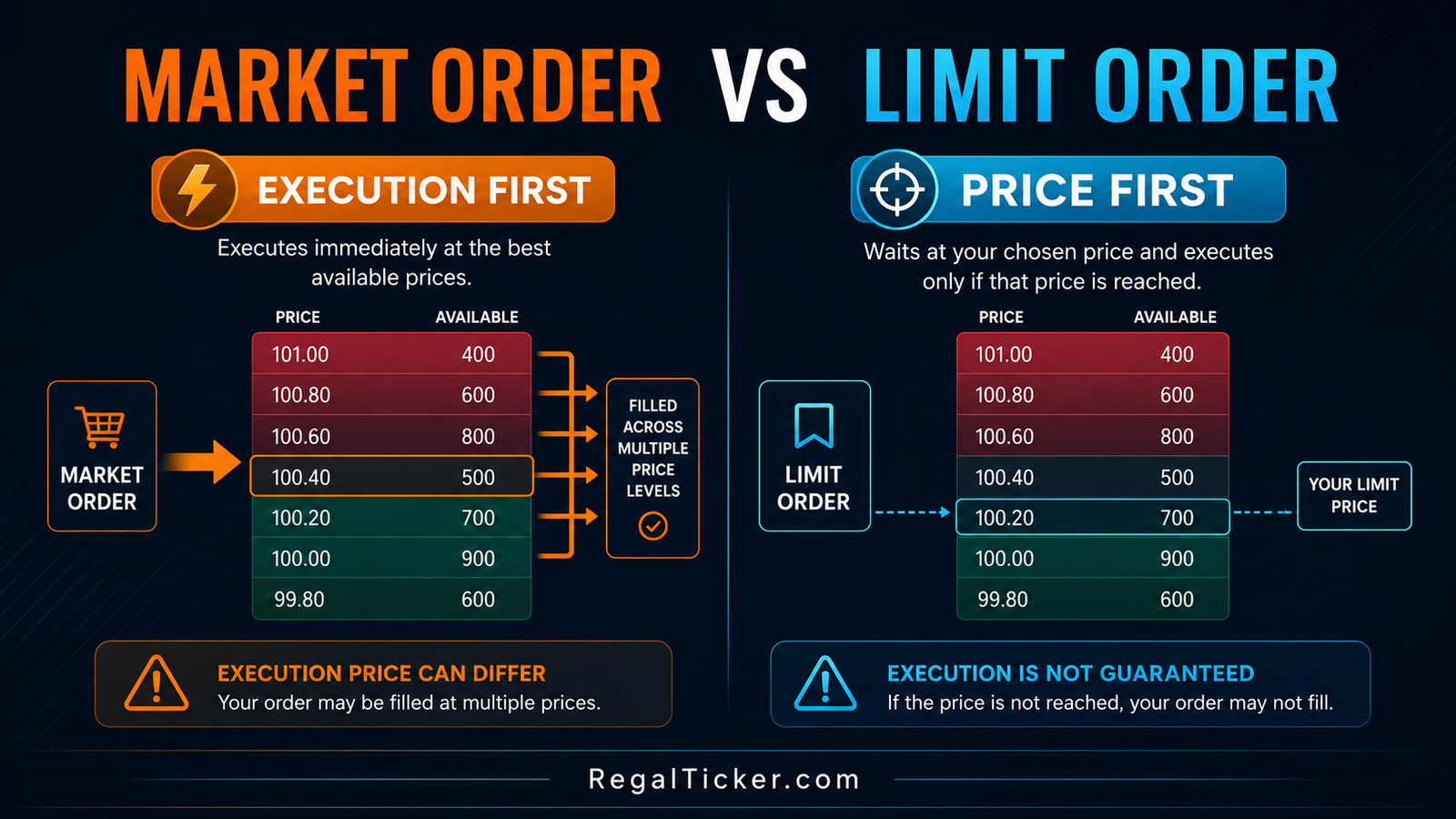
A market order tells the exchange to buy or sell immediately at the best available prices. It prioritises execution, not a particular price.
Suppose the best available sellers are offering:
- 200 shares at ₹100.10
- 300 shares at ₹100.20
- 500 shares at ₹100.40
If you place a market order to buy 1,000 shares, the order may consume all three levels. Your purchase would therefore have multiple fills and an average price above the first visible ask.
This is why “market price” does not mean a guaranteed single price. The last traded price is simply the price of the most recent completed trade. Your next market order interacts with the quantities available when it reaches the exchange.
Advantages of a Market Order
- It generally offers the highest chance of prompt execution in a liquid stock.
- It is simple to place.
- It can be useful when completing the transaction matters more than a small price difference.
Risks of a Market Order
- The execution price is not guaranteed.
- A large order can be filled at several price levels.
- The difference between the expected and actual price is called slippage.
- Risk is greater in illiquid or fast-moving securities.
The underlying mechanism is explained in How Are Share Prices Decided?, where demand, supply and order matching combine to create the traded price.
What Is a Limit Order?
A limit order specifies the worst price you are willing to accept.
- A buy limit order can execute at the limit price or lower.
- A sell limit order can execute at the limit price or higher.
Imagine a share is trading near ₹100, but you are willing to buy only at ₹98 or below. You can place a buy limit order at ₹98. The order will wait unless sellers become available at ₹98 or a better price.
A limit order gives price protection, but not execution certainty. The market may never reach your limit. Even if it does, other orders ahead of yours may consume the available quantity first.
Market Order vs Limit Order
| Feature | Market order | Limit order |
|---|---|---|
| Main priority | Execution | Price control |
| Price specified | No | Yes |
| Execution guaranteed | Not absolutely, but usually more likely in a liquid market | No |
| Execution price guaranteed | No | Will not be worse than the limit |
| Partial fill possible | Yes | Yes |
| Main risk | Slippage | Missed or incomplete execution |
Neither is automatically superior. The appropriate choice depends on liquidity, spread, order size and your purpose. You can review relevant educational utilities in the Regal Ticker Investor Tools hub, but a calculator cannot remove execution risk.
What Is a Stop-Loss Order?
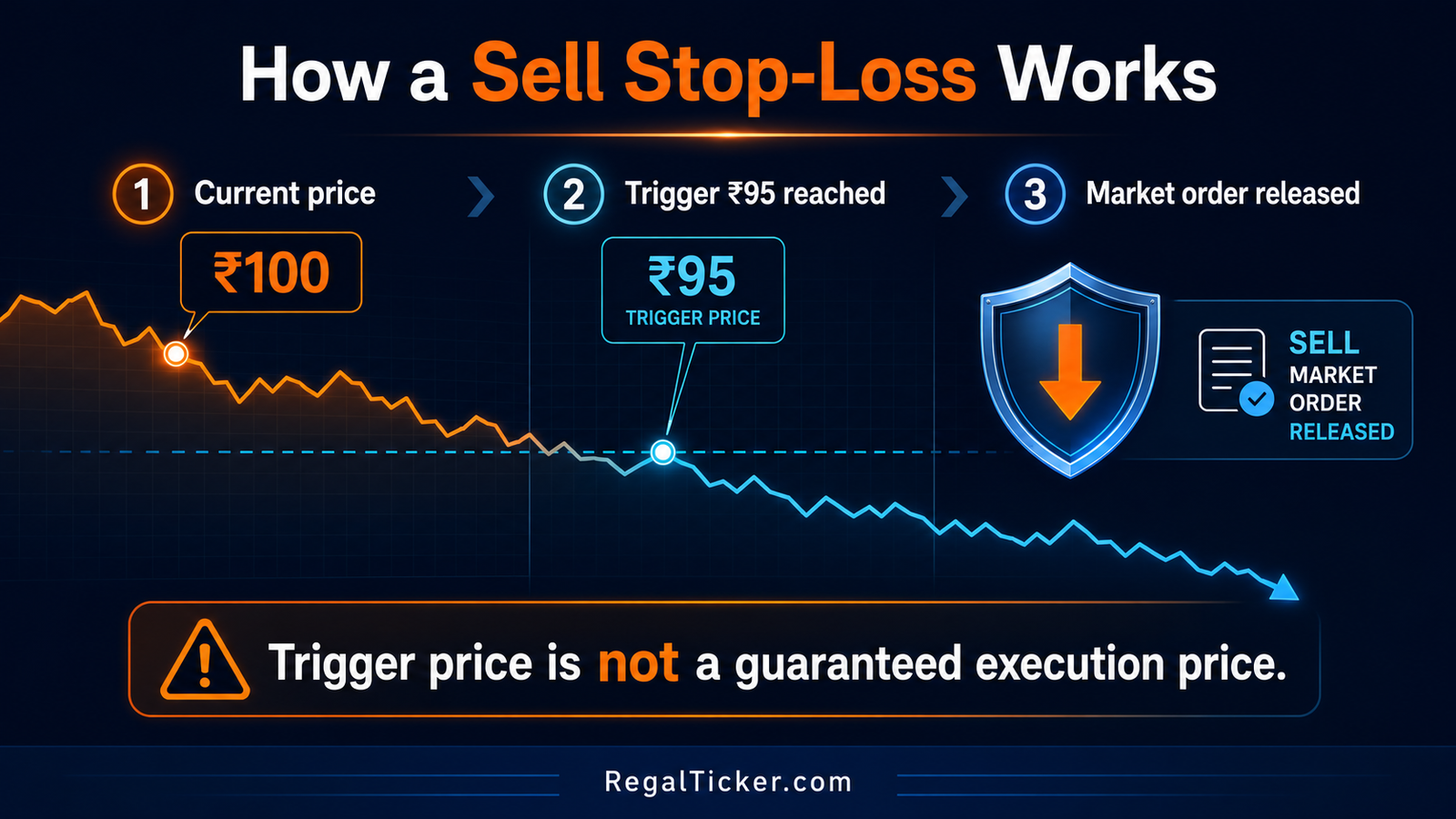
A stop-loss order remains inactive until a trigger condition is met. On NSE’s normal market, a sell stop order is triggered when the last traded price reaches or falls below its trigger; a buy stop order is triggered when the last traded price reaches or rises above its trigger.
After activation, a stop-market order is released as a market order. That distinction matters:
- The trigger decides when the instruction activates.
- The available order book decides the execution price.
Suppose you own a share bought at ₹100 and place a sell stop-loss trigger at ₹95. If the last traded price reaches ₹95, the order activates. If the next available bids are ₹94.90 and ₹94.60, fills may occur there rather than at ₹95.
Does a Stop-Loss Guarantee the Maximum Loss?
No. It can help execute an exit after a trigger, but it cannot guarantee the trigger price. A price gap, sudden volatility, insufficient buyers or a trading halt can produce a materially different fill.
Treat a stop-loss as an execution instruction—not insurance. Position sizing and diversification remain important. Explore those principles in the Risk Management learning hub.
What Is a Stop-Limit Order?
A stop-limit order contains two prices:
- Trigger price: activates the order.
- Limit price: controls the acceptable execution range after activation.
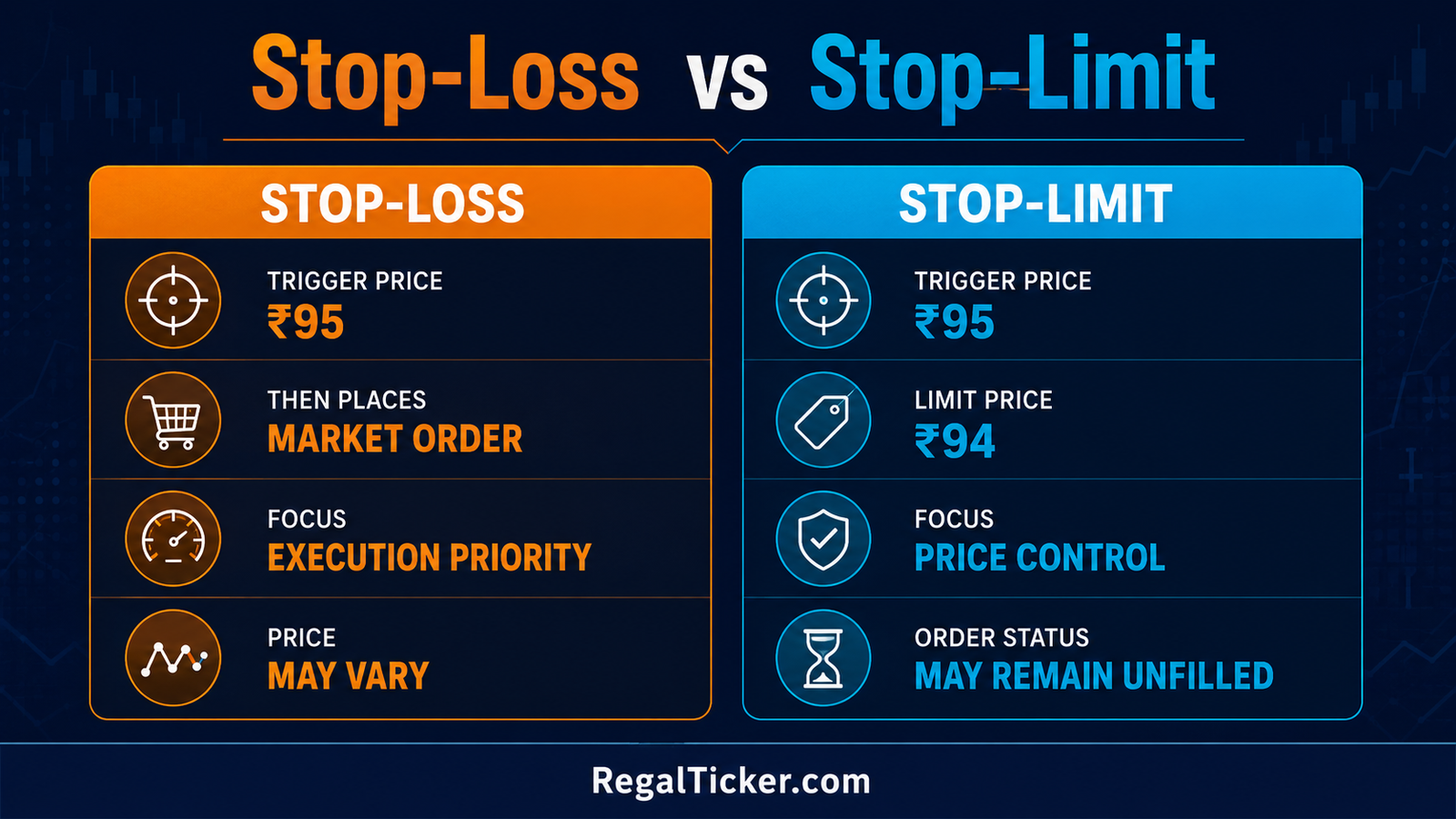
For example, a sell stop-limit instruction might use a trigger of ₹95 and a limit of ₹94. Once the trigger condition is met, a sell limit order at ₹94 is released. It may execute at ₹94 or higher, but not below ₹94.
This provides price control, but creates non-execution risk. If the market falls quickly from ₹95 to ₹92 without sufficient bids at ₹94 or above, the order may remain unfilled while the price keeps falling.
Stop-Loss vs Stop-Limit Order
| Feature | Stop-loss/stop-market | Stop-limit |
|---|---|---|
| Activates at trigger | Yes | Yes |
| Becomes | Market order | Limit order |
| Priority after trigger | Execution | Price |
| Execution price guaranteed | No | Cannot be worse than the limit |
| Execution guaranteed | No absolute guarantee | No; non-execution risk can be significant |
Broker interfaces may use labels such as SL and SL-M, and available order types can vary by segment or broker. Read the order ticket carefully before submitting it.
Common Beginner Mistakes
Treating the LTP as a guaranteed price
The last traded price describes the previous transaction, not the price promised for your order.
Placing a market order in a shallow order book
Low visible quantity can make a market order sweep several prices. Read Bid Price, Ask Price, Spread and Order Book Explained before deciding.
Confusing trigger price with execution price
A trigger activates an order. It is not necessarily the fill price.
Setting a stop-limit too narrowly
A narrow difference between trigger and limit may increase the possibility that a fast market passes through the acceptable range.
Ignoring partial fills
One order may be executed in several pieces, and a limit order may be only partly completed.
Choosing an order without checking costs
Frequent orders can create brokerage, taxes and statutory charges. The later lesson on trading costs will connect directly to the Investor Tools hub.
A Practical Order Checklist
Before submitting an order, ask:
- Am I buying or selling?
- Is the stock liquid, and how wide is the spread?
- Do I prioritise execution or price control?
- How large is my quantity relative to visible depth?
- If using a stop, what happens after it triggers?
- Can I tolerate a partial fill or no fill?
- Have I reviewed the order type, product type, quantity and price?
If you are still setting up your account, first read How to Open a Demat and Trading Account in India and Stock-Market KYC: Documents and Verification Process.
Key Takeaway
A market order seeks execution at the best available prices. A limit order accepts only your chosen price or better. A stop-loss activates a market order after a trigger, while a stop-limit activates a limit order.
The central trade-off is simple: orders that prioritise execution expose you to price uncertainty; orders that prioritise price expose you to non-execution. Read the order book, understand the spread and select the instruction that matches your actual objective.
Frequently Asked Questions
Which is better: market order or limit order?
Neither is universally better. A market order prioritises prompt execution; a limit order prioritises price control.
Can a limit order execute at a better price?
Yes. A buy limit may execute below its limit, and a sell limit may execute above its limit.
Is a stop-loss price guaranteed?
No. The trigger activates the order; the fill depends on available prices.
Why did my order execute in parts?
The required quantity was not available at one price, so the exchange matched it against multiple opposite orders.
Can a stop-limit order remain unfilled?
Yes. After triggering, it is still a limit order and will not execute outside its acceptable price.
Where can I verify the official exchange mechanism?
See the NSE equity trading-system guidance and SEBI’s investor guide on buying and selling shares.