
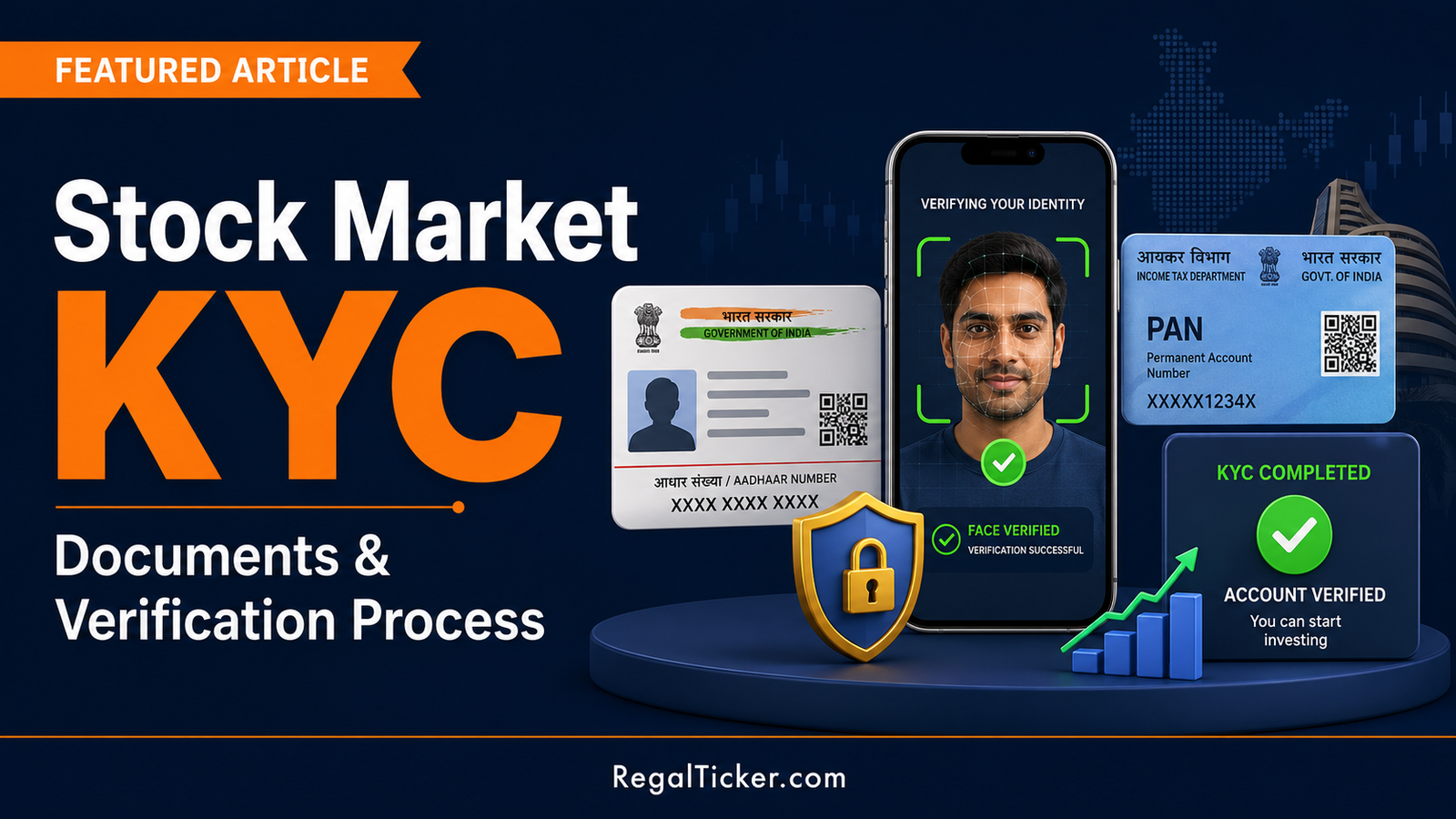
Stock market KYC is the identity-verification process completed before an investor begins an account-based relationship with a securities-market intermediary. It is used when opening a Demat or trading account and helps connect your identity, address, bank and contact details with your investment records.
KYC is not merely an upload screen that stands between you and an account. Accurate KYC helps intermediaries meet regulatory duties, reduces identity misuse and ensures important alerts and statements reach the correct investor.
> Quick answer: Stock market KYC usually involves submitting identity and address details, PAN, contact and bank information, completing in-person or permitted video/electronic verification, and having the record checked or registered through the securities-market KYC framework. Requirements can vary by applicant type and selected market segments.
What does KYC mean in the stock market?
KYC means Know Your Customer or, in securities-market documents, often Know Your Client. Its purpose is to establish who the client is before a regulated intermediary provides account-based services.
When you apply for a Demat and trading account, KYC details may be collected as part of the account-opening form. SEBI investor guidance describes document submission, in-person verification and account activation as key stages of the process.
If you have not yet chosen an intermediary, first read How to Open a Demat and Trading Account in India. For the role of each account, see Demat Account vs Trading Account vs Bank Account.
Why is securities-market KYC required?
KYC helps:
- Verify identity and address
- Connect transactions and holdings with the correct PAN
- Reduce impersonation and fraudulent account creation
- Support anti-money-laundering and regulatory checks
- Keep contact, bank and income-range records current
- Allow investors to receive transaction and depository alerts
KYC does not assess whether an investment is suitable or profitable. It verifies and records the client; it does not protect the client from market losses.
The six essential KYC attributes
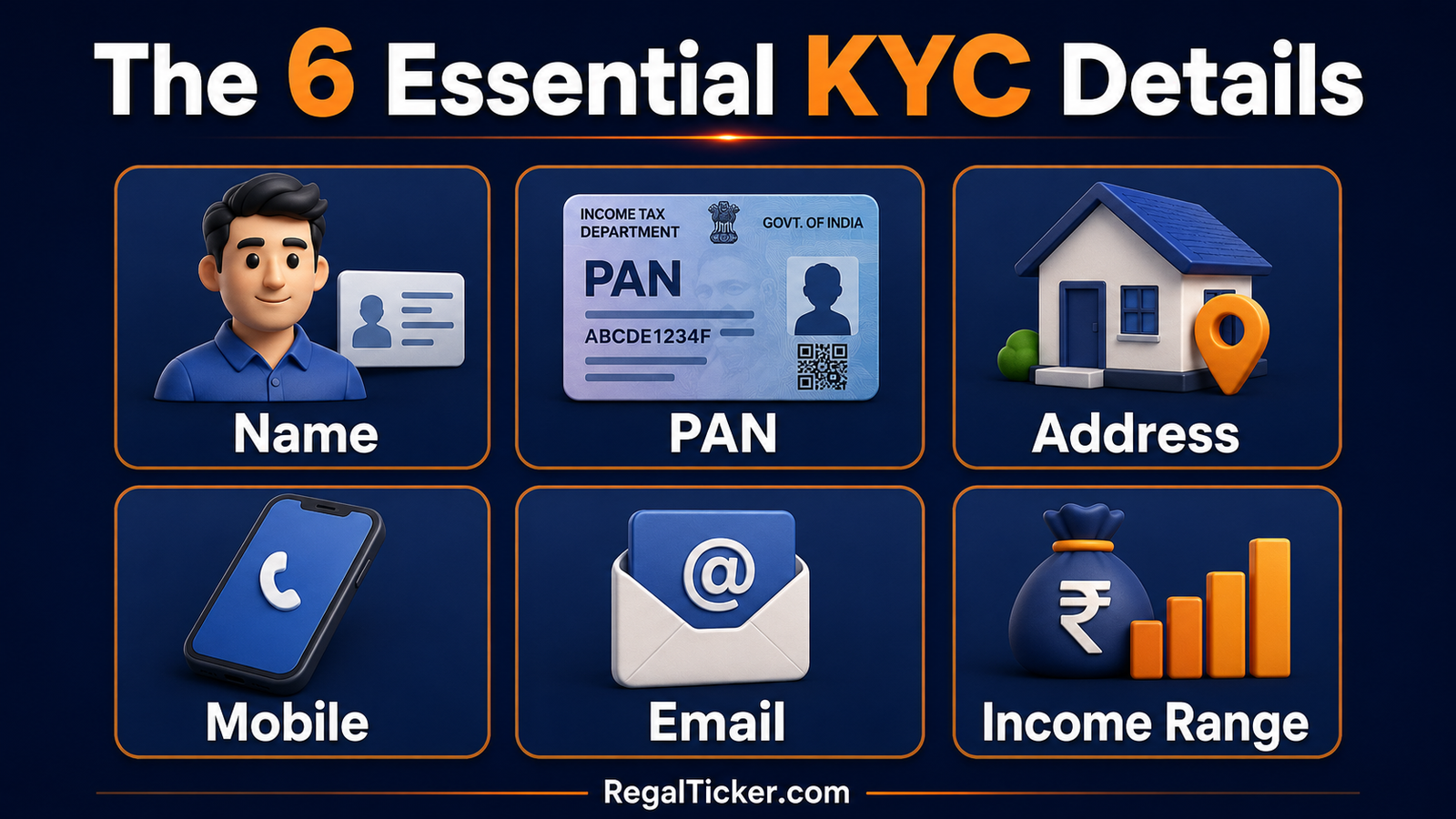
CDSL highlights six mandatory KYC attributes for securities accounts:
- Name
- PAN
- Address
- Mobile number
- Email address
- Income range
These details should be complete and consistent. Your own mobile number and email are especially important because intermediaries, exchanges and depositories use them for alerts and communication.
Documents commonly required for stock market KYC
The precise checklist depends on whether the applicant is a resident individual, NRI, minor, HUF, company, trust or another entity. For a resident individual, commonly requested evidence includes the following.
PAN
PAN is a core identifier in securities-market KYC. Ensure the number is correct, the PAN is operative under applicable requirements and the name matches the application.
Proof of identity
PAN can serve as a key proof of identity. An intermediary may also obtain Aadhaar or another accepted official document according to the selected KYC method.
Proof of address
Accepted evidence may include Aadhaar, passport, driving licence, voter identity card, utility bill or another permitted document. The acceptable age and format of a document may differ, so follow the current checklist shown in the official application.
Bank-account proof
A cancelled cheque, passbook or bank statement may be used to verify the account holder’s name, account number and IFSC. The bank account should belong to the applicant as required by the intermediary.
Photograph and signature
Online onboarding may capture a live image and electronic signature or request a signature specimen.
Income proof for selected segments
Activating derivatives or specified segments may require additional financial evidence, such as a bank statement, income-tax record, salary document, holdings statement or net-worth certificate accepted by the intermediary.
Income range is a KYC attribute, but that does not mean every cash-equity applicant must upload the same derivative-segment income proof.
Match your details before uploading
Compare the name, date of birth and address shown across PAN, Aadhaar or other address proof, bank proof and the application. Small differences—initials, reordered names, old addresses or a missing middle name—can trigger additional review.
Use clear, complete files:
- Do not crop document edges
- Avoid glare and blur
- Ensure numbers and photographs are readable
- Upload the correct side or page
- Use current evidence where validity or recency matters
- Do not digitally alter an official document
How the KYC verification process works
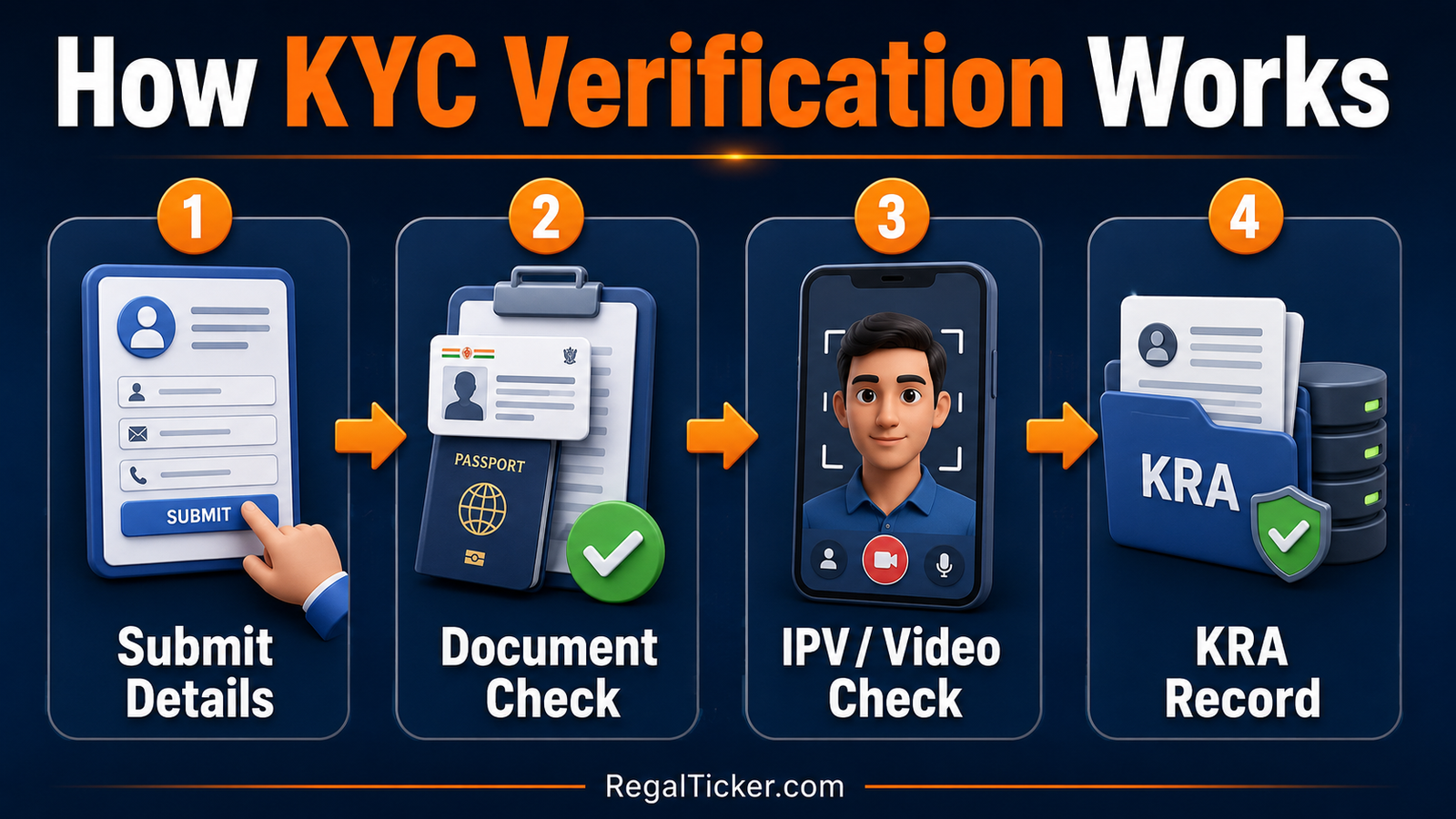
1. Data entry
You enter personal, contact, address, occupation, income-range and tax-related information in the KYC and account-opening flow.
2. Document verification
The intermediary checks submitted information and supporting evidence. Digital systems may validate details against permitted records.
3. Mobile and email verification
OTP or verification links may be used to confirm the contact points. These contacts should remain under your control.
4. In-person verification
IPV helps verify that the applicant is the person seeking the relationship. SEBI investor guidance notes that many institutions permit digital IPV through video or Aadhaar-based electronic processes, subject to the applicable method.
5. KRA processing
A KYC Registration Agency, or KRA, maintains securities-market KYC records under the regulatory framework. If a KYC record already exists, an intermediary may retrieve relevant records and ask for changes or missing information where required.
6. Account-level checks and activation
KYC completion is part of account opening, but the intermediary may still need to verify bank information, segment eligibility, signatures and account-specific forms before activation.
What is video IPV?
Video IPV is a digital form of in-person verification. The application may require you to show your face clearly, follow on-screen prompts, display a document or record a short live video. Requirements differ by implementation.
Complete video IPV yourself:
- Use a well-lit environment
- Keep your face unobstructed
- Use a stable internet connection
- Follow the exact prompts
- Do not let an unknown person control your screen
- Never disclose an OTP or password over an unsolicited call
What is a KRA?
A KRA is a regulated KYC Registration Agency in the securities market. It helps make KYC records available within the permitted framework so investors do not necessarily start the entire identity-record process from zero with every intermediary.
However, reusable KYC does not mean nothing will ever be requested again. An intermediary may need updated information, account-specific documents, contact validation, missing attributes or enhanced checks.
KYC status: Validated, Registered and On Hold
KRA status terminology can include:
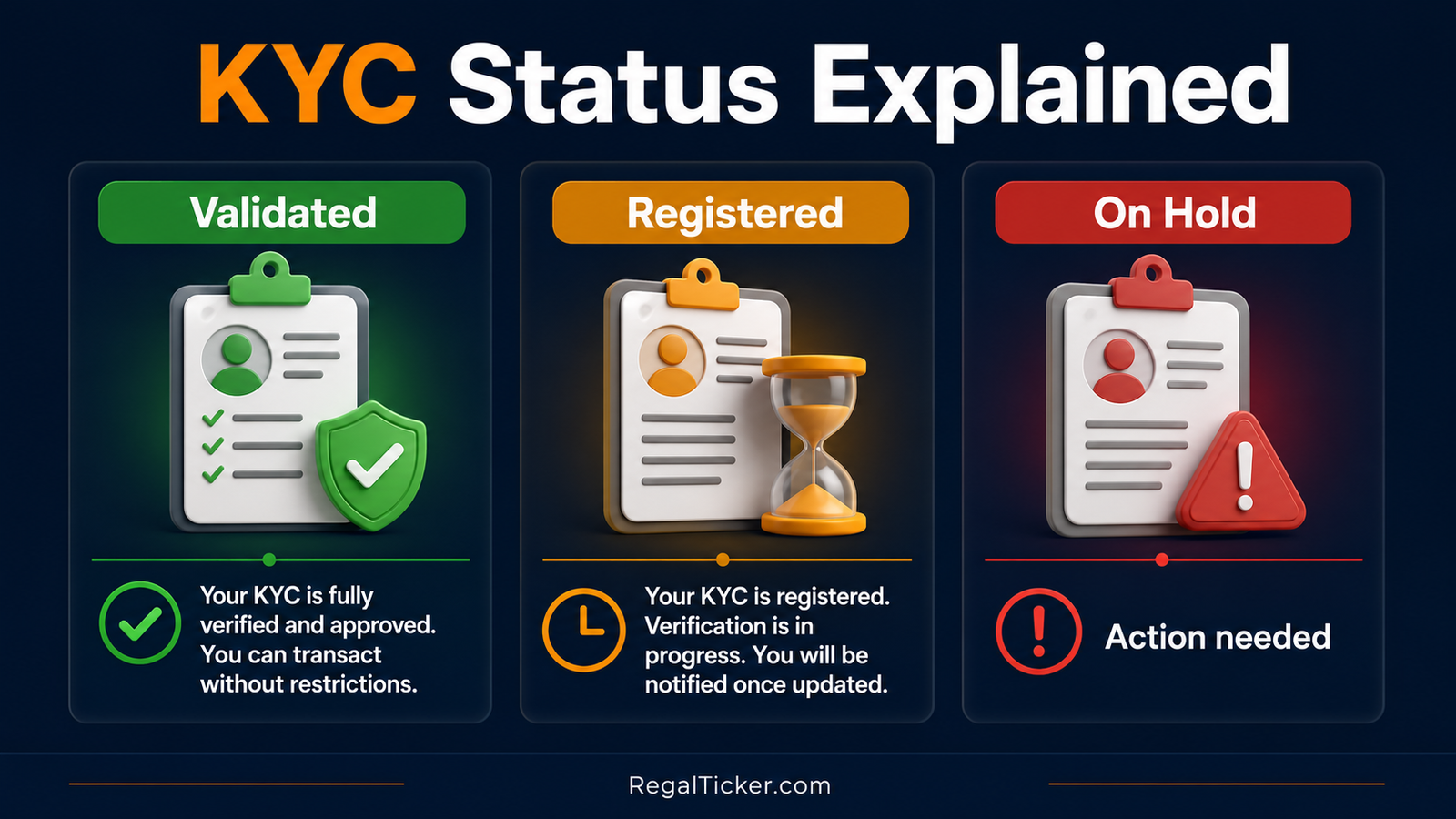
KYC Validated
The KYC record has attained the relevant validated status. This generally supports portability across intermediaries under the applicable framework.
KYC Registered
The record is registered, but a fresh intermediary or transaction context may require additional steps or validation, depending on current rules and the record.
KYC On Hold or Rejected
The record needs attention. Reasons can include unvalidated mobile or email, PAN-Aadhaar issues where applicable, or deficient documents. The exact reason should be checked and corrected through the intermediary or KRA-directed process.
CVL KRA provides a PAN-based status inquiry and explains that a result may display as Validated, Registered or On Hold.
Common reasons for KYC delay or rejection
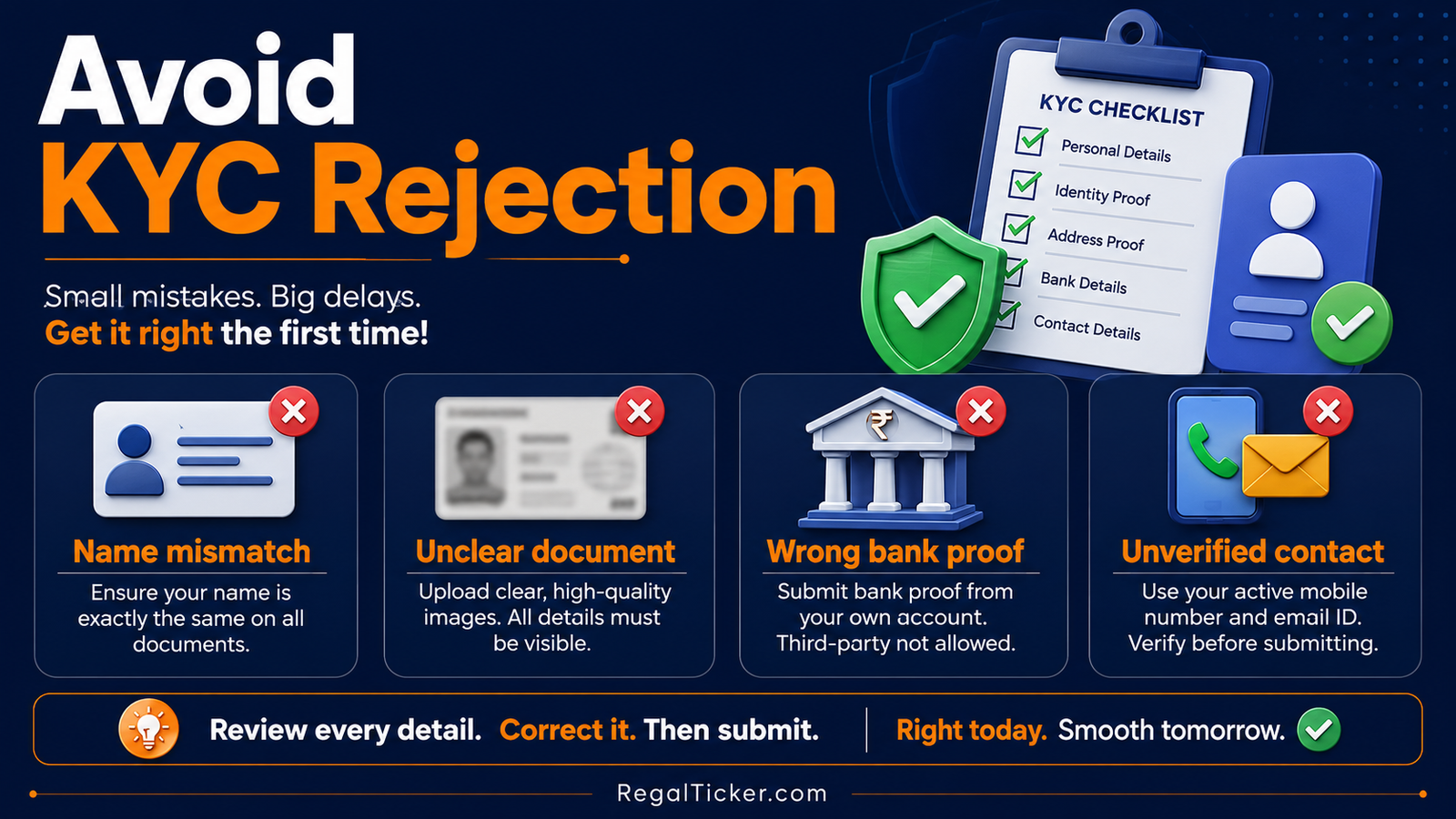
Name mismatch
The spelling or sequence of the name differs across PAN, address proof, bank proof and the application.
Unclear or incomplete documents
An image is blurred, cropped, expired, password-protected or missing a required page.
Address mismatch
The application shows a current address but the evidence shows an older address without permitted supporting proof.
Unverified contact details
The mobile number or email has not been confirmed, belongs to another person or was entered incorrectly.
PAN-related problem
The PAN is entered incorrectly, is inoperative under applicable requirements or does not match the applicant.
Bank-proof problem
The account holder name is absent or different, or the account number and IFSC are unclear.
Failed IPV
The face is not visible, the recording is unclear or the applicant does not follow the live verification prompt.
How to fix a KYC problem
- Read the exact deficiency or status reason.
- Correct the underlying detail rather than repeatedly uploading the same file.
- Use the intermediary’s official modification or re-KYC process.
- Validate mobile and email when requested.
- Submit a clearer or updated proof.
- Track the result through the intermediary or an official KRA status facility.
Do not pay an unknown person who promises to “unlock” KYC. Use official channels, preserve acknowledgement records and escalate through the intermediary’s grievance process if a correct request remains unresolved.
When should KYC be updated?
Update your KYC or account records when material details change, including:
- Address
- Mobile number
- Name
- Bank account
- Income range where an update is due
- Tax residency or related declarations
The method may be an account modification, KYC modification or re-KYC depending on the field and current framework. Do not assume changing a detail in a trading app automatically updates every connected record.
KYC safety rules every investor should follow
- Enter your own mobile number and email
- Use only official websites or verified apps
- Never share OTPs, passwords, PINs or depository authorisation codes
- Read documents before e-signing
- Download a copy of executed forms
- Check exchange and depository alerts
- Report unknown account-opening activity immediately
- Regularly review holdings and transactions
SEBI advises investors to read documents carefully before signing and to keep track of their Demat portfolio. You can use RegalTicker Investor Tools for calculations, but never enter confidential account credentials into an unauthorised tool.
KYC, CKYC and bank KYC are not automatically identical
Different financial sectors use connected but distinct regulatory systems and records. Completing KYC with a bank does not necessarily mean a securities intermediary requires no further onboarding, account forms or verification. Similarly, securities-market KYC does not itself open a trading or Demat account.
Think of KYC as the verified identity foundation. Account opening adds the service-specific agreement, bank link, segment choices, nomination and intermediary records.
Frequently Asked Questions
Is KYC compulsory for a Demat and trading account?
Yes, an intermediary must complete applicable client identification and KYC requirements before establishing the account relationship.
Is PAN required for stock market KYC?
PAN is a core mandatory document and identifier for ordinary securities-market account opening, subject to limited regulatory exceptions that may apply in specific situations.
Can stock market KYC be completed online?
Many intermediaries provide online KYC using digital document submission, OTP verification, electronic signing and video or permitted electronic IPV. Availability depends on the applicant and onboarding route.
What is IPV in KYC?
IPV means in-person verification. It confirms that the applicant is the person completing KYC. It may be conducted through an accepted video or electronic process.
How can I check my KYC status?
Use an official KRA status-inquiry facility or ask your registered intermediary. A KRA inquiry typically uses PAN and a security verification step.
Does KYC expire?
KYC is not a one-time excuse to ignore outdated records. Intermediaries may request revalidation, modification or updated information under current rules, especially when details or documents change.
Is income proof compulsory for everyone?
Income-range information is part of securities KYC. Separate documentary income proof is commonly requested for derivatives or specified segments rather than every basic cash-equity account.
Can I use someone else’s mobile number for KYC?
Use your own mobile number and email. Direct control of these contacts is important for verification, alerts and account security.
Conclusion
Stock market KYC works best when your documents are clear, your identity details match and your contact information belongs to you. Treat the process as an investor-protection record, not a formality to rush through.
Once KYC and account opening are complete, your next learning step is to understand how orders work before placing one. The next Demat & Trading lesson will explain market, limit, stop-loss and stop-limit orders.