

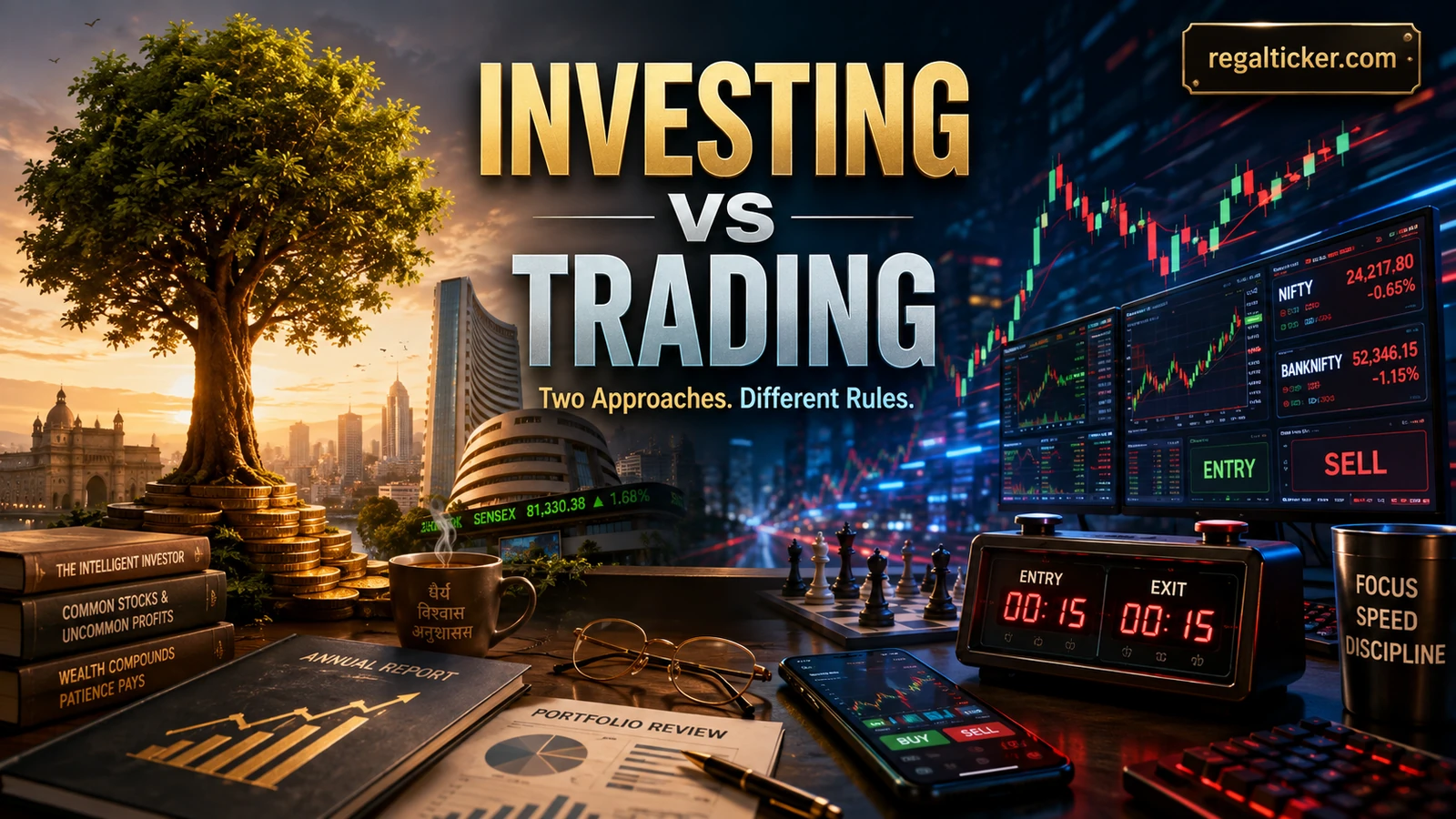
Investing and trading can involve buying the same share through the same broker, yet the reason for entering the position can be completely different. An investor usually wants to participate in the long-term growth and cash flows of a business. A trader usually wants to benefit from a defined price move over a shorter period.
The difference is therefore not simply “years versus days.” It is the decision system behind the position: why you bought, what evidence supports the idea, how risk is controlled, what would make you exit and how success is measured.
⚡ Quick answer
Investing generally means owning securities with a long-term thesis based on business quality, valuation, growth, income or diversification. Trading generally means taking positions to benefit from shorter-term price movements using a defined setup, entry, risk limit and exit plan.
Neither approach guarantees profit. Investing can fail because the business, valuation or portfolio construction is poor. Trading can fail because the setup, execution, position size or discipline is poor. The most dangerous mistake is to enter as a trader and, after the price falls, quietly change the label to “long-term investment” without doing the research that a real investment requires.
Key takeaways
Investing and trading are different processes, not merely different holding periods.
Investors usually focus on business quality, financials, valuation, diversification and long-term outcomes.
Traders usually focus on price behaviour, liquidity, volatility, entry, stop-loss, target and position sizing.
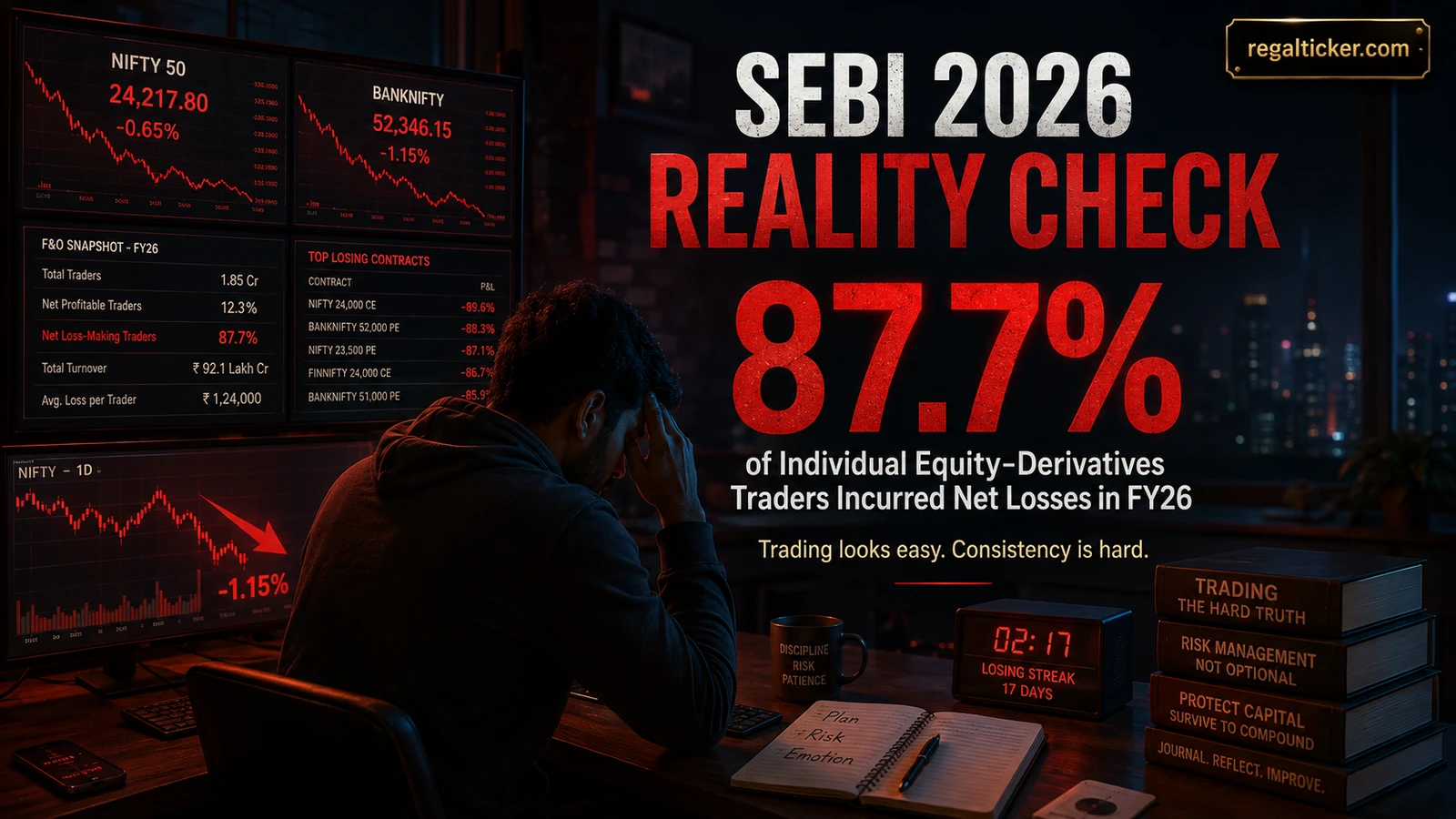
SEBI’s FY25–FY26 study found that 87.7% of individual traders in the equity derivatives segment incurred net losses in FY26, showing how difficult active leveraged trading can be.
A delivery position is not automatically an investment; delivery is a product/settlement choice, while investing is an approach.
A losing trade does not become an investment simply because you hold it longer.
Investors and traders both need risk controls, records and realistic expectations.
Frequent trading can make brokerage, statutory charges, slippage and taxes more important to net results.
Long-term investors should still review whether the investment thesis and valuation remain sensible.
A person can invest and trade at the same time, but the capital, rules and records should be separated.
The better approach is the one that matches your objective, time, knowledge, temperament and capacity for loss.
Investing vs Trading at a Glance
The easiest way to understand the difference is to compare the purpose behind the position.
| Factor | Investing | Trading |
|---|---|---|
| Primary objective | Participate in long-term business value creation and/or income | Benefit from shorter-term price movement |
| Typical horizon | Usually years | Minutes, days, weeks or sometimes months |
| Main research | Business, financial statements, industry, management, valuation | Price, volume, trend, volatility, liquidity, setup |
| Monitoring | Periodic thesis and portfolio review | Often frequent or continuous |
| Exit logic | Thesis changes, valuation, allocation or goal changes | Setup invalidation, stop, target or time-based exit |
| Main risk controls | Diversification, allocation, valuation and thesis discipline | Position sizing, stop-loss, risk-reward and execution discipline |
| Transaction frequency | Usually lower | Usually higher |
| Cost sensitivity | Costs still matter | Costs and slippage can compound quickly |
| Emotional challenge | Patience through volatility | Fast decisions, losses, overtrading and revenge trading |
| Measurement | Total return, CAGR, income and goal progress | Net result across a series of trades after costs |
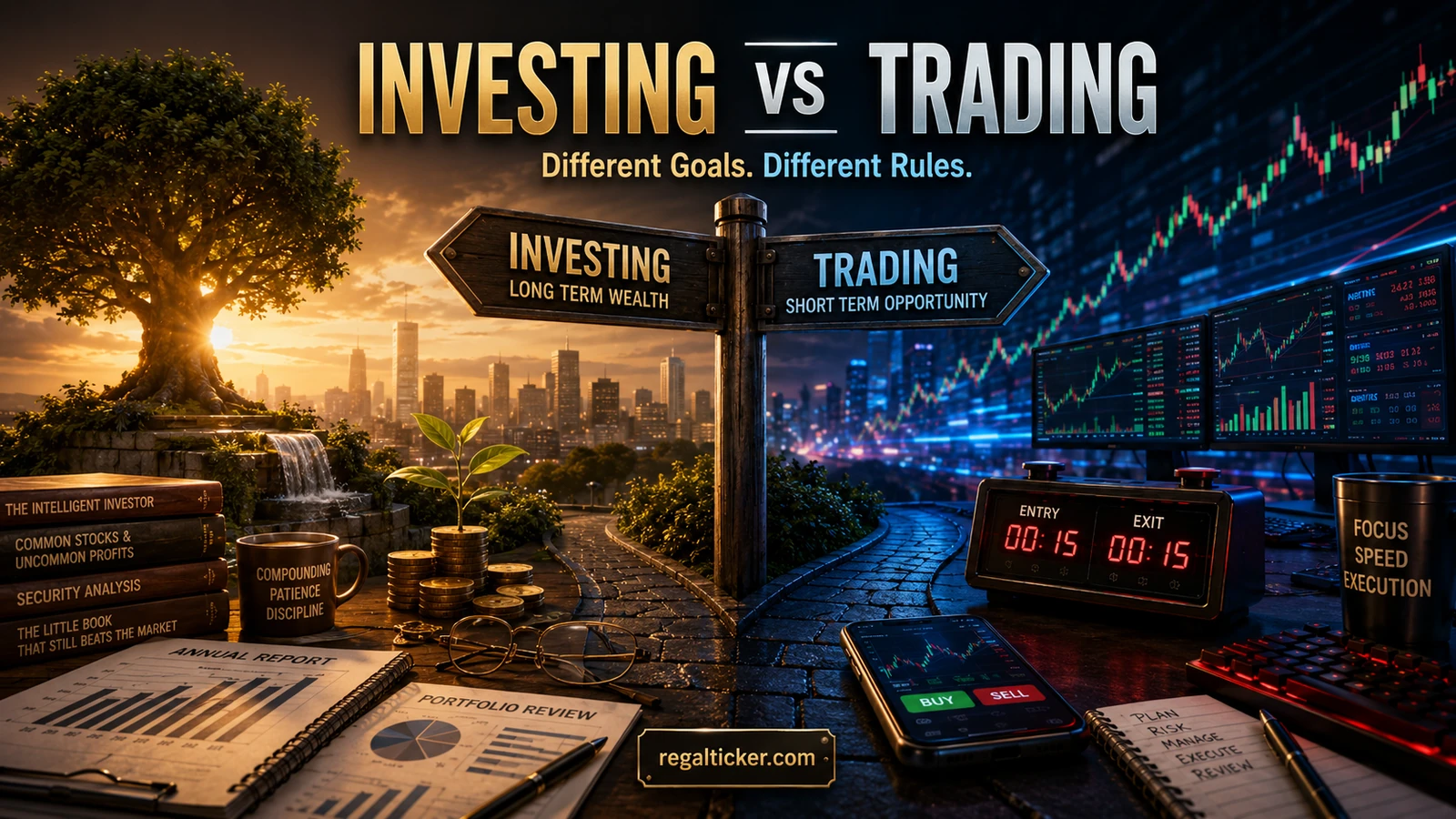
These are broad patterns, not rigid legal categories. An investor may rebalance after a few months. A position trader may hold for several weeks. What matters most is why the position exists and what rules govern it.
SEBI 2026 Reality Check: Most Individual Equity-Derivatives Traders Lost Money
SEBI’s latest profitability study for FY25–FY26 gives beginners an important reality check before treating trading as an easy route to fast returns.
In FY26, 87.7% of individual traders in India’s equity derivatives segment incurred net losses. Their aggregate net losses were approximately ₹91,685 crore.
That means roughly 88 out of every 100 individual equity-derivatives traders in the study ended the year with a net loss.
The figure should be interpreted carefully. It applies specifically to individual traders in equity derivatives such as futures and options. It does not mean that 87.7% of long-term investors, delivery investors or every type of cash-market trader lost money.
The lesson is broader: frequent activity, leverage, transaction costs, poor position sizing and weak discipline can make active trading much harder than it appears from screenshots of winning trades or social-media claims.
Caution
Trading opportunity and trading probability are not the same thing
Markets offer trading opportunities every day, but opportunity does not guarantee a profitable process. Before using leverage or increasing trade frequency, understand position sizing, maximum loss, transaction costs and how a strategy performs across many trades—not just the best examples.
What Is Investing?
Investing means committing capital to an asset because you expect its value, income or usefulness in a portfolio to develop over time.
In the stock market, a long-term equity investor is buying an ownership interest in a real business. The share price will move every day, but the investor’s main question is usually not “Will this stock rise tomorrow?” It is closer to:
Is this a good business, what could it earn in the future, what risks could damage it, and is the current price sensible relative to that value?
A long-term investor may study:
- the company’s products, services and competitive position;
- revenue, profit and cash-flow trends;
- debt and balance-sheet strength;
- management quality and capital allocation;
- industry structure and regulatory risks;
- valuation relative to expected business performance;
- portfolio concentration and diversification.

That process is covered in more depth in What Is Fundamental Analysis?.
Investing does not mean “buy and forget”
Long-term investing requires patience, but patience is not the same as refusing to change your mind.
A valid investment thesis can weaken because:
- the company loses its competitive advantage;
- earnings quality deteriorates;
- debt becomes excessive;
- management behaviour raises governance concerns;
- industry economics change;
- the valuation becomes difficult to justify;
- your own financial goal or allocation changes.
A falling price does not automatically mean the thesis is broken, but neither does a long holding period make a weak business safe.
Investor note
Important point
Long-term thinking should extend the time available for a sound thesis to develop. It should not extend the life of an idea after the thesis has clearly failed.
How investors pursue returns
Equity investors may benefit from:
- growth in the underlying business;
- reinvestment of earnings;
- dividends;
- changes in valuation;
- compounding when gains remain invested.
For a specific stock holding, the Stock Return Calculator can help measure total return and annualised performance, including dividends and entered costs.
If you want to compare investments held for different periods, use the CAGR Calculator to express the start-to-end change as an annualised rate.
Neither calculator tells you whether a company is good or whether future returns will repeat. They measure outcomes; they do not replace research.
What Is Trading?
Trading means taking positions primarily to benefit from price movement over a shorter timeframe.
A trader may hold a position for minutes, days, weeks or sometimes months depending on the strategy. The key distinction is that the trade normally begins with a defined market setup and invalidation condition, rather than a long-term business-ownership thesis.
A trader may study:
- market trend and structure;
- support and resistance;
- trading volume;
- liquidity and bid-ask spread;
- volatility;
- catalysts or events;
- entry price;
- stop-loss or invalidation level;
- target or exit condition;
- position size.
If you are learning chart structure, the deeper technical lesson is Trend Analysis: Uptrend, Downtrend and Sideways Market.
Trading also depends heavily on execution. Understanding How Share Prices Are Decided helps explain why the visible market price is not a promise that your order will fill at that level.
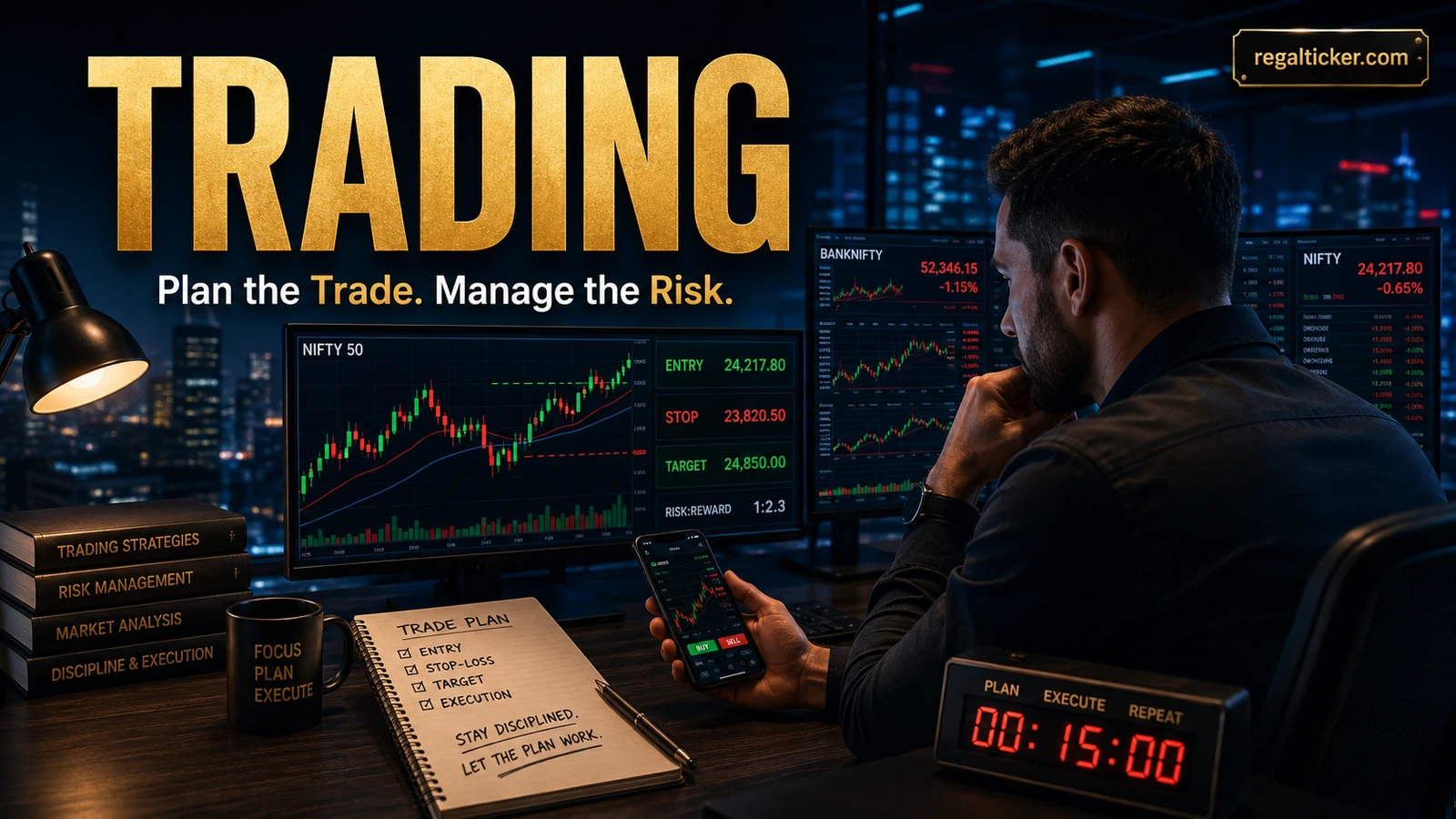
Entry, stop and target are connected
A trade should not be planned as:
> “I like this chart, so I will buy first and think about risk later.”
The entry price, invalidation point and potential target should be considered together.
💡 Real example
A trade planned before entry
Suppose a trader considers buying a share at ₹500.
Planned entry: ₹500 Stop-loss: ₹480 Planned target: ₹550 Risk per share: ₹20 Potential reward per share: ₹50
The trader can then decide whether the potential reward is reasonable relative to the planned risk and whether the position size fits the amount of capital they can afford to lose.
The Risk-Reward Calculator can map the entry, stop, target and account impact before a position is opened.
A favourable risk-reward ratio does not make a trade profitable by itself. Probability, execution, liquidity, position sizing and consistency still matter.
The Real Difference Is the Decision Framework
Beginners often reduce investing vs trading to one sentence:
Investing is long term; trading is short term.
That is directionally useful but incomplete.
1. Purpose
An investor normally wants ownership exposure to a business or diversified asset over time.
A trader normally wants to capture a price move.
Two people can therefore buy the same company at the same price for completely different reasons.
2. Research question
An investor may ask:
> What is this business worth, and can its value grow?
A trader may ask:
> What is price doing, where is the setup wrong, and is the potential reward worth the risk?
The questions are different, so the evidence needed to answer them is also different.
3. Exit logic
An investor may sell because:
- the thesis breaks;
- valuation becomes excessive;
- a better allocation is available;
- the position becomes too large;
- the underlying goal changes.
A trader may exit because:
- the stop is hit;
- the pattern is invalidated;
- the target is reached;
- momentum changes;
- the planned holding window ends.
4. Monitoring
A diversified long-term investor may review periodically rather than watch every tick.
A trader may need to monitor price and risk continuously depending on the strategy.
5. Behaviour under a falling price
This is where beginners most often mix the two systems.
An investor may tolerate a temporary decline if the thesis remains valid and the position still fits the portfolio.
A trader may need to exit a fundamentally good company because the price setup has failed.
Neither response is automatically correct outside the process that created the position.
Holding Period Matters — But It Does Not Define Everything
Holding period is visible, so it receives the most attention.
An investor may hold for years because business value can take time to develop. A temporary market decline may not change the long-term thesis.
A trader may hold for a few hours or several weeks as long as the setup remains valid.
But consider these two examples:
Person A: buys a share for a two-week breakout trade and keeps it for three years after the stop was ignored.
Person B: buys the same share after studying the business and valuation, with a multi-year thesis, and sells after six months because a major governance issue destroys that thesis.
Person A held longer, but that does not make the original decision an investment. Person B held for less time, but the decision process was clearly investment-oriented.
Time is evidence of the approach, not the definition of the approach.
How Returns Should Be Measured
Investors and traders can both make the mistake of looking only at gross profit.
For an investor
Useful questions include:
- What is the total return including dividends?
- What is the annualised return over the actual holding period?
- Did the result beat a relevant benchmark?
- Was the risk consistent with the goal?
- Did portfolio concentration become excessive?
Use the Stock Return Calculator for position-level total return and the CAGR Calculator for a simple annualised comparison when there are no intermediate cash flows.
For a trader
One winning trade proves very little.
A trading process should be evaluated across a meaningful series of trades after considering:
- losses;
- brokerage and statutory charges;
- slippage;
- taxes;
- position size;
- drawdown;
- consistency of rule-following.
A strategy with many small wins and occasional uncontrolled losses can still be poor. A strategy with a lower win rate can still be viable if gains and losses are controlled appropriately.
Investor note
The useful question is not “How often am I right?” It is “What happens to capital after wins, losses, costs and risk are all counted?”
Risk, Costs and Taxes
Both investing and trading can lose money.
Common investing risks
- Business risk: earnings, competitive position or industry economics deteriorate.
- Valuation risk: a strong company is purchased at an unjustifiably high price.
- Concentration risk: too much capital is committed to one company, sector or theme.
- Governance risk: management or disclosure quality deteriorates.
- Liquidity risk: a position cannot be exited efficiently.
- Goal mismatch: money needed soon is exposed to equity volatility.
- Behavioural risk: the investor reacts emotionally to market headlines.
Common trading risks
- Position-size risk: one trade is large enough to damage the account.
- Gap risk: price moves beyond the intended stop.
- Execution risk: slippage or insufficient liquidity worsens the exit.
- Leverage risk: a small market move creates a large capital impact.
- Overtrading: excessive activity creates low-quality decisions and high costs.
- Revenge trading: a loss triggers a larger or impulsive follow-up trade.
- Strategy drift: rules change after the trade is already losing.
Market conditions can amplify these emotions. Review Bull, Bear and Sideways Markets to understand how optimism, fear and impatience can change behaviour across market regimes.
Caution
Neither “long term” nor “stop-loss” makes a process automatically safe
A long holding period cannot repair a weak business or excessive valuation. A stop-loss cannot guarantee the exact exit price in a gap or fast market. Risk must be controlled at the portfolio or position level before the outcome is known.
Costs, Slippage and Taxes Matter
Trading usually involves more transactions, so small costs can become important when repeated many times.
A stock-market transaction can involve:
- brokerage;
- Securities Transaction Tax where applicable;
- exchange transaction charges;
- SEBI turnover fees;
- GST;
- stamp duty;
- depository/DP charges where applicable;
- bid-ask spread;
- slippage and market impact.
The exact cost depends on the product, exchange, broker, order behaviour and current statutory rates.
Before assuming that a small gross profit is worthwhile, estimate the transaction impact using the Brokerage Calculator.
For a deeper explanation of explicit and hidden execution costs, read Brokerage, STT, Exchange Charges and Other Trading Costs.
Tax treatment is not determined by one simple label
Tax treatment can depend on the asset, holding period, transaction facts and whether the activity is treated as investment or business income under applicable law.
Do not assume:
- every short holding is taxed in exactly the same way;
- every long holding receives identical treatment;
- changing the word “trade” to “investment” changes the tax facts.
For eligible listed-equity transactions, the Capital Gains Tax Calculator can help classify a gain using the entered dates and current calculator assumptions. Complex or business-income situations may require a qualified tax professional.
SEBI Investor also advises investors to understand applicable charges and brokerage, keep records and choose products according to investment objectives and risk appetite.
The Failed Trade → “Investment” Trap
This deserves its own section because it is one of the most damaging beginner behaviours.
The pattern often looks like this:
- A share is bought for a short-term move.
- No clear exit rule is followed.
- The price falls.
- The trader does not want to accept the loss.
- The position is renamed a “long-term investment.”
- Fundamental research is performed only after the loss has already become uncomfortable.
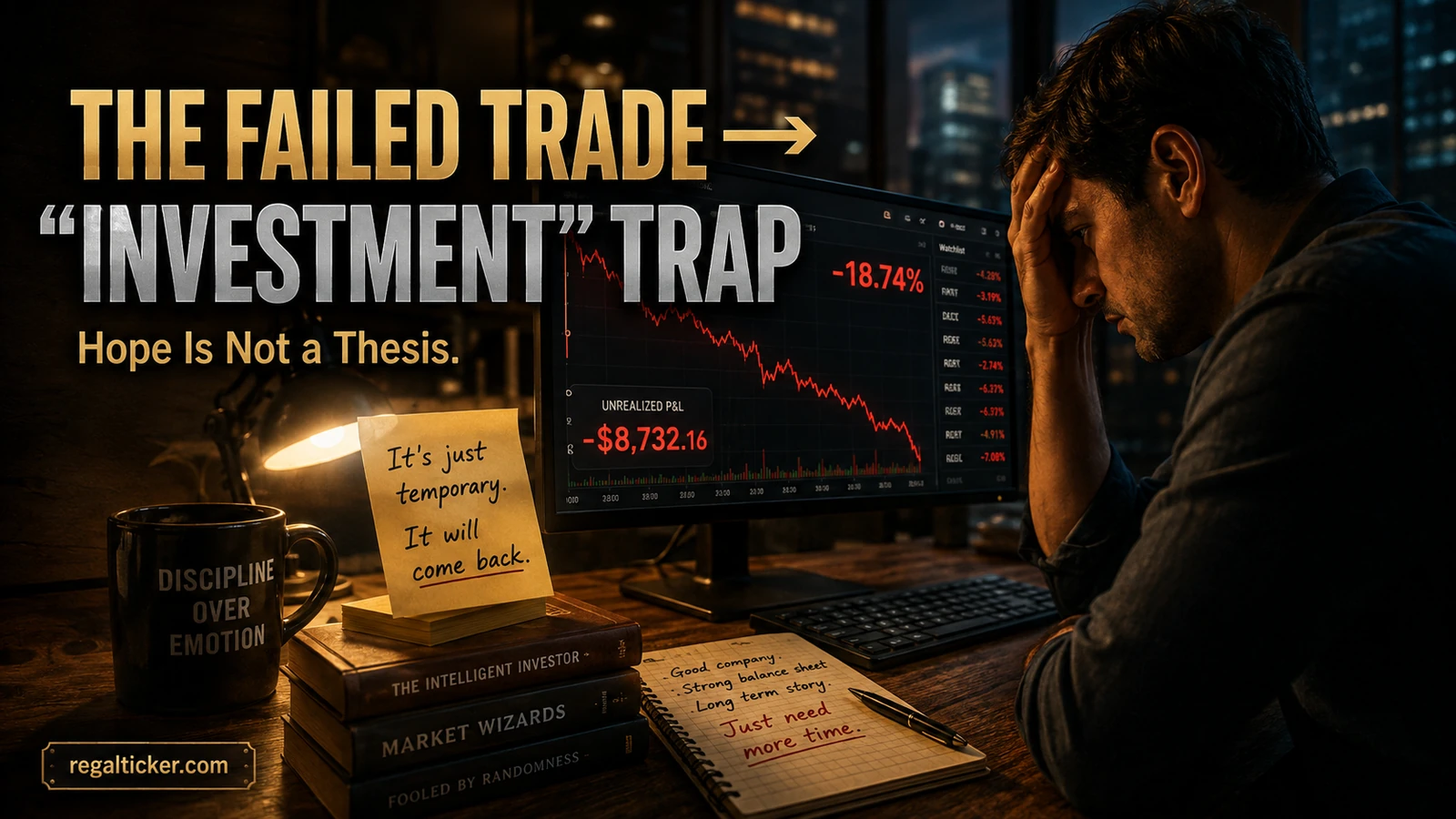
The problem is not that holding through a decline is always wrong. The problem is that the decision system changed after the market moved against the position.
Caution
Hope is not a new investment thesis
If a position began as a trade, do not remove the stop and call it an investment simply because the price fell. A genuine investment thesis should be based on business quality, valuation, risk and portfolio fit—not on the desire to avoid recognising a loss.
What should happen instead?
If a trade fails, evaluate it according to the trading plan.
If you genuinely want to consider the company as a long-term investment, start a new analysis from zero:
- understand the business;
- study the financials;
- review management and governance;
- assess industry risk;
- estimate valuation;
- decide what portfolio weight is sensible.
Do not let the purchase price force the conclusion.
Is Delivery Trading the Same as Investing?
No.
This distinction deserves to be explicit because beginners often use the words interchangeably.
Delivery describes how the equity position is carried and settled. Investing describes the objective and decision process.
You can buy a share using a delivery product and sell it two days later because of a short-term price view. That is not automatically long-term investing.
You can also buy a delivery share with a multi-year thesis based on business quality and valuation.
For settlement, leverage, ownership and same-day square-off mechanics, use the dedicated guide Delivery Trading vs Intraday Trading.
That page owns the product mechanics. This lesson owns the investor vs trader decision framework.
Can You Be Both an Investor and a Trader?
Yes.
The approaches are not mutually exclusive, but mixing the records and rules creates problems.
A person might:
- keep a diversified long-term investment portfolio;
- separately allocate a smaller amount to a tested trading process.

The important word is separately.
Before entering any position, label it:
- Investment or trade?
- Why am I entering?
- What research supports it?
- What is the time horizon?
- How much capital is allocated?
- What would make me exit?
- What is the maximum acceptable loss?
- How will I measure the result?
💡 Real example
One person, two separate systems
Rohan keeps ₹8 lakh in a long-term diversified equity portfolio. He reviews business results, valuation and allocation periodically.
Separately, he allocates ₹1 lakh to a trading account. Each trade has a predefined entry, stop, target and position-size rule.
A fall in a trading position does not allow him to transfer the trade mentally into the ₹8 lakh investment portfolio. The two systems have separate capital, records and decision rules.
This separation does not guarantee success, but it prevents one strategy from quietly absorbing the mistakes of the other.
Which Approach May Fit Different Goals?
There is no universal answer.
Ask yourself:
What is the objective?
If the goal is long-term wealth building, ownership and participation in business growth, an investment process may be more aligned.
If the goal is to develop an active strategy for shorter-term market opportunities, trading may be the relevant process.
How much time can you commit?
Investing still requires research and review, but it does not normally require constant screen monitoring.
Many trading styles demand more frequent attention, preparation and record-keeping.
What knowledge are you building?
Investors commonly need business-analysis, accounting, industry and valuation skills.
Traders commonly need market-structure, technical-analysis, execution and risk-management skills.
How do you react to losses?
Both approaches involve losses, but the behavioural pressure is different.
An investor may struggle with panic during a broad market decline.
A trader may struggle with rapid losses, missed trades, overtrading and revenge trading.
Have you calculated costs?
Frequent turnover can make charges and slippage important. Measure them before deciding that an active strategy is producing a meaningful edge.
Are you choosing based on hype?
Do not choose trading because it looks fast.
Do not choose investing because the word “long term” sounds automatically safe.
Choose the process that matches your goal, time, knowledge, risk capacity and temperament.
Common Mistakes and What to Learn Next
1. Starting without defining the position
If you cannot say whether the position is an investment or trade before entering, the exit rules will probably become emotional later.
2. Buying a “good company” at any valuation
A strong business can still produce poor returns if expectations are already excessive.
3. Trading without a maximum loss
A setup without defined risk is incomplete.
4. Using leverage before mastering position sizing
Leverage increases exposure; it does not improve the quality of the setup.
5. Ignoring transaction costs
Gross profit is not net profit.
6. Copying tips
A position taken from someone else’s tip gives you no reliable thesis when the price moves against you.
SEBI Investor specifically warns against making decisions based on hot tips and advises dealing through registered intermediaries.
7. Changing the plan after entry
Moving a stop farther away, averaging automatically or changing a trade into an investment after a loss are forms of strategy drift.
8. Measuring only the winners
Review the complete record: wins, losses, costs, drawdown and rule-following.
Continue Learning
Investing and trading are only two roles inside a much larger market ecosystem.
The next Stock Market Basics lesson, Who Participates in the Stock Market?, explains how retail investors, traders, institutions, brokers, exchanges, clearing corporations, depositories and SEBI interact.
If you want to go deeper by approach:
- Investors can continue with What Is Fundamental Analysis?.
- Traders can continue with Trend Analysis: Uptrend, Downtrend and Sideways Market.
- Both should understand Market Order, Limit Order, Stop-Loss and Stop-Limit Order.
- Both should understand the broader Stock Market Risk Checklist.
Frequently Asked Questions
What is the simplest difference between investing and trading?
Investing generally seeks to participate in long-term business value creation or income. Trading generally seeks to benefit from shorter-term price movements using a defined setup and risk plan.
Is trading just short-term investing?
No. Time horizon is only one difference. Trading normally uses different research, risk controls, monitoring and exit logic.
No. Delivery is a product and settlement choice. Investing is an approach based on objective, research, time horizon and decision rules.
Is investing safer than trading?
Not automatically. A concentrated or overvalued investment can be highly risky. Trading can also create severe losses through leverage, poor position sizing, gaps and weak discipline. The risks are different and must be managed appropriately.
Is trading the same as gambling?
A researched trading process with defined risk, position sizing and repeatable rules is not the same as pure chance. However, tip-based speculation, uncontrolled leverage and impulsive activity can become gambling-like behaviour.
Can a failed trade become a long-term investment?
Only after a genuinely independent investment analysis supports that decision. Simply holding because the price fell does not create an investment thesis.
Can I invest and trade at the same time?
Yes, but it is sensible to keep the capital allocation, objective, research, records and exit rules clearly separated.
Which is better for beginners: investing or trading?
There is no universal answer. The appropriate path depends on goals, time, knowledge, risk capacity and temperament. A beginner should first understand how markets, orders, costs and risk work before committing meaningful capital.
Which tools are useful for investors and traders?
Investors may use the Stock Return Calculator and CAGR Calculator to measure performance. Traders may use the Risk-Reward Calculator to plan entry, stop and target. Both can use the Brokerage Calculator to understand transaction costs, while eligible listed-equity investors can use the Capital Gains Tax Calculator for tax estimates.
Verify through official sources
Official references
Educational disclaimer: This article is for education and financial awareness only. It is not investment advice, trading advice or a recommendation to buy, sell or hold any security. Market-linked investments can lose value. Trading can result in rapid losses, particularly when leverage is used. Verify current broker rules, charges, tax treatment and regulatory information through official sources before acting.