The benchmark rose again, but Friday was not another broad rally
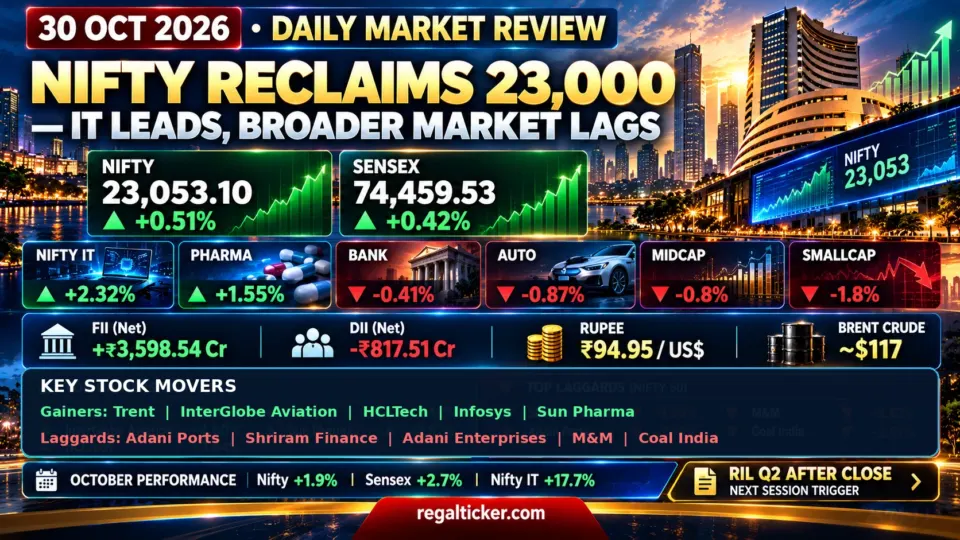
Nifty 50 closed above 23,000 for the first time in the current rebound, gaining 116.35 points to 23,053.10, up 0.51%. Sensex added 308.49 points to 74,459.53, up 0.42%.
The green close looks like a straightforward continuation of Thursday’s rebound. Underneath the indices, however, the market changed character.
Nifty IT surged 2.32% and pharma gained roughly 1.55%, while Bank Nifty fell 0.41%, Nifty Auto lost 0.87%, Midcap 100 declined about 0.8% and Smallcap 100 fell around 1.8%. NSE breadth was weak, with substantially more declining stocks than advancing stocks.
So Friday’s message is different from the 29 October review. Thursday was broad. Friday was a large-cap, technology-and-healthcare-led advance.
⚡ Quick answer
What moved the Indian stock market on 30 October 2026?
Nifty gained 0.51% to 23,053.10 and Sensex rose 0.42% to 74,459.53 as IT and pharma shares outweighed weakness across banks, autos, energy and the broader market. Nifty IT rose 2.32%, while Midcap 100 and Smallcap 100 fell about 0.8% and 1.8%. FIIs were strong cash-market buyers at ₹3,598.54 crore, the rupee strengthened to ₹94.95 per dollar, but Brent climbed toward $117 as Middle East supply risk intensified.
Key takeaways
Nifty 50 closed at 23,053.10, up 116.35 points or 0.51%.
Sensex ended at 74,459.53, up 308.49 points or 0.42%.
Nifty IT gained 2.32%; pharma rose about 1.55%.
Bank Nifty fell 0.41% and Nifty Auto lost 0.87%.
Nifty Midcap 100 fell about 0.8% and Smallcap 100 about 1.8%.
Trent was the biggest Nifty gainer, up 5.44%.
InterGlobe Aviation, HCLTech, Infosys and Sun Pharma were also among the leading gainers.
Adani Ports, Shriram Finance, Adani Enterprises, M&M and Coal India were among the laggards.
Provisional cash-market data showed FIIs buying ₹3,598.54 crore while DIIs sold ₹817.51 crore.
The rupee strengthened to ₹94.95 per dollar and finished October with its best monthly gain in eight months.
Brent rose about 2% to roughly $117.14, keeping India’s oil risk elevated.
For October, Nifty gained 1.9% and Sensex 2.7%, ending a two-month losing streak.
Nifty IT surged 17.7% in October, its strongest month in more than six years.
Midcaps and smallcaps still fell 3.4% and 4.2% for the month despite the large-cap recovery.
1. Closing scorecard: Nifty above 23,000, breadth below the surface
| Market measure | 30 Oct close / move |
|---|---|
| Nifty 50 | 23,053.10 (+0.51%) |
| Sensex | 74,459.53 (+0.42%) |
| Bank Nifty | 54,686.95 (-0.41%) |
| Nifty IT | 32,606.90 (+2.32%) |
| Nifty Pharma | 27,124.85 (+1.55%) |
| Nifty Auto | 25,422.70 (-0.87%) |
| Nifty Midcap 100 | about -0.8% |
| Nifty Smallcap 100 | about -1.8% |
The benchmark milestone is visually important: Nifty reclaimed 23,000.
But market breadth matters more for portfolio interpretation. Moneycontrol’s market dashboard showed only 881 NSE advances versus 2,383 declines at the close.
That means a large number of individual stocks did not participate in the headline gain.
Friday therefore belongs in the category of “index up, portfolio experience mixed”—the exact kind of session where investors should look beyond the benchmark.
2. IT was the engine of the rally
Nifty IT rose 2.32%, becoming the strongest major sector of the day.
HCLTech and Infosys were among the leading Nifty gainers, while the sector also ended October with a 17.7% monthly gain, its best month in more than six years.
Reuters linked the month’s IT strength to relatively reasonable valuations and growing evidence that AI-related work is beginning to contribute to efficiency and revenue opportunities.
That does not mean the AI transition is settled.
RegalTicker’s Anthropic IPO analysis focuses on the enterprise-AI demand side, while the HBM shortage article shows how hardware demand is tightening the physical AI supply chain.
Indian IT sits downstream from both trends. The investment question is whether companies turn AI into billable revenue and margins—not whether global AI headlines are simply positive.
3. Pharma helped; banks and autos did not
Pharma rose about 1.55%, giving the benchmark a second defensive-growth engine.
Bank Nifty, by contrast, slipped 0.41%, while autos fell 0.87%.
That sector split explains why the headline indices could rise while the broader market weakened.
Technology and healthcare can carry large index weight even when domestic cyclicals and financials are soft. Investors should therefore avoid reading Friday’s green close as proof that domestic risk appetite strengthened across the board.
The Fundamental Analysis path becomes useful in this kind of rotation because the market is rewarding earnings and sector-specific visibility rather than simply lifting everything together.
4. Trent became the session’s clearest earnings-led winner
Trent rose 5.44%, making it the biggest Nifty gainer in the closing scorecard.
InterGlobe Aviation, HCLTech, Infosys and Sun Pharma were also among the leading gainers.
The common thread was not one sector. It was company-specific or earnings-linked buying.
That is increasingly important in the September-quarter season. With valuations no longer expanding uniformly, the market is rewarding businesses that can demonstrate demand, margins and execution while punishing disappointments more aggressively.
Friday therefore reinforces the same lesson as Thursday: earnings quality is becoming more important than a generic market narrative.
5. The broader market lag is the main caution signal
Midcaps fell about 0.8% and smallcaps about 1.8%.
For October as a whole, the divergence is even sharper: Reuters reported midcaps down 3.4% and smallcaps down 4.2%, even as Nifty gained 1.9% and Sensex 2.7%.
This is a meaningful regime difference.
Large-cap indices can recover because a handful of technology, banking or heavyweight stocks rerate. Smaller stocks depend more heavily on liquidity, valuation tolerance and broad risk appetite.
The Risk Management path is more relevant here than assuming a 23,000 Nifty automatically means every portfolio should be recovering at the same speed.
Investor note
Nifty above 23,000 does not mean breadth is healthy
Friday’s advance was narrow enough that many portfolios may have fallen even while the benchmark rose. Watch whether midcaps, smallcaps and banks rejoin the move before treating the index breakout as a fully broad market recovery.
6. FIIs turned into strong buyers while DIIs sold
Provisional cash-market data showed:
| Investor group | 30 Oct net flow |
|---|---|
| FII / FPI | +₹3,598.54 crore |
| DII | -₹817.51 crore |
That is almost the mirror image of Thursday, when FIIs sold and DIIs bought.
The foreign buying is encouraging because October had been defined by persistent foreign outflows. Moneycontrol estimated October’s total FII outflow at roughly ₹45,162 crore despite the late-month improvement.
One strong buying day therefore does not erase the month.
But it does strengthen the case that foreign activity is becoming more two-way rather than mechanically negative. If that continues alongside a firmer rupee and strong earnings, the flow backdrop could improve meaningfully.
7. The rupee had its best month in eight months
The rupee strengthened to about ₹94.95 per dollar on Friday from roughly ₹95.26 in the previous session.
Reuters calculated that the currency gained around 1% in October, its strongest monthly performance since February.
RBI measures to reduce spot-market dollar pressure from oil companies, intervention and tighter currency-market management helped.
That is significant because the rupee improved even while oil stayed expensive.
But the currency risk has not disappeared. A sustained crude price above $110 can increase importer dollar demand and put pressure back on the current account and inflation expectations.
The stronger rupee is therefore a stabiliser, not immunity.
8. Brent near $117 limited the celebration
Brent crude rose about 2% to $117.14 per barrel as renewed Middle East supply risks intensified.
Oil was on track for a fourth consecutive monthly gain.
This is the uncomfortable contradiction in Friday’s market.
India’s equities closed higher and the rupee strengthened, yet one of the country’s most important macro inputs became more expensive.
The crude-oil and Hormuz analysis remains the essential background: higher crude can hit inflation, the current account, the rupee and corporate margins through different channels and at different speeds.
If Brent remains around $117, it can cap how much relief lower global yields or stronger earnings provide.
9. October ended positive—but the leadership was extremely uneven
For the month:
- Nifty 50 gained 1.9%.
- Sensex rose 2.7%.
- Nifty IT surged 17.7%.
- Midcaps fell 3.4%.
- Smallcaps fell 4.2%.
That is not a normal “market up” month.
It was a large-cap and technology-led recovery inside a weaker broader market.
Reuters noted that TCS, Infosys, HCLTech and Tech Mahindra gained roughly 16%–22% during October. Jio Platforms also rose strongly after its listing.
The key lesson is leadership concentration. When one sector carries the index, investors need to ask whether the move can broaden or whether future returns depend on that same narrow group continuing to outperform.
10. Reliance’s post-close results become Monday’s biggest domestic trigger
Reliance Industries reported its Q2 results after Friday’s market close.
The company delivered a record quarter, with consolidated revenue around ₹3.62 lakh crore, EBITDA about ₹62,409 crore, and reported profit around ₹29,550 crore in the company’s results coverage. Reuters separately reported strong consolidated profit growth and highlighted a major improvement in the oil-to-chemicals business as energy markets remained tight.
Because the results arrived after the Indian cash market closed, they cannot explain Friday’s index move.
They belong to the next session, Monday 2 November.
That timing distinction matters. A daily market review should not use after-close information to rewrite the causes of a session that was already finished.
For Monday, watch how Reliance trades alongside Jio Platforms, oil prices and the broader index.
11. What to watch on Monday, 2 November
First, watch Reliance Industries and Jio Platforms after the post-close results.
Second, watch whether Nifty IT can hold its leadership after a 17.7% monthly surge. Momentum is strong, but the bar for future earnings delivery is rising.
Third, watch breadth. Friday’s advance was narrow. A healthier continuation would bring banks, autos, midcaps and smallcaps back into the move.
Fourth, watch Brent crude near $117. Oil remains the clearest threat to India’s improving currency and foreign-flow backdrop.
Fifth, watch FII follow-through. Friday’s ₹3,598.54 crore cash-market buying was strong, but persistence matters more than one session.
Finally, use the weekend to separate market narratives from company economics. The Cash Flow Statement guide and Fundamental Analysis path are useful when earnings season is moving individual stocks more than the index itself.
Frequently asked questions
Where did Nifty close on 30 October 2026?
Nifty 50 closed at 23,053.10, up 116.35 points or 0.51%.
Where did Sensex close?
Sensex ended at 74,459.53, up 308.49 points or 0.42%.
Which sector led the market?
Nifty IT led with a 2.32% gain, while pharma also advanced.
Was the broader market strong?
No. Midcaps fell about 0.8%, smallcaps about 1.8%, and declining NSE stocks substantially outnumbered advancing stocks.
Were FIIs buyers?
Yes. Provisional cash-market data showed FII net buying of ₹3,598.54 crore, while DIIs sold ₹817.51 crore.
How did October finish?
Nifty gained 1.9% and Sensex 2.7% for October, while Nifty IT surged 17.7%. Midcaps and smallcaps still declined for the month.
What is the biggest trigger for Monday?
Reliance Industries’ Q2 results, released after Friday’s close, are one of the biggest domestic triggers for the next session, alongside crude oil, IT leadership and market breadth.
Verify through official sources
Official references
- Reuters — Indian shares end October higher — Closing levels, October performance, IT leadership, broader-market monthly divergence and key earnings themes.
- Moneycontrol — Taking Stock 30 October — Closing index levels, sector moves, mid/smallcap performance, top movers and rupee close.
- Moneycontrol — Market dashboard — NSE breadth, sector snapshots and closing market dashboard.
- Trendlyne — 30 October provisional FII/DII cash activity — FII net buying of ₹3,598.54 crore and DII net selling of ₹817.51 crore.
- Moneycontrol — 30 October FII/DII activity — October foreign-flow context and 30 October provisional cash figures.
- Reuters — Rupee 30 October — Rupee close, October performance and RBI measures.
- Reuters — Oil 30 October — Brent near $117 and Middle East supply-risk context.
- Moneycontrol — Reliance Q2 FY27 results — Post-close Reliance revenue, EBITDA and profit figures for the next-session watch-list.
- Reuters — Reliance Q2 — Independent current reporting on Reliance’s post-close Q2 performance.
Final takeaway
Nifty reclaimed 23,000, but breadth is the weekend question
Friday delivered an important benchmark milestone and a powerful finish to a strong month for IT. Foreign cash buying and a firmer rupee added support.
Yet the market underneath was weaker than the index: midcaps and smallcaps fell, breadth was negative, banks and autos lagged, and crude climbed back toward $117.
That makes Monday’s question simple. If Reliance results, IT leadership and foreign buying pull the broader market higher, the rebound becomes healthier. If Nifty rises while most stocks continue to fall, 23,000 will be a strong index level sitting on increasingly narrow participation.
Educational disclaimer: RegalTicker provides educational and informational content only. This daily market review is not investment advice, a trading signal or a recommendation to buy or sell any security. Market prices, commodity prices, exchange rates and provisional institutional-flow figures can change or be revised. Verify current exchange, issuer and regulator information before making financial decisions.