
This rebound was broader than the previous session
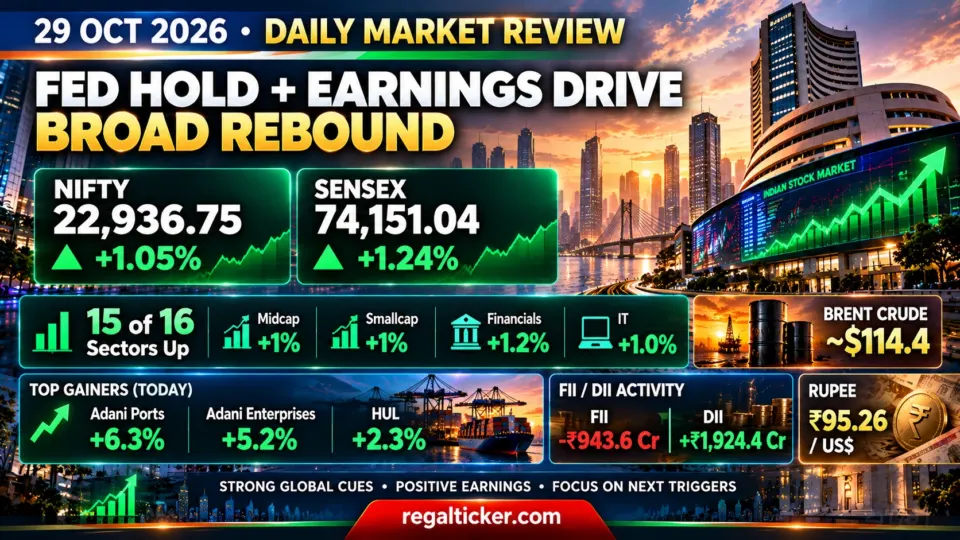
Indian equities finally converted the resilience visible underneath Wednesday’s market into a strong benchmark rebound. Nifty 50 rose 237.90 points to 22,936.75, up 1.05%, while Sensex gained 905.01 points to 74,151.04, up 1.24%.
The important part was breadth. Fifteen of the 16 major sectors advanced, while Nifty Midcap 100 and Smallcap 100 each rose about 1%. Financials and IT both participated, making Thursday very different from the narrow or rotation-heavy sessions seen earlier in the week.
The trigger mix was constructive rather than euphoric: the Federal Reserve held its policy rate at 3.75%–4.00%, corporate earnings supported stock-specific buying, and Brent eased to around $114.4 during the session. That relief came after the 28 October review, when IT and oil pressure had dragged the benchmarks even as the broader market held up.
⚡ Quick answer
Why did the Indian stock market rise on 29 October 2026?
Nifty gained 1.05% to 22,936.75 and Sensex rose 1.24% to 74,151.04 as the Fed kept rates unchanged, oil eased modestly and strong quarterly earnings improved risk appetite. Fifteen of 16 major sectors advanced, midcaps and smallcaps gained about 1%, and financials and IT rose around 1.2% and 1% respectively. Adani Ports jumped 6.3% after stronger results and an upgraded operating-profit outlook.
Key takeaways
Nifty 50 closed at 22,936.75, up 237.90 points or 1.05%.
Sensex ended at 74,151.04, up 905.01 points or 1.24%.
Fifteen of 16 major sectors advanced.
Nifty Midcap 100 and Smallcap 100 gained about 1% each.
Financial stocks rose about 1.2% and IT about 1%.
Adani Ports gained 6.3%; Adani Enterprises rose 5.2%; HUL added 2.3%.
Power Grid gained 3.4% and NTPC 2.2%.
Brent crude eased about 0.8% to roughly $114.4 during the session.
The rupee closed almost unchanged at about ₹95.26 per U.S. dollar after recovering from a two-week low.
Provisional cash-market data showed FII net selling of ₹943.60 crore and DII net buying of ₹1,924.41 crore.
The Fed held the target range at 3.75%–4.00%, but two policymakers preferred a 25-basis-point hike.
1. Closing scorecard: a broad risk-on session
| Market measure | 29 Oct close / move |
|---|---|
| Nifty 50 | 22,936.75 (+1.05%) |
| Sensex | 74,151.04 (+1.24%) |
| Nifty Midcap 100 | about +1% |
| Nifty Smallcap 100 | about +1% |
| Financials | about +1.2% |
| Nifty IT | about +1.0% |
| Major sectors advancing | 15 of 16 |
Thursday’s advance matters because it was not produced by one heavyweight or one defensive sector. The participation across large caps, financials, IT and the broader market made it a more convincing rebound than a simple index bounce.
For investors following the sequence day by day, the Market hub is useful because the last three sessions show three different market structures: Tuesday was nearly flat, Wednesday was red at the index level but resilient underneath, and Thursday produced a broad-based rebound.
2. The Fed removed one immediate uncertainty—but did not turn dovish
The Federal Reserve held the federal-funds target range at 3.75%–4.00%, as widely expected.
That helped because the market did not receive an unexpected rate increase after weeks of concern that expensive oil could keep inflation pressure elevated. But the statement was not a clean “risk-on” signal.
The Fed said inflation remained elevated and that it wanted more information before determining the appropriate stance. Two members dissented in favour of a 25-basis-point increase.
So the useful interpretation is not “the Fed is easing.” It is that one immediate uncertainty passed without a surprise hike.
RegalTicker’s Fed October 2026 guide explains why the next transmission still runs through U.S. yields, the dollar, foreign flows and global risk appetite.
3. Oil relief helped India, but $114 is still expensive
Brent crude fell about 0.8% to roughly $114.4 per barrel during Thursday’s market session.
For India, even a small decline matters when oil is coming from a highly elevated base. A lower crude price reduces immediate anxiety around the import bill, inflation expectations and the rupee.
But $114 oil is not benign.
The crude-oil and Hormuz analysis remains the better framework: the question is not whether crude falls $1 on one day, but whether supply risk, freight, insurance and the rupee combine to keep India’s landed energy cost structurally high.
That is why the market could rebound strongly while oil remained one of the biggest macro risks.
4. Adani Ports became the day’s clearest earnings winner
Adani Ports rose 6.3% after reporting stronger quarterly performance and lifting its operating-profit guidance.
The company said Q2 FY27 revenue increased 24% and EBITDA rose 23%, and it raised its FY27 revenue and EBITDA guidance bands by ₹1,000 crore each.
The market response matters beyond one stock because ports are an economic-throughput business. Cargo, logistics, marine services and international assets provide a real-economy read on trade and infrastructure activity.
That also creates a natural connection to the new India container-manufacturing scheme analysis: domestic container capacity, port throughput and logistics growth are separate businesses, but they sit inside the same long-term trade infrastructure chain.
5. Adani Enterprises, HUL and power stocks broadened the rally
Adani Enterprises gained about 5.2% after strong quarterly earnings.
Hindustan Unilever rose 2.3% as investors balanced higher profit against commodity-cost pressure.
Power Grid gained 3.4% and NTPC advanced 2.2%, supported by expectations of stronger electricity demand.
The important point is that the gainers came from different sectors—ports, diversified infrastructure, consumer staples and power. That breadth reinforced the message from the sector data: this was not a one-theme rebound.
Investor note
Broad participation is useful, but one strong day does not repair the whole trend
Nifty and Sensex had lost about 2% over the previous seven sessions before Thursday’s rebound. A broad rally improves the short-term tone, but investors still need confirmation from earnings, crude, flows and follow-through rather than treating one session as a new bull trend.
6. FII and DII flows sent different messages
Provisional cash-market data showed:
| Investor group | 29 Oct net flow |
|---|---|
| FII / FPI | -₹943.60 crore |
| DII | +₹1,924.41 crore |
That is a useful reminder that a market can rally strongly even when foreign cash investors are net sellers for the day.
Domestic institutions were the stronger cash-market support on Thursday. At the same time, foreign activity had become less one-sided than earlier in October, with several positive sessions in the preceding week.
The October FPI outflow analysis remains useful context: crude, the rupee, valuation and global yields still determine whether foreign buying becomes durable.
Daily FII/DII data are context, not a complete explanation of the index.
7. The rupee stabilised after touching a two-week low
The rupee closed around ₹95.26 per U.S. dollar, almost unchanged from the previous session after touching a two-week low earlier in the day.
Likely RBI intervention, fading dollar demand and softer oil helped the currency recover.
That stabilisation supported equities because the rupee and crude have been working together as India’s main macro pressure pair. High oil raises dollar demand from importers; a weaker currency increases the local cost of those imports.
Thursday did not solve that problem. It simply stopped it from worsening during the session.
8. IT joined the rebound—but the AI story still needs selectivity
Indian IT rose about 1% on Thursday.
That participation is important because IT had been one of Wednesday’s largest drags. But the sector remains caught between two powerful forces.
On one side, global AI demand is supporting cloud, infrastructure and transformation spending. The Anthropic IPO analysis and HBM shortage article show how intense the global AI infrastructure cycle has become.
On the other side, Indian software-services earnings still depend on actual client budgets, pricing, margins, utilisation and AI-led productivity.
A strong global AI trade does not mean every IT stock should rise together indefinitely.
9. What the market still had to prove on 30 October
The first test after a broad rebound is follow-through.
Nifty had reclaimed 22,900 but still needed to hold above the breakout area rather than surrender the move immediately.
The second test was breadth. A healthy continuation would ideally keep midcaps and smallcaps participating instead of reverting to a narrow large-cap rally.
The third test was crude. A renewed move higher would quickly return India’s import and inflation risk to the centre of the market.
And the fourth test was earnings. With the September-quarter season progressing, individual results were becoming more important than a blanket “market” call.
The Fundamental Analysis path is particularly useful in that environment because earnings quality, cash conversion and guidance can separate winners from stocks simply carried by the index.
10. The session in one sentence
Thursday was the week’s first convincing broad rebound: Fed uncertainty eased, oil softened slightly, earnings supplied stock-specific leadership and 15 of 16 sectors participated.
The caution is that none of the larger macro problems disappeared.
India still had oil above $110, a fragile rupee, heavy October foreign outflows and a global market debating whether AI capital spending and inflation can coexist with higher rates.
That combination means breadth and earnings follow-through matter more than the size of one green candle.
Frequently asked questions
Where did Nifty close on 29 October 2026?
Nifty 50 closed at 22,936.75, up 237.90 points or 1.05%.
Where did Sensex close?
Sensex ended at 74,151.04, up 905.01 points or 1.24%.
Why did the market rise?
The Fed held rates unchanged, oil eased modestly and strong quarterly earnings supported a broad rally across 15 of 16 major sectors.
What happened to Adani Ports?
Adani Ports rose 6.3% after strong quarterly results and an improved operating-profit outlook.
Were FIIs buyers?
No. Provisional cash-market data showed FII net selling of ₹943.60 crore, while DIIs bought ₹1,924.41 crore.
What happened to the rupee?
The rupee recovered from a two-week low and closed almost unchanged near ₹95.26 per U.S. dollar.
Verify through official sources
Official references
- Reuters — Indian shares rebound after Fed hold — Closing levels, sector breadth, Brent, Adani Ports and major market drivers.
- Moneycontrol — Taking Stock 29 October — Closing scorecard, movers, sector participation and broader-market performance.
- Federal Reserve — 28 October FOMC statement — Primary source for the unchanged 3.75%–4.00% target range and dissenting votes.
- Trendlyne — 29 October provisional FII/DII cash activity — FII net selling of ₹943.60 crore and DII net buying of ₹1,924.41 crore.
- Reuters — Rupee 29 October — Rupee close, two-week low, RBI support and oil context.
- Adani Ports — Q2 FY27 investor information — Primary company source for Q2 FY27 results and guidance update.
Final takeaway
The rebound was broad enough to matter, but not broad enough to end the macro debate
Thursday repaired a large part of the damage from the previous session. Nifty and Sensex rallied more than 1%, midcaps and smallcaps participated, and nearly every major sector closed higher.
The strongest signal was breadth; the strongest caution was that oil remained above $110 and foreign cash investors still sold on the day. The next confirmation therefore had to come from follow-through: another session where earnings, breadth and institutional demand—not only one macro headline—kept the rebound alive.
Educational disclaimer: RegalTicker provides educational and informational content only. This daily market review is not investment advice or a trading signal. Market prices, exchange rates, commodity prices and provisional institutional-flow data can change or be revised. Verify current exchange, issuer, regulator and central-bank information before making financial decisions.