

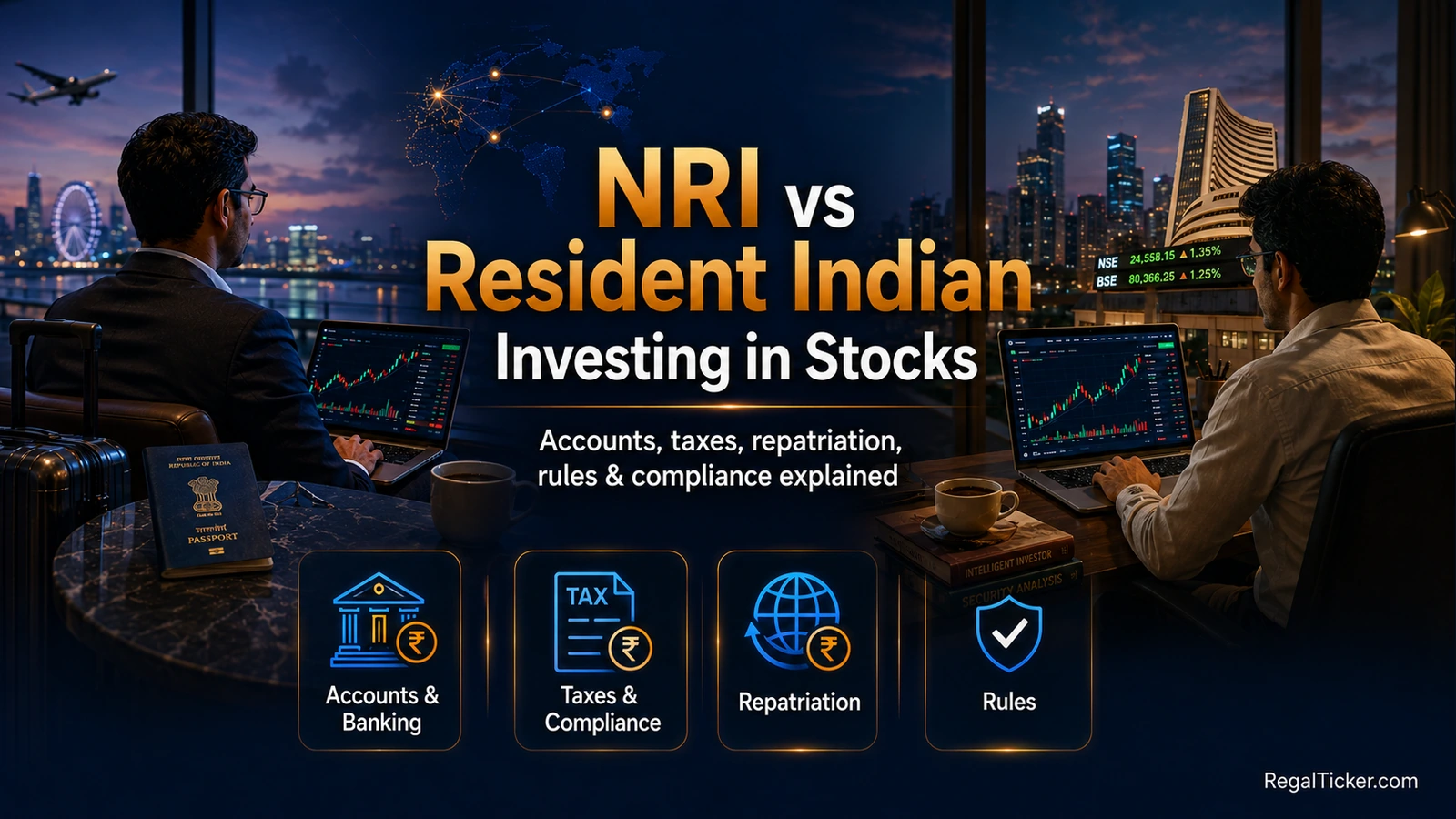
NRI Investing
How accounts, FEMA rules, taxes, repatriation and compliance change when an Indian investor becomes non-resident.
⚡ Quick answer
What changes when a resident Indian investor becomes NRI?
The shares may be the same, but the investing structure changes. A resident investor normally uses a resident bank account linked to regular Demat and trading accounts. An NRI must ensure the banking and securities relationships correctly reflect non-resident status, usually using NRE and/or NRO banking, NRI KYC and the appropriate repatriable or non-repatriable investment route. FEMA becomes important because cross-border money movement and repatriation now matter. Indian capital-gains rates on qualifying listed equity can be the same headline rates for residents and NRIs, but withholding, DTAA, filing and overseas-country reporting can make the NRI tax process more complex.
Key takeaways
The biggest NRI difference is structure, not necessarily the stock or headline capital-gains rate.
FEMA status affects banking, funding, repatriation and the way non-resident investment accounts are operated.
Income-tax residential status is a separate test; do not use one simple day-count rule for every NRI question.
Resident investors use ordinary resident banking, while NRIs generally need correctly classified NRE/NRO and NRI securities relationships.
A PIS route may still matter in certain NRI stock-investing setups, but PIS is not a universal requirement for every NRI investment.
NRIs can access many Indian investment products, but product, country and intermediary restrictions can differ.
Repatriation and record-keeping should be planned before investing, not after the sale.
NRI vs resident Indian investing: the difference at a glance
A person can own the same listed Indian company before and after moving abroad, yet the compliance path surrounding that investment can change materially.
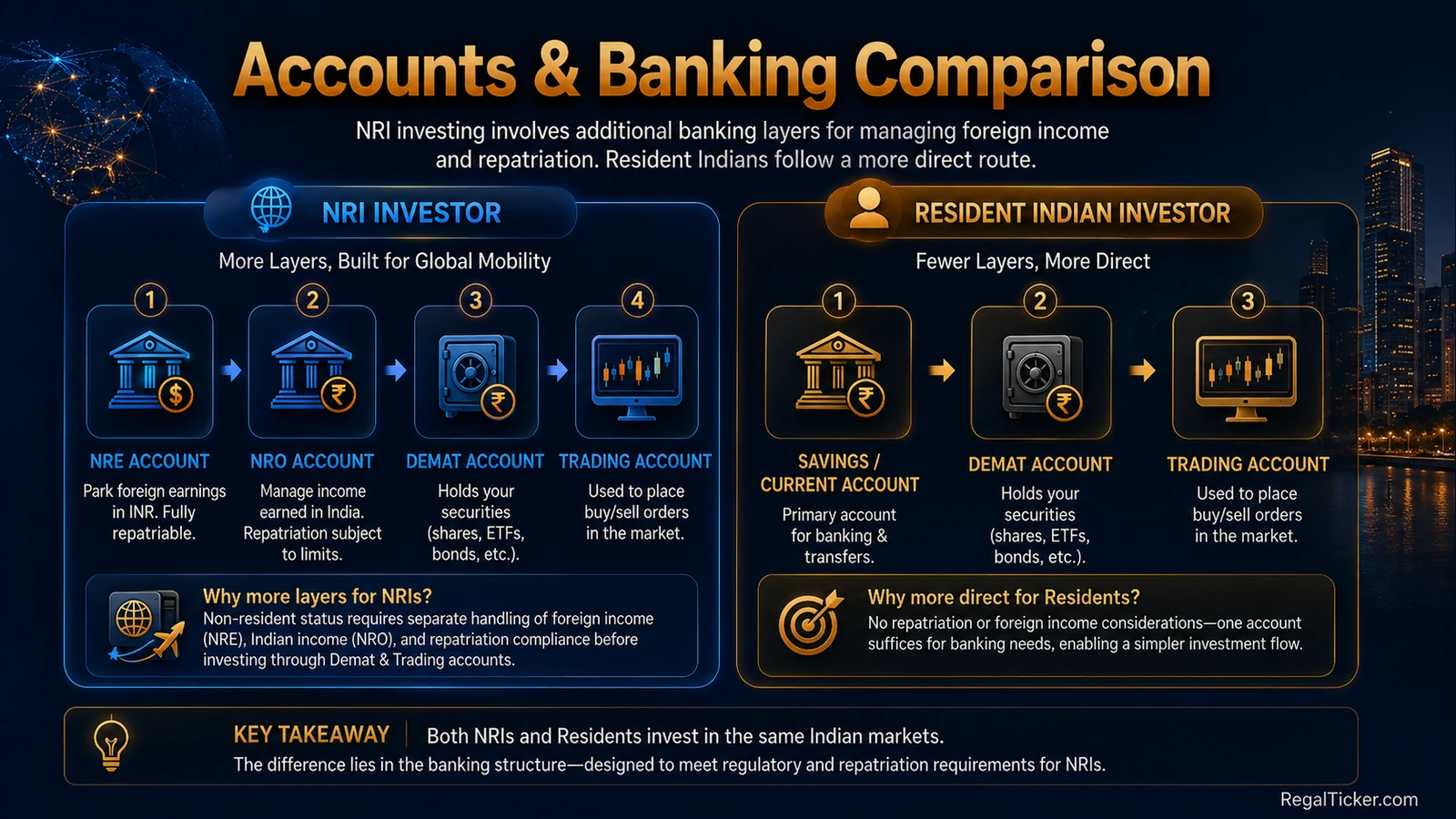
For a resident investor, the flow is usually straightforward:
Resident bank account → trading account → Demat account → buy/sell securities
For an NRI, the flow can involve another layer:
Non-resident status → NRE/NRO bank route → NRI KYC → NRI trading/Demat setup → permitted investment route → tax and repatriation records
That is why simply asking, “Can an NRI buy the same stock as a resident?” is not enough. The better question is:
“Through which account, with which money, under which status, and what happens when the proceeds need to move abroad?”
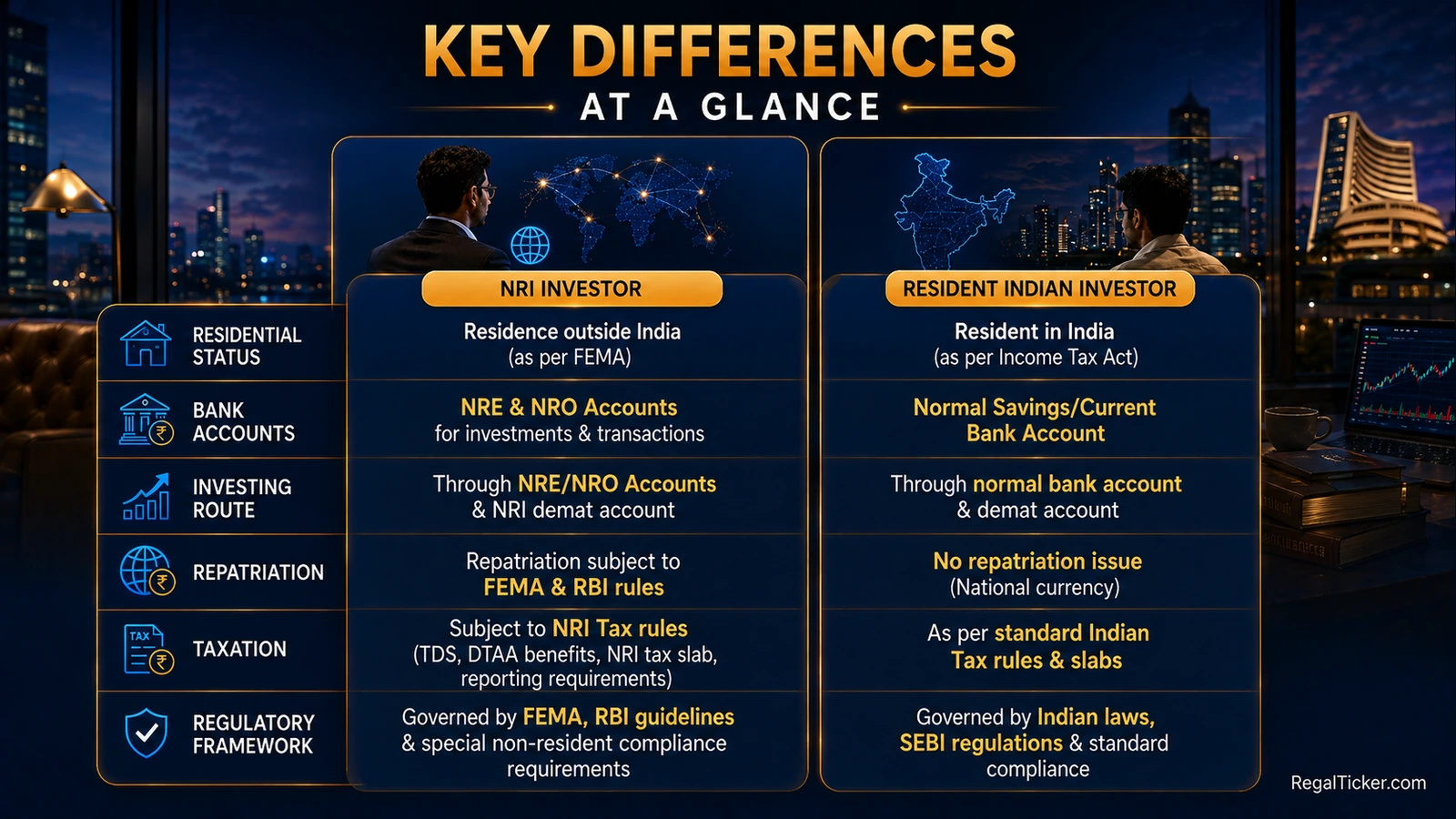
Resident Indian investor
- Banking — Resident savings/current account
- KYC — Resident address/status
- Securities setup — Regular Demat and trading account
- Cross-border rule — FEMA repatriation normally not relevant to an ordinary domestic trade
- Sale proceeds — Remain in the domestic resident banking system unless separately remitted abroad under applicable rules
NRI investor
- Banking — NRE and/or NRO, depending on source and purpose of funds
- KYC — Non-resident status plus overseas address/documentation
- Securities setup — NRI-compatible Demat and trading relationships
- Cross-border rule — FEMA and repatriation route matter
- Sale proceeds — Credited and remitted according to the applicable account and investment route
- The difference is therefore less about which button you press to buy a share and more about the infrastructure around that trade.
First: NRI, resident Indian and OCI are not the same label
Before comparing accounts and tax, separate three concepts that are often mixed together.
Resident Indian
For this guide, a resident Indian investor means someone whose relevant banking/investment relationships are operated as a person resident in India.
A resident investor typically uses normal resident banking and resident Demat/trading relationships. Foreign-exchange rules can still matter when money is sent outside India, but ordinary domestic investing does not have the same NRE/NRO and repatriation structure as NRI investing.
NRI
The Reserve Bank of India describes a Non-Resident Indian (NRI) for its non-resident account framework as a person resident outside India who is a citizen of India.
The important words are:
resident outside India + Indian citizen.
That is different from simply saying someone “travels a lot” or “spends 182 days abroad.” FEMA residence and income-tax residence should be checked separately.
OCI
An Overseas Citizen of India (OCI) cardholder is not the same as an NRI because an NRI is an Indian citizen, while an OCI cardholder is a foreign national with OCI status.
For several FEMA banking and investment purposes, RBI materials group eligible PIO/OCI persons with NRIs. However, do not assume every NRI rule automatically applies in exactly the same way to every OCI transaction. Check the rule for the specific product and activity.
Important terms
Terms used in this section
- NRI — Indian citizen who is resident outside India for the relevant FEMA context.
- OCI — Foreign national holding OCI status; not Indian citizenship.
- FEMA residence — Drives foreign-exchange, non-resident banking and repatriation questions.
- Income-tax residence — Determines tax residence under the Income-tax Act and is tested separately.
Investor note
Do not use “182 days = NRI” as a universal shortcut
Indian income-tax law contains day-count tests and special rules, while FEMA uses its own residence framework and purpose/intention concepts. If you have just moved abroad, returned to India, or divide time between countries, verify the status relevant to the transaction rather than relying on one internet rule.
If your residency position is uncertain, especially in the year you leave India or return permanently, use the detailed FEMA vs Income Tax Residency for NRIs guide before changing your banking or investment setup. FEMA residence and income-tax NR, RNOR or ROR status can produce different answers for the same person.
What changes in your bank accounts after becoming NRI?
This is often the first practical change an investor must handle.
RBI’s current non-resident account FAQ states that when a resident Indian becomes a person resident outside India, the existing resident account should be redesignated as an NRO account.
That means you should not keep using an ordinary resident savings account as if nothing changed after becoming non-resident.
NRE account: mainly for eligible overseas funds
An NRE account is an Indian-rupee non-resident account used for eligible money coming from outside India and other permitted credits. RBI describes NRE balances as repatriable subject to the applicable framework.
For investing, the key benefit is not simply “NRE = tax free bank account.” The investment question is:
Will this route preserve the repatriable character I need for the investment proceeds?
NRO account: mainly for Indian-source rupee money and local obligations
An NRO account is commonly used for legitimate rupee receipts in India and for local payments.
Examples can include eligible rent, pension, interest, dividend and other Indian receipts.
NRO balances have a different remittance framework from NRE balances. This distinction becomes important when you later sell an investment and want to send eligible money overseas.
A resident investor does not need NRE/NRO for ordinary domestic investing
A resident Indian normally links a regular resident bank account to the broker and does not need to classify every stock purchase as repatriable or non-repatriable.
This is one reason NRI investing can feel more complicated even when the actual trade is identical.
For a deeper banking explanation, read NRE vs NRO vs PIS Account.
Demat and trading accounts: same basic jobs, different status setup
A common misconception is that an NRI needs a completely different concept of Demat account.
The job of the accounts is still the same:
- a Demat account holds securities electronically;
- a trading account is used through the broker to place and record eligible buy/sell transactions.
What changes is the status, linked bank route and permitted transaction structure.
If these concepts are new, first read What Is a Demat Account?, What Is a Trading Account?, and Demat Account vs Trading Account vs Bank Account.
NRI KYC requires the overseas status to be visible
NSE’s NRI trading-account FAQ says an NRI client must provide a foreign address with documentary proof at registration. SEBI’s securities-market KYC material also recognises additional non-resident documentation requirements.
The lesson is simple:
Do not leave your securities account classified as resident after your real status has changed.
Update the bank, broker, depository participant and KYC records as required.
PIS vs non-PIS: where the NRI route can differ further
PIS means Portfolio Investment Scheme. It has long been associated with certain NRI listed-share investment routes, particularly repatriable structures routed through designated banking arrangements.
NSE’s current NRI trading FAQ still recognises NRE and NRO based trading relationships and refers to PIS documentation where a PIS-based structure is being used.
But PIS should not be treated as:
- a substitute for a Demat account;
- a substitute for a trading account; or
- a universal requirement for every NRI investment product and every broker route.
Ask these questions before choosing the NRI route
- Will the investment be made on a repatriation or non-repatriation basis?
- Which NRE or NRO account will fund it?
- Does this bank/broker setup use PIS for the intended security?
- Where will dividends and sale proceeds be credited?
- Does the broker support the products and market segments you want?
- What documents will be required when eligible proceeds are sent abroad?
Can NRIs invest in the same products as resident Indians?
Often, yes—but not always through the same route or with the same operational freedom.
Listed equity shares
Both residents and NRIs can invest in eligible Indian listed shares, subject to the rules that apply to their status and the company/security.
The NRI route may involve foreign-investment limits, repatriation classification and bank/broker reporting that do not arise in the same way for a resident investor.
Mutual funds
NRIs can invest in eligible Indian mutual-fund schemes, but fund-house onboarding policies can differ by country of residence. Overseas tax and regulatory obligations—especially in countries with extensive financial-product reporting—can also affect availability.
ETFs
Both residents and NRIs can access eligible exchange-traded funds through the appropriate securities setup. An NRI should confirm that the broker/account route supports the intended ETF and funding method.
IPOs
NRIs can participate in eligible public issues under the applicable investor category and issue terms. The payment route and category should be checked in the offer document rather than assumed from a resident application process.
Bonds, REITs and InvITs
NRIs can access various eligible fixed-income and listed trust products, but taxation and permitted routes can differ by instrument.
Caution
Indian eligibility is only half of a cross-border investment
Your country of residence may impose separate tax, disclosure, estate, sanctions, product-distribution or broker rules. An investment can be permitted in India and still create reporting or tax work abroad.
Tax treatment: NRI vs resident Indian on listed shares
This is where many comparisons go wrong.
People often assume:
> “NRI tax on Indian shares must always be much higher.”
That is too simplistic.
For qualifying listed equity transactions satisfying the relevant conditions, the current Indian headline capital-gains rates can be the same for a resident and an NRI.
Short-term capital gains on qualifying listed equity
For transfers on or after 23 July 2024, the Income Tax Department’s current guidance shows a 20% rate under Section 111A for qualifying short-term gains, subject to the statutory conditions.
Long-term capital gains on qualifying listed equity
For qualifying Section 112A gains on transfers on or after 23 July 2024, the current rate is 12.5% on aggregate qualifying long-term gains above the applicable ₹1.25 lakh annual threshold, subject to the conditions of the section.
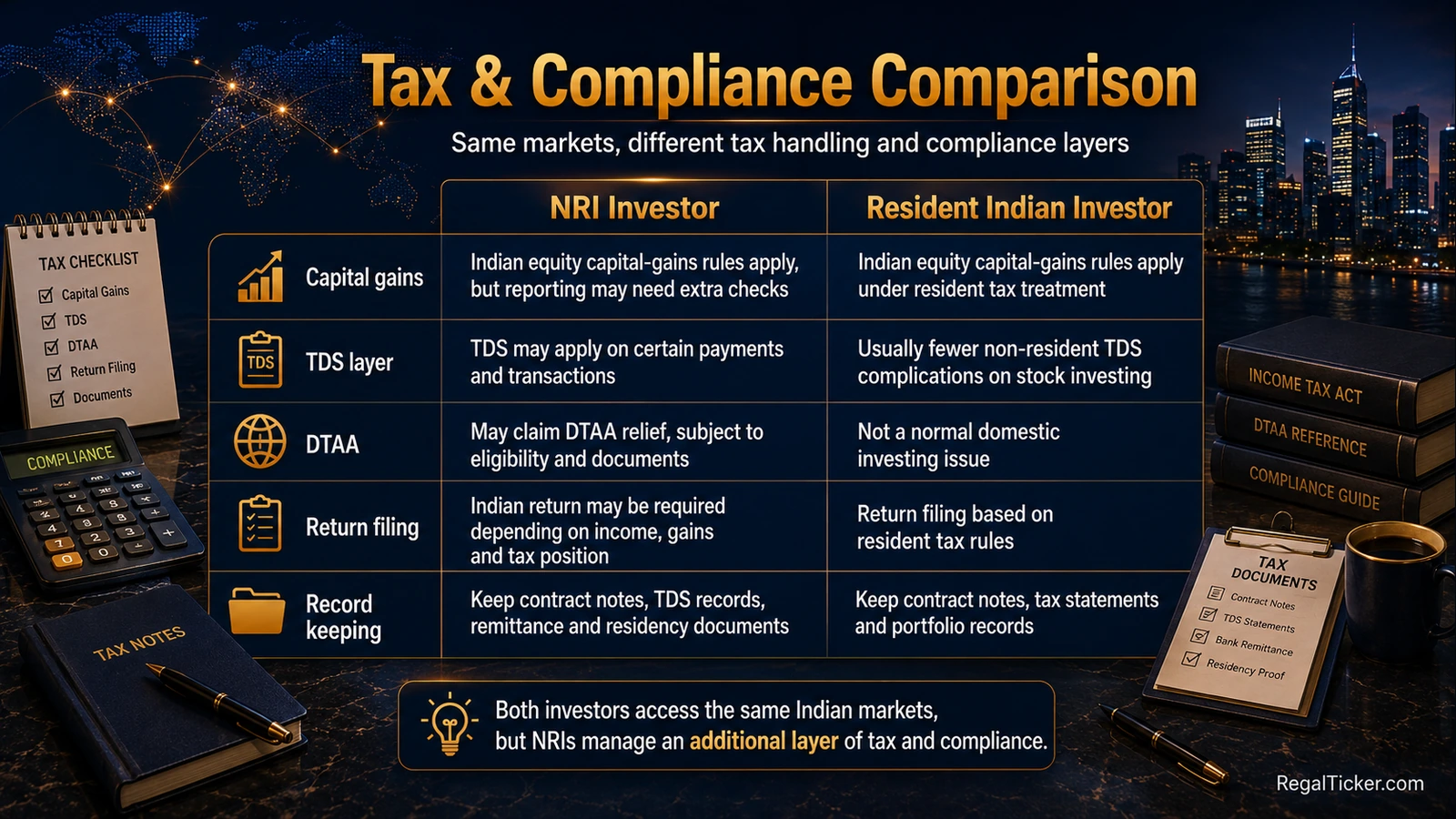
So where does the NRI tax difference appear?
The difference can arise around the rate—not necessarily in the headline rate itself.
An NRI may have to consider:
- tax withholding/TDS depending on the type of payment and transaction;
- special non-resident provisions for certain assets/income;
- Indian tax-return filing;
- DTAA relief;
- foreign tax credit in the country of residence;
- overseas reporting of Indian accounts and investments;
- currency conversion for the foreign tax return;
- and documentation when money is remitted abroad.
A resident investor usually does not have the same treaty and cross-border reporting layer for a purely domestic portfolio.
Investor note
TDS is not the same as final tax
A tax amount withheld during the year does not automatically equal the final Indian tax liability. The return may need to reconcile gains, losses, deductions/credits allowed by law, treaty claims and tax already withheld.
For the deeper NRI tax workflow, use NRI Capital Gains Tax on Indian Shares.
Repatriation: the biggest practical difference after the investment is sold
A resident Indian who sells shares normally receives the money into the domestic banking system. If the resident later wants to send money abroad, that is a separate outward-remittance question.
An NRI often thinks about repatriation from the beginning, because the investment route can affect whether and how eligible proceeds can be moved back to the country of residence.
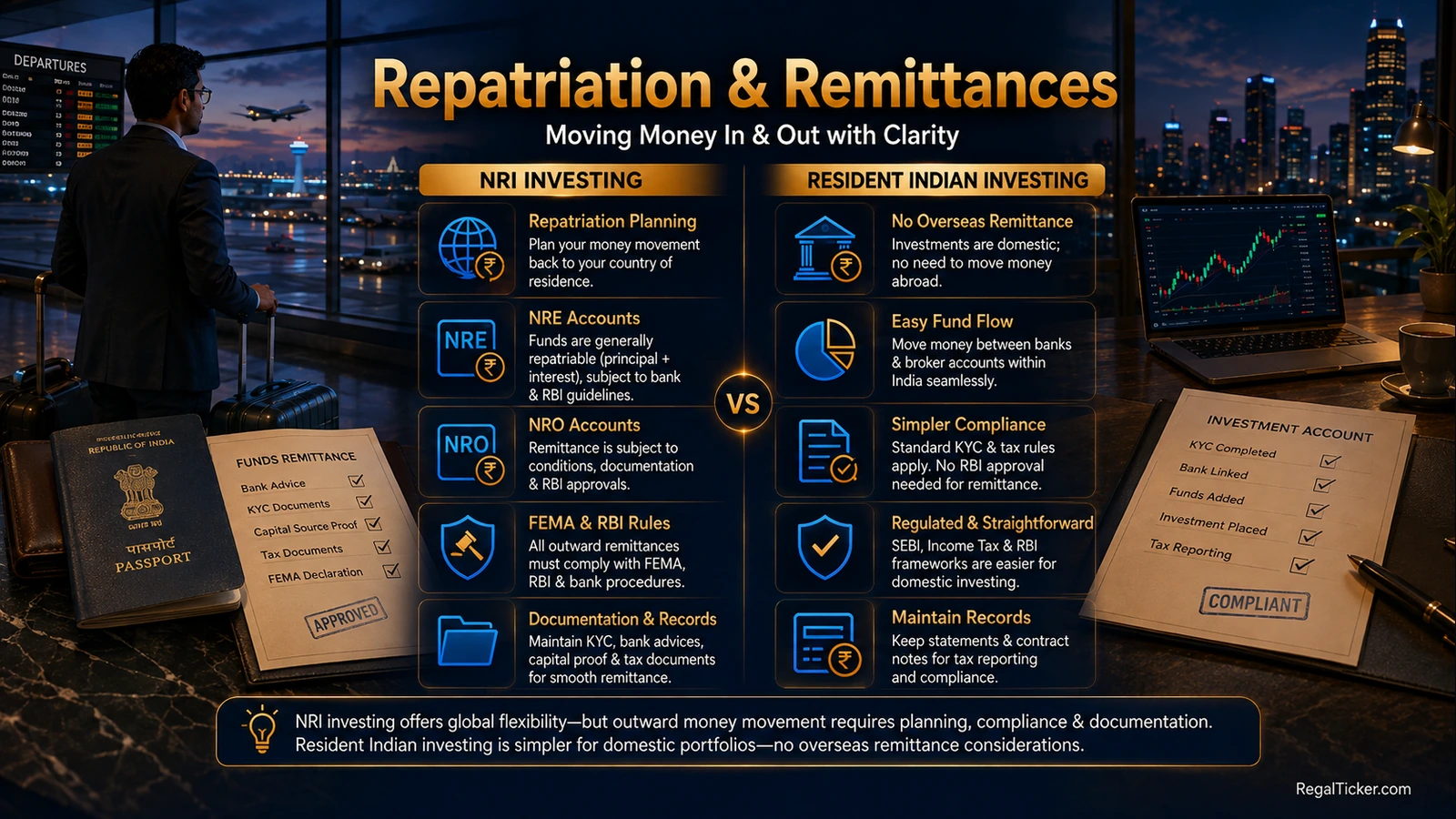
NRE balances
RBI describes NRE balances as repatriable under the applicable rules. Where the investment and sale proceeds properly retain repatriable character, the authorised bank can process eligible outward remittances subject to the applicable documentation and checks.
NRO balances
NRO remittance follows a different framework.
RBI’s current FAQ states that, apart from current income and other permitted remittances, eligible NRIs/PIOs may remit up to USD 1 million per financial year from qualifying NRO balances/assets, subject to the stated conditions, taxes and authorised-dealer documentation.
This is not a blanket rule that every NRO balance can automatically be wired abroad.
⭐ Pro tip
Design the exit before making the entry
Before investing, ask the bank and broker where the sale proceeds will land and what documentation will be needed if those proceeds are later repatriated. This one question can prevent a lot of confusion after a large sale.
Worked example: the same investor before and after moving to Dubai
💡 Real example
Meera moves from Mumbai to Dubai but wants to keep investing in India
Meera already has a resident savings account, Demat account and trading account in India. While living in Mumbai, she transfers money from her resident bank account to the broker, buys listed shares and receives sale proceeds back into the resident banking system. Later she moves to Dubai for employment and becomes resident outside India for the relevant FEMA context. She should not simply continue using the old resident setup unchanged. She reviews the bank account classification, updates NRI KYC and overseas address with the broker/DP, uses the NRE/NRO structure appropriate to her money flows and confirms whether the chosen investment route is repatriable or non-repatriable. The stock she buys may be exactly the same company—but the banking, documentation and repatriation architecture around the investment is now different.
What this means for you: the investor’s status can change even when the portfolio does not.
What should you change when you become NRI?
If you are moving abroad and already invest in India, use a transition checklist rather than opening random new accounts.
Resident-to-NRI investment transition checklist
- Inform your Indian bank when your residential status changes.
- Redesignate resident bank accounts where required; RBI states that an existing resident account should be redesignated as NRO when the holder becomes resident outside India.
- Review whether an NRE account is needed for eligible overseas funds and repatriable money flows.
- Inform your stockbroker and depository participant.
- Update KYC with non-resident status and overseas address documentation.
- Confirm the status/classification of the Demat account.
- Confirm which trading account and bank route should be used for future purchases.
- Ask whether the intended investing route uses PIS or a permitted non-PIS setup.
- Preserve acquisition records for shares purchased before becoming NRI.
- Review the tax consequences in both India and the new country of residence.
- Do not transfer investment money through a relative’s or third party’s bank account merely for convenience.
What happens when an NRI returns to India?
The process also works in reverse.
If you permanently return to India and become resident again, do not leave the NRE/NRO and NRI securities relationships frozen in the old classification forever.
RBI’s non-resident account FAQ says an NRE account should be redesignated as a resident account or the funds may be transferred to an eligible RFC account when the account holder becomes resident in India, subject to the applicable rules.
You should also review:
- NRO account redesignation;
- Demat and trading status;
- KYC address and tax residency;
- foreign holdings and overseas accounts;
- and any continuing foreign tax/reporting obligations.
The correct change depends on your facts, so coordinate the bank, broker/DP and tax records rather than updating only one account.
NRI vs resident Indian: common mistakes that create problems
Mistake 1: continuing to use a resident account after moving abroad
This creates a status mismatch between the investor and the banking relationship.
Mistake 2: assuming the same tax rate means the same tax process
The listed-equity headline rate may be similar, while TDS, DTAA, foreign tax credit and overseas reporting can still make the NRI process different.
Mistake 3: treating NRE and NRO as interchangeable
They serve different money-flow and repatriation purposes.
Mistake 4: thinking PIS is the trading account
PIS is a regulatory/banking investment route in relevant setups; the broker trading account and Demat account still perform their own functions.
Mistake 5: choosing a broker solely on headline brokerage
Use the Brokerage Calculator to compare costs, but NRI support, bank integration, permitted segments and service can matter more than a small per-order price difference.
Mistake 6: forgetting the country-of-residence tax return
Indian tax is only one side of the cross-border investment.
Mistake 7: assuming old online articles about NRI limits are current
FEMA and foreign-investment rules can change. Verify material ownership-limit questions using the current legal/regulatory framework rather than copying an old percentage table.
Mistake 8: ignoring corporate-action records
Bonus shares, splits, rights issues, buybacks, mergers and demergers can alter quantity or cost basis. Use the Corporate Actions hub when you need to understand the mechanics.
Mistake 9: trusting unregistered overseas “India investing” agents
NRIs can be targeted with fake broker apps, guaranteed-return schemes and social-media stock tips. Start with Investor Safety in the Stock Market and verify the intermediary independently.
Which investor has the simpler setup?
For pure operational simplicity, a resident Indian generally has the easier domestic structure.
The resident investor normally does not need to separate NRE/NRO money flows, plan repatriation at the account level or coordinate Indian investment records with a foreign tax return.
But that does not mean NRI investing is unmanageable.
A well-designed NRI setup can become routine once four things are clear:
- your status;
- your banking route;
- your securities-account structure; and
- your tax/repatriation record system.
The complexity is front-loaded. Once the structure is correct, the day-to-day act of investing can be straightforward.
A practical decision table
COMPARISON TABLE:
| Question | Resident Indian | NRI |
|---|---|---|
| Which bank account funds the trade? | Resident savings/current account | NRE and/or NRO depending on route |
| Overseas address proof required for NRI status? | No | Yes, typically required for NRI registration/KYC |
| Demat account needed for listed shares? | Yes | Yes |
| Trading account needed for exchange orders? | Yes | Yes |
| FEMA repatriation planning for ordinary domestic trade? | Usually no | Yes, often important |
| PIS decision relevant? | No | Can be relevant depending on setup |
| Headline listed-equity STCG/LTCG rates always different? | No | No; qualifying headline rates can be the same |
| TDS/DTAA/cross-border tax layer? | Usually not for purely domestic investing | Can be material |
| Country-of-residence reporting? | Normally no foreign-country layer | Potentially yes |
| Need to redesignate accounts after moving abroad? | Not applicable while resident | Yes, status changes should be reflected |
Use calculators for the numbers, not for regulatory status
Use the calculator
Check costs and estimated tax before you trade
Use the Brokerage Calculator to understand trading costs and the Capital Gains Tax Calculator to model a gain. Calculators are useful for arithmetic, but they cannot decide your FEMA residence, DTAA entitlement, repatriation route or whether a particular NRI account structure is compliant. BUTTON URL: https://regalticker.com/tools
What about OCI investors?
OCI deserves a separate mention because many articles use “NRI/OCI” as if they are synonyms.
They are not.
An NRI is an Indian citizen resident outside India for the relevant RBI/FEMA context.
An OCI cardholder is a foreign national with OCI status. RBI’s non-resident account FAQ includes eligible OCI cardholders within its PIO framework for several account purposes, provided the person is resident outside India.
In practice, many banking/investment rules may be similar for eligible NRIs and OCIs, but citizenship-sensitive rules and the exact transaction permission should still be checked.
If you hold a foreign passport and OCI card, do not select “NRI” on a form merely because you were born in India. Use the status the form and law actually require.
Quick checklist before investing after moving abroad
Is your NRI investment structure ready?
- My Indian bank knows I am non-resident where applicable.
- Old resident bank accounts have been redesignated where required.
- My broker and DP have my current NRI/overseas details.
- PAN and KYC records are current.
- I understand what my NRE account is for.
- I understand what my NRO account is for.
- I know whether the investment is intended to be repatriable.
- I know whether PIS is relevant to my chosen bank/broker route.
- I know where dividends and sale proceeds will be credited.
- I have checked Indian capital-gains tax before selling.
- I know whether tax may be withheld and how I will obtain the records.
- I know what my country of residence expects me to report.
- I am keeping contract notes, bank statements and remittance evidence.
Where to continue in the NRI Specialist Academy
Guide 1 gave you the overall map: NRI Investing in the Indian Stock Market.
This Guide 2 explains why your status changes the account and compliance architecture.
The logical next topic is the banking foundation itself: NRE vs NRO vs PIS Account. That existing article should become the academy’s next detailed account guide after its factual and architecture cleanup.
Use the NRI Investing Specialist Academy whenever you want to return to the full learning path.
Final takeaway
Same market, different investing infrastructure
A resident Indian and an NRI can own many of the same Indian securities, but the NRI adds a cross-border layer: non-resident banking, FEMA, overseas KYC, repatriation and potentially DTAA/foreign reporting. Do not assume the portfolio can keep operating exactly as it did before you moved abroad. Update the status and money route first; then invest through the structure that matches your actual circumstances.
Frequently asked questions
What is the main difference between NRI and resident Indian stock investing?
The main difference is the account, banking and cross-border compliance structure. A resident investor generally uses ordinary resident banking, while an NRI must use correctly classified non-resident banking and securities relationships and consider FEMA and repatriation.
Can an NRI use the same resident savings account for investing after moving abroad?
Do not assume so. RBI guidance states that when a resident Indian becomes a person resident outside India, the existing resident account should be redesignated as an NRO account.
Does an NRI need a different Demat account?
The Demat account still holds securities electronically, but the investor’s status and the account/transaction classification must correctly reflect the non-resident setup. Notify the DP and broker when your status changes.
Can an NRI and resident Indian buy the same listed shares?
Often yes, subject to the rules and limits applicable to the security and investor. The NRI may use a different funding/repatriation route and can face additional foreign-investment compliance.
Is NRI capital-gains tax always higher than resident tax?
No. For qualifying listed equity transactions, current Section 111A and 112A headline rates can be the same. NRIs can still have additional withholding, treaty, filing and overseas-reporting considerations.
What are the current qualifying listed-equity STCG and LTCG rates?
Current Income Tax Department guidance shows 20% for qualifying Section 111A short-term gains and 12.5% for qualifying Section 112A long-term gains above the applicable ₹1.25 lakh annual threshold for transfers on or after 23 July 2024, subject to the statutory conditions and additional tax components.
What is the biggest repatriation difference between NRE and NRO?
NRE balances are generally repatriable under the applicable rules. NRO balances have a more conditional remittance framework, including the RBI’s USD 1 million per financial year facility for eligible balances/assets subject to conditions, taxes and documentation.
Is PIS compulsory for every NRI stock investment?
No universal answer should be assumed. PIS remains relevant in certain NRI banking/trading structures, while other permitted routes may be available. Confirm the setup with the bank and broker for the intended security.
Is an OCI the same as an NRI?
No. An NRI is an Indian citizen resident outside India in the relevant context. An OCI cardholder is a foreign national with OCI status, although several FEMA account/investment rules can treat eligible OCI/PIO persons similarly to NRIs.
What should an investor do when returning permanently to India?
Review and update the NRE/NRO bank accounts, Demat/trading status, KYC and tax residence. RBI guidance provides for redesignation of NRE accounts when the holder becomes resident again, subject to the applicable rules.
Verify through official sources
Official references
- Reserve Bank of India — Accounts in India by Non-residents
- NSE — FAQs for NRI Trading Account
- SEBI — KYC Norms for the Securities Market
- SEBI Investor Education — Investment by NRIs in Indian Securities Market
- Income Tax Department — Tax on Sale of Shares in India
- Income Tax Department — Non-Resident guidance
- Ministry of Home Affairs — Overseas Citizen of India Cardholder
Educational disclaimer: This guide is for educational purposes. NRI/OCI status, FEMA residence, tax residence, treaty entitlement, permitted investment routes and repatriation depend on individual facts and can change with law or intermediary procedures. Verify material decisions with the relevant official authority, authorised dealer bank, regulated intermediary and qualified tax/legal professional for your situation.